RSS Feed

September 12

September 12, 1941 – The Donald Duck Short Film Old MacDonald Duck is Released to Theaters

vlcsnap-2014-09-12-18h55m44s54

“Let’s see…eenie meenie miney mo, okay, missy, here we go.”

On September 12, 1941, the Donald Duck short film Old MacDonald Duck was released to theaters. It was directed by Jack King.

It’s a sunny day on Donald’s farm, and he is happily feeding the animals and singing “Old MacDonald,” with the animals accompanying him. He calls out for his cow Clementine, but she seems to be nowhere to be found. He finally spies her up a tree, eating leaves, and she gracefully jumps down to meet him. He sits down to milk her, and all is going well until a fly lands on Clementine’s nose. She accidentally whacks Donald with her tail, and although he is initially irritated, he resumes work until the fly lands on his own beak. After slapping it away, he tries to pull his hat down over his head, but the fly finds its way in and bugs him. He is interrupted to the point where he loses focus, and ends up milking into his hat, sitting on his pail, and wearing his stool as his hat. The fly continues to mock him, so Donald uses Clementine’s udder to shoot milk at the bug. The bug is terrified, but manages to safely get away. The bug seeks the ultimate revenge, and tricks Clementine into wrapping her tail around Donald’s neck before swishing him around to rid herself of the fly, and ends up dumping poor Donald into the milk bucket. The fly then bites the cow to make her kick Donald into the barn, with tools falling all over him. The fly laughs himself silly over his triumph.

September 11

September 11, 1957 – The Disney Anthology Episode “The Fourth Anniversary Show” Premieres
vlcsnap-2014-09-11-18h59m34s10

“I remember how his fingers flew over the keys of our battered, old piano, how his face glistened with perspiration as he concentrated on the music, and all the time I could see pictures; I could see his lovely fantasy coming to life on the screen.”

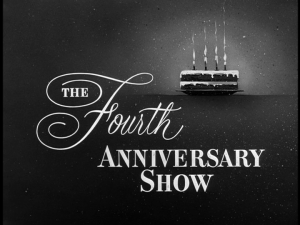
On September 11, 1957, the Disney Anthology episode “The Fourth Anniversary Show” premiered on ABC. Celebrating four years on the air, the episode shows some upcoming projects for the studios, and a stylized flashback sequence. The show also features proposed scenes for a film called The Rainbow Road to Oz, which would have been an adaptation of one of Frank L. Baum’s Oz stories, which Disney owned the rights to; this film was never made. The episode was directed by Sidney Miller and Hamilton S. Luske. It starred the Mouseketeers, Fess Parker, Jerome Courtland, Guy Williams, and Walt Disney as himself and as the voice of Mickey Mouse.

The episode begins with Walt attempting to play “Peter and the Wolf” on the piano. He reflects on how the piano in front of him played an important part in one of the many adventures at the studio, when Sergei Prokofiev came to the studio to work with the animators on a segment. The audience is then taken back in time to a storyboarding meeting in 1938, when the studio was hard at work on Fantasia and Pinocchio. Walt gets a call from Rudy Polk, VP of a talent agency, who tells him that an important composer wants to talk to Walt, and that Prokofiev had Disney in mind when he wrote Peter and the Wolf. Walt agrees, and they work together in a small little studio, although Prokofiev spoke very little English, and Walt spoke no Russian. Polk explains the piece to Walt while Prokofiev plays, and Walt listens intently. Unfortunately, although Walt wanted to work on the story, WWII put a wrench in any non-military stories and films. After the war, they went back to “Peter and the Wolf,” which was one of the first post-war projects. The short subject film is then presented.

Walt is kidnapped by the Mouseketeers and given a surprise anniversary party

Walt is kidnapped by the Mouseketeers and given a surprise anniversary party

After the short, Walt is about to go into an introduction of more classical music in Disney films, when Mouseketeer Cubby shows up at his office door. Walt introduces him, but tells him that they will talk later. He tries to go back to his introduction, but turns to find Cubby still at the door. Walt explains that he’s talking to the Disneyland audience, but Cubby interprets this as an okay to enter, and tells the other Mouseketeers that Walt’s “just sitting on the desk talking.” The Mouseketeers enter and start jabbering away, when Walt tells them to hold on for a second. He then introduces them: Annette, Bobby, Darlene, Karen, and of course, Cubby. They drag him to the Mouseketeer stage, where they surprise him with a party celebrating the anniversary of the Disneyland show. They put on a special show for him about everything they’d seen on the Disneyland television show, and ask him what’s in store for the next year. He answers that there’s more Donald and Goofy adventures, more global adventures, and a new character – Andy Burnett – explained by Fess Parker, with scenes from the new miniseries starring Jerome Courtland. Courtland then serenades the Mousketeers with a new song from the series called “Ladies in the Sky.”

After this, Walt gives a brief overview of what’s next, although Moochie keeps asking about Zorro. He then explains that Zorro will no longer be on Disneyland, but will be its own series. When Moochie asks if Zorro was real, Walt explains that Zorro was a mythical feature, but it soon interrupted by Zorro himself, and soon has a sword fight with a shadowy figure. Zorro, of course, wins, and makes the sign of the Z before he disappears. Walt then decides to leave, and the kids give him a present: a shooting script of the film The Rainbow Road to Oz. The Mousketeers volunteer to take over all the preparations for the film, and who off the characters in their story. They show a scene where the character of the Patchwork Girl (played by Doreen) meets the Scarecrow (played by Bobby) for the first time. Another segment plays, with Darleen singing a song called the “Oz-Can Hop.” Walt agrees to make the film, and then the Mousketeers present another song with a large anniversary cake. Mickey then makes a surprise appearance at the end, noting that the Mousketeers are a great bunch of kids, with which Walt agrees.


September 10

September 10, 1990 – The Two Hour Programming Block The Disney Afternoon Premieres

Disney_Afternoon_soundtrack

“There’s so much to do, get it ready just for you, everybody’s busy bringing you a Disney afternoon!”

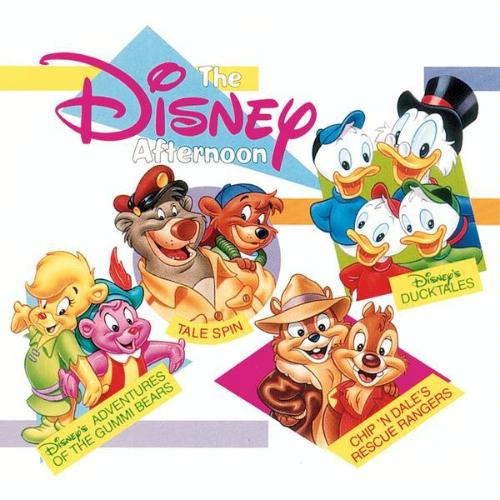
On September 10, 1990, the two-hour programming block The Disney Afternoon premiered. Overall, the block began with four separate series: Duck Tales, The Adventures of the Gummi Bears, Chip ‘n’ Dale Rescue Rangers, and Tale Spin. Gummi Bears had already premiered on NBC in 1985 and was very successful; Ducktales had also premiered on NBC in 1987, and was quickly syndicated, along with Chip ‘n’ Dale. Tale Spin was the only program in the block that had premiered on The Disney Channel, and became syndicated once it joined the Disney Afternoon block. The block ran from 1990 until 1997, with several line-up changes every year, with new shows including Darkwing Duck, Goof Troop, Bonkers, Aladdin, Gargoyles, Quack Pack, The Lion King’s Timon & Pumbaa, Mighty Ducks, and The Shnookums and Meat Funny Cartoon Show. The popularity of the shows in the block led to an attraction in Disneyland, and several pieces of media, including a soundtrack album.

September 9

September 9, 1938 – The Mickey Mouse Short Film Mickey’s Parrot is Released to Theaters

vlcsnap-2014-09-09-19h50m25s66

“Oh boy, pretty swell joint!”

On September 9, 1938, the Mickey Mouse short film Mickey’s Parrot was released to theaters. It was directed by Bill Roberts.

A furious storm is brewing outside, and a moving truck passes by Mickey’s house, accidentally dropping a parrot and his cage from the back when it passes over a pothole. The parrot decides to take shelter at Mickey’s, where inside, Mickey and Pluto are listening to a lovely little story on the radio. The story is interrupted with an urgent news flash: Machine Gun Butch has escaped from prison, and is armed and dangerous. Mickey quickly prepares for the possible intrusion, and grabs his shotgun at the same time that the parrot enters the house, and is sent flying into the non-working boiler. The gun goes off, and Mickey and Pluto head for the bed, where they break it in their haste to hide. Mickey decides to creep into the basement to catch the killer, with Pluto following closely behind him.

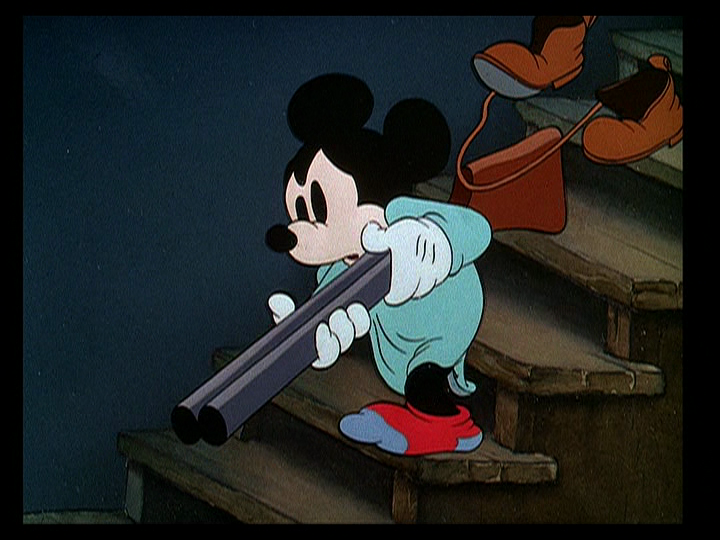
Mickey accidentally gets his gun caught on a pair of shoes, which follow him down the stairs

Mickey accidentally gets his gun caught on a pair of shoes, which follow him down the stairs

The two separate without knowing, and Mickey heads into the basement. A pair of shoes gets caught on the butt of his shotgun, giving the illusion that someone is walking right behind him. Mickey sees the shoes behind him, and thinking the killer is there, jumps into the boiler, shaking. The parrot leaves through a vent and explores the house, trapping himself within a cabinet. He talks to himself as he tries to open a can of fish food, startling Pluto, who thinks the fish is insulting him. Pluto attacks the fish, knocking over the cabinet and freeing the parrot, who flies into the kitchen and gets stuck inside a turkey. Pluto is about to eat the turkey, when it starts talking to him. Not one to lose to food, Pluto attempts to fight back, but is soon scared by the talking and walking turkey. Finally, the parrot’s identity is revealed, and Pluto and the parrot have a fair fight in the kitchen which ends with Pluto getting stuck in the piano. Mickey hears the commotion upstairs, and is surprised to find Pluto, and when the parrot accidentally pops some popcorn back in the kitchen, Mickey and Pluto take cover in the fireplace, and Mickey shoots at the “killer” in the kitchen. Mickey soon finds that the menace is really just a parrot, and Mickey offers the parrot some crackers, which he soon takes and places in Pluto’s mouth before the dog can bite him.

September 8

September 8, 1995 – The Animated Series The Lion King’s Timon & Pumbaa Premieres on The Disney Afternoon

TimonPumbaa

“Here’s your grub: I hope you choke. Augh! I mean, I’m Timon and I’ll be your waiter!”

On September 8, 1995, the animated series The Lion King’s Timon & Pumbaa premiered as part of the Disney Afternoon programming block. Based on the characters from the hit 1994 animated feature film, the show was about their adventures in various settings. The show ran for three seasons, with 85 full episodes. The show starred Nathan Lane, Kevin Schon, and Quinton Flynn as Timon (split in various episodes), and Ernie Sabella as Pumbaa.

TaP_1

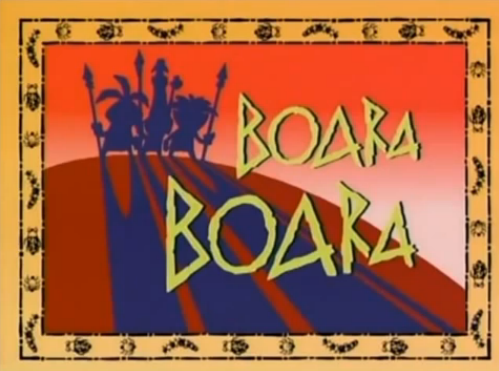
The first half episode, “Boara Boara,” begins with Timon and Pumbaa being washed up on the shore of an island, although they were hoping to end up in a snowy place for a ski vacation. They decide to make the best of it and enjoy the beach. Unfortunately, they aren’t alone, as a tribe in the island has decided to take Pumbaa to make them their meal. Timon panics when he can’t find his friend, while Pumbaa is being served up to the king of the tribe. The King, however, beats his henchmen when they realize that Pumbaa resembles their god. Timon braves through the jungle to find his friend, and is irritated to find his friend being revered. When he attempts to take Pumbaa away, the tribe captures Timon and takes him to the volcano as a sacrifice, although Timon mistakes it as them making him King. When they reach the top of the volcano, Timon is thrown into the lava, and barely manages to make it out alive, and begs the tribe to keep him alive, offering to do anything. The anything he ends up doing though is serving Pumbaa hand and foot. After a while, Pumbaa is asked to make fire for the tribe, but is soon revealed as an imposter. Timon and Pumbaa attempt to escape, when they decide instead to distract the tribe with a samba. In the end, the tribe members decide to leave, and Timon and Pumbaa head back to the beach, where they discover that developers have taken over.

TaP_2

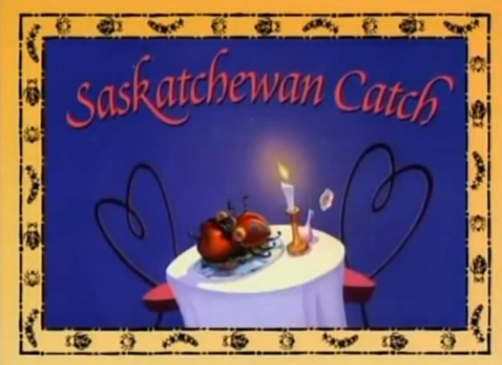
The second half, “Saskatchewan Catch,” begins with Timon and Pumbaa bug hunting in a forest for the best-tasting bug in the universe: the Saskatchewan Sky-High Beetle. Timon is just about to catch it when he falls from his perch and lands on a branch. A flying squirrel falls from a height and hits Timon, and the two fall to the ground. Pumbaa then states that Timon has fallen sixteen times, and maybe they could use some help. Pumbaa suggests that they get the help of the flying squirrel, and Timon tries to butter her up to help her. She promises to help them, only if they help her get the affections of another flying squirrel. Timon sets to work in getting the male squirrel’s attention, but to no avail. They are finally able to capture the male squirrel, and they trick him into having dinner with the female squirrel. He is taken with her on first sight, and the romance between them begins to bloom. However, Timon disagrees with the male’s take on love, as the male squirrel wants to give up all of his freedom to be with woman. In the end, although they get the lovers together, they are unable to get the bugs that they wanted, as the squirrels fly off into the night together.

September 7

September 7, 1984 – The Morocco Pavilion Opens in Epcot’s World Showcase

restaurant-marrakesh-gallery00

“Savory cuisine and sprightly belly dancing transport you to the heart of Morocco.”

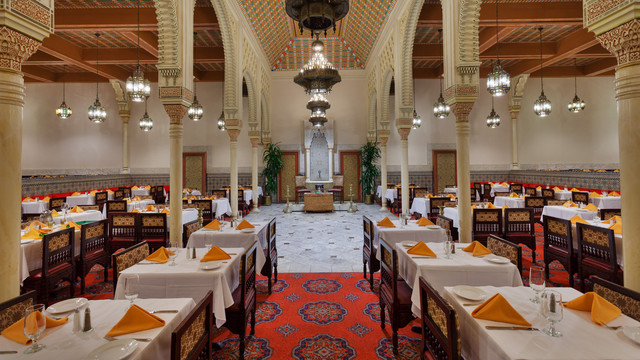
On September 7, 1984, the Morocco Pavilion was added to Epcot’s World Showcase; it was the first country to be added since the showcase’s opening. It is also currently the only area to be sponsored by its home country, and includes an information center for the Moroccan National Tourist Office. Characters Aladdin and Jasmine are available to meet at certain times in the pavilion. The pavilion is home to Restaurant Marrakesh, which gives guests a taste of famous Moroccan delicacies such as roast lamb, couscous, and bastilla. Guests to the pavilion can also shop for clothing, jewelry, and rugs, as well as learn how to belly dance and how to make couscous.

September 6

September 6, 1972 – Actress and Disney Legend Anika Noni Rose is Born

ANR_DL

“I always dreamed of being a voice in a Disney movie…I feel like what an honor that this is how the dream comes true, bigger and stronger than I had even imagined it.”

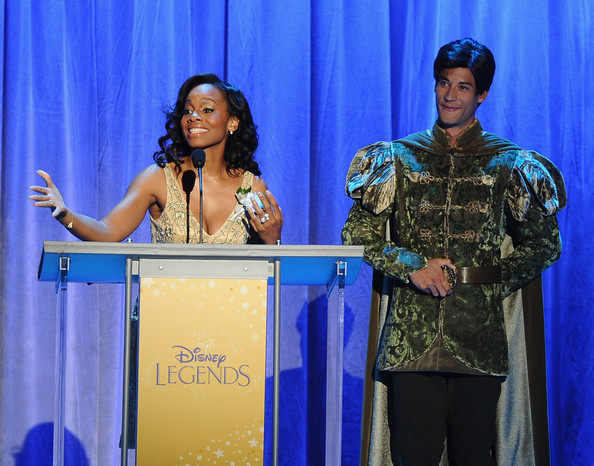
On September 6, 1972, Anika Noni Rose was born in Bloomfield, Connecticut. After graduating from Florida A&M University with a degree in theater, she moved to San Francisco to study at the American Conservatory Theater. After this, Rose moved to New York, where she landed a role in the Broadway production of Footloose, playing the character Rusty. Her big break, however, came with the musical Caroline, or Change, playing the role of Emmie Thibodeaux, and winning the Tony Award for Best Performance by a Featured Actress in a Musical. Rose also starred in a string of films, with her best known role being the character Lorrell in Dreamgirls; for this role, she was awarded several nominations. In 2009, she won the coveted role of Tiana in the Disney animated feature The Princess and the Frog. She continues to work in television, film, and theater, including a Broadway production of A Raisin in the Sun in 2014, and continues to voice the character of Tiana in special Disney projects. In 2011, Rose was named a Disney Legend for her work as Tiana.

September 5

September 5, 1974 – The Hoop Dee Doo Musical Revue Begins in Fort Wilderness’ Pioneer Hall

https://i0.wp.com/www.bestoforlando.com/bestof/shows/disney-hoop-dee-doo-musical-revue/images/Best-Orlando-Shows-Hoop-Dee-Doo-Review-big.jpg

“Get ready to clap your hands, stomp your feet, sing along and have a good ol’ time at rustic Pioneer Hall in Disney’s Fort Wilderness Resort and Campground.”

On September 5, 1974, the Hoop Dee Doo Musical Revue began its performances in Pioneer Hall, located in the Fort Wilderness resort and campground of Walt Disney World. Guests sit down to a buffet of American barbeque favorites, including ribs and fried chicken, while they enjoy a two-hour-long Wild West themed show. The show is presented by performers the likes of Claire de Lune, Johnny Ringo, Dolly Drew, Six Bits Slocum, Flora Long, and Jim Handy. . Guests have three different seating options: the main floor, the back balcony, and the side balconies, and must pay in advance to get reservations. A version of the show opened in Tokyo Disneyland’s Diamond Horseshoe in 1983.

September 4

September 4, 2001 – The Indiana Jones Adventure: Temple of the Crystal Skull Attraction Opens in Tokyo DisneySea

IJATotCS_3

“Expect the unexpected on this temple tour!”

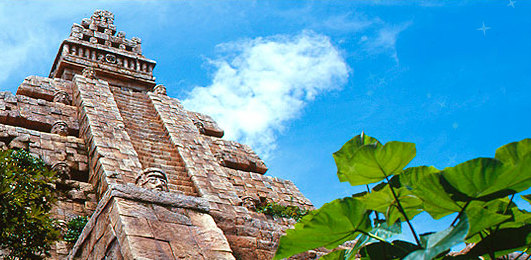
On September 4, 2001, the attraction The Indiana Jones Adventure: Temple of the Crystal Skull opened in Tokyo Disneyland’s expansion, Tokyo DisneySea. The ride lasts about three minutes, and is located in the Lost River Delta area. The story behind the attraction is that Paco, Indy’s friend, has arraigned tours of a temple to find the Fountain of Youth, without Indy knowing. Guests board jungle vehicles that can seat about twelve people and head through the temple ruins of the Crystal Skull, a vengeful spirit.

September 3

September 3, 1910 – Imagineer and Disney Legend Yale Gracey is Born

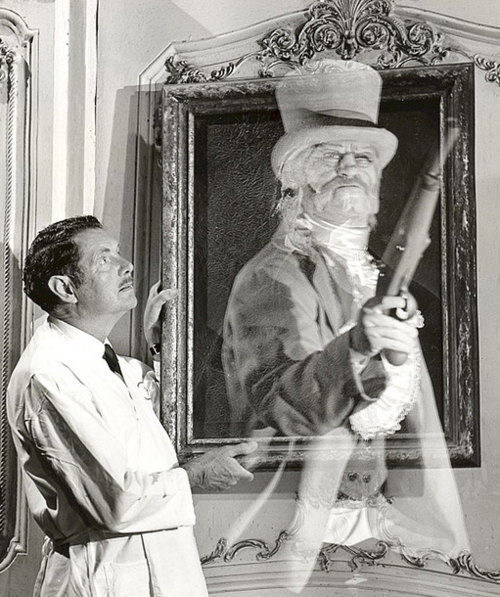
Gracey

“Whenever we needed a special effect, we went to Yale.” – John Hench, Imagineer and Disney Legend

On September 3, 1910, Yale Gracey was born in Shanghai, China. Gracey was the son of an American consul, and attended an English boarding school before moving to the United States to study at the Art Center School of Design. Gracey began his career at the Disney Studios in 1939, working as a layout artist on Pinocchio and Fantasia, as well as for several short films. During his lunch hour, Gracey would work on gadgets and models, some of which caught Walt Disney’s attention; Gracey was then offered a position in WED Enterprises to create attractions and special effects for Disneyland. He began work at WED as a research and development designer, creating several illusions that are still well-known and loved today, including the “grim, grinning ghosts” in the Haunted Mansion. Gracey also worked extensively on the attractions for the 1964-1965 World’s Fair, including the Carousel of Progress. Gracey retired in 1975 after 36 years of work with the company, but continued to serve as a consultant for new attractions at Walt Disney World. He passed away on September 5, 1983. In 1999, Gracey was honored as a Disney Legend for his work as an Imagineer.