RSS Feed

Tag Archives: Academy Award winning

June 6

Posted on

June 6, 2012 – The Short Film Paperman Premieres at the Annecy International Animated Film Festival
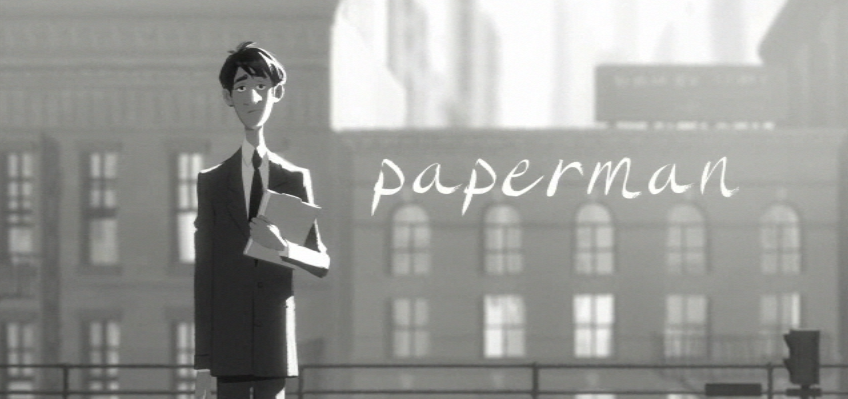
Paperman

“A single young man in mid-century New York chances upon a beautiful young woman. Will he see her again?”

On June 6, 2012, the short film Paperman premiered at the Annecy International Animated Film Festival. The short was a minimalistic film that was a blend of 2D and CG animation in a new blend where the CG enhanced the 2D animation rather than the other way around. The short was met with critical acclaim at the festival, and would go on to win the Academy Award for Best Short Film. It was directed by John Kahrs, with story by Clio Chiang and Kendelle Hoyer, and score by Christophe Beck.

The short begins with a man waiting for his train, when a paper belonging to a young woman hits his shoulder. The two wait silently, and when another train passes, one of the man’s papers flies into the face of the woman, leaving a lipstick stain on the sheet. After they share a laugh, the man watches the young woman head the other way on her train. He sits at his desk at work, despondent, when he sees her in an office across the street. Trying to get her attention, he decides to make paper airplanes out of his paperwork, with many near misses. Eventually, he runs out of paper, leaving only the sheet with the lipstick mark available. Seeing that it is his last chance, he turns the sheet into a plane, but the wind whips it out of his hand before he can send it flying her direction. He decides to chase after her, but loses her in the street. He finds the airplane with the lipstick, and angrily throws it across town. The plane comes across all the other paper airplanes, and gathers them together in a whirlwind. The planes find the man and follow him before attaching themselves to him. They carry him across town to the train station, while the lipstick plane finds the girl and has her follow it to the train station. The man and woman are reunited at the train station from that morning, and are seen having a date in the credits.

March 25

March 25, 1947 – Singer, Songwriter, and Disney Legend Sir Elton John is Born

EJ_DL

“I sat there with a line of lyrics that began, ‘When I was a young warthog,’ and I thought, ‘Has it come to this?’”

On March 25, 1947, Sir Elton John (born as Reginald Kenneth Dwight) was born in Pinner, Middlesex, England. As a young boy, John showed great promise for music, being able to play the piano starting at the age of three. After taking formal lessons at the age of seven, he was awarded a scholarship to the Royal Academy of Music at the age of 11. A keen composer, John met lyricist Bernie Taupin in 1967, and the two collaborated on several hit songs for other artists. John’s first album Empty Sky was released in 1969, but it was the second album Elton John in 1970 that established John as an artist with the top ten hit single “Your Song.” Between the years 1970 and 1982, Elton had 30 hits under his belt from 15 albums. In the early 1990s, John was asked to work with lyricist Tim Rice (known for his work with Andrew Lloyd Weber) for a new Disney animated feature, The Lion King. The film was a smashing success, with John and Rice earning three Academy Award nominations for “Circle of Life,” “Hakuna Matata,” and “Can You Feel the Love Tonight,” with the latter winning the award. In 1997, the film was then translated to the Broadway stage, with most of the songs intact. John and Rice collaborated again for Disney with the creation of the 2000 Broadway Musical Aida, which would go on to win three Tony Awards, including Best Original Musical Score. John has continued to stay busy in many areas, including theater, charity, and of course, music. He was knighted in 1998 to become Sir Elton John, CBE, for his humanitarian efforts in fighting against AIDS, and was further honored in 2004 with a Kennedy Center Honor. He was honored as a Disney Legend in 2006.

March 10

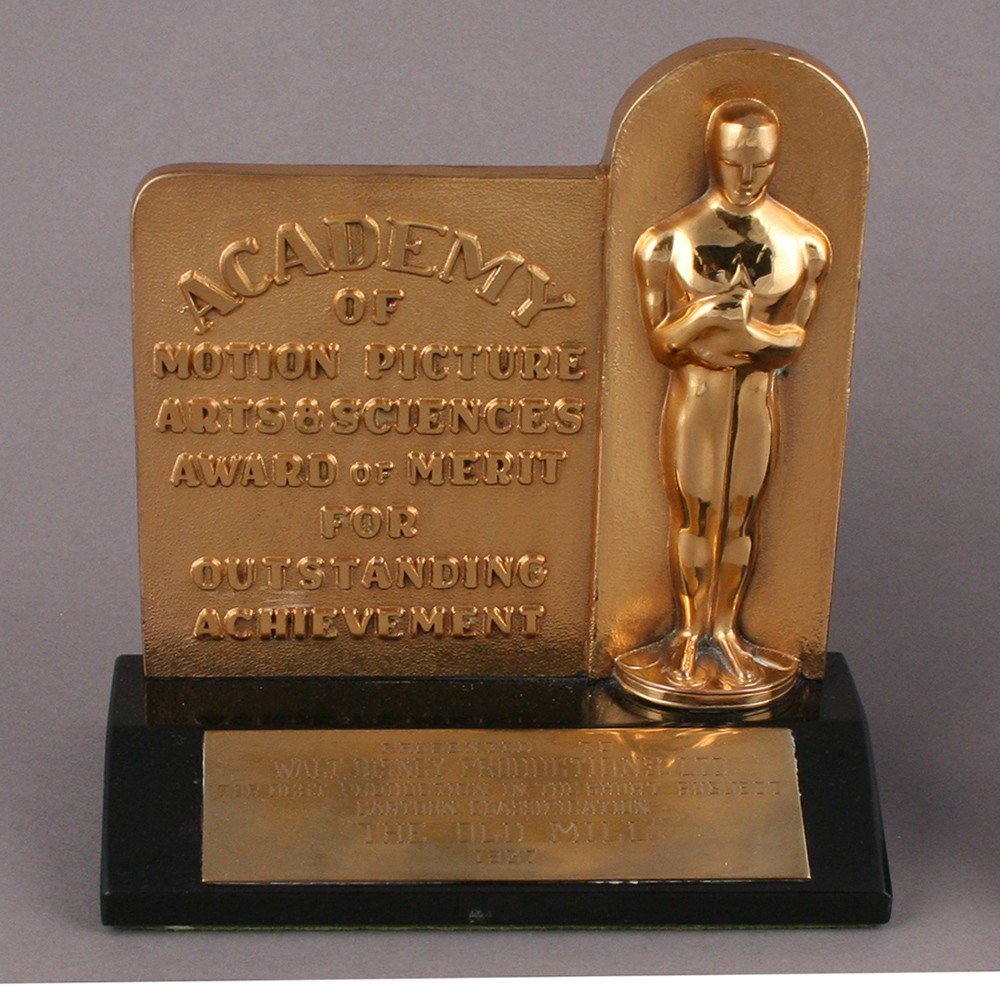
March 10, 1938 – Disney Wins Two Academy Awards for The Old Mill and the Multiplane Camera

Special Academy Award_1938

On March 10, 1938, the 10th Academy Awards were held at the Biltmore Hotel in Los Angeles, California. Disney’s groundbreaking short film The Old Mill, which was the first use of the multiplane camera and features realistic depictions of nature, won the Academy Award for Best Short Film, beating Paramount’s Color Classic Educated Fish and Columbia’s The Little Match Girl. The use of the multiplane on this short served as a testing ground for work on the feature film Snow White and the Seven Dwarfs. Creators of the multiplane camera were further honored at this ceremony by winning a special Academy Scientific and Technical Award

February 23

February 23, 1939 – Walt Disney is Awarded a Special Academy Award for Snow White and the Seven Dwarfs

vlcsnap-2015-02-23-17h28m51s162

“Aren’t you proud of it, Mr. Disney?” “Why, I’m so proud I think I’ll bust.”

On February 23, 1939, the 11th Academy Awards were held at the Biltmore Hotel in Los Angeles, California. That night, Walt Disney was awarded an Academy Honorary Award for the full-length animated feature film Snow White and the Seven Dwarfs. A special statue was created for this honor, featuring one regular size Oscar along with seven miniature statuettes on a step platform. This award was presented to Walt by actress Shirley Temple.

November 25

November 25, 1997 – The Pixar Short Film Geri’s Game was Released

vlcsnap-2014-11-25-17h38m08s228

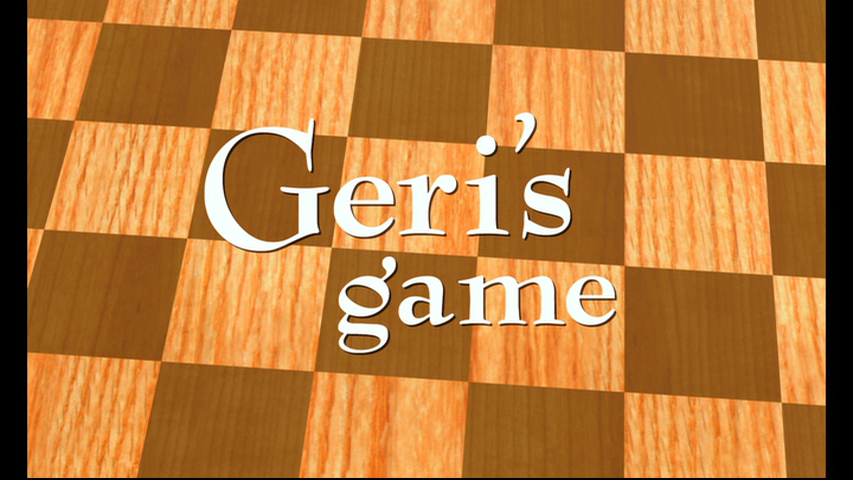
On November 25, 1997, the Pixar short film Geri’s Game was released. The short was released a year before its film pairing with a bug’s life, as it was sent forward for Academy Award consideration. It was also submitted independently from Pixar’s association with Disney. It won the Academy Award for Best Animated Short Film at the 70th Academy Awards. It was written and directed by Jan Pinkava, with Bob Peterson as the voice of Geri.

The short begins at a park on a fall day, where Geri is setting up his chess game. He puts on his glasses and moves a white pawn, then waits, while it is revealed to the audience that he is not playing against anyone, and the park is empty. He then takes off his glasses and slowly makes his way over to the other side of the table and makes a vicious move with a black pawn. He carefully gets up again and moves back to the other side, putting on his glasses and playing against himself. This continues, with Geri playing a game against himself with two personalities: the aggressive player on black, and the gentler, less-confident player on white. The aggressive Geri is taking out the gentler Geri’s pieces one by one, leaving gentler Geri rather protective of his Queen. Aggressive Geri teases gentler Geri, as he has nowhere to go. Suddenly, gentler Geri has a heart attack, and falls to the ground. As aggressive Geri checks himself, he realizes that he is fine, and checks on the other Geri. While aggressive Geri isn’t looking, gentler Geri switches the board, so it looks as though he’s been playing black the whole time. Aggressive Geri checks on gentler Geri as he gets back in his seat, then resumes his boastful laughter. Gentler Geri then makes his winning move, shocking aggressive Geri, as he hasn’t realized the ruse. Angered about the loss, aggressive Geri gives up the game, and reluctantly hands over the prize: a set of false teeth. Geri sits back and laughs, alone in the park.

November 6

November 6, 2007 – The Pixar Short Films Collection is Released on DVD

Pixar_Shorts

“13 Sensational Pixar Shorts Together For The First Time!”

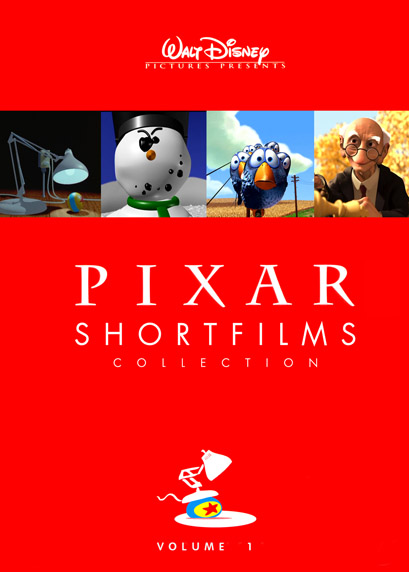
On November 6, 2007, the Pixar Short Films Collection was released on DVD. The collection contains short films created by Pixar Animation Studios, dating back to their premiere short film The Adventures of Andre & Wally B., released in 1984 at the SIGGRAPH Conference, and ending with 2006’s Lifted, originally released alongside Ratatouille. The collection also features a short documentary called The Pixar Shorts: A Short History, and several shorts featuring the Pixar lamp that were created for the show Sesame Street. A second collection of shorts was released on DVD and Blu-Ray on November 13, 2012.

October 31

October 31, 1936 – The Silly Symphony The Country Cousin is Released to Theaters

vlcsnap-2014-10-31-18h56m14s139

“Come to the city and live in splendor with me.”

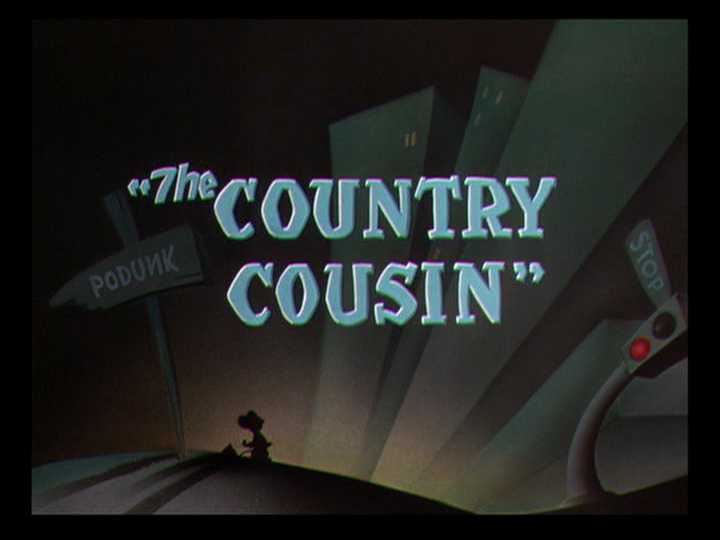
October 31, 1936, the Silly Symphony The Country Cousin was released to theaters. It would go on to win an Academy Award for Best Animated Short Film at the 9th Academy Awards. The short was directed by Wilfred Jackson.

The short begins with Abner Countrymouse receiving an invitation from his cousin Monty Citymouse, asking him to live in the city. Abner, taking Monty up on his offer, walks the railroad tracks and arrives at Monty’s place, with Monty quickly – but quietly – showing him around. Right away, Abner nearly gets caught in a mousetrap, but Monty saves him before showing him a spread of the finest foods laid out. Abner enthusiastically eats away, but Monty has to continue shushing the poor country bumpkin. After eating a spoonful of hot mustard, Abner rushes around and drinks some champagne to cool down his mouth, getting painfully drunk in the process and hiccupping. He tries to pull himself together, much to the annoyance of Monty, but ends up losing his umbrella in some toast points and knocking the entire stack down. Abner then ends up in a drunken fight with his reflection in a gelatin mold; although he decides to walk away from the fight, he slips on some butter on a plate and spins wildly around, breaking pieces of china as he spins out of control and taking his cousin with him. The two luckily do not garner the attention of the house cat, who is sleeping soundly, until Abner, with his drunken bravado, decides to kick the cat. Monty flees the scene, while Abner runs outside and ends up on the dangerous streets. After dodging feet and cars, Abner decides city life isn’t worth it for him, and he runs back to his country home.

October 3

October 3, 1941 – The Pluto Short Film Lend a Paw is Released to Theaters

vlcsnap-2014-10-03-20h12m35s101

“Save him, Pluto! Save the poor little kitty!”

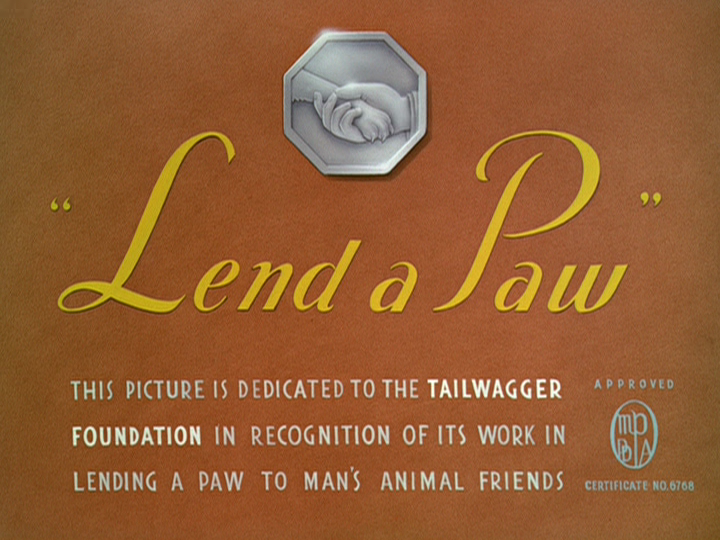
On October 3, 1941, the Pluto short film Lend a Paw was released to theaters, although under the Mickey Mouse banner. It is the remake of the 1933 Mickey Mouse short film, Mickey’s Pal Pluto, and was dedicated to the nonprofit Tailwagger Foundation “in recognition of its work in lending a paw to man’s animal friends.” The short was directed by Clyde Geronimi. It would go on to win the Academy Award for Best Animated Short Film at the 14th Academy Awards.

On a snowy day, Pluto is sniffing around when he hears mewing from inside a bag floating on a patch of ice down the creek. He jumps in to rescue the kitten, and takes it to shore, although he isn’t too happy about the bag’s contents. The kitten follows him, wanting nothing more than to be his friend, and ends up in Pluto’s house. Pluto greets Mickey, and Mickey automatically greets the kitten, incurring Pluto’s jealousy. Mickey takes care of the kitten, and the little Devil inside jumps out of Pluto’s head and tells him that he needs to get rid of the kitten. Pluto’s Angel, however, steps in and tries to guide Pluto back to the proper path. The Devil gets rid of the Angel and convinces Pluto to get rid of the kitten by making it appear that he ate Mickey’s goldfish. Unfortunately, the plan goes wrong, and the bowl crashes onto the floor. Mickey, suspicious, asks the fish who did it, and she immediately points her fin at Pluto. Mickey kicks Pluto out of the house, leaving him in the show. Pluto sits in the snow, crying.

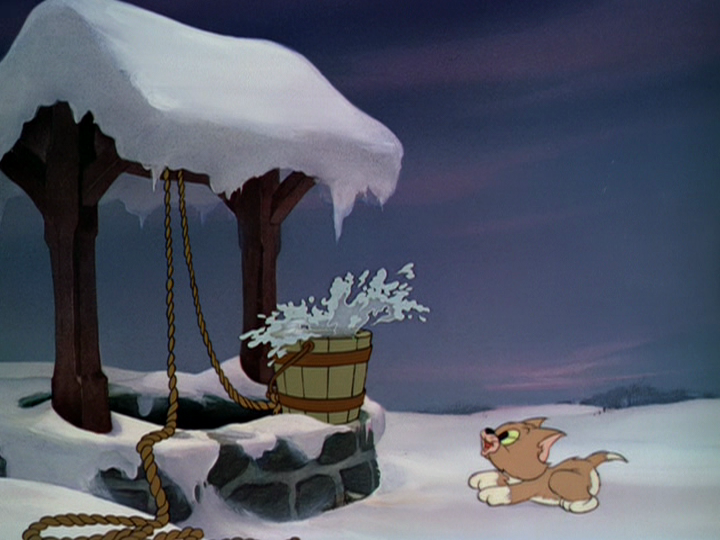
The kitten's ball bounces into the well bucket, leading the kitten to certain danger

The kitten’s ball bounces into the well bucket, leading the kitten to certain danger

A bit later, the kitten is chasing after a ball when it goes out the doggy door, and bounces into the bucket at the well. The kitten jumps into the bucket, and both he and the bucket land in the well. Pluto watches as the kitten struggles to stay above water, and Pluto’s Angel tells him to rescue the kitten. The Devil steps in again and tells Pluto to let the kitten drown. In the end, Pluto’s Angel beats up the Devil, and demands that Pluto save the kitten, which he does. Mickey is alerted to the danger by Pluto’s cry, and Mickey saves the kitten and Pluto. Mickey warms Pluto back up in the house, and the kitten gives him a grateful lick. Pluto’s Angel then reminds him that “kindness to animals…will be rewarded in the end.”

June 25

June 25, 1969 – The Walt Disney Educational Materials Co. is Incorporated

DEP Logo web

“Building thinkers every day.”

On June 25, 1969, the Walt Disney Company production asset The Walt Disney Educational Materials Company was incorporated. The company went through several name changes, finally settling on Disney Educational Productions, a moniker they still use today. For over 60 years, the company has provided educators with Disney educational films and materials, with several being nominated and/or awarded with honors from several organizations. The company’s materials fall under five main categories: Disneynature, Social Studies, Language & Arts, Math & Science, and Health & Safety; a sixth category is listed with all programs containing scientist Bill Nye.

February 3

February 3, 1986 – Pixar Animation Studios is Founded

vlcsnap-2014-02-03-05h09m14s140

“The best scientists and engineers are just as creative as the best storytellers.” – Steve Jobs

On February 3, 1986, the Pixar Animation Studios was founded by Ed Catmull, Alvy Ray Smith, and Steve Jobs. Its history goes back to 1979, when Ed Catmull was recruited by George Lucas to head Lucasfilm’s new Computer Division. In 1983, after being fired by Disney, Jon Lasseter was brought on to the graphics group of the Computer Division as an “interface designer,” with the goal of having Lasseter bring the group one step closer to the dream of creating a computer animated film. Working together, the group created the short film The Adventures of Andre & Wally B, which was shown at the computer graphics conference SIGGRAPH to critical acclaim for its groundbreaking software developed to create the squash-and-stretch and motion blur techniques. The group also created the Pixar Image Computer, used mostly in government and medical communities (although Disney purchased a number of computers for what would later become the Computer Animation Production System, or CAPS). However, although this software and computer were the most powerful and impressive of their day, Lucas’ interest in the company waned, as he didn’t want to run a company selling software. Catmull and Smith gained Lucas’ blessing to spin off the company and call it Pixar, and found an investor in entrepreneur Steve Jobs, who invested $10 million into the struggling group.

In 1987, Pixar’s short film Luxo Jr. became the first 3D computer animated short film to be nominated for an Academy Award, and the lamp became the symbol of the company; in 1989, Pixar would win an Academy Award for their short film Tin Toy. To keep the company afloat while still working toward their dream, Pixar did commercial work for companies like Tropicana and Trident Gum. Pixar was then able to work on a collaborative effort with Walt Disney Studios, helping develop CAPS further, and Pixar also developed RenderMan, which became an industry standard in computer graphics. Despite all these technical advancements, the company was not able to make a profit, and Jobs contemplated selling it, with Microsoft being one of the potential buyers. Lasseter pitched an idea to the Walt Disney Studios about Pixar creating a 30 minute holiday special based on the award winning short Tin Toy; Disney thought that the short had a potential of being a full-length feature film, and gave Pixar the chance of reaching their dream. The film, Toy Story, became a spectacular success, grossing over $360 million at the box office. Since then, Pixar founded their studio in Emeryville, California, in 2000, and in 2006, was purchased by Disney. Pixar has had an unprecedented string of hits unlike any studio in history, with hit films including a bug’s life, Monsters, Inc., Finding Nemo, The Incredibles, Cars, Ratatouille, WALL-E, Up, and Brave.