RSS Feed

July 4

Posted on

July 4, 1962 – The Indian Trading Post Opens in Frontierland

Image credit: yesterland.com. The Briar Patch, which originally was The Indian Trading Post

On July 4,, 1962, the Indian Trading Post store opened in Disneyland’s Frontierland. It was originally part of the Indian Village attraction, with the store selling Native American arts and crafts. When the Indian Village was renamed Bear Country in 1972, the Indian Trading Post remained. In 1988, when the entire area was turned into Critter Country, the Indian Trading Post was renamed to the Briar Patch, to match the characters from Splash Mountain’s Song of the South theme and the characters from Winnie the Pooh. The Native American souvenirs were then replaced with souvenirs pertaining to those characters.

July 3

Posted on

July 3, 1914 – Disney Legend and Composer George Bruns is Born

“George was big and easy-going, but he worked very hard and produced a seemingly endless string of fresh melodies and haunting scores.” – Animators Frank Thomas and Ollie Johnson.

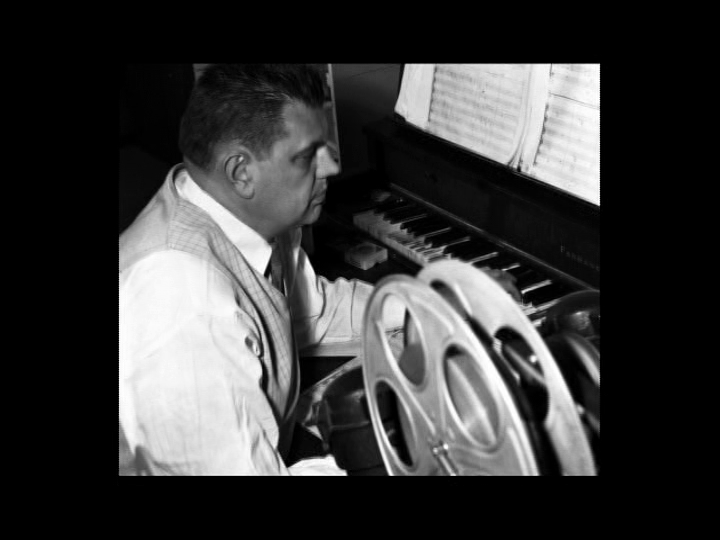
On July 3, 1914, George Bruns was born in Sandy, Oregon. He was taking piano lessons by age six; by high school he could play the tuba and trombone proficiently, and he later was able to play 12 more instruments well. Bruns attended Oregon State University, and moved to Los Angeles, California, in 1950. There, he began his conducting career for Capitol Records and UPA Studios. Bruns got his big break in 1953, when Walt Disney hired him personally to score the feature Sleeping Beauty, which would earn him his first of four Academy Award nominations while at the Disney Studios. Bruns was then asked to compose a piece for the upcoming television series about Davy Crockett. This piece would become Bruns’ most well known composition, skyrocketing to the top of the Hit Parade for six months and selling more than eight million records.

Bruns continued to score Disney films for 22 years, with films including The Absent-Minded Professor, 101 Dalmatians, The Jungle Book, Robin Hood, and The Love Bug. He would earn three other Academy Award nominations for the first live-action musical for the studio, Babes in Toyland; for the 1963 animated film The Sword in the Stone; and for the song “Love” from Robin Hood. Bruns continued to score pieces for the Disney television serials; the theme for Zorro gave him another hit, selling a million records. After contributing to more than 200 projects, Bruns retired from Disney in 1975 and returned to Oregon to continue to compose and to teach at Lewis and Clark College. Bruns passed away on May 23, 1983, in Portland, Oregon. In 2001, he was honored as a Disney Legend.

July 2

Posted on

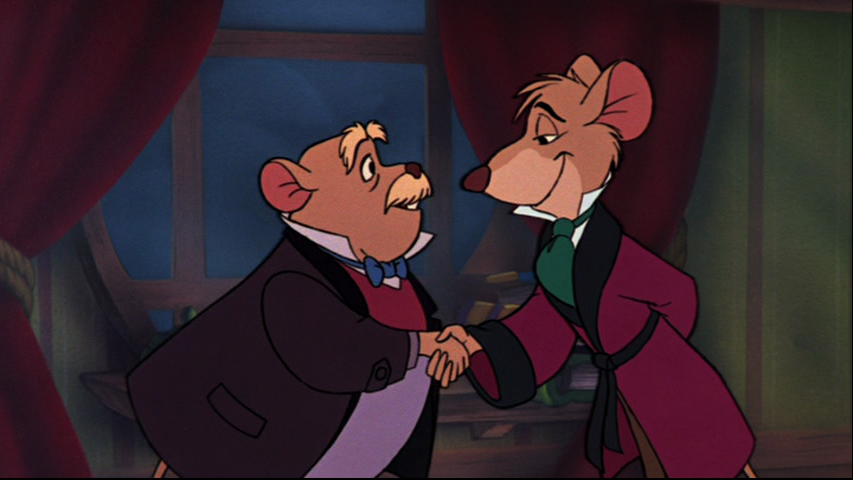
July 2, 1986 – The 26th Disney Animated Feature, The Great Mouse Detective, is Released to Theaters
“It was the eve of our good queen’s Diamond Jubilee, and the year Her Majesty’s government came to the very brink of disaster.”

On July 2, 1986, the animated feature The Great Mouse Detective was released to theaters. Based on the popular book Basil of Baker Street by Eve Titus, which was in turn based on the stories of Sherlock Holmes by Sir Arthur Conan Doyle, this was the first Disney animated film to use innovative computer generated animation combined with hand-drawn characters, as seen in the final match inside the workings of Big Ben. The film was directed by John Musker, Ron Clements, Dave Michener, and Burny Mattinson. It starred Barrie Ingham as Basil, Val Bettin as Dr. Dawson, Vincent Price as Ratigan, Susanne Pollatschek as Olivia, and Alan Young as Hiram. Vincent Price would later say that this was one of his favorite roles.

The film was originally titled Basil of Baker Street, but the marketing department decided that the name had to be changed to The Great Mouse Detective. The filmmakers disagreed with this decision, and a (fake) memo from the head of the animation department, Peter Schneider, was sent out to everyone, including Jeffrey Katzenberg, who was less than thrilled with its content. The memo stated that due to the renaming of Basil of Baker Street, all the Disney animated films would then be renamed: Snow White became Seven Little Men Help a Girl, Dumbo became The Wonderful Elephant Who Could Fly, and Peter Pan became The Amazing Flying Children. The memo was leaked to the LA Times, and eventually the contents ended up as a category on the hit game show, Jeopardy.
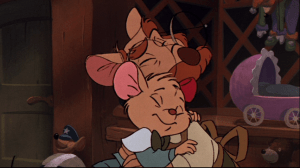
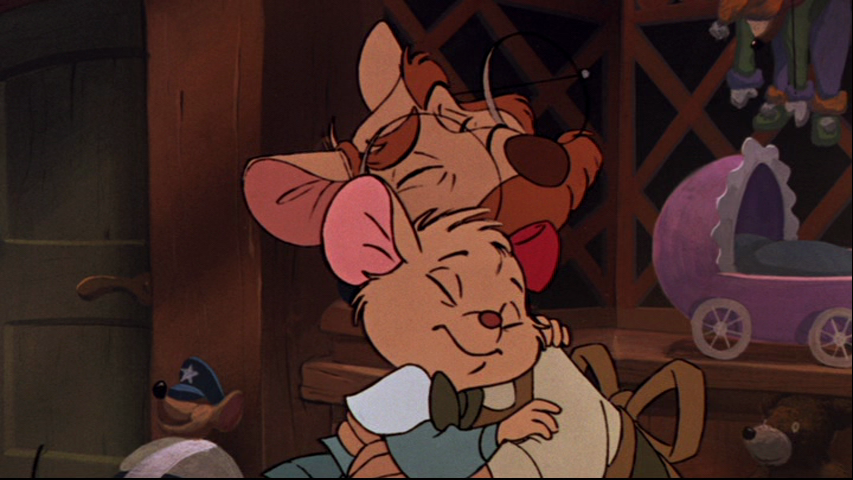
Hiram and Olivia celebrate her birthday, sharing a hug before a stranger appears to kidnap Hiram

The film, set in 1897 London, opens on Flaversham’s toy shop, where Hiram Flaversham is surprising his daughter Olivia for her birthday with an animatronic ballerina. As the two celebrate, a suspicious bat breaks into the store and kidnaps Hiram, while Olivia watches from a hiding place. Shortly after, Dr. David Q. Dawson, who has just returned to London from service in Afghanistan, comes across Olivia, who is searching for a Basil of Baker Street to help find her father. He offers to help her, and they come across 221 ½ Baker Street, where they wait for the detective to arrive.

As they wait, the two are startled by the hurried entrance of a Chinese mouse carrying a gun, only to find that it is Basil wearing a costume. He seemingly ignores Olivia as she tries to explain her case, while he runs around doing various errands. It is only when Olivia mentions that her father was taken by a bat with a pegleg, that Basil agrees to take her case, which he believes will lead him to the capture of the bat’s boss, the evil Professor Ratigan. Across town, Hiram is seen working reluctantly on a project for Ratigan, and when he refuses to work any more, Ratigan threatens to hurt Olivia. At this threat, Hiram decides his only option to protect her is to finish Ratigan’s evil scheme.
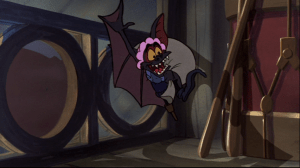
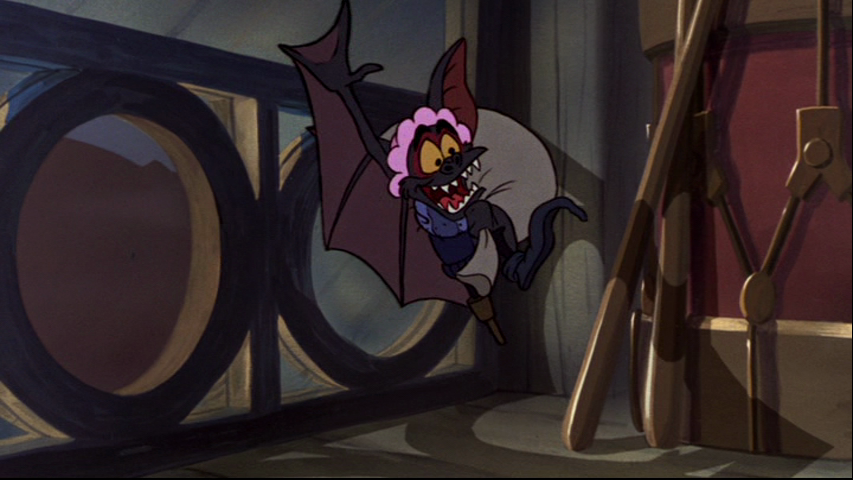
Fidget, Ratigan’s minion, escapes with all he needs for Ratigan’s plan, including Olivia

As Basil, Dawson, and Olivia go over the case, the kidnapping bat, named Fidget, appears in the window, and Olivia shrieks. Basil and Dawson quickly go after the creature, following a trail he left behind. Although Basil tries to force Olivia not to follow the pair, she goes with them to help them on the case. They meet up with a Basset Hound named Toby, who happens to be the dog of famous detective Sherlock Holmes. With Toby tracking the scent, they trail the bat to a human toy store, where he steals uniforms from toy soldiers. They don’t catch him, but they find an important clue to understanding Ratigan’s plan: a list of important supplies.

Using the toys as a distraction, Fidget captures Olivia and escapes. Dawson sadly blames himself for Olivia’s capture, but Basil assures him they will rescue her and stop Ratigan’s schemes. As they race back to Baker Street to plan their attack, Ratigan surprises Hiram with a special visitor that will ensure he finishes his task: Olivia. Ratigan, initially elated that Fidget brought back everything he was supposed to, quickly loses his temper when he finds that Basil of Baker Street is now on the case.
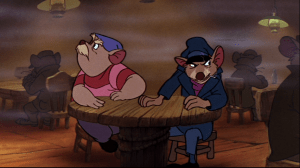
Dawson (L) and Basil disguise themselves as sailors as they infiltrate Fidget’s haunt, the Rat Trap

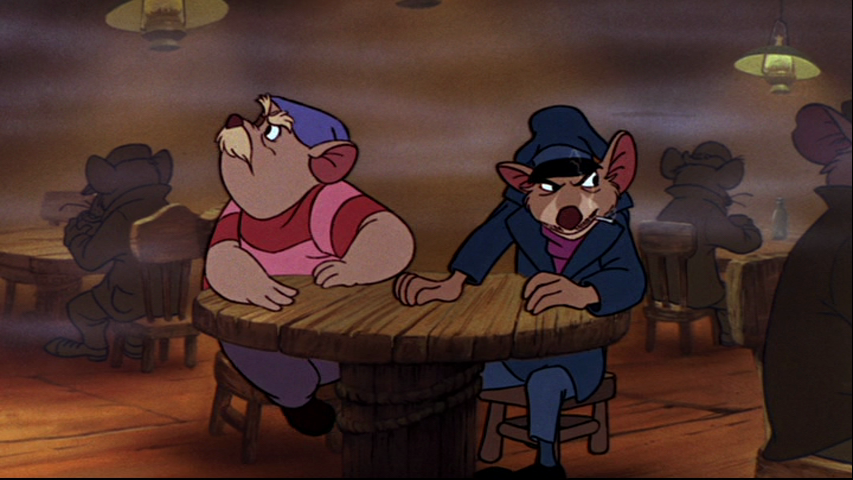
Back at Baker Street, Basil deduces the origin of the list, a seedy club near the waterfront. Disguised as sailors, he and Dawson sneak in to a bar called the Rat Trap, and while Dawson is distracted by the showgirls Basil keeps a careful eye out. Their drinks are drugged by the bartender after they inquire about Ratigan, but they are able to find and follow Fidget, who had stopped in for a drink. As they travel through the sewers, they find the location of Ratigan’s lair. They are caught in a trap when they arrive, and are left to be killed by various torture devices while Ratigan leaves to carry out his plan. Ratigan and his crew quickly head to Buckingham Palace, where Queen Victoria is preparing for her Diamond Jubilee celebration. The members of Ratigan’s gang quickly hijack the guards and bring the queen a “present” – a robotic version of herself. The queen is then captured as Ratigan’s plan becomes clear: Ratigan will use the robot to have the queen name Ratigan as her royal consort, giving him the power to control the throne.

Back at Ratigan’s lair, Basil has seemingly given up, saddened about how Ratigan has outwitted him. As Dawson tries to console him, Basil suddenly gains inspiration from a stray line of Dawson’s lecture. Motivated once again to defeat his adversary, Basil saves the group, and they quickly head to Buckingham Palace, arriving in the nick of time to save the queen from being eaten by Felicia, Ratigan’s pet cat. From backstage, Basil takes over the controls of the robot, exposing Ratigan’s plan and reuniting Olivia with her father again. Unfortunately, Fidget manages to free himself, takes Olivia, and escapes with Ratigan. After they chase each other around the skies of London with Ratigan’s flying contraption and Basil’s use of balloons, Basil and Ratigan’s final showdown takes place within Big Ben. Both Ratigan and Basil fall from the clock tower, but as Olivia, Hiram, and Dawson begin to mourn the detective’s demise, Basil emerges from the clouds, using a propeller from Ratigan’s flying contraption to keep himself airborne.
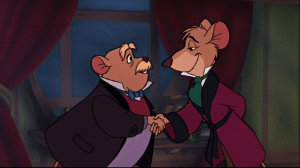
Basil and Dawson form a long partnership after this first case, with Basil asking that Dawson remain as his assistant

Basil and Dawson are honored at the queen’s Jubilee, and Olivia and Hiram depart for home. Dawson plans to find his own place to live in London, but Basil offers him a chance to stay at his flat and be his assistant. Shortly after, a woman appears at their door, imploring them for help. As the camera pans out, Toby is seen at their window, listening in on the case.

July 1

Posted on

July 1, 1994 – The Lion King Celebration Parade Premieres in Disneyland

“Attention, all creatures great and small. It is time to trim your manes, stomp your hooves, and ruffle your feathers, in glorious celebration as we present the Legend of the Lion King!”

On July 1, 1994, the Lion King Celebration Parade began in Disneyland. The parade was the first time Audio-Animatronic figures, used on the floats, appeared outside stationary attractions; remote-controlled crocodiles and large African bugs were also used in the parade.

The parade was a mix of a Disney parade and a stage show: The parade would stop at various intervals and perform for visitors a brief show, which included the song “Circle of Life.” The segment also included men and women dressed as birds perfoming acrobatic stunts on poles, and an Audio-Animatronic Simba letting out a loud roar from the Pride Rock float. This section of the parade would end with a performance of “I Just Can’t Wait to be King” before continuing down the parade route. The parade ended its performance run on June 1, 1997.

June 30

June 30, 1993 – Disney Buys Miramax Films

On June 30, 1993, Disney finalized the deal to buy Miramax Films, which not only had Disney financing future Miramax productions, but also gave Disney access to the more than 200 films in the Miramax library. Miramax founders Harvey and Bob Weinstein sold the studio for $60 million, although they continued to work with Miramax, with Disney having the final say on what they could release. In 2005, the Weinsteins and Disney did not renew their contractual relationship. The main point of their dispute was Michael Moore’s film Fahrenheit 9/11; Disney had not wanted to release it, but many communication errors kept the film under Miramax until the Weinsteins moved it to their own distribution group to release it.

After Disney’s purchase, many successful films were released, including The Piano, The Crow, Little Buddha, Pulp Fiction, Trainspotting, Sling Blade, and The English Patient. In 2009, Disney cut Miramax’s staff and film output about 70 percent, and by January 29, 2010, the studio’s offices were closed, and everything left was moved to Disney’s headquarters in Burbank. In July of that year, the arrangements to sell Miramax began. Ron Tutor and his investment group bought the studio in December 2010 for $660 million.

June 29

June 29, 1935 – The Silly Symphony Who Killed Cock Robin? is Released to Theaters

“Who killed Cock Robin? Who got him with a shot and put him on the spot? Who killed Cock Robin and vanished like a phantom in the night?”

On June 29, 1935, the Silly Symphony short film Who Killed Cock Robin? was released to theaters. The short was a modern take on the popular nursery rhyme, which was believed to be a satirical comment on the fall of Sir Robert Walpole, who was falsely accused of corruption and imprisoned in the Tower of London. He was eventually released and became the first Prime Minister of Great Britain, but was met once again with opposition and was forced to resign. The short was directed by David Hand, and stars Billy Bletcher as the voice of the judge, and Martha Wentworth as the voice of Jenny Wren. The short is also notable for the many celebrity caricatures; Jenny Wren is a caricature of popular actress Mae West.

The short opens with Cock Robin whistling and playing a guitar outside the home of Miss Jenny Wren. Jenny steps out onto her balcony to listen to the music, and Cock Robin begins to croon. A shadow of a bird with a bow and arrow is seen against the trees, firing an arrow straight into Cock Robin’s chest. He swoons a bit, then plummets to the ground, with everyone looking. Everyone comes out, alarmed at what just happened, and the police are called in to investigate. The medics take Cock Robin away on a stretcher.

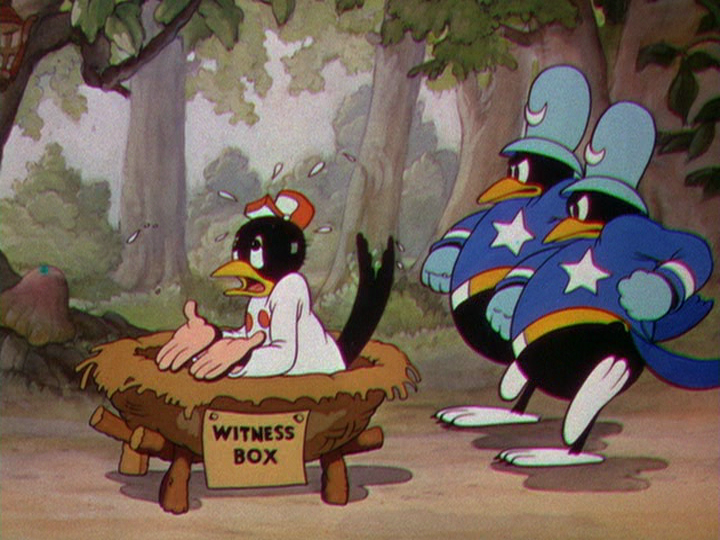
The Crow appears as the first witness, but keeps insisting that he doesn’t know anything

The court case begins, with the judge asking who killed Cock Robin. A scared crow is sitting in the witness box, and when asked, answers that he doesn’t know who killed him. When shown Cock Robin’s body, the crow turns deathly white and tries to flee. He reiterates that he knows nothing about the case, and is hauled off to jail as they pull out the next witness, Legs Sparrow. Legs won’t answer the questions, so the next witness, the Cuckoo Bird, is called. The Cuckoo Bird isn’t a reliable witness, however, so they decide to move on, with everyone rather frustrated that nobody knows.

Jenny Wren steps forward as the next witness, entrancing the entire court. She tells the judge that she wants to see justice done, as somebody took out her Robin. When she suggests that somebody ought to be hanged for the crime, the judge, very taken with Miss Wren, demands that all three suspects be hanged for the crime. Out of nowhere, another arrow flies in, taking the judge’s hat and nailing it against a tree. The judge looks up to see the real culprit, Cupid. Cupid informs them all that he shot Cock Robin, but Robin isn’t dead, he’s just fallen for Jenny and landed on his head. Jenny asks Robin to kiss her, and he wakes up, giving her a smooch.

June 28

June 28, 1988 – Disney’s Grand Floridian Beach Resort Opens at Walt Disney World

Image credit: Official Walt Disney World Website

 “This magnificent hotel sits along the white-sand shores of Seven Seas Lagoon…Enjoy an opulent experience that begins inside the Grand Lobby, which stands over five stories high, sparkling with the light from two brilliant chandeliers.”

On June 28, 1988, the Grand Floridian Beach Resort (renamed Disney’s Grand Floridian Resort & Spa in 1997) opened at Walt Disney World. The resort is owned and operated by Walt Disney Parks and Resorts, and is a Victorian-themed luxury hotel and spa located in the Magic Kingdom area. The hotel is categorized as a deluxe resort, the highest of the four designations of lodgings at the Walt Disney World Resort, and is considered Disney’s flagship hotel. It was renovated in 2007, with all the guestrooms redecorated and provided with updated technology, including flat-panel televisions.

The hotel contains a highly renowned restaurant called Victoria & Albert’s, a 13-year recipient of the prestigious AAA Five Diamond Award, as well as Narcoossee’s, a restaurant that gives guests views of the Magic Kingdom fireworks show, Wishes. Also included at the resort is Citricos, an American restaurant with Mediterranean flair; 1900 Park Fare, which gives guests a chance to dine with Mary Poppins and Cinderella; the Grand Floridian Café, featuring traditional American fare; and the Gasparilla Grill and Games, a 24-hour snack bar with an arcade.

June 27

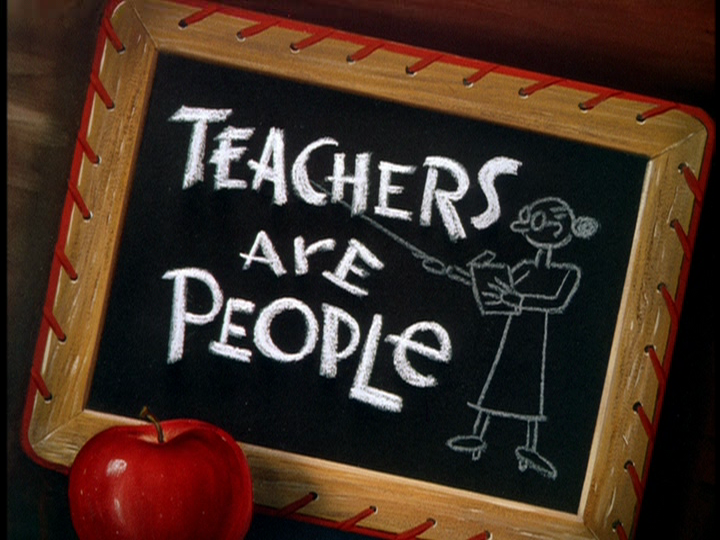
June 27, 1952 – The Goofy Short Film Teachers are People is Released to Theaters

“The person upon whose capable shoulders rests the responsibility for their education is that unsung hero, the teacher.”

On June 27, 1952, the Goofy short film Teachers are People was released to theaters. It was directed by Jack Kinney, with story by Dick Kinney and Brice Mack. The short was narrated by Alan Reed, who would go on to fame as the voice of Fred Flintstone. When this short was released, the idea that a school would be bombed or that dangerous weapons would be brought in a school was an outlandish one; needless to say, attitudes have changed a great deal since then.

The short opens with the narrator explaining how school has become a vital part of every child’s life. We then see a mother dragging her reluctant son George to school, dressed in a smart suit and sailor cap, holding an apple for his teacher. When he reaches his clubhouse in the front yard, he quickly changes and emerges in somewhat “cooler” attire. We then see the other children walking to school, “whetting their appetites for knowledge” (splashing through rain puddles) and “forming friendships for the future” (a boy is seen carrying all of a pretty girl’s schoolbooks).

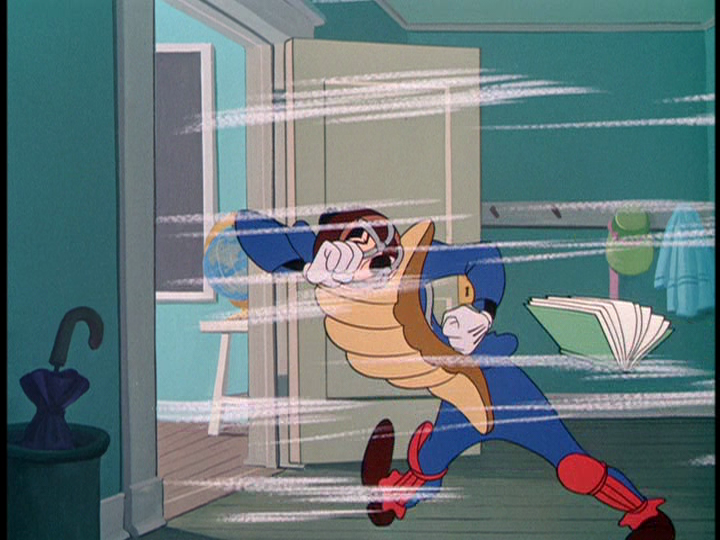
Goofy, as the brave educator, prepares himself as he enters a classroom full of chaos

As the audience’s attention turns to the school, the doors open to reveal the educator, played by Goofy. He steps forward as the crossing guard is letting the kids cross the road, but unfortunately Goofy gets stuck in the middle of the road as the cars speed past. The audience then sees his classroom: the children have gone wild, throwing books and ink, making a complete mess of the room. Before Goofy enters, he dons an umpire’s outfit, ready to tackle anything that comes his way. He calms everyone down, and the students begin to sing a good morning song.

As Goofy erases a demeaning doodle from the board, a little mirror pops out of his jacket, allowing him to see George attempting to hit the teacher with his slingshot. Goofy ducks just in time, and demands that George put all of his toys and pranks into the drawer in his desk. George reluctantly puts in his slingshot, and various weapons, including fireworks, a pocketknife, and a grenade. The grenade shocks Goofy, and he carefully places it in a nearby bucket of water. As Goofy calls roll, we see the students continuing to play pranks on each other. When he calls for George, he sees George sneaking out the window to go fishing, and quickly pulls him back inside.

An oblivious Goofy is unaware that his student George is causing mischief behind his back

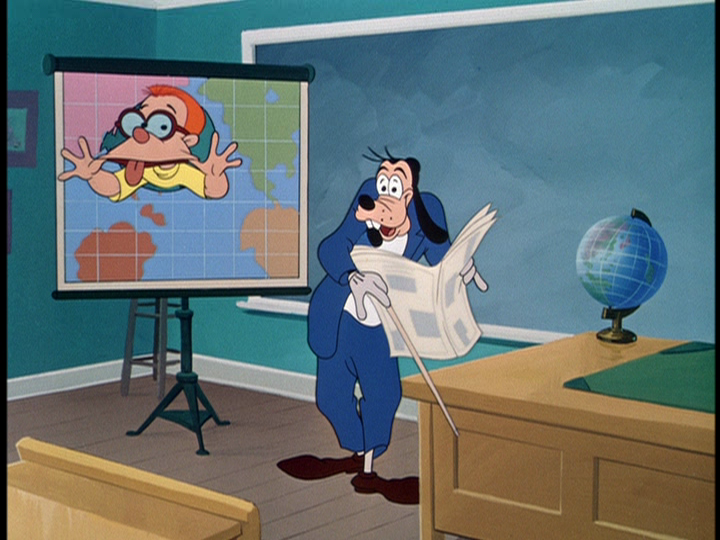
Goofy then calls for homework, and the students begin to place apples on the teacher’s desk. One apple seems to be missing, and when Goofy wonders who is absent, he looks over to see George at his place in the corner, eating his apple. George then begins to run the chalk down the chalkboard, making an annoying squeaking sound. Goofy cuts him off before the geography lesson, and pulls down the map. While he tries to give the geography lesson, the students have their books propped up, but are playing with various toys behind them. George then cuts a hole in the map, making faces at his fellow students.

When the bell sounds for lunch, the student stampede outside, making a mess of the playground. Goofy hears a group of his students whispering, and when he goes over to hear their conversation, he blushes at the obscene nature of the joke. The students return from lunch as if they were forcibly marched, and Goofy has to drag George inside. When the spelling lesson begins, Goofy asks George to spell the word “cat.” George attempts to cheat off his neighbor’s paper, but when the student pulls it away, George pulls a squirt gun on him. The student misspelled the word on purpose, so George ends up squirting the student in the face.

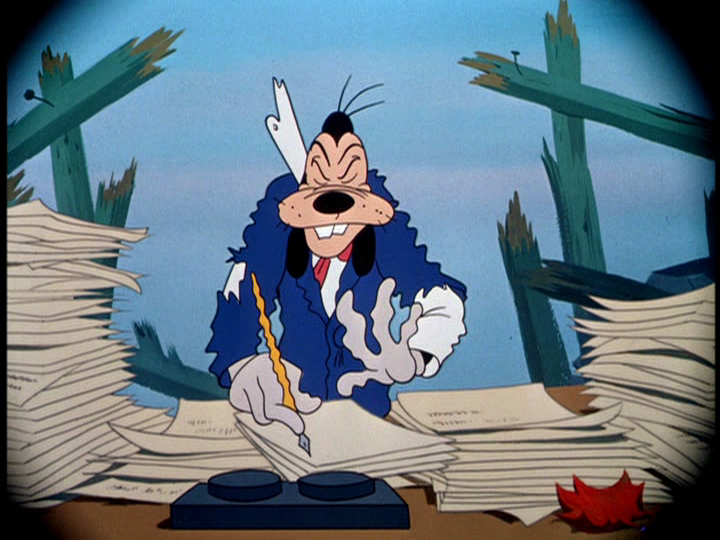
Poor Goofy is reaching the end of his rope as George squeaks the chalk during his punishment

George continues to cause mischief in the classroom, and finally sets the clock ahead an hour to 3 o’clock, when the bell rings and the students take off like a shot. Goofy is left to clean up the students’ mess, and have a parent-teacher conference. In this conference, the parent grabs Goofy by his collar and demands to know “What’s the matter with my kid’s grammar?” before punching Goofy on the head. As the short draws to a close, the school building suddenly explodes, and we see “I will not bomb the school again” written several times on the chalkboard by George, still using the squeaking chalk.

June 26

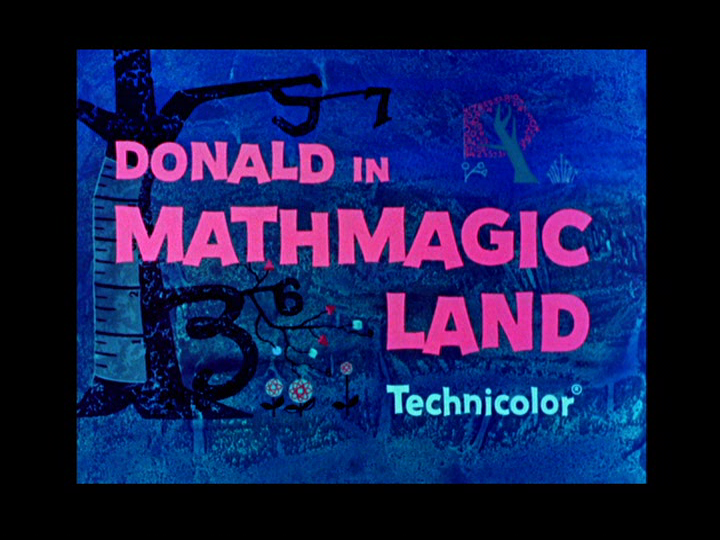
June 26, 1959 – The Donald Duck Featurette Donald in Mathmagic Land is Released to Theaters.

“By golly! You do find mathematics in the darndest places!”

On June 26, 1959, the featurette Donald in Mathmagic Land was released to theaters. This Academy Award-nominated short would go on to become one of the most popular educational films ever released by Disney. It was also shown on the first program of Walt Disney’s Wonderful World of Color, introduced by Professor Ludwig von Drake, who played the True Spirit of Adventure in the featurette. The story was written by Milt Banta, Bill Berg, and Dr. Heinz Haber, and starred Clarence Nash as the voice of Donald.

Donald, dressed in a hunter’s outfit, enters a dark room with his gun and looks around, remarking on how strange this all seems to be. He follows a trail of numbers, and finds the creature making the markings is a walking pencil, who challenges Donald to a game of tic-tac-toe, which Donald loses. He continues to walk, surprised by the square roots he runs into. He calls out hello to anyone who will hear him, and the voice of the narrator greets him. The narrator informs Donald that he is in Mathmagic Land, the land of great adventure, and that he, the narrator, is the True Spirit of Adventure. The spirit tells Donald he will take him on a journey through the wonderland of mathematics.

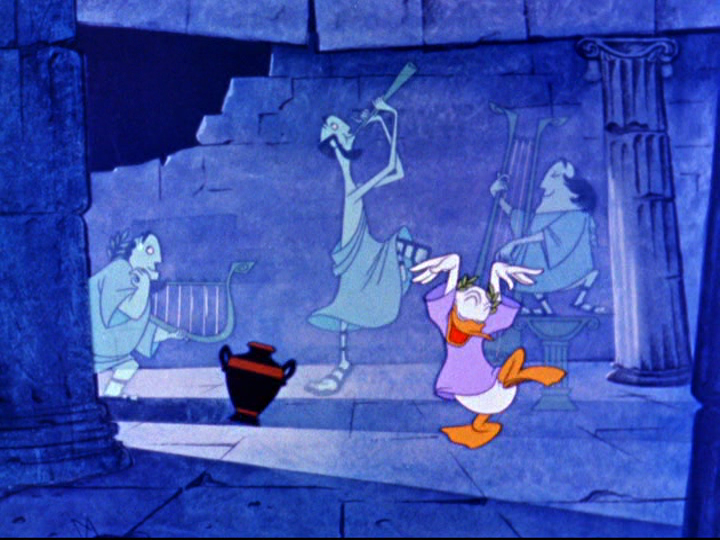
Donald having a jam session with the Pythagoreans, while learning that without math, there would be no music

As Donald storms away, saying math is for eggheads, the spirit informs Donald that without “eggheads,” there would be no music. He takes Donald back in time to Ancient Greece to meet Pythagoras, the father of mathematics and music. Donald is still confused, so the spirit shows Donald how music is full of mathematics. The first example shown is a harp, demonstrating how an octave is created. Donald and the spirit then sneak in on a meeting of the Pythagoreans, who are playing music in their meeting. Donald interrupts them, saying they need to play something with a beat. The Pythagoreans, the spirit explains, helped create the music we know and love today. As the spirits of the Pythagoreans disappear, Donald is left with a surprise – he is made a member of the Pythagoreans.

The segment then moves to another Pythagorean discovery: the pentagram, filled with mathemagic. The first concept explained is the golden section, then we move to the golden rectangle, which the pentagram creates many times over. The Greeks believed the golden rectangle to be a natural law of beauty. The spirit then shows how the pentagon, another Pythagorean shape, is found in nature, before moving on to other shapes found in nature.

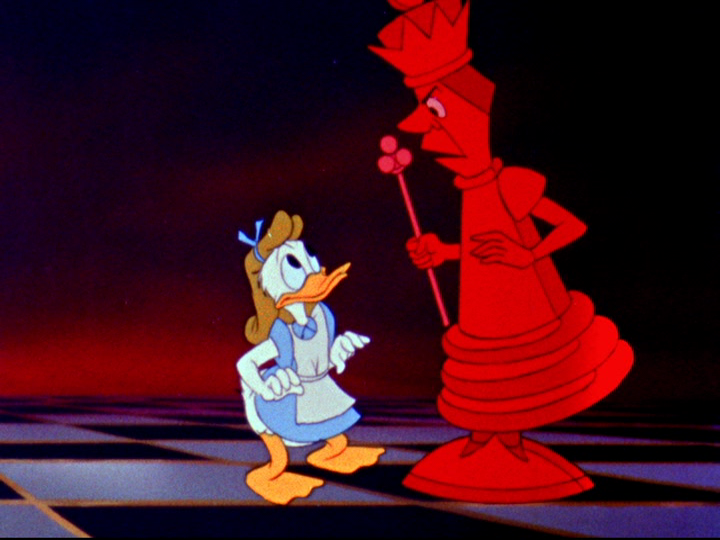
Donald plays the part of Alice when being taught the mathematical principles of the game of chess

Donald, who is enjoying his adventure so far, is delighted to hear that one can find mathematics in games, as well. The spirit begins with the game of chess, explaining it with the concept of Alice in Wonderland, with Donald playing the part of Alice. After a slight adventure with the chess pieces, Donald is able to watch a game in safety, but is bored by it. The spirit then begins to list sports with a geometric field, like baseball and football. The game that gets Donald really excited, however, is billiards. The spirit then shows an expert playing three-cushion billiards, and the mathematics used to get the perfect shot.

The spirit then tries to get Donald to play a game with his mind, only to find that Donald’s mind was completely cluttered with antiquated ideas, bungling, false concepts, and superstitions. He cleans out Donald’s mind, then has Donald think of a perfect circle, and puts a triangle in it. When asked what he sees, Donald sees a sphere. The spirit then has Donald take one thing and see how many items he can come up with using those shapes. Donald is then taken to a hall filled with doors, with most of them open. Some of the doors Donald discovers are locked, to which the spirit replies that they are the doors of the future, with the key being mathematics. The short then ends with the Galileo quote: “Mathematics is the alphabet with which God has written the universe.”

June 25

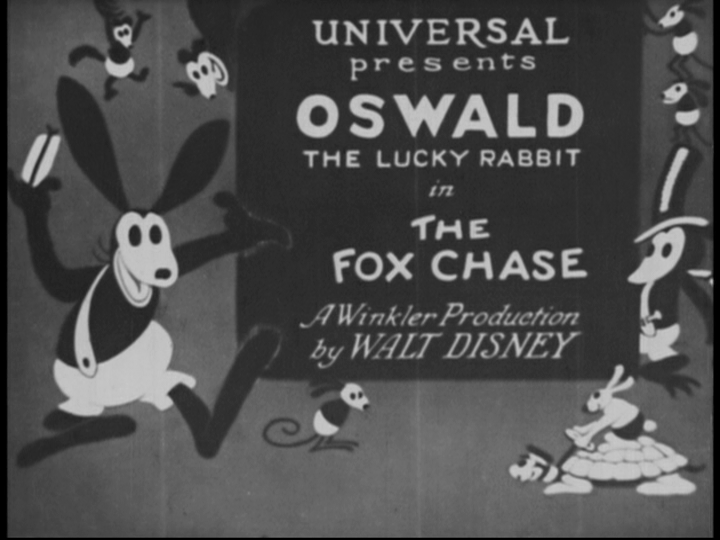
June 25, 1928 – The Oswald the Lucky Rabbit Short The Fox Chase is Released to Theaters

On June 28, 1928, the Oswald the Lucky Rabbit short The Fox Chase was released to theaters. It was the 22nd Oswald short film, and was one of the last Oswald shorts produced by Disney. It was produced at the same time that Walt Disney and Ub Iwerks were working in secret on the first Mickey Mouse cartoon, Plane Crazy. The Oswald short would later be remade as The Fox Hunt in 1931.

It’s the day of the big fox chase, and Oswald seems to be having trouble controlling his horse. The fox in question is standing in front of the dogs, taunting them as they wait behind the starting line. The horn sounds, and everyone stands at attention, waiting for the signal. The gun fires, and everyone heads out.

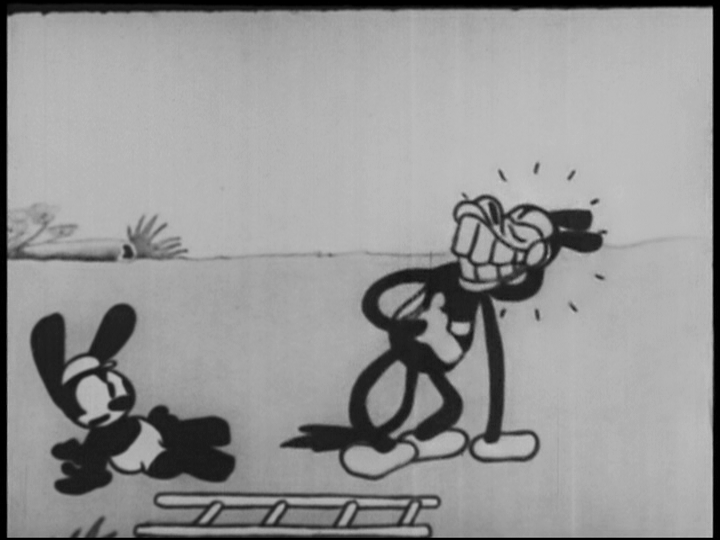
Oswald’s horse has a good laugh at Oswald’s expense while the rabbit is unable to mount

Unfortunately for Oswald, his horse is unable to head out with everyone else, and bucks Oswald off, laughing at the rabbit’s misfortune. As Oswald tries to leap onto his steed, the horse blocks him, and Oswald once again finds himself on the ground. After several failed attempts, Oswald tries to be clever by tying the horse’s tail to a nearby ladder and using it to mount, but the horse foils him again, and Oswald is dragged across the field, still clutching the ladder.

While the fox is having a good time outsmarting the dogs chasing him, Oswald is still trying to mount his horse. The horse finally stops, and Oswald, his legs completely stretched out, is no longer in the mood for games. He finally mounts the temperamental horse and continues with the chase. The fox is still able to outsmart his pursuers, but ends up running right past Oswald, who turns around suddenly. As horse and rider tumble over a stump, Oswald has become the “horse,” with his horse riding him. With another strange turn of events, Oswald then ends up riding one of the dogs chasing the fox, and jumps up and down with joy that he’s almost caught the cunning critter.

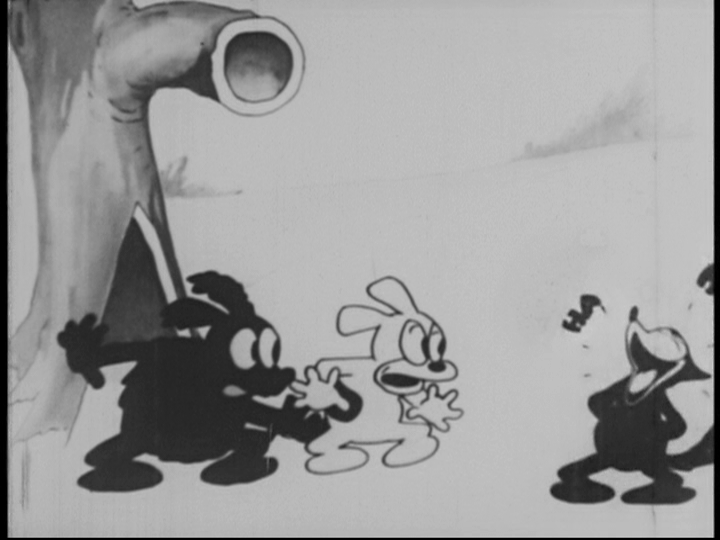
The two dogs that surprise the fox by hiding in the tree are fooled once again, and watch with surprise as the fox laughs at them

Two other dogs spot the fox heading their way and hide in a nearby tree, jumping out as the fox runs by, and all three start fighting. The fox manages to sneak out and laughs at the two dogs’ folly. The fox hides in a log and manages to keep outsmarting the dogs. When Oswald comes along, he comes up with an idea to drive the fox out, only to discover that a skunk has been hiding in the log instead. When Oswald and the two dogs run away in fear, the skunk turns to the audience and reveals that he’s only wearing a costume, and is really the fox, who laughs, as he’s won the chase.