RSS Feed

January 5

January 5, 1935 – The Silly Symphony The Tortoise and the Hare is Released to Theaters

vlcsnap-2014-01-05-11h00m53s146

“You don’t talk tootin’, cutie. I’m the very best there is!”

On January 5, 1935, the Silly Symphony The Tortoise and the Hare was released to theaters. It was based on the Aesop fable Hare and the Tortoise. The short won the Academy Award for Best Cartoon in 1934, winning against Columbia’s Holiday Land and Universal’s Jolly Little Elves. It was released as an educational film in 1986, retitled Aesop’s Hare and the Tortoise, with an overview done by Walt Disney from an episode of Disneyland. A sequel to this short was also released in 1936, entitled Toby Tortois Returns. The short was directed by Wilfred Jackson.

The short begins on race day, with everyone turning out to see the big race between Toby Tortoise and Max Hare. Max steps out meet the cheering crowd, while Toby is greeted by laughs. Toby greets Max with a friendly “may the best man win,” with Max replying that of course he will, but promises not to beat Toby too badly. The official starts the race, and Max takes off with a shot, while Toby is still at the starting line. As Max runs by so fast that trees are pulled out from their roots, he stops when he sees Toby galloping slowly with some snails. Max decides to “take a nap” while Toby continues his pace, and when Toby sees the sleeping Hare, he tries to use the situation to his advantage. Max then gets up and speeds past Toby once again.

Max stops racing so he can chat up some girls from the local girls' school

Max stops racing so he can chat up some girls from the local girls’ school

Max stops once he sees the girls of Miss Cottontail’s Girls’ School, thinking that he has plenty of time to chat with the young ladies. The girls see Toby galloping by, and try to stop him to talk. Toby refuses to stop, as he has a race to run. As Toby continues, Max stays with the girls to off his speed skills. Suddenly, a cheer rings out, and Max realizes that he needs to hurry to catch up to Toby. Toby sees Max running full speed and picks up his pace. It’s a fight to the finish, and Toby manages to win in the end. The crowd cheers for Toby and carries them on his shoulders as the victor.

January 4

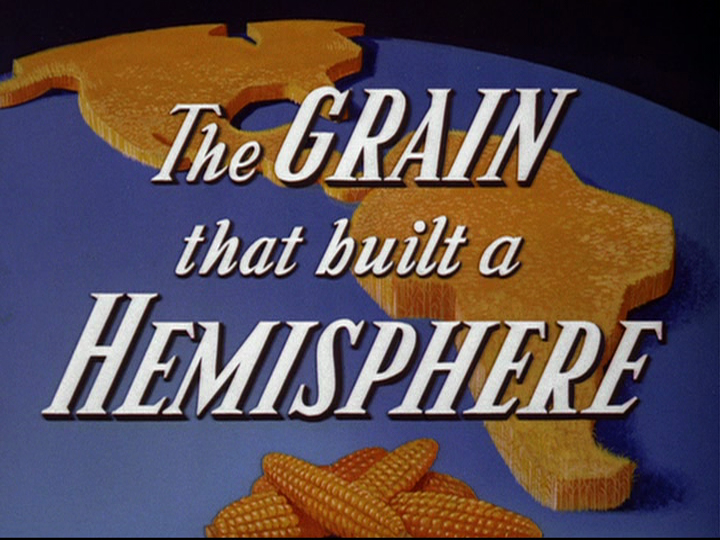
January 4, 1943 – The Educational Propaganda Short Film The Grain That Built a Hemisphere is Delivered

vlcsnap-2014-01-04-16h01m49s225

“Corn is the symbol of a spirit that links the Americas in a common bond of union and solidarity.”

On January 4, 1943, the educational short film The Grain That Built a Hemisphere was delivered to the Coordinator of Inter-American Affairs. It was nominated for an Academy Award for Best Documentary in 1943, but lost to The Battle of Midway, Kokoda Front Line!, Moscow Strikes Back, and Prelude to War. This short also includes a short segment from the 1938 Silly Symphony Farmyard Symphony. The short was directed by Bill Roberts.

The short begins with an explanation of corn, and how it possibly came to be. The earliest version of corn grew on the mountains centuries ago, but was not noticed by hunters as they searched for food. When hunters were unable to find game, they were able to find corn and use it for food; this discovery is then credited as helping begin the civilization of the Americas. The narrator then directs the attention to the Mayan civilization, which was built around the growth and worship of corn, with great temples built in dedication to the corn gods, including Yum Kaax. The Aztecs also built a civilization based on corn, with their corn goddess named Centeotl. The Incas, located in the Andes, worshipped a sun god, who provided them with all they needed to grow their corn. The crop of corn spread around South America and all the way to Canada; it was also sent over the world through the conquistadors and spread from there.

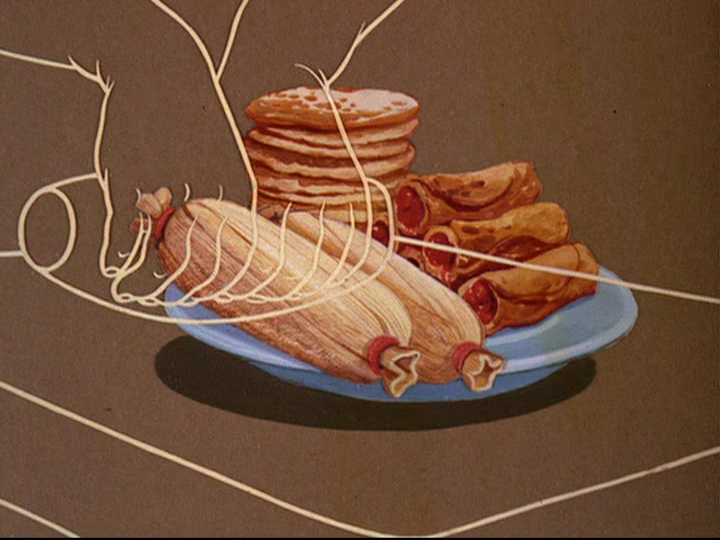
A list of foods made from corn is shown through animation

A list of foods made from corn is shown through animation

The narrator lists the various foods made from corn, including tortillas, succotash, and bourbon. Brought to present day, where it is explained that, thanks to advances in machinery, we can harvest enough corn in fifteen hours, compared to the 500 the Mayans needed. The next topic is how to inbreed corn, and the entire process is explained step by step. It produces small versions of the corn plant, but once two small unrelated inbred plants are cross-bred, that produces a stronger, larger stalk with more ears. Seventy-five percent of all corn produced in the United States goes to feed for livestock, with hogs eating the most of that percentage. After this, a scientific study of corn is presented, with an explanation of how the two parts of the corn kernel (the endosperm and the germ) are used to create oils and starches, which have a variety of uses. A hypothesis of how corn can be used to help the war effort is also presented, with the idea that corn can be used to create tough plastics, powerful fuels and explosives, tires, parachute fabrics, and more.

January 3

January 3, 1991 – The NBC Television Series Blossom Premieres

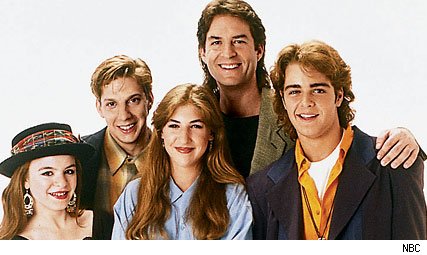
blossom-cast-427ak021810“Are you referring to the onset of puberty? A feeling of ennui, a kind of overall…bloat?”

On January 3, 1991, the sitcom Blossom premiered on NBC. Produced by Impact Zone Productions in association with Witt/Thomas Productions and Touchstone Television (the latter of which would become ABC Studios in 2007), it was distributed by Disney-ABC Domestic Television and ran for 5 seasons with 114 episodes. The pilot was released on July 5, 1990, as a television special; NBC, pleased with the ratings, ordered a full season of the show as a midseason replacement in January. The show centers around teenager Blossom Russo who, like the rest of her family, has to adjust to her parents’ divorce. Blossom’s family consists of her father Nick, a piano player; older brother Tony, a recovering alcoholic and drug addict; and older brother Joey, a stereotypical “dumb jock.” Blossom also has a best friend named Six Lemeure, who is considered part of the family. The series was created by Don Reo, and stars Mayim Bialik as Blossom, Ted Wass as Nick, Michael Stoyanov as Tony, Joey Lawrence as Joey, and Jenna von Oÿ as Six.

The first episode to premiere, “Blossom Blossoms,” begins with Blossom shopping for her first box of tampons at the grocery store, but is rather embarrassed as her crush Mitchell works at the store, and ends up too ashamed to buy them. She relays the story to her friend Six, and then admits her wish that her mother would live with her sometimes to help her through the things she’s going through. Six reassures her that everything will be okay, and gives Blossom the option of talking to her own mother. After Six leaves, Blossom goes to her kitchen and discovers her brothers working on a film for school, but is annoyed at their antics. Later that evening, she goes to the kitchen again and talks to her father, who is concerned that she’s awake at a late hour. However, she doesn’t feel like she can talk to her father about all that she’s going through, and leaves the conversation, pretending that everything worked itself out.

In a fantasy, Blossom heads to the kitchen again and is greeted by her “mother,” Phylicia Rashād. Her “mother” starts explaining the facts of life by using icing to draw on a cake. Blossom wakes up from her dream and is saddened that her mother really isn’t there, so she decides to try and call her mom, who is actually in Paris. Her mom isn’t there, and she attempts to leave a message, but finds she can’t do so. Later in the week, Nick asks his sons if they’ve noticed anything unusual about Blossom. They tell him that she seemed strange the other day, but don’t believe that there’s anything wrong. Blossom heads over to her neighbor Agnes’s house to deliver her groceries, and starts to let out her feelings that she feels abandoned by her mother. Agnes comforts her, and convinces her to talk to her father again, telling her she should work with what she’s got. Blossom gets home and gently tries to allude to Nick what’s going on. Nick goes through a range of emotions, but in the end embarrasses Blossom by announcing to her brothers that Blossom has gotten her period. Later, the family is preparing to go out for a “celebratory dinner,” which Blossom finds incredibly weird. As Nick helps her with her hair, Blossom asks if her mother will ever come home. Nick tells her that this isn’t her home anymore, but it’s okay for Blossom to miss her, but promises that he’ll be there to answer any questions she has.

January 2

January 2, 1979 – The Dumbo’s Circus Parade Begins in Walt Disney World

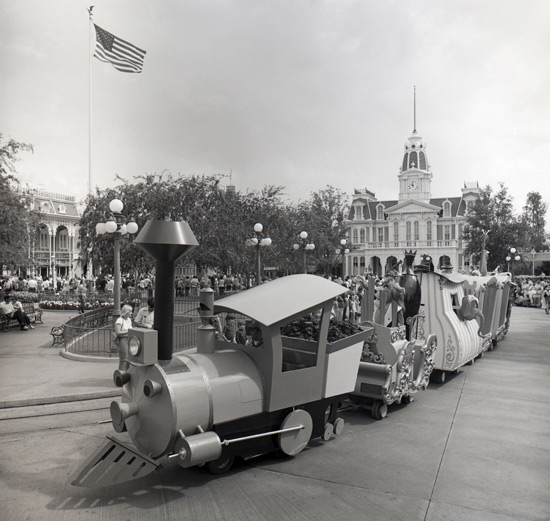
Dumbo's Circus Parade

“In 1979, Walt Disney Entertainment brought a parade inspired [by Dumbo] to life in the Magic Kingdom Park in the form of Dumbo’s Circus Parade…”

On January 2, 1979, the Walt Disney World parade Dumbo’s Circus Parade began its run through the Magic Kingdom. Based on the scene in the 1941 film Dumbo when the circus arrives to town, the parade features a float of the train Casey Jr., with various Disney characters playing the part of circus performers. Mickey Mouse played the part of the ringmaster, leading a three ring circus behind the train that featured Donald Duck as a snake charmer, and Goofy as a circus weightlifter. A barrage of clown characters followed behind this, featured on a float that acted as the clown headquarters. The parade lasted until December 21, 1979, and was replaced with the Tencennial Parade on October 1, 1981, which celebrated Walt Disney World’s tenth anniversary.

January 1

January 1, 1938 – Disney Makes its First Appearance in the Tournament of Roses Parade

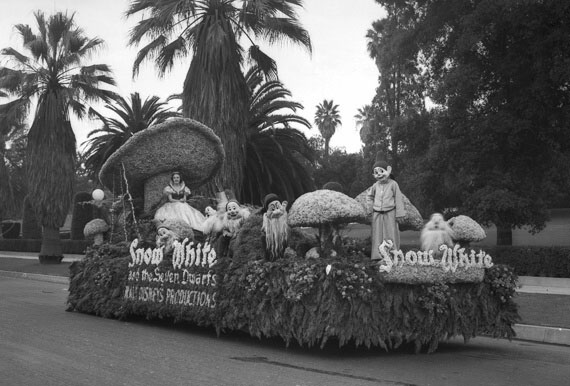
1938 rose parade 3

“I couldn’t have been more excited that day, especially when the Snow White float went by.” – Roy E. Disney

On January 1, 1938, the Tournament of Roses Parade took place in Pasadena, California, with the theme being “Playland Fantasies.” This parade marked Disney’s first involvement with the parade, when characters from Snow White and the Seven Dwarfs (released in 1937) were featured prominently on a float. Marjorie Belcher, the live-action model for Snow White, wore the costume to ride on the float; several of the actors who dressed up as the dwarfs for the film’s premiere were also on hand to ride the float. Since this first involvement, Disney has had a special partnership with the parade, including Walt Disney acting as the Grand Marshal in 1966, Roy E. Disney acting as the Grand Marshal in 2000, and a special dedication float to the 50th anniversary of Disneyland in 2005, with Mickey Mouse as the Grand Marshal.

December 31

December 31, 1920 – Actor, Singer, Songwriter, and Disney Legend Rex Allen is Born

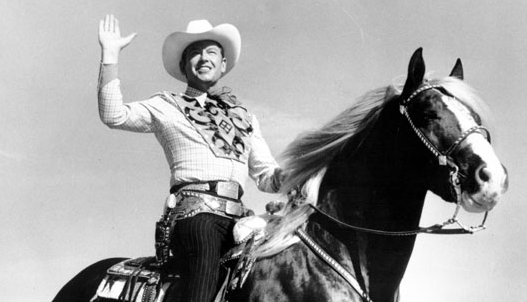
Rex Allen

“Basically, all I ever wanted to do was try to be a singer and make a living at that.”

On December 31, 1920, Rex Elvie Allen was born in Willcox, Arizona. He honed his skills as a singer during his youth, performing in local functions with his father, who played the fiddle. After high school, Allen began his career in vaudeville, and performed on the Chicago radio program National Barn Dance, one of the first American country music programs in radio. Allen left the program in 1949 to move to Hollywood, where he scored a contract with Republic Pictures. His first movie was The Arizona Cowboy, and Allen would go on to become a fixture in cowboy films for Republic. He also had a record deal with Mercury Records, making country music records through 1952, where he switched labels to Decca.

In 1956, Allen began his work with the Disney Studios by narrating the documentary Cow Dog, which would go on to be nominated for an Academy Award. He continued to narrate for Disney nature documentaries, earning the nickname “The Voice of the West.” His most noticeable role, however, is the narration of the 1963 film The Incredible Journey. Allen’s vocals are also featured in several Disney park attractions, most notably the voice of the Father in the original Carousel of Progress; the 1993 updated attraction has Allen now voicing the role of the Grandfather. For his work with Disney, Allen was inducted as a Disney Legend in 1996; he passed away at age 78 in 1999.

December 30

December 30, 2003 – The Hotel Chain Holiday Inn Replaces Downtown Disney’s Courtyard by Marriott

HI

“Guests can experience world-class accommodations and service at the only Holiday Inn located in the Walt Disney World Resort area.”

On December 30, 2003, the hotel chain Holiday Inn purchased the former Courtyard by Marriott hotel located in Lake Buena Vista, Florida, near the Downtown Disney area. Before becoming a Courtyard by Marriott, it was originally a Howard Johnson’s. Unfortunately, the hotel was closed on August 14, 2004, after Hurricane Charley caused extensive damage to the property. The hotel was reopened on July 15, 2010, after a $35 million renovation, and still remains under the Holiday Inn banner. The hotel has since won a certificate of excellence by TripAdvisor, and a JD Power Award for Guest Satisfaction Index.

December 29

December 29, 2011 – Cast Member Oscar Martinez Celebrates 55 Years Working at Disneyland

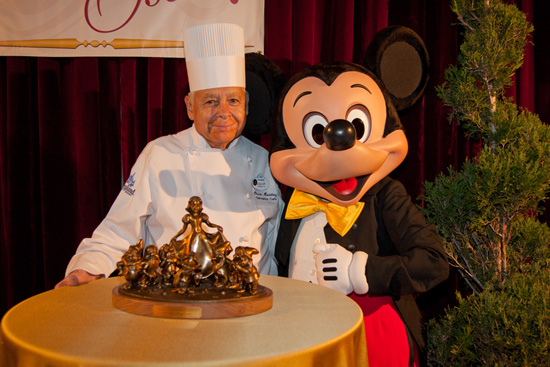
OM_55

“Mix within one person one cup of integrity to ensure a strong foundation, one cup of sincerity to keep it from separating, and half of a cup of humor just for flavor, and just a pinch, a tiny pinch, of humility to keep it from burning. Pour all ingredients into the one good person, mix well, let it cook for 55 years, and that is how you get success.” – Matt Gray, Disneyland Park Food and Beverage General Manager

On December 29, 2011, Carnation Café cook celebrated his 55th anniversary working at Disneyland. Martinez began employment as a busboy, and has become a favorite of many guests through his tenure, as well as having trained several thousands of cast members. Martinez was the first cast member to reach this milestone, and was awarded a special Snow White and the Seven Dwarfs-themed service award by George A. Kalogridis, the president of the Disneyland Resort at a special ceremony held at the Main Street Opera House. At the ceremony, Martinez was asked if he was ready to retire, to which he responded that it would be a while before he “[hung his hat] up.”

December 28

December 28, 1955 – The Walt Disney Anthology Episode “Man and the Moon” Premieres
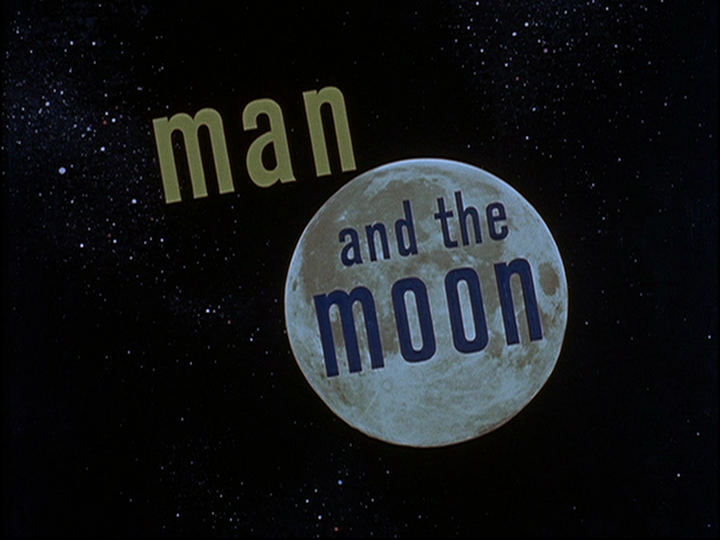
vlcsnap-2013-12-28-18h40m57s95

“After consulting with the scientists, our artists and studio technicians have prepared a factual picture of how the coming conquest of the moon will be accomplished.”

On December 28, 1955, the Disneyland episode “Man and the Moon” premiered on television. Known as a “science-factual” presentation, the episode was part of a series that explored the same ideas that were in the Tomorrowland section of the Disneyland theme park. The episode was directed and produced by Nine Old Men animator Ward Kimball, and written by Kimball, William Bosché, and John Dunn. It features Dr. Wernher Von Braun, who also assisted the creation of the episode as a technical consultant. The episode was rerun in 1959, but was renamed “Tomorrow the Moon.” Like many episodes of Disneyland, the episode was shot in color, although it was broadcast in black and white.

The episode begins with an introduction by Walt, who introduces the rocket ride located prominently in Disneyland’s Tomorrowland. He then takes the audience to a meeting of animators and studio technicians to discuss how to correctly portray an exploration of the moon. Ward Kimball then takes the helm, who begins the study with a history of man’s fascination with the moon. It begins with cave drawings explaining how primitive man thought the moon came to be, then moves on to the individual legends of cultures around the world. The first book dedicated to the moon was Plutarch’s parchment, where he called the moon a smaller earth, populated by demons. In 1609, Galileo Galilei created his telescope and looked at the moon, which led to Johannes Kepler writing his book Somnium. More science-fiction books were written about people’s travels to the moon, including one by Cyrano de Bergerac and Jules Verne. The commentary then moves to mentions of the moon in literature, beginning with Shakespeare, before moving to superstitions and legends.
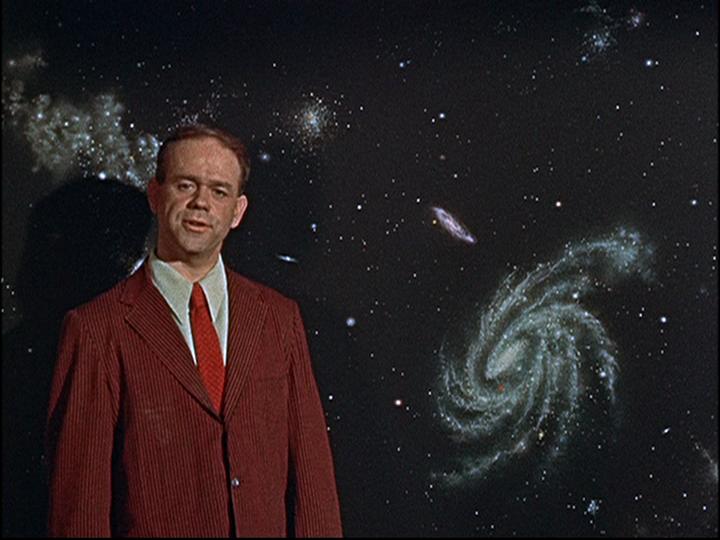
Ward Kimball begins his description of how the universe and the moon was possibly formed

Ward Kimball begins his description of how the universe and the moon was possibly formed

Kimball then moves to how the moon stands in our solar system, and the mystery of how the moon came to be. He explains the legend of the big bang, and then explains the moon’s movement around the Earth, and how it appears to change shape. The moon’s gravitational pull also has an effect on the tides of the ocean. Kimball then shows an image of the moon taken through telescopes and telegraphic lenses, and explains the moon’s appearance. He then introduces Dr. Wernher von Braun, who is on hand to enlighten about plans of a trip around the moon. He describes that the orbit around the moon must be done in two phases to get the ship out into the atmosphere and into the orbit around the moon. He shows a model of a space station in the shape of a wheel. The shape, with the wheel revolving at three revolutions a minute, will create an artificial gravity for the 50 men that will be inside. He then describes how the pieces for the space station will be sent out into space in cargo ships. His explanation is accompanied by detailed illustrations of the ships and crew members that will help assemble the space station. The purpose of the trip around the moon, von Braun clarifies, is to test methods and equipment that will be used on later voyages into deep space, and no landing will be attempted. Timing is quite important on this mission, as the rocket needs to be in line with the moon’s rotation around the Earth. Von Braun then shows a model of how that rocket would possibly look.

Von Braun then introduces a fictionalized account of how the first expedition around the moon would look once all the problems have been solved and the space station has been built. The crew gathers to their places and begin prepping the ship for its journey to the orbit. The firing timer is then engaged, and it is only a few minutes before the ship is fired off to the orbit. The launch occurs without a hitch, and after they are on their way, the crew takes off their helmets and starts checking the view around them to make sure they have the right position. Unfortunately, after a while, Emergency Alarm 2 goes off, and the men discover that a meteorite has hit their second nitric-acid tank. One of the men heads out in the bottle suit to use the robotic arms to fix the leak. The leak is plugged, and the man returns to the ship successfully. As they near the moon, they check to see if they are still in the right position. They find that they might collide with the moon, and use a tape selector to fix the ship’s course by firing rockets for a certain amount of time. As they pass by the moon, the men take photos and make observations of everything on the moon’s surface; as they travel on the dark side of the moon, they fire flares so they are able to still see the surface. They discover some strange readings through their instruments, and take a quick picture before they pass from behind the moon and view the Earth once again. The ship returns to the space station, victorious, and plans are made on the next mission of exploring the moon, and the planet Mars.

December 27

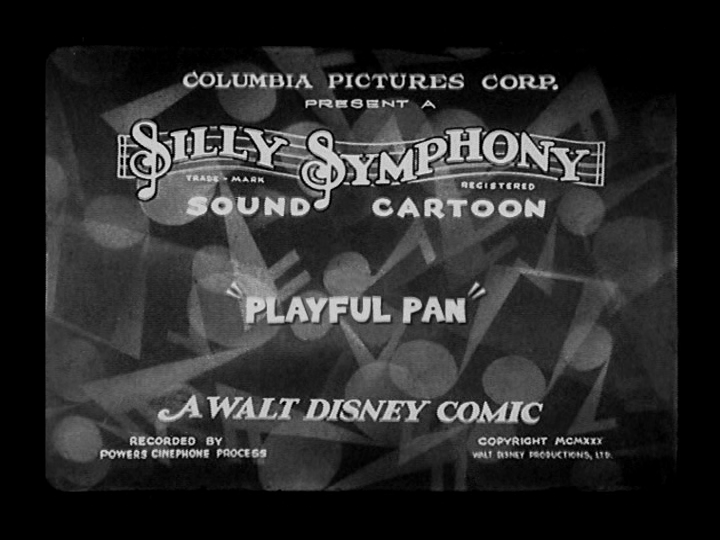
December 27, 1930 – The Silly Symphony Playful Pan is Released to Theaters

vlcsnap-2013-12-27-22h01m45s237

On December 27, 1930, the Silly Symphony Playful Pan was released to theaters. The short was based on the Greek mythological character Pan, the god of the wild. It was directed by Burt Gillett.

The short begins with Pan playing his pipes on a rock in a pond, with the fish dancing around to the melody. The fish follow Pan as he frolics across the pond on rocks and logs. As he lands on the other side of the bank, the flowers begin dancing to his melody. Pan gets all the flowers nearby to participate in the music-making before getting the bugs nearby to dance to the music. The trees and the clouds start dancing as well, with the clouds creating lightning from their moves. Unfortunately, one bolt of lightning cuts down a tree and accidentally starts a fire in the forest. All of the animals scurry away to avoid the flames, and several trees are destroyed by the flames. The animals work together to save each other and try and put out the flames. A raccoon finds Pan and explains the problem, and Pan hurries to find half of the forest in flames. He attempts to manipulate the fire with his pan pipe music, acting as a pied piper to lead them to the pond, where the flames are quickly put out. After relieving the forest of the fire, Pan disappears.