RSS Feed

Category Archives: Uncategorized

April 4

April4, 1944 – Snow White and the Seven Dwarfs is Reissued to Theaters
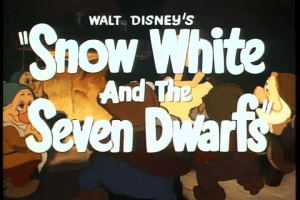
vlcsnap-2016-04-04-18h50m34s132

Snow White and the Seven Dwarfs is more than a great picture, it’s an experience in happiness.”

On April 4, 1944, Disney’s first full-length animated feature film Snow White and the Seven Dwarfs was reissued to theaters for the first time. Almost seven years after its first release, the rerelease was a gamble taken by the studios as they tried to make some money during the war years. Pinocchio and Fantasia had not been as financially successful as Walt Disney had hoped, though Dumbo managed to be another smash for the studio; unfortunately, shortly after its release was the attack on Pearl Harbor, and the entrance of the United States into World War II. The loss of the European markets hurt the Disney Studios deeply, with the war instructionals and propaganda films not providing enough income to keep the studios in business. The film has since been reissued seven times since.
April 3

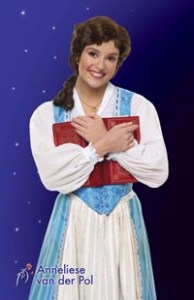
April 3, 2007 – Anneliese van der Pol Take the Stage as Belle in Beauty and the Beast

AVDP_Belle

“It’s so exciting not only to be making my Broadway debut in this fabulous show, but to also have the honor of being the last person to play Belle on Broadway.”

On April 3, 2007, Disney Channel star Anneliese van der Pol took the stage as Belle in the Broadway production Beauty and the Beast. Van der Pol would be the final Belle in this production, as the Broadway run was scheduled to end on July 29 after almost 5,500 performances. A star of Disney Channel’s Original Series That’s So Raven, van der Pol was also chosen for her numerous theater credits, including California productions of Evita, Oklahoma!, and The Nutcracker. This role was her Broadway debut, and she is the second former Disney star to play the role after Christy Carlson Romano.

April 2

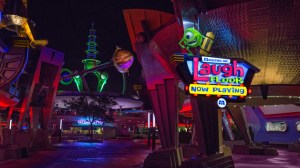
April 2, 2007 – The Monsters, Inc. Laugh Floor Attraction Opens in Walt Disney World

MonstersIncLF

“Discover the power of laughter from the original Monsters of Comedy during a hilarious interactive show.”

On April 2, 2007, the interactive attraction Monsters, Inc. Laugh Floor opened in Walt Disney World’s Tomorrowland area. The attraction, featuring characters from the Pixar films Monsters, Inc. and Monsters University, takes guests into a comedy club in the heart of Monstropolis, where character Mike has duties as the M.C. Guests are implored to laugh at the jokes in order to build up enough power to open the doors at the end of the show. Using special technology, the comedians interact with the audience, including choosing one audience member to be “that guy,” the butt of every joke. While waiting for the show to begin, guests are also asked to provide their own jokes through text messages that may be used during one of the show’s acts.

April 1

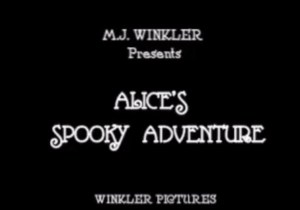
April 1, 1924 – The Alice Comedy Alice’s Spooky Adventure is Released to Theaters

ASA

“You knocked it in there— now go get it—

On April 1, 1924, the Alice Comedy Alice’s Spooky Adventure premiered in theaters. It was the third Alice Comedy created, and starred Virginia Davis as Alice.

The short begins with Alice and the gang accidentally hitting a baseball through a nearby window. However, the boys refuse to retrieve it because they think the house is haunted, which leaves Alice as the lone volunteer. She heads inside and looks for the baseball, and sees a moving box instead. However, she is relieved to see that it’s only a cat. She is startled by something else and falls backwards, with several items and a sheet falling on her head. She then wakes in the cartoon world, where ghosts are haunting all the houses and items are flying through the air. She hears a cry for help from a ghost, which, when she pulls off the sheet, is revealed to be her friend Julius. The pair then hear some nearby music and start to dance before heading over to the Spookville Open Air Concert. Ghosts are dancing and having fun at the gathering, though Julius finds himself in trouble when he interrupts a mahjong game. Alice knocks the ghosts out to save Julius, and the two celebrate, with Julius declaring his love for Alice. Meanwhile, Alice wakes up back in the real world, and heads out of the house with the baseball, but is caught by a cop, who locks her up in a cell for trespassing.

March 31

March 31, 2001 – The Animal Kingdom Lodge Opens for Annual Passholders

DAKL

“Step into the heart of Africa at this magnificent Resort hotel.”

On March 31, 2001, Disney’s Animal Kingdom Lodge opened for a special open house exclusively for Walt Disney World Annual Passholders, weeks before its official opening on April 16. The hotel, as do many other attractions and resorts, has an intriguing backstory: the lodge is based on a traditional African kraal, and was built on the top of an extinct volcano. Keeping with the theme of the park, the resort has many animals inhabiting the nearby savannah plains, including wildebeest and giraffes. The hotel has almost 1,300 rooms in six stories, and three restaurants: Jiko, Boma, and Mara.

March 30

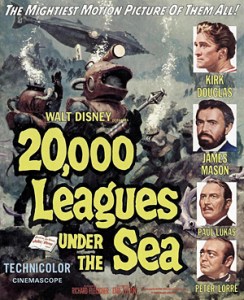
March 30, 1955 – 20,000 Leagues Under the Sea Wins Two Academy Awards

20000 Leagues

“Got a whale of a tale to tell you, lads, a whale of a tale or two…”

On March 30, 1955, the 27th Academy Awards were held at the RKO Pantages Theatre in Hollywood, California, as well as the NBC Century Theatre in New York City. Nominated for three awards, the live-action feature film 20,000 Leagues Under the Sea manages to walk away with two: Best Art Direction – Color (awarded to John Meehan and Emile Kuri), and Best Special Effects (awarded to John Hench and Joshua Meador). Walt himself managed to win an Academy Award for the Best Documentary Feature for the True-Life Adventure The Vanishing Prairie.

March 29

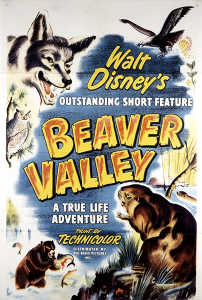
March 29, 1951 – The True-Life Adventure In Beaver Valley Wins an Academy Award

Beaver Valley

“The close call with the coyote has failed to shake our young beaver’s stubborn resolve.”

On March 29, 1951, the 23rd Academy Awards were held at the RKO Pantages Theatre in Hollywood, California. The True-Life Adventure In Beaver Valley (also known as simply Beaver Valley), scored Walt Disney Productions the Academy Award for Best Short Subject (Two-Reel), Disney’s only win this ceremony. It was the second of five eventual wins for the studio in this category. The featurette focused on a beaver as he lived his life in a pond area, and his interactions with other kinds of animals, including a moose, deer, and raccoons. The featurette would also go on to win the Golden Bear for documentaries at the 1st Berlin International Film Festival.

March 28

March 28, 1941 – The Pluto Short Film A Gentleman’s Gentleman is Released to Theaters

vlcsnap-2016-03-28-18h15m19s336

“Now, my good man, run to the corner and get me the Sunday paper. Here’s a dime; now, be careful and don’t lose it.”

On March 28, 1941, the Pluto short film A Gentleman’s Gentleman premiered in theaters. It was originally released under the Mickey Mouse short line, but has since been regarded as a Pluto short film. It was directed by Clyde Geronimi.

It’s an early Sunday morning, and Pluto brings in Mickey’s breakfast on a tray, as if he were Mickey’s butler. He pours him coffee, and Mickey gives him a dime to go get the Sunday paper, warning him not to lose it. Pluto gingerly takes the dime and rushes off, but starts flipping it with his tongue as soon as he gets outside. He loses the catch and watches as the dime rolls away before landing on its side. As he goes to pick it up with his teeth, he is unable to grab it, and it ends up eventually landing in a sewer grate. Pluto tries to grab it, but his leg is too short to reach it, as is his tail. He cries as he realizes how hopeless the situation is, but is soon relieved when he spies a gum machine. He manages to steal a gumball from the machine, and attaches the chewed gum to his tail to grab onto the dime. He retrieves the dime and grabs the paper. As he heads home, he hears the praise from nearby customers, but trips when trying to show off. As he collects the paper, he spies a comic, starring him, on the front page, and stops to read. Unfortunately, he doesn’t notice the wind that has swept his paper away, and starts chasing after the individual pages. He manages to find them all in a mud puddle, and comes home with a mud covered paper and a disappointed Mickey, who laughs at Pluto when he starts to cry again.

March 27

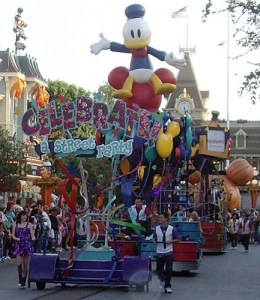
March 27, 2009 – The Celebrate! A Street Party Parade Begins in Disneyland

Celebrate“In everything you do, celebrate you!”

On March 27, 2009, the Celebrate! A Street Party daytime parade began its run in Disneyland. The parade, added for the “What Will You Celebrate” festivities of 2009, started from the it’s a small world attraction and wandered down toward Main Street. There were three special “celebration zones” for guests to be in where the parade would stop and entertain guests with a special dance to the songs chosen for the show. Songs included “I Love Rock and Roll,” “I Wanna Be Like You,” and “Friend Like Me,” as well as an original son g for the show, “Celebrate You,” played at the end of the show. Several Disney characters were on hand for the parade, including a special appearance of Chip and Dale’s paramour, Clarice.

March 26

March 26, 1907 – Composer and Disney Legend Leigh Harline is Born

Leigh Harline

“[Harline’s songs] seemed like symphonic writing by a good classical composer.” – Director Wilfred Jackson

On March 26, 1907, Leigh Harline was born to a large family in Salt Lake City. After majoring in music at the University of Utah, he moved to California in 1928 to work as a composer, conductor, arranger, instrumentalist, singer, and announcer for various radio stations. He joined the Disney Studios in 1932, and quickly set to work writing music for the Silly Symphony series. After acknowledging the innovative ways of using music to tell the story, Walt Disney gave Harline the plum role of scoring the studio’s first full-length animated feature film, Snow White and the Seven Dwarfs, alongside fellow Disney Legend Frank Churchill. Harline and Churchill’s work on the film scored them an Oscar nomination for Best Music and Score. Afterwards, he was asked to work on Pinocchio, which scored him two Oscars: Best Music and Original Score, and Best Song for the classic “When You Wish Upon a Star.” He left in 1941 to work at several other studios as a freelance composer, and racked up eight additional Oscar nominations throughout his career. In the 1960s, Harline added television scoring to his repertoire, scoring for several popular series, such as Daniel Boone, featuring another Disney Legend, Fess Parker. On December 10, 1969, Harline passed away in Long Beach, California. For his work on early Disney shorts, and for creating one of the most iconic songs from the studio, he was inducted as a Disney Legend in 2001.