RSS Feed

Tag Archives: Black and white

January 16

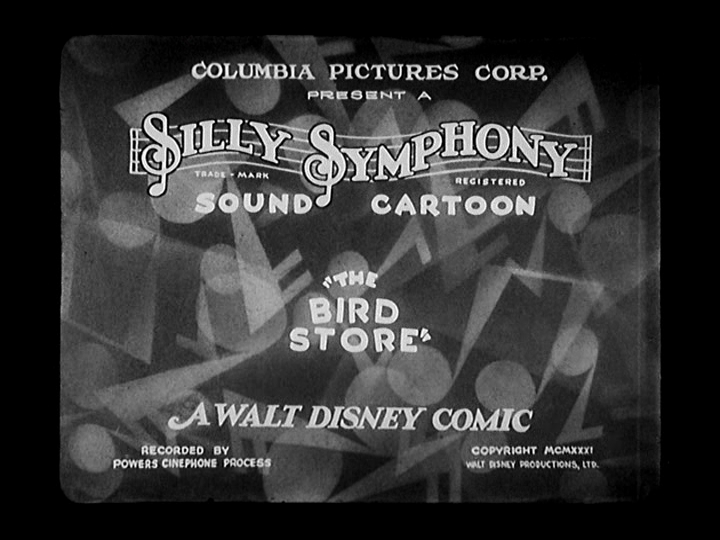
January 16, 1932 – The Silly Symphony The Bird Store is Released to Theaters

vlcsnap-2015-01-16-19h17m08s173

On January 16, 1932, the Silly Symphony The Bird Store was released to theaters. It was directed by Wilfred Jackson. Caricatures of the Marx Brothers are also found in this short film

The short begins with the birds in the store all chirping at once, but slowly turning into a beautiful melody by two canaries. Other birds are seen singing in their own ways, including two sets of doves that find their mates flirting with others. A parrot chases a flea to a typewriter, and flicks it away, but scares itself in the process and runs into the phone. Outside the window of the shop, a hungry cat licks its lips, watching as a baby canary is taught how to sign by its parents. While celebrating, the baby falls out into a bag of seed, and does not see the cat enter the shop and attack. All the birds in the shop notice the attack, and in an attempt to save the baby, they all spring into action, using a blowtorch to trap the cat in a cage. They then send his cage flying so he lands in the city dog pound after reuniting the baby with its parents.

December 4

December 4, 1957 – The Disneyland Anthology Episode “Mars and Beyond” Airs

vlcsnap-2014-12-04-16h08m50s13

“In this exciting age when everyone seems to be talking about the future possibilities of space travel, there’s much speculation on what we will discover when we visit other worlds.”

On December 4, 1957, the Disneyland Anthology episode “Mars and Beyond” aired on television. The episode features several well-known technical advisors, including Dr. Ernst Stuhlinger, Dr. E. C. Silpher, and Dr. Wernher von Braun, as they explore the possibilities should man travel to Mars. The episode was later released a featurette in theaters on December 26, 1957, and portions of the film were reedited into a short film called Cosmic Capers, released in England in 1979. The short features several different styles of animation, ranging from the humorous to the more serious. The voices in the animated sequence are all done by Disney veteran Paul Frees. This episode was directed by Ward Kimball, with story by Kimball, William Bosche, John Dunn, Charles Downs, and Con Pederson.

The episode begins with a robot named Garco introducing Walt to the television audience. Walt poses the question of what we will find when we start traveling to other planets. It then goes into the story of man, with each passing age speculating and wondering about their existence and the nature of the world around them. It then explains the process of man’s thoughts and knowledge of the stars movement around the world, leading into a dark world of superstition and stupidity. In the time of the Renaissance, Copernicus came along to prove mathematically that the sun was the center of the universe, not the Earth as was believed. Galileo then proved that the planets were not just specks of light, but spheres just like the Earth. Soon after, people start speculating what life is like on other planets. One of the first to describe the supposed inhabitants of other planets was Bernard de Fontanelle, a Romantic poet. In the 19th century, many people chose Mars as the planet most likely to have inhabitants, as they believed they saw specks of light and interpreted them to be signals to Earth. Several books are written about people meeting Martians, each more fantastical than the previous. At the time of this episode, an eager public is more than willing to read stories about life on other planets, usually with the same formula.

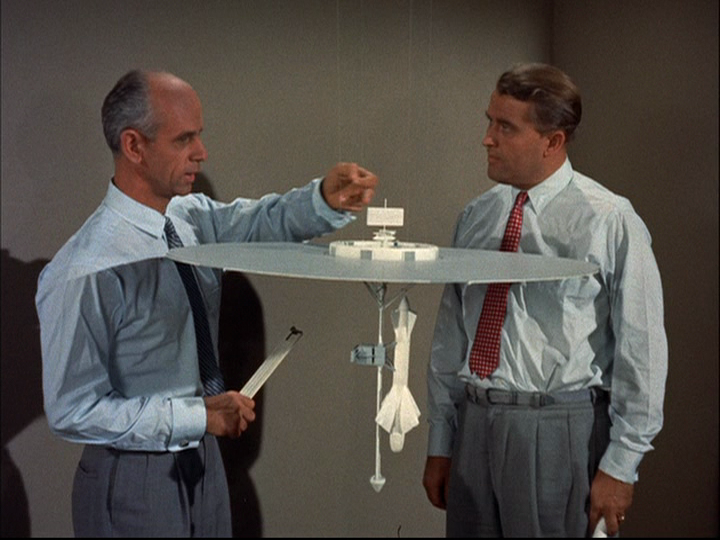
The episode explores possible space travel, with assistance from two well-known scientists

The episode explores possible space travel, with assistance from two well-known scientists

The story then goes to the discussion about other universes, with the Milky Way being one of billions. To give the example about how evolution may be occurring across other planets, the audience is lead into the story of the creation of our own universe, beginning with the Big Bang. The planets are also compared to Earth, and how man would die on each planet, save for the golden zone of Venus, Mars, and the Earth, where it would be possible for man to live. If man were to journey to Mars, life might just be possible, providing that the right resources are provided to sustain life. Mars has always captured the interest of astronomers, and the episode explores the history of the interest of Mars, with the study of the planets’ surface. Dr. E. C. Slipher, a senior astronomer who had worked at the Lowell Observatory in Arizona for over fifty years, is interviewed about potential life on Mars. He explains the facts that astronomers accept, including the size of Mars being half the size of Earth. He introduces a spectrograph, which can help interpret the atmosphere of Mars, and a thermocouple, which can interpret the temperature of Mars. However, photographic evidence of the canals on Mars cannot be obtained due to the Earth’s atmosphere blurring the photo. Although a small amount of information that has been collected, it isn’t enough for astronomers to draw any definite conclusions about Mars, including the conclusion about life on Mars. However, many scientist speculate what life would be like should there be any slight changes to the conditions on the planet. The final part of the program focuses on the possibility of travel to Mars from Earth. Dr. Ernst Stuhlinger and Dr. Wernher von Braun have been working together to create a special atomic type of spaceship that would be able to travel outside the gravitational pull of Earth without using a ton of chemical fuel, with the parts of the spaceship assembled in space after being brought up by conventional rockets. A small atomic reactor will continue to provide heat to power a turbogenerator. A plan is explained for the trip to Mars, which will take a little over 13 months to accomplish, and six ships will be used for the entire expedition.

November 17

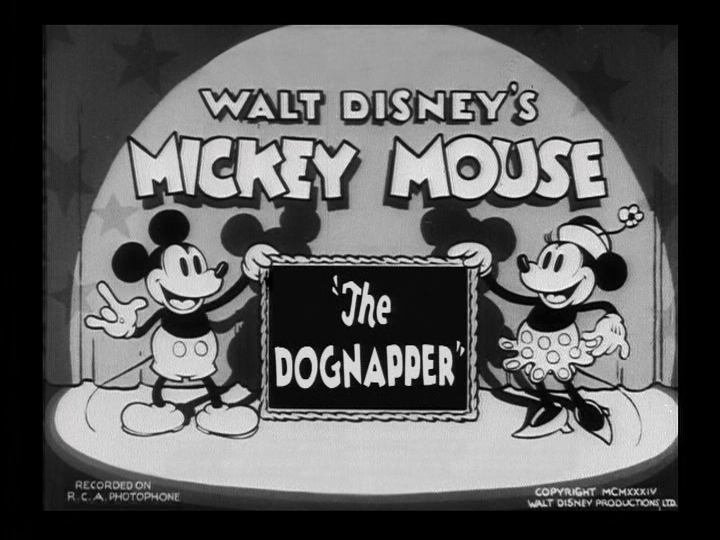
November 17, 1934 – The Mickey Mouse Short Film The Dognapper is Released to Theaters

vlcsnap-2014-11-17-18h12m43s207

“Careful boys, he’s got blood in his eyes and shoots to kill!”

On November 17, 1934, the Mickey Mouse short film The Dognapper was released to theaters. It was directed by Dave Hand.

The short opens with a newspaper declaring that Minnie’s prize pooch Fifi has been stolen by Peg Leg Pete. An announcement goes out to Officers Mickey and Donald, and while Donald is scared of the description of Pete, they soon decide to pursue him when they see him racing down the road. However, their motorcycle is less than ideal, and poor Donald almost gets left behind. There’s a shootout on the road as they follow Pete. Pete destroys the bridge, but the boys are able to drive on the rails and keep up the chase. Pete headst o his hideout at the Glutz Sawmill, and while Mickey and Donald are able to find their way in, Pete has already chained up Fifi and has his machine gun at the ready. Mickey quickly finds him, but is knocked into a barrel by Donald. Donald orders him to put his hands up, but Pete pulls out a bigger gun on Donald, and sends Donald flying into the wall. Mickey, with the help of Fifi, manages to capture Pete, but Donald once again stops Mickey from capturing the villain. However, the two are finally able to thwart him using the tools available in the sawmill, until Pete starts the saw, nearly chopping the pair in two. The saw breaks and is sent flying after Pete at a wild speed, and he runs wildly around the mill, but is sent flying when the saw attaches to his foot. Donald and Mickey use a girdle to capture Pete and return home with Fifi as heroes.

October 30

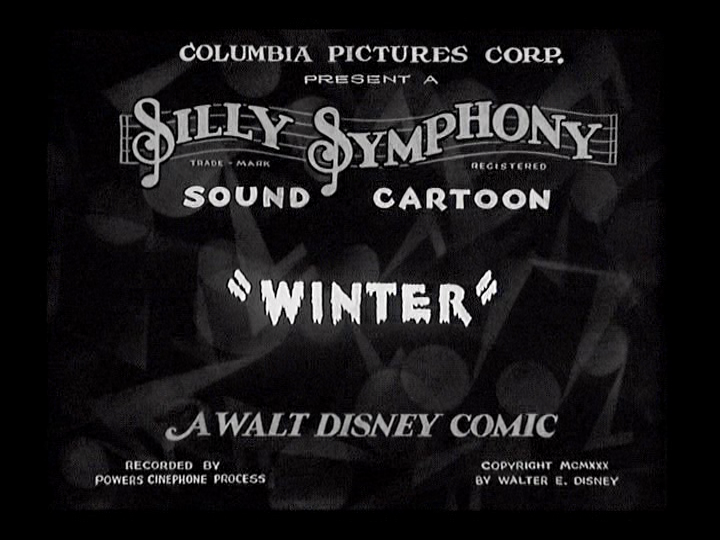
October 30, 1930 – The Silly Symphony Winter is Released to Theaters

vlcsnap-2014-10-30-20h50m53s70

On October 30, 1930, the Silly Symphony Winter was released to theaters. It was the last of a series of shorts dedicated to the seasons. It was directed by Burt Gillett.

It’s a blustery winter’s night, and a wolf howls into the wind. Three bears are sleeping under a giant rock formation, and the trees dance while the snow falls around them. A quartet of birds sing as they are perched on a reindeer’s antlers, and fly away as the reindeer gets up to go ice skating. Several other woodland creatures appear to dance in the snow, and one cub starts playing pranks on a sleeping bear. Unfortunately, the bear wakes up, but then starts to dance himself. A moose joins in the fun, braying loudly before joining a group of animals that are waiting for the Weather Prophet, Mr. Groundhog, to emerge from his house. He finally steps outside, covering his eyes, and looks around, unable to see his shadow. The animals dance at this news, when the sun suddenly shines, and the groundhog is spooked by his shadow. The shadow disappears once the sun is hidden by the clouds again, and another large storm brews, sending all the animals back to their homes as fast as can be.

October 24

October 24, 1929 – The Silly Symphony Springtime is Released to Theaters

vlcsnap-2014-10-24-19h18m03s121

On October 24, 1929, the Silly Symphony Springtime was released to theaters. It was the first in a series of Silly Symphonies about the seasons, followed by Summer (January 16, 1930), Autumn (February 15, 1930), and Winter (October 30, 1930). Springtime was directed by Walt Disney.

The flowers, trees, and bugs are all dancing around, enjoying the fair spring weather. A crow comes along and eats a dancing caterpillar, dancing away itself back to its nest, where his sweetheart is waiting. Her babies hatch and start dancing around the nest. Suddenly, a large storm develops, and one tree is seen taking a bath in the rain when he is struck by lightning. The storm quickly passes, and two grasshoppers are seen playing leapfrog when they are eaten by a frog. The frog jumps from lily pad to lily pad, with another frog playing a tune on the backs of turtles. A spider jumps down from his web and dances on a nearby log before using his web as a harp. Three frogs begin dancing on a log, croaking with the music, when a nearby crane spies them and stalks its way over. It attempts to eat the frogs, when they jump inside each other like nesting dolls and flee, but the crane eats them all and jumps away happily, although he falls into a large puddle, splashing water onto the screen.

October 23

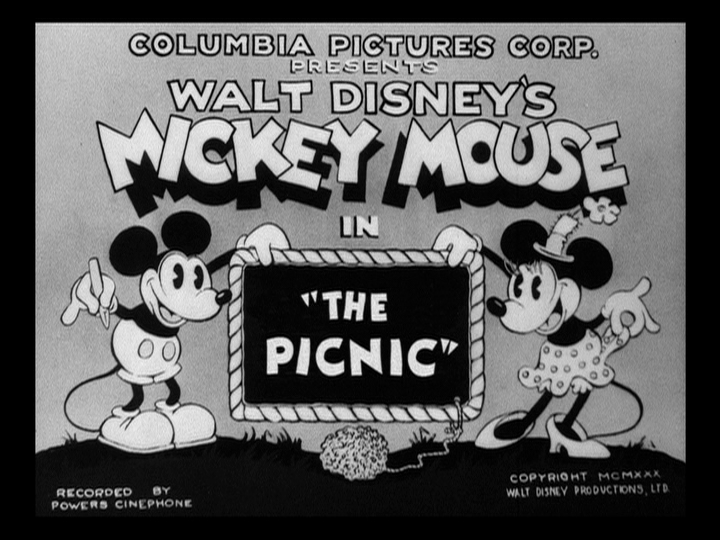
October 23, 1930 – The Mickey Mouse Short Film The Picnic Premieres in Theaters

vlcsnap-2014-10-23-18h33m42s30

“Sure, you can bring your Little Rover.”

On October 23, 1930, the Mickey Mouse short film The Picnic premiered in theaters. It features a dog that looks like Pluto, playing the part of Little Rover; Pluto would not become Pluto until the 1931 short film The Moose Hunt. The Picnic was directed by Burt Gillett.

Mickey is driving to Minnie’s whistling “Minnie’s Yoo Hoo” as he goes. Minnie calls out to him when he arrives, and calls out for her dog “Little Rover,” who is a rather large dog and jumps on Mickey upon seeing him. Mickey ties him to the back of the car, and they all head off to their picnic. Little Rover decides he’d rather chase after some rabbits and pulls the car with him as he pursues them. As he runs off, Mickey and Minnie decide to set up their picnic near a creek, and Mickey starts up the Victrola before asking Minnie to dance to “In the Good Ol’ Summertime.” Many animals also decide to dance to the music while stealing the picnic food, with Mickey and Minnie unaware as they continue to dance. Little Rover continues to search for the rabbits, and before they all know it, a large storm arrives. Mickey packs up what little remains of the picnic and heads to the car, driving as best he can in the rain. He has Little Rover act as a windshield wiper while he continues to drive,

October 1

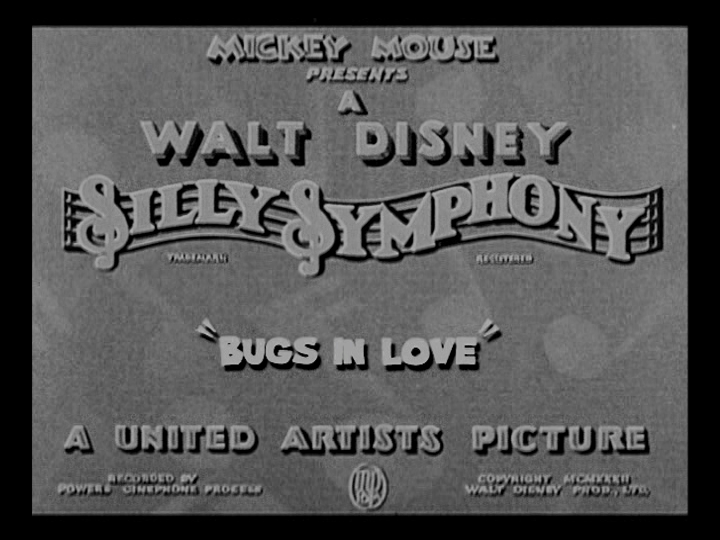
October 1, 1932 – The Silly Symphony Bugs in Love is Released to Theaters

vlcsnap-2014-10-01-07h34m14s34

On October 1, 1932, the Silly Symphony Bugs in Love was released to theaters. It was directed by Burt Gillett.

There’s a small fair set up for the bugs of the dump, and they are enjoying themselves on several rides created through pieces of trash. A band plays music using safety pins, and a mirror is used for a skating rink, with talcum powder being used for snow. Two bugs are skating on their own private rink, sharing a kiss. The girl heads home and the boy calls for her, drawing a heart for her on a nearby box. A crow spots the pair and eyes them hungrily. The two bugs profess their love for each other, and the crow breaks through the box and starts chasing after them, laughing maniacally. He chases the girl into her house and trashes the place after trapping the boy in a bottle. The boy manages to break out and grabs an arrow from an old clock to attack the crow. A passerby notices the danger and sounds the alarm, alerting all the bugs to the crow’s appearance, and they grab whatever weapons they can to attack the crow. They cover the crow in paste and ink, and bite him with an old pair of dentures before attacking him with a whisk and a mousetrap. They catch him in an old shoe and force him to drink castor oil. Finally out of danger, the girl bug and boy bug reunite, sharing a kiss as everyone watches.

September 29

September 29, 1934 – The Mickey Mouse Short Film Mickey Plays Papa is Released to Theaters

vlcsnap-2014-09-29-19h05m16s168

“The clock struck twelve. A mysterious figure prowled about. It was a perfect night for a murder.”

On September 29, 1934, the Mickey Mouse short film Mickey Plays Papa was released to theaters. An edited version of this short was shown on the Mickey Mouse Club in the 1950s, only with Mickey edited out, and retitled Pluto and the Baby. The short was directed by Burt Gillett.

On a windy night, just as the bell tolls midnight, a mysterious figure approaches Mickey’s house. They spy on him reading The Cry in the Night, with him unknowingly describing the scene outside his window. The figure leaves a basket on Mickey’s doorstep, with a baby fast asleep inside, and pins a note: Please give little Elmer a good home He ain’t much trouble Thanks. The figure cries as they give baby Elmer up, and as Mickey reads the part about the murder in his book, they hear a loud scream from the porch. They carefully make their way to the door, but are startled silly from the book at the shaking caused by the wind. The baby and the basket are blown inside, and Mickey carefully takes the baby into his arms. He and Pluto are happy to see baby Elmer, but soon are clueless when it comes to stopping his cries. Mickey decides to cheer Elmer up with his Charlie Chaplin impression, which doesn’t impress Elmer. Mickey finally realizes that Elmer is hungry, and Pluto offers Elmer his bone, which the baby throws back at Pluto’s nose. Pluto then performs a few tricks of his own, but can’t stop the baby from crying. Pluto then gets distracted by a wind-up duck toy, and destroys it after it runs into him.

Mickey ends up getting the top of the bottle stuck on his nose as he prepares Elmer's bottle

Mickey ends up getting the top of the bottle stuck on his nose as he prepares Elmer’s bottle

Mickey finishes making Elmer a bottle, only to get the top stuck on his nose. When he tries to remove it using a drawer, the drawer and all the sharp contents fly out and trap Mickey against the wall. Pluto, meanwhile, accidentally swallows a jumping rabbit toy, and when he hits the pump, the rabbit jumps inside, causing Pluto to fly into the air. As he jumps about, trying to free himself from the toy, he knocks over a table, which knocks the toy out of him, but a fishbowl lands on his behind, and the fish begins to bite him. He is able to free himself after trapping himself in a trunk. Mickey is finally successful in pulling off the top of the bottle, but his nose is elongated in the process. Elmer finally laughs at Mickey’s appearance, and Mickey does an impression of screen actor Jimmy Durante.

September 26

September 26, 1930 – The Silly Symphony Monkey Melodies is Released to Theaters

vlcsnap-2014-09-26-05h32m41s53

On September 26, 1930, the Silly Symphony Monkey Melodies was released to theaters. It was directed by Burt Gillett.

The short begins with monkeys dancing and swinging on vines, with all different kinds moving in their own way. Three chimps start singing and dancing in unison, entertaining the group of chimps on the branch above. A couple of parrots mimic the chimps, dancing hard enough to cause the coconuts above them to fall on their heads. One monkey starts picking the flowers from a nearby tree, and brings them to his sweetheart, and the two shyly interact before dancing together and sharing kisses. He hten starts feeding her bananas, before the two chase each other across the jungle, landing on a log in a river. Further down the river, several large crocodiles have taken up the melody and are dancing. The monkeys continue to sail down the river, unaware of the crocodiles, and not noticing one chasing after them. The crocodile catches up with them and taunts them, but the pair manages to escape before he can chomp down. After the crocodile, they run into a hippo, a snake, and a leopard. Fortunately, they are able to get away from those dangers, and end the short with a kiss.

September 11

September 11, 1957 – The Disney Anthology Episode “The Fourth Anniversary Show” Premieres
vlcsnap-2014-09-11-18h59m34s10

“I remember how his fingers flew over the keys of our battered, old piano, how his face glistened with perspiration as he concentrated on the music, and all the time I could see pictures; I could see his lovely fantasy coming to life on the screen.”

On September 11, 1957, the Disney Anthology episode “The Fourth Anniversary Show” premiered on ABC. Celebrating four years on the air, the episode shows some upcoming projects for the studios, and a stylized flashback sequence. The show also features proposed scenes for a film called The Rainbow Road to Oz, which would have been an adaptation of one of Frank L. Baum’s Oz stories, which Disney owned the rights to; this film was never made. The episode was directed by Sidney Miller and Hamilton S. Luske. It starred the Mouseketeers, Fess Parker, Jerome Courtland, Guy Williams, and Walt Disney as himself and as the voice of Mickey Mouse.

The episode begins with Walt attempting to play “Peter and the Wolf” on the piano. He reflects on how the piano in front of him played an important part in one of the many adventures at the studio, when Sergei Prokofiev came to the studio to work with the animators on a segment. The audience is then taken back in time to a storyboarding meeting in 1938, when the studio was hard at work on Fantasia and Pinocchio. Walt gets a call from Rudy Polk, VP of a talent agency, who tells him that an important composer wants to talk to Walt, and that Prokofiev had Disney in mind when he wrote Peter and the Wolf. Walt agrees, and they work together in a small little studio, although Prokofiev spoke very little English, and Walt spoke no Russian. Polk explains the piece to Walt while Prokofiev plays, and Walt listens intently. Unfortunately, although Walt wanted to work on the story, WWII put a wrench in any non-military stories and films. After the war, they went back to “Peter and the Wolf,” which was one of the first post-war projects. The short subject film is then presented.

Walt is kidnapped by the Mouseketeers and given a surprise anniversary party

Walt is kidnapped by the Mouseketeers and given a surprise anniversary party

After the short, Walt is about to go into an introduction of more classical music in Disney films, when Mouseketeer Cubby shows up at his office door. Walt introduces him, but tells him that they will talk later. He tries to go back to his introduction, but turns to find Cubby still at the door. Walt explains that he’s talking to the Disneyland audience, but Cubby interprets this as an okay to enter, and tells the other Mouseketeers that Walt’s “just sitting on the desk talking.” The Mouseketeers enter and start jabbering away, when Walt tells them to hold on for a second. He then introduces them: Annette, Bobby, Darlene, Karen, and of course, Cubby. They drag him to the Mouseketeer stage, where they surprise him with a party celebrating the anniversary of the Disneyland show. They put on a special show for him about everything they’d seen on the Disneyland television show, and ask him what’s in store for the next year. He answers that there’s more Donald and Goofy adventures, more global adventures, and a new character – Andy Burnett – explained by Fess Parker, with scenes from the new miniseries starring Jerome Courtland. Courtland then serenades the Mousketeers with a new song from the series called “Ladies in the Sky.”

After this, Walt gives a brief overview of what’s next, although Moochie keeps asking about Zorro. He then explains that Zorro will no longer be on Disneyland, but will be its own series. When Moochie asks if Zorro was real, Walt explains that Zorro was a mythical feature, but it soon interrupted by Zorro himself, and soon has a sword fight with a shadowy figure. Zorro, of course, wins, and makes the sign of the Z before he disappears. Walt then decides to leave, and the kids give him a present: a shooting script of the film The Rainbow Road to Oz. The Mousketeers volunteer to take over all the preparations for the film, and who off the characters in their story. They show a scene where the character of the Patchwork Girl (played by Doreen) meets the Scarecrow (played by Bobby) for the first time. Another segment plays, with Darleen singing a song called the “Oz-Can Hop.” Walt agrees to make the film, and then the Mousketeers present another song with a large anniversary cake. Mickey then makes a surprise appearance at the end, noting that the Mousketeers are a great bunch of kids, with which Walt agrees.