RSS Feed

Tag Archives: Animated Feature Film

October 21

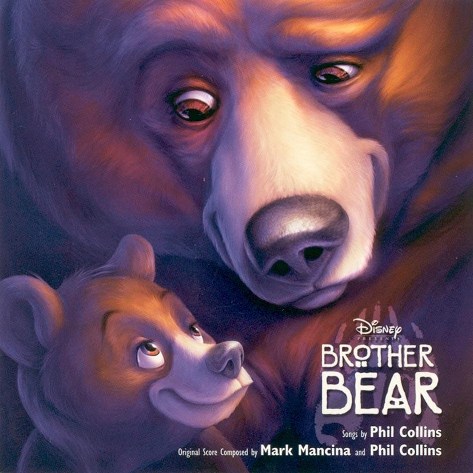
October 21, 2003 – The Soundtrack to the Animated Feature Brother Bear is Released Through Walt Disney Records

Brother Bear Soundtrack

“Tell everybody I’m on my way, new friends and places to see…”

On October 21, 2003, the soundtrack to Disney’s 44th Animated Feature Brother Bear was released to theaters. The soundtrack featured a score by Mark Mancina and Phil Collins, and original songs by Collins. Besides Collins, the album features performances by Tina Turner, The Blind Boys of Alabama, Oren Waters, The Blind Boys of Alabama, Oren Waters, and the Bulgarian Women’s Choir. One song, “Welcome,” was used as the theme song for the Disneyland parade Walt Disney’s Parade of Dreams. The album peaked at number 52 on the Billboard 200, while the song “Look Through My Eyes” charted at the number 5 position on the Adult Contemporary chart.

October 7

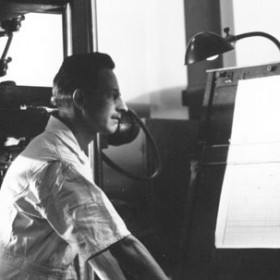
October 7, 1918 – Film Editor and Disney Legend Norman “Stormy” Palmer is Born

Norman Palmer

“Stormy was one of the key players in creating the classic Disney True-Life Adventures series, and he was a true pioneer in the field of nature documentaries.”- Producer and Creative Director Dave Bossert

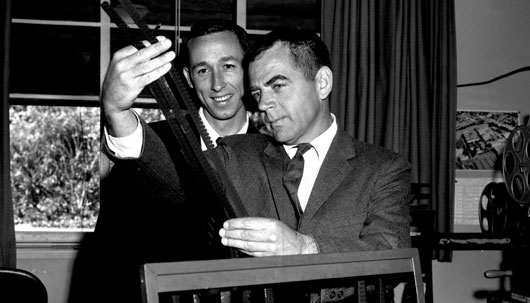
On October 7, 1918, Norman Palmer was born in Santa Ana, California. After graduating from Hollywood High School in 1937, he applied to the Walt Disney Studios, joining as a projectionist in 1938. Soon after he arrived, Palmer was transferred to the editorial department. His early career was cut short by the onset of World War II, when he joined the Field Photographic Branch of the Office of Strategic Services in Washington D.C., editing films. He was soon sent overseas, taking aerial photos over Europe. After the war, Palmer came back to Disney, where he continued editing films, including Melody Time and Make Mine Music. When the studio stared working on the True-Life Adventure series, Palmer was brought in to edit the films, including Academy Award winning The Living Desert and White Wilderness. It was Palmer’s special skill with editing and attention to detail that brought attention to these nature documentaries. Palmer also brought his editing skills to several Disney television series. After 45 years with the company, Palmer retired in 1983. He was inducted as a Disney Legend in 1998. Palmer passed away in 2013 at the age of 94.

September 27

September 27, 2003 – The Animation Art of Ron Clements Exhibit Opens at the Sioux City Arts Center

“I think kids who spend more time by themselves, they tend to use their imaginations more. I wrote stories and drew characters and did things like that.”

On September 27, 2003, the Sioux City Arts Center in Sioux City, Iowa, held its opening night reception for its newest exhibit “The Animation Art of Ron Clements.” The exhibit honored Disney animator and film director Ron Clements, and focused on his (at the time) five main films that he co-directed with John Musker: The Great Mouse Detective, The Little Mermaid, Aladdin, Hercules, and Treasure Planet. The stories of these five films are told through storyboards, cels, and sketches.

September 19

September 19, 1989 – Snow White and the Seven Dwarfs is Inducted in the National Film Registry

NationalFilmRegistry

“The National Film Registry selects 25 films each year showcasing the range and diversity of American film heritage to increase awareness for its preservation.”

On September 19, 1989, the first 25 films to be inducted in the Library of Congress’ National Film Registry. The Registry, established the previous year thanks to the National Film Preservation Act, works to conserve works that establish America’s film heritage. The public nominated up to 1,000 films for inclusion, with Snow White and the Seven Dwarfs being the only animated narrative feature on the list. Several Disney and Pixar films have followed suit, including Fantasia in 1990, Pinocchio in 1994, Beauty and the Beast in 2002, Toy Story in 2005, and Bambi in 2011.

September 17

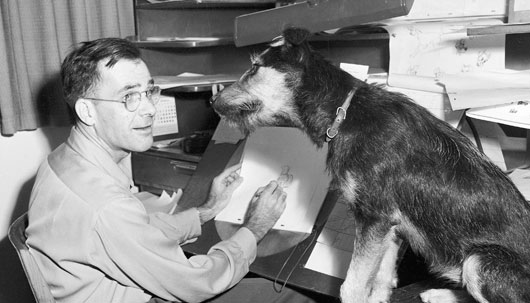
September 17, 1917 – Visual Effects Coordinator and Disney Legend Bob Broughton is Born

Bob Broughton

“If it looked like we doctored up a scene, we were a failure. Our effects weren’t supposed to be obvious.”

On September 17, 1917, Robert Broughton was born in Berkeley, California. A man of many talents, Broughton studied chemistry, physics, math, and optics at the University of California at Los Angeles. He joined the Disney Studios in 1937 in the mailroom, and quickly found his way to the camera department where his first major assignment was to shoot the test camera for Snow White and the Seven Dwarfs; his job ensured that the animated scenes flowed smoothly before the final production shot. Broughton was then moved to the multiplane camera, becoming one of only two operators for the complex machine. After moving to the special photographic effects department and assisting with the “Night on Bald Mountain” segment, Broughton found himself promoted to camera department supervisor. His work with the studio was interrupted by World War II, where he served in the Army as a cameraman for the Office of Strategic Services. His skills were used on an Oscar Award winning film about the Battle of Midway, and after the war, he returned to Disney to assist fellow Disney Legend Ub Iwerks. Broughton’s technical wizardry created magical effects for several animated and live-action films, and even for the Disney Anthology series. He continued to work on films until his retirement in 1982, and remained involved with the company through the Golden Ears Retirement Club for fifteen years. He was honored for his work in Disney film in 2001. In 2009, Broughton passed away at the age of 91.

September 5

September 5, 1912 – Animator, Member of Disney’s Nine Old Men, and Disney Legend Frank Thomas is Born

Frank Thomas

“Frank was a giant in our field and he meant everything to me and to all of us who love the art of animation. Besides being one of the key guys to help elevate animation from a novelty to an incredible art form, he was so generous in passing along his knowledge and experiences to the generations that followed.” – John Lasseter

On September 5, 1912, Franklin Rosborough Thomas was born in Fresno, California. Thomas knew from an early age that he wanted to be an artist, and in his sophomore year at Fresno State, his interest expanded into animated films. After graduating from Stanford University, he honed his craft at the Chouinard Art Institute in Los Angeles. After being told by a member of his rooming house that the Disney Studios had an opening, Thomas applied and joined on September 24, 1934 as employee number 224. His first assignment was the animated short film Mickey’s Elephant. In 1941, Thomas was picked to be part of a small goodwill tour of South America, which culminated in the animated feature films Saludos Amigos and The Three Caballeros. As a member of the Nine Old Men, Thomas served as a directing animator for several characters, as well as being well regarded for several of his animated sequences, including the dwarfs crying over Snow White’s body, and Bambi and Thumper’s ice skating scene. Thomas was also the pianist for the famed Disney Dixieland band Firehouse Five Plus Two. In 1978, Thomas retired from the Disney Studios, but still remained involved in the field of animation, co-writing several books with colleague and long-time friend Ollie Johnston, including one of the most important books in the study of animation: Disney Animation: The Illusion of Life. He, along with other members of the Nine Old Men, were honored as Disney Legends in 1989. In 2004, Thomas passed away at the age of 92.

September 3

September 3, 2001 – The Animated Series Disney’s The Legend of Tarzan Premieres

D_TLoT_1

“Come on! What’s more important than an afternoon of mindless frolicking with his old pals, huh?”

On September 3, 2001, the animated series Disney’s The Legend of Tarzan premiered on UPN and in syndication, as part of the Disney’s One Too programming block. The series was based on the characters from the Edgar Rice Burroughs series of Tarzan and the animated feature based on the books. It is set after the events of the film, where Tarzan succeeds Kerchak as the Lord of the Jungle. The series ran for 39 episodes in two seasons. The series was created by Disney Pictures Television, and starred Michael T. Weiss as Tarzan, Olivia d’Abo as Jane, April Winchell as Terk, Jim Cummings as Tantor, Suzanne Blakeslee as Kala, and Jeff Bennett as Professor Archimedes.

The first episode, “Tarzan and the Race Against Time,” begins with Tantor standing quietly in the jungle, talking to himself before he is startled by friend Terk. The two can’t find Tarzan, though they do find him swinging vines with his wife Jane, and Terk thinks that Tarzan has forgotten them in favor of Jane. Jane tries to show off, but Tarzan quickly saves her from falling to her doom. She continues to swing, and the two head back to the treehouse. Terk starts talking badly about Jane, and Tantor points out that Terk is jealous. Tarzan drops in, and as Terk starts to talk about Jane, Tarzan begins wrestling with Terk, just as they used to do. As they play, Terk gets caught in a hollow log and is pulled out, covered in spiders. Tarzan is bitten by one of the spiders, but brushes it off as nothing.

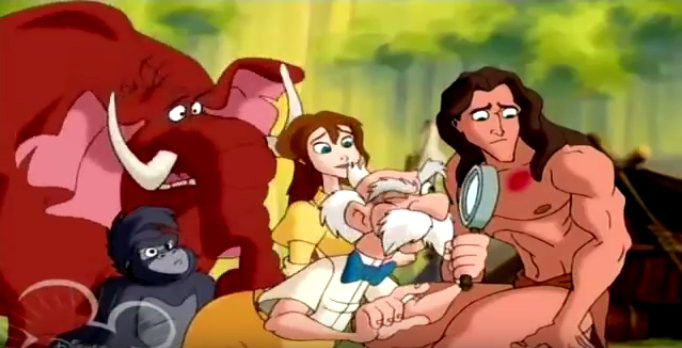
The Professor observes the mark left by the spider bite in front of a worried Jane, Tantor, and Terk

The Professor observes the mark left by the spider bite in front of a worried Jane, Tantor, and Terk

When he heads back to the treehouse, Jane sees the mark where he was bitten, and immediately calls her father to investigate. It turns out that the spider is quite poisonous, and there isn’t much time before Tarzan dies from the poison. The only antidote is in the root of the Mububu flower, which only grows at the top of a waterfall. Jane rushes off to get the flower, although Tarzan believes that he is fine. Against her wishes, Tarzan goes with her, as well as her father, Tantor, and Terk. Terk doesn’t believe there is anything wrong with Tarzan, and is more annoyed by Jane than anything. Terk continues to torment Jane, who constantly finds herself in dangerous situations. The group is attacked by a snake, and although Tarzan fights back, he is growing weaker thanks to the venom. Tarzan’s pride keeps him from accepting help from the others, and he quickly sets forth to get the others across the chasm, but falls when blurry vision keeps him from catching his vine. He lands in the lair of wild jackals, and barely has enough strength to ward them off. The group sets off to save Tarzan, managing to make it just in time.

Tarzan collapses after the attack, and Jane struggles up the ledge with Terk to retrieve the Mububu root. Tarzan has a hallucination that Tantor’s trunk is the earlier snake, and that Jane’s father is Clayton. When Jane and Terk reach the top of the waterfall, they find the flower in the middle of the raging waterfall. Jane has finally had enough of Terk’s berating, and finally tells Terk to hold her tongue rather than tell her she can’t do anything. Terk begrudgingly helps, but the vine snaps once Jane retrieves the flower. Terk dives in to grab the vine, and the two end up hanging from the rock. Terk and Jane work together to save themselves and get the flower quickly to Jane’s father. The antidote is quickly made, and Tarzan is saved. The episode ends with Terk appreciating Jane, though she acts as though she doesn’t.

August 26

August 26, 2008 – The Direct-to-Video Animated Feature The Little Mermaid: Ariel’s Beginning is Released
vlcsnap-2015-08-26-13h26m35s36

“The world above is a wonderful place, but everyone knows the true magic lies under the sea.”

On August 26, 2008, the direct-to-video animated feature The Little Mermaid: Ariel’s Beginning was released on DVD and Blu-Ray. The film, a prequel to the hit 1989 animated feature The Little Mermaid, was written by Julie Selbo and Jenny Wingfield, with screenplay by Robert Reece and Even Spiliotopoulus. It was directed by Peggy Holmes, and stars Jodi Benson as Ariel, Samuel E. Wright as Sebastian, Sally Field as Marina Del Ray, and Jim Cummings as King Triton.

The film begins with an introduction of Atlantica, with a young King Triton playing with his daughter Ariel, and listening to his wife Athena sing to their daughters. Triton gifts Athena a special music box that plays their song, and it is revealed that life is wonderful and magical. Things change when a strange boat of pirates travels to their cliffs, and Athena is killed when she tries to retrieve the music box, and the pirate ship crashes into her. Triton is devastated at his loss, and music was banned from Atlantica. Ten years later, Atlantica is still thriving, and Ariel is as precocious as ever. The girls are woken by their governess, Marina Del Rey, who hates her job. The girls go to greet their father, as is routine, and Ariel asks that they go swim by the reef instead. Triton, still grieving for his loss, strictly forbids it, and the group goes on their morning walk, where Ariel plays a prank on her sister. Ariel gets lectured by her father for disrupting their routine, and he punishes her harshly.
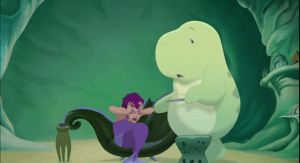
Marina can't stand her job much longer, and wishes to take over Sebastian's position

Marina can’t stand her job much longer, and wishes to take over Sebastian’s position

Marina vents to her assistant Benjamin the Manatee, as she wants Sebastian’s job. She comes up with a plan to rid the kingdom of Sebastian and take over his job. Meanwhile, as Ariel toils away at her punishment, Flounder swims on by, playing some music. Ariel hears him and asks him to do it again, but he nearly gets arrested by two guards for breaking the Triton Act, the law that outlaws music. Flounder grabs her and the two swim away, with the guards in pursuit. The pair run into Sebastian, and Sebastian orders Flounder to be taken away to the dungeon. Ariel covers for him, and he is let off with a warning, though Ariel is sent back to her room. Triton comes by to bid the girls goodnight, but Ariel is less than receptive. Soon after Ariel spies Flounder sneaking out of the palace grounds, and she decides to follow him. She finds him heading into a secret building, which is revealed to be a music club, surprisingly led by Sebastian. Ariel’s appearance spooks the club members, even though she promises not to tell. She starts recalling a melody from a long time ago, and the sea creatures join in with her song. Sebastian begrudgingly makes him a member of her music club.

The next morning, Sebastian and Marina are called in front of Triton, who says that there is a problem with Ariel. Triton asks Sebastian to take care of Ariel, much to the surprise of both Marina and Sebastian. Ariel’s sisters question where she was the previous night. Attina, the eldest, worries about Ariel, and Ariel finally explains the underground club. The girls suddenly realize how much they miss their mother, and they all ask her to take them to the club. Marina is confused and suspicious as to why the girls are awake on time. That night, the princesses all head to the club, and see Sebastian, who is less than thrilled to see the princesses. Although they are having the best time, they absence does not go unnoticed by Marina, who tracks them down to the club. Once she sees Sebastian, she realizes that she has her leverage to get his job, and runs straight to Triton.
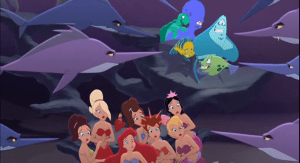
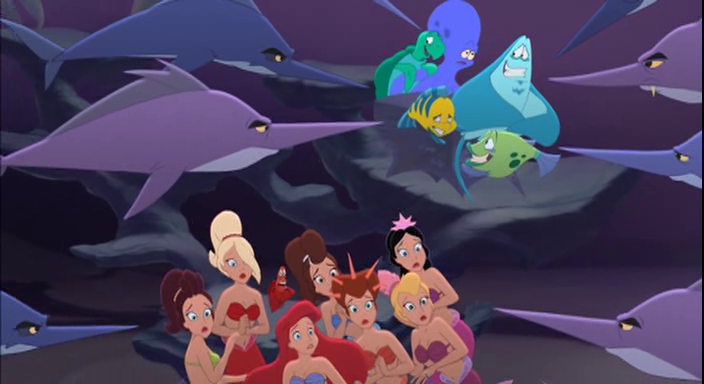
The club is crashed by the palace guards, who capture the band and the girls

The club is crashed by the palace guards, who capture the band and the girls

The girls continue to go to the club, and one night, the club is invaded by the palace guards and Triton. Triton has Sebastian and the other club goers locked away, and gives Marina Sebastian’s job. Triton then destroys the entrance to the club. Back at the palace, the girls are placed under house arrest, and Ariel demands to know why music is forbidden in the kingdom. Triton tells her that there will be no music in the kingdom, to which Ariel replies that her mother wouldn’t have wanted that before swimming away. Ariel’s sisters turn their back on her as well, as they believe she’s made the situation worse. Marina is over the moon about her new position, with the power going straight to her head. That night, Triton finds a statue of his wife and sits by it, distraught. Ariel, similarly distraught, swims out of her room and heads to the jail to free Sebastian and the other band members. She decides to run away from Atlantica, and the group goes with her. Sebastian leads them to a secret area, with Flounder leading them song on the way.

Benjamin has noticed Ariel’s absence, and pulls Marina aside to tell her, although Attina tells Triton first. Triton reassures her that they’ll find Ariel, and heads off to find her. Marina, angered at this slight, especially since Sebastian is missing as well, heads off on her own search with her group of electric eels, vowing to get rid of Ariel as well. Sebastian has led the group to their destination, and explains to Ariel that there’s more to this place than it appears. The next morning, Ariel wakes up and hears something nearby, and finds her mother’s old music box. Sebastian explains that it was an anniversary gift, and why Triton took Athena’s death so hard. Ariel, finally understanding her father’s pain, decides to bring the music box home to Triton, much to Sebastian’s glee. Ariel, Sebastian, and Flounder head back, but meet up with Marina’s eels, who attack. Sebastian tries to protect Ariel and Flounder, and the rest of the band appears to help protect the trio. Ariel gets hurt when she rushes to protect Sebastian from Marina, and Triton, who saw the entire thing, rushes to her side. The music box opens and plays the song, and Triton sings it, waking Ariel. In the end, Triton brings music and happiness back to the kingdom, and appoints Sebastian as the court composer. Marina is locked in jail with Benjamin, and after Benjamin consoles her, the two dance in their cell.
 

August 17

August 17, 1954 – The Special Short Film Willie the Operatic Whale is Released to Theaters

vlcsnap-2015-08-17-16h05m37s3

“A signing whale? Whaddya know! Imagine that! I don’t believe it! I don’t believe it!”

On August 17, 1954, the special short segment Willie the Operatic Whale was released to theaters. A segment from the animated feature film Make Mine Music, it was originally entitled “The Whale Who Wanted To Sing At The Met.” All the voices in the short were performed by Nelson Eddy.

The segment begins with how the story began, with a small segment in the newspaper about a mysterious voice heard at sea, which then became a front page story, then a screaming headline. Scientists are split on the issue, with one camp believing that it was impossible, while some believe it had to be possible. Then, Impresario Professor Tetti Tatti weighs in, believing that the whale must have swallowed an opera singer, and is determined to retrieve the poor victim. Whitey the seagull finds the newspaper announcing Tetti Tatti’s search for the whale, and tries to get his friend Willie the Whale to sing for Tetti Tatti. Willie is serenading the sea animals when Whitey finds him. Willie heads over to Tetti Tatti’s ship and starts serenading him with some Figaro. The sailors refuse to shoot the harpoon as they listen to Willie’s beautiful singing. Willie could also sing in three separate voices, all at the same time, and was considered a singing miracle. However, Tetti Tatti is still convinced that there are three opera singers inside Willie, and desperately grabs at the harpoon; fortunately, he is stopped by the sailors. Willie is then seen singing on the stage of the Met, singing grander and grander roles. Unfortunately, the singing at the Met was all a dream, as Tetti Tatti got his way and managed to harpoon Willie, killing him. Whitey flies around, depressed that his friend has been murdered, but is reassured by the narrator that people aren’t used to miracles, and Willie is singing in Heaven. Willie is seen singing in the clouds to a sold out show.

August 12

August 12, 1919 – Supervisor of the Paint Lab and Disney Legend Dodie Roberts is Born

Dodie Roberts

“I love puzzles, and mixing paint was like putting together a puzzle. It was fascinating to create colors and to get them exact.”

On August 12, 1919, Dodie Roberts was born in Plainview, Nebraska. After attending college in Delaware, Roberts moved to Southern California in 1939, and was invited to visit the burgeoning Disney Studios. In October of that year, Roberts gained employment at the Studio as a runner for the Ink and Paint Department. Soon after, she was promoted, being given the choice position of creating new colors for the staff. The work was challenging and exact, as many proprietary colors were created in the lab for use in animated features; only the Supervisor of the department was allowed to know the ingredients in the paints, as there was fear that other studios could swipe the formula. In 1972, Roberts became the Supervisor of the Paint Lab, overseeing eight staff members and more than 500 shades of color. One of her responsibilities was making sure that the right paints were selected, down to the gradations of single colors to match the lighting and mood in any particular scene. In 1984, Roberts retired after 45 years with Disney. A shade of purple was developed in her honor, named Dodie 6. She, along with fellow employee Al Jones, worked to found the Disney Golden Ears Retirement Club in the same year for former employees. In 2000, she was honored as a Disney Legend. In 2008, Roberts passed away at the age of 88.