RSS Feed

Tag Archives: 1960s

March 18

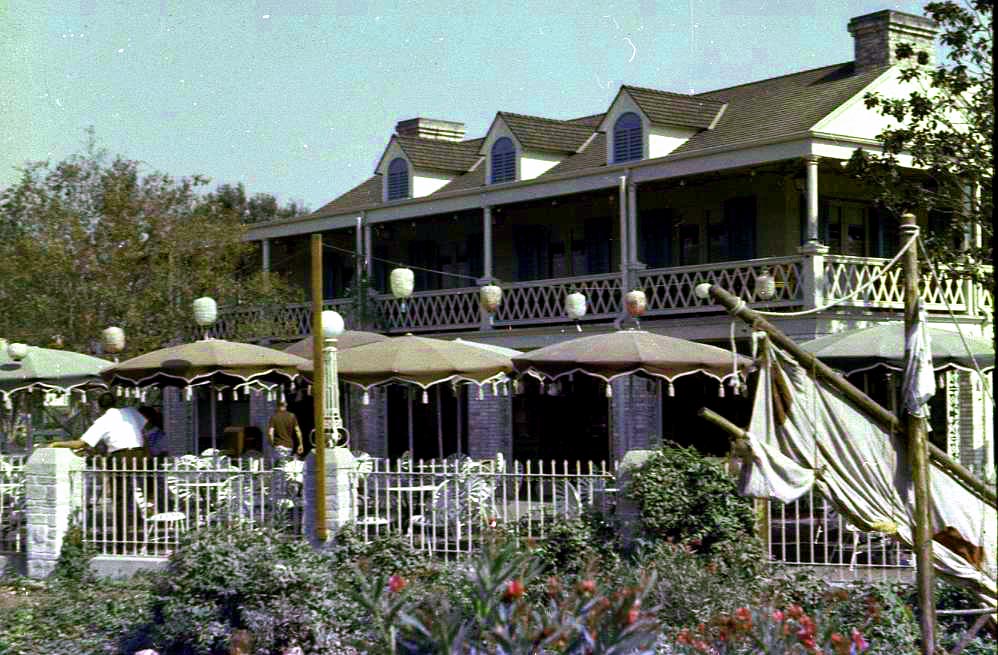
March 18, 1967 – The Blue Bayou Restaurant Opens in Disneyland’s New Orleans Square

blue-bayou-restaurant-00

“Dine on Cajun and Creole specialties at one of Disneyland Park’s most popular – and most romantic – restaurants.”

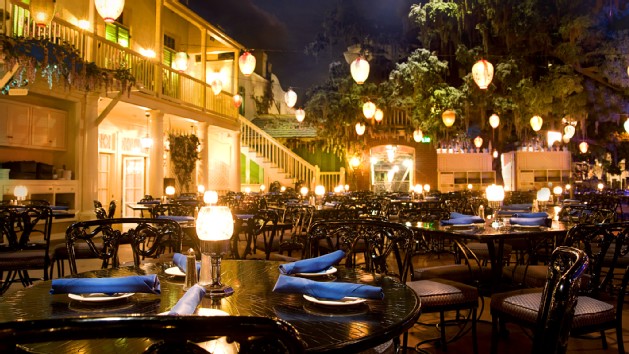
On March 18, 1967, the Blue Bayou Restaurant opened in the New Orleans Square area of Disneyland. The restaurant is considered one of the most attractive dining areas in the entire park, and has also been considered a “must-do” part of any Disneyland visit. Located in the same building as the Pirates of the Caribbean attraction, diners are able to watch as guests travel through the attraction while enjoying a special nighttime atmosphere reminiscent of summers in the bayou. Versions of this restaurant have been opened in Tokyo Disneyland and Disneyland Paris.

March 16

March 16, 1961 – The Special Short Film The Saga of Windwagon Smith is Released to Theaters

vlcsnap-2014-03-15-09h04m17s84

“The prairie is just like the ocean, only greener and drier, you see, and the billowing waves of buffalo grass make sailing quite easy to be.”

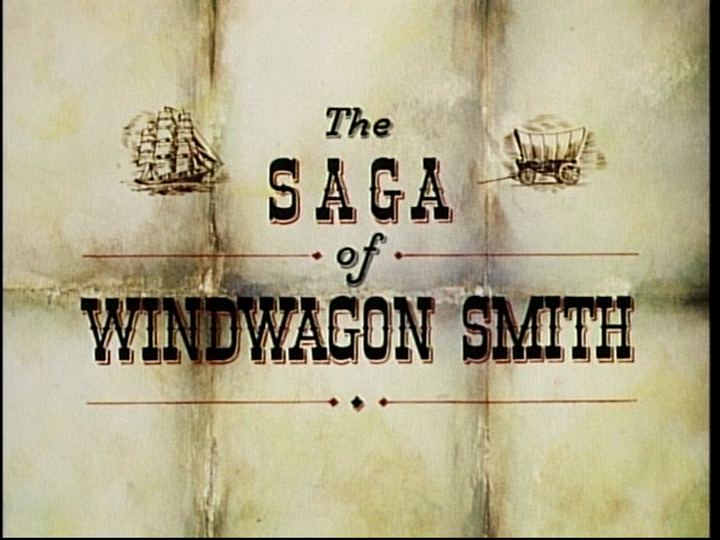
On March 16, 1961, the special short film The Saga of Windwagon Smith was released to theaters. The short was released near the end of the golden age of Disney short films, and at a time where the art was becoming more experimental. Jasper and Horace from One Hundred and One Dalmatians make a cameo appearance in this short. The short itself was directed by Charles Nichols, with story by Nichols and Lance Nolley. It features the voices of Rex Allen and the Sons of the Pioneers.

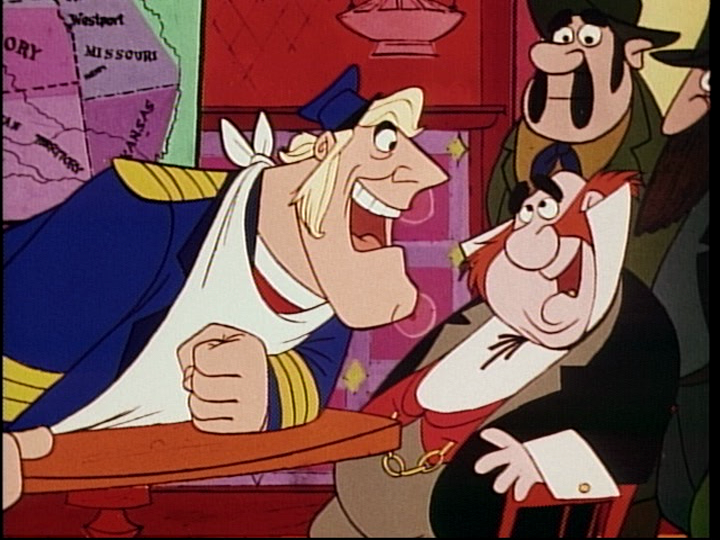
The story takes place in Westport, located at the start of both the Oregon and Santa Fe Trails. Most of the town is seen sleeping in the Kansas sun, but they are startled awake by a strange cloud running down Main Street. They hear a strange voice bellowing from the cloud, and as an anchor is tied to a hitching post, the town sees a covered wagon with a deck and a mast with a tiller attached to it. The man inside steps down and greets the town, and when asked by Mayor Crum where he is from, the man explains his name is Captain Smith. He had sailed the seven seas, he continues, and wishes to sail the prairies.  The town assumes that, as he has no oxen to pull his wagon, the wind must make it move, and Smith tells them that this is the case before hurrying into the nearest saloon for a bite to eat. When he takes a look at the waitress in the bar, the mayor’s daughter Molly, it’s love at first sight for Smith. Molly has also fallen for Smith, but her father soon sends her away so he and Smith can talk business.

Smith and the mayor talk business about the windwagon, with the mayor wondering if it can hold cargo

Smith and the mayor talk business about the windwagon, with the mayor wondering if it can hold cargo

The mayor asks if Smith’s windwagon will haul freight, and Smith confirms this, as the hull can hold a full cargo. He then makes the grand claim that he can sail from Kansas to Santa Fe in only two weeks, as opposed to the two months it would take a regular covered wagon with oxen. The accountant of the town figures this would be a quarter of the time, with four times the profit. The town gets excited about the financial prospects of windwagon use, and decide to build a super windwagon with Smith’s help, creating a new company called The Prairie Clipper Company. Building soon begins, and every night after work, Smith and Molly meet on the unfinished deck to continue their romance. The mayor is furious at Molly’s romance with Smith, and warns her to stay away.

The day the windwagon is finished, everyone comes out to admire it before the roll it to the edge of town. Molly christens the ship, and everyone gets on inside, except for Molly, who is told by her father that this cruise was for men only. Smith climbs on board and gets ready to set sail. The windwagon heads off on the Santa Fe Trail, and the men inside start getting seasick. The men demand to be let out, and Smith begins to take them back to town, when the wheel gets stuck. As the windwagon passes town, the men jump out as fast as they can, leaving Smith all alone. As he vows to go down with the ship, he is surprised to find Molly on the deck. She had stowed herself away on the ship, and as a hurricane fast approaches the ship, Smith tries to convince her to leave, but she wishes to stay with him. The windwagon is swallowed by the hurricane, and after Smith fixes the tiller, the two sail on top of the hurricane, heading west, and the two are never heard from again. Legend has it when the sunset turns gold, you can see the wagon in the sky, with Smith steering the wagon with Molly by his side.

March 13

March 13, 1960 – Animator, Storyboard Artists, and Disney Legend Joe Ranft is Born

vlcsnap-2014-03-13-16h11m59s180

“Joe was really a major part of Pixar’s soul. He was one of the key players who made all the films what they are.” – Director Pete Doctor

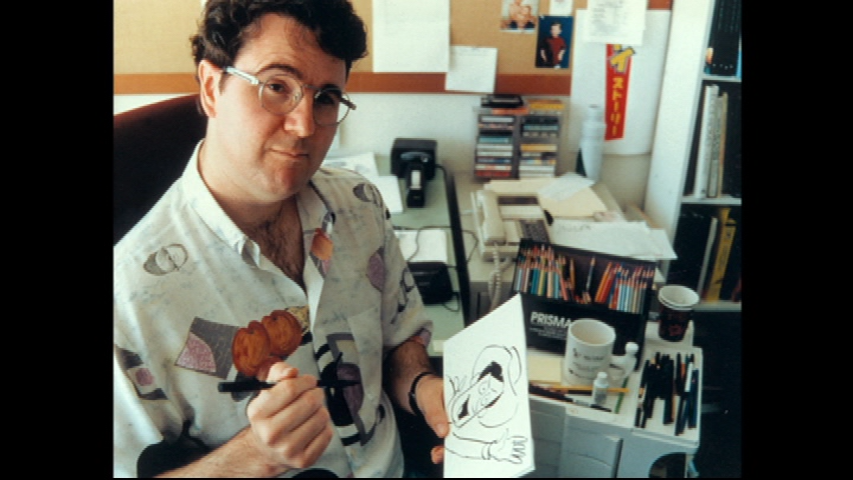
On March 13, 1960, Joseph Henry Ranft was born in Pasadena, California, and grew up in Whittier. He had a strong interest in movies, magic, and performing, all things that would impact his career. In 1978, Ranft enrolled in the California Institute of the Arts, where he studied Disney-style animation alongside future collaborators John Lasseter and Brad Bird. In 1980, Ranft accepted a job offer from Disney, and earned a quick reputation as an outstanding story artist. He contributed to the story of several films, including Oliver and Company, Who Framed Roger Rabbit, Beauty and the Beast, The Lion King, and Fantasia 2000. In 1991, Ranft began working for Pixar, working on the story for their first computer-animated feature film, Toy Story. His knack of performing and impressions got him hired as the voice of Heimlich in the studio’s second film, A Bug’s Life; he would continue writing and performing on Toy Story 2, voicing Wheezy the penguin, and had writing credits for Monsters, Inc. and Cars. Unfortunately, Ranft was killed in a car accident on August 16, 2005, leaving behind a legacy of storytelling and a reputation as a “story giant of our generation,” as relayed by director Henry Selick. Ranft was named a Disney Legend in 2006.

February 16

February 16, 1964 – The Scarecrow of Romney Marsh, Part II Premieres on Television
vlcsnap-2014-02-16-17h33m59s16

“Mutiny among the Scarecrow’s men is a worse danger than the soldiers are.

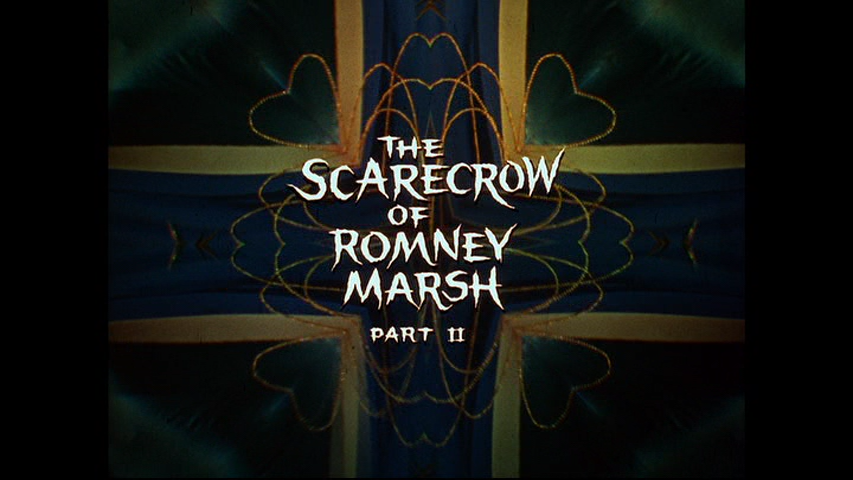
On February 16, 1964, the Wonderful World of Color Disney anthology episode premiered with the second part of the three-part dramatic story of The Scarecrow of Romney Marsh. It was based on the Christopher Syn stories by Russell Thorndike and William Buchanan. Teleplay was done by Robert Westerby, and it was directed by James Neilson. It stars Patrick McGoohan as Dr. Syn/The Scarecrow, George Cole as Mr. Mipps, Michael Hordern as Thomas Bates, Geoffrey Keen as General Pugh, Patrick Wymark as Joseph Ransley, Alan Dobie as Mr. Frank Fragg, Eric Flynn as Lt. Philip Brackenbury, and Sean Scully as John Bates.

After a brief introduction by Walt, the story continues where Part I left off (please see 2013’s February 9th entry for more information). General Pugh is burning houses to the ground looking for the Scarecrow, angering Squire Thomas Banks, as the houses on his land are being burned, with those citizens being terrorized. Pugh strikes a deal with Banks for information: he wants the names of those who couldn’t pay their rent, then inexplicably had the money to pay. Banks gives him the name of one individual, a fellow by the name of Ransley, whom he calls a difficult fellow. Banks arranges to meet with Ransley the next morning, and Ransley arrives to meet Pugh. John intercepts Ransley’s arrival, and once he shows Ransley to the meeting room, he listens in at the door. Pugh questions Ransley, wondering how he was able to pay six months back rent and keep paying rent though his crops are poor and his flock of sheep is dwindling. Pugh accuses Ransley of being a smuggler, but Ransley denies it. Pugh threatens Ransley with jail unless he tells Pugh everything about the Scarecrow and his smuggling ring. To save himself, Ransley offers to find out information that will lead to the Scarecrow’s arrest. Pugh gives him 48 hours, or he will be sent to jail.
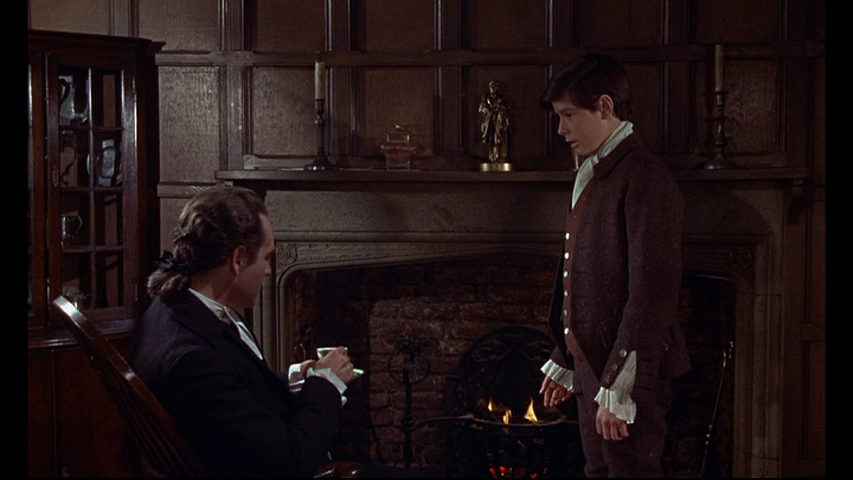
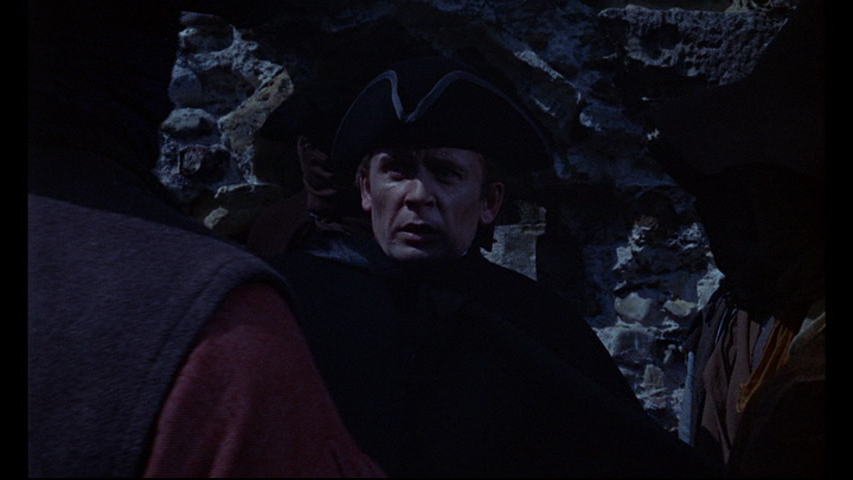
John tells Syn about everything he's heard between Pugh and Ransley

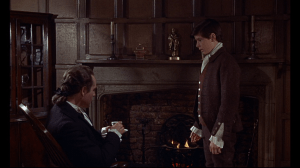
John tells Syn about everything he’s heard between Pugh and Ransley

John, having heard all this, rushes off to tell Syn. One traitor, he warns, is enough to get them all hanged. Syn thinks on this, as there is a shipment coming in the next day. Syn does decide that it’s too dangerous for John to ride the next evening, as Pugh is staying at his house, but he is to keep his eyes and ears open for any more information. Syn heads to Ransley’s farm to see how the man is doing, and greets Ransley’s ill mother for a start, and finds that Ransley doesn’t take care of his family. She tells him that she’s grateful to the Scarecrow for saving them, but that Joe, who she knows is one of the Scarecrow’s smugglers, would betray the Scarecrow to save himself. As she and her grandsons are afraid of Ransley, she says they have no choice but to obey him no matter what he decides. She is sent upstairs by Ransley, and Syn talks with Ransley about the Scarecrow. Ransley things that Scarecrow’s men won’t betray him due to fear, but without the fear, they’d gladly betray him. As Syn leaves, he stays in the doorway to hear Ransley’s plans, and secretly follows him and his sons to the Oast house up Knoll Hill. Syn discovers that after Ransley gets his share of the contraband the next night, they’ll take it and leave.

After talking with John and Mipps, Syn decides that the only option is to make an example of Ransley to the other men in his outfit, as mutiny among the men is worse than anything they could imagine. He then pulls John aside to put in place the next part of the plan. Back at the Banks house, Kate Banks talks with Brackenbury, but is soon called away by John, who tells Brackenbury that he overheard a group of smugglers talking about a shipment of brandy coming in, being taken up to the old Oast house on Knoll Hill. John plants the idea in Brackenbury’s head that this is the perfect chance to catch some of the Scarecrow’s men. Brackenbury, who has been dreaming of a chance to prove himself, decides not to tell Pugh and handle this matter himself.
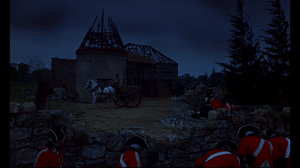
Ransley arrives at the Oast house, unaware of the troops waiting to arrest him

Ransley arrives at the Oast house, unaware of the troops waiting to arrest him

The night of the shipment arrives, and Scarecrow and his men are at their work, with Scarecrow giving out his orders. Ransley soon starts on his betrayal, smiling to himself after the Scarecrow rides off with his right hand man Hellspite. Ransley arrives at Oates house, unaware that Brackenbury and his men are waiting for him. Ransley decides to run for it, but is shot in the shoulder and captured by the king’s men. He is soon taken to court with his sons, and are told that they will not hang them if they confess the name of the Scarecrow. Syn arrives to watch the proceedings, and interrupts with a note that was left at his door: “If the Reverend Dr. Syn speaks for the prisoners on trial, he will answer to the Scarecrow with his own life.” Pugh questions why Syn would receive such a note, and Syn says that he had told Mipps about a point of law concerning this case, which was probably spread by Mipps at the inn. Banks allows the point of law to be heard, and Syn points out that, if the Scarecrow had known about the betrayal, he wouldn’t have wasted twenty kegs of expensive contraband. The kegs are examined and, finding that they contain nothing more than sea water, Ransley and his sons are free to go. Ransley thanks Syn, but Syn warns him that he should get away as far as he can. Pugh then threatens Ransley that he needs to provide proof by that evening, or he will be thrown in jail.

Mipps is sent to watch the prosecutor Fragg, as Syn is suspicious of him. As Fragg enters the inn, a tense silence falls. Mipps starts a conversation with Fragg, telling him that he knows everything about everyone in town and, as a member of the church, is the soul of discretion. Fragg takes the bait, and starts asking Mipps about Ransley. He asks Mipps for a horse that night, with no one knowing about it, and Mipps promises to have it for him at the fork in the sea road. Fragg shows up at Ransley’s and wishes to talk with him, with Mipps and John sneaking in to listen. Fragg offers to help Ransley, so long as Ransley offers to help him. Ransley wants to run, but Fragg offers to help Ransley and give him all the reward money if Ransley gives the names of the men in the Scarecrow’s gang, the signal system, and hiding places for the loot. Ransley, feeling cornered, decides to help Fragg. John and Mipps rush off to tell Syn of this new development. Fragg heads off to talk to Pugh, telling him that he’ll smash the Scarecrow’s gang, although he will need Pugh’s men at standby to protect him. Pugh agrees, but still insults Fragg in the process. Syn knows that Ransley will betray him, and decides to use Ransley as an example once more to those who would not only betray him, but those men who offer blood money for betrayal.
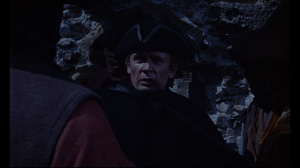
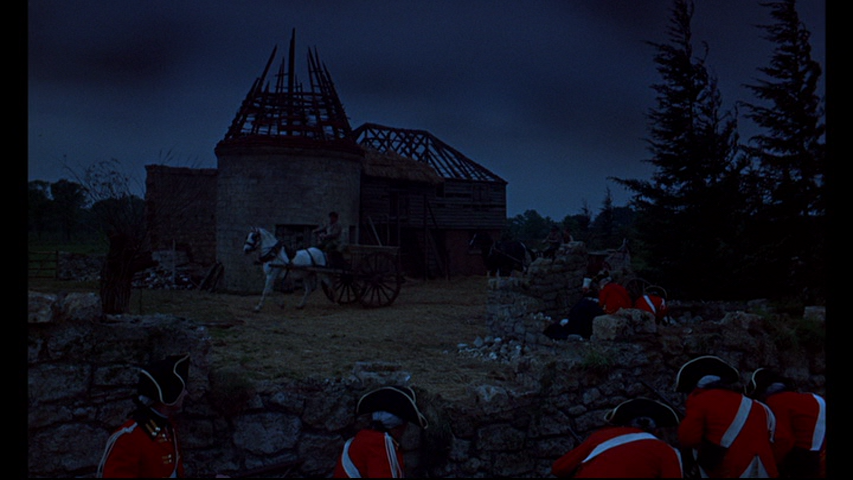
Fragg is ambushed by the Scarecrow's men while waiting for Ransley

Fragg is ambushed by the Scarecrow’s men while waiting for Ransley

Pugh and his men wait at the old monastery, where Fragg asked them to wait, while Fragg waits at the old castle for Ransley. Fragg is ambushed by the Scarecrow and his men, and is captured. Ransley and Fragg are taken to an old barn with the Scarecrow conducting court. Ransley is charged with treachery, with Curlew and Hellspite providing testimony. Ransley’s pockets are emptied, and the list is found, damning Ransley. He is sentenced to hang, and Fragg is forced to watch as the man is hung. Frightened, Fragg flees, and the Scarecrow lets him go. After the men leave, it is revealed that the Scarecrow didn’t really hang Ransley, but tied the rope to a bit of the chair to make Ransley pass out. The Scarecrow tells him that Ransley is dead, and so he must flee and begin a new life, for if his men find that he is alive, they really will kill him. Ransley runs, and Mipps laughs at the ruse they have done. The next morning, a burial service is held for Ransley, and Fragg, on his way back to London, sees the sign stating “Here lies Joseph Ransley, departed this world as the result of an accident, May 17, 1775.” Pugh arrives and tells Syn to leave space in the graveyard for the Scarecrow, and Syn just smiles and tells Pugh to take care of that cold he’s caught.
January 8

January 8, 1962 – The Popular Frontierland Restaurant Swift’s Chicken Plantation Closes

plantationhouse

“Swift’s Chicken Plantation House was Walt’s reply to the incredibly successful chicken restaurant at Knott’s Berry Farm in nearby Buena Park.” – Sam Gennawey, The Disneyland Story.

On January 8, 1962, the popular Disneyland Frontierland restaurant known as Swift’s Chicken Plantation closed. It had been open since the park’s opening on July 17, 1955, and was known for serving the best meals in the park. The restaurant was sponsored by Swift’s Meats, and served those products. It was located on the shores of the River of America. During the expansion of Frontierland and the building of New Orleans Square, the decision was made to close the restaurant and tear it down to make best use of the space.

December 19

December 19, 1962 – The Special Short Film A Symposium on Popular Songs is Released to Theaters

vlcsnap-2013-12-19-19h50m01s221

“Come in and sit down and I’m going to play for you several hundred of the latest hit songs of the past 60 years, which, naturally, I wrote myself.”

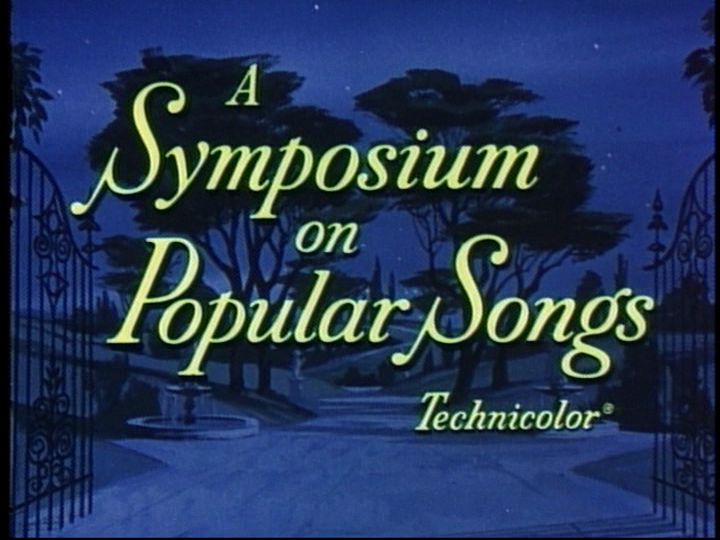
On December 19, 1962, the special short film A Symposium on Popular Songs was released to theaters. The short is a mix of traditional animation and stop motion animation, relaying the history of popular music within the 20th century. The short was nominated for an Academy Award for Best Animated Short Film, but lost to The Hole by Storyboard Inc. and Brandon Films. The short was directed by Bill Justice, with story by Xavier Atencio. It stars the vocal talents of Paul Frees, Gloria Wood, Billy Storm, and Skip Farrell. The songs within the short were written by the Sherman Brothers, with musical arraignment by Camarata.

The short takes place inside Ludwig von Drake’s stately mansion, where he greets the audience at the door and brings them inside to talk about popular music. He begins with his life story at the beginning of the turn of the century where, inspired by his poverty and his ragged clothing, he created ragtime music. He then plays his hit song, “The Rutabaga Rag,” with some accompanying stop-motion animation of vegetables dancing. After this, he moves to the Roaring Twenties, where he was asked to come up with a new style of popular music to put Dixie on the map. He does so with the song “Charleston Charlie,” an allusion to popular ’20s singer Helen Kane.

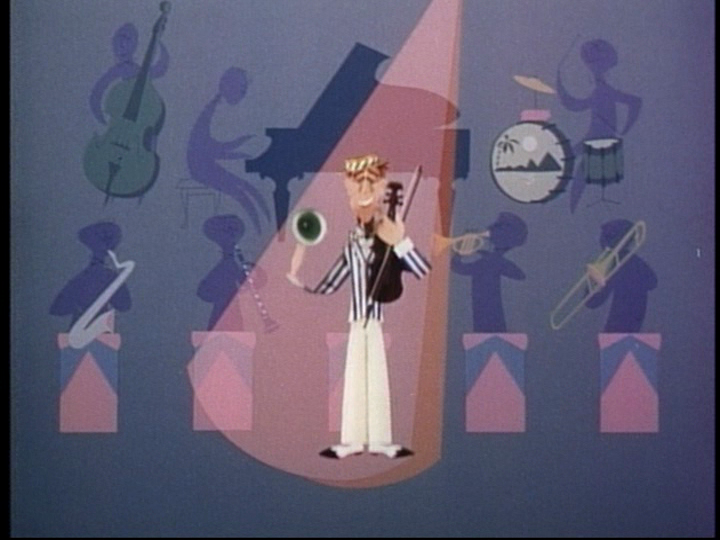
Ludwig moves to the Great Depression era of songs, and turns to a picture of a signer with a backing band

Ludwig moves to the Great Depression era of songs, and turns to a picture of a signer with a backing band

Moving to the Great Depression era, Ludwig has a bit of a panic when he talks about how he lost his money in the stock market. He bought a piano with his last nickel, and wrote the song “Although I Dropped $100,000.” The song parodies the popular songs of the time period, including “Let a Smile Be Your Umbrella” and “Stormy Weather.” Ludwig explains after this that he invented the microphone, and by doing so, invented the idea of a crooner. He wrote the love ballad “I’m Blue for You, Boo-Boo-Boo-Boo-Boo,” which has the singer imitating the crooning style of Bing Crosby. After this, Ludwig moved on to the style of Boogie Woogie, with three singers singing “The Boogie Woogie Bakery Man” which is allusion to the swing style, particularly the songs of the Andrews Sisters.

Ludwig then turns on the television to his favorite music show, The Von Drake Hour, which plays many of his hit songs. The song that starts to play is “Puppy Love is Here to Stay,” which is the beginning of the “modern era” of music (modern for the time the short was released). Soon, Ludwig turns off thetelevision and takes the audience into his hi-fi studio to play his final song, “Rock, Rumble, and Roar” which pays homage to the early rock and roll era in popular music. He forgot the record, and decides to play the song himself, which is segmented with snippets of all the earlier songs. The short ends with the house shaking and rocking along with the raucous music Ludwig is playing.

October 1

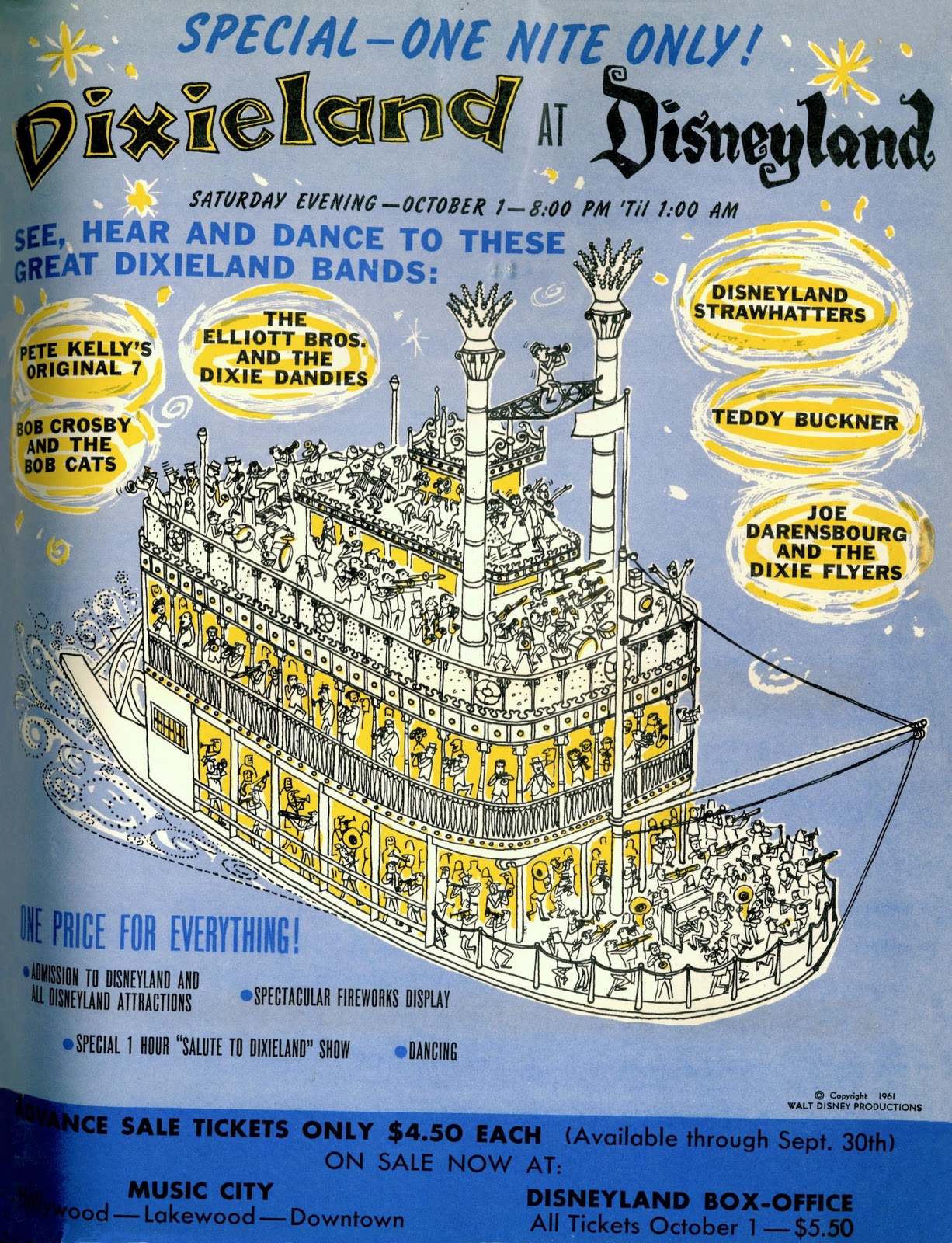
October 1, 1960 – The First Dixieland at Disneyland Event is Held

“See, hear, and dance to these great Dixieland bands!”

On October 1, 1960, the first Dixieland at Disneyland event was held for one night only. Several bands were featured at the event, including Bob Crosby and the Bob Cats, The Elliot Brothers and the Dixie Dandies, Teddy Buckner, Joe Darensbourg and the Dixie Flyers, and Disneyland’s own Disneyland Strawhatters, who had been featured at the park since 1956. The show consisted of a floating Mardi Gras-style parade down the Rivers of America, with several firework effects. The grand finale of the parade was all the bands featured together on the Mark Twain riverboat, playing “When the Saints Come Marching In,” and the bands would disembark and go to six separate locations in the park to perform for guests until midnight. At midnight, the bands would gather together once again and play as an ensemble until 1 am.

July 24

July 24, 1966 – New Orleans Square is Dedicated at Disneyland

vlcsnap-2013-07-24-05h25m58s244

“[New Orleans Square] is quite a project, it’s the way I’ve always wanted to see Disneyland built when you see all the buildings…it’s really a joy to see it done in the way we’ve done New Orleans Square.” – Walt Disney

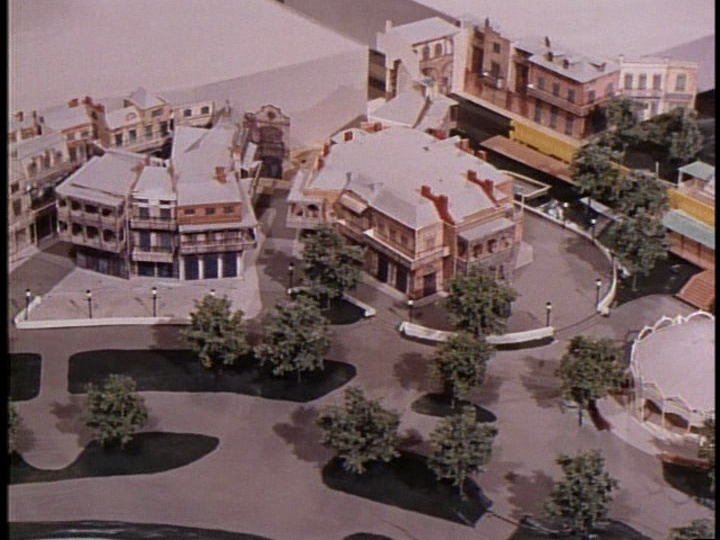
On July 24, 1966, the new New Orleans Square land of Disneyland was dedicated at a special ceremony featuring Walt Disney and the mayor of New Orleans, Victor Schiro. An admirer of the unique look of New Orleans, Disney had believed that this style would add an ideal touch to the area alongside the banks of the Rivers of America. This area houses two of Disneyland’s most popular attractions: Pirates of the Caribbean, and the Haunted Mansion. As there is not a lot of space available in this area, Imagineers had to be very creative in their placement of the attractions and the various restaurants and shops. Walt had wanted to build an apartment there, but Roy Disney changed these plans after Walt passed away, and the area would later become the Disney Gallery. This dedication was also Walt’s last major public appearance at the park.

July 2

Posted on

July 2, 1967 – The Rocket Jets, the PeopleMover, and the General Electric Carousel of Progress Open in Disneyland’s Tomorrowland

vlcsnap-2013-07-02-05h21m17s40

“There’s a great big beautiful tomorrow just a dream away!”

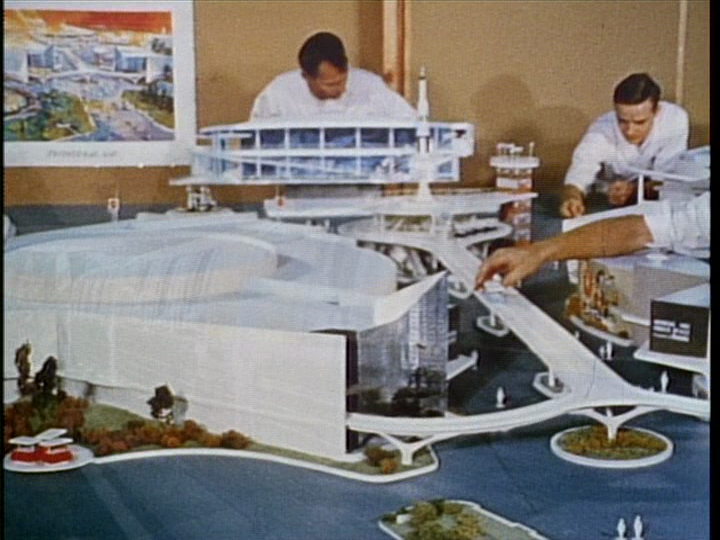
On June 2, 1967, as part of a major update to the Tomorrowland section of the Magic Kingdom, three new attractions were opened: the Rocket Jets, the Peoplemover, and the General Electric Carousel of Progress. The Rocket Jets were the replacement for Astro-Jets and the Tomorrowland Jets. The attraction is built much like the current Dumbo the Flying Elephant attraction, where guests climbed into rockets and circled around a space shuttle, able to control the height of their rocket with a lever, giving guests a great view of the park. The attraction was closed on January 6, 1997, and replaced with the Astro Orbiter in 1998.

The PeopleMover was an innovative attraction at the time of its opening, as it featured electric motors in the track that would propel the vehicles through Tomorrowland; this same technology was used to build a PeopleMover in the Houston International Airport. Guests would board the PeopleMover and see a preview of Tomorrowland as they traveled through several of the attractions. The attraction had major improvements added in 1968; the Superspeed Tunnel was added in 1977, and footage from the feature film Tron was added in 1982. The attraction was closed on August 21, 1995.

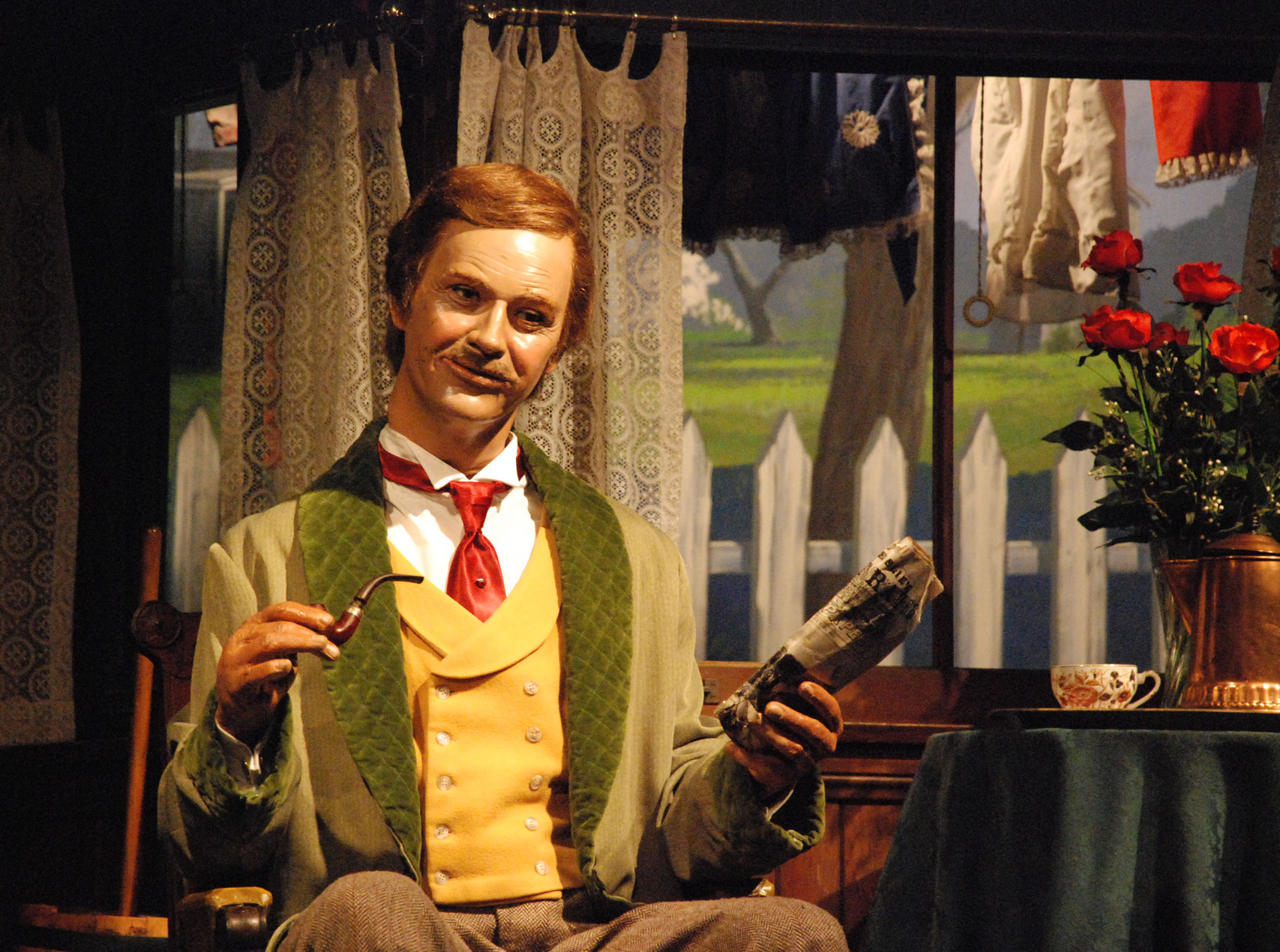
Carousel_of_Progress_1900

The General Electric Carousel of Progress was originally an attraction at the 1964 New York World’s Fair, and was moved to Tomorrowland  after the fair was over. Sponsored by General Electric, the attraction took guests through the home of an Audio-Animatronic family through the years, stressing the increased importance of electricity as the decades changed. A song for the attraction, “There’s a Great Big Beautiful Tomorrow,” was written by the legendary songwriting team the Sherman Brothers. The attraction closed on September 9, 1973, and was moved to Walt Disney World, with America Sings taking the Carousel’s place in Disneyland.

July 1

Posted on

July 1, 1966 – The Primeval World Attraction Opens on the Disneyland Railroad

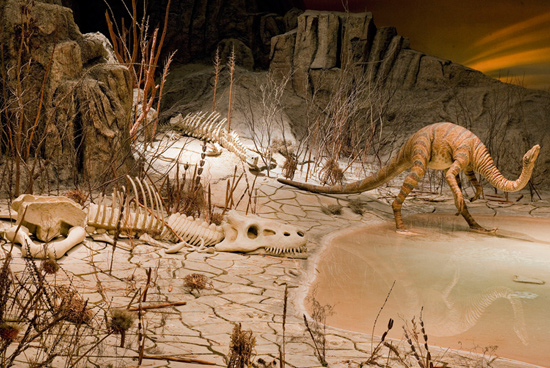
PrimevalWorld

“…travel back in time back to the fantastic Primeval World – land of the dinosaurs.”

On July 1, 1966, the diorama on the Santa Fe and Disneyland Railroad Primeval World opened in Disneyland. The original attraction was featured at the 1964 New York World’s Fair, as part of Ford’s Magic Skyway. The attraction appears to have been inspired in part by the “Rite of Spring” segment from the 1940 animated feature Fantasia. Using Audio-Animatronics, several dinosaurs are brought to life in a misty swamp area, including an Apatosaurus, a Pteranodon, a Tyrannosaurus, and a Stegosaurus. As more is learned about dinosaurs (such as the renaming of the Brontosaurus to the Apatosaurus), it has created several inaccuracies in the attraction, including the fact that the Stegosaurus and the Tyrannosaurus did not exist in the same time period. A version of the attraction has been created for the Western River Railroad in Tokyo Disneyland, appearing just before the arrival at Adventureland Station.