RSS Feed

Tag Archives: 1960s

July 18

July 18, 1965 – The Plaza Inn Opens in Disneyland

“Drop ‘inn’ for hearty American fare the whole family will love and a lively Character Breakfast with some favorite Disney friends.”

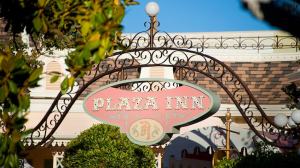
On July 18, 1965, the restaurant Plaza Inn opened in Disneyland on Main Street, U.S.A. Designed in Victorian style to match the feel of the area’s turn-of-the-century charm, this restaurant features a buffet/family style meal, featuring such meals as Mickey Waffles, pot roast, and penne pasta. This restaurant also features a special “Minnie & Friends” character dining breakfast, where guests can dine alongside Tigger, Chip ‘n’ Dale, and Minnie Mouse.

July 2

Posted on

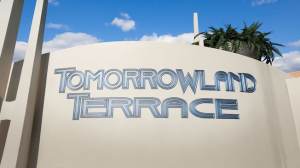
July 2, 1967 – Tomorrowland Terrace Opens in Disneyland

“Grab your dancing shoes and head to the hoppin’est place on earth where you can strut your stuff weekend nights all summer long!”

On July 2, 1967, the dining area Tomorrowland Terrace opened in Disneyland. Not only was it a fast-food facility, the area also had live bands and a dancefloor, with a stage for the bands that could be raised to meet the guests at the restaurant level. Similar versions of this facility were opened in Walt Disney World (which closed in 1994) and Tokyo Disneyland. The Disneyland version closed in June, 2001, and later opened as Club Buzz; it has since reopened in that space with different varieties of bands playing every night.

June 10

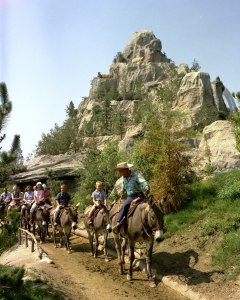
June 10, 1960 – The Pack Mules Through Nature’s Wonderland Attraction Opens

On June 10, 1960, the Pack Mules Through Nature’s Wonderland attraction opened in Disneyland’s Frontierland. This was the third incarnation of this type of attraction, as it was previously Rainbow Ridge Pack Mules (open from 1956 through 1959) and Mule Pack (open from 1955 through 1956). Guests rode on mules through Frontierland past several Disneyland landmarks to the town of Rainbow Ridge, which can still be found in the shadow of Big Thunder Mountain. The attraction was closed in 1973.

May 24

Posted on

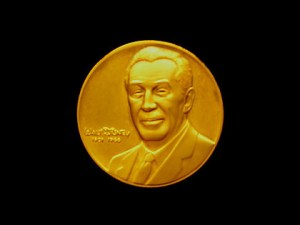
May 24, 1968 – Walt Disney is Posthumously Awarded the Congressional Gold Medal

“Whereas Walt Disney’s life personified the American dream and his rags-to-riches story demonstrated that the United States of America remains the land of opportunity…”

On May 24, 1968, President Lyndon Johnson presented the Congressional Gold Medal to Walt Disney’s widow, Lillian Disney. Walt, who had passed away on December 15, 1966, had previously received the Presidential Medal of Freedom in 1964. In the joint resolution to issue the medal, it honored Walt’s contributions, his humanitarian efforts, his help with the war effort during World War II, and “his belief that good will ultimately triumphs over evil.”

May 12

Posted on

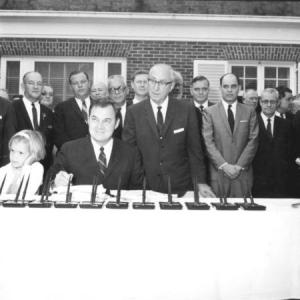
May 12, 1967 – Florida Governor Claude R. Kirk, Jr. Signs Disney Bill

On May 12, 1967, then-Florida Governor Claude R. Kirk, Jr. signed special legislation that allowed Walt Disney Productions’ the ability to run the operations for Walt Disney World. Before the legislation, there were concerns that Florida taxpayers would have to pay for the construction of the new Disney park. This legislation allowed the formation of the Reedy Creek Improvement District with two cities: Bay Lake and Reedy Creek (now known as Lake Buena Vista). The creation of these cities allowed Disney to issue tax-free bonds, as well as remain unaffected by any current or future state land-use laws.

February 8

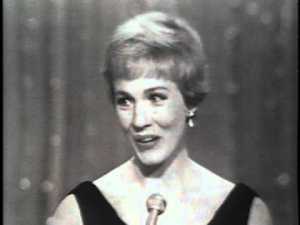
February 8, 1965 – Julie Andrews Wins Golden Globe for Mary Poppins Performance

ja_gg

“Finally, my thanks to a man who made a wonderful movie, and who made all this possible in the first place: Mr. Jack Warner.”

On February 8, 1965, the 22nd Golden Globes were held. The talk of the night was the race between Warner Brothers’ My Fair Lady and Walt Disney Pictures’ Mary Poppins, particularly because of Julie Andrews, as she had originated the lead of Eliza Doolittle in My Fair Lady on Broadway, but was not cast in Mary Poppins as Jack Warner believed Andrews lacked the name recognition that Audrey Hepburn had. Julie Andrews would, that night, win the Golden Globe for her performance as the titular character in Disney’s film, thanking Jack Warner in a tongue-in-cheek manner as she accepted her award. Of the four Golden Globe nominations Mary Poppins received, Andrews’ award was the only one that the film won.

September 22

September 22, 1965 – The Goofy Short Film Goofy’s Freeway Troubles is Released to Theaters
gft

“With increasing frequency, new sections of freeway are being opened around the world.”

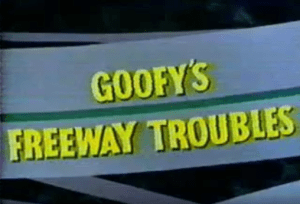
On September 22, 1965, the Goofy short film, Goofy’s Freeway Troubles, premiered in theaters. It was the last Goofy film produced in the golden age of Disney short films, until How to Hook Up Your Home Theater in 2007. The short is directed by Les Clark, with story by William R. Bosché.

The short begins with an explanation of freeways, along with the rules associated with them – and the drivers that ignore the rules. Goofy plays the roles of Driverius Timidicus (the timid driver), Neglectorus Maximus (the careless, distracted driver), and Motoramus Figitus (the impatient driver with road rage). Other freeway driving problems are discussed, using the example of Stupidicus Ultimas, the driver that never takes care of anything. His car is ragged, and he hasn’t taken it in to get anything checked. On the freeway, his tire blows, and he ends up causing a traffic accident as he loses control. Other problems present themselves, with much the same result: traffic accidents. Stupidicus also overloads his car with items that fly out of his car when he suddenly stops. Stupidicus is also not smart when it comes to getting gas, and he ends up running out of fuel on the busy highway. The narrator then explains rules for drivers if they run into any problems on the road; he also explains that the physical and mental health of the driver is just as important as the mechanical health of the car.
September 19

September 19, 1966 – Walt Disney Holds Final Press Conference

wd_mkv

“Walt’s plan for the picturesque area, located about equidistant from Los Angeles and San Francisco, provides for year-round recreational activities by people of all ages and athletic abilities.”

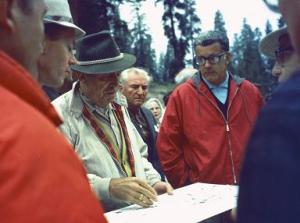
On September 19, 1966, Walt Disney held what was to eventually be his last press conference. Walt, who had not been doing well for the past few months, was announcing his plans for developing the Mineral King Valley as a ski resort. Inspired after the filming of Third Man on the Mountain, Walt had been developing the ski idea for several years. In 1965, after the United States Forest Service called for bids on the Mineral King Valley, Disney won the thirty-year lease by bidding $35 million. Walt quickly set to work to create plans for the January 1969 due date, which included fourteen ski lifts, a self-contained village, two hotels, a heliport, and many other amenities. Walt also forbade vehicles from the area, preferring that guests park at the entrance and be taken into the valley by other means. The press conference also featured California Governor Edmund G. “Pat” Brown, with Walt and Brown making their statements. Afterwards, Walt rested a moment inside the general store before taking photos Brown then heading back to Visalia. Less than three months later, Walt would pass away, and the plans for the area fell through due to opposition to the development of the property. Mineral King Valley then reverted back to the parks service in1978, when Congress annexed it back to Sequoia National Park.

June 25

June 25, 1967 – The Circle-Vision 360 Film America the Beautiful Opens in Disneyland

AtB

“She is a rich land, and a rare land. A fresh, and fair, land.”

On June 25, 1967, the Circle-Vision 360 film America the Beautiful opened in Disneyland’s Tomorrowland. The film, originally known as a Circarama film, opened at the Brussels World’s Fair in 1958 before being brought to Disneyland in 1960. This 1967 version is a reshot version of the original film, and was revised again in 1975 for the American Bicentennial celebrations. Shot with nine cameras on a circular stand, the film gives guests a 360 experience of important American landscapes and American ways of life. It was closed on January 3, 1984, and was replaced by American Journeys. A 16mm version of the film was created for educational purposes in 1980.

June 13

June 13, 1960 – Hayley Mills Appears as Pollyanna on the Cover of Life Magazine

HM_LM

“A pert and perfect Pollyanna.”

On June 13, 1960, actress and Disney Legend Hayley Mills was featured on the cover of Life Magazine as the titular film character Pollyanna. The film was a success with film critics since its release in May, with the article focusing on young Mills, who would go on to win the Academy Juvenile Award for the role.