RSS Feed

Tag Archives: 1930s

May 19

Posted on

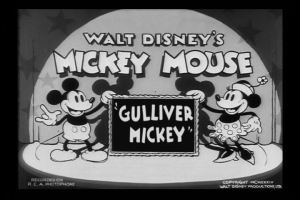
May 19, 1934 – The Mickey Mouse Short Film Gulliver Mickey is Released to Theaters
vlcsnap-2016-05-19-18h14m41s793

“Now, you all keep quiet, and I’ll tell you about the time Uncle Mickey was shipwrecked.”

On May 19, 1934, the Mickey Mouse short film Gulliver Mickey was released to theaters. It was based on the book Gulliver’s Travels by Jonathan Swift. The short was directed by Burt Gillett.

Mickey is reading the book Gulliver’s Travels, when he spots his nephews pretending to sail a boat across the floor. Mickey pretends to be a whale and rocks their boat, but is surprised when they attack him. The boat tumbles from his jump, and the nephews all start to cry when they think their game is over. Mickey, in an effort to calm them, decides to use one of Gulliver’s travels to tell his nephews a story. He begins the story with a violent storm, which left him shipwrecked on an island. He fell asleep on the shore, waking up to find that he had been tied down by the townspeople. He is surprised, but amused, by the size of the people, though they are not amused by his antics. The tiny army attacks him, though Mickey once again only finds it more comical than anything. He is able to deflect anything they throw at him, until a giant spider comes into town destroying everything. Mickey fights the spider valiantly, though it looks as though the spider may win. In the end, Mickey acts out fighting the spider by punching a pillow, much to his nephews’ amusement, though one nephew scares Mickey with a rubber spider, showing Mickey might not be so brave after all.

May 13

Posted on

May 13, 1935 – Storyboarder, Animator, and Disney Legend Burny Mattinson is Born

Burny Mattinson

“Disney has always been a family place. I think that’s what’s so rich about it.”

On May 13, 1935, Burnett Mattinson was born in San Francisco, California. A skilled artist from an early age, Mattinson managed to score a job at Disney thanks to his mother, who dropped him off at the gate of the Disney Studios after he graduated high school. A guard called the head of Personnel for him, and he got a job in the mailroom. Mattinson’s case is similar to those early animators, as he had no formal art training before he started working as an in-betweener a mere six months later. For the animated feature Sleeping Beauty, he was promoted to assistant animator under Marc Davis. After working with Davis on One Hundred and One Dalmatians, he worked with fellow Nine Old Men animator Eric Larson for twelve years on a variety of projects; he then began working with Ollie Johnston after an internal animation training program. Mattinson made his mark by recommending to then CEO Ron Miller an idea for a holiday film, which to his surprise was approved, and Mattinson was picked to direct what would eventually become Mickey’s Christmas Carol. He continued to make his mark on several Disney projects, and in 2008, he was honored as a Disney Legend. In 2013, he celebrated his 60th anniversary with the company, becoming one of the longest serving employees with the company.

March 18

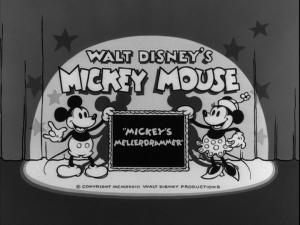
March 18, 1933 – The Mickey Mouse Short Film Mickey’s Mellerdrammer is Released to Theaters

vlcsnap-2016-03-18-18h00m01s192

“Let’s hide in Uncle Tom’s cabin!”

On March 18, 1933, the Mickey Mouse short film Mickey’s Mellerdrammer premiered in theaters. The subject matter is somewhat controversial, as it has Mickey and friends putting on a production of Uncle Tom’s Cabin. It’s important to remember that this short is a reflection of the attitudes of the 1930s, and the play was the most well-known play in this time. The short was directed by Wilfred Jackson.

Mickey and his friends are putting on a production of Uncle Tom’s Cabin, with Mickey as Uncle Tom and Topsy, Minnie as Eva, Clarabelle Cow as Eliza, and Horace Horsecollar as Simon; the cast is also joined by fifty bloodthirsty bloodhounds. The theater is packed, and the cast quickly prepares themselves, with comic ways of applying their costumes. The play begins with a rousing musical number, with Horace and Goofy helping with sound effects and props. The audience boos the villain, Simon, as he enters on stage, while Mickey does a quick costume change to become Uncle Tom. His performance is well-received, but the play is interrupted when Horace uses his whip to accidentally pull Goofy on stage. When the play resumes, the audience starts throwing rotten fruits and veggies at poor Horace. The next scene is quite an affair, with Clarabelle playing Eliza and crossing the ice. Mickey and Minnie help dress several dogs as bloodhounds, though they attempt to dress one cat up as well. The cat rushes the stage, and the dogs chase after it, destroying the set and musical instruments of the orchestra. The audience cracks up, and Mickey quickly pulls the curtain. Minnie and Mickey head out for their bows, while Horace is pelted with rotten fruits and vegetables again.

March 5

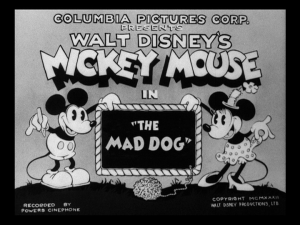
March 5, 1932 – The Mickey Mouse Short Film The Mad Dog is Released to Theaters

vlcsnap-2016-03-05-18h31m29s89

“Look, don’t shoot him, mister. Don’t shoot him. He’s my pal.”

On March 5, 1932, the Mickey Mouse short film The Mad Dog premiered in theaters. The short was directed by Burt Gillett.

Mickey is washing something in a tub, and it revealed that under all the bubbles is Pluto. Pluto struggles to get away from Mickey, and finally does, though he ends up in a game of tug-of-war with Mickey. He plays with a slipped bar of soap and accidentally swallows it, and is bewildered when he starts hiccupping bubbles. Mickey chases him around the house, but Pluto slips outside and down the street. An old woman walking down the street sees Pluto and, mistaking the bubbles for a sign of rabies, screams and calls for the police. The whole town panics seeing the “mad dog” running down the road, and chase after him throwing things and trapping him in an empty lot. Pete the dog catcher walks in and is ready to put Pluto down, when Mickey runs in just in time to save him and plead his case. Mickey fights Pete, and helps Pluto make an escape. Pete continues to chase them down the road, but the pair are able to slow him down considerably. In the end, Pete gets his head stuck in his own dog catching vehicle, and Mickey gets Pluto, and all of his fleas, home safely.

March 4

March 4, 1937 – The Silly Symphony The Country Cousin Wins Best Animated Short Film at the Academy Awards

WaltDisney_Oscar

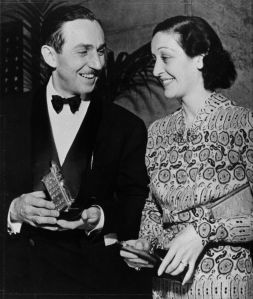
On March 4, 1937, the 9th Academy Awards were held at the Biltmore Hotel in Los Angeles, California. Disney’s Silly Symphony The Country Cousin walked away as the winner for Best Animated Short Film, beating out the likes of Harman-Ising’s The Old Mill Pond and Fleischer Studios Popeye the Sailor Meets Sinbad the Sailor. This was Disney’s fifth win in this category, having dominated since the category’s conception in 1932.

February 15

February 15, 1936 – The Mickey Mouse Short Film Orphan’s Picnic Premieres in Theaters

vlcsnap-2016-02-15-18h07m54s184

“I’ll tell you when to eat!”

On February 15, 1936, the Mickey Mouse short film Orphan’s Picnic was released to theaters. It was directed by Ben Sharpsteen.

Mickey is driving a truck full of orphans, while Donald conducts them in song. Upon arrival in the park, the kids run around, climbing trees and playing in the pond while Donald sets up the picknic. He chases one orphan off when he tries to grab a sandwich, and starts fending off the other orphans that grab the cake. Meanwhile, Mickey is playing a game with some of the orphans, and ends up running into a tree. Donald tries to rescue the food from the hungry orphans, but they pelt him with pie pans and arrows. One orphan gives Donald a flower as an apology, with Donald unaware that there’s a bee inside. The bee chases Donald a bit before flying back to the hive, but Donald, always one to hold a grudge, throws a rock at the hive. The angry swarm chases Donald all around the park, with the orphans watching, laughing, and contributing to the trouble. The boys apologize again, and present him with a sandwich, with Donald once again unaware of the “secret” ingredient: another bee.

February 11

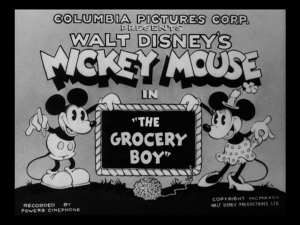
February 11, 1932 – The Mickey Mouse Short Film The Grocery Boy is Released to Theaters

vlcsnap-2016-02-11-18h11m25s172

“Groceries! Groceries!”

On February 11, 1932, the Mickey Mouse short film The Grocery Boy was released to theaters. It was directed by Wilfred Jackson.

Mickey is busy in his grocery store weighing potatoes. Once he completes the task, he tries to unload them, but spills them all over the floor. The phone rings, and he trips over himself to answer it. Minnie is calling, but she is in a foul mood, asking tersely if he would please hurry with her groceries; secretly, she can’t wait to see her sweetheart. Mickey rushes to her house and delivers her groceries with a smile. Mickey says hello, but Minnie tells him goodbye, quite obviously playing hard-to-get. When Mickey angrily tries to leave, he accidentally opens a closet where the ironing board falls out, and the iron falls on Mickey’s head. Minnie drops her ruse and tends to Mickey, but soon has to tend to the turkey in the oven. Mickey musically assists Minnie in preparing the food, with the dishes joining in the melody. Meanwhile, Pluto has also noticed the turkey in the oven, and runs off with it, with Mickey chasing after him around the house. Minnie finally catches the dog and tries to wrestle the turkey away, with little success. Minnie also tries to save the cake they baked, but that crashes on Mickey’s head.


February 6

February 6, 1934 – Vice Chairman and Principal Creative Executive of WDI and Disney Legend Marty Sklar is Born

Marty Sklar

“Our training was by Walt, who was always there pitching in with new ideas and improving everyone else’s input. The fire was that we were constantly breaking new ground to create deadline projects never attempted before in this business. That, I’m proud to say, has never stopped in my years at Disney.”

On February 6, 1934, Martin A. Sklar was born in New Brunswick, New Jersey. He attended UCLA for undergraduate studies, and serves as the editor for the Daily Bruin college newsletter. In 1955, he was recruited to create a newsletter to be sold on Main Street of Disneyland for the park’s first year: The Disneyland News. Upon graduation, Sklar joined Disney, working with Disneyland’s publicity and marketing department and creating the Vacationland magazine. In 1961, Sklar joined WED Enterprises (now known as Walt Disney Imagineering) to work on the special shows for the 1964-1965 New York World’s Fair. During this time, he continued to do publicity work for Walt Disney specifically, writing material to be used in publications and television; he is best known for writing the material for a special 20 minute film about EPCOT. In 1974, Sklar became the Vice President of Concepts and Planning in WDI, where he helped with the development of Epcot in Walt Disney World. He continued to rise in the ranks, with being named Vice President of Creative Development in 1979, Executive Vice President in 1982, and President and Vice Chairman in 1987. He held the last role until 1996. During his tenure, Sklar led the efforts for entertainment concepts within Disneyland Paris, Tokyo Disney Resort, and Hong Kong Disneyland. In 2001, Sklar was not only honored with a special award for 45 years of service in the Disney Company, and was also named a Disney Legend. In 2005, the 50th anniversary of Disneyland, Sklar was named Imagineering’s international ambassador. In 2009, after 53 years at Disney, Sklar retired.

January 30

January 30, 1934 – Executive Vice President for Disney Parks and Disney Legend Bob Matheison is Born

BMatheison

“…Bob has created a rich legacy of quality, integrity, and dedication that will continue to benefit the Walt Disney World resort for many years to come.” – Attractions President Judson Green

On January 30, 1934, Bob Matheison was born in Portland, Oregon. He graduated from USC in 1955, majoring in telecommunications, and joined the Army after graduation. He worked at Fort Hood as the chief of the radio-television branch, which kicked off his career in radio broadcasting. In 1960, Matheison scored a job at Disney through a college friend, and became the sound coordinator for Disneyland; he soon worked his way up to become the manager of Guest Relations, assisting production of broadcasts from the park. In 1965, Walt Disney personally tapped Matheison to work with several attractions set to premiere at the 1965 World’s Fair; he would manage the it’s a small world attraction, along with supervising the technical staff for Magic Skyway, Great Moments with Mr. Lincoln, and the Carousel of Progress. In 1966, Matheison was named the head of the research and development team for the Florida Project (which would eventually become Walt Disney World). While working on this project, he also developed an extensive 13- week training program for executives of the park, which was the forerunner of the Disney Institute corporate training program. In 1969, he was named the director of operations for Disneyland, and took the title to Walt Disney World a year later when sent to set up the new parks operating plan. In 1972, Matheison was promoted to the vice president of operations; in 1984 he was promoted to vice president of Magic Kingdom and EPCOT; in 1987, he reached the position of executive vice president of Walt Disney World. In 1994, after 34 years with the company, Matheison retired. He was honored as a Disney Legend in 1996 for the many hats he wore during his tenure at Disney.

January 13

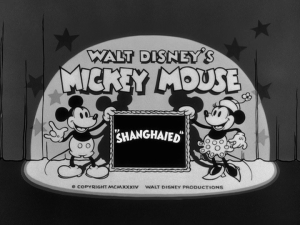
January 13, 1934 – The Mickey Mouse Short Film Shanghaied is Released to Theaters

vlcsnap-2016-01-13-19h12m20s252

“The captain’s got a girl, the captain’s got a girl…”

On January 13, 1934, the Mickey Mouse short film Shanghaied was released to theaters. It was directed by Burt Gillett.

The sailors are singing a song about their captain, mocking that he’s got a girl, when one sailor gets knocked out by Pete, who has tied up Mickey and Minnie in his cabin. Pete walks over to Mickey and mocks him before turning his attention to Minnie. Minnie pays no mind to his flirtations, and her screaming has Mickey breaking free from his bonds to save his girl. Using a swordfish from the wall, Mickey attempts to battle Pete, who continues to not take him seriously. A humorous sword fight ensues, though Mickey’s swordfish proves to be a poor weapon. Mickey, however, is able to use everything in the cabin at his disposal and free Minnie at the same time. As the two start to make their escape, Pete sends his crew after Mickey, but Mickey is able to use a cannon and miscellaneous kitchen supplies to subdue them. With one final attack using a harpoon, Mickey ends the attack by Pete and his crew, leaving Pete to be chased by sharks in the ocean while Mickey and Minnie steer the ship to safety.