RSS Feed

Tag Archives: Mickey Mouse

November 30

November 30, 2010 – The Platform Video Game Epic Mickey is Released

Image credit: amazon.com

Image credit: amazon.com

“The world I had created was ravaged – a wasteland.”

On November 30, 2010, the platform video game Epic Mickey was released in North America, after previous releases in Australia on November 25and in Europe on November 26. Designed by Warren Spector and developed by Junction Point Studios, the game was published by Disney Interactive Studios and released on Nintendo’s Wii console. Epic Mickey was notable for being the first major project with Disney’s first successful animated character, Oswald the Lucky Rabbit, after the reacquisition of the character. The game was also designed to bring back the personality traits of Mickey Mouse from his earlier films, focusing less on the suburban “everyman” character Mickey became, and more on his mischievous and adventurous side. The game received mixed to positive reviews, and sold out its first day from the online Disney Store. Due to its immense popularity, a sequel was released on November 18, 2012.

The plot of the game deals with a land called the Cartoon Wasteland, created by the sorcerer Yen Sid as a home for obscure or discarded Disney characters, such as Oswald and Gremlin Gus. One day, a still-unknown Mickey Mouse enters the workshop where the model of the Cartoon Wasteland stands, and accidentally creates a creature known as the Shadow Blot. Mickey tries to erase it using paint thinner, but ends up spilling the thinner on the model. As Mickey tries to clean up before Yen Side returns, he creates more chaos and gives the Shadow Blot more strength. The Cartoon Wasteland becomes a land of ruin. Years later, the Shadow Blot abducts Mickey and takes him to the Wasteland, where he meets an angry and jealous Oswald. Mickey must use the magic paintbrush to win back Oswald’s trust and return the Cartoon Wasteland to its former glory.

November 29

November 29, 1934 – The First Set of Disney Balloon Joins the Macy’s Christmas Parade

Image credit: Disney Parks Blog

“See gigantic balloons designed by none other than Walt Disney, creator of Mickey Mouse himself!”

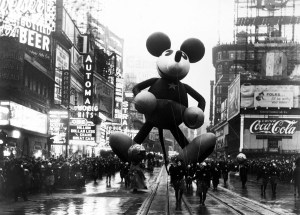
On November 29, 1934, Disney characters made their debut in Macy’s Santa Claus Parade (later renamed the Macy’s Thanksgiving Day Parade). Although Mickey had been a big star since 1928, it wasn’t until 1934 when Disney characters were featured, including Mickey Mouse. The effort of bringing the Disney characters to the parade was due to the efforts of Walt Disney and Tony Sarg of Macy’s.

The Mickey balloon was over 40 feet tall and was held by 25 handlers in Mickey and Minnie Mouse costumes. Balloon Mickey had a giant Macy’s star on his chest in a bit of cross-promotion. Other Disney characters featured were Pluto, the Big Bad Wolf (measuring at 34 feet), one of the Three Little Pigs (measuring at 31 feet), and Horace Horsecollar (measuring at 12 feet).

November 21

November 21, 1952 – The Mickey Mouse Short Film Pluto’s Christmas Tree is Released to Theaters

“Okay Pluto, let’s get our tree!”

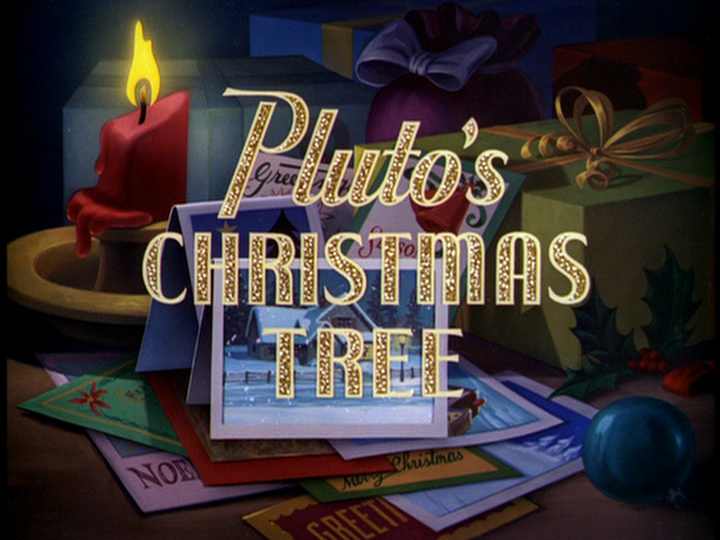
On November 21, 1952, the Mickey Mouse short film Pluto’s Christmas Tree was released to theaters. Although labeled a Mickey Mouse short, Pluto is the main character, with Chip and Dale as his antagonists. It was directed by Jack Hannah, with story by Bill Berg and Milt Schaffer.

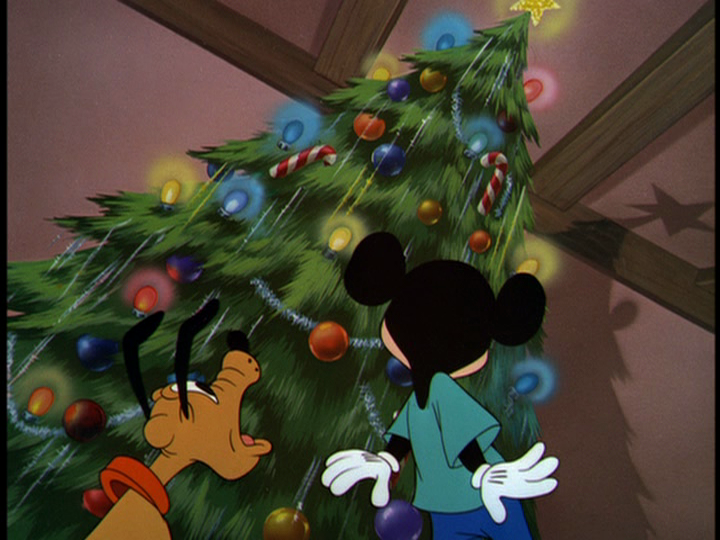
It’s a snowy day in suburbia, when Mickey and Pluto leave their house to go find the perfect Christmas tree. As Pluto sniffs around, Chip and Dale are nearby, gathering nuts. Chip throws one at Pluto, startling the dog. Pluto playfully chases after them, until they hide in a pine tree – the same one Mickey decides to chop down. Mickey and Pluto drag the tree home, and Mickey begins to decorate it. Chip and Dale, having fallen asleep on the journey home, wake up and marvel at the decorations now adorning the tree. Dale spies a candy cane and tries to grab one, but becomes more amused at his reflection in an ornament.

Pluto tries to alert Mickey to the appearance of the chipmunks, but they disappear just as Mickey turns around

After Mickey finishes decorating, Pluto notices a strange light flickering from the side of the tree. He investigates and finds Chip and Dale hiding inside, with Dale throwing ornaments to distract the dog. Pluto tries to alert Mickey to the appearance of the chipmunks, but Mickey just dismisses the dog, leaving Pluto alone again to track down the pair. When he chases Dale, Dale takes the hat and beard off of one of Mickey’s Santa candles and puts them on, trying to fool the dog. When Pluto barks, Mickey goes to light the candles; so as not to catch on fire, Dale blows the match out once it comes close. Pluto once again resumes his chase of the chipmunks, and dives into the tree. A fight that includes Mickey ensues, ending with the tree’s destruction. While initially mad at Pluto, Mickey is surprised to see the chipmunks in the tree. Mickey invites them to stay, as it is Christmas. They hear Goofy, Donald, and Minnie caroling outside, and all watch from the window.

November 18

November 18, 1928 – The First Mickey Mouse Short Film, Steamboat Willie, Premieres

“I only hope that we never lose sight of one thing – that it was all started by a mouse.” – Walt Disney

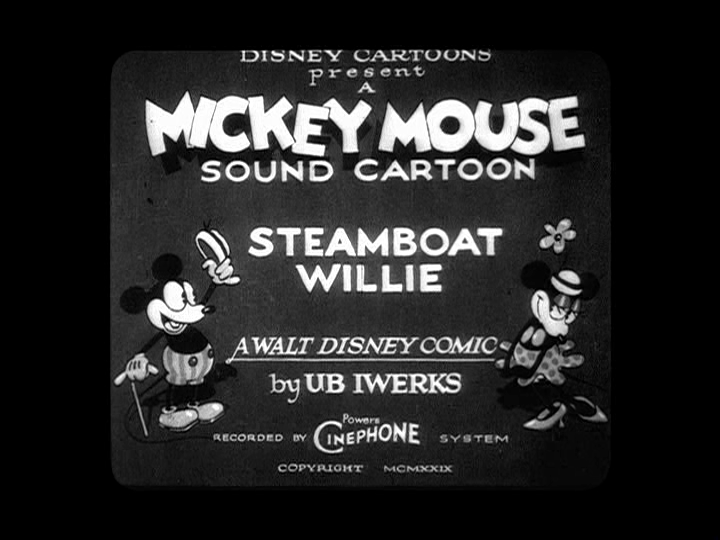
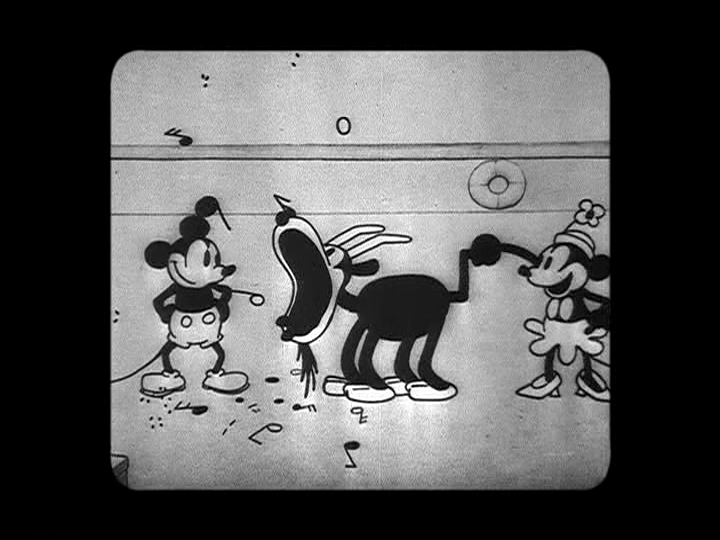
On November 18, 1928, the first Mickey Mouse short film, Steamboat Willie, premiered in theaters. Not only is it notable for being the first Mickey Mouse short film released (although not the first Mickey Mouse short produced), but it is also notable for being one of the first cartoons with synchronized sound, and the first to have a fully post-produced soundtrack. When Walt Disney was unable to get a deal with RCA or Western Electric for the film, he turned to Pat Powers and his bootleg Powers Cinephone process. The initial recording session was a disaster, which ended with Disney hiring a 15-piece band to play, and Walt Disney voicing all of the characters. The film’s title was a parody of a Buster Keaton film called Steamboat Bill Jr. The Disney film premiered at the Colony Theater in New York, and was an instant success, skyrocketing Mickey and the Disney Studios to stardom.

A steamboat is heading down the river, with Mickey at the wheel, whistling a “Steamboat Bill.” Pete appears behind him, yells at him for taking control of the boat, and sends the mouse flying onto the lower deck. The boat reaches Podunk Landing and the cargo is loaded quickly. A frantic Minnie Mouse sprints to catch the boat before it leaves, only to just miss it. Luckily, Mickey hears her cries and uses the hook on the boat to bring her aboard. She drops her guitar and sheet music, which is soon devoured by a nearby goat.

After the goat eats Minnie’s sheet music, the two use the goat to play the tune “Turkey in the Straw”

As Mickey tries to pull the guitar away from the goat, he and Minnie come to the conclusion that the goat can be worked like a turn-crank record player. Using whatever materials he can find, including an animal menagerie, the two begin their own rendition of “Turkey in the Straw.” After the performance, Mickey turns around to find Pete waiting for him angrily, and is sent to the galley to peel potatoes.

November 15

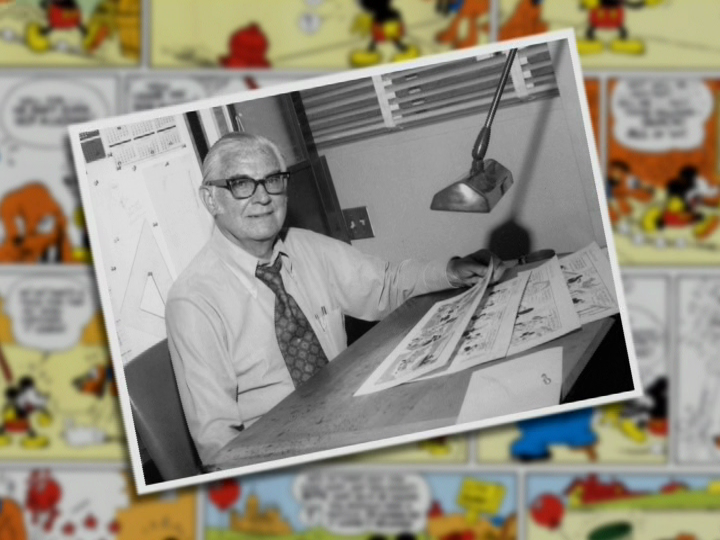
November 15, 1975 – Floyd Gottfredson’s Final Daily Strip is Published

“Floyd played a major role in getting Disney’s (then) new character, Mickey Mouse, known throughout the world by producing Mickey’s daily comic strip.” – Archivist Dave Smith

On November 15, 1975, the final daily strip drawn by comic strip artist Floyd Gottfredson was published. Gottfredson, having drawn the comic as a “temporary assignment” in 1930, retired from the Disney Company on October 1, 1975. The comics began as an adaptation of the short films, evolving into a humorous adventure. As Gottfredson continued the strip, the strip became more gag focused as the size of comics shrank.

November 12

November 12, 1932 – The Mickey Mouse Short Film The Klondike Kid is Released to Theaters

“Guess we’re both nobodys.”

On November 12, 1932, the Mickey Mouse short film The Klondike Kid was released to theaters. The short was directed by Wilfred Jackson, and stars Walt Disney as Mickey Mouse, Marcellite Garner as Minnie Mouse, Pinto Colvig as Goofy and Pluto, and Billy Bletcher as Pierre.

The short opens at the Klondike Bar in the middle of a blizzard, but inside, the atmosphere is merry with many people drinking and dancing. Mickey is playing the piano, and scrapes up the change people throw at him when he finishes. As he gathers the coins, he notices at the window a girl, who faints in the snow. He rescues her, bringing her into the warmth. She begins to cry, and when Mickey asks her name, she responds that she’s just “nobody.” She laughs at his jokes, and warms up to him when he offers her some food.

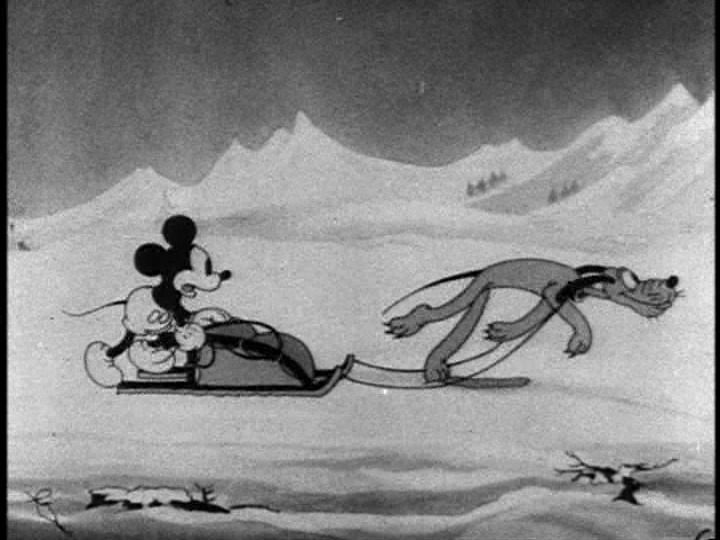
After Pierre kidnaps the girl, Mickey uses Pluto as his sled dog and pursue the villain

The door of the bar bursts open, and in storms Peg Leg Pierre, who attacks Mickey and pins him to the wall before he kidnaps the girl. As she screams in terror, many of the patrons try to help her, but are prevented by an ensuing gunfight. Pierre steals her away, but Mickey frees himself and chases after her. He harnesses Pluto as his sled dog, but Pluto gets the idea of running only after he spots a rabbit to chase. The sled breaks, and Mickey finds himself skiing down the hill into Pierre’s hideout.

Inside Pierre’s cabin, Mickey and Pierre fight and the two are caught in mattress springs. Meanwhile’s Pluto’s rabbit chase ends with him snowballing down the hill and knocking Pierre’s cabin from its foundation. As the short ends, Pierre is knocked out, and Mickey and the girl attempt to kiss, only to kiss Pluto, who pops out of the snow in between them.

October 27

October 27, 1954 – The Television Series Disneyland Premieres on ABC

“…this year, we want you to see and share with us the experience of building this dream into a reality.”

On October 27, 1954, the first episode of the Disney anthology series Disneyland premiered on ABC. The show, named after the theme park Walt Disney was planning to build, gave audiences glimpses of the dream that would become the California theme park. The first episode was entitled “The Disneyland Story,” and was directed by Robert Florey.

When Walt Disney was in the midst of creating his theme park, he realized that the only way he could secure enough funding was to embrace the new medium of television. He struck a deal with the then-fledgling ABC network, which agreed to help provide financing if he created a weekly hour-long television show for them, with Walt as host. This show made Walt Disney a familiar figure in households nationwide, and created several staples in popular culture, including the Davy Crockett craze of the 1950s.

“The Disneyland Story” begins with an aerial view of the Walt Disney Studio in Burbank, California. There is then a behind the scenes view at what is going on at the studios, including a look at the upcoming film 20,000 Leagues Under the Sea, a live-action model stage for Sleeping Beauty, and some strange music being composed in the music department. The narrator takes us to a place called the Disneyland Plans Room, where “something unusual is going on in the studio today, something that never happened before.” Walt then takes over as host, introducing his vision of Disneyland, the four worlds of the park, and the format of the four worlds of the television show. Introducing Frontierland, he then presents a segment about the Davy Crockett serial that will soon begin filming, and introduces Fess Parker, who sings the theme song.

Going to Adventureland, Walt presents producer Ben Sharpsteen, who talks about the planned area and shows some films they’ve done of the Galapagos Islands, the Falkland Islands, Lapland, Morocco, and Portugal. Walt introduces Tomorrowland, and director and animator Ward Kimball explains the plans and ideas for the Tomorrowland segments, including designing and building the first passenger-carrying rocket. The last realm Disney introduces is Fantasyland, where “in this land, hopes and dreams are all that matter.” He then says that Uncle Remus would have called it a “laughing place,” which leads into the “laughing place” segment from Song of the South.

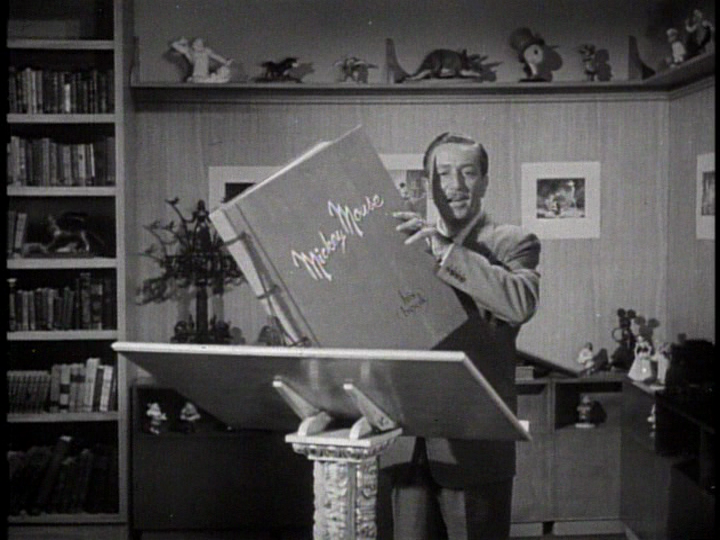
Walt Disney pulls down a book from his shelves that chronicles the life of his greatest star, Mickey Mouse

To remind everyone that “it all started with a mouse,” Walt then presents the story of Mickey Mouse, starting with his humble beginnings in the short film Plane Crazy. He introduces Mickey’s friends and fellow stars – Pluto, Goofy, and Donald – before presenting one of the most important roles in Mickey’s career: the role of the sorcerer’s apprentice in Fantasia. After exploring Mickey’s career, clips are shown of the next week’s episode, a presentation of the Disney film Alice in Wonderland.

October 15

October 15, 1937 – The Mickey Mouse Short Film Clock Cleaners is Released to Theaters

“Hickory dickory dock, the mouse ran up the clock…”

On October 15, 1937, the Mickey Mouse short film Clock Cleaners was released to theaters. The short was directed by Ben Sharpsteen, and stars Walt Disney as Mickey Mouse, Clarence Nash as Donald Duck, and Pinto Colvig as Goofy. The short is also notable for being edited; at one point, Donald yells “Says who?” to the spring mocking him, which was misconstrued in the 90s as Donald cursing. However, the Hays Code, adopted in 1930, would not have allowed such language in the first place.

At the top of a high clock tower, the bell rings three o’clock. Mickey is seen on the clock face, standing on the second hand and cleaning the numbers. Inside, Goofy is seen brushing the gears, and Donald grabs a mop to clean the main spring, even though there are several signs telling him to keep off the mainspring. As he cleans the spring, his mop gets caught, and as he pulls it loose, the spring uncoils, trapping Donald inside.

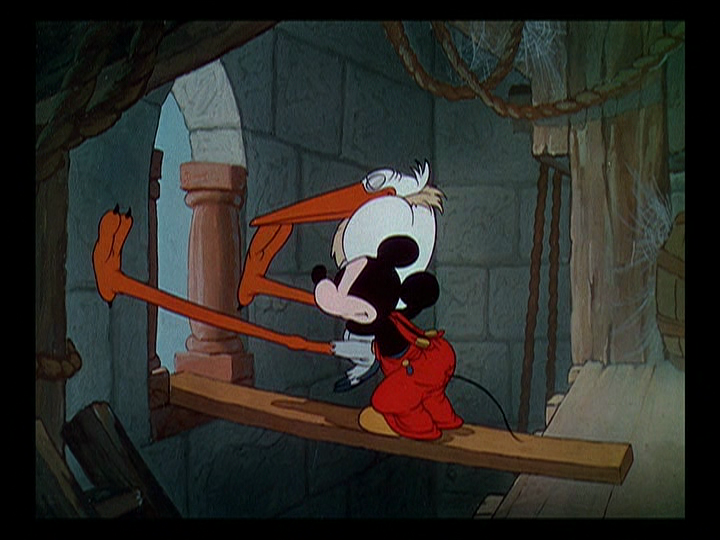
Even while sleeping, the stork is able to outwit Mickey as the mouse tries to throw the stork out of the clock tower

Mickey begins sweeping inside, and hears snoring from nearby gears. He spies a stork asleep in a nest above some gears, and tries to wake it. The stork ignores Mickey, continuing to sleep, and eluding the mouse with every move. The stork then throws Mickey out the window. As this happens, Donald attempts to put the spring back together, only to have it taunt him and knock him into the cogs nearby. Donald is knocked back and forth, and is unable to stop moving his body back and forth after being thrown from the cogs.

Goofy is seen cleaning the bell of the tower, when it strikes four o’clock. He is hit in the head by the mechanical statues that ring the bell, and begins to walk around in a daze. Mickey notices just in time that Goofy is about to fall off the building, and begins to run around after him, preventing him from falling to his doom. Unfortunately, Goofy falls through a missing ring in a ladder, only to be shot back up by a flag pole, sending him and Mickey flying into the clock tower. They land on the main spring, just after Donald finally got it back together, and all three are sent flying into the cogs the Donald was knocked into before, unable to stop their bodies from dancing back and forth from the cog’s motion.

September 30

September 30, 2006 – Dream-Along With Mickey Debuts at Walt Disney World

Image Credit: Walt Disney World official site

“Mickey invites you to join him and celebrate the magic of dreams at this fun-filled, dream-inspired musical show where adventure and ‘happily ever after’ come alive right in front of your eyes.”

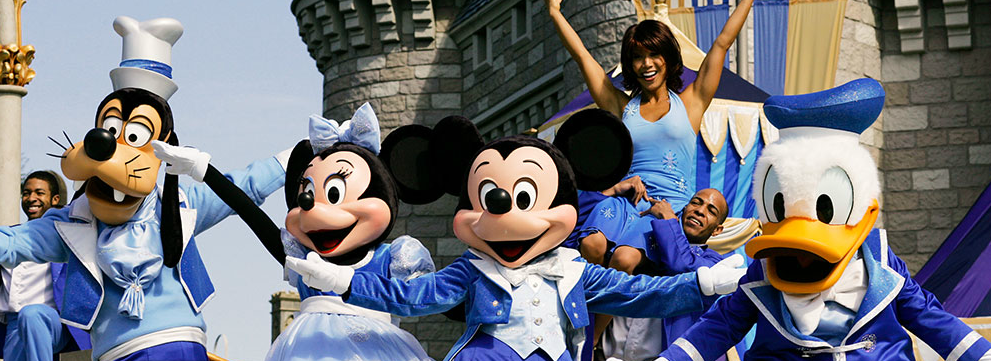
On September 30, 2006, the musical stage show Dream-Along With Mickey debuted at Walt Disney World’s Magic Kingdom. The show stars not only Mickey and the gang, but includes appearances by Cinderella, Aurora, Snow White, Captain Hook, and Peter Pan, among others. As the celebration part of the show begins, Maleficent from Sleeping Beauty appears, and Mickey has to stop her from turning dreams into nightmares, with the help of the audience. The show is 20 minutes long, and takes place at Main Street within the Magic Kingdom.

September 27

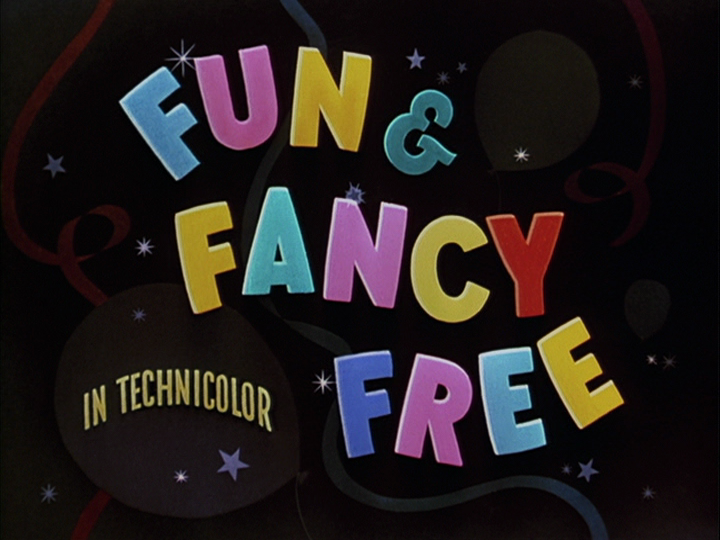
September 27, 1947 – The Ninth Animated Feature Film, Fun and Fancy Free, is Released to Theaters
“So if you’d really like to be happy-go-lucky just like me, drown your frowns my friend and you will see, you’ll see, that you’ll be full of fun and fancy-free.”

On September 27, 1947, the ninth animated feature film, Fun and Fancy Free, was released to theaters. It was the second package film released by Disney, comprised of two stories: Bongo (written originally by Sinclair Lewis), and Mickey and the Beanstalk, a retelling of the classic tale Jack and the Beanstalk. The two were originally meant to be full-length features of their own. Although Mickey was in the feature film Fantasia, this was the first time Goofy and Donald were also used to carry a feature film. As the story was tightened, many scenes were dropped, including the scene where Mickey receives the magic beans for his cow from none other than Minnie Mouse, playing the queen. The two stories were stopped in development when the country entered World War II. The live action segments were directed by William Morgan, with the animation sequences directed by Jack Kinney, Bill Roberts, and Hamilton Luske. The film included the talents of Anita Gordon, Cliff Edwards, Billy Gilbert, The Kings Men, the Dinning Sisters, and the Starlighters, as well as Edgar Bergen (ventriloquist for Charlie McCarthy and Mortimer Snerd) and Luana Patten. This film also marks the last time Walt Disney voiced the character of Mickey Mouse, as he would have sound effects man Jimmy MacDonald take over the role.

The movie begins with the voice of Jiminy Cricket ringing out, singing about being happy-go-lucky, and begins to sing and dance around a library, expressing his sadness about the whole world worrying about so many things. “But why get so excited,” he asks. “What’s going to be is going to be.” Unfortunately, he runs into a cat that chases him out of the library. He finds himself in a girl’s room, coming across what he calls a “deadpan doll and a droopy bear.” To cheer them up, he puts on a record about the story of Bongo, a musical story sung by Dinah Shore.
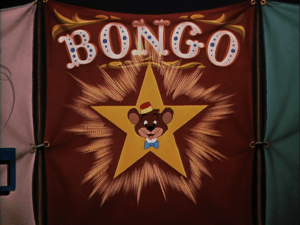
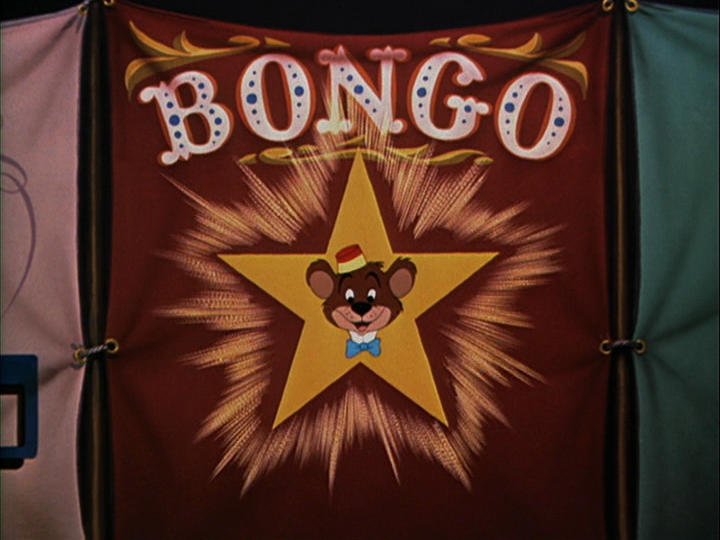
The story of Bongo begins with his days in the circus, where he was the star

Bongo is a circus bear: “he was born in the circus, grew up in the circus; in fact, Bongo was the star of the circus.” Bongo was seen as being able to do it all, with the circus tent packed with fans that wanted to see him perform the greatest of stunts. But although Bongo appeared thrilled with what he was doing, he was a prisoner of the circus, kept in a cage. He spent his nights dreaming of a place where he was free from the circus life. One fateful day, he decides to answer the call of the wild, and escapes from the circus train. Finally free, he explores the woods where he landed, smelling the flowers and leaping over tree roots. Unfortunately, Bongo doesn’t know how to survive in the woods, but he’s still elated to be out in nature. He soon makes friends with the animals of the forest, and they walk around, exploring their surroundings.

Unfortunately, life in the woods is not as pleasant as Bongo thought, as at first he is unable to get to sleep, then finds himself caught in a storm. He becomes discouraged that his dream life wasn’t the way he thought it would be, and even more discouraged that he can’t even catch food like a real bear would. As he tries to catch a fish, he hears the giggle of a young female bear named Lulubelle, and begins to follow her as she flirts with him. The two quickly fall in love, but there is one problem: Lumpjaw, the roughest, toughest, meanest bear in the woods, who wants Lulubelle all to himself. After some mixup, Lulubelle ends up in Lumpjaw’s arms, with Bongo being left heartbroken, as he didn’t understand the way of bears (bears express their love by slapping). Lulubelle sneaks away from the bears to find Bongo, and a fight ensues between Bongo and Lumpjaw, with Bongo using his circus skills to win. Lulubelle and Bongo live happily ever after in love.
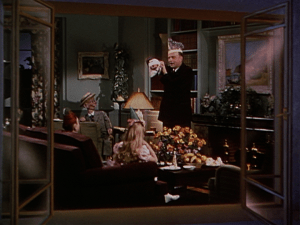
Jiminy decides to attend a party hosted by Edgar Bergen (C), with his puppets Charlie McCarthy and Mortimer Snerd, with Luana Patten as the guest

After the story ends, Jiminy comes across a party invitation for Luana Patten at Edgar Bergen’s house across the way, and decides to attend himself. Bergen is entertaining Luana, Mortimer Snerd, and Charlie McCarthy, and decides to tell the group a story: Mickey and the Beanstalk. He has Luana create a picture in his mind of Happy Valley, where Mickey, Goofy, and Donald live. Happy Valley was a prosperous place, with a magic singing harp residing in its castle, casting a spell of joy over the entire valley. One day, a mysterious shadow appears in Happy Valley, and steals the harp from the castle. Once the harp is stolen, the valley loses its joy and prosperity. The audience is taken inside the cottage of Mickey, Goofy, and Donald, sharing a pitiful meal. Unable to take it anymore, Donald loses his cool, going mad with hunger and desperation. He takes the axe from the wall and decides to kill their beloved cow.

The next day, Mickey decides to take their cow to market, with Goofy and Donald hopeful that they will be able to afford food. When Mickey comes home, however, he informs them that he sold the cow for magic beans. Donald loses his cool again, throwing the beans away. Once the moon hits the spot where the beans fell, however, a giant beanstalk begins to grow, destroying their house in the process and sending the trio sky high. When morning comes, the three are amazed to see a castle in the sky, and decide to explore. After surviving an attack a giant dragonfly, the three reach the castle steps and climb inside. They discover that the banquet table is covered in food, and don’t hesitate to eat the best meal they’ve had in ages. They also discover the harp being held hostage in a treasure box nearby, and she warns them about the giant, as he has the ability to turn himself into anything he wishes.
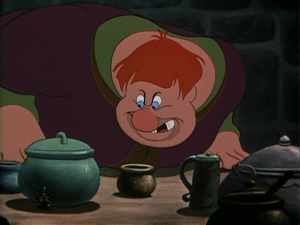
The giant suddenly appears, and looks around the table for the trio

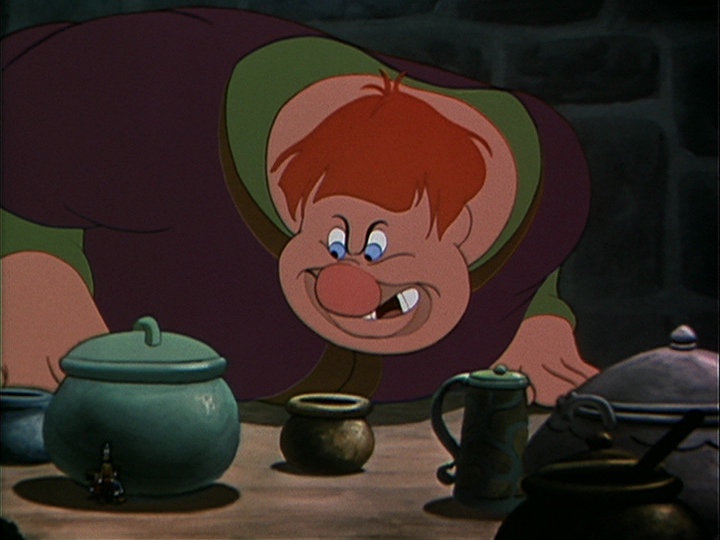
Suddenly, the giant appears, singing a simple song about himself and adding the words, “Fe Fi Fo Fum.” He smells the scent of the trio and searches for them, but gets distracted by the food on the table and begins to eat. He catches Mickey, but with Mickey’s quick thinking, he’s able to escape, tricking the giant into changing into a fly. However, the giant would rather change into a pink bunny rabbit, and when he spies the trio with a flyswatter, he catches them and throws them into the treasure box, keeping the harp out for her to sing him to sleep. With the harp’s help, Mickey is able to free his friends and escape with the harp. The giant wakes up as they begin their escape and chases after the three. When the trio makes it to the bottom of the beanstalk, they grab a saw and begin to chop the beanstalk down, sending the giant tumbling down to earth. Happy Valley is returned to its peaceful and prosperous state.

As Bergen finishes telling the story, he notices that Mortimer begins to cry over the death of the giant. Bergen tries to explain that the giant never existed, and is succeeding until the roof of his house lifts, and the giant appears, asking the group if they’ve seen a mouse. Bergen faints, and the giant leaves, exploring Hollywood for signs of Mickey (and taking the Brown Derby restaurant with him as a new hat).