RSS Feed

Tag Archives: Academy Award Nominated

June 26

June 26, 2007 – Two Albums for Pixar’s Animated Feature Film Ratatouille are Released Through Walt Disney Records

60942.FOLDER 0102.indd

“Dreams are to lovers as wine is to friends…”

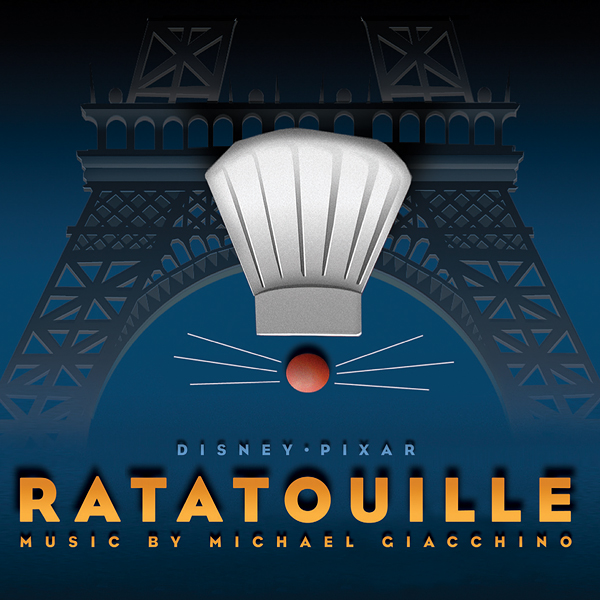
On June 26, 2007, two soundtrack albums for Pixar’s with animated feature film Ratatouille were released through Walt Disney Records: the official score composed by Michael Giacchino, and a compilation album entitled Ratatouille: What’s Cooking? This was Giacchino’s second time working with Pixar, having worked with director Brad Bird on The Incredibles. French artist Camille was hired to perform the ending song “Le Festin” (translation: the feast), with the song remaining in French in each translated version of the film. The score garnered Giacchino his first Academy Award nomination for Best Original Score and his first Grammy Award for Best Score Soundtrack Album. The second album is a compilation of songs that are inspired, rather than taken from, the film. The album includes tracks titled “Saturday Night Fish Fry” and “Banana Split for My Baby,” and are performed by Fred Mollin and the Blue Sea Band, Johnny Neel, and Troy Johnson.

June 24

June 24, 2008 – The Soundtrack to the Pixar Animated Film Wall-E is Released Through Walt Disney Records

Wall-ESoundtrack

“We’re coming down to the ground, we hear the birds sing in the trees, and the land will be looked after, we send the seeds out in the breeze.”

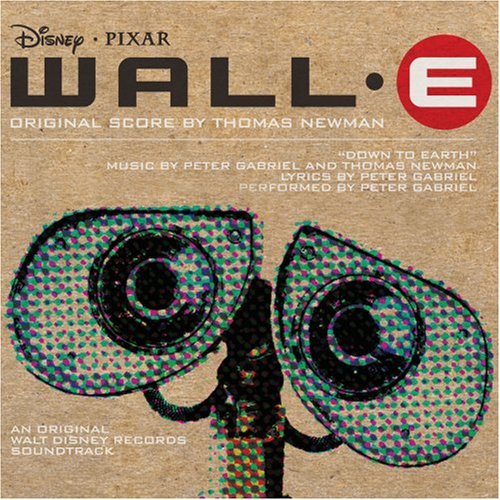
On June 24, 2008, the soundtrack to Pixar’s ninth animated feature film Wall-E was released through Walt Disney Records. Composed by Thomas Newman, this is Newman’s second collaboration with Pixar, his first being Finding Nemo. Included in the soundtrack is the original song for the film “Down to Earth,” written and performed by Peter Gabriel, “La vie en Rose” performed by Louis Armstrong, and two excerpts from the musical film Hello, Dolly!: “Put On Your Sunday Clothes” and “It Only Takes a Moment,” both sung by Michael Crawford. The soundtrack won two Grammy Awards for Best Original Song (“Down to Earth”) and Best Instrumental Arrangement for the piece “Define Dancing,” and was nominated for Best Motion Picture Score, but lost to The Dark Knight by James Newton Howard and Hans Zimmer. The soundtrack was also nominated for two Academy Awards for Best Original Music Score and Best Original Song, both losing to Slumdog Millionaire.

June 22

June 22, 2004 – Six Disney Songs are Listed on AFI’s 100 Years…100 Songs List

 100years_songs

“When you wish upon a star, your dreams come true.”

On June 22, 2004, the American Film Institute released their list of the top 100 songs in American cinema in a documentary special on CBS, known as 100 Years…100 Songs. Of the 400 nominees, six Disney songs were included in the final list, ranging from Disney’s early years to the Disney Renaissance period. The highest ranking song was “When You Wish Upon a Star” from Pinocchio, ranking at number 7. “Some Day My Prince Will Come” from Snow White and the Seven Dwarfs ranked at number 19, “Supercalifragilisticexpialidocious” from Mary Poppins ranked at number 36, “Zip-a-Dee-Doo-Dah” from Song of the South ranked at number 47, “Beauty and the Beast” ranked at number 62, and “Hakuna Matata” from The Lion King ranked at number 99.

June 18

June 18, 1999 – The 37th Animated Feature Film Tarzan is Generally Released
vlcsnap-2013-06-18-05h23m51s252

“Somewhere, something is calling for you. Two worlds: one family.”

On June 18, 1999, Disney’s 37th Animated Feature Film Tarzan was released generally to theaters. The film was based on Tarzan of the Apes by Edgar Rice Burroughs. Glen Keane, animator for adult Tarzan, designed the character after watching his son perform skateboarding stunts and by watching extreme sports, giving the character a feel of “surfing” through the jungle. For the jungle, a new 3D painting and rendering technique was created for film, called Deep Canvas. This technique allows animators to create a computer animated background that still has the feel of a traditional painted background; it was awarded a special Academy Award in 2003. The songs for the film were written and performed by singer-songwriter Phil Collins, with score by Mark Mancina. Collins’ song “You’ll Be in My Heart” won the Academy Award and Golden Globe for best Original Song. The film overall was a critical and financial success, and was the last film of the Disney Renaissance to have a box office impact. The screenplay was written by Tab Murphy, Bob Tzudiker, and Noni White, and was directed by Chris Buck and Kevin Lima. It stars Tony Goldwyn as Tarzan, Minnie Driver as Jane, Glenn Close as Kala, Lance Henriksen as Kerchak, Brian Blessed as Clayton, Nigel Hawthorne as Professor Porter, Rosie O’Donnell as Terk, and Wayne Knight as Tantor.

There’s been a shipwreck, but a couple and their young child have been able to make it out alive. They look to the jungle as a place of safety in their small boat, and sail towards it. In the jungle, a gorilla couple is also enjoying family time with their baby. The scenes switch between the two families as they work on creating homes for themselves. One night, the baby gorilla wakes up and goes after a frog to play with it, unaware that the leopardess Sabor is nearby and on the prowl. The baby is unable to escape, and is viciously attacked and killed by Sabor. As the gorillas migrate, the mother, Kala, sadly trails behind, until she hears the sound of a baby cry, and takes off in its direction. She comes across the tree house that the human family has built, and opens the door to find that Sabor has killed the parents inside. She hears the baby cry from its crib, and finds that he has not been harmed. Kala takes to the child, and adopts him as her own. However, she soon discovers that Sabor never left the house, and runs to escape, the baby still in her hands. Sabor chases the baby after Kala accidentally drops him into netting nearby, but they manage to escape, and Kala brings the baby back to her herd.
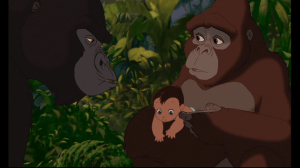
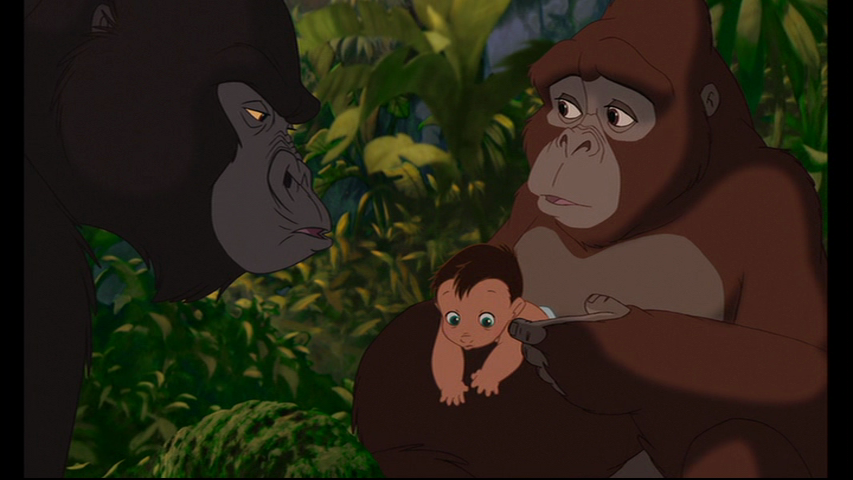
Kala tells Kerchak her intentions of adopting the baby as her own, but he refuses to accept the child

Kala tells Kerchak her intentions of adopting the baby as her own, but he refuses to accept the child

When Kala joins the herd, she declares that she will be the baby’s mother, although her mate Kerchak refuses to accept him. He begrudgingly accepts that Kala will raise him, but tells her that he will never acknowledge him as his son. Kala decides to call the baby Tarzan. The years pass, and Tarzan has grown into a willful child, who still has a hard time fitting in with the herd. Although he is friends with another gorilla named Terk, the other children want nothing to do with what they call the “hairless wonder.” The kids play a prank on him, telling him he can play with them if he retrieves a hair from an elephant and, desperate to fit in, goes to get one, but nearly ends up stomped to death by the elephants. He accidentally starts a stampede that breaks through where the gorillas are nesting, incurring the wrath of Kerchak. Saddened that Kerchak believes that Tarzan will never fit in with the herd, he runs away. Kala finds him later, and tells him that they are family, as their hearts are exactly the same. With renewed vigor, Tarzan is determined to prove his worth to the family.

After adapting to everything in the jungle, Tarzan grows into a strong man, able to hold his own against anything. One day, Tarzan senses something nearby, and narrowly escapes when Sabor breaks through. Kerchak tries to defend the family against Sabor, and Tarzan assists him by taking on the leopardess. In the end, Tarzan manages to kill Sabor, and the whole herd cheers. It looks like Kerchak is about to accept Tarzan as a member of the herd, when a strange sound pierces through the jungle. Kerchak informs everyone they need to move, but Tarzan goes off to explore the strange sound. He comes across a trio of people, and studies them carefully: a trigger-happy guide named Mr. Clayton, Professor Porter, and his daughter, Jane. Jane takes a moment to draw a baby baboon, but is soon chased by the baby’s entire herd. Tarzan soon jumps in to save her. She is rather frightened by Tarzan, but soon discovers that he is rather gentle and nothing to fear. He introduces himself, and starts mimicking her, quickly picking up English. He then helps take her back to her camp.
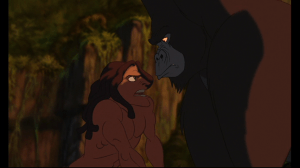
Tarzan and Kerchak clash over the idea of whether the humans are dangerous or not

Tarzan and Kerchak clash over the idea of whether the humans are dangerous or not

Terk, elephant friend Tantor, and other members of the herd go looking for Tarzan, and come across the camp set up by the Professor and Clayton. The group starts trashing the camp, but are soon chased away by an angry Kerchak. The Professor and Clayton return to the camp after Tarzan leaves with the frightened herd, and Jane relays the story of how Tarzan saved her to her companions. Back at the nest, Kerchak decrees that no one is to go near the strangers, and gets into an argument with Tarzan, as Tarzan does not believe Jane to be dangerous. Tarzan is furious, wondering why Kala never told him that there were creatures that looked like him. Jane tells her father about Tarzan, and Tarzan soon returns to the camp to see her. Jane then decides to teach Tarzan about the world outside of the jungle, while Clayton wishes to use Tarzan to find the gorillas. Tarzan and Jane grow closer, and Jane asks if Tarzan will take them to the gorillas, but he refuses, as he wishes to obey Kerchak. Unfortunately, the ship soon arrives to take the professor and Jane back to England, and Jane asks Tarzan to come with her. Tarzan says he can’t, and asks her to stay. Clayton then takes advantage of Tarzan’s feelings for Jane, and has Tarzan take them to see the gorillas, as Clayton says Jane will wish to stay if she sees them.

Terk and Tantor keep Kerchak occupied as Tarzan takes Jane to the camp. Unfortunately, Kerchak arrives to find the group there, and attacks Clayton. Tarzan saves them from Kerchak, but also alienates himself from the family in the process. Kala finally reveals the truth about Tarzan’s parents, and leaves him to make up his mind about if he should stay in the jungle or go with Jane. In the end, Tarzan decides to go back to England with Jane, much to the sorrow of Kala. As the humans head to the ship, Clayton reveals his true intentions of capturing all of the gorillas, with Jane and the professor trapped in cages to prevent them from stopping Clayon’s plan. Terk and Tantor, hearing Tarzan’s cry for help, set out to rescue their friend. In the jungle, Kerchak and the herd sense danger, and as he tries to protect the herd, he is soon captured. As the herd is trapped in cages and tied down by ropes, Tarzan appears in the mist, bringing with him a whole herd of jungle animals to free the herd. Kerchak asks in surprise that Tarzan came back, and Tarzan tells him that he came home. As Clayton tries to shoot Tarzan, Kerchak takes the bullet. Angered, Tarzan fights Clayton, destroying his gun. As Clayton tries to attack Tarzan with his knife, he is caught in the vines, and dies by hanging as a vine stays wrapped around his neck. Tarzan returns to the herd to fine Kerchak dying. Kerchak finally accepts Tarzan as his son, and asks that Tarzan take care of the family from then on.
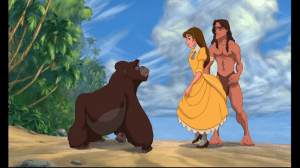
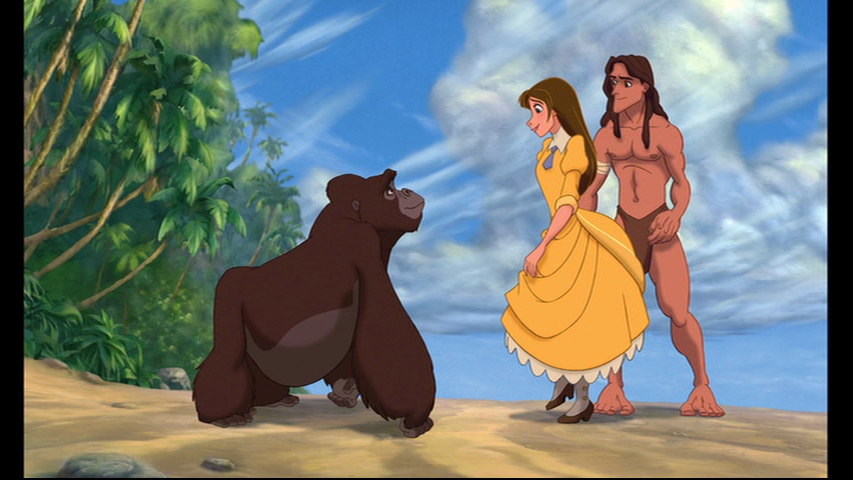
Jane, deciding to stay, is welcomed into the family

Jane, deciding to stay, is welcomed into the family

Jane still has to return to England, and the two say goodbye on the beach. Jane is heartbroken with having to leave Tarzan behind, and her father tells her that she needs to stay. Realizing that with Tarzan is where she belongs, she returns to the beach and embraces Tarzan. The Professor decides he wishes to stay as well, and the two effectively join the family.
May 21

Posted on

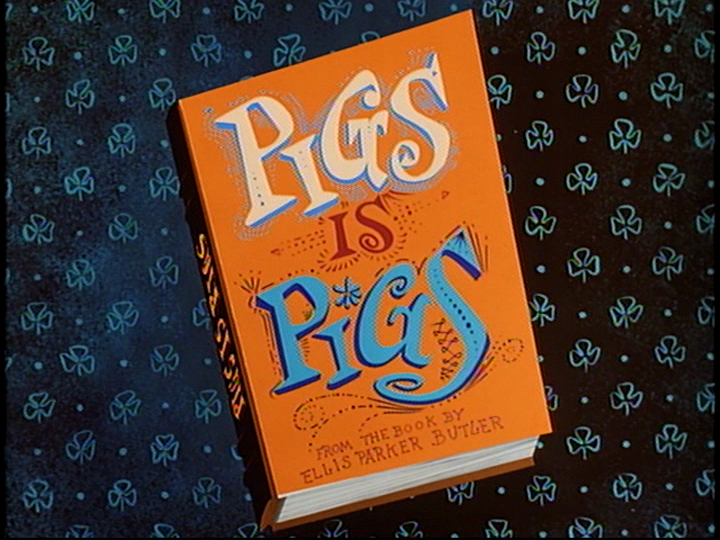
May 21, 1954 – The Special Short Film Pigs is Pigs is Released to Theaters

vlcsnap-2013-05-21-04h26m08s43

“Whenever an agent gets in a debate, and there is an argument over the rate, the agent must wire for a rule and apply, and hold onto the package until they reply.”

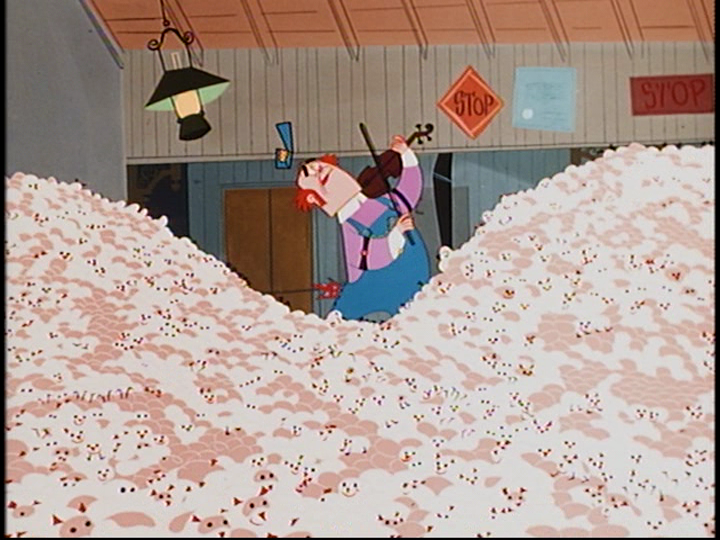
On May 21, 1954, the special short film Pigs is Pigs was released to theaters. The short was based on the short story by Ellis Parker Butler, which was first published in 1905. The style of animation used in the short was based on the UPA style of limited animation, which was very popular in this time period. It was directed by Jack Kinney, with story by Leo Salkin and animation by John Sibley. The short was nominated for an Academy Award.

At the Westcote Railway Station, Agent Flannery gets ready for the day. Flannery is known as the best agent there is, as he follows each rule to the letter. One day, he receives a package of two guinea pigs, and, having never seen guinea pigs before, notices that they don’t look like pigs, but he’ll follow the rules for pigs, as “it says [they] are” with “the writing plain to see.” A customer named McMorehouse arrives to pick up the guinea pigs, and is incensed to find that pigs cost four cents more than pets, and argues with Flannery that guinea pigs are pets, not pigs. McMorehouse refuses to pay the extra money, and Flannery states that in the case of a debate between the agent and customer, he’ll have to contact the main office for a ruling; until then, he will have to hold on to the package. McMorehouse storms out, saying that when Flannery finds he’s wrong, he is to send the package to his address.

Flannery is swamped by the ever multiplying guinea pigs, and tries to calm them with Irish jigs

Flannery is swamped by the ever multiplying guinea pigs, and tries to calm them with Irish jigs

At the headquarters, the telegram arrives from Flannery and goes through a very regimented process of signing, dating, and copying. Meanwhile, Flannery tries to take care of the guinea pigs, only to find that they have started breeding. He creates a bigger crate for the guinea pigs, as there are now nine, but multiplying fast, with guinea pigs in every drawer and bursting from every place possible. At headquarters, the debate continues, with everyone up to the board of directors trying to determine whether guinea pigs are pigs or pets. They finally determine that guinea pigs are pets, and the lower rate applies. The guinea pigs multiply and multiply, bursting out of the Westcote Station. When Flannery gets the telegram, he rushes to McMorehouse’s home, only to find that that McMorehouse doesn’t live there anymore. He wires the office again, asking what he should do in this situation, as there is no rule for this. Not knowing that they pigs have multiplied into “two million and two,” the office makes a recommendation that the guinea pigs be sent there. Flannery fills six hundred boxcars with guinea pigs and sends them on their way. The guinea pigs are stored everywhere in the whole company, even the president’s office. From that day forward, Flannery refuses to follow the rules to the letter anymore, declaring that all animals will thereby be classified as pets.

February 27

February 27, 2005 – The Pixar Film The Incredibles Wins Two Academy Awards

BradBird

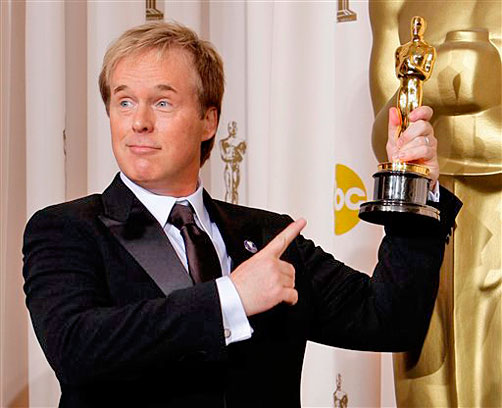
“Animation is about creating the illusion of life, and you can’t create it if you don’t have one.” – Brad Bird at his acceptance speech

On February 27, 2005, the 77th Academy Awards were held at the Kodak Theater in Los Angeles, California. Nominated for four Academy Awards, the sixth Pixar film, The Incredibles, walked away with two, including Best Animated Feature, beating out DreamWorks’ Shark Tale and Shrek 2. The Academy was also awarded the Best Sound Editing Oscar to Michael Silvers and Randy Thom, who were nominated against Paul N.J. Ottosson for Spider-Man 2 and Randy Thom and Dennis Leonard for The Polar Express. This would be director Brad Bird’s first Academy Award; he would win again three years later for Ratatouille.

February 19

February 19, 1968 – The Jungle Book and The Happiest Millionaire are Announced as Academy Award Nominees

1_Feb19

“Look for the bare necessities, the simple bare necessities, forget about your worries and your strife.”

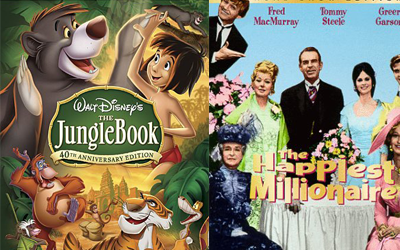
On February 19, 1968, the nominees for the 40th Academy Awards were announced, with Disney films receiving two: Best Original Song for “The Bare Necessities” from The Jungle Book, and Best Costume Design for Bill Thomas for The Happiest Millionaire. These were two of the last productions that Walt Disney would play an active role in before his passing in 1966. Both films would unfortunately lose in their categories.

February 8

February 8, 1952 – The Special Short Film Lambert, the Sheepish Lion Premieres in Theaters

vlcsnap-2013-02-07-21h11m42s207

“Lambert, the sheepish lion, Lambert, is always trying to be a wild and wooly sheep, Lambert, the sheepish lion.”

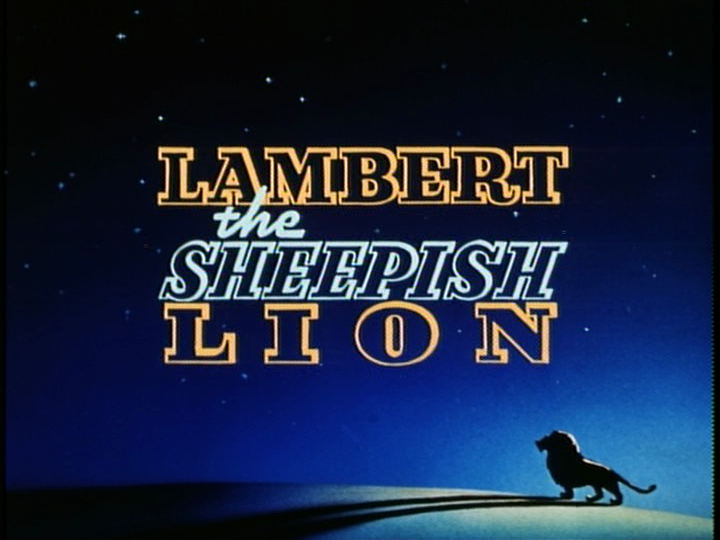
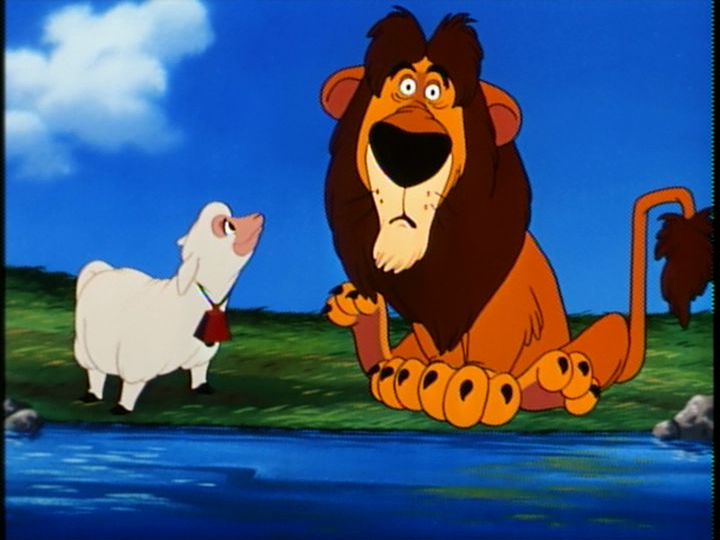
On February 8, 1952, the special short film Lambert, the Sheepish Lion premiered in theaters. The stork in this short should look familiar, as he is the same stork that was featured in Dumbo, which was also voiced by actor Sterling Holloway, who also narrated the short. An original print of the film was given to Emperor Hirohito as a gift, as it was his favorite Disney short film. The short was also nominated for an Academy Award, but lost to the Tom and Jerry short The Two Mouseketeers. The story was written by Bill Peet, Ralph Wright, and Milt Banta, and was directed by Jack Hannah.

One spring evening, a stork delivers a bundle to a sleeping flock of sheep. He opens the bundle to reveal several newborn lambs, which scurry about to claim their mothers. One ewe, however, is skipped by all the lambs, and she goes off to cry. Meanwhile, the stork has one little “lamb” that won’t wake up. When he finally does get it to open its eyes, he realizes that it’s a lion cub named Lambert, and it has already bonded with the lonely ewe. The stork tries to take Lambert to his home in South Africa, but the ewe attacks the stork and keeps Lambert with her. The next morning, the lambs begin to play, and Lambert wishes to join in, but realizes right away that he’s different. The lambs make fun of poor Lambert, who goes back to his mother. He continues to watch the lambs play, and when he tries to join in, he is continually bullied.

Lambert has grown from a cub to a full lion, with his mother still being so proud of him

Lambert has grown from a cub to a full lion, with his mother still being so proud of him

The seasons change, and soon the lambs are all grown up, and so is Lambert. However, although he is a full-grown lion, he still acts like a sheep, and is still the butt of the jokes of the rams. One night, as everyone is sleeping, the sound of a wolf wakes Lambert up, and he spies a hungry wolf surveying the flock. The wolf decides that Lambert’s mother is to be his meal, and the rams all hide behind trees. Although Lambert is terrified, he decides to screw up his courage and act like a raging lion, scaring the wolf silly. After saving his mother, the flock now considers Lambert one of them, and he lets out a triumphant “baa.”

January 30

January 30, 1951 – Singer-Songwriter, Multi-Instrumentalist, Actor, and Disney Legend Phil Collins is Born

PC

“[Collins’] voice has a tendency to wrap itself around you and bring you into his world. As soon as he starts singing, it’s just magic and provides a very welcoming feeling.” – Composer Mark Mancina

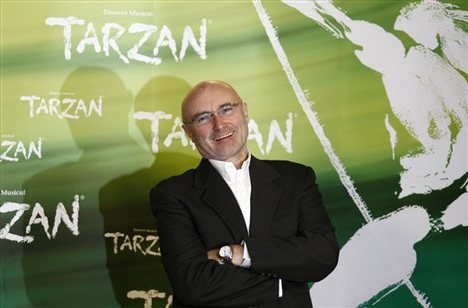
On January 30, 1951, Philip David Charles Collins was born in Hounslow, London, England. At age five, he was given a toy drum set, and was presented with complete sets by his parents and makeshift ones by his uncle as he got older. Collins was also a child actor, winning the role of the Artful Dodger in the West End production of Oliver! All the while, Collins continued to focus on his music, forming a band while in school and drumming for Flaming Youth and George Harrison. Collins found his big break in 1970, when he auditioned for and won the spot as the drummer for the band Genesis. After lead singer Peter Gabriel left the band in 1975, Collins became the lead vocalist of the group. The band had great success with Collins at the helm, including reaching Top 40 Chart in America. In 1981, Collins began a solo career, scoring a hit with his first single, “In the Air Tonight.” In 1985, he was nominated for his first Academy Award for the song “Against All Odds” from the film of the same name.

Collins’ first work for Disney came with the 1999 film Tarzan, where he wrote and performed the songs for the film. The song “You’ll Be in My Heart” reached number 1 on the Adult Contemporary charts and stayed at the top for 19 weeks; it was also awarded the Golden Globe for Best Original Song and the Academy Award for Best Original Song. Collins also performed the songs for the film in German, French, Spanish, Bulgarian, and Italian. “Strangers Like Me” from the soundtrack peaked at number 10 on the Adult Contemporary Charts. In 2002, he was awarded as a Disney Legend. Collins would go on to write and perform the songs for another Disney film, 2003’s Brother Bear. In 2006, when Tarzan was adapted for the Broadway stage, Collins contributed greatly to the production, writing 11 new songs and pieces of the score.

January 14

January 14, 1955 – The Donald Duck Short Film No Hunting Premieres in Theaters

vlcsnap-2013-01-13-19h07m23s232

“But your old grandpappy up there on the wall didn’t have it so soft. No, that old boy really had to work for his vittles.”

On January 14, 1955, the Donald Duck short film No Hunting premiered in theaters. This is one of the few shorts filmed in Cinemascope, and Donald is noted for being the only classic Disney character to appear in this process. No Hunting was nominated also for an Academy Award, but lost to Speedy Gonzales from Warner Brothers’ Merrie Melodies series. It was the ninth nomination for Donald Duck’s series. The short also features a cameo of Bambi and his mother, with her remarking, “Man is in the forest. Let’s dig out.” The short was directed by Jack Hannah, with story by Dick Shaw and Bill Berg, and stars Clarence Nash as Donald and Bill Thompson as Donald’s grandfather.

Donald sits at his dining room table, staring up at a picture of his grandfather, who was a hunter. The narrator explains that while Donald has a nice spread of food in front of him, his grandfather didn’t have it so easy, having to hunt buffalo for his supper. As the narrator notes in Donald’s newspaper that hunting season begins soon, the image of Donald’s grandfather is suddenly excited and tears himself away from the portrait. He declares that he and Donald are going hunting, and his spirit takes over Donald, forcing him to go hunting.

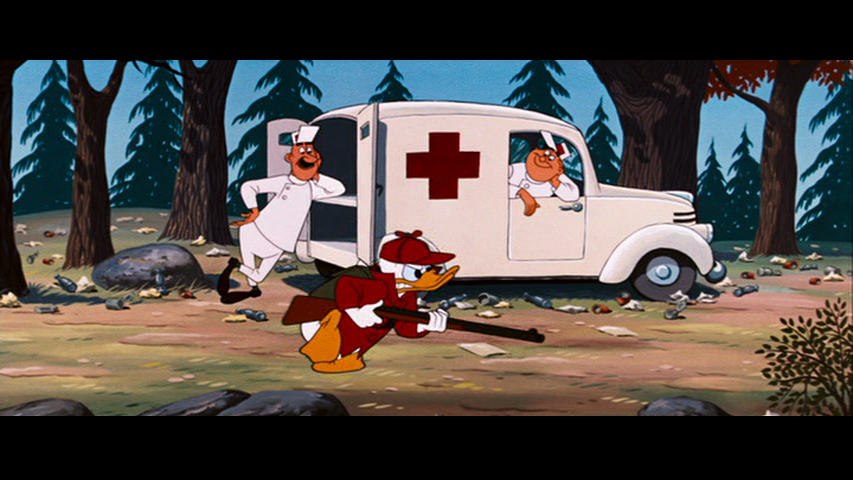
Donald stalks the hunting grounds, with medics waiting patiently, along with food vendors and other interested parties

Donald stalks the hunting grounds, with medics waiting patiently, along with food vendors and other interested parties

As Donald travels to the hunting grounds, the local residents begin preparing for the worst, including all farm animals leaving the barn and taking shelter in the root cellar. Hunters appear with expensive gear, and all wait with anticipation for hunting season to begin. At the stroke of midnight, Donald sounds his horn, and the hunters begin to shoot, turning the forest into trench warfare. Donald’s grandfather appears every so often to give him advice, including the difference between a cow (not fair game) and a deer (fair game). He tries to hide among all the chaos, and when he finally asks his grandfather what to do, the grandfather tells him to “dig out fast” before fleeing the scene. The men begin to march home, covered in bandages, and Donald’s grandfather appears once more with a cow, calling it “meat on the table.”