RSS Feed

Tag Archives: 1940s

November 5

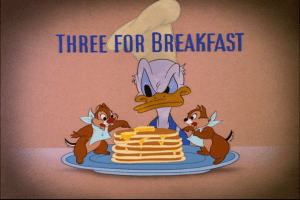
November 5, 1948 – The Donald Duck Short Film Three for Breakfast is Released to Theaters
vlcsnap-2016-11-05-18h31m48s206

“So that’s the play, is it?”

On November 5, 1948, the Donald Duck short film Three for Breakfast premiered in theaters. It was directed by Jack Hannah, with story by Nick George.

It’s a beautiful morning in suburbia, and Chip and Dale are fast asleep with their nut storage in a house’s stovepipe. While they wake up, Donald is busy in his kitchen cooking breakfast. The steam from the pancake griddle rises through the pipe, alerting the chipmunks, who hungrily decide to get some pancakes for themselves. The pair sneak into the kitchen, and manage to create a makeshift pancake grabber with a fork and a string. An annoyed Donald quickly catches on and tricks them with a rubber pot holder instead on a real pancake. Donald then gets the idea to use rubber cement to trick and distract them, but the rubber cement pancake ends up smacking Donald in the face. The chipmunks flee into the toaster, which Donald then turns on. He catches them when they pop out, but the pair manage to escape after taking more pancakes, including the rubber cement one. Donald then attempts to tie the rubber cement around his house to pull them back and keep his breakfast; Dale uses butter to trip up Donald and send him flying all around the house.
September 23

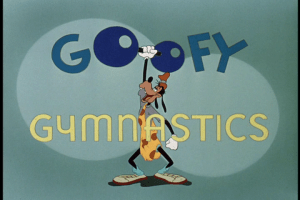
September 23, 1949 – The Goofy Short Film Goofy Gymnastics is Released to Theaters

vlcsnap-2016-09-23-19h53m41s354

“Don’t be a spineless weak-kneed no good nincompoop!”

On September 23, 1949, the Goofy short film Goofy Gymnastics premiered in theaters. A segment of this short was featured in the film Who Framed Roger Rabbit. It was directed by Jack Kinney, with story by Dick Kinney.

The short begins with Goofy home from a day of work, exhausted. As he leafs through a magazine, he finds an advertisement for a workout program that promises fame, money, and fortune. He sends away for a home gym kit, and he quickly sets it up when it arrives. He starts with the barbell exercises first, but is unable to lift the weight and ends up hurting himself. When he finally is able to lift the barbell, a fly lands on him and sends him crashing through the floors of his building. He sets out to start the second exercise: chin-ups. He is able to do them, until it is revealed that he is moving the bar to meet his chin rather than the other way around. Goofy then moves on to the cable expanders, while ominous music plays in the background. He gets caught in the cables, which sends him flying around the room and destroying the equipment in the process. In the end, Goofy is tired to the point where he just falls asleep.

July 30

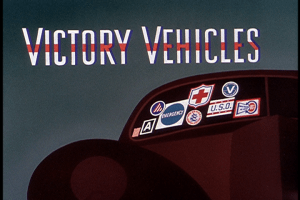
July 30, 1943 – The Goofy Wartime Short Film Victory Vehicles is Released to Theaters

vlcsnap-2016-07-30-19h33m34s832

“Who needs a limousine that’s always out of gasoline? Hop on your pogo stick and laugh your cares away!”

On July 30, 1943, the Goofy wartime short film Victory Vehicles premiered in theaters. The short takes a humorous look at rationing and shortages during wartime; it also spawned a song “Hop On Your Pogo Stick,” complete with sheet music, which was written by Ned Washington and Oliver Wallace. It also features a small cameo by Pluto in one of the early scenes. The short was directed by Jack Kinney.

The short begins with an explanation of why cars were necessary. When the gasoline and rubber shortage was started, the use of cars was limited significantly. Many citizens created their own versions of transportation, flooding the patent office with their (not-so-bright) ideas. The ideas span a variety of hobbies and work activities to help people get from point A to point B. Suddenly, the solution to this problem is made clear: the pogo stick. We then see Goofy, a defense contractor, heading to work via pogo stick, with a giant smile on his face. The narrator then talks about all the benefits of having pogo sticks instead of cars, and how it works in any condition. The short ends with everyone in town using a variety of pogo sticks.

June 28

June 28, 1940 – The Pluto Short Film Bone Trouble is Released to Theaters

vlcsnap-2016-06-28-17h43m36s936

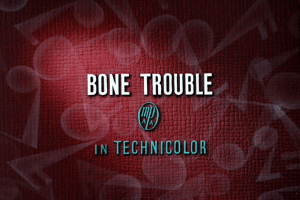
On June 28, 1940, the Pluto short film Bone Trouble premiered in theaters. It is the second short film in Pluto’s individual series. This short features the first appearance of Pluto’s nemesis and rival for Dinah the Dachshund’s affections, Butch. The short was directed by Jack Kinney, and is notable for being his first short film as a director.

Pluto is snoozing away in his doghouse when he is woken by a rooster’s crowing. He spies his empty dog dish, with the birds having eaten all of his food, and hears a strange sound from the other side of the fence. He sees a bone in Butch the Bulldog’s bowl, and decides to dig under the fence and steal the bone. As Pluto tries not to wake Butch, he runs into difficulties in acquiring the bone. As he gets it and starts walking away, he is unaware that Butch has woken up and is in pursuit. Pluto comes face to face with Butch and tries to pretend nothing has happened, but then decides to try and make a break for it. The chase is on all across town and in a carnival, but Pluto manages to lose him in the hall of mirrors. As Pluto passes by each mirror, his appearance changes, much to his surprise. His reflection in one mirror frightens him, as does another. He plays around with the mirrors, amusing himself with each distortion. When he spies Butch, the chase begins again, but Pluto manages to use the mirrors to his advantage to scare Butch enough to send him flying away.

May 1

Posted on

May 1, 1942 – The Donald Duck Wartime Short Film Donald Gets Drafted is Released to Theaters

vlcsnap-2016-05-01-19h59m08s568

“Hi General, I wanna be a flier!”

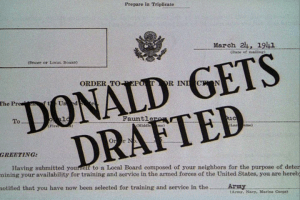
On May 1, 1942, the Donald Duck wartime short film Donald Gets Drafted premiered in theaters. It was the first of the series of wartime propaganda shorts that sought to use the Disney stars to tell a relatable story about how wartime was affecting citizens, adding levity to a very tense situation. The short provides several gags in the draft selection process, with a slight nod to the sarcasm of the Depression-weary public. The short was directed by Jack King.

The short begins with a rendition of the song “The Army’s Not the Army Anymore” while showing Donald’s orders to report for induction (also revealing that Donald’s middle name is “Fauntleroy”). Donald reports with gusto, admiring the posters in front of the recruiting station. After seeing a poster with a woman on it, Donald is determined to become a pilot. After Donald signs a paper, he is sent to a physical exam of a more humorous nature than anything else. He is then fitted for his uniform, which they shrink to his size. Soon after, Donald is sent to his base, but he is frustrated that he only marches, as he still wants to fly. He manages to anger his drill sergeant, who is none other than Pete. Pete gives Donald “special training,” which he manages to fail over and over again. When Donald threatens to quit, Pete responds that Donald must learn discipline. While Donald is ordered to stand still, a group of ants starts crawling out of their hole and up Donald’s legs, making standing still quite a challenge for the duck. Unable to take it anymore, Donald goes crazy, and his gun goes off, shooting at every angle. Finally, Donald is placed on kitchen duty, peeling spuds, and peels off the word “phooey” in response to the opening song.

April 5

April 5, 1940 – The Donald Duck Short Film Donald’s Dog Laundry is Released to Theaters

vlcsnap-2016-04-05-18h57m03s205

“Oh boy, oh boy! It’s all finished!”

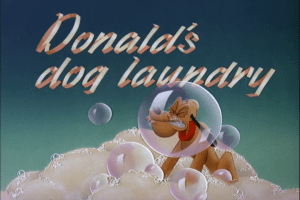
On April 5, 1940, the Donald Duck short film Donald’s Dog Laundry premiered in theaters. It was directed by Jack King.

Donald has instructions for a modern dog washer, and sets up to make it using a makeshift of spare parts. Poor unaware Pluto is snoozing away nearby, but wakes up when he accidentally breathes in a leaf while snoring. Donald calls Pluto over for a bath, but Pluto has other ideas and tries to sneak away. Donald chases after him, and after a humorous back-and-forth, Pluto is able to hide in his doghouse. Donald, ever determined, grabs a toy bone marked as bait (complete with string attached), and sets a trap for Pluto to follow the bone. Pluto takes the bait, but Donald pulls the bone a bit too hard, getting it lodged in a rock. Pluto manages to get the bone out, but has a hard time chewing it, as the rubber keeps hitting him in the face. The trick turns into a game of tug of war, with Pluto finally getting the bone, and Donald having to resort to another baiting trick: a cat puppet. Pluto hears Donald make cat noises and, thinking the puppet to be a real cat, stalks his prey. Donald puts the puppet in the tub and continues to harass Pluto, covering him in suds. Unfortunately, the suds make Pluto sneeze, and when Donald goes to put Pluto in the tub, Pluto lets out a sneeze so vehemently that it sends Donald flying into the dog washing contraption. Donald ends up cleaner than ever, and surprisingly pleased that the machine works.

April 4

April4, 1944 – Snow White and the Seven Dwarfs is Reissued to Theaters

vlcsnap-2016-04-04-18h50m34s132

Snow White and the Seven Dwarfs is more than a great picture, it’s an experience in happiness.”

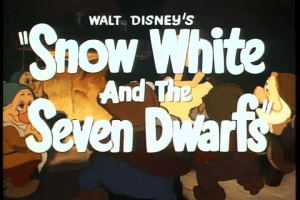
On April 4, 1944, Disney’s first full-length animated feature film Snow White and the Seven Dwarfs was reissued to theaters for the first time. Almost seven years after its first release, the rerelease was a gamble taken by the studios as they tried to make some money during the war years. Pinocchio and Fantasia had not been as financially successful as Walt Disney had hoped, though Dumbo managed to be another smash for the studio; unfortunately, shortly after its release was the attack on Pearl Harbor, and the entrance of the United States into World War II. The loss of the European markets hurt the Disney Studios deeply, with the war instructionals and propaganda films not providing enough income to keep the studios in business. The film has since been reissued seven times since.

March 28

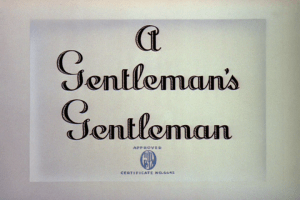
March 28, 1941 – The Pluto Short Film A Gentleman’s Gentleman is Released to Theaters

vlcsnap-2016-03-28-18h15m19s336

“Now, my good man, run to the corner and get me the Sunday paper. Here’s a dime; now, be careful and don’t lose it.”

On March 28, 1941, the Pluto short film A Gentleman’s Gentleman premiered in theaters. It was originally released under the Mickey Mouse short line, but has since been regarded as a Pluto short film. It was directed by Clyde Geronimi.

It’s an early Sunday morning, and Pluto brings in Mickey’s breakfast on a tray, as if he were Mickey’s butler. He pours him coffee, and Mickey gives him a dime to go get the Sunday paper, warning him not to lose it. Pluto gingerly takes the dime and rushes off, but starts flipping it with his tongue as soon as he gets outside. He loses the catch and watches as the dime rolls away before landing on its side. As he goes to pick it up with his teeth, he is unable to grab it, and it ends up eventually landing in a sewer grate. Pluto tries to grab it, but his leg is too short to reach it, as is his tail. He cries as he realizes how hopeless the situation is, but is soon relieved when he spies a gum machine. He manages to steal a gumball from the machine, and attaches the chewed gum to his tail to grab onto the dime. He retrieves the dime and grabs the paper. As he heads home, he hears the praise from nearby customers, but trips when trying to show off. As he collects the paper, he spies a comic, starring him, on the front page, and stops to read. Unfortunately, he doesn’t notice the wind that has swept his paper away, and starts chasing after the individual pages. He manages to find them all in a mud puddle, and comes home with a mud covered paper and a disappointed Mickey, who laughs at Pluto when he starts to cry again.

March 23

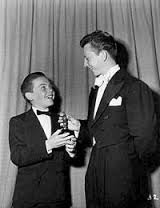
March 23, 1950 – Bobby Driscoll Wins the Academy Juvenile Award

Bobby Driscoll Award

“[The award] goes to the little boy whose performance in The Window and So Dear to My Heart enchanted movie-goers and critics alike, Bobby Driscoll.” – Presenter Donald O’Connor

On March 23, 1950, the 22nd Academy Awards were held at the Royal Pantages Theater in Hollywood, California. For his work in the Disney film So Dear to My Heart, as well as the RKO film The Window, Bobby Driscoll was awarded with the Academy Juvenile Award as the best juvenile actor of 1949. So Dear to My Heart was Driscoll’s second film for the Disney Studios, and he had received several positive reviews for his role as Jeremiah Kincaid. He was the ninth recipient of the award, joining actors such as Mickey Rooney and Shirley Temple.

January 7

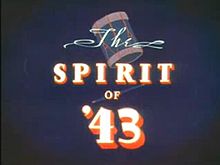
January 7, 1943 – The Wartime Short Film The Spirit of ’43 is Delivered to the U.S. Treasury Department

Spirit of 43

“You must save for victory!”

On January 7, 1943, the wartime short film The Spirit of ’43 was delivered the U.S. Treasury Department. After the success of The New Spirit, the Treasury Department was more than eager to have Donald represent them again and encourage Americans to pay their taxes to help the war fund. After the debacle in the House for not paying Disney for The New Spirit, it was decided that the Treasury Department’s funds for the short would have to be approved by Congress in advance; the $20,000 came through quickly. Unfortunately, this amount wasn’t enough to pay for brand new animation, so the studio reused some footage from The New Spirit.

A factory whistle blows, signaling payday. As Donald walks with his cash, he is confronted by his two inner personalities: the Thrifty Donald, who convinces Donald to save some of his pay; and the Spendthrift Donald, who appears after his money begins to burn a hole in his pocket. The Spendthrift Donald takes him to the Idle Hour Club, but Thrifty Donald reminds Donald that his income tax is due in four different payments. Donald is convinced to save right away to help the troops in the war, as he doesn’t want to save for the Axis. In the end, he punches out the Spendthrift, who in the end looks like Hitler. There is then a montage of what people’s taxes will go towards.