RSS Feed

April 25

April 25, 1952 – The Donald Duck Short, Let’s Stick Together, is Released to Theaters
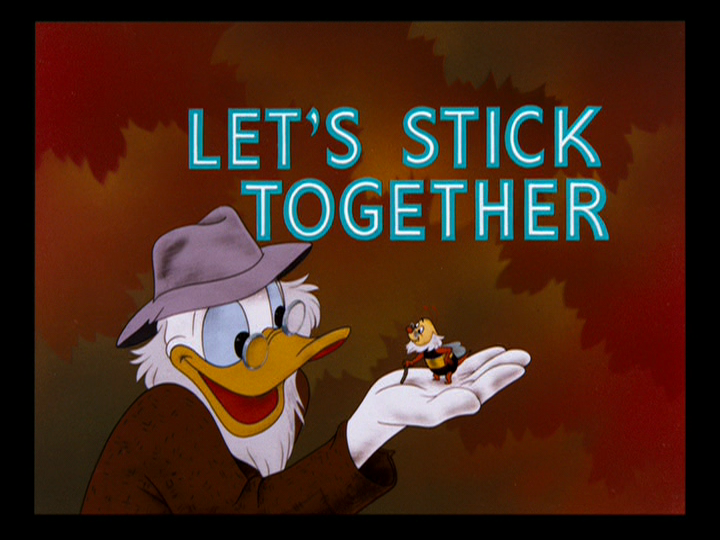
“You know, strange as it may seem, I used to be in business with that old duffer.”

On April 25, 1952, the Donald Duck short, Let’s Stick Together, was released to theaters. It features one of Donald’s many adversaries, Spike the Bee, who made his premiere in the 1948 Donald Duck short, Inferior Decorator. The short was directed by Jack Hannah, with the story by Nick George and Al Bertino. It also stars Clarence Nash as Donald, Bill Thompson as Spike, and voice actress legend June Foray in a cameo as Spike’s wife.

The short opens on a crisp fall day in the park, where an old bee is seen sitting on a ledge of a tree in his rocking chair, smoking a corncob pipe. He is suddenly startled as something lands into the ground in front of him. As the camera pans out, we see that the item belongs to an elderly Donald Duck, who is picking up trash in the park. He sits down on a bench to rest, and the bee laughs, narrating to the audience how he knows Donald, and taking the audience with him as he reminisces.
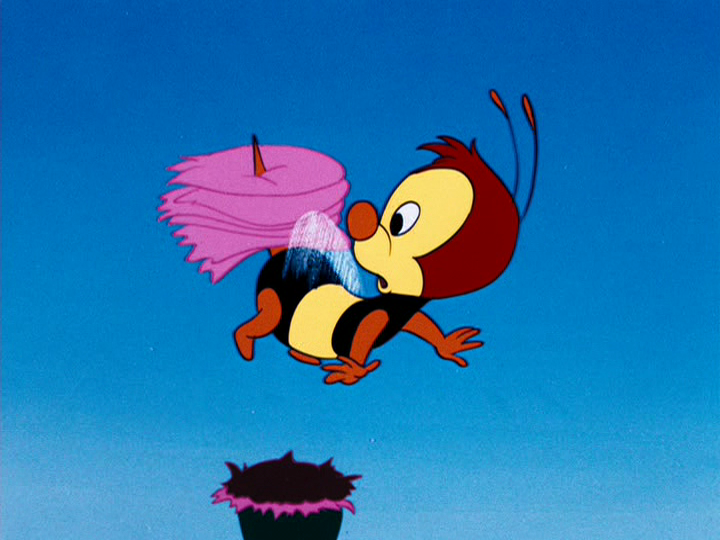
Spike discovers that his stinger is part of his secret talent

The flashback begins with Spike looking at the want ads in an abandoned newspaper. Just as he picks out what he thinks is the perfect job, the paper is snatched out from under him, flipping him into the air and dropping him harshly on the ground. Annoyed, Spike flies up to perch on a flower to look at his “attacker.” He then spies Donald, who is picking up the trash in the park, and gets an idea: he can use his stinger to pick up trash, and calls it his “hidden talent.” Excited by this discovery, he flies around Donald and shows the duck that he can help pick up trash. Donald is impressed, but is confused when Spike pushes Donald to the bench, letting him know he won’t be needed.

Spike makes quick work of the trash, and brings Donald part of a cigar he’s found. Donald pats Spike on the head and begins to relax while Elderly Spike relays to the audience that this was the beginning of a beautiful friendship. The next day, the two went into business together, beginning at a local carnival. Donald is seen selling balloons for 10 cents a balloon, and after he sells them, he sends Spike out to pop them, forcing the children to buy from Donald again. Spike is distracted, however, by an ad for a balloon dancer, and slips inside, popping the balloons that cover the girl. She lets out a shriek, and Spike flies out again, shrugging.
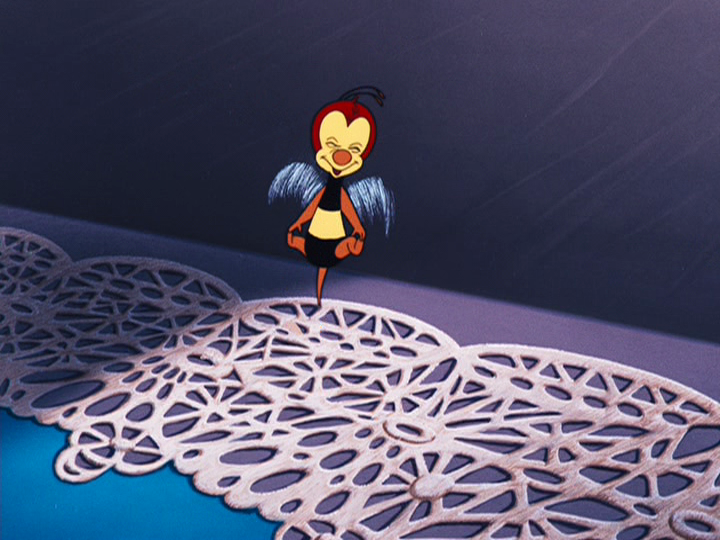
Spike working on creating a lace pattern

The next job the two held was a tattoo parlor, with Donald using Spike’s stinger for a needle. Donald is impressed with Spike’s work, and they move on to other projects, including making socks, lace, monogrammed handkerchiefs, and even fancy curtains. Soon, as Spike tells us, they were in full production mode. As the orders kept coming in, Spike became more and more fatigued. He pleads with Donald to let him have a vacation, and Donald surprises him with a greenhouse full of flowers, complete with a lady bee as well. Falling in love makes Spike work harder than ever, only he destroys everything by stitching hearts everywhere.

Donald, seeing as how everything has been vandalized, cries out that he’s ruined, and glares at the lovesick bee before trying to swat the lady bee. Spike runs to protect his lady, and decides to sting the duck in the tail. It was the end of their partnership, and Spike and his lady “have been happy all these years,” Spike tells the audience. The audience hears the truth, however, as Spike’s lady begins to scream at him for lounging around. Spike decides to join Donald once again in their partnership, and the two hobble down the road together.
April 24

April 24, 1989 – The New Mickey Mouse Club Premieres on the Disney Channel

Image Credit: UltimateDisney.com

On April 24, 1989, the third incarnation of the Mickey Mouse Club, later known as MMC, aired on the Disney Channel. The main difference between the original show and this updated reincarnation was that the Mickey Mouse element was highly de-emphasized in favor of the popular show trends of the day, which made the show lean more toward a Saturday Night Live format. The show premiered with twelve teenagers and two adults in the cast. Three members stayed with the show through its run: Josh Ackerman, Lindsey Alley, and Jennifer McGill; Tiffini Hale from the first season would return for the final season in 1995.

The show ended up as a launching point for many of today’s stars, including Justin Timberlake, Britney Spears, and Ryan Gosling. The Mouseketeers would still continue to have theme days, including Music Day (Monday), Guest Day (Tuesday), Anything Can Happen Day (Wednesday), Party Day (Thursday), and Hall of Fame Day (Friday). Many new serials were released through the show, including Teen Angel, Teen Angel Returns, Just Perfect, Match Point, My Life as a Babysitter, Emerald Cove, and Treasure of Lost Creek.

April 23

April 23, 1943 – The Donald Duck Short, Fall Out – Fall In, is Released to Theaters

“After supper…? Please?”

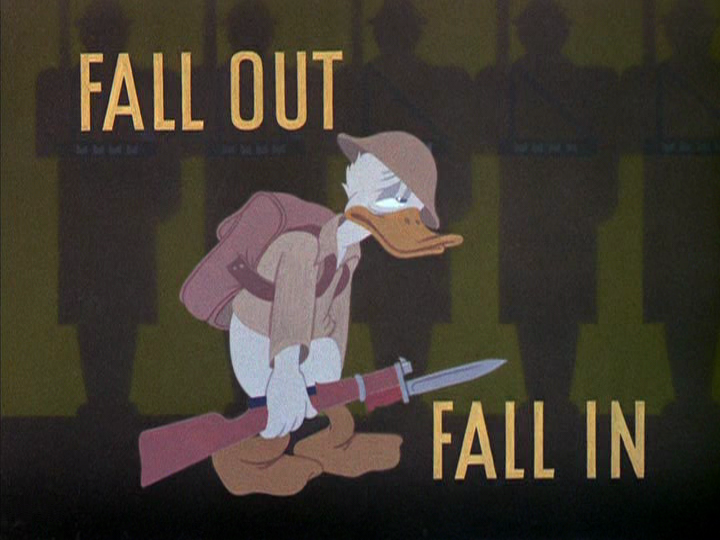
On April 23, 1943, the Donald Duck wartime short, Fall Out – Fall In, was released to theaters. As with the other Donald Duck wartime shorts, it was based on the experiences many of the animators had when they were in the army during World War II. It is also one of the few times that Donald’s headshot in the opening shows him without his usual sailor hat—he’s wearing an Army hat instead. The short was directed by Jack King, with Clarence Nash as the voice of Donald Duck.

The short opens just as the sun is rising, with a rooster letting out his call. Soldiers are marching on the horizon, with Donald Duck the last one in line. When he passes a sign saying that the group has traveled five miles, Donald marks it down on the bag of the soldier in front of him, and continues marching with a smile. At the 10-mile mark, Donald’s cheer has waned slightly, and his rifle seems to be pulling his shoulder down, but he adjusts it and continues to march, though definitely not as enthusiastically as before.

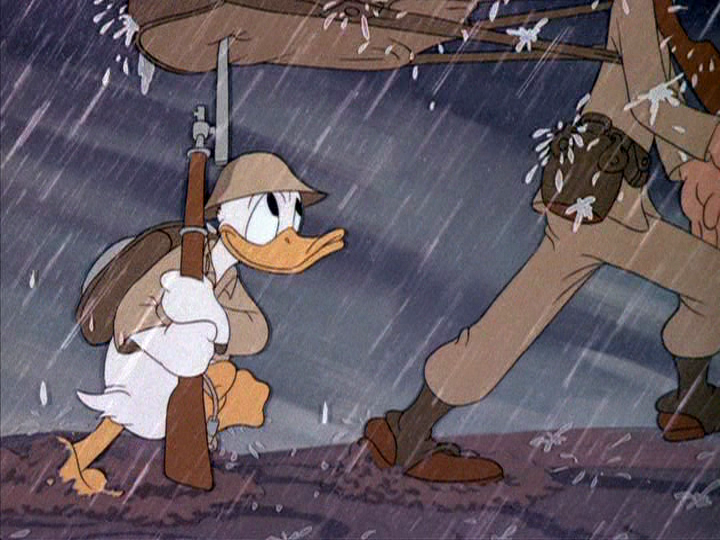
Donald using ingenuity to keep himself dry

A harsh storm hits the troops by mile 20. Donald is annoyed with the raindrops hitting his helmet, but he comes up with an idea to shield himself from the rain by using the bag of the soldier ahead of him. As they continue to march, the rain turns into snow, and icicles hang from the duck’s tail. Donald is still wearily keeping track of the miles on his fellow soldier’s bag, with the count at 35 miles traveled.

As suddenly as the snowstorm arrived, the snow disappears and is replaced by scorching hot weather, 40 miles into their march. Donald isn’t so much as marching any more as he is limping, and sweating buckets. As the sun sets on the troops, their commanding officer calls them to a halt, and we see that Donald has marked the soldier in front of him up and down with hash marks for each mile they’ve crossed. When Donald is told to fall out, he collapses.

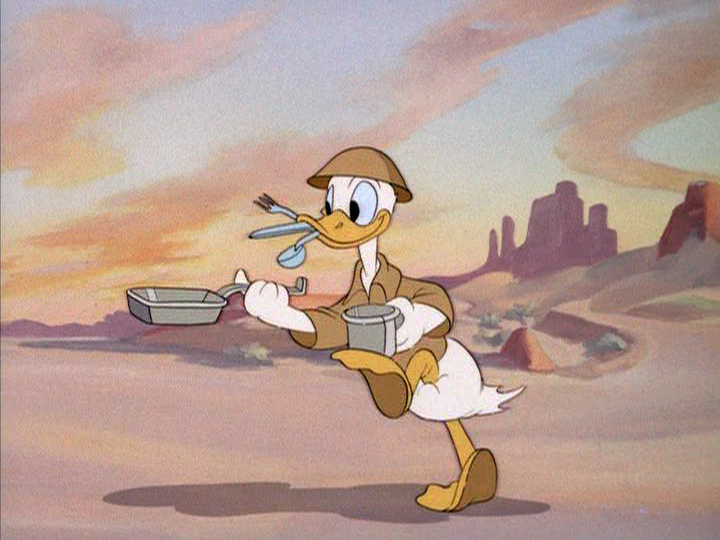
Donald rushes madly to grab his meal after the excruciating hike

When a trumpet sounds, Donald revives, knowing that the sound means that it’s dinnertime. Excited, he opens his overstuffed bag, grabs his utensils, and runs to get his food – but his commanding officer won’t let him eat until he’s made up his tent. Donald leaps to the task, driven by the promise of food; unfortunately he has the worst luck when it comes to building his tent, and we see him still trying to build it long after the other soldiers have gone to sleep. Exhausted, Donald collapses and refuses to take care of his tent, but he can’t sleep because all of the other soldiers’ snoring keeps him awake.

Donald has only closed his eyes for a second, when the trumpet again sounds, telling the soldiers that it’s time to wake up. Too exhausted to even notice that he’s tied his belongings around a tree, Donald falls in line, carrying the tree and his belongings with him for the long trek back to camp.

April 22

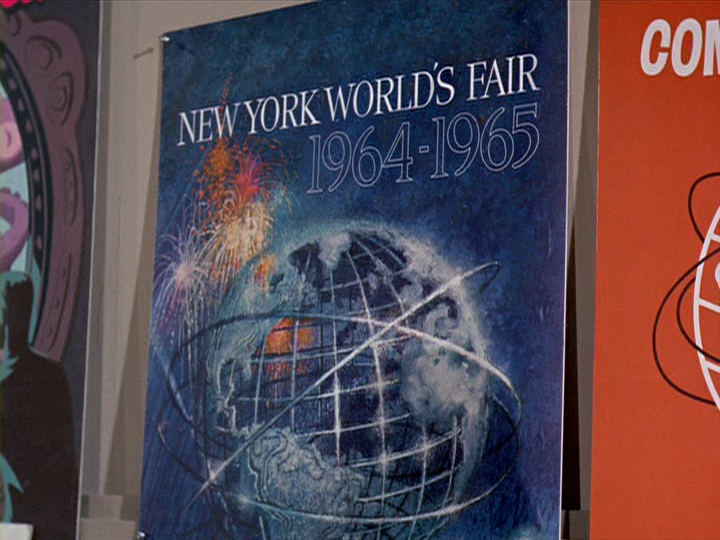
April 22, 1964 – The New York World’s Fair Opens

“…the New York exposition of 1964 is the greatest World’s Fair of all time.” – Walt Disney

On April 22, 1964, the New York World’s Fair opened to the public. This two-year fair included four Disney exhibits: Ford’s Magic Skyway; It’s a Small World (presented by Pepsi-Cola/UNICEF); Progressland, featuring the Carousel of Progress (sponsored by General Electric); and Illinois’ Great Moments with Mr. Lincoln. After the fair ended, these four attractions made their way back to Disneyland, and have been there since.

The idea for doing attractions at the fair came from the success of Disneyland, and the requests Walt received about building similar Disneylands across the country. Walt wondered if Disney attractions would be as popular on the East coast as they were on the West, and used the fair to test this theory. The attractions Disney built ended up being the most popular attractions at the fair.

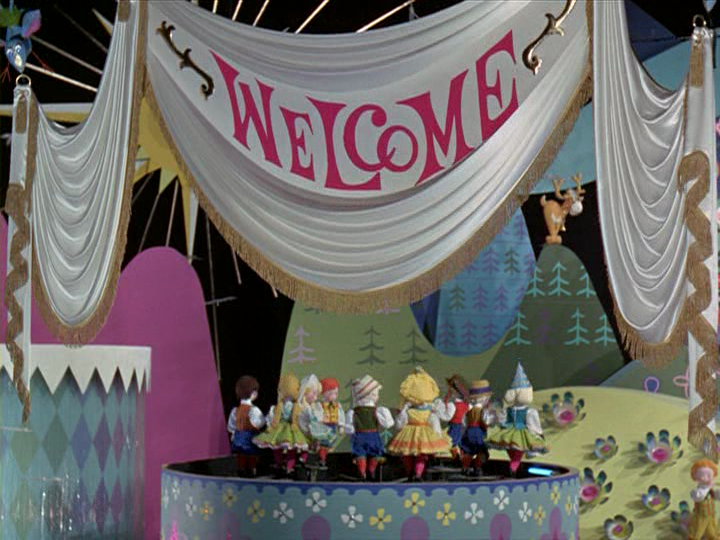
The Welcome sign of the It's A Small World ride

The sponsorship of the attractions paid for Disney Imagineers to research and develop new methods of “animation” as Walt called it, which would become the Audio-Animatronic figures extensively used throughout the attractions. The “It’s a Small World” attraction used 297 audio-animatronic children alone.


April 21

April 21, 2008 – Disney’s New Film Banner, Disneynature, is Announced.

Image Credit: Official Disneynature Site

On April 21, 2008, Disney announced a new production banner, known as Disneynature. Under this banner, Disney releases nature documentaries, which began with the release of Earth on Earth Day, 2009. Other nature documentaries released were  African Cats: Kingdom of Courage, The Crimson Wing: Mystery of the Flamingos, Oceans, Orangutans: One Minute to Midnight, Naked Beauty: A Love Story that Feeds the Earth, and Chimpanzee.

The banner is headquartered in Paris, France, and headed up by Jean-Francois Camilleri, formerly the senior vice president for Walt Disney Studios Motion Pictures France. Disneynature can trace its roots back to Disney’s award-winning True-Life Adventures from the late ’40s to the ’60s, and has received many positive reviews for the films it has released.

April 20

April 20, 1935 – The Silly Symphony, The Robber Kitten, is Released to Theaters

“I never took a bath, and I never will, oh, Dirty Bill!”

On April 20, 1935, the Silly Symphony, The Robber Kitten, was released to theaters. It was directed by Dave Hand, with the story written by William Cottrell; the short stars Billy Bletcher, best known as the voice of Pegleg Pete, as the voice of Dirty Bill the robber.

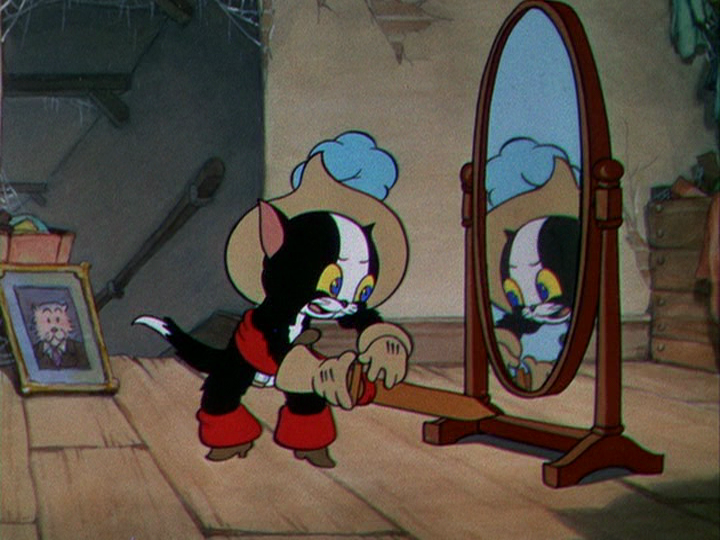
Ambrose continues his game of robber by threatening his own reflection

The Silly Symphony opens on a coach robbery, a voice telling the passengers to put their hands up. The camera zooms out to reveal a kitten named Ambrose holding two pop-guns, playing robbery with his toys. He continues to threaten his toys, and ends up shooting them because they won’t “give up the money.” Ambrose continues to play robber, until his mother is heard hollering his name from downstairs. Ambrose dismisses his mother’s call, telling no one in particular that Ambrose is no name for him, and from now on, his name is Butch.

Downstairs, his mother is preparing his bath. Ambrose sneers into the mirror and tells himself that robbers don’t take baths. He decides to run away to become a real robber, narrowly avoiding his mother as he steals cookies before heading out the open window to freedom from baths, only to land in a rain barrel. He shakes the water off before grabbing his hobby-horse and riding down the road. Unfortunately for Ambrose, his mother sees him through the kitchen window and demands that he come back, but he ignores her and rides away.

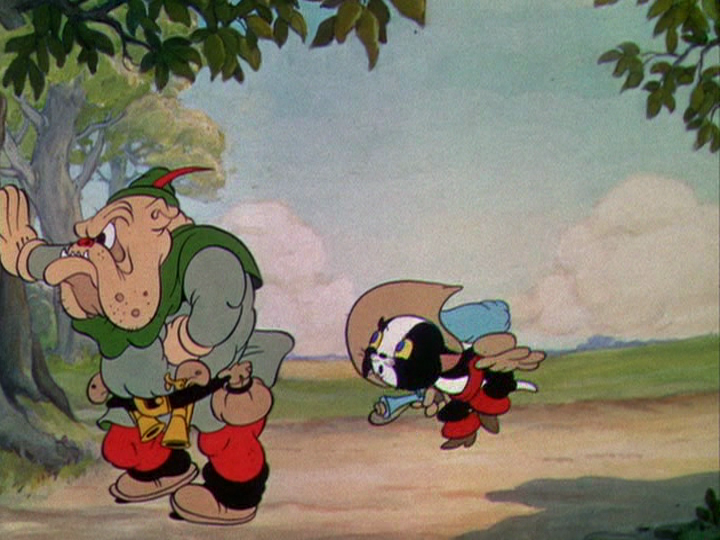
Ambrose sneaks up on Dirty Bill, attempting to rob the criminal

Meanwhile, the robber Dirty Bill is sitting in the woods, staring at his own face on a wanted poster and laughing. Ambrose spots him and attempts to rob him, but as Dirty Bill reaches for a real gun rather than Ambrose’s pop gun, Ambrose’s voice breaks. Dirty Bill turns around to see that Ambrose is only a kid, and asks Ambrose if he would really rob another robber. Ambrose is impressed that he’s really around a robber on a wanted poster.

Dirty Bill offers Ambrose a seat, and Ambrose copies the older robber exactly before asking if Dirty Bill’s mother ever made him take a bath. Dirty Bill brags in song that he’s never taken a bath, nor will he ever do so. Teasing him, Dirty Bill asks the kitten if he’s pulled any big jobs lately. Wanting to impress the robber, Ambrose tells him that of course he has, and begins to tell Dirty Bill about holding up a stagecoach (going back to the game of the morning). Unfortunately for Ambrose, his imagination and story-telling skills are too good, making the robber believe that the bag of cookies Ambrose is carrying is filled with treasure, and Dirty Bill attempts to steal it from the kitten.

Thinking the kitten is actually holding treasure, Dirty Bill suddenly turns violent

When Ambrose tries to convince Dirty Bill that he really is only holding cookies, Dirty Bill pulls out a knife, lusting for what he thinks is treasure. Scared out of his wits, Ambrose leaps out of his clothing, leaving the cookies behind as well, and sprints as fast as he can home and into the bathtub, where his mother is waiting to punish him. Sheepishly, he greets his mother, and plays with the bubbles in the tub, his robber days now behind him.

April 19

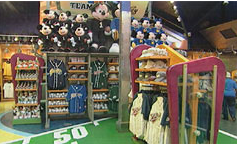
April 19, 1987 – Team Mickey Athletic Club Opens in Walt Disney World

Image Credit: Official Walt Disney World Site

On April 19, 1987, Team Mickey Athletic Club opened at the Disney Village Marketplace at Walt Disney World. The store specializes in sports fashion and various merchandise, including athletic jerseys, hats, and autographed sports photos. The store is now located in the Downtown Disney area of the Walt Disney World Resort.

The store sells merchandise on a variety of sports, including baseball, golf and football. There are many Mickey and Friends themed jerseys and shirts, as well as gear for the ESPN channel. There is also a large selection of merchandise for professional and college teams.

April 18

April 18, 1994 – Beauty and the Beast: The Broadway Musical Opens on Broadway

“When we’re human again, only human again, when we’re knickknacks and whatnots no more…”

On April 18, 1994, the Beauty and the Beast Broadway musical, Disney’s first musical on Broadway, opened at the Palace Theater on Broadway. Based on the hit 1991 animated film, the musical took most of the songs and plot from the film version, but added some new songs, including a new Howard Ashman and Alan Menken song written for, but never used in, the film (the song, “Human Again,” would be added to the animated film when it was rereleased in 2002). Other new songs added to the film were written by Alan Menken and Sir Tim Rice.

The original cast starred Susan Egan as Belle, Terrence Mann as the Beast, Tom Bosley as Maurice, Burke Moses as Gaston, Gary Beach as Lumiere, and Heath Lamberts as Cogsworth. The show would go on to receive nine Tony Award nominations in 1994, but won only one, for costume. The original cast recording was released on April 26, 1994. The musical ran until 2007, becoming Broadway’s eighth-longest running production. The success of the musical led to worldwide productions, including an Australian production featuring Hugh Jackman as Gaston.

April 17

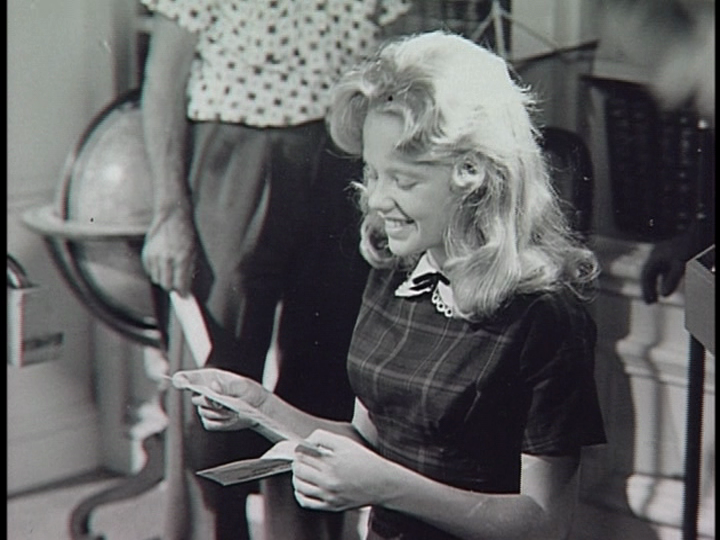
April 17, 1961 – Hayley Mills Wins A Special Oscar for Pollyanna.

“To Hayley Mills for Pollyanna, the most outstanding juvenile performance during 1960.”

On April 17, 1961, the Academy Awards were held in Santa Monica, California. That year actress Hayley Mills would be the last actor to receive the Academy Juvenile Award, for her role in the Disney film Pollyanna. The film had propelled the young girl to stardom, and Mills went on to star in more Disney family films, including The Parent Trap.

Mills had auditioned for the lead in the film Tiger Bay, and was discovered by Lillian Disney, who suggested that Mills be cast in the lead in Pollyanna. The film was based on the book Pollyanna by Eleanor H. Porter, published in 1913. The book tells the story of a young girl who is suddenly orphaned and sent to live with her aunt in New England. The character tries to see the best in every situation, and ends up changing the entire town for the better. Not only did Mills win the Academy Juvenile Award, but she was also nominated for a BAFTA award for her role.

April 16

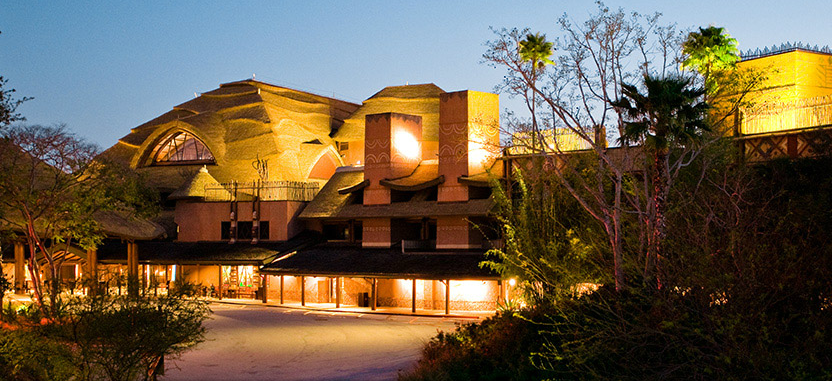
April 16, 2001 – Disney’s Animal Kingdom Lodge Opens

Image Credit: Official Walt Disney World Site

On April 16, 2001, the new Animal Kingdom Lodge opened at the Walt Disney World Resort. Located in the Animal Kingdom Resort on a 43-acre wildlife preserve, the African-style lodge has authentic African artifacts, thatched ceilings, golden-tone furnishings, and a mud fireplace in the main lobby. The elevated rock platform outside the main lobby gives guests a view of the animals and the African grasslands grounds around the lodge.

The lodge also has two award-winning restaurants, Jiko and Boma. Jiko fuses African food with Mediterranean, Indian and European influences, and also has a selection of South African vintage wines. Boma gives the guests an African-style buffet, with food from fifty different African countries. The lodge also contains an 11,000-square-foot pool known as Uzima, with a 67-foot-long slide.