RSS Feed

Monthly Archives: December 2014

December 21

December 21, 2007 – The Goofy Short Film How to Hook Up Your Home Theater is Released to Theaters
HtHUYHT_1

“Modern sports fans, however, can fully immerse themselves in game day with a new home theater system. The advanced technology practically puts the viewer on the field.”

On December 21, 2007, the Goofy short film How to Hook Up Your Home Theater was released to theaters; this was the first Goofy theatrical short film since 1961’s Aquamania. It was directed by Kevin Deters and Stevie Wermers-Skelton, with story by Deters, Wermers-Skelton, Wilbert Plijnaar, and Dan Abraham. It stars Corey Burton as the narrator, and Bill Farmer as Goofy.

The short begins with a look at the big game, on Goofy’s tiny black and white television, when Goofy sees his neighbor getting a new big screen television and home theater system, and decides to get his own the next day at his nearest electronics store. He is laden down with several “important” elements of his system, and goes to pick his screen, which is the biggest in the store. Finally, it is delivery day, and Goofy waits anxiously, although the system arrives early the next day. The system is so massive that they have to lift Goofy’s house to fit the boxes inside. After unpacking it, and removing about a million packing peanuts, Goofy finds the instructions, although they are incredibly complex. He then has trouble plugging in the cables, and has to use a chainsaw to cut a wall of his house in order to reach the back of the screen. He then sets up all the speakers, surrounding him all around and ensuring eventual deafness. He mounts the speakers in crazy places, leaving wires and overloaded sockets in his wake. After setting it all up, he almost forgets about the big game, when he finds the universal remote and turns the television on. The television explodes, sending Goofy, chair, and screen to the actual playing field, where, after getting pummeled by the players, he remarks that “it’s almost like being there!”
December 20

December 20, 1961 – The Goofy Short Film Aquamania Premieres in Theaters

vlcsnap-2014-12-20-18h32m00s125

“This could be any town, anywhere, anytime, because here, just as everywhere else, one-third of the population are…aquamaniacs.

On December 20, 1961, the Goofy short film Aquamania premiered in theaters. It was nominated for an Academy Award at the 34th Academy Awards, but lost the Yugoslavian short film Surrogat. It was directed by Wolfgang Reitherman with story by Vance Gerry and Ralph Wright.

The story begins with the explanation of the term Aquamaniac, complete with diagrams and case-study file. The study is of Goofy, although called by the narrator “Mr. X.” They show his dilapidated home and pristine motor boat. Before he became an aquamaniac, his home was well-kept, and he would walk to work; however, the earliest warning signs showed during his walk, as he loved to walk past a store that sold boats. Although he tries to convince himself that he doesn’t need a boat, he finally gives in and buys one. After purchasing his boat, he takes his son Junior out to the ocean, not noticing that there is a long line of boats and cars waiting to get in for the jet-skiing race. He struggles with getting the boat in the water, and ends up with his car at the bottom of the ocean, completely destroying it thanks to the salt water.

Mr X. desperately tells Junior to stop, but Junior thinks he wants to go faster and win the contest

Mr X. desperately tells Junior to stop, but Junior thinks he wants to go faster and win the contest

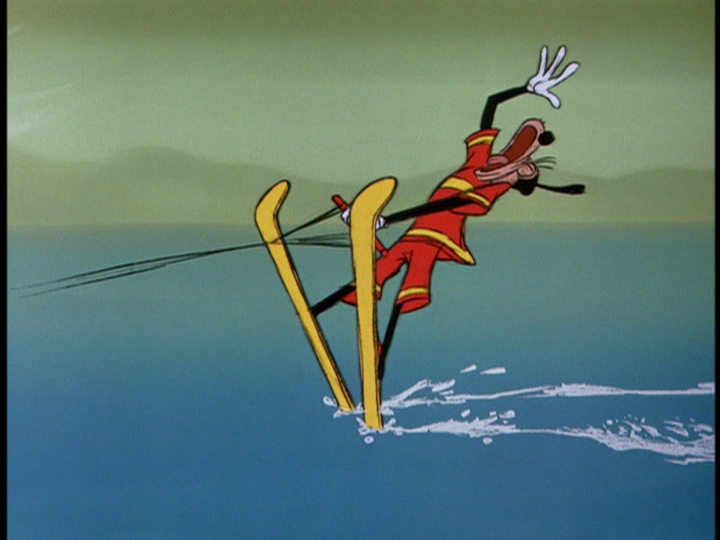
Mr. X then puts on his water skis, and Junior excitedly enters his dad in the water skiing race. Mr. X tries to tell his son to stop, but Junior takes this as a sign to go faster. Mr. X ends up flying over the competitors after going over the first jump, but when he lands in the water, he picks up an octopus on his head, who helps him water ski through the slalom. Heading around a turn, Mr. X heads out too far and ends up landing on a cart on a ramp, and flies through the beach. The octopus grabs on to some beach umbrellas, sending the pair high in the sky like a kite, where a bolt of lightning strikes them. They land on the tracks of a roller coaster and, after colliding with the roller coaster carts, end up flying back through the finish line, winning the race.

December 19

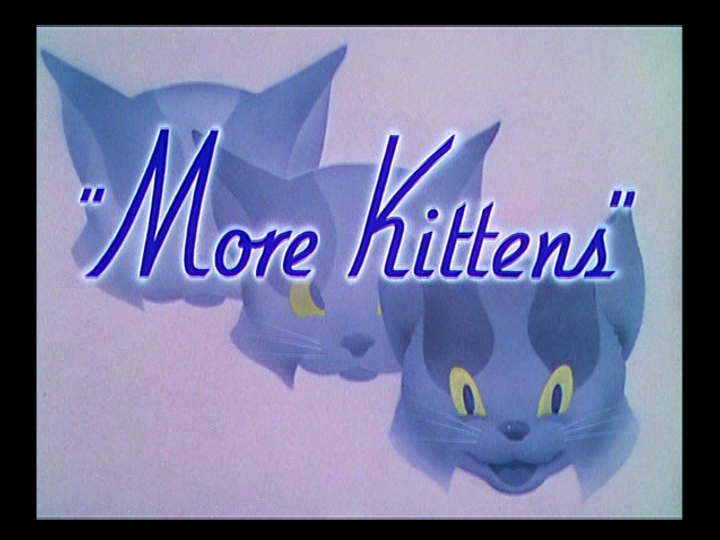
December 19, 1936 – The Silly Symphony More Kittens is Released to Theaters

vlcsnap-2014-12-19-16h37m01s239

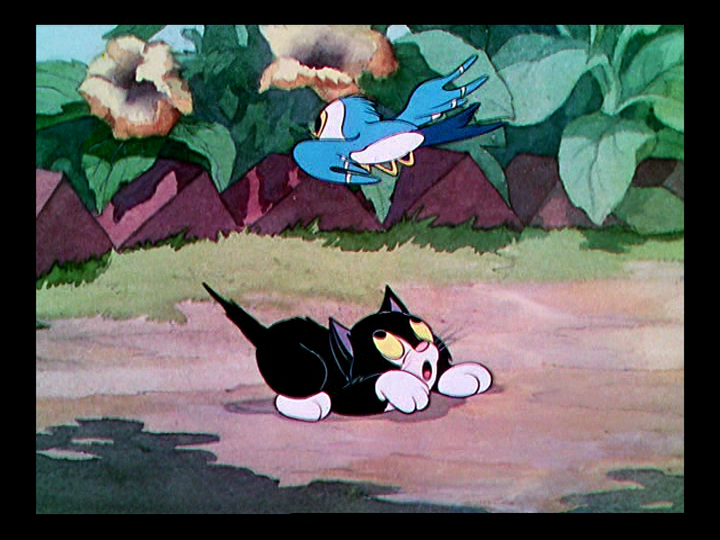
On December 19, 1936, the Silly Symphony More Kittens was released to theaters. It was a sequel to the Academy Award winning Silly Symphony Three Orphan Kittens. Both shorts were directed by Dave Hand. The popular song “Who’s Afraid of the Big Bad Wolf” makes a cameo appearance in this short.

The three orphan kittens are thrown out of a house, and hide in a nearby bloodhound’s doghouse. The bloodhound notices that one of the kittens has fallen into its bowl of milk, and rescues it before drinking the contents. As the kittens brush up against the bloodhound’s face affectionately, their tails tickle its nose and it sneezes, sending two of the kittens flying into the yard. The kittens look around, confused, as they realize they’ve landed on something moving, and look down to find themselves riding on the back of a turtle. The turtle itself is surprised and falls down the stairs, with the turtle and kittens tumbling about. The third kitten has been resting on the bloodhound’s back, when it chases a fly on the bloodhound’s nose. The bloodhound is bugged by the fly and tries to swat it, finally getting it with its ears. The kitten stalks the fly after it lands, and ends up falling on the turtle. The kitten and the turtle fight before the turtle turns tail and walks away.

The bird mocks the kitten for not only missing the turtle, but being unable to attack him as well

The bird mocks the kitten for not only missing the turtle, but being unable to catch him as well

A bird mocks the kitten for losing to the turtle, and it turns its attention on the bird, pouncing and trying to attack it. The bird and the kitten end up within the bloodhound’s mouth, fighting, although the kitten gets pushed out, and the bird whistles triumphantly. The bird finally leaves the bloodhound’s mouth, and all three kittens chase after it, with two ending up in the laundry basket, and one on the clothesline. In the end, the kittens gets swept away when they knock over the washing bucket, and end up at the front door of the house, alerting the maid. Furious, she chases after the kittens, and they three ends up at the bloodhound’s once again, where it hides the kittens from the angry maid. The short ends with the bloodhound adopting the kittens, and they give it grateful kisses.

December 18

December 18, 1992 – The It’s a Small World Toy Shop Opens in Disneyland’s Fantasyland

Small World Toy Shop

“Come visit the best store for good girls and boys!”

On December 18, 1992, the It’s A Small World Toy Shoppe opened in Disneyland’s Fantasyland, just outside the exit for the attraction of the same name. The store was originally sponsored by Mattel, and features products from the company, including Hot Wheels and Disney Princess dolls.

December 17

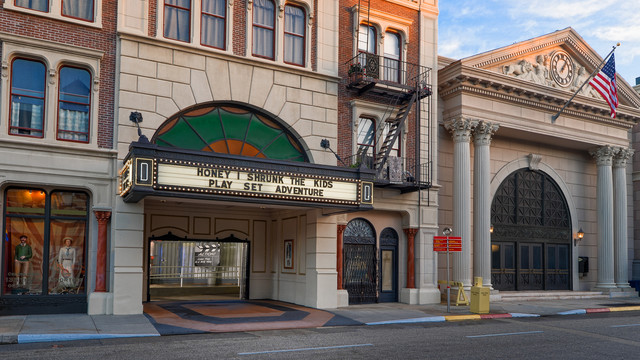
December 17, 1990 – The Honey I Shrunk the Kids Adventure Zone Attraction Opens in Disney-MGM Studios

honey-i-shrunk-the-kids-movie-set-adventure-gallery06

“Discover what it’s like to be the size of a bug at this large-scale, backyard-themed play space.”

On December 17, 1990, the Honey I Shrunk the Kids Adventure Zone interactive attraction opened in Walt Disney World’s Disney-MGM Studios (now known as Hollywood Studios). Based on the 1989 live-action film, the area gives guests the feeling of having been shrunk by inventor Wayne Szalinski and have to make their way through the backyard, including 30-feet-tall blades of grass, giant bumblebees, and enormous ants. The area is a popular attraction for younger kids and preschoolers.

December 16

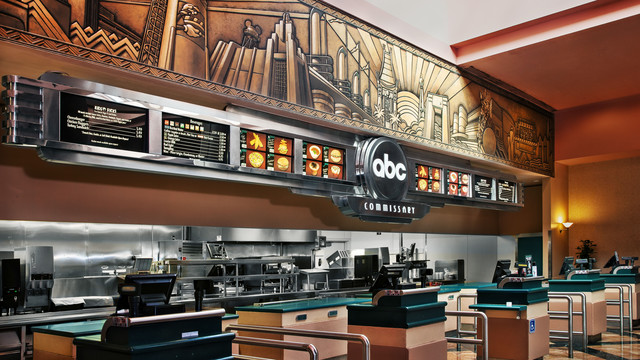
December 16, 1990 – The Commissary Opens in Hollywood Studios

abc-commissary-gallery06

“An Art Deco setting features film posters of past and present as movie trailers play on TVs.”

On December 16, 1990, The Commissary restaurant opened in Hollywood Studios. The quick-service restaurant is decorated in an Art Deco style, reminiscent of the style of Old Hollywood. Its menu features popular dishes such as a chicken club, New York strip steak, and roasted salmon. On July 1, 1997, the restaurant was renamed ABC Commissary, named after the Disney owned television channel, and features trailers and behind-the-scenes looks of popular ABC shows on its many television screens.

December 15

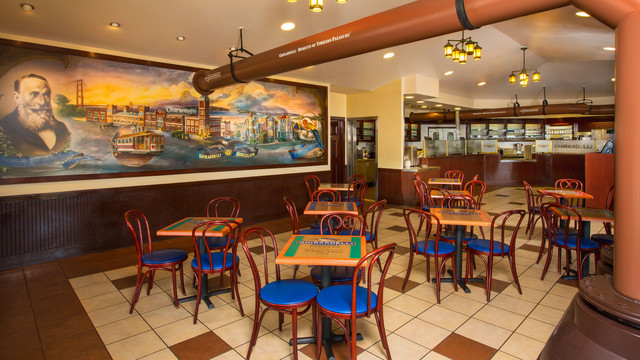
December 15, 1997 – Ghirardelli’s Soda Fountain and Chocolate Shop Opens in Walt Disney World’s Downtown Disney

ghirardelli-soda-fountain-gallery01

“The world-famous chocolatier delivers decadent sundaes smothered with hot, house-made fudge as well as chocolate treats and drinks.”

On December 15, 1997, Ghirardelli’s Soda Fountain and Chocolate Shop opened in the Downtown Disney area of Walt Disney World. The quick-service store features chocolate by the famous chocolate company, with special San Francisco themed sundaes, including the Golden Gate Banana Split: vanilla, chocolate, and strawberry ice creams topped with pineapple, strawberries, hot fudge, bananas, whipped crème, chopped almonds, and a cherry. A version of this store was opened in Disneyland’s Downtown Disney area on June 7, 2012.

December 14

December 14, 2008 – The Documentary The Age of Believing: The Disney Live-Action Classics Premieres on Turner Classic Movies

vlcsnap-2014-12-14-16h17m53s22

“Using his signature style, hard-work, and an unwavering belief in his vision, Walt Disney created the most successful family film franchise of all time.”

On December 14, 2008, the documentary The Age of Believing: The Disney Live-Action Classics premiered on the cable channel Turner Classic Movies. Interviewees range from film critic and historian Leonard Maltin, nephew Roy E. Disney, author and historian Bob Thomas, director Ken Annakin, composer Richard Sherman, and actors Glynis Johns, Dick van Dyke, Lesley Ann Warren, Dean Jones, Kevin Corcoran, Hayley Mills, and Kurt Russell. It was written and directed by Peter Fitzgerald. The documentary explores the Disney Studios venturing into the highly successful area of live-action family films, beginning with the Alice Comedies of the 1920s, which featured a live-action character in a cartoon setting. Although Disney became known for its animated features, it wasn’t until the 1940s during the onset of World War II that the studio was able to start its foray into live-action production, beginning with Victory Through Air Power. Saludos Amigos and The Three Caballeros featured extensive sequences of combination live-action and animation, thanks to Ub Iwerks’ engineering process. The earliest live-action features were the True-Live Adventure series, starting after the war, with several winning Academy Awards; around the same time, Buena Vista Distribution was formed to handle the release of Disney films. Also after the war, to use funds Disney had sitting in England, it was decided to make films in England to make Treasure Island, The Sword and the Rose, and other classics. The English films were a success, and gave Disney the courage to pursuit one of the greatest live-action films of the studio’s history, 20,000 Leagues Under the Sea.

The documentary also explores the foray into television, which became a main tool in promoting Disney live-action films. Many segments from the Disney anthology series were put together as live-action releases and gained high reviews, particularly the Davy Crockett films. The documentary then explains the behind-the-scenes of a string of several beloved family films, beginning with Old Yeller. The Shaggy Dog was a surprise hit for the studio, and the beginning of comedy films, cemented by the success of The Absent-Minded Professor. The studio found success in all sorts of types of live-action films in the 1960s, and started the careers of several actors, including Kevin Corcoran and Hayley Mills. The film Babes in Toyland was the studio’s first attempt at a live-action musical; although receiving a lukewarm reception, this film paved the way to the creation of Mary Poppins, which became Walt Disney’s crowning achievement. The documentary also touches on Walt’s lung cancer and his final months. After his death, the studio kept working on the live-action films in production while Walt was alive, and Roy O. Disney helped keep the studio going with new films, including The Love Bug series. In the late 1960s, Disney films were seen as “uncool” in Hollywood due to sweeping social changes, but the studio continued to create now-classic films, although it was a struggle for the studio. Although there were no great successes, the film Tron became a cult classic, and the studio continues to make successful family films.


December 13

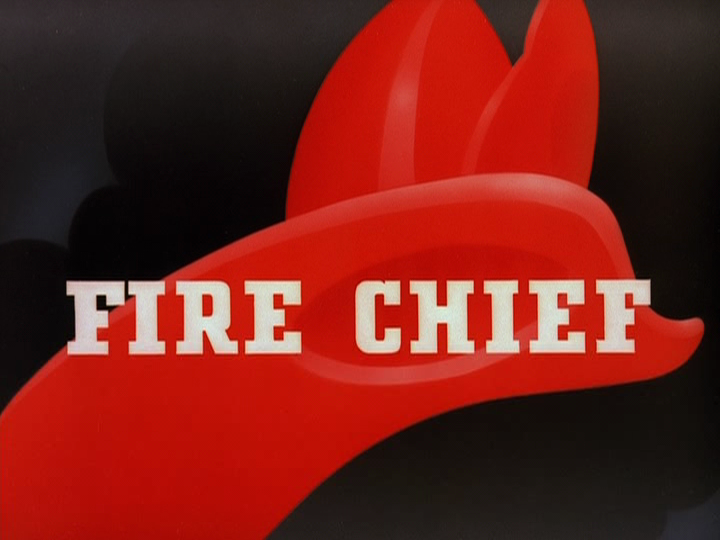
December 13, 1940 – The Donald Duck Short Film Fire Chief Premieres in Theaters

vlcsnap-2014-12-13-17h53m27s13

“So, they was trying to get something over on me.”

On December 13, 1940, the Donald Duck short film Fire Chief premiered in theaters. It was directed by Jack King.

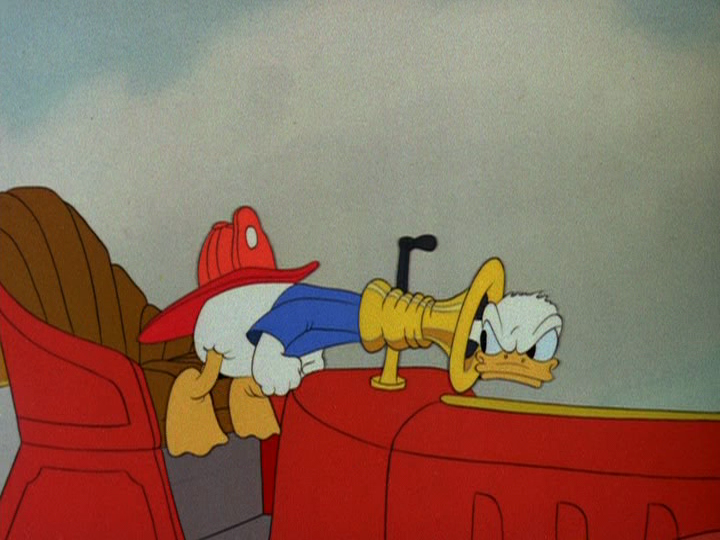
Donald is sound asleep at his fire station, with his snoring waking his nephews. Irritated, they use their slingshots to hit the alarm, waking Donald and sending him flying to his fire truck. He almost starts the engine when he hears his nephews laughing, and realizes he’s been tricked. When he rushes back upstairs to reprimand them, he finds that they’re already asleep. Knowing that they’re just faking it, he decides to get them back, and blows a trumpet to call them to attention, and having them march in step. Unfortunately, as Donald is marching backwards, he falls right through the hole for the fireman’s pole. One of the nephews, not paying attention, crashes into the other two, and all three fall down the hole on top of Donald. He soon sends them to their posts, although he is very critical of the way one of them places coal in the fire. When Donald dumps all the coal in the boiler, the fire becomes intense to the point where the ceiling catches fire, and the alarm sounds. Unaware that it is his own building that it on fire, Donald readies his team. The nephews try to tell Donald that the fire house is on fire, but Donald doesn’t notices until he’s already halfway down the street.

Donald rushes back to the fire at his own station, only to get stuck in the horn after he comes to a sudden stop

Donald rushes back to the fire at his own station, only to get stuck in the horn after he comes to a sudden stop

When Donald makes it back, he gets stuck in the horn, until his nephews get him out. He gets on the ladder and tells the boys to send him up, and they send him up so fast that the ladder disconnects, and Donald is sent high into the sky. He falls to the ground, and the boys are ready with the net, but Donald falls through the chimney of the fire station and into the stove. Donald continues to sound the alarm, and the boys work to put out the fire while Donald stays stuck in the stove. Donald finally manages to break free, but runs into more trouble with the fire house, which ends up knotted and building up behind him. The hose bursts from the water and the pressure, sending Donald flying into a bicycle store. He makes his way back and attempts to take over, although he mistakenly attaches the fire hose to a gasoline pump rather than the fire hydrant. The boys make a run for it, and Donald burns the firehouse, his fire truck, and his helmet to the ground.

December 12

December 12, 2008 – The Cars Toons Short Film Tokyo Mater Premieres in Theaters

TokyoMater

“Hahaha, can I!…hey, can I?”

On December 12, 2008, the short film Tokyo Mater was released to theaters alongside the Disney animated feature Bolt. The short is part of the Cars Toons series from Pixar, and includes a special cameo of Sully and Mike from Monsters, Inc. and the Harryhausen restaurant. It was directed by John Lasseter, Rob Gibbs, and Victor Navone, with story by Lasseter, Gibbs, Bobby Alcio Rubio, and Scott Morse. It stars Larry the Cable Guy as Mater, Keith Ferguson as Lightning McQueen, Michael Wallis as Sheriff, Mach Tony Kobayashi as Kabuto, and Robert Ito as Ito-San.

The short begins with some drag racers flying through Radiator Springs, and as the sheriff chases after them, Mater admits to McQueen that he used to be a drag racer, and reveals the story. A car is on the side of the road and needs a tow to a place very far away, but Mater insists on taking him anyway. He ends up in Tokyo, and Mater is shocked by what he sees. After he accidentally bumps into the Drag King Kabuto, Mater is challenged to a drift race at midnight. The only way Mater can win is through a serious modification upgrade, which he accepts. Mater and Kabuto have to race to the top of Tokyo Tower, and the winner will be the new Drag King. The loser will be stripped of all of their modifications and reduced to a stop car. The two take off, but Mater is losing horribly. He ends up going the wrong way through traffic and is nearly stopped by police. He manages to escape the police, but is soon surrounded by ninjas. He is rescued by Lightning Dragon McQueen, who then takes him through a special shortcut to reach the tower. It’s a close finish, by Mater manages to win, and Kabuto becomes nothing more than a stock car. However, no one believes Mater’s story, and they watch in silence as Mater runs off, pretending he’s been upgraded.