RSS Feed

Tag Archives: Live Action

July 7

Posted on

July 7, 1963 – The Live Action Film Summer Magic is Released to Theaters
“Land of promise, bounteous, this is beautiful, this is beautiful Beulah, in the rocky state of Maine.”

On July 7, 1963, the live action film Summer Magic was released to theaters. The film, based on the book Mother Carey’s Chickens by Kate Douglas Wiggins, is one of the earliest Disney musicals, with music written by Buddy Baker, and songs by the songwriting team the Sherman Brothers, with their song “Ugly Bug Ball” becoming a hit of the year. It was directed by James Neilson, and stars Hayley Mills as Nancy Carey, Burl Ives as Ossian Popham, Dorothy McGuire as Margaret Carey, Deborah Walley as Julia, Eddie Hodges as Gilly, Jimmy Mathers as Peter, Una Merkel as Mariah Popham, and Peter Brown as Tom Hamilton.

The film opens in Boston during the time of Ragtime music. Nancy Carey finds a letter in her front hall, and opens it excitedly, but then gets back to the sad task of packing her house with her brothers, Gilly and Peter. Their father had recently passed away, and the Careys are moving to a smaller house, as they can no longer afford their current residence. Their mother, Margaret, returns from their attorney’s office, with the unfortunate news that the mining stocks they’d counted on to help them are worthless, but she reassures them that they’ll get along fine, although they can’t afford to live in Boston. Nancy excitedly reveals to the family that she wrote the caretaker of a house they’d seen on vacation in Beulah, Maine. The caretaker will allow them to live in the house for $60 a year, and their mother agrees that they should go.
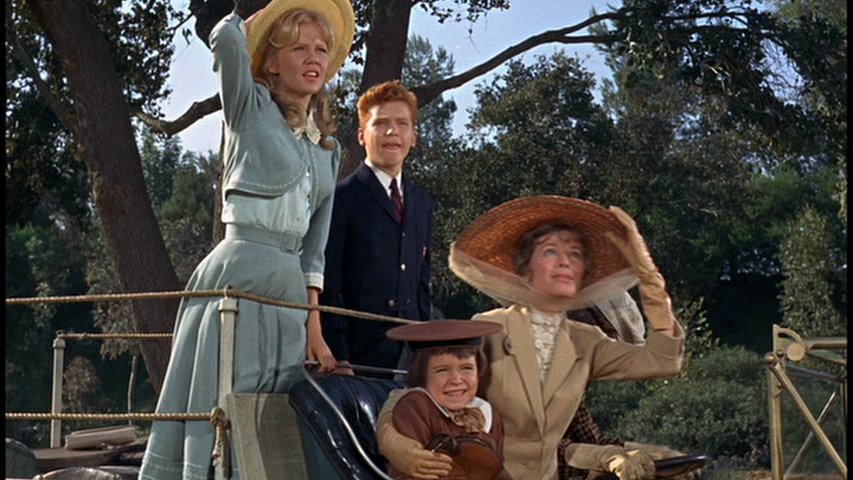
The Careys arriving at the Yellow House in Beulah

The Careys arrive at the “Yellow House,” as they affectionately call it, and meet the caretaker, Ossian Popham. After sorting out some of the “little white lies” in Nancy’s letter (calling her younger brother a “rickety baby,” for one), Mr. Popham allows them to stay and volunteers to help them fix up the house. The Careys soon become acclimated to the small town, with Gilly taking a job as Ossian’s assistant. Peter tries to fit in with the other boys, but is ridiculed and bullied for his Boston-style hair and clothes. Ossian helps Peter out by giving him some “country clothes,” and helps Nancy with all of the supplies she needs. Ossian’s wife, Mariah, is soon suspicious of Ossian’s behavior, and continues to ask if he has actually written the owner of the house, Mr. Hamilton, for permission to allow the Careys to stay there. Ossian continues to avoid her accusations.

The situation gets crazier for the Careys when Peter gets a job taking care of a sheepdog named Sam, who tears through the house and ruins all of Nancy’s wallpaper. Just as they decide that Sam can stay, they learn that another guest will be staying with the Careys: Cousin Julia. This revelation causes great distress for Nancy and Gilly especially, who dislike their cousin immensely for her spoiled attitude. After Julia’s father died, she was adopted by the Fergusons, who felt guilty for selling Julia’s father worthless stocks, the same stocks Nancy’s father invested in. The Fergusons can no longer afford to keep her (“Another unfortunate investment,” Margaret explains), and Margaret asks that Nancy and Gilly keep this a secret from Julia, as the news would devastate her.
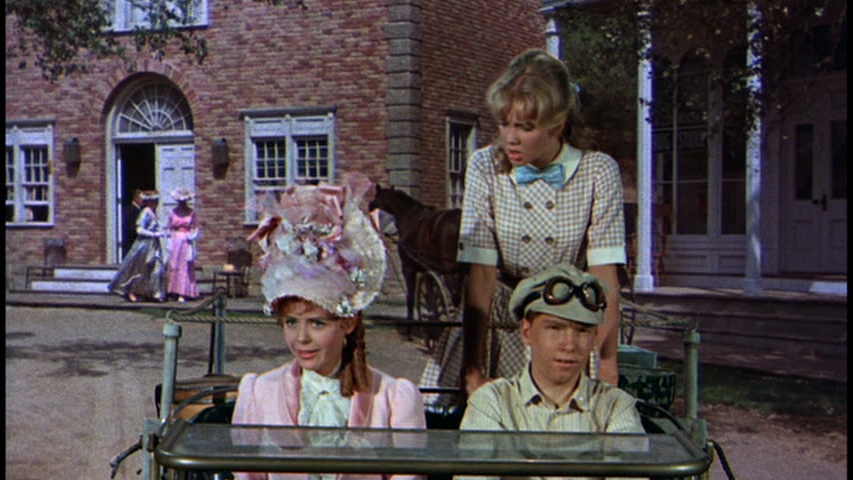
Gilly (Lower Right) and Nancy (Upper Right) drive their cousin Julia to their house; Julia is rather unimpressed with the small town

When Julia arrives, Nancy and Gilly exaggerate every little detail and purposefully try to scare their cousin, pretending that bears will attack their house. After Julia has a good scare when Sam climbs through her bedroom window, Nancy and Gilly try to make peace with her, realizing their pranks may have gone a little too far. Meanwhile, as Margaret tries to face facts with the financials of their situation, Ossian tells them that a letter has arrived from Mr. Hamilton, saying that due to their renovations, he will let them live rent-free, providing they find a suitable place for his mother’s picture. They agree happily, and continue to work on the house. Julia, however, keeps her stuck-up airs and bests Nancy for the attention of the new schoolteacher, Mr. Bryant. Nancy is pushed to her breaking point, and finally tells Julia why she was sent to stay with them. Julia, heartbroken at first, realizes that she wishes to stay with Careys in Beulah, rather than return to the Fergusons, even though they are able to afford to keep her again. Nancy and Julia call a truce and become friends.
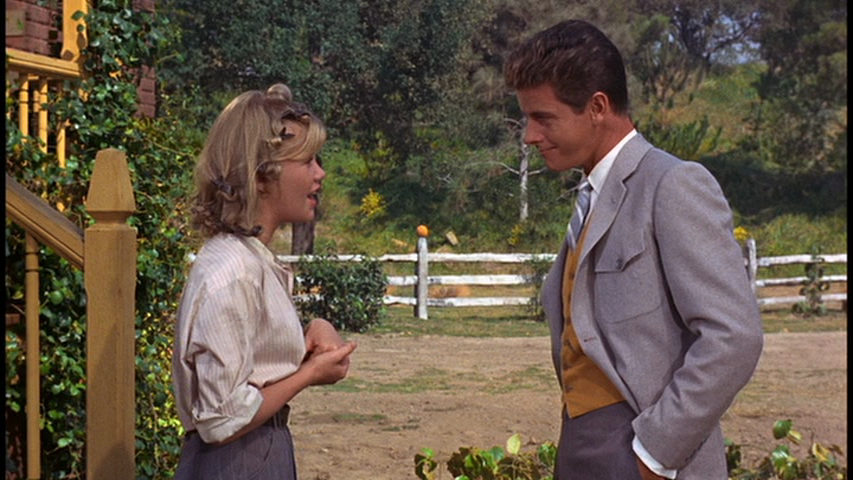
Nancy meets a handsome stranger at the house, unaware that she has just met Mr. Hamilton, the owner

The Careys are preparing for their housewarming party on Halloween when a strange man pulls up to the house. Nancy bumps into him and starts telling him the reason for the celebration and the mess the house was in before the Careys took over, unaware that the man she’s talking to is Mr. Hamilton. He soon leaves for town to see Ossian, demanding to know why the Careys are living there, and why Ossian never informed him of anything. Ossian gives Mr. Hamilton all the letters Nancy wrote him, hoping that he will be persuaded by them to let the Careys stay. That evening, as everyone attends the party with their dates, a lonely Nancy shuts herself in her room, refusing to attend alone. Her mother tries to convince her to meet her guests, with Nancy agreeing and putting on a brave face. As she makes her way down the stairs of the house, her shoe falls off and lands right in front of Mr. Hamilton, who has decided to show up with Ossian, and he escorts Nancy to the party. At the party, they unveil what they’ve been told is a picture of Mr. Hamilton’s mother, actually a grim-faced relative of Mariah Popham’s, leaving Mr. Hamilton rather angry. He makes his way over to Nancy, though, and won over by Nancy and her actions, continues to dance with her, an obvious romance blossoming between the two. The film ends with Ossian remarking that “the black cloud has a silver lining.

July 6

Posted on

July 6, 1938 –Actress Luana Patten is Born

On July 6, 1938, Luana Patten was born in Long Beach, California. A model since the age of 3, Patten was picked from hundreds of girls to star in the film Song of the South as Ginny, alongside Bobby Driscoll as Johnny. She would go on to become the first actress to sign a long-term contract with Disney, starring in several films with Driscoll, including Melody Time and So Dear to my Heart. In fact, she and Driscoll were the first long-term contract players at the studio. She also starred in the film Fun and Fancy Free with Edgar Bergen, Charlie McCarthy, and Mortimer Snerd. After taking a brief break to finish high school, Patten returned to the studio for a couple of films, her last role being Nora White in the 1966 film Follow Me, Boys. After leaving the studio, Patten continued to act until 1970, when she retired from the industry. She passed away at the age of 57 in 1996 from respiratory failure.

June 26

June 26, 1959 – The Donald Duck Featurette Donald in Mathmagic Land is Released to Theaters.

“By golly! You do find mathematics in the darndest places!”

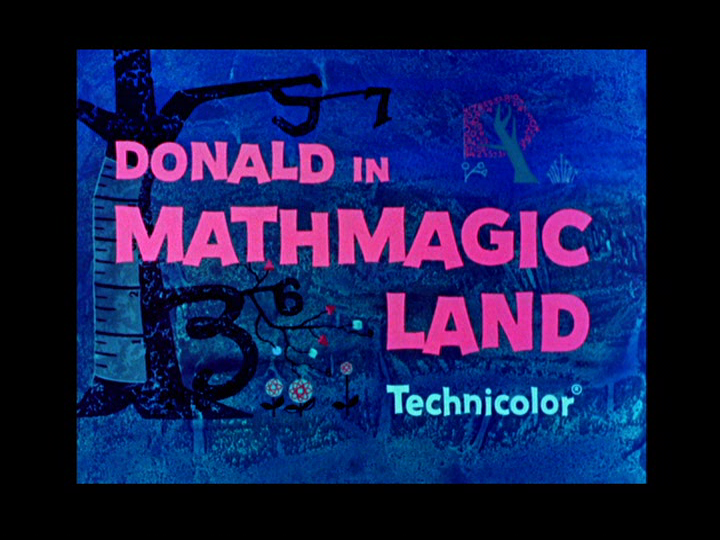
On June 26, 1959, the featurette Donald in Mathmagic Land was released to theaters. This Academy Award-nominated short would go on to become one of the most popular educational films ever released by Disney. It was also shown on the first program of Walt Disney’s Wonderful World of Color, introduced by Professor Ludwig von Drake, who played the True Spirit of Adventure in the featurette. The story was written by Milt Banta, Bill Berg, and Dr. Heinz Haber, and starred Clarence Nash as the voice of Donald.

Donald, dressed in a hunter’s outfit, enters a dark room with his gun and looks around, remarking on how strange this all seems to be. He follows a trail of numbers, and finds the creature making the markings is a walking pencil, who challenges Donald to a game of tic-tac-toe, which Donald loses. He continues to walk, surprised by the square roots he runs into. He calls out hello to anyone who will hear him, and the voice of the narrator greets him. The narrator informs Donald that he is in Mathmagic Land, the land of great adventure, and that he, the narrator, is the True Spirit of Adventure. The spirit tells Donald he will take him on a journey through the wonderland of mathematics.

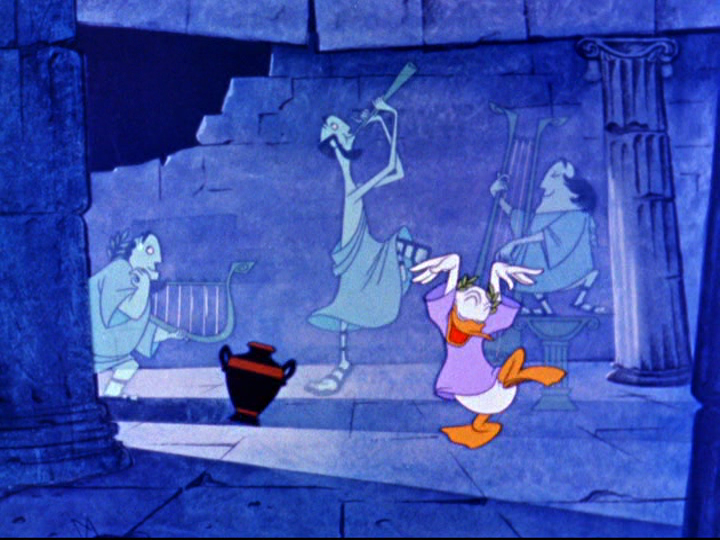
Donald having a jam session with the Pythagoreans, while learning that without math, there would be no music

As Donald storms away, saying math is for eggheads, the spirit informs Donald that without “eggheads,” there would be no music. He takes Donald back in time to Ancient Greece to meet Pythagoras, the father of mathematics and music. Donald is still confused, so the spirit shows Donald how music is full of mathematics. The first example shown is a harp, demonstrating how an octave is created. Donald and the spirit then sneak in on a meeting of the Pythagoreans, who are playing music in their meeting. Donald interrupts them, saying they need to play something with a beat. The Pythagoreans, the spirit explains, helped create the music we know and love today. As the spirits of the Pythagoreans disappear, Donald is left with a surprise – he is made a member of the Pythagoreans.

The segment then moves to another Pythagorean discovery: the pentagram, filled with mathemagic. The first concept explained is the golden section, then we move to the golden rectangle, which the pentagram creates many times over. The Greeks believed the golden rectangle to be a natural law of beauty. The spirit then shows how the pentagon, another Pythagorean shape, is found in nature, before moving on to other shapes found in nature.

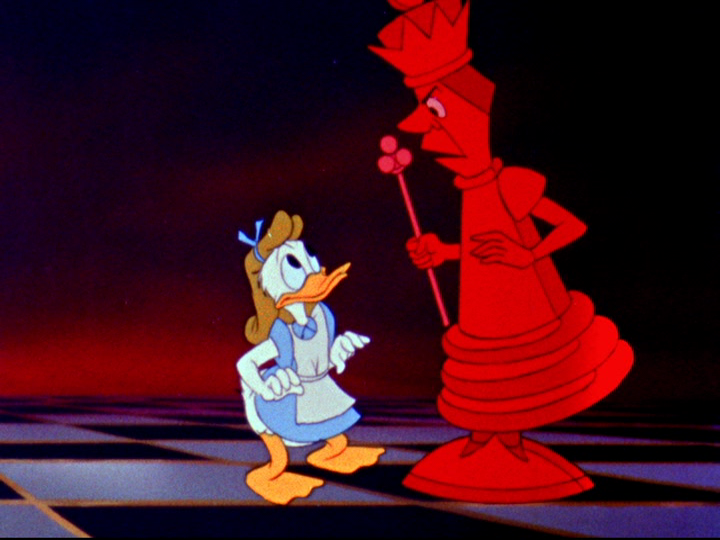
Donald plays the part of Alice when being taught the mathematical principles of the game of chess

Donald, who is enjoying his adventure so far, is delighted to hear that one can find mathematics in games, as well. The spirit begins with the game of chess, explaining it with the concept of Alice in Wonderland, with Donald playing the part of Alice. After a slight adventure with the chess pieces, Donald is able to watch a game in safety, but is bored by it. The spirit then begins to list sports with a geometric field, like baseball and football. The game that gets Donald really excited, however, is billiards. The spirit then shows an expert playing three-cushion billiards, and the mathematics used to get the perfect shot.

The spirit then tries to get Donald to play a game with his mind, only to find that Donald’s mind was completely cluttered with antiquated ideas, bungling, false concepts, and superstitions. He cleans out Donald’s mind, then has Donald think of a perfect circle, and puts a triangle in it. When asked what he sees, Donald sees a sphere. The spirit then has Donald take one thing and see how many items he can come up with using those shapes. Donald is then taken to a hall filled with doors, with most of them open. Some of the doors Donald discovers are locked, to which the spirit replies that they are the doors of the future, with the key being mathematics. The short then ends with the Galileo quote: “Mathematics is the alphabet with which God has written the universe.”

June 21

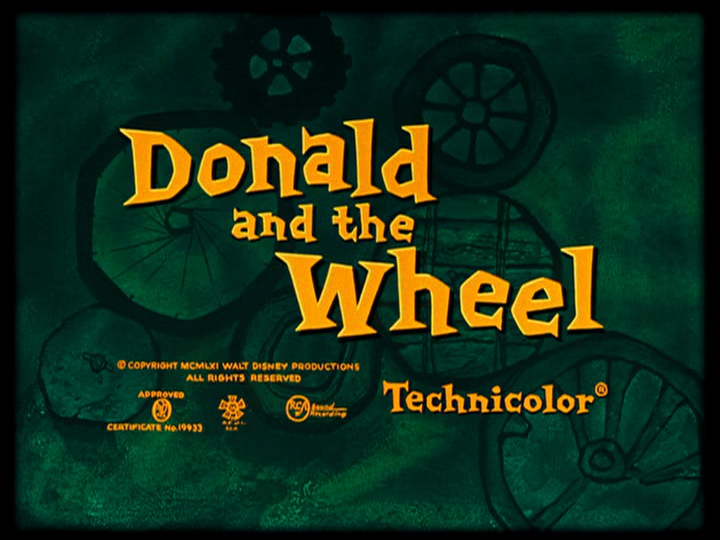
June 21, 1961 – The Donald Duck Short Film Donald and the Wheel is Released to Theaters

“Well, frost me, Poppa, can it be your intention, to bat your choppers over nothing more than a wheel? Your brain is all tied up in a sling to think a wheel is such a great thing.”

On June 21, 1961, the Donald Duck short Donald and the Wheel was released to theaters. The story was written by Bill Berg, with songs and rhymes by Mel Leven, music by Buddy Baker, and direction by Hamilton S. Luske. It stars the vocal talents of The Mellomen (Bill Cole, Bill Lee, Thurl Ravenscroft, and Max Smith), with Ravenscroft and Smith as the father and Junior, and Clarence Nash as the voice of Donald Duck.

This educational short begins with two “spirits of progress” watching a piece of wood rolling around like a wheel. Junior, the younger of the spirits, asks his dad why he’s so impressed with the wheel. His father claims it to be the greatest invention of all time, to which Junior scoffs. When his father challenges him to name something better than the wheel, Junior accepts the challenge, but every invention he names is only possible thanks to the wheel. The father takes his son back in history to meet the inventor of the wheel.

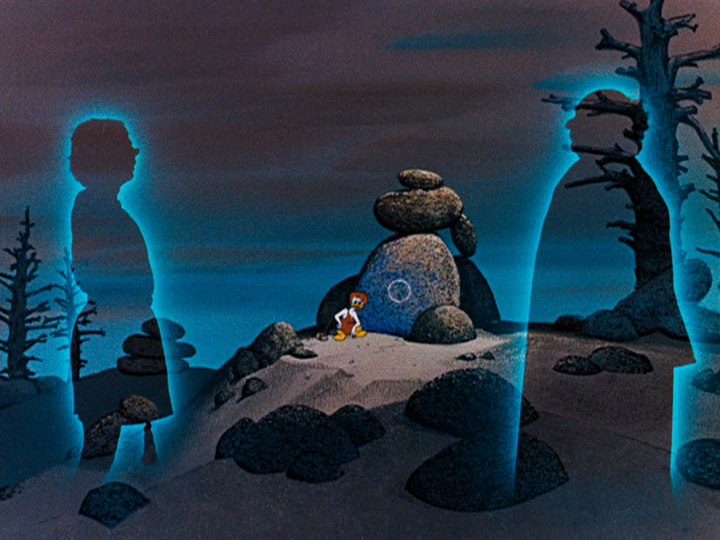
The Spirits of Progress start to tell Caveman Donald about the great invention of the wheel

Back in the caveman age, we see a prehistoric Donald Duck, who, after a run-in with a tiger, is inspired to create the wheel. The spirits try to explain to Donald what a wheel is used for, but Donald seems to not be able to understand. Donald finally asks them who they are, and they explain to him that they are the “spirits of progress,” there to help him with his great invention. The first example they give him is attaching two wheels to his sled, making it easier for him to cart around.

The song at that point goes through the evolution of the wheel, with Donald also donning the attire of each time period being sung about. Steam is soon added to the idea of the wheel, with trains and automobiles lauded in song, and Donald involved in comic situations with each passing period. Finally, after a massive pile-up on the highway, Donald angrily declares he’d rather walk.

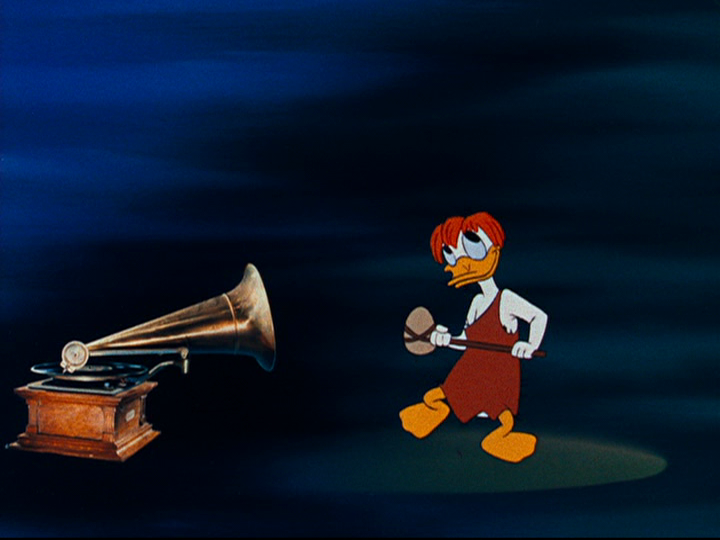
Caveman Donald dances to the music from the gramophone, a more “practical” example of the use of wheels

They go back to Donald’s time, trying to take another approach with how important the wheel is. When they try to explain that the world is round, Donald insists that the world is flat. Junior takes over this time, trying to explain the rotation of the Earth, the moon, and all the planets in the solar system. The demonstration continues with gears to show how wheels keep things working. For a more “practical” example, they begin with a music box, moving to the gramophone, then the jukebox, which features Donald dancing with a live-action dancer.

The spirits, however, push a little too hard with how important the wheel will be, showing wheels in everything he will use in his day. When they claim that he’s about to create a great invention, Donald tells them “Oh, no! I’m not going to be responsible for that!” The spirits are consoled with the fact that although Donald didn’t invent the wheel, someone eventually did.

June 10

June 10, 1949 – Birth of Disney Legend Kevin “Moochie” Corcoran

“…kids in the audience related more to Corcoran, who created a character who was part All-American boy and part hellion.” – Film Writer Donald Liebenson.

Born on June 10, 1949, in Santa Monica, California, Kevin Anthony Corcoran began his acting career at the tender age of two. In 1956, Corcoran auditioned for a serial on the Mickey Mouse Club called “Adventures in Dairyland,” and won the role of a character named Moochie, a nickname that would stick with him throughout his career at Disney. He was then cast specially by Walt in the sequel serial, “The Further Adventures of Spin and Marty,” as well as “The New Adventures of Spin and Marty.”

Corcoran also appeared in several popular Disney films, with his only starring role as Toby in Toby Tyler, a film about an orphan who runs away to join the circus. He played supporting roles in Old Yeller, The Shaggy Dog, Pollyanna, Swiss Family Robinson, Babes in Toyland, Bon Voyage!, Savage Sam, and A Tiger Walks. Corcoran played the younger brother to actor Tommy Kirk in five Disney films, including Swiss Family Robinson and The Shaggy Dog. Corcoran also voiced Goliath II in the short film of the same name, and was featured in several Disney mini-series and serials, such as Daniel Boone, The Mooncussers, and Johnny Shiloh. After the 1964 film A Tiger Walks, Corcoran mostly retired from acting and attended California State University, getting a degree in theater arts.

Corcoran returned to Disney after college, using his skills behind the camera instead of as an actor, and working as an assistant director and producer on several projects, including Pete’s Dragon. He has also worked as a first assistant director for many television series outside of Disney, including Quantum Leap and Murder She Wrote, also acting as an assistant producer and director on the latter series. Corcoran was inducted as a Disney Legend on October 9, 2006, alongside Tim Considine, David Stollery, and Tommy Kirk.

May 27

Posted on

May 27, 1948 – The 10th Animated Feature, Melody Time, is Released to Theaters

“Yes, it’s Melody Time, time to hitch your wagon to a song. Cause a song’s the one and only thing that will take you over the rainbow to the land where music is king.”

On May 27, 1948, the tenth animated feature and sixth package film, Melody Time, was released to theaters. It was directed by Clyde Geronimi, Hamilton Luske, Jack Kinney, and Wilfred Jackson. The stories were written by Winston Hibler, Erdman Penner, Harry Reeves, Homer Brightman, Ken Anderson, Ted Sears, Joe Rinaldi, Bill Cottrell, Art Scott, Jesse Marsh, Bob Moore, and John Walbridge, with “Little Toot” by Hardie Gramatky, and Carl Carmer as the Folklore Consultant. Many famous performers contributed to the film, including Roy Rogers and Trigger, Dennis Day, the Andrews Sisters, Fred Waring and his Pennsylvanians, Freddy Martin, Ethel Smith, Frances Langford, and Buddy Clark as the Master of Ceremonies.

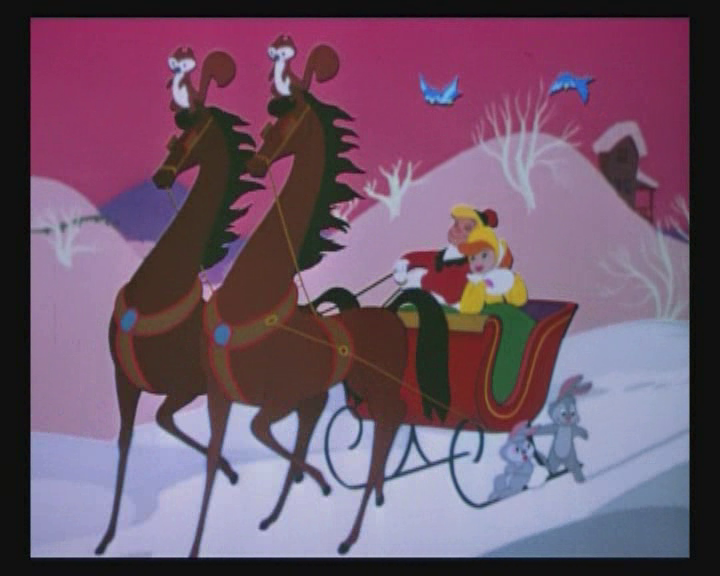
The two couples happily riding in a horse-drawn sleigh

The first segment is Once Upon a Wintertime, sung by Frances Langford. Two couples – one human, one rabbits – share an adventure on a beautiful winter day. The human couple takes a sleigh ride, and the rabbits hitch on to the cart for a ride. The couples stop near the pond to go ice skating, and both males end up upsetting their mates more than once throughout their trip. When both females end up on a dangerous patch of thin ice near a waterfall, they are saved with the help of the horses from the sleigh and a pair of squirrels, and all is well once again for the couples.

The next segment is a new take on the piece “The Flight of the Bumblebee,” known as Bumble Boogie, by Freddie Martin and his Orchestra. A frightened bumblebee is in a nightmare that involves all sorts of musical instruments, and he tries to escape as best he can while being pursued by harmonies and all sorts of strange musical creations.

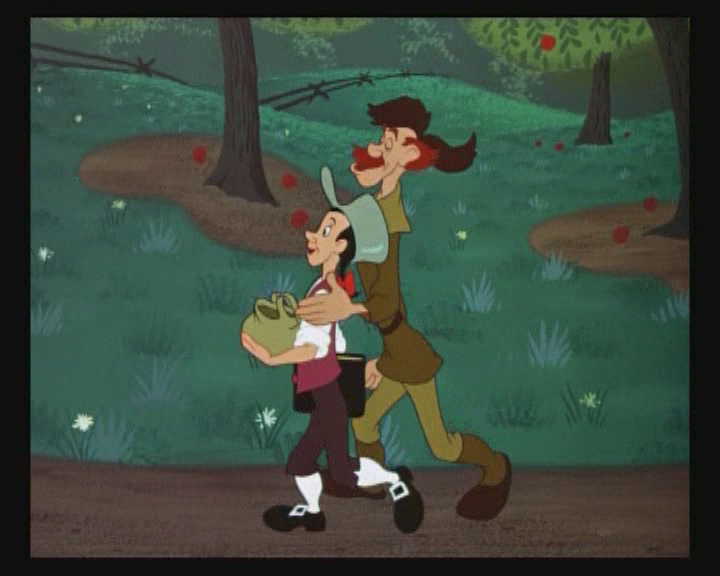
Johnny Appleseed (L) and his Angel walk down the path, with the Angel finally convincing him to go west and plant his apples.

This is followed by Dennis Day performing the tale of Johnny Appleseed, a story from “the pages of American Folklore.” Day was the narrator, Johnny, and Johnny’s Angel. This segment opens with Johnny picking apples from his apple trees, when he suddenly sees a wagon trail. Johnny feels the urge to head west, but believes himself to not be enough of a pioneer. His Angel appears, and convinces him to head west if that’s what he wants to do. Johnny decides to go west and plant his apple trees. No matter what dangers he faced, he was able to persevere, and was able to begin planting his trees wherever he found fertile soil. The settlers would honor him well for his gift of apple trees, which provided them with much needed food. Johnny continued planting for forty years, until one day, his Angel appeared to take him to Heaven, needing him to plant apple trees there.

Following that segment is Little Toot, as performed by The Andrews Sisters. Little Toot is a small tugboat who is very enthusiastic about joining the family business – unfortunately, Little Toot always finds himself in trouble, unable to behave, though he tries to be good. After nearly getting caught by a police officer, Little Toot decides to be helpful, but ends up accidentally causing trouble by turning the rudder on the boat his father is tugging and the boat crashes into the city. The police take Little Toot way out to sea as punishment, and his father is now only allowed to tow garbage. Fortunately, Little Toot is able to redeem himself by saving a ship that is in distress in a storm. Proclaimed a hero, Little Toot is able to return home.

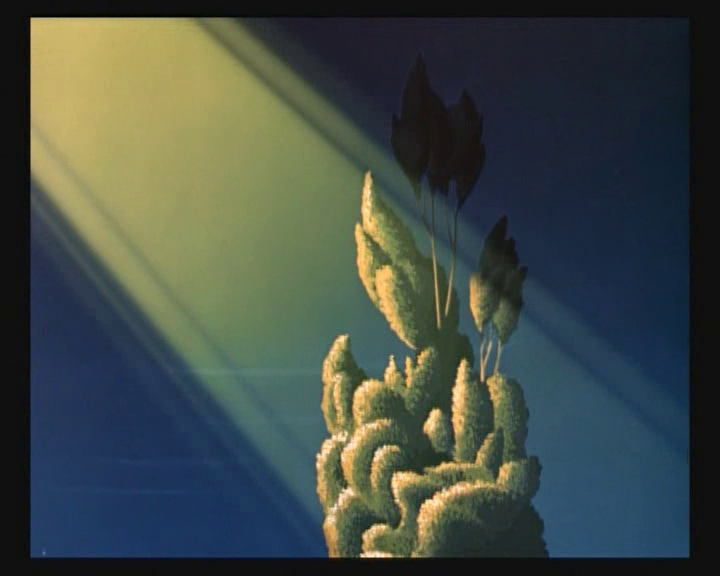
One of the beautiful illustrations used for the segment Trees.

Next is Trees, performed by Fred Waring and his Pennsylvanians, and based on the poem by Joyce Kilmer. The short is a simple homage to a tree, with a different style of animation than the rest of the film, looking like a more realistic Bambi than a regular-style Disney cartoon.

Trees is followed by the more upbeat Blame it on the Samba, performed by Ethel Smith and the Dinning Sisters, and stars Donald Duck, Jose Carioca, and the Arucuan Bird. Donald and Jose are walking in a depressing blue scene, when they stop by the Arucan Bird’s restaurant “Café de Samba.” Once the samba begins to play, the two are able to snap out of their funk and begin to dance. The short also combines live action again, where Donald and Jose dance while Ethel Smith plays the organ, and then plays the congas before breaking into her own dance to the samba. She returns to the organ by the end of the short, with everyone dancing happily.

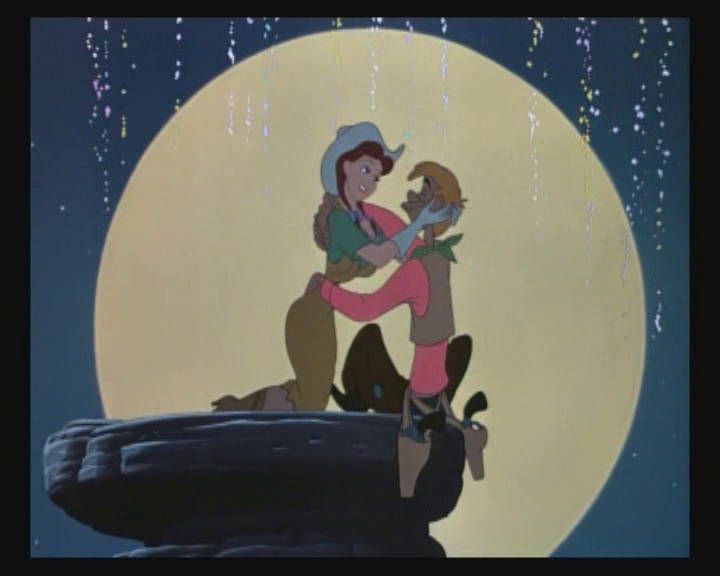
Pecos Bill and Slue-Foot Sue, proclaiming their love under a full moon

The last segment is hosted by Roy Rogers and Trigger, and also features child stars Bobby Driscoll and Luana Patten, telling one of the stories of Pecos Bill. After Bobby asks who Pecos Bill is, Roy begins to tell the story about how the bravest man of the west came to be and why the coyotes howl the way they do. Once, a wagon containing sixteen children and their parents was coming across a mean river in Texas, when a toddler popped out of the back and landed in the river. A coyote was traveling at night, and discovered the child in her den, and took to him, so Pecos Bill grew up with coyotes. One day, a pony was wandering through the desert and was saved by Bill, and this would become Bill’s best friend – Widow-Maker. Bill became the roughest, toughest cowboy in the west, with Widow-Maker by his side. Their partnership is threatened by a woman named Slue-Foot Sue, and the rest of the short tells how Widow-Maker ends their relationship, and why coyotes howl.

May 18

Posted on

May 18, 2004 – The Third Wave of the Walt Disney Treasures is Released

Image Credit: Wikipedia

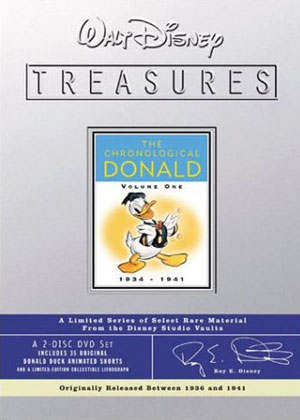
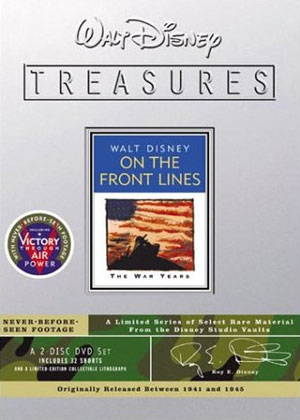
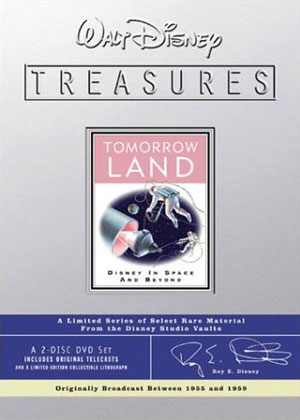
On May 18, 2004, Disney’s video distribution company, Buena Vista Home Entertainment, released the third wave of the popular Walt Disney Treasures. This set included Mickey Mouse in Living Color, Volume Two; The Chronological Donald; On The Front Lines; and Tomorrow Land. Although this wave was supposed to be released in December, as the other two were, the release had to be delayed to meet the demand of the popularity of the sets. As with the other two waves, the third set was introduced by film critic Leonard Maltin, who also provides commentary for the more politically incorrect works, known as the works “In the Vault.”

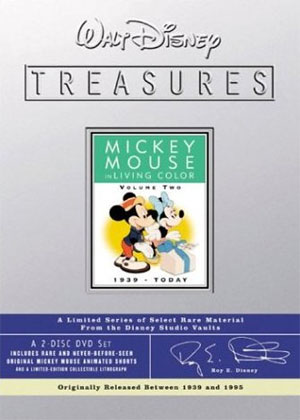
Mickey Mouse in Living Color. Image Credit: wikipedia

Mickey Mouse in Living Color, Volume Two is the second of the Mickey Mouse color short collections, and the fourth Mickey Mouse collection in all. The first disc gives the shorts from 1939 to the last Mickey Mouse short film in 1953, with bonus features including The Sorcerer’s Apprentice from Fantasia, Mickey and the Beanstalk from Fun and Fancy Free, as well as an Easter egg of Walt Disney performing the voice of Mickey for the short Mr. Mouse Takes a Trip. Disc two shows the modern revival of Mickey Mouse, which includes Mickey’s Christmas Carol, The Prince and the Pauper, and Runaway Brain. The bonus features are numerous on this disc, and include an interview with the voices of Mickey and Minnie (Wayne Allwine and Russi Taylor), an interview with Disney animators Mark Henn and Andreas Deja, and clips from the Walt Disney anthology series that use Mickey as an example of animation techniques.

The Chronological Donald. Image credit: wikipedia

The Chronological Donald is the first set of Donald Duck short films, which begins with the Silly Symphony The Wise Little Hen in 1934 on disc one, and ends with the 1941 short Chef Donald on disc two. The disc one bonus features include a clip from the film The Reluctant Dragon, where the voice of Donald, Clarence Nash, is heard performing with Florence Gill, the voice of Clara Cluck. Disc two includes a mini-biography about Clarence Nash, and how his unusual voice inspired the creation of Donald Duck, as well as another clip from The Reluctant Dragon, where Donald is explaining to Robert Benchley how animation comes to life.

On the Front Lines. Image credit: wikipedia

On the Front Lines is a collection of all the propaganda, educational shorts, and films released when the Disney Studios were taken over during World War II. Disc one includes mostly the short films, including the shorts where Donald is drafted into the army. In the vault, there are four films: Der Fuehrer’s Face (a propaganda film where Donald believes he lives in a land occupied by Nazis), Education for Death (a chilling film based on the book by Gregor Ziemer), Reason and Emotion (a humorous look about how people needed to keep their emotions in check during wartime), and Chicken Little (a horrifying update to the children’s story). Disc two is of the film Victory Through Air Power, which Walt Disney created to send a message to the American people that the war could be won through the use of aviation and long-range bombing. This DVD set is the first release of the film since its rerelease in 1944. This disc also includes some training shorts, behind the scenes documentaries of the film Victory Through Air Power, galleries of insignias and posters created during wartime, and an interesting interview with long-time Disney employee John Hench, who recounts his time at the studio after the attack at Pearl Harbor.

Tomorrow Land. Image credit: wikipedia

The last set in this wave is Tomorrow Land, which pulls together episodes from the anthology series about space and the future, with many of these episodes directed by Nine Old Men member Ward Kimball. The first disc has three episodes: Man in Space, Man and the Moon, and Mars and Beyond. The second disc includes Eyes in Outer Space, Our Friend the Atom, and EPCOT, a look at the Florida Project Walt Disney planned, which was to be a Tomorrowland type theme park. Bonus features include interviews with author Ray Bradbury and long-time employee Marty Sklar, as well as an Easter egg of the Sherman Brothers singing “There’s a Great Big Beautiful Tomorrow” with Walt, as the song was featured at the General Electric Pavilion at the 1964 World’s Fair.

May 13

Posted on

May 13, 1992 – Fantasmic! Premieres at Disneyland

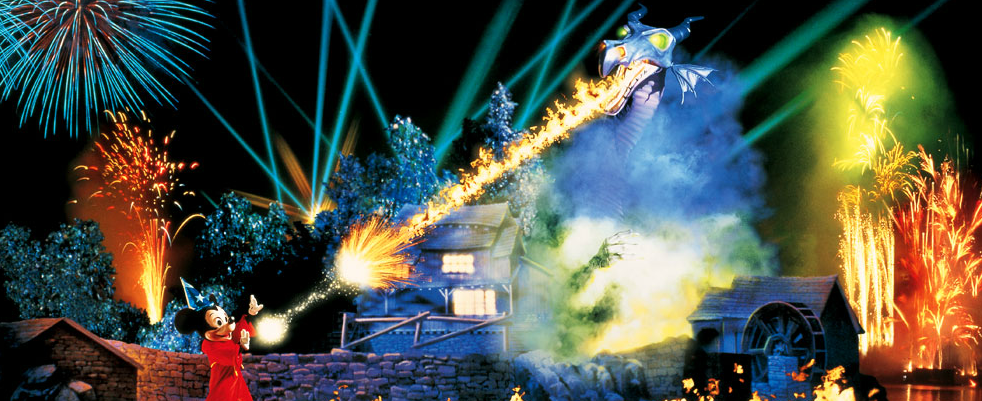
Image Credit: Official Disneyland Website

“Welcome to Fantasmic! Tonight, our friend and host Mickey Mouse uses his vivid imagination to create magical imagery for all to enjoy. Nothing is more wonderful than the imagination, for in a moment, you can experience a beautiful fantasy or an exciting adventure. But beware, nothing is more powerful than the imagination, for it can also expand your greatest fears into an overwhelming nightmare.”

On May 13, 1992, the evening show Fantasmic! premiered at Tom Sawyer Island at Disneyland. The spectacular show involves water effects and fireworks, with live actors in Disney character costumes acting out the plot of Mickey’s dream. The show has become one of the most popular nighttime events in the park’s history, and has expanded to a show in Walt Disney World’s Hollywood Studios resort (located in Sunset Boulevard), and Tokyo Disneyland’s Tokyo DisneySea Resort (located at the Mediterranean Harbor).

The story features Mickey Mouse using his imagination to create a wonderful fantasy world, which is soon threatened by Disney villains, including Maleficent and Ursula. Many scenes from classic Disney animation were reworked to be shown on three giant screens made of mist, while some classic characters appear by live-action actors to recreate classic scenes, including the fight between Peter Pan and Captain Hook.

The show has been reworked several times, including creating more accessibility for audience members, as the show’s unexpected popularity ended up causing traffic jams on the shores of the Rivers of America. Guests would line up for hours to get a good spot to see the show. The show is approximately 22 minutes long, and is shown late at night, usually past 9:00pm.


May 8

Posted on

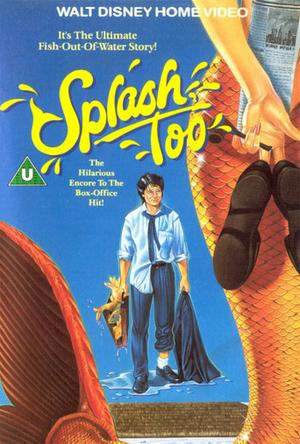
May 8, 1988 – The Television Show Splash, Too, Part Two, Premieres on Television

Image Credit: Screened.com

On May 8, 1988, the second half of Splash, Too, premiered on ABC television. The sequel to the successful 1984 film Splash, the special had only one returning cast member: Dody Goodman as Mrs. Stimler. The special starred Todd Warring as Allen Bauer, Amy Yasbeck as Madison, Donovan Scott as Freddie Bauer, and Rita Taggert as Fern Hooten. Splash, Too was also the first motion picture filmed at the new Disney-MGM Studios, and had a production budget of $3.3 million.

Set four years after the original film, Allen and his now-wife, Madison, return to New York City, where Allen’s brother Freddie is dangerously close to losing the family business. While Allen helps his brother, Madison has her own mission: to rescue her friend Salty the dolphin, who is being held captive for scientific experiments. The married couple grows closer as they strive to reach their respective goals.

May 7

Posted on

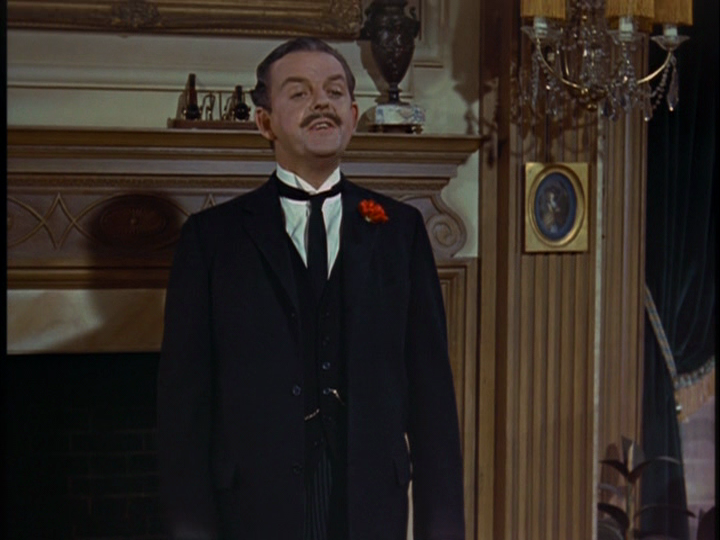
May 7, 1917 – Actor and Disney Legend David Tomlinson is Born

“…Walt said, ‘Very good, let’s see if we can get him.’ And that’s how it was – it was as simple as that. We knew he had the right personality.” – Richard M. Sherman on casting David Tomlinson.

Although David Tomlinson had a prominent career in England, he will always be known to generations of children as Mr. Banks in the film Mary Poppins. Tomlinson was born on May 7, 1917, in Henley-on-Thames, Oxfordshire, England. He began his acting career with amateur stage productions, progressing to a film debut in 1940’s Quiet Wedding. He briefly left acting to serve in the RAF in World War II, but came back after the war ended, although he did not leave behind his love of flying, continuing to pilot planes, much to the chagrin of his neighbors.

Tomlinson was asked to play the part of George Banks in Mary Poppins after many of the members of staff had watched his films. Before the film, he had never sung before, but a bit of polishing soon had him singing on screen like a professional. This role would become his most well known, particularly for the character’s change of heart and song “Let’s Go Fly a Kite.” Tomlinson would go on to star in two other films for the Disney Studios: The Love Bug as the evil Thorndyke, and the professor of magical arts Emelius Brown in Bedknobs and Broomsticks alongside Angela Lansbury. Tomlinson died at the age of 83 in 2000, and was inducted as a Disney Legend in 2002.