RSS Feed

Tag Archives: Disneyland

February 23

February 23, 1955 – “Davy Crockett at the Alamo” Premieres on ABC
vlcsnap-2013-02-23-09h52m19s150

“During the past season, we’ve presented two stories based on the life of Davy Crockett of Tennessee, a man whose courage, whose humor, and exploits lifted him into the legend class.”

On February 23, 1955, the final episode in the Davy Crockett trilogy, “Davy Crocket at the Alamo,” premiered on ABC in the Disney Anthology series Disneyland. Although this was written as Davy Crockett’s last adventure, two additional episodes were created thanks to the show’s enormous popularity; these final episodes were turned into a full-length feature film. The “Alamo” episode was directed by Norman Foster, and was written by Tom Blackburn. It stars Fess Parker as Davy Crockett, Buddy Ebsen as George Russel, Hans Conreid as Thimblerig, Nick Cravat as Bustedluck, Kenneth Tobey as James Bowie, and Don Megowan as William Travis.

The story begins with Davy and his friend George Russel heading out West “to follow the sun.” On a riverboat, a sly fellow named Mr. Thimblerig is playing pinochle with the travelers. He asks Davy and George to participate in the game. Davy says he doesn’t hold much for gambling, considering it foolish, but he finally consents to play and in the course of the game, he reveals to everyone how Thimblerig has been swindling them all. Thimblerig then realizes he’s been playing Davy Crockett, and ends the game, having been “hoisted on his own petard.” Later that evening, Davy stands on the railing of the boat, telling George of his intentions to head to Texas to help all the settlers in trouble. George is not thrilled with this plan, but he decides to go along with it. As they head downstairs for a drink, Thimblerig drunkenly offers his companionship, and ends up accompanying Davy and George to Texas.
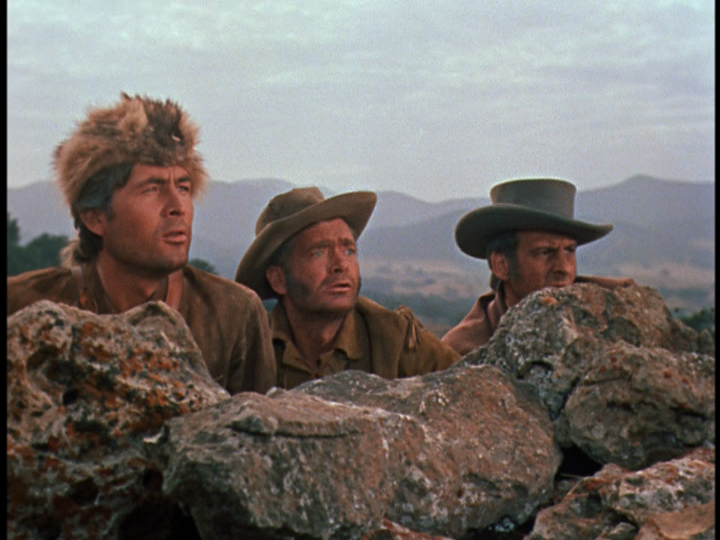
Davy, Georgie, and Thimblerig peer over the rocks carefully to observe their surroundings

Davy, Georgie, and Thimblerig peer over the rocks carefully to observe their surroundings

As the three arrive in Texas, Davy spots smokesignals in the distance and follows them, although he knows that it could be the dangerous Comanche tribe. The trio peeks over a rock formation to see a Comanche warrior help the buffalo stampede, when the warrior falls off his horse. Crockett tries to help the injured Indian when the warrior pulls a knife on him. Davy and the warrior scuffle, but Davy wins and helps nurse the warrior back to health, nicknaming him “Bustedluck.” Davy then converses with Bustedluck, who offers to lead them to a white settlement as thanks for their help. They pass a small group of Mexicans, who warn Davy and the others that San Antonio has been taken over by Santa Ana, and the Texans have moved to the Alamo, which is surrounded by soldiers. Davy and his men continue to the Alamo anyway, and are soon pursued by Mexican soldiers. The Texans inside the Alamo help protect Davy and his crew until they can get safely inside the fort.

Davy is then sent to meet Jim Bowie, the commander, who is thrilled that Crockett is here, until he realizes that Crockett brought only four men. Davy volunteers to be a courier for more troops, but Bowie tells him that he’s needed there to help at least hold the fort. Colonel Bowie had been injured and with his condition worsening, he relinquishes his command. While Crockett is offered the position, he refuses and gives it up to William Travis, who is second in command to Bowie. Travis gives Crockett and a group of men the south wall to protect, and they watch as a messenger is sent from Santa Ana’s camp. The message says that the men in the Alamo are allowed to surrender on Santa Ana’s terms, or they will be slaughtered. Travis and Davy refuse to surrender, and the battle starts.
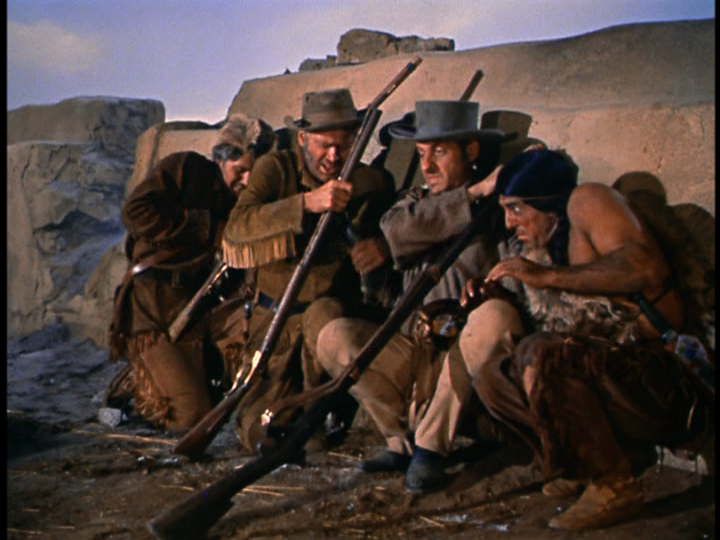
Davy and his crew band together as the Alamo is shelled day and night

Davy and his crew band together as the Alamo is shelled day and night

The Alamo is shelled all day and night, but after four days there are still no casualties. Late one night, George lets Davy know that they’re almost out of ammunition, and Davy reveals that he’s known that since they got there, only Bowie made him promise not to say anything. George is furious, thinking that Davy couldn’t trust him, and storms away, declaring that it’s now “every man for hisself.” George then goes to Travis, asking to be let out to get more troops from Goliad. George then makes it out, while Davy watches, worrying. A few days later, George makes it back, but arrives with the bad news that Goliad won’t be able to spare any men. Davy has to break the news to the ailing Bowie, who requests to be taken outside to be with his men. Travis breaks the news to the men that they are on their own to protect the Alamo. He then gives the men the option to either stay or leave, and not a single man will leave the Alamo.

One of the lookouts spies Santa Ana’s men sneaking up to the fort, and the final battle begins as those men storm the Alamo. The men in the Alamo are able to hold off the men in the first wave, but it becomes increasingly difficult with each storm of the small building. Bustedluck is the first of Crockett’s men to die, stabbed with a bayonet while protecting Thimblerig. Thimblerig is then shot by the invading troops, as is Travis. George is shot several times, but refuses to go down until he fires the cannon, and Bowie, hidden away in a room, prepares himself with two pistols as the soldiers break in. Davy turns to the dying George, whose last words are “Give ’em what fer, Davy.” Davy fights bravely as the last survivor as the men advance on him, although he is eventually killed in the process. The story ends with the flag waving above the Alamo turning into the flag of the State of Texas.
December 17

December 17, 1961 – The Walt Disney’s Wonderful World of Color Episode “Backstage Party” Premieres

vlcsnap-2012-12-16-17h29m40s219

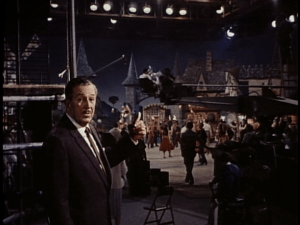
“Oh, the party hasn’t started yet. By the way, folks, these are some of the babes from Babes in Toyland.

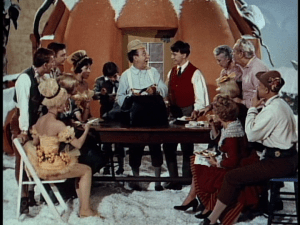
On December 17, 1961, the episode “Backstage Party” from the Disney anthology series Walt Disney’s Wonderful World of Color premiered on television. The episode takes viewers backstage at the Disney Studios, to the celebration of the completion of the upcoming feature film Babes in Toyland, starring Annette Funicello and Tommy Sands. The episode was directed by Jack Donohue and Hamilton S. Luske, with teleplay by Larry Clemmons.

The episode begins with the audience at the front gate, receiving directions to Stage Four, where the party is held. Unfortunately, there are many twists and turns on the way there; the audience progresses through a set with lavish homes, an Old West setting, then the set for the Zorro series, and finally finds Stage Four. Walt greets the audience warmly, and brings them inside to see some of the Babes in Toyland sets. He shows a set with an accompanying film scene, and explains how the set was invented to destroy itself. Moving to another set, Walt explains the music of Babes in Toyland, which was based on Victor Herbert’s original operetta from 1903. After a scene with music, a toy soldier directs the audience to where Walt has gone: to the Forest of No Return. Walt then explains how every piece in the forest was made for the film, including all the rocks and trees. A tree lets Walt know it’s time to head to Stage Two for the shooting of the final scene, and Walt brings us along.

On Stage Two, Walt begins to point out all the important people behind the scenes of filming

On Stage Two, Walt begins to point out all the important people behind the scenes of filming

On Stage Two, Walt points out the important people, from the director, to a stagehand in the rafters who is about to retire, to the actors waiting to shoot the scene. They then shoot the gypsy scene from the film, with Walt and the child actors watching. When the scene is shot, the party begins. A giant cake is brought to the set, along with other tables of food. Walt explains that the backstage party is very democratic – everyone celebrates the wrap of the film together. Annette Funicello comes over to Walt and offers him a glass of lemonade. Walt introduces Annette as Mary Quite Contrary, and Tommy Sands, who plays her romantic interest, Tom the Piper’s Son. Walt then asks Annette to play the hostess while he goes to do some chores. Annette introduces us to Ray Bolger (best known as the Scarecrow in MGM’s The Wizard of Oz), and asks him to perform the old soft-shoe dance he’s well known for: Ida. Many members of the cast and crew begin to dance in the background, although Bolger claims that he’s the “only one in the world who can perform the dance.” He introduces his character in the film as the villain, Barnaby, and Annette introduces Henry Calvin and Gene Sheldon, who play Barnaby’s henchmen, Gonzorgo and Roderigo.

Ed Wynn (C) begins to entertain the various cast and crew members with props

Ed Wynn (C) begins to entertain the various cast and crew members with props

Annette also introduces Ed Wynn, whom she calls “one of the all-time greats of show business.” Wynn entertains the crowd, pulling props from his bag and presenting accompanying jokes. Tommy Kirk (Grumio in the film) presents Wynn with a statue called a “Mousecar,” the Disney version of an Oscar. Annette then introduces Tommy Sands, and many members of the band that are having a jam session on the set. Sands begins to play the bongo drums, much to the amusement of the cast and crew, and sings “Jeepers Creepers.” He introduces Ann Jillian, who serenades the crowd with Henry Calvin. After their song, Annette points out the choreographer, Tommy Mahoney. After a small dance routine, the director Jack Donohue is brought to the middle of the set for a surprise. The whole cast and crew serenade him about the filming experience, then present him with a “jack-in-the-box,” with the model of his own head popping out from the box. The episode ends with one more song about the end of filming.

December 16

December 16, 1952 – WED Enterprises is Founded

“Well, WED is, you might call it my backyard laboratory, my workshop away from work. It served a purpose in that some of the things I was planning, like Disneyland for example…it’s pretty hard for banking minds to go with it…so I had to go ahead on my own and develop it to a point where they could begin to comprehend what I had on my mind.” – Walt Disney

On December 16, 1952, the design and development organization WED Enterprises was founded by Walt Disney (with WED being Walt’s initials). The organization was founded to help create Disneyland. The first three Imagineers (a portmanteau of ‘Imagination’ and ‘Engineer’) working on this project, and first three employees of WED, were Harriet Burns, Fred Joerger, and Wathel Rogers, who had been working on the Disneyland project before the organization was formed. Walt would sell his interest in WED Enterprises to Walt Disney Productions in 1965, with the whole organization moving to Glendale in 1961. In 1986, the organization was renamed Walt Disney Imagineering.

October 27

October 27, 1954 – The Television Series Disneyland Premieres on ABC

“…this year, we want you to see and share with us the experience of building this dream into a reality.”

On October 27, 1954, the first episode of the Disney anthology series Disneyland premiered on ABC. The show, named after the theme park Walt Disney was planning to build, gave audiences glimpses of the dream that would become the California theme park. The first episode was entitled “The Disneyland Story,” and was directed by Robert Florey.

When Walt Disney was in the midst of creating his theme park, he realized that the only way he could secure enough funding was to embrace the new medium of television. He struck a deal with the then-fledgling ABC network, which agreed to help provide financing if he created a weekly hour-long television show for them, with Walt as host. This show made Walt Disney a familiar figure in households nationwide, and created several staples in popular culture, including the Davy Crockett craze of the 1950s.

“The Disneyland Story” begins with an aerial view of the Walt Disney Studio in Burbank, California. There is then a behind the scenes view at what is going on at the studios, including a look at the upcoming film 20,000 Leagues Under the Sea, a live-action model stage for Sleeping Beauty, and some strange music being composed in the music department. The narrator takes us to a place called the Disneyland Plans Room, where “something unusual is going on in the studio today, something that never happened before.” Walt then takes over as host, introducing his vision of Disneyland, the four worlds of the park, and the format of the four worlds of the television show. Introducing Frontierland, he then presents a segment about the Davy Crockett serial that will soon begin filming, and introduces Fess Parker, who sings the theme song.

Going to Adventureland, Walt presents producer Ben Sharpsteen, who talks about the planned area and shows some films they’ve done of the Galapagos Islands, the Falkland Islands, Lapland, Morocco, and Portugal. Walt introduces Tomorrowland, and director and animator Ward Kimball explains the plans and ideas for the Tomorrowland segments, including designing and building the first passenger-carrying rocket. The last realm Disney introduces is Fantasyland, where “in this land, hopes and dreams are all that matter.” He then says that Uncle Remus would have called it a “laughing place,” which leads into the “laughing place” segment from Song of the South.

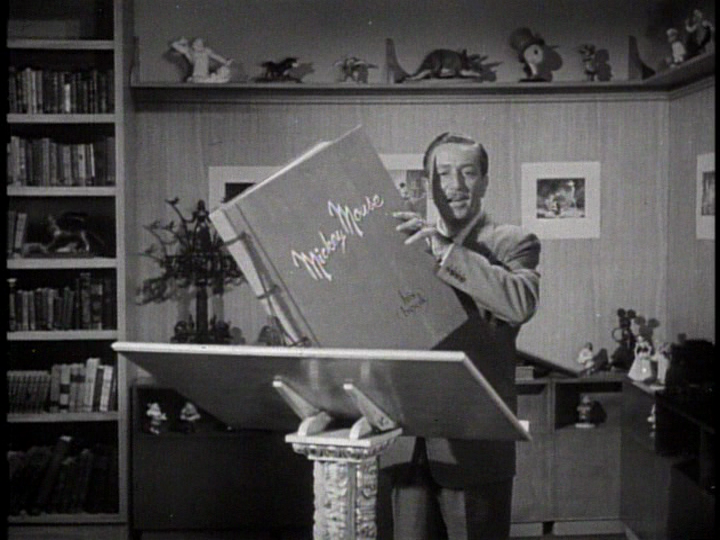
Walt Disney pulls down a book from his shelves that chronicles the life of his greatest star, Mickey Mouse

To remind everyone that “it all started with a mouse,” Walt then presents the story of Mickey Mouse, starting with his humble beginnings in the short film Plane Crazy. He introduces Mickey’s friends and fellow stars – Pluto, Goofy, and Donald – before presenting one of the most important roles in Mickey’s career: the role of the sorcerer’s apprentice in Fantasia. After exploring Mickey’s career, clips are shown of the next week’s episode, a presentation of the Disney film Alice in Wonderland.

June 10

June 10, 1949 – Birth of Disney Legend Kevin “Moochie” Corcoran

“…kids in the audience related more to Corcoran, who created a character who was part All-American boy and part hellion.” – Film Writer Donald Liebenson.

Born on June 10, 1949, in Santa Monica, California, Kevin Anthony Corcoran began his acting career at the tender age of two. In 1956, Corcoran auditioned for a serial on the Mickey Mouse Club called “Adventures in Dairyland,” and won the role of a character named Moochie, a nickname that would stick with him throughout his career at Disney. He was then cast specially by Walt in the sequel serial, “The Further Adventures of Spin and Marty,” as well as “The New Adventures of Spin and Marty.”

Corcoran also appeared in several popular Disney films, with his only starring role as Toby in Toby Tyler, a film about an orphan who runs away to join the circus. He played supporting roles in Old Yeller, The Shaggy Dog, Pollyanna, Swiss Family Robinson, Babes in Toyland, Bon Voyage!, Savage Sam, and A Tiger Walks. Corcoran played the younger brother to actor Tommy Kirk in five Disney films, including Swiss Family Robinson and The Shaggy Dog. Corcoran also voiced Goliath II in the short film of the same name, and was featured in several Disney mini-series and serials, such as Daniel Boone, The Mooncussers, and Johnny Shiloh. After the 1964 film A Tiger Walks, Corcoran mostly retired from acting and attended California State University, getting a degree in theater arts.

Corcoran returned to Disney after college, using his skills behind the camera instead of as an actor, and working as an assistant director and producer on several projects, including Pete’s Dragon. He has also worked as a first assistant director for many television series outside of Disney, including Quantum Leap and Murder She Wrote, also acting as an assistant producer and director on the latter series. Corcoran was inducted as a Disney Legend on October 9, 2006, alongside Tim Considine, David Stollery, and Tommy Kirk.

May 18

Posted on

May 18, 2004 – The Third Wave of the Walt Disney Treasures is Released

Image Credit: Wikipedia

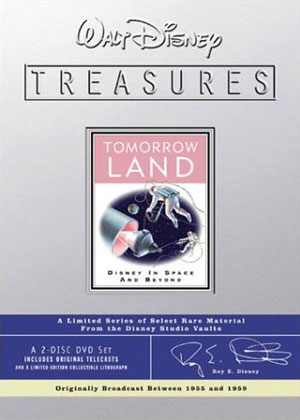
On May 18, 2004, Disney’s video distribution company, Buena Vista Home Entertainment, released the third wave of the popular Walt Disney Treasures. This set included Mickey Mouse in Living Color, Volume Two; The Chronological Donald; On The Front Lines; and Tomorrow Land. Although this wave was supposed to be released in December, as the other two were, the release had to be delayed to meet the demand of the popularity of the sets. As with the other two waves, the third set was introduced by film critic Leonard Maltin, who also provides commentary for the more politically incorrect works, known as the works “In the Vault.”

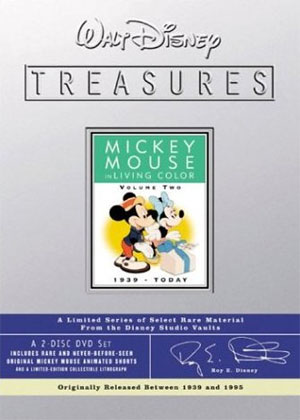
Mickey Mouse in Living Color. Image Credit: wikipedia

Mickey Mouse in Living Color, Volume Two is the second of the Mickey Mouse color short collections, and the fourth Mickey Mouse collection in all. The first disc gives the shorts from 1939 to the last Mickey Mouse short film in 1953, with bonus features including The Sorcerer’s Apprentice from Fantasia, Mickey and the Beanstalk from Fun and Fancy Free, as well as an Easter egg of Walt Disney performing the voice of Mickey for the short Mr. Mouse Takes a Trip. Disc two shows the modern revival of Mickey Mouse, which includes Mickey’s Christmas Carol, The Prince and the Pauper, and Runaway Brain. The bonus features are numerous on this disc, and include an interview with the voices of Mickey and Minnie (Wayne Allwine and Russi Taylor), an interview with Disney animators Mark Henn and Andreas Deja, and clips from the Walt Disney anthology series that use Mickey as an example of animation techniques.

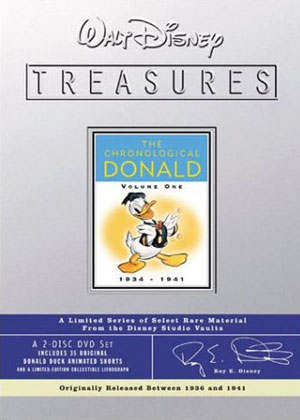
The Chronological Donald. Image credit: wikipedia

The Chronological Donald is the first set of Donald Duck short films, which begins with the Silly Symphony The Wise Little Hen in 1934 on disc one, and ends with the 1941 short Chef Donald on disc two. The disc one bonus features include a clip from the film The Reluctant Dragon, where the voice of Donald, Clarence Nash, is heard performing with Florence Gill, the voice of Clara Cluck. Disc two includes a mini-biography about Clarence Nash, and how his unusual voice inspired the creation of Donald Duck, as well as another clip from The Reluctant Dragon, where Donald is explaining to Robert Benchley how animation comes to life.

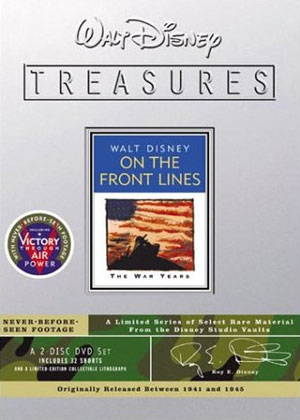
On the Front Lines. Image credit: wikipedia

On the Front Lines is a collection of all the propaganda, educational shorts, and films released when the Disney Studios were taken over during World War II. Disc one includes mostly the short films, including the shorts where Donald is drafted into the army. In the vault, there are four films: Der Fuehrer’s Face (a propaganda film where Donald believes he lives in a land occupied by Nazis), Education for Death (a chilling film based on the book by Gregor Ziemer), Reason and Emotion (a humorous look about how people needed to keep their emotions in check during wartime), and Chicken Little (a horrifying update to the children’s story). Disc two is of the film Victory Through Air Power, which Walt Disney created to send a message to the American people that the war could be won through the use of aviation and long-range bombing. This DVD set is the first release of the film since its rerelease in 1944. This disc also includes some training shorts, behind the scenes documentaries of the film Victory Through Air Power, galleries of insignias and posters created during wartime, and an interesting interview with long-time Disney employee John Hench, who recounts his time at the studio after the attack at Pearl Harbor.

Tomorrow Land. Image credit: wikipedia

The last set in this wave is Tomorrow Land, which pulls together episodes from the anthology series about space and the future, with many of these episodes directed by Nine Old Men member Ward Kimball. The first disc has three episodes: Man in Space, Man and the Moon, and Mars and Beyond. The second disc includes Eyes in Outer Space, Our Friend the Atom, and EPCOT, a look at the Florida Project Walt Disney planned, which was to be a Tomorrowland type theme park. Bonus features include interviews with author Ray Bradbury and long-time employee Marty Sklar, as well as an Easter egg of the Sherman Brothers singing “There’s a Great Big Beautiful Tomorrow” with Walt, as the song was featured at the General Electric Pavilion at the 1964 World’s Fair.

April 4

April 4, 1956 – Where Do the Stories Come From? Premieres on Television

“Potential story ideas exist all around us.” – Walt Disney

On April 4, 1956, the Disneyland episode Where Do the Stories Come From? premiered on ABC. Directed by Jack Hannah, the episode attempts to explain the most often-asked question of the members of the Disney studios: where do they get their story ideas?

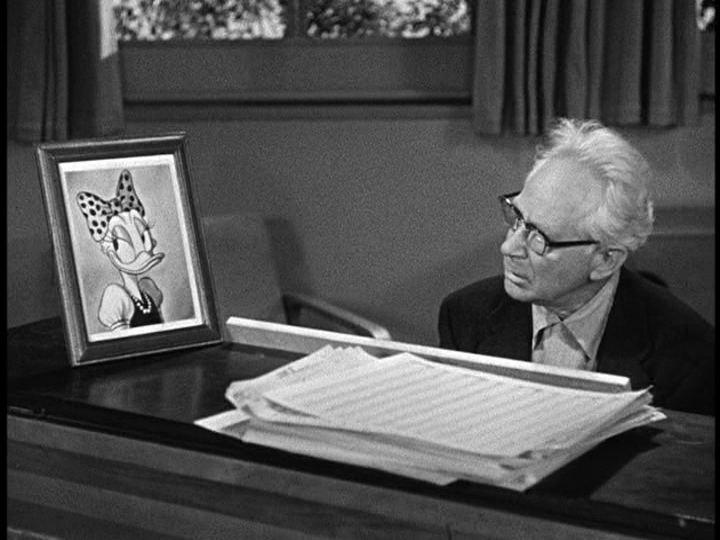
Composer Oliver Wallace studies a picture of Daisy, trying to find inspiration for a song about her

The episode opens with Walt Disney saying that the question of “Where do the stories come from?” is one that is asked a lot, and this episode will try to explain it the best he can. He tells the audience that story ideas can come from books, or are inspired by a song. The first example he gives of the latter is the song that had to be written for Daisy Duck; “she had to have a song,” since everyone else had one. The assignment for Daisy’s song was given to studio composer, Oliver Wallace. He thinks of words that rhyme with Daisy, and comes up with “crazy,” which gives him the title, “Crazy Over Daisy.” Soon, Wallace is composing an entire melody, and not long after, two men are seen listening to a record of the completed song. It then became the inspiration for a short film called Crazy Over Daisy, set in the early 1900s, which is shown next.

For the next example Disney brings up a short that was based on the True-Life Adventure series, where any interesting footage of animals could inspire the story artists to come up with a short film. “In viewing the thousands of feet of true-life adventure film that comes into the studio, we sometimes come across an animal that is a natural foil for one of our cartoon characters,” Disney explains, as he introduces the short R’Coon Dog.  Thinking a raccoon would be a match for Mickey Mouse and Pluto, the animators consult Pluto about his part in the film. Pluto is seen in the projection room, watching the footage of raccoons, and then is seen in the story room, where the animators are seen drawing the raccoon character.  Pluto takes the drawing a bit too seriously and tears it up with his teeth. The audience then sees R’Coon Dog.

The next example Disney presents draws on the experiences of the artists during World War II, when they had to get their physicals. The animators thought “it would be fun to put Donald Duck in the same ordeal,” and they show a compilation of some of the Donald Duck wartime shorts, including Donald Gets Drafted, and Fall Out Fall In.

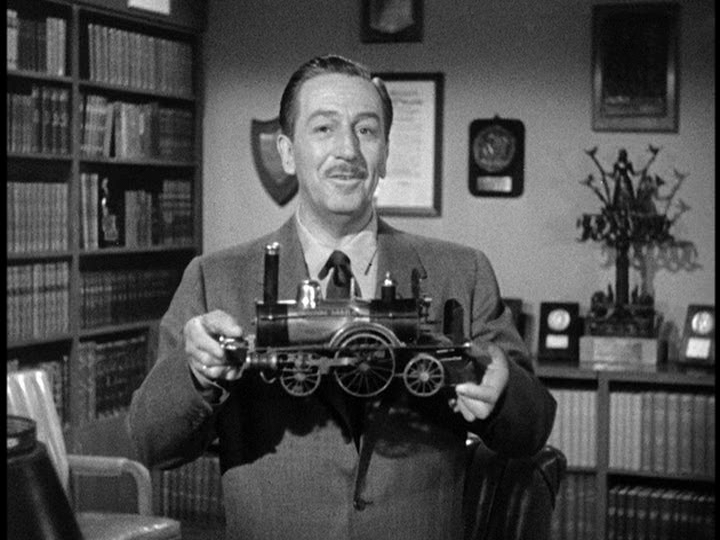
Walt Disney presents the hobby of many at the Disney Studio: model railroads

Disney then presents his own hobby of model railroads, as well as two animators who “haven’t escaped the bug” of the hobby, as Disney puts it: Ollie Johnston and Ward Kimball of the Nine Old Men. The audience sees home movies of Ollie and Ward with their model railroads.  Every detail is built to scale on Ollie’s model, and Ward has a full-size model in his own backyard. Not to be outdone by his two animators, Disney shows off his own model railroad, named the Lilly Belle, and some of the home movies of creating the track in Disney’s backyard. “The hardest part of the job was convincing my wife that the flower beds had to go,” Disney jokes. The hobby shared by these three men led to the creation of a Donald Duck short, Out of Scale.

March 9

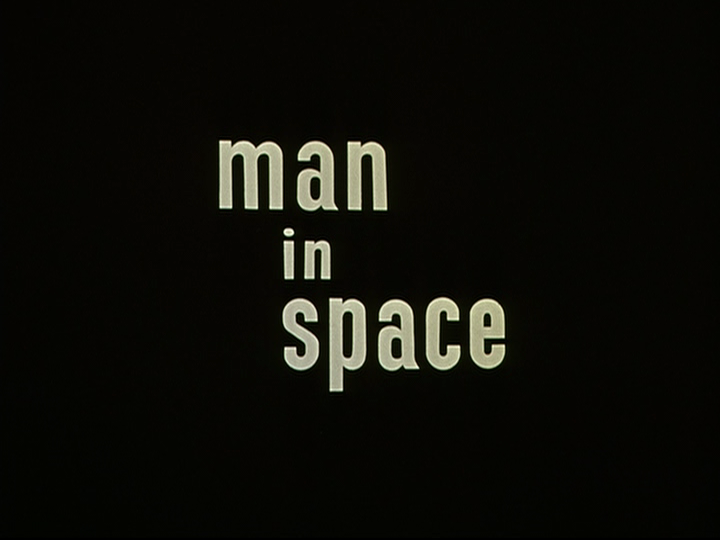
March 9, 1955 – Man in Space Premieres on the Disneyland Television Show

“One of man’s oldest dreams has been the desire for space travel, to travel to other worlds.” – Walt Disney

On March 9, 1955, audiences watching the Disneyland Television Show saw a different kind of episode, called Man in Space. The first installment of the Tomorrowland segments of the show, Man in Space was directed and produced by Ward Kimball (see March 4th entry), who had written the episode with William Bosche, and features guests Werner von Braun, Willy Ley, and Heinz Haber, who were major scientists associated with space exploration. It was so well received that President Dwight D. Eisenhower asked for a copy to present to the Pentagon, and this helped push the space program into the forefront of the public imagination. In 1956, an edited version of Man in Space was nominated for an Academy Award for Best Short Subject (Documentary), after it was released to theaters on a double bill with Davy Crockett and the River Pirates.

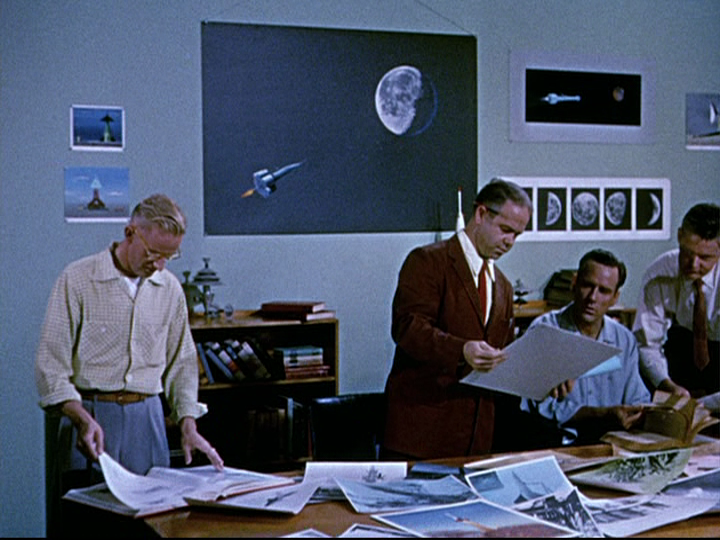
Ward Kimball (C) looking at mock-ups and prototypes in the design room

As the Man in Space episode opens, the audience is taken to a design room, where men are hard at work designing prototypes of rockets and developing methods of space travel. Walt explains that the creative talents of the Disney Studios are working with engineers and scientists to make the dream of interplanetary travel a reality. “In working with engineers and scientists,” director and producer Ward Kimball explains, “we have found that there are many different opinions as to how we will eventually cross the space frontier.” The one common point between these opinions, though, is that it will be a rocket-powered ship heading into space. Kimball then leads the viewers into a history of rocketry, beginning with China in the 13th century.

The rocket was not a modern invention, Kimball points out; the Chinese invented it at the battle of Kai-fung-fu in 1232. A brief animation segment shows two Chinese men shooting rockets at each other from far distances, with each rocket increasing in size. Kimball then jumps forward 500 years to Sir Isaac Newton and his often paraphrased “for every action force, there is always an equal but opposite reaction force.” Kimball makes this clearer by using the example of the family dog when it sneezes. The segment also shows a few examples of rocket propulsion experiments, including a steam-powered rocket, and notes that designers ultimately stuck with gunpowder-powered designs.

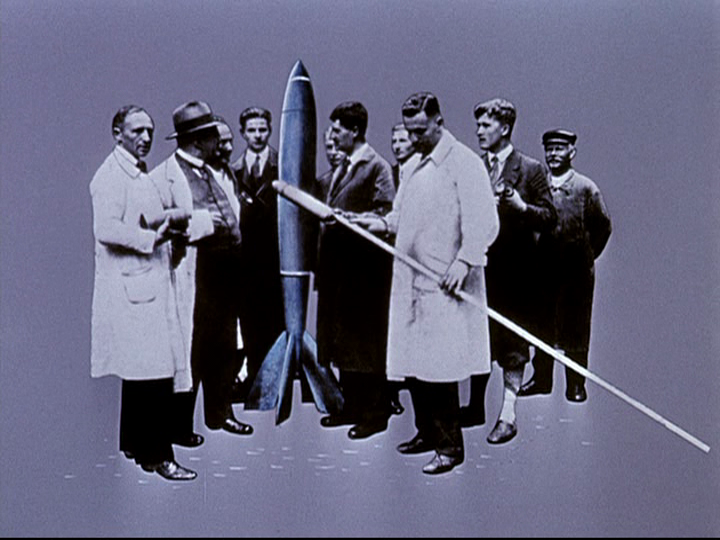
A stylized photograph of one of the early German societies dedicated to the study of rocket science

In 1865, Jules Verne published From the Earth to the Moon, which again piqued people’s interest in flying into space. Verne’s story inspired the French filmmaker Georges Melies to create the first space-travel film in 1902. Kimball shows the audience this silent film, and continues with a history of the different kinds of fuels used to power small rockets that could one day be used to send men to space. Rocket frenzy was highly evident in the 1920s and ’30s, with rockets attached to any possible vehicle. Around this time, a new society in Germany was founded, with the mission of scientifically exploring the possibility of space travel. The German army took a keen interest, and used the society’s findings to create rocket missiles and one of the forerunners of a spaceship, known as the V-2. After WWII, 75 of these V-2 rockets were taken to the U.S. for study in its newly developed rocket program.

Kimball then introduces rocket historian Willy Ley to explain how rocket firing works. Ley begins by showing a model of a rocket motor and explaining to Disney artists how it works. An animated sequence explains how the motor continues to work in space where there is no oxygen. Ley asks the animators to create a sketch of a three-stage rocket to help him explain how it would work. The animators ask some very interesting questions as Ley uses the chalkboard to help his explanations, but the section is not overly technical, so the audience is still be able to understand well.

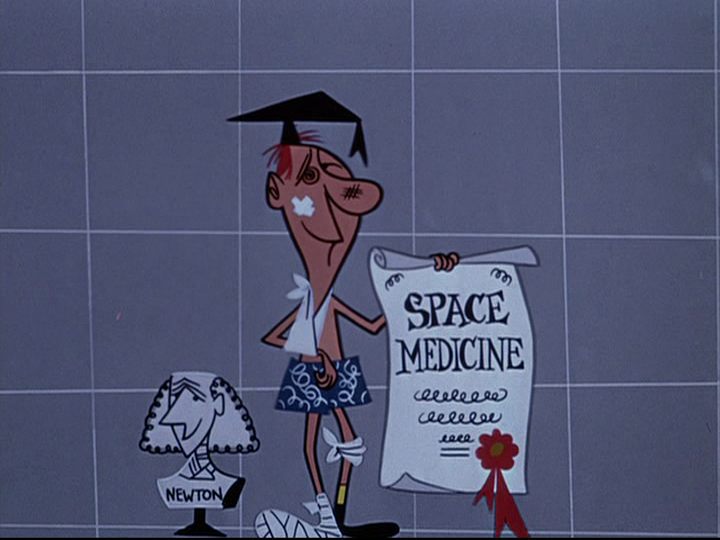
The "ordinary man" example, after going through rigorous (and humorous to the audience's perspective) training, passes the space medicine course

In the next segment of Man in Space, Kimball describes a new field of science known as space medicine, or how man will react physically and mentally in space, and introduces the expert in this field, Dr. Heinz Haber. Haber pulls down a screen to set the stage for another animated segment, this time of the “common man” who will be sent into space. As we follow this common man through his daily routine in space, Kimball’s special brand of humor keeps things light.

In the third segment of the episode, Kimball explains the two problems of space flight: building a rocket ship, and preparing and training the men to travel into outer space. Kimball then introduces Dr. Wernher von Braun, the chief of the Army’s guided missile division, who was the overall director of development for the original V-2 rocket. Von Braun is seen explaining to two other men the problems of space travel. Looking at some similar present-day situations can help come up with solutions, von Braun says. He gives a few examples of the current research, with testing performed on the ground in simulated atmospheres. The tests that von Braun describes are then presented in an animated sequence narrated by Dick Tufeld, best known as the voice of the robot in the television show, Lost in Space. The animated short ends with an accomplished mission into space, with the next goal of getting man to the moon, then the planets, and then to what lies beyond.


February 13

February 13, 1957 – The Disneyland Episode Tricks of Our Trade Premieres on ABC

“Before our eyes, we have seen an entire industry grow literally from the ground up. And this growth was no accident. It was painstakingly built, step by step, by men with pioneering spirit, who loved this puzzling new art form, and believed in its future.”- Walt Disney.

On February 13, 1957, audiences were treated to a different kind of episode of Disneyland: one that focused on how animated films were able to capture things as realistically as they did. With our host, Walt Disney, we are taken through the “tricks of the trade,” where he explains some of the then-commonplace animation principles, as well as some of technical advances made in the studio, and why they needed to be created. The examples given are obviously staged, but they give the audience a great example of the process used to come to a solution. Animation examples are from Snow White and the Seven Dwarfs, Bambi, and Fantasia. The episode was written by animation veteran Dick Huemer and directed by Wilfred Jackson. It also includes cameos of four of the famed Nine Old Men: Frank Thomas, Ollie Johnston, Marc Davis, and Milt Kahl. The episode refers to the book, The Art of Animation, which was the book that inspired John Lasseter to want to be an animator (please see the January 12th entry for more information).

“Because the animated cartoon comes to life on the screen, it belongs in the field of the motion picture,” Walt explains, as he opens up the episode. “But because it is drawn and painted, it is also one of the graphic arts, like painting. As a matter of fact, it is often referred to as the last of the graphic arts.” Disney then goes to his desk and shows the audience the book The Art of Animation, which was written by Bob Thomas about the Disney Studios. Disney turns to chapter eight, entitled Tricks of Our Trade, and explains that the pupils were their own teachers when it came to the principles of animation. “They had to be, because no one in the world could give them the answer to what they wanted to know,” Disney says, adding that their overall question was: How could animation be improved?

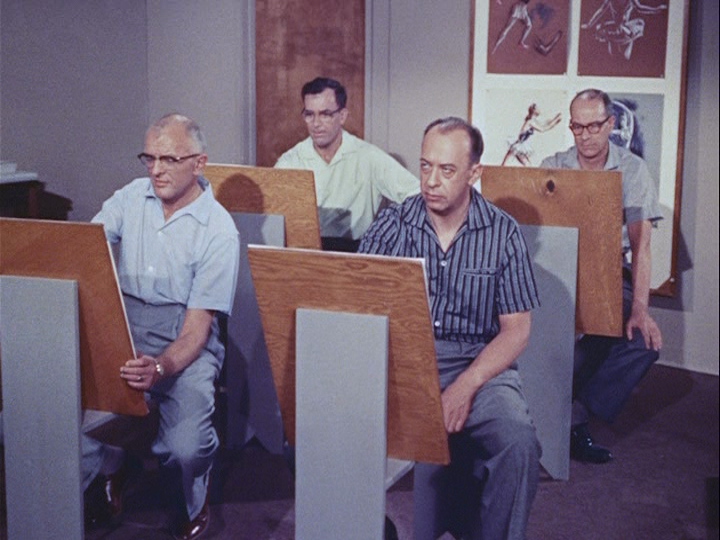
The animators in a classroom after hours, learning more about their own medium by one of their own

The first segment shown is of a group of animators watching a film of overweight comedian Billy House performing a two-step. The animators note that an overweight man moves differently, and that the human body does not move all in one piece. When the film is slowed down, there are many details they recognize that cannot be seen at normal speed. We then see the animators use what they saw to create an animation of the dwarf Happy doing the two-step dance, with the animation principles of weight, contact, follow-through, squash and stretch, and overlapping actions being used effectively. Disney points out while it’s true that thoughts and emotions can be expressed through pantomime, who a character is and what they think can best be revealed by dialogue. The trick of using dialogue is shown through a clip from Show White and the Seven Dwarfs, where Snow White identifies which dwarf is which.

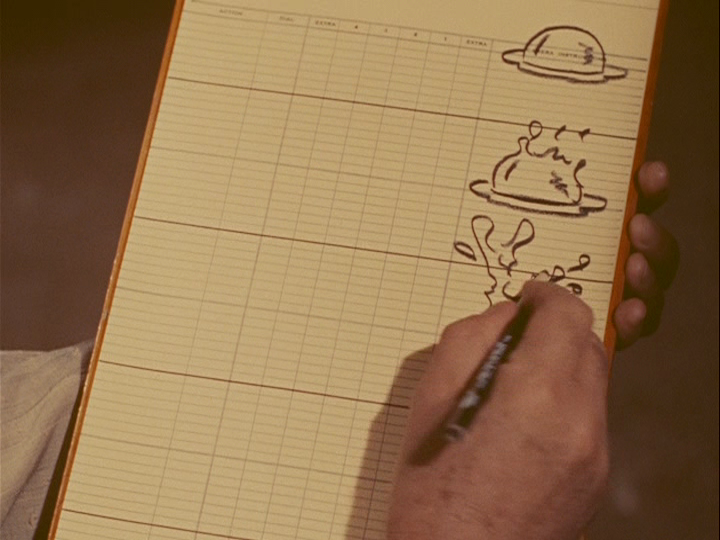
Dan MacManus sketching on an exposure sheet, trying to see how many frames it wll take to draw before the animator can draw the bubble bursting

The next animation technique we look at is effects animation: the trick of making the cartoon characters more believable by using extremely realistic animation of incidental action. There are many clips of animators watching various actions—including a baseball thrown through a window, or a bubble being blown from a pipe—and Disney explains that animating breakage required tremendous attention to detail. This leads into a clip of the earthquake from The Rite of Spring sequence in Fantasia. Continuing with that sequence, we see three effects animators looking at a tub of orange-colored mud, trying to solve three different problems for the creation of earth sequence in The Rite of Spring. Joshua Meador, head of the experiment, uses color chalks and pastels to render the sketch that would give an overall impression of the sequence. Jack Boyd’s assignment is to establish the individual action of a pair of bubbles, verifying his findings with the 2-drawing flipping action. Dan MacManus’s job is to see exactly how many drawings it would take to animate the bursting of a bubble, using an exposure sheet and a stopwatch. The audience then sees the clip from The Rite of Spring in its entirety.

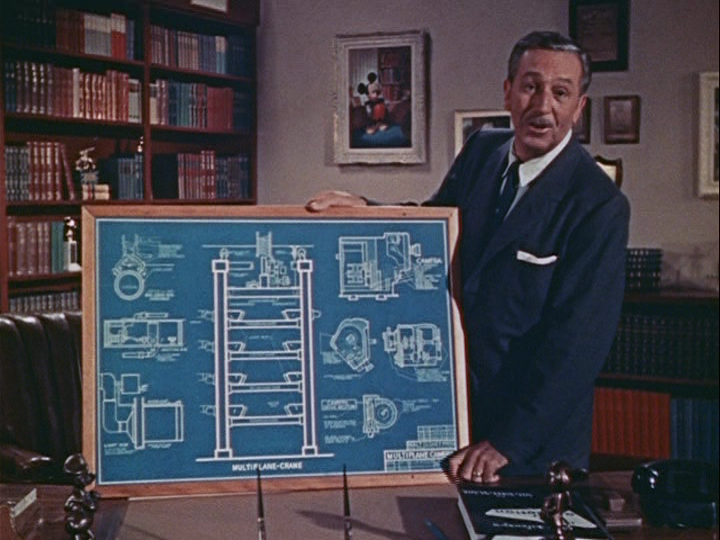
Walt with a blueprint of the Multi-Plane Camera, a Walt Disney Studios invention. Coincidentally, Ub Iwerks had created his own version at his own studio, only it was a horizontal camera

Walt pulls out a picture, calling it a different kind of drawing, which “also came out of our school of self-improvement here at the studio.” The blueprint is of the multi-plane camera, which was first used to great success in the Silly Symphony The Old Mill. Disney explains that the old process for animated films was fairly simple in construction and operation, but the biggest problem was that any dimension the character brought with him or her into the scene disappeared when the character left the frame. Another example used was a painting of a house on a moonlit night, and when the camera zoomed in on the scene, everything got larger, including the moon, which does not happen in reality. The use of the multi-plane camera shows the audience the big difference it makes in that scene. The audience next sees the opening scene of Bambi, and how the multi-plane camera works to give realism to the forest.

Four of the famous Nine Old Men, studying ballet moves. From Far Left: Milt Kahl, Frank Thomas, Marc Davis, and Ollie Johnston

“Perhaps the thing that distinguishes animated cartoons more than anything else is the trick of caricature,” Disney says. He tells the audience the story of the animation of Dance of the Hours from Fantasia, which involved the use of a live-action model to help the animators see the ballet movement of the dance. The ballet dancer they used was Helene Stanley, who was also the live-action model for Cinderella and Aurora in Sleeping Beauty. In this segment, we see the four of the famous Nine Old Men as they study Stanley’s movements. Kahl discovers that he may not be getting the kick right. Davis asks Stanley to perform it again, and as she does, Kahl makes a comment that the kick should be higher “in order to get all that weight off the ground. She’s no cream puff, you know.” Davis agrees, adding, “Yeah, that is a lot of beef.” These comments grab Stanley’s attention, but she keeps dancing. Thomas steps forward with his drawing and asks if he’s made the trunk too long: at this point, the audience sees that the drawings are those of the animals in the Fantasia sequence, although Stanley still thinks they are talking about her. Kahl responds to Thomas, “Oh, no, that’s what gives it that goofy look. Trunk’s way out of proportion to the rest of her body…it wouldn’t hurt to make [her legs] good and hairy.” These comments finally get the best of Stanley, who grabs her hat and cape and runs to the door, before turning around and seeing the animals they’ve been animating, and laughs before returning to the stage. The episode ends with the ballet segment from Fantasia, with all elephants, ostriches, and hippos.

The episode is wonderful for those who are fans of animation, and wish to see a dramatic look at how the animators were able to teach themselves and develop the new techniques to create better animation. Similar to “lessons learned” when creating computer animation in this generation, this highly recommended episode shows how the animators really had to, and did, step up to blaze a new trail.

February 1

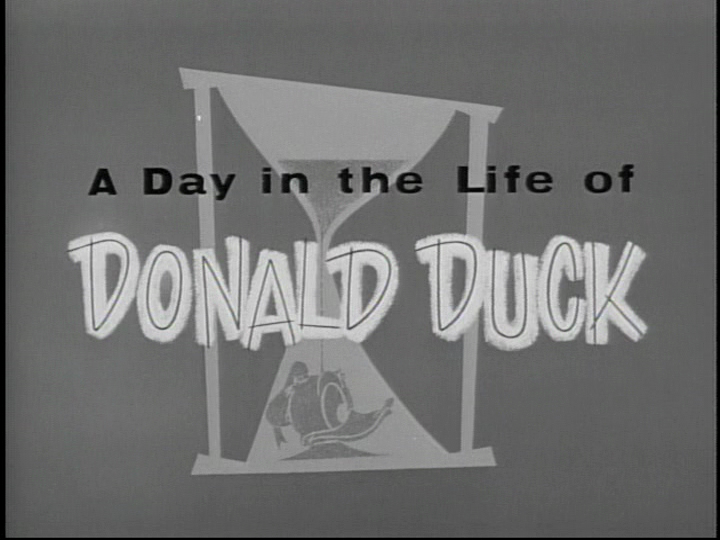
February 1, 1956 – A Day in the Life of Donald Duck Premieres on Disneyland.

“You know something Donald? You’re a big international favorite.”

On February 1, 1956, Disneyland audiences spent A Day in the Life of Donald Duck. As Walt Disney explains in the introduction, there have been so many fan letters to Donald, that he thought the audience might want to spend a day with Donald at the studio. Directed by Jack Hannah, with story by Albert Bertino and Dave Detiege, we see how Donald begins his day, as well as his interactions with Jimmie Dodd, Roy Williams, the Mouseketeers, and the most important person in Donald’s life: his voice, Clarence Nash.

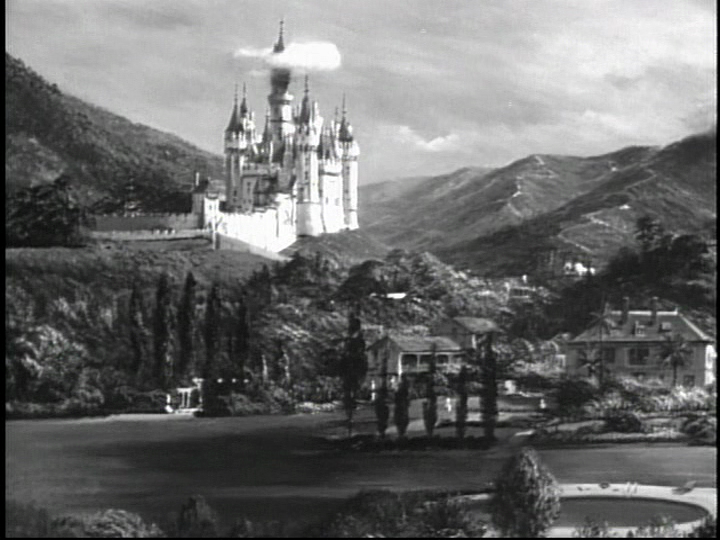
“Donald, like any other average cartoon character, lives a simple, unassuming life in a quiet residential section of Beverly Hills,” Disney tells the audience, showing pictures of the neighborhood. “He resides in a modest little cartoon house. He drives to work in a modest little cartoon car. And if he seems a bit reckless, you must remember that Mr. Duck drives with a cartoon license.” As we see Donald pull into a spot marked “No Parking,” he is immediately confronted by a police officer. Donald, however, folds the car into a tiny packet, tucks it under his hat, and walks to his office.

Donald's "modest" house in Beverly Hills

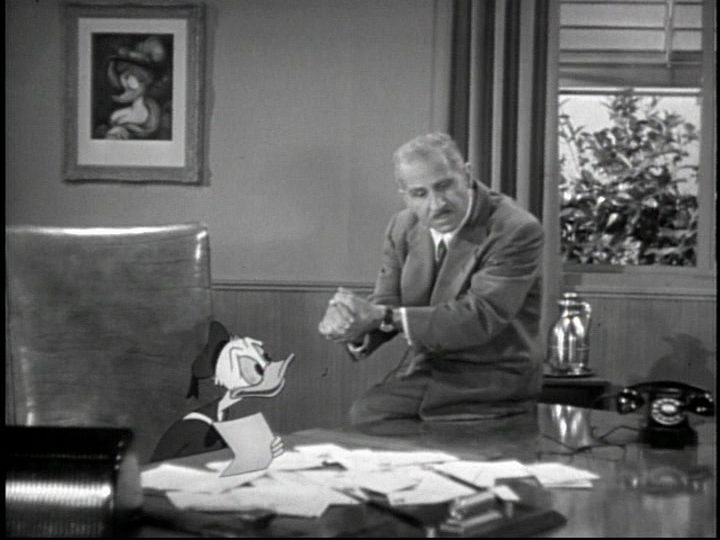
When he arrives at his office, the intercom sounds, and his secretary greets him respectfully as Mr. Duck. Donald responds with, “Just call me Donald, toots. What’s first on my schedule, tootsie?” in keeping with Donald’s personality as a bit of a wolf. She responds that he has fan mail, which he opens eagerly. The letters, however, are not pleasing in Donald’s opinion. One letter openly says, “Dear Donald, I can’t understand a word you say.” This is the last straw in Donald’s opinion, and he demands to speak with his voice, Clarence Nash. Nash comes in with a cheery attitude, which doesn’t change Donald’s mood in the slightest, no matter what Nash does to cheer him up. They end up arguing, with Nash reverting to his Donald Duck voice, even as he pulls out a coonskin cap and starts signing the Davy Crockett theme song. Donald tells him he’s a horrible singer. Nash leaves, with the two still taunting each other, and Donald vows that he’s got to get himself a new voice.

Donald and his voice, Clarence Nash, as Nash shows him a new trick

The next guest to enter is Jimmie Dodd (host of the Mickey Mouse Club), who has written a new song about Donald, inspired by fan art from children all over the world. “They’re so great, they had to have a song written about them,” Jimmie explains, and begins the song, which Donald immediately loves. There are versions of the song sung in different languages with accompanying pictures, including Spanish, French, Italian, and German. The images and tunes are stereotypical for the fifties, but somewhat sweet and fun all the same.

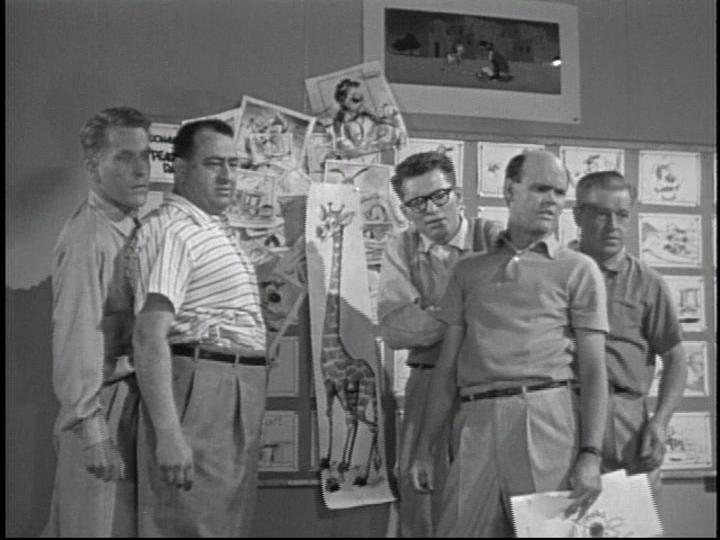
Donald then leaves for an 11 o’clock appointment at the Story Room, and when the storymen hear Donald coming down the hall, they begin to panic, as they fear his temper more than anything. They try to make Donald comfortable, and when they try to show him storyboards for a short entitled Peaceful Day, Donald asks for more birds and butterflies. The storymen overeagerly agree to his requests, to the point that Donald gets annoyed, and demands that there be a short with just him in it. This gets them to thinking, and the audience is then shown the brainstorm: the short, Drip Dippy Donald (originally released March 5, 1948).

The bewildered story team, trying to acquiesce to Donald's requests

Back in his office, Donald receives a call from Walt, who asks him to show the Mousketeers around the studio, as Mickey has remembered that they had never seen it before. Donald eagerly agrees, and runs to meet the Mouseketeers, who surprise Donald by making him an honorary Mouseketeer and giving him his own set of Mickey Mouse ears. As they run around the studio, the kids slip into the Sound Effects Department, closing the door just as Donald is about to get inside, leaving him on the outside as the kids see how sound effects were added to the Donald Duck short, Fire Chief (originally released December 13, 1940). One example they show is when a building is set on fire, the special effects team uses sparklers and crumpled plastic to create the sound of the burning ceiling.

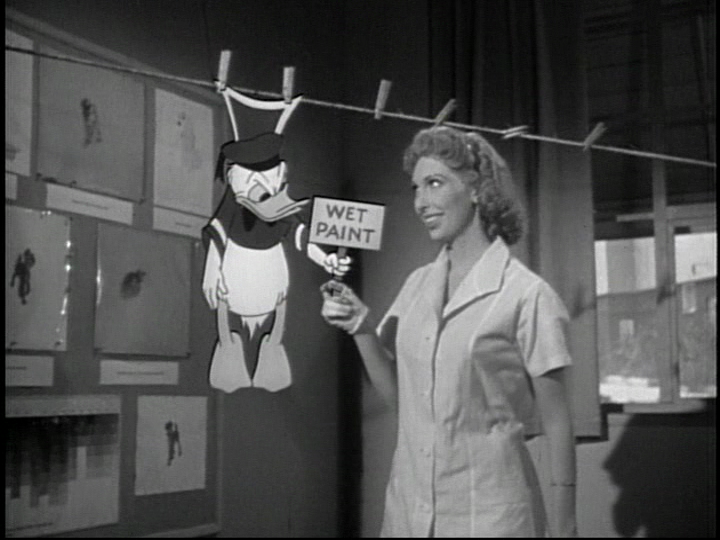
When the short ends, the door opens, and Donald is ready to step inside, until an effects man empties a bucket of water over him, which causes half of Donald’s paint to run. This necessitates a trip to the Ink & Paint Studio, where the painter quickly re-paints Donald and hangs him up to dry, an experience Donald finds quite humiliating. The painter explains that twenty gallons of paint are usually used for a Donald Duck picture, which surprises the kids and causes Donald to remark that he is “very expensive.” She also explains that in one picture, they used just one pint of paint for Donald; the audience is then shown the short The Vanishing Private (originally released September 25, 1942).

Donald and the Painter, with Donald pointing out how humiliating this is for him

After the short, we see the kids with Jimmie Dodd again, singing the new Donald Duck song he wrote. As Donald tries to sing the last line of quacks, he is cut off by Roy Williams, the other host of the Mickey Mouse Club. The kids are excited to see him, and he tells them that he’s practicing drawing the characters. To prove that anyone can draw, Roy asks one of the Mouseketeers to make a scribble on the easel. From her scribble, Roy is able to draw an ostrich. Donald, jealous of the stolen attention, challenges Roy and scribbles on the easel. Roy accepts, and ends up turning Donald’s scribble into a humorous image of Donald Duck. As Donald throws a tantrum and jumps up and down on the teasing picture, the kids flee the room and head into the projection room. “And now, in Donald’s honor – he really is a good scout,” Roy welcomes the kids, “I’d like to dedicate this picture to all you Mouseketeers.” Donald is touched by the tribute, and the audience is then shown the short, Good Scouts (originally released July 8, 1938).

This episode is a must-see for fans of Donald Duck. There are many wonderful gags, and the interaction of Donald with Clarence Nash is enough of a reason to watch. It’s a perfect example of all the temperaments of Donald, with the added bonus of it being set in the real, rather than the cartoon, world.