RSS Feed

September 22

September 22, 1984 – Michael Eisner and Frank Wells are Named CEO and President of Walt Disney Studios

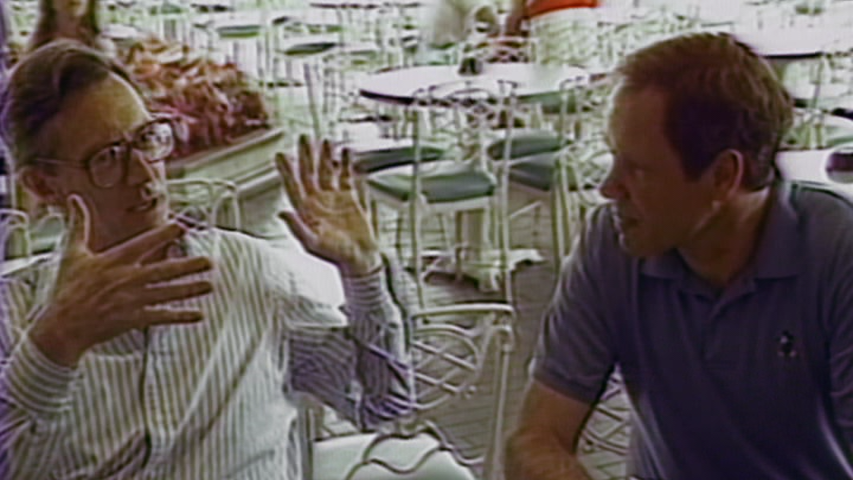
L: Frank Wells. R: Michael Eisner

“I thought, you know, Frank [Wells]’s more of a businessman, and Michael [Eisner] is a little nuts, and the two together kind of in some ways made me think of Walt and my dad. So we began saying, ‘How would you two like to take this job?’” – Roy E. Disney

On September 22, 1984, Michael Eisner and Frank Wells were named CEO and President of Walt Disney Studios. Wells, a former classmate of Roy E. Disney’s, had suggested to Disney that Eisner would be a good chairman of the company, with Eisner being seen as having an amazing track record after his stint as the President and COO of Paramount Pictures Corp. Wells came to Disney from Warner Brothers as the Vice Chairman, and served as President and Chief Operating Officer. The two were able to bring Disney back to its glory in an era known as the “Disney Renaissance.” The partnership ended with the Wells’ death on April 3, 1994, with Eisner assuming the presidency on April 4th.

September 21

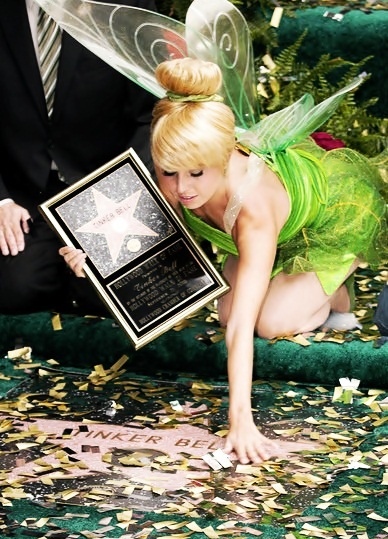
September 21, 2010 – The Character Tinker Bell Receives a Star on The Hollywood Walk of Fame

Image credit: pinterest

“Hello ladies and gentlemen! Please help me welcome to Hollywood this beloved Disney character, Tinker Bell!”

On September 21, 2010, coinciding with the release of the direct-to-video film Tinker Bell and the Great Fairy Rescue, the character of Tinker Bell was given a star on the famous Hollywood Walk of Fame. Since her introduction in the 1953 animated classic Peter Pan, Tinker Bell became an animated superstar, appearing as the character to open the Disneylandanthology. She has also been seen as an important character in the theme parks, and starred in her own series of films beginning in 2008 with Tinker Bell, along with the 2009 film Tinker Bell and the Lost Treasure. With the popularity of the 2008 film, Tinker Bell has headlined a franchise known as the Disney Fairies.

September 20

September 20, 2003 – The Animated Series Lilo & Stitch: The Series Premieres on ABC

Image credit: wikipedia

“I’m okay. I’m fluffy!”

On September 20, 2003, the Disney animated series Lilo & Stitch: The Series premiered on ABC’s ABC Kids. The series is a spinoff of the 2002 animated feature film Lilo & Stitch, and continues the story of the pair where the direct-to-video film Stitch! The Movie left off (this film has been considered more of a pilot for the series, similar to the pilot episode of the series DuckTales [see September 18th entry]). The series is about Lilo and Stitch’s task of collecting all the other 625 experiments created by Dr. Jumba Jookiba and helping them become good. The series ran for 65 episodes over two seasons, and repeats still run on Disney’s Disney Junior Channel. Many of the original voice actors reprised their roles in the series, including Chris Sanders as Stitch (with the role shared by Michael Yingling), Daveigh Chase as Lilo, and David Ogden Stiers as Dr. Jumba Jookiba. The series was nominated for a Daytime Emmy Award for Outstanding Achievement in Music Direction and Composition.

The first episode of the series, “Richter: Experiment 513” begins with an earthquake that was caused by one of Jumba’s experiments. Lilo and Stitch journey underground to stop the experiment from causing the Earth to crack in two, and prevent the experiment’s capture by former Captain Gantu of the Galactic Order.

September 19

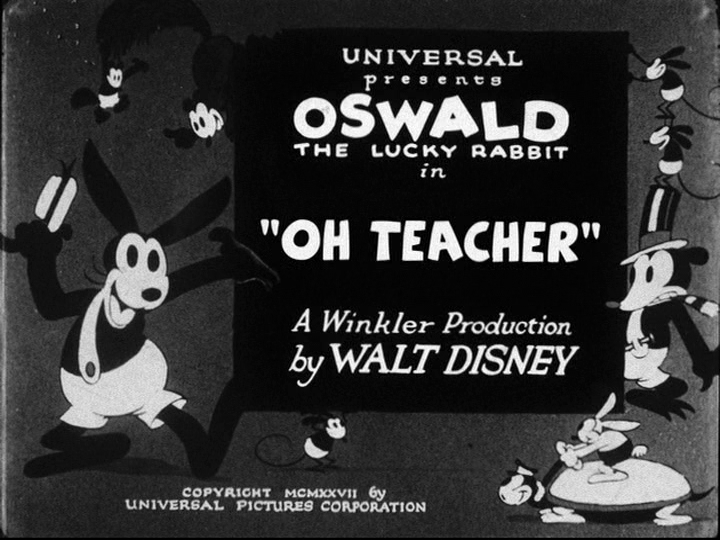
September 19, 1927 – The Oswald the Lucky Rabbit Short Oh Teacher Premieres in Theaters

On September 19, 1927, the Oswald the Lucky Rabbit short film Oh Teacher was released in theaters. It was the second Oswald short released after Trolley Troubles.

Oswald is seen riding his bike, swinging his schoolbooks around on their strap. As he rides by, he picks up a flower and begins to play a game of “She Loves Me, She Loves Me Not,” which turns out in his favor. He stops at his girlfriend’s, letting her sit in the sidecar of his bike, and the two ride off for school.

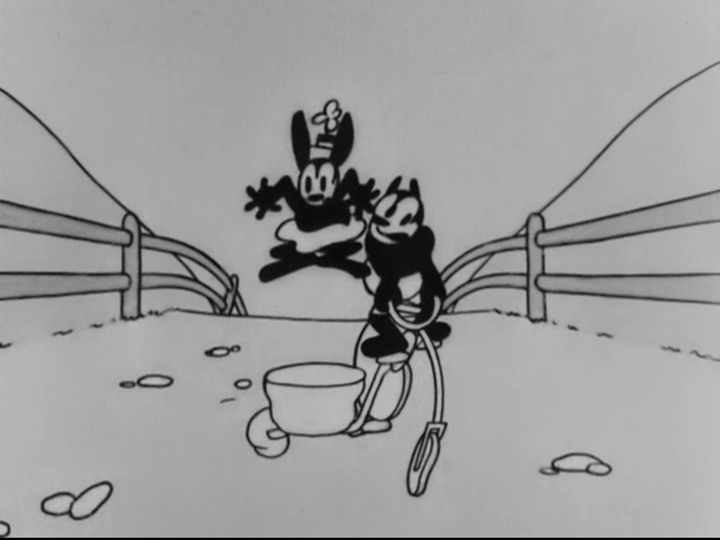
The troublemaker loses control of the bike as it winds down a rocky road

Near the schoolhouse, a mother pig stands with her child, kisses him goodbye, then places him on a hook to be picked up by the school trolley. A troublemaker grabs the child’s tail on the trolley, using it to pull him and his bike along. The conductor gets angry and uses exhaust fumes to brush the kid off. As the troublemaker sits in the middle of the road, he spies Oswald riding down the path, and decides to play a prank, pushing Oswald from his bike. The troublemaker quickly takes control of the bike (and Oswald’s girlfriend), but is unable to control it as it careens down a rocky path.

Oswald chases after the bike, but is unable to stop it as it crashes into a pole, splitting the sidecar from the bike. Oswald’s girlfriend, helpless, is sent on a one-way trip into the river, where she tries to keep her head above water and screams for help. In a clever gag, Oswald uses the cry for “help” to take him to his girlfriend, reaching out to her from the bank. The troublemaker, however, climbs on Oswald and saves the girl, taking the credit for Oswald’s hard work. The girl falls for the troublemaker, and Oswald challenges the troublemaker to a fight, which he loses.

The school bell rings, and all the students march inside. At recess, Oswald waits for the troublemaker to show his face, ready to clobber him. Once again, a fight begins between the two, with Oswald accidentally winning, and having his girlfriend fall in love with him again.

September 18

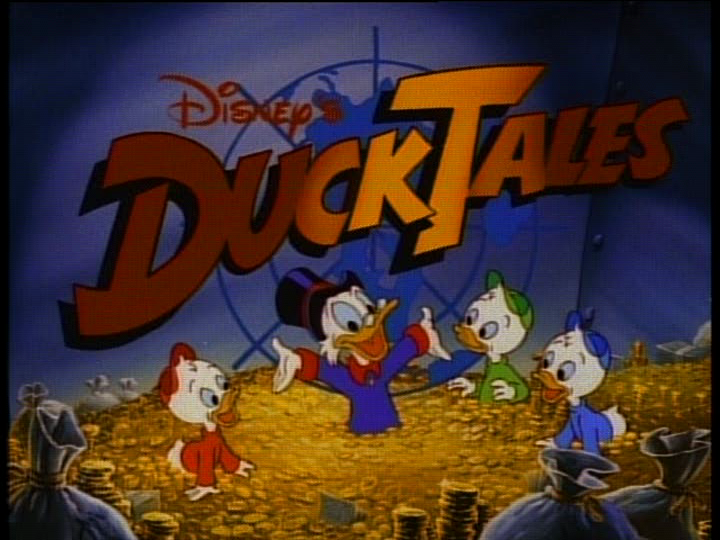
September 18, 1987 – The Animated Series DuckTales Premieres in Syndication

“Every day they’re out and making duck tales, woo-hoo!”

On September 18, 1987, the animated series DuckTales premiered in syndication. Based on the characters from the Uncle Scrooge comics by Carl Barks, the series tells the story of Scrooge McDuck and his grandnephews Huey, Dewey, and Louie, after their uncle Donald Duck leaves them in Scrooge’s care. The four go on amazing adventures, which mostly deal with thieves trying to steal Scrooge’s fortune or his “Number One Dime,” the source of Scrooge’s good luck and fortune. This series was the first Disney series for syndication, and its popularity launched other Disney series, including DuckTales spinoff Darkwing Duck, TaleSpin, and Chip ’n’ Dale Rescue Rangers. The series stars Alan Young as Scrooge, and Russi Taylor as Huey, Dewey, and Louie. It lasted for 100 episodes over 4 seasons, and led to a theatrical film in 1990, DuckTales the Movie: Treasure of the Lost Lamp. The series won a Daytime Emmy in 1990 for Outstanding Film Sound Editing.

The first episode was a television movie called “Treasure of the Golden Suns,” which has since been split into five separate episodes. The movie introduces Scrooge, with whom Donald leaves his nephews when he joins the Navy. Meanwhile, a mysterious figure helps the criminal Beagle Boys escape from jail to steal a treasure map from Scrooge’s vault. Scrooge ends up taking his nephews, their nanny Mrs. Beakley, and Mrs. Beakley’s granddaughter Webby with them on an expedition to find the treasure on the map, while battling the Beagle Boys at every turn.

September 17

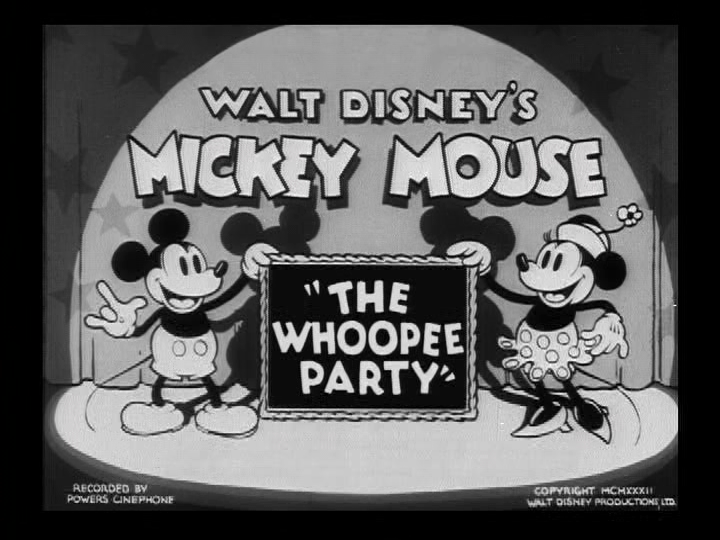
September 17, 1932 – The Mickey Mouse Short Film The Whoopee Party Premieres in Theaters
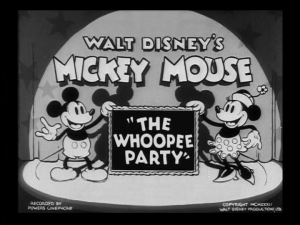
“We’re the kitchen mechanics, we fix all the refreshments.”

On September 17, 1932, the Mickey Mouse short film The Whoopee Party was released to theaters. The short features two popular pieces of music in the 20s and early 30s: “The Maple Leaf Rag” by Scott Joplin, and “Runnin’ Wild” by A.H. Gibbs, Joe Grey, and Leo Wood (mostly known for Marilyn Monroe’s performance in the 1959 comedy film Some Like It Hot). It was directed by Wilfred Jackson, and stars Walt Disney as the voice of Mickey Mouse, Marcellite Garner as the voice of Minnie Mouse, and Pinto Colvig as the voice of Goofy.

A splendid party is taking place, with a whole cast of characters dancing happily to the music. Minnie is at the piano playing and singing, while Clarabelle Cow accompanies her on the violin. Mickey, Goofy, and Horace Horsecollar are in the kitchen, preparing snacks for the party and singing their own version of the song as the “Kitchen Mechanics.”
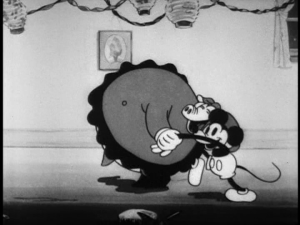
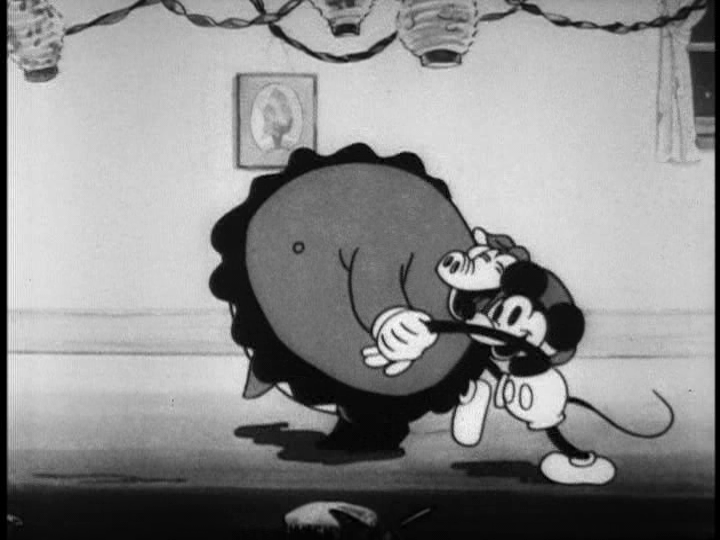
Mickey asks a rather shy pig to dance with him, and when she agrees, the two begin to dance wildly to the music

After Minnie finishes her first song, the Kitchen Mechanics come out and announce with great fanfare that the food is ready. The guests immediately swarm the table, and the band strikes up again, playing Scott Joplin’s “Maple Leaf Rag.” The guests dance and eat, and Mickey asks a rather shy pig to dance with him. The furniture and the food get involved in the dancing as well, with everyone having a wonderful time, yelling “Whoopee!” and throwing confetti.

Goofy attaches a glove to the end of his noisemaker, and uses it to scare Clarabelle as she dances. In retaliation, she places a horseshoe in a boxing glove, attaches it to her own noisemaker, and uses it to punch Goofy, sending him flying into a fishbowl. The song then changes to “Running Wild” as Mickey uses various household objects to help create the music.
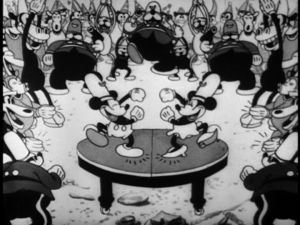
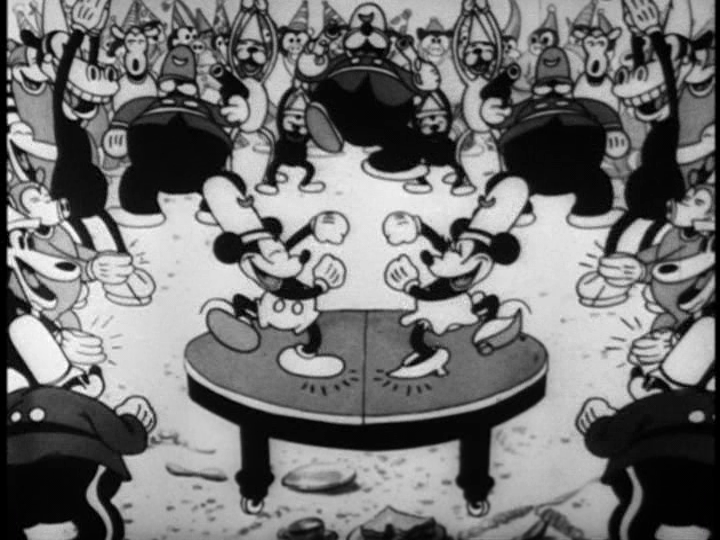
The party is so successful, even the police join in with the celebrations

Suddenly, a patrol car is sent to Mickey’s house, with the police dashing inside. At first, it appears that they’re using force to subdue the party, but when the audience is taken inside, the police have joined the party, dancing wildly and blowing their whistles in time with the music. The short ends with Mickey and Minnie lifting their hats and letting out another loud “Whoopee!”
September 16

September 16, 1995 – The Animated Series Timon and Pumbaa Premieres in Syndication

Image credit: wikipedia

“Wait a minute! Which is probably the amount of time we have left to live.”

On September 16, 1995, the Disney animated series Timon and Pumbaa premiered in syndication. It was one of the last Disney animated series to be shown on CBS through the cross-promotion deal between the two companies. Based on the hit 1994 film The Lion King, the series deals with the misadventures of Timon the meerkat and Pumbaa the warthog, with their adventures sometimes taking them across the globe. Ernie Sabella reprised his role as Pumbaa, but Nathan Lane was unable to reprise his role as Timon, and the role taken over by Kevin Schon and Quinton Flynn (to a lesser extent). The series ran for 85 episodes over 5 seasons, and is currently shown on Disney’s Disney Junior channel on cable television. The series was nominated for ten, and won three, Daytime Emmy Awards: Outstanding Individual Achievement in Animation, Outstanding Sound Mixing, and Outstanding Performer in an Animated Program.

September 15

September 15, 1998 – A Bug’s Life Soundtrack is Released Through Walt Disney Records

“He just knew that he’d come through, it’s the time of your life, so live it well.”

On September 15, 1998, the soundtrack for the Pixar film A Bug’s Life was released on Walt Disney Records. The soundtrack was composed by Randy Newman, who has done several soundtracks for Pixar, including Toy Story. The first track of the album is the song “The Time of Your Life,” written and performed by Newman, and meant as the theme song for the film. The soundtrack won a Grammy Award in 2000 for Best Score Soundtrack for Visual Media, beating out the scores for Shakespeare in Love (Stephen Warbeck), Star Wars Episode I: The Phantom Menace (John Williams), Le Violon Rouge (John Corigliano), and La Vita è Bella (Nicola Piovani).

September 14

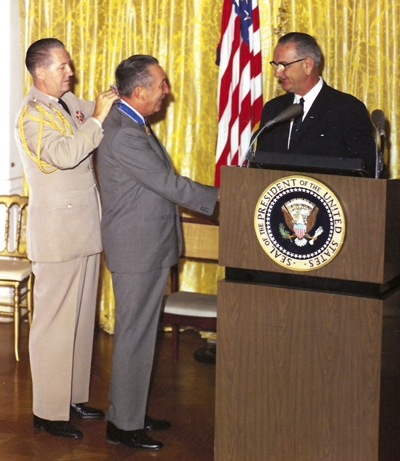
September 14, 1964 – Walt Disney is Awarded the Presidential Medal of Freedom

Image Credit: michaelbarrier.com

“The Medal may be awarded…to any person who has made an especially meritorious contribution to (1), the security or national interests of the United States, or (2) world peace, or (3) cultural or other significant public or private endeavors.”

On September 14, 1964, Walt Disney was presented the Presidential Medal of Freedom by President Lyndon B. Johnson. The award is the highest civilian award in the United States, although not limited to American citizens, and is bestowed by the President himself. Disney was recognized as a pioneer in the animated movie cartoon field. He received the award alongside Dean Acheson (former Secretary of State), Detlev W. Bronk (neurophysiologist), Aaron Copland (composer), Willem de Kooning (painter), J. Frank Dobie (writer), Lena F. Edwards (physician and humanitarian), Thomas Stearns Eliot (Nobel prize winning author), John W. Gardner (president of the Carnegie Foundation for Advancement of Teaching), Reverend Theodore M. Hesburgh, Clarence L. Johnson (aircraft engineer), Frederick R. Kappel (AT&T Chairman), Helen Keller, John L. Lewis (former president of the United Mine Workers), Walter Lippmann (journalist), Alfred Lunt and Lynn Fontanne (actors), Ralph Emerson McGill (publisher), Samuel Eliot Morison (sailor and historian), Lewis Mumford (author), Edward R. Murrow (radio and television reporter), Reinhold Niebuhr (theologian), Leontyne Price (opera singer), A. Philip Randolph (leader in the Civil Rights movement), Carl Sandburg (Pulitzer Prize-winning poet), John Steinbeck (Nobel Prize-winning author), Helen B. Taussig (professor of pediatrics), Carl Vinson (former chairman of the House and Armed Services Committee), Thomas J. Watson, Jr. (Chairman of the Board of IBM), and Paul Dudley White (physician).

September 13

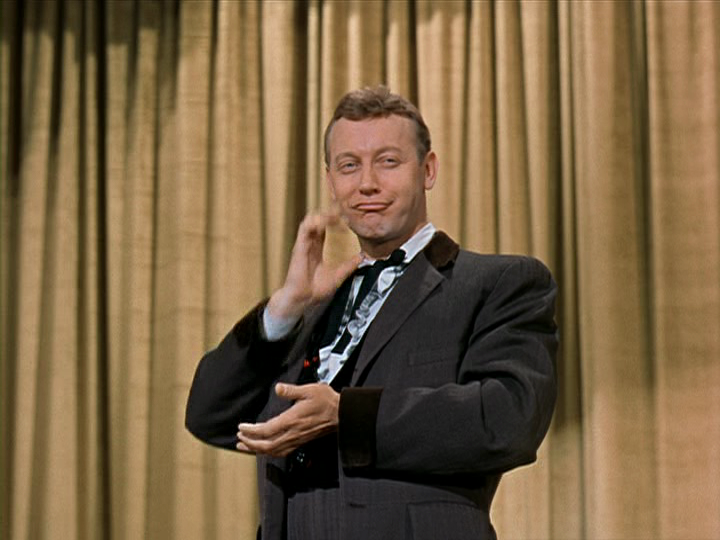
September 13, 1920 – Performer and Disney Legend Wally Boag is Born

“My longest job before the Golden Horseshoe Revue was 54 weeks. And to think it all began with a two-week contract I signed with Walt Disney when the park opened.”

On September 13, 1920, longtime Disneyland performer Wallace Vincent Boag was born in Portland, Oregon. A trained dancer, Boag was teaching his own dance classes at 16, but had turned his attention to honing his comedic skills at age 19. Boag performed at prestigious venues at a young age, including Radio City Music Hall, the Palladium in London, and the Tivoli Theater in Australia. In 1945, Boag was signed with MGM Studios, appearing in such films as Without Love and The Thrill of Romance.

His chance to work with the Disney Studios began in 1955, when a friend told him about auditions for a routine in the new Disneyland Park known as the “Golden Horseshoe Revue.” Boag won a role in the show, and soon became a favorite of Walt’s. While performing the Revue, Boag would also make appearances on “The Mickey Mouse Club,” “Disneyland,” and “Walt Disney’s Wonderful World of Color,” particularly in an episode of the latter program celebrating the Revue’s 10,000th performance in 1962. Boag also appeared in Disney films, including The Absent-Minded Professor and The Love Bug; in addition to these, Boag provided the voice of Jose the parrot in the Enchanted Tiki Room. In 1971, Boag left California to open the Diamond Horseshoe Revue at Walt Disney World, but returned to Disneyland where he remained until his retirement on January 28, 1982. He was inducted as a Disney Legend in 1995, and passed away on June 3, 2011.