RSS Feed

September 7

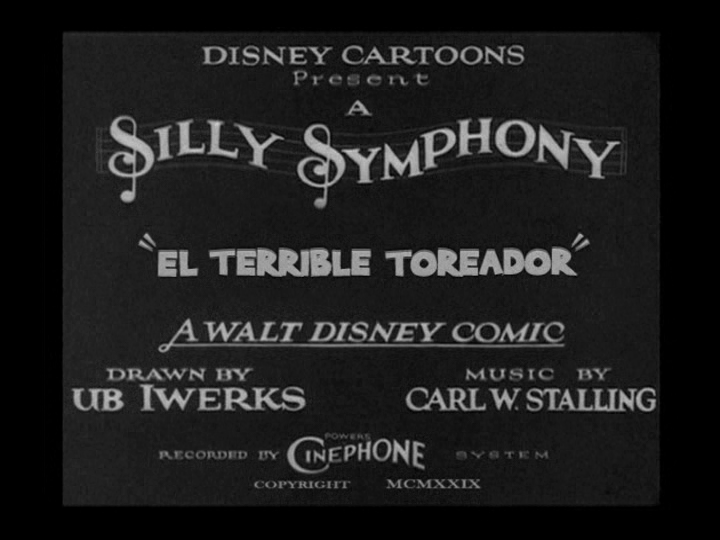
September 7, 1929 – The Silly Symphony El Terrible Toreador is Released to Theaters

vlcsnap-2015-09-01-09h20m08s162

On September 7, 1929, the Silly Symphony El Terrible Toreador was released to theaters. It was directed by Walt Disney, and features music from the opera Carmen by Georges Bizet.

The short opens with people eating in a cantina, with a waitress balancing a beer on her head as she wanders the floor. One soldier falls in love at first sight upon seeing her, and she dances about after he gives her a generous tip. El Terrible Toreador enters the cantina, and the soldier grabs for the waitress, though she works on fighting off his advances. The Toreador, angered at this lack of respect for the waitress, picks a fight with the soldier. The scene then moves to the bullfighting arena, where everyone cheers for the Toreador and the bull as they start to duke it out. The fight has many silly moments between the pair, including a game of patty-cake and a skipping dance. The waitress has a bouquet of flowers for the Toreador, but the soldier pours pepper over the flowers before she throws them. The bull smells the bouquet and sneezes his teeth out, which the Toreador uses to attack the bull. The bull is angered and, after his teeth return, charges at the Toreador. The Toreador wins the fight by pulling the bull inside out.

September 6

September 6, 1993 – The Live-Action Series Disney’s Adventures in Wonderland is Syndicated

AiW

“Use your imagination and you’ll understand, it’s an adventure in Wonderland.”

On September 6, 1993, the live-action Disney Channel series Disney’s Adventures in Wonderland was syndicated, after premiering on the Disney Channel on March 23, 1992. The show was fairly popular, being shown on several channels besides the Disney Channel, and running for a total of 100 episodes. The show would go on to win three Emmy Awards: Hairdressing, Writing, and Makeup. It starred Elisabeth Harnois as Alice, Armelia McQueen as the Red Queen, John Robert Hoffman as the Mad Hatter, and Reece Holland as the March Hare.

September 5

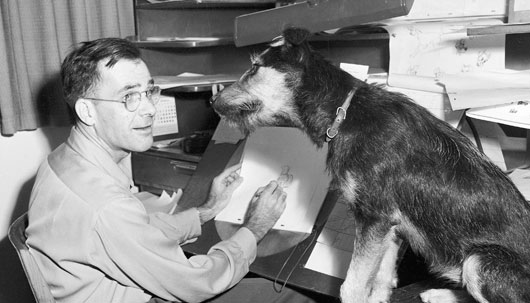
September 5, 1912 – Animator, Member of Disney’s Nine Old Men, and Disney Legend Frank Thomas is Born

Frank Thomas

“Frank was a giant in our field and he meant everything to me and to all of us who love the art of animation. Besides being one of the key guys to help elevate animation from a novelty to an incredible art form, he was so generous in passing along his knowledge and experiences to the generations that followed.” – John Lasseter

On September 5, 1912, Franklin Rosborough Thomas was born in Fresno, California. Thomas knew from an early age that he wanted to be an artist, and in his sophomore year at Fresno State, his interest expanded into animated films. After graduating from Stanford University, he honed his craft at the Chouinard Art Institute in Los Angeles. After being told by a member of his rooming house that the Disney Studios had an opening, Thomas applied and joined on September 24, 1934 as employee number 224. His first assignment was the animated short film Mickey’s Elephant. In 1941, Thomas was picked to be part of a small goodwill tour of South America, which culminated in the animated feature films Saludos Amigos and The Three Caballeros. As a member of the Nine Old Men, Thomas served as a directing animator for several characters, as well as being well regarded for several of his animated sequences, including the dwarfs crying over Snow White’s body, and Bambi and Thumper’s ice skating scene. Thomas was also the pianist for the famed Disney Dixieland band Firehouse Five Plus Two. In 1978, Thomas retired from the Disney Studios, but still remained involved in the field of animation, co-writing several books with colleague and long-time friend Ollie Johnston, including one of the most important books in the study of animation: Disney Animation: The Illusion of Life. He, along with other members of the Nine Old Men, were honored as Disney Legends in 1989. In 2004, Thomas passed away at the age of 92.

September 4

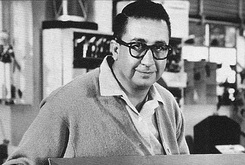
September 4, 1919 – Animator, Imagineer, and Disney Legend X Atencio is Born

X Atencio

“I didn’t even know I could write music, but somehow Walt did. He tapped my hidden talents.”

On September 4, 1919, Francis Xavier “X” Atencio was born in Walsenburg, Colorado. He moved to Los Angeles in 1937 to attend the Chouinard Art Institute, which hosted classes for several Disney artists. At the urging of his instructors, he submitted his portfolio to the Studio, and in 1938 Atencio was hired by Disney as an artist. He quickly rose within the company, becoming an assistant animator in three years. When World War II broke, he served in the United States Army and was stationed in England as a photo interpreter. He came back to the studio in 1945 to work on several animated short films. In 1953, he received his first credit for the Academy Award Winning short film Toot, Whistle, Plunk and Boom. He also lent his talents to the likes of Jack and Old Mac, Noah’s Ark, and the stop motion animated sequences in The Parent Trap and Mary Poppins. In 1965, Atencio switched gears and was asked by Walt to assist in the creation of the Primeval World diorama within WED Enterprises. He continued to work as an Imagineer, bringing his unique talents to several attractions, including penning the unforgettable songs for The Haunted Mansion (co-writing “Grim Grinning Ghosts”) and Pirates of the Caribbean (writing “A Pirate’s Life for Me”). Atencio assisted with several attractions in Walt Disney World, and traveled to Tokyo Disneyland to assist with the recordings for the Haunted Mansion. In 1984, after nearly fifty years with the company, Atencio retired. For his prolific work, he was honored as a Disney Legend in 1996.

September 3

September 3, 2001 – The Animated Series Disney’s The Legend of Tarzan Premieres
D_TLoT_1

“Come on! What’s more important than an afternoon of mindless frolicking with his old pals, huh?”

On September 3, 2001, the animated series Disney’s The Legend of Tarzan premiered on UPN and in syndication, as part of the Disney’s One Too programming block. The series was based on the characters from the Edgar Rice Burroughs series of Tarzan and the animated feature based on the books. It is set after the events of the film, where Tarzan succeeds Kerchak as the Lord of the Jungle. The series ran for 39 episodes in two seasons. The series was created by Disney Pictures Television, and starred Michael T. Weiss as Tarzan, Olivia d’Abo as Jane, April Winchell as Terk, Jim Cummings as Tantor, Suzanne Blakeslee as Kala, and Jeff Bennett as Professor Archimedes.

The first episode, “Tarzan and the Race Against Time,” begins with Tantor standing quietly in the jungle, talking to himself before he is startled by friend Terk. The two can’t find Tarzan, though they do find him swinging vines with his wife Jane, and Terk thinks that Tarzan has forgotten them in favor of Jane. Jane tries to show off, but Tarzan quickly saves her from falling to her doom. She continues to swing, and the two head back to the treehouse. Terk starts talking badly about Jane, and Tantor points out that Terk is jealous. Tarzan drops in, and as Terk starts to talk about Jane, Tarzan begins wrestling with Terk, just as they used to do. As they play, Terk gets caught in a hollow log and is pulled out, covered in spiders. Tarzan is bitten by one of the spiders, but brushes it off as nothing.
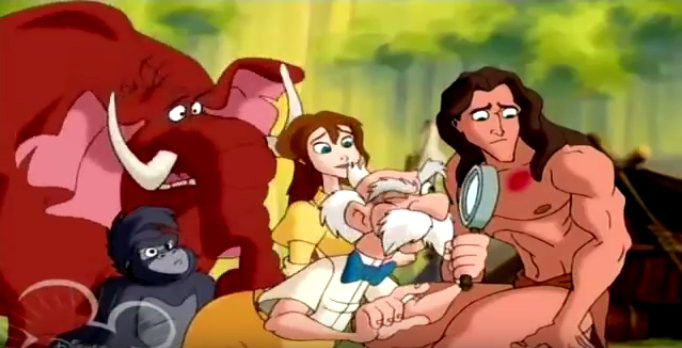
The Professor observes the mark left by the spider bite in front of a worried Jane, Tantor, and Terk

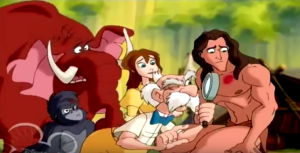
The Professor observes the mark left by the spider bite in front of a worried Jane, Tantor, and Terk

When he heads back to the treehouse, Jane sees the mark where he was bitten, and immediately calls her father to investigate. It turns out that the spider is quite poisonous, and there isn’t much time before Tarzan dies from the poison. The only antidote is in the root of the Mububu flower, which only grows at the top of a waterfall. Jane rushes off to get the flower, although Tarzan believes that he is fine. Against her wishes, Tarzan goes with her, as well as her father, Tantor, and Terk. Terk doesn’t believe there is anything wrong with Tarzan, and is more annoyed by Jane than anything. Terk continues to torment Jane, who constantly finds herself in dangerous situations. The group is attacked by a snake, and although Tarzan fights back, he is growing weaker thanks to the venom. Tarzan’s pride keeps him from accepting help from the others, and he quickly sets forth to get the others across the chasm, but falls when blurry vision keeps him from catching his vine. He lands in the lair of wild jackals, and barely has enough strength to ward them off. The group sets off to save Tarzan, managing to make it just in time.

Tarzan collapses after the attack, and Jane struggles up the ledge with Terk to retrieve the Mububu root. Tarzan has a hallucination that Tantor’s trunk is the earlier snake, and that Jane’s father is Clayton. When Jane and Terk reach the top of the waterfall, they find the flower in the middle of the raging waterfall. Jane has finally had enough of Terk’s berating, and finally tells Terk to hold her tongue rather than tell her she can’t do anything. Terk begrudgingly helps, but the vine snaps once Jane retrieves the flower. Terk dives in to grab the vine, and the two end up hanging from the rock. Terk and Jane work together to save themselves and get the flower quickly to Jane’s father. The antidote is quickly made, and Tarzan is saved. The episode ends with Terk appreciating Jane, though she acts as though she doesn’t.
September 2

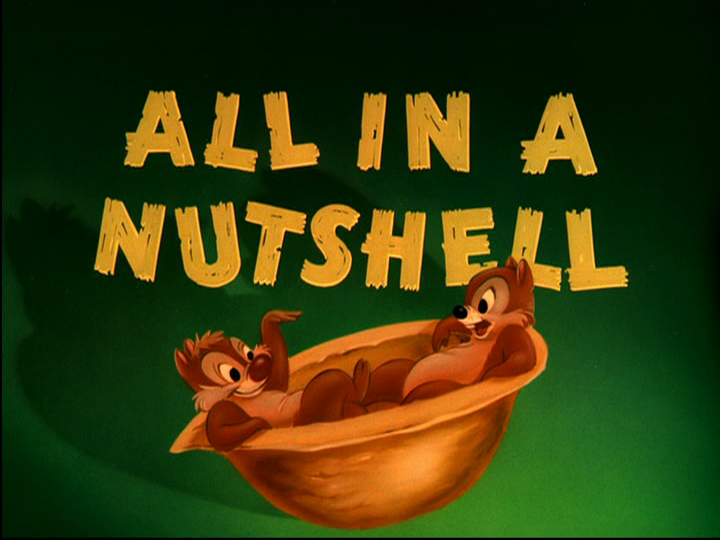
September 2, 1949 – The Donald Duck Short Film All in a Nutshell is Released

vlcsnap-2015-09-01-09h36m31s7

“Hot dog! This oughta sell like hot cakes!”

On September 2, 1949, the Donald Duck short film All in a Nutshell was released to theaters. It was directed by Jack Hannah, with story by Bill Berg and Nick George.

Donald has set up a little nut butter stand shaped like a giant walnut, and is at work creating jars when he is out of nuts. He spies Chip and Dale collecting nuts in their tree, and decides to steal their nuts. Chip and Dale fall out of the tree, confused as to where their nuts have gone, but follow the trail back to the nut stand. Dale believes the stand to be the biggest but they’ve ever seen, and he and Dale decide to carry it home, not realizing they can’t lift it. After being injured by Dale’s antics, Chip finds a large rock atop a hill and decides to use it to crash into the nut to break it open. The rock manages to roll down the hill and crack the top of the stand. Donald rushes out once he hears the noise, but soon returns back to his work. Chip and Dale open the top of the stand and find the nut butter inside, and taste test a jar. Finding it to their liking, they decide to take more jars. Dale gets distracted by the jar filling machine, and takes the place of a jar to eat more butter. Chip gets Dale back on track so they can steal more jars. Unfortunately, one of the jars breaks over Donald’s head, and he chases the two out of the stand. They soon capture him and steal the rest of the jars, but he quickly pursues them. Donald crashes into their tree, and the two send him flying out across the countryside in a makeshift cannon with a log and a beehive, with the chipmunks celebrating their victory.


September 1

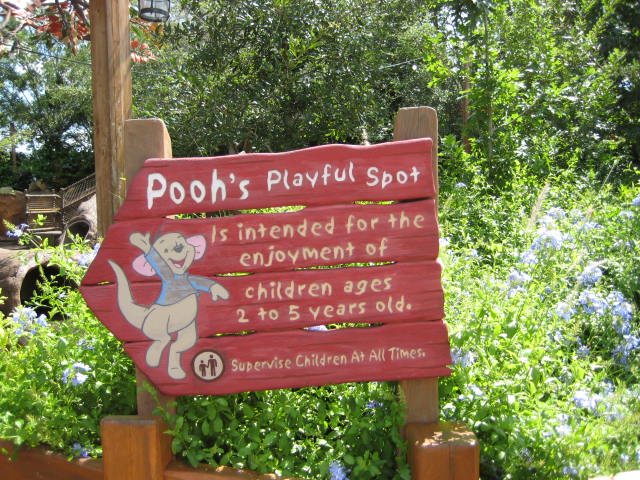
September 1, 2005 – The Playground Area Pooh’s Playful Spot Opens in Walt Disney World

Pooh's Playful Spot

“Pooh’s Playful Spot is intended for the enjoyment of children ages 2 to 5 years old.”

On September 1, 2005, the playground area Pooh’s Playful Spot was added to the Magic Kingdom park of Walt Disney World. The new playground area took the place of the closed 20,000 Leagues Under the Sea attraction, which had closed in 1994. The area served as a spot for children ages 2 to 5 to play safely and included several popular elements from the successful film franchise. There are also some slides and logs to crawl through, as well as a couple of spilled hunny pots for kids to crawl around. The area was closed in 2010 to make way for the New Fantasyland expansion.

August 31

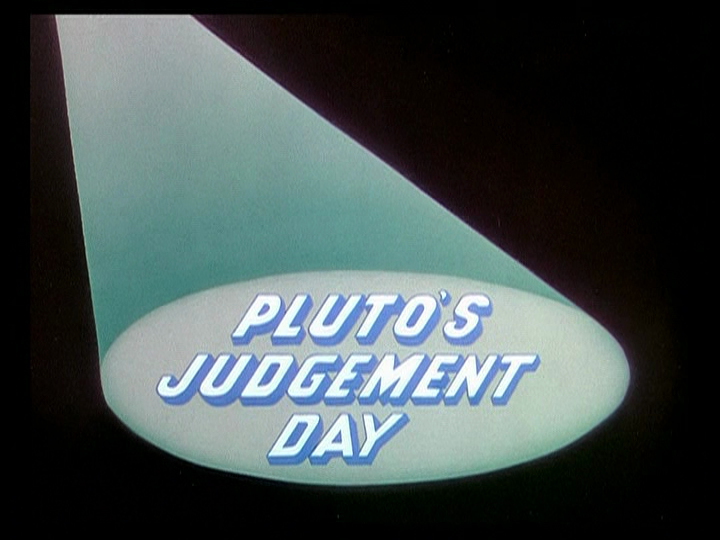
August 31, 1935 – The Mickey Mouse Short Film Pluto’s Judgement Day is Released to Theaters

vlcsnap-2015-08-31-18h50m10s162

“Always chasing cats, aren’t ya? Well, you’re gonna have plenty to answer for on your judgement day!”

On August 31, 1935, the Mickey Mouse short film Pluto’s Judgement Day was released to theaters. It was directed by Dave Hand.

The short begins with Pluto chasing a kitten around the yard until it jumps inside the house. The chase creates a huge mess, and Mickey chastises the pup. Pluto angrily lies down in front of the fire and starts to nap while Mickey cleans up the frightened kitten. Pluto then dreams that a cat has come to the door to call him out for a challenge, and Dream Pluto heads out, though Dream Mickey attempts to stop him. Pluto is led to a special cat cavern, where he is taken deep below and decried as Public Enemy No. 1. He is sentenced for his crimes against all cats, with the judge, jury, and all present all cats, with a wink to the audience that justice certainly is not on Pluto’s side. Each witness is brought in, with one crime more horrific than the next. The jury deliberates for one second before they deliver a guilty verdict for Pluto, and the cats carry him out to his punishment of being held over a fire. Pluto is woken up by a stray piece of coal from the fire, and lands in the tub, splashing Mickey and the kitten. Although initially frightened of the kitten, Mickey convinces the pair to kiss and make up.

August 30

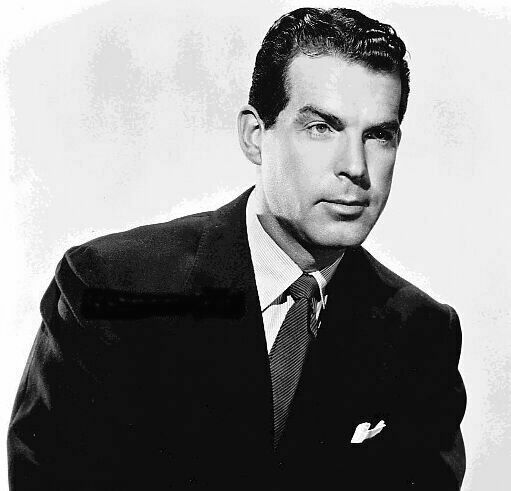
August 30, 1908 – Actor and Disney Legend Fred MacMurray is Born

Fred MacMurray

“I will say the seven pictures I made at the Disney Studio were the pleasantest times I’ve had in the picture business, and I’ve been around quite a while.”

On August 30, 1908, Frederick Martin MacMurray was born in Kankakee, Illinois. His family moved to Wisconsin when he was a boy and after graduating from high school, he earned a scholarship to Carroll University. He supported himself through college by playing the saxophone and performing as a vocalist for local bands; he ultimately did not graduate from college. In 1920, MacMurray headed west to Los Angeles, where he found work with the California Collegians vocal ensemble, which appeared in several Broadway productions. MacMurray ended up as Bob Hope’s understudy for the production Roberta, and scored a screen test and studio contract after being scouted by a Paramount talent scout. 1935 found MacMurray in the film The Gilded Lily alongside Claudette Colbert, and became a star overnight. Walt Disney hired MacMurray for the first live-action comedy for the studio called The Shaggy Dog, which went on to be a surprise hit in 1959. All in all, MacMurray was hired for seven live-action feature films, including Follow Me, Boys!, The Absent Minded Professor, and The Happiest Millionaire. His last feature for the studio was 1973’s Charley and the Angel. In 1987, MacMurray had the honor of becoming the first Disney Legend, honored for his work in entertaining millions. He passed away in 1991 at the age of 83.

August 29

August 29, 1905 – Comic Artist and Disney Legend Al Taliaferro is Born

Al_Taliaferro

“Al was dying for his own comic strip. He was a pretty ambitious guy, hard working, and a fast worker, too…Al thought [Donald Duck] would be a great character for him to develop for the comics.” – Disney Legend Floyd Gottfredson

On August 29, 1905, Charles Alfred Taliaferro was born in Montrose, Colorado. As a young man, his family to Southern California and, after graduating from Glendale High School in 1924, he took correspondence art courses and studied art at the California Art Institute. In 1931, he scored a job at the Disney Studios as the assistant to comic strip artist and fellow Disney Legend Floyd Gottfredson, who was working on the Mickey Mouse daily strip and the Sunday strips. During Taliaferro’s tenure, Donald Duck made his Disney premiere in the Silly Symphony The Wise Little Hen. Once the Silly Symphony made its way to the Sunday strips, Taliaferro realized the commercial potential for Donald Duck, and lobbied to give the character its own strip. Although there was some resistance to give Donald his own strip, Taliaferro prevailed and on February 7, 1938, the Donald Duck strip premiered. Working with colleague Bob Karp, the strip proved to be a huge success. Taliaferro found more success in the creation of three new characters: Donald’s nephews Huey, Dewey, and Louie. They proved to be so popular that a short film was created for them: Donald’s Nephews, which was released on April 15, 1938. Taliaferro passed away on February 3, 1969. He was posthumously honored as a Disney Legend in 2003.