RSS Feed

Tag Archives: Donald Duck

March 11

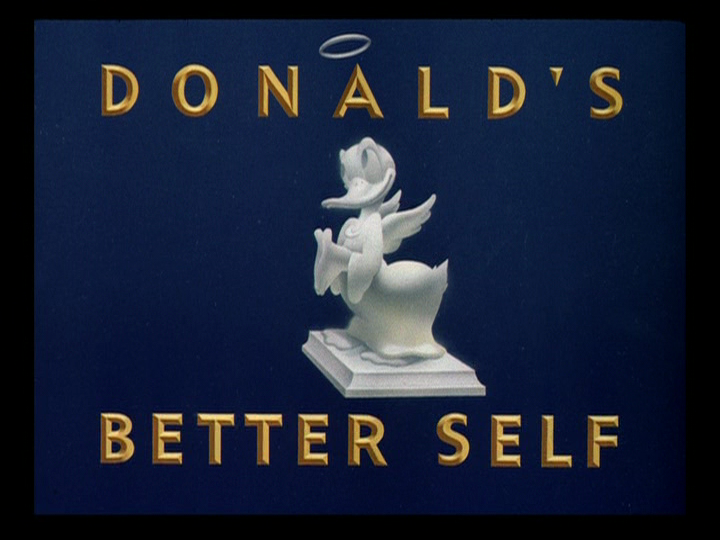
March 11, 1938 – The Donald Duck Short Film Donald’s Better Self is Released to Theaters

vlcsnap-2014-03-11-19h27m48s238

“Why did I do it? Oh, why did I do it?”

On March 11, 1938, the Donald Duck short film Donald’s Better Self was released to theaters. The short was directed by Jack King.

Donald is snoozing in bed, when his alarm goes off. He rolls over, but his Angel self happily gets out of bed to enjoy the day. He then goes over to wake up the sleeping Donald, letting him know that it’s time to get up. As Donald slowly makes his way out of bed, his Devil side pulls him back in. Donald wastes no time in falling back to sleep, much to the annoyance of the Angel; seeing his work is done, the Devil sneaks out the window. Angel finally gets Donald awake and ready for school, and Donald follows behind him on the road. On the way to school, however, Donald gets distracted by Devil, who hands him a fishing rod; Donald, of course follows along eagerly.

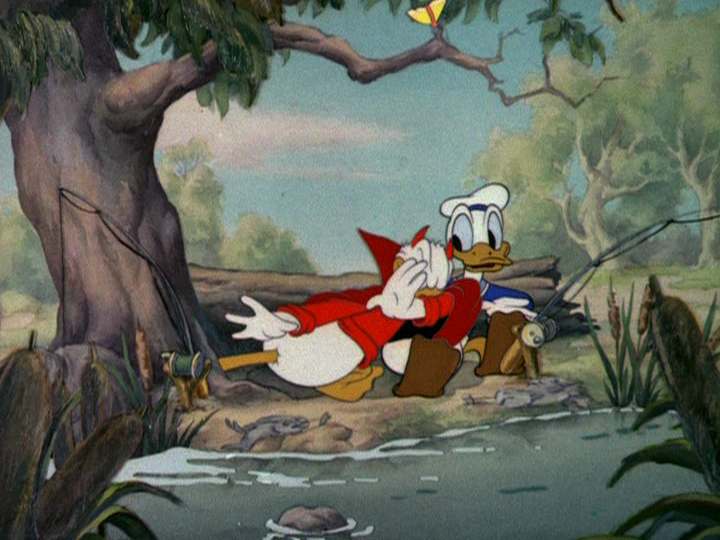
Devil convinces Donald to skip school and go fish, where they share jokes and waste the day

Devil convinces Donald to skip school and go fish, where they share jokes and waste the day

Down at the fishing hole, Donald and Devil are having a great time, with Devil offering Donald a pipe of tobacco. Donald doesn’t want to smoke, but after being asked if he’s afraid, he takes the pipe and smokes it. Devil teaches Donald how to “smoke like a man,” but Donald is unable to do it correctly, and starts feeling ill. Meanwhile, Angel has been looking for Donald, and finds him on the ground while Devil laughs hysterically. Devil cowers in fear, but Angel reassures him that he won’t fight. Thinking this is weakness, Devil wastes no time in beating up Angel. Angel then takes matters into his own hands and attacks Devil, leaving him as a battered pulp in the ground. Donald cheers for Angel, but Angel is angry at him too. Donald grabs his schoolbooks and immediately goes with Angel to school.

March 5

March 5, 1954 – The Donald Duck Short Film Donald’s Diary is Released to Theaters

vlcsnap-2014-03-04-19h03m55s129

“This morning was much like any other morning, and when I took my usual walk, I had no idea that on this day I was destined to find the girl of my dreams.”

On March 5, 1954 , the Donald Duck short film Donald’s Diary was released to theaters. It was directed by Jack Kinney, with story by Brice Mack and Dick Kinney.

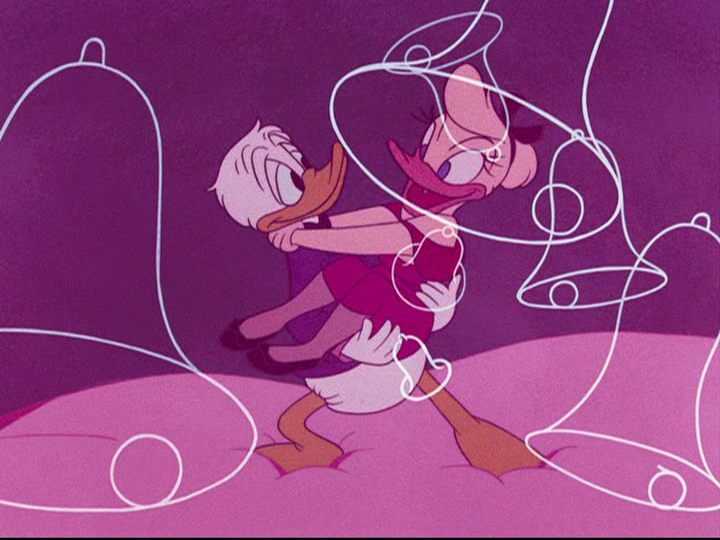
The story begins on February 29th, with Donald putting another entry in his diary. He talks about beginning his day, not knowing that this would be the day he would meet the girl of his dreams – who happens to be sitting in her parlor reading “How to Catch a Husband.” Daisy spies him walking, and quickly changes into something more alluring. She steps outside and drops her handkerchief, but Donald, oblivious to her presence, just steps on it and turns a corner. Daisy tries again and again to get his attention, but to no avail, until she ends up tying him up in a tree. The two end up dating in a quick courtship, and he is soon invited to meet her family, which consists of less than ideal relatives. Finally, Donald believes it to be the day to ask Daisy to marry him, and arrives at her house.

While waiting for Daisy, Donald dreams of what their married life would be like

While waiting for Daisy, Donald dreams of what their married life would be like

He waits hours for Daisy to be ready, and falls asleep in the process. He dreams of her saying yes, and their ensuing wedding. They take a honeymoon, unfortunately with her brothers, and is soon angry that her engagement ring is rather small. As they move into their dream cottage, Donald realizes that her whole family has moved in with them. When he wakes up the next morning, he is shocked to see Daisy has let herself go so quickly. He arrives home from work, and as he greets his wife, she takes his wallet and all of his cash, and burns dinner. Her family then arrives and eats all of the dinner, leaving nothing for him. He realizes that marriage is not for him, feeling that he’d lose his identity. He wakes up from his nightmare and flees her house as fast as he can. He then finishes his diary entry, which reveals that he ran away to join the French Foreign Legion.

February 24

February 24, 1956 – The Donald Duck Short Film Chips Ahoy is Released to Theaters

vlcsnap-2014-02-24-03h50m15s148

“Hey! Wait a minute, stupid! That’s water. Don’t you know you can’t walk on water?”

On February 24, 1956, the Donald Duck short film Chips Ahoy was released to theaters. It was the last short that featured Donald fighting with his nemesis, and the last classic short to feature Chip and Dale. The short was filmed in CinemaScope. It was directed by Jack Kinney, with story by Dick Kinney and Milt Schaffer.

Chip and Dale are sitting on a tree branch, lamenting how hungry they are, when they spy one last acorn on the tree. As they fight over the acorn, it tumbles from their grasp and falls to the water below. Chip then spots a tree in the middle of the river with hundreds of acorns, and the two race down the tree. As the two think of a way to get across the water, Chip spies a ship in a bottle in a nearby shack. Donald then takes a stroll across the dock to get to his boating shack, when he spots Chip and Dale carrying a boat on their backs. When he finds out that the two stole his ship, he fixes to get it back. He uses a fishing pole to reel his ship back in, and starts playing pranks on the two. Dale finally spots that Donald is holding their ship, and Donald catches him. Chip drops the anchor on Donald’s foot, and Donald drops the ship back into the water, and Dale onto the deck. Dale then takes some nearby rope and ties Donald up before jumping onto the ship.

vlcsnap-2014-02-24-04h05m00s49

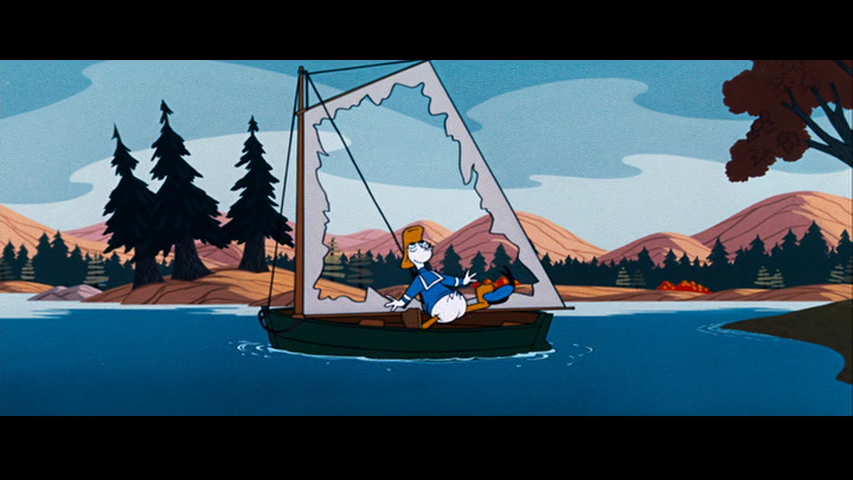
Donald attempts to go after the chipmunks in a variety of boats, all having been tampered with by Dale

Donald then gets into his own boat to go after them, unaware that Dale has already cut Donald’s sail to ribbons. When Donald gets into a canoe, Dale reveals he took care of that too – he burrowed holes into the bottom of the canoe. Donald gets into a rowboat, which Dale already took the screws from. Finally, Donald gets into a speedboat, and when Chip starts to panic, Dale calmly reveals that he tied a rope to the end of the speedboat. When the rope is taut, Donald is sent flying into the acorn tree, sending acorns flying everywhere, including onto the ship. When Donald tries to grab the ship, he slips on the acorns and sends the boys back to shore on a wave. That night, the boys are eating their acorns when Chip looks to see that Donald, still trapped on that little island, has cut down the acorn tree and started building a boat, a sight at which the chipmunks can’t help but laugh.

February 11

February 11, 1938 – The Donald Duck Short Film Self-Control is Released to Theaters

vlcsnap-2014-02-11-19h03m37s57

“When anger rises in your soul, laugh and count to ten, self-control should be your goal, laugh and count to ten!”

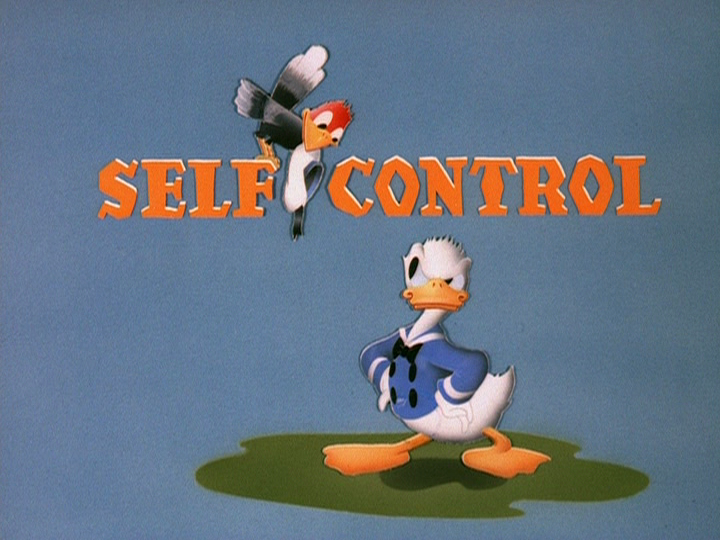
On February 11, 1938, the Donald Duck short film Self-Control was released to theaters. It was directed by Jack King.

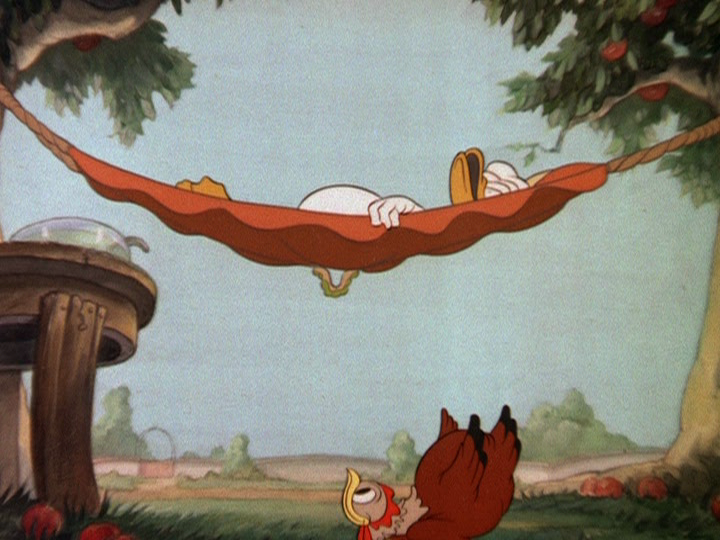
Donald is lounging in his backyard, swinging in a hammock and singing. A musical philosopher named Uncle Smiley starts talking on the radio about self-control, and Donald eagerly listens. When Uncle Smiley asks if Donald has ever lost his temper, Donald answers that he never has, but Uncle Smiley still gives him a secret how to control his temper: just laugh and count to ten. Donald agrees to follow the advice before settling down to take a nap in his hammock. At that moment, a fly lands on his foot, disturbing him, and he angrily swats at it. He misses and lands on his head, and as his anger rises, he starts to count to ten. His anger subdued, he gets back in his hammock and snores away.

As Donald sleeps, he is unaware of the chicken/caterpillar conflict brewing underneath his hammock

As Donald sleeps, he is unaware of the chicken/caterpillar conflict brewing underneath his hammock

A caterpillar falls from the apple tree his hammock is tied to, and starts crawling around underneath the hammock. A nearby chicken notices the caterpillar, and as she jumps up to catch it, she pokes Donald in the backside with her beak. Donald cries out and nearly loses his temper again, but Uncle Smiley starts singing again about letting his troubles fly away. The caterpillar starts crawling around Donald, and when Donald tries to brush it off, the caterpillar slaps him with his tail. The chicken then leaps on to Donald to catch the caterpillar, and Donald falls to the ground again. He counts to ten, but not all of his anger has disappeared. As Uncle Smiley starts to sing again, Donald tells him off and tries to ignore him. A woodpecker then shows up and lands on the punch bowl of lemonade nearby. Donald wakes to find the bird in his lemonade and tries to shoo him away, but ends up with a lemon slice in his eye. Although he tries to ignore the bird, the woodpecker starts pecking the apple tree, filling Donald’s hammock with apples. Having had enough, Donald fights the woodpecker and grabs a shotgun to shoot it, but to no avail. Tired of Uncle Smiley’s advice, he takes the shotgun and uses it to destroy the radio.

December 16

December 16, 1983 – The Mickey Mouse Cartoon Featurette Mickey’s Christmas Carol Premieres in Theaters
vlcsnap-2013-12-16-19h31m33s118

“What’s this world coming to, Cratchit? You work all your life to get money, and people want you to give it away!”

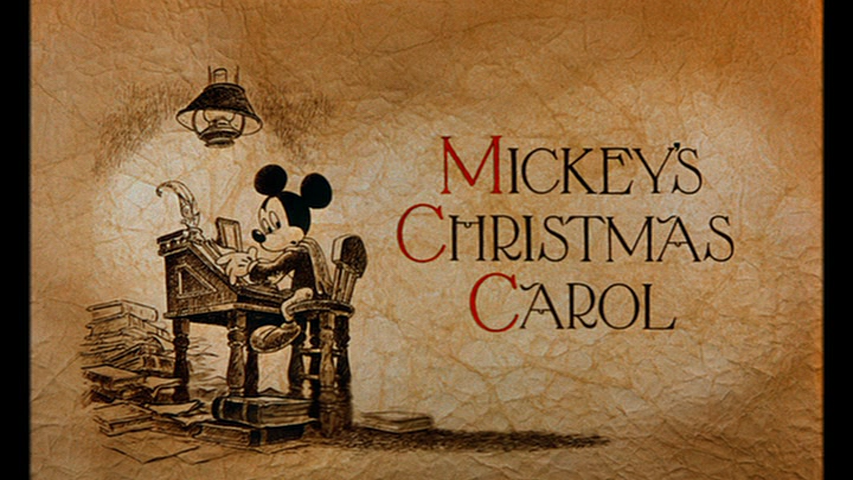
On December 16, 1983, the Mickey Mouse cartoon featurette Mickey’s Christmas Carol premiered in theaters. The 25 minute film was based on the classic Charles Dickens story A Christmas Carol, with Disney comic book staple Uncle Scrooge McDuck playing the part of Ebenezer Scrooge. Mickey portrays Bob Cratchit, Goofy plays Jacob Marley’s ghost, and Donald Duck plays Fred, among several other classic Disney characters. This was Mickey’s foray back into theaters after his last short film in 1953, The Simple Things. The idea for the film went back to the 1974 record of the same name. The film was released on a double billing with the film The Rescuers. It was eventually nominated for an Academy Award – the first Mickey Mouse short to be honored so since 1948’s Mickey and the Seal; it would lose to Sundae in New York. The film was directed by Burny Mattinson, with story by Mattinson, Tony L. Marino, Ed Gombert, Don Griffith, Alan Young, and Alan Dinehart. It stars Alan Young as Scrooge, Wayne Allwine as Mickey Mouse, Clarence Nash as Donald, Hal Smith as Goofy, Eddie Carroll as Jiminy Cricket, and Will Ryan as Willie the Giant and Pete.

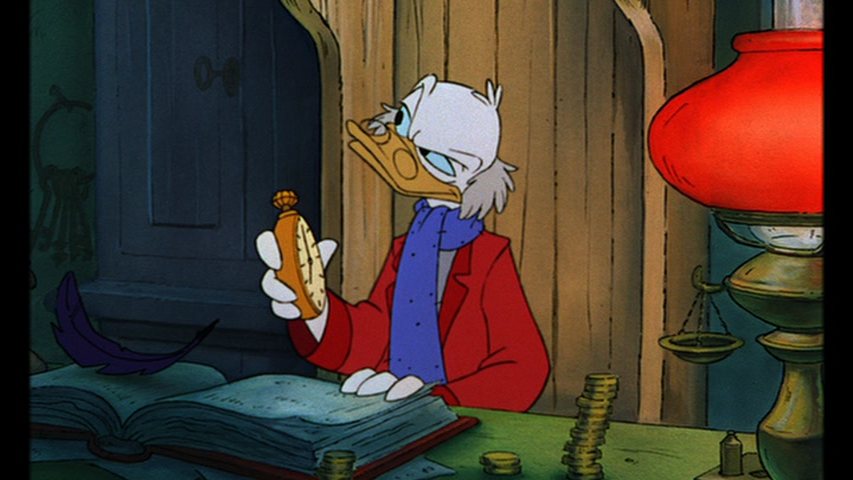
The film begins on Christmas Eve in London, and Scrooge is heading back to his office, where he lectures employee Bob Cratchit for using a piece of coal in the stove. Cratchit works up the nerve to ask Scrooge for half of Christmas Day off, and Scrooge agrees, so long as his pay is docked. Scrooge goes back to his desk to count his money, but is soon interrupted by the appearance of his nephew Fred. Fred brings his uncle a wreath, but he and Cratchit are soon dismayed at Scrooge’s attitude about Christmas. Fred invites his uncle to Christmas dinner, but is soon kicked out of the office. After Fred leaves, two men arrive asking Scrooge for a donation for charity. He sends them on their way without a donation, and laments to Cratchit about how he doesn’t understand why everyone wants him to give his money away.
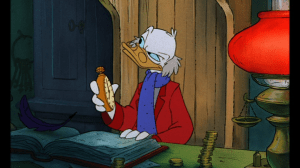
Scrooge eyes the clock, but begrudgingly lets Cratchit go home for Christmas

Scrooge eyes the clock, but begrudgingly lets Cratchit go home for Christmas

That evening, Cratchit leaves merrily to join his family for Christmas, and Scrooge heads home in the late London night. As he arrives home, his door knocker suddenly turns into the face of his old partner, Jacob Marley. Scrooge is startled, but thinks nothing of it. A shadow follows him up the stairs, and although Scrooge tries to hide, the ghost of Marley finds him and warns him of his fate – to have to carry heavy chains on his soul for all eternity, thanks to his sins. Marley tells him that three spirits will meet him through the night, should he want to avoid that fate. Scrooge heads to bed, worried about the spirits, but soon dismisses them and goes to sleep. The Ghost of Christmas Past arrives at one, and takes Scrooge back to his past, when he used to be kinder and believed in Christmas. After a dizzying flight through London, Scrooge arrives back at his old employer’s Christmas Party. Scrooge spies himself in the corner, and watches as he falls in love with Isabelle, the love of his life.

As they continue watching Scrooge’s life, they see the decline of Scrooge’s love for Isabelle, as money has become his only love. She leaves him, and Scrooge begs the spirit to take him home. When the clock strikes two, the Ghost of Christmas Present arrives, who is surrounded by the food of generosity. Scrooge argues that no one has ever offered him generosity, but the ghost shoots back that Scrooge never gave reason for anyone to show him any. The ghost takes Scrooge to the house of Bob Cratchit, where Scrooge sees his family, with the sickly Tiny Tim. Scrooge is concerned with the lack of food the Cratchits have, as well as the welfare of Tiny Tim, who may not live to see another Christmas. As Scrooge asks the spirit what happens to the boy, the spirit disappears, and all the lights around him go out.
Cratchit and his family mourn the loss of their youngest child, Tiny Tim

Cratchit and his family mourn the loss of their youngest child, Tiny Tim

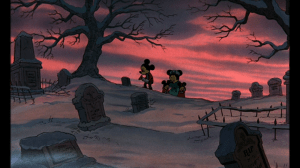
The Ghost of Christmas Future arrives, with Scrooge being taken to the graveyard. Scrooge sees Cratchit mourning over his son’s grave, but when Scrooge begs for Tiny Tim’s life, he is interrupted by the laughter of two weasels, who are digging the grave for Scrooge. Scrooge is taken to his plot and sees his name on the tombstone, and is then pushed into the grave by the spirit. As the spirit laughs, Scrooge begs for his life, pleading that he will change. As he falls, he finds that he is back in his own room, arriving home on Christmas morning. Scrooge rushes outside, and starts his day by making a huge donation to the two men from yesterday. Scrooge then runs into his nephew Fred, and accepts the invitation to Christmas dinner before going shopping. He rushes over to Cratchit’s house, and pretends to be the same old Scrooge. He soon reveals his new demeanor, making Cratchit his partner and giving him a raise. The film ends with a celebration in the Cratchit house, with Scrooge acting as another father to Cratchit’s children.
December 8

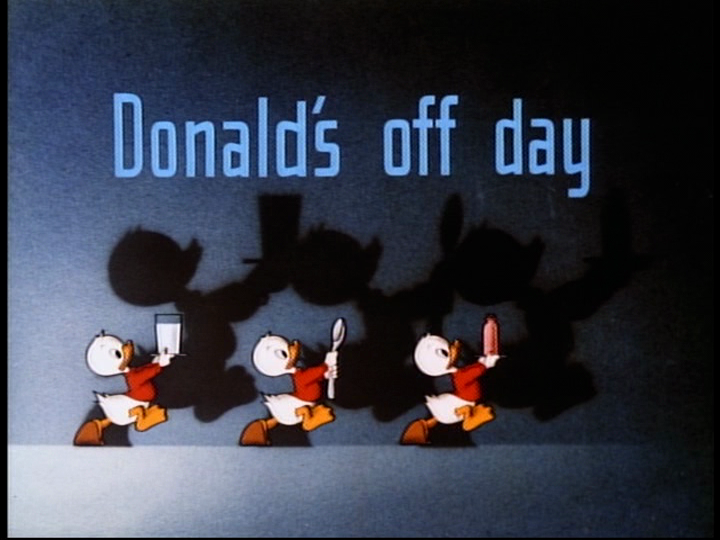
December 8, 1944 – The Donald Duck Short Film Donald’s Off Day is Released to Theaters

vlcsnap-2013-12-08-18h52m50s210

“Are you a well man? You may think so, but you probably need a doctor. Call Dr. Quack at Maine-13-uh-oh, or you may be a dead duck.”

On December 8, 1944, the Donald Duck short film Donald’s Off Day was released to theaters. It was the first short directed by Jack Hannah, who would go on to direct over 90 short films. The story was written by Bill Berg and Dick Shaw.

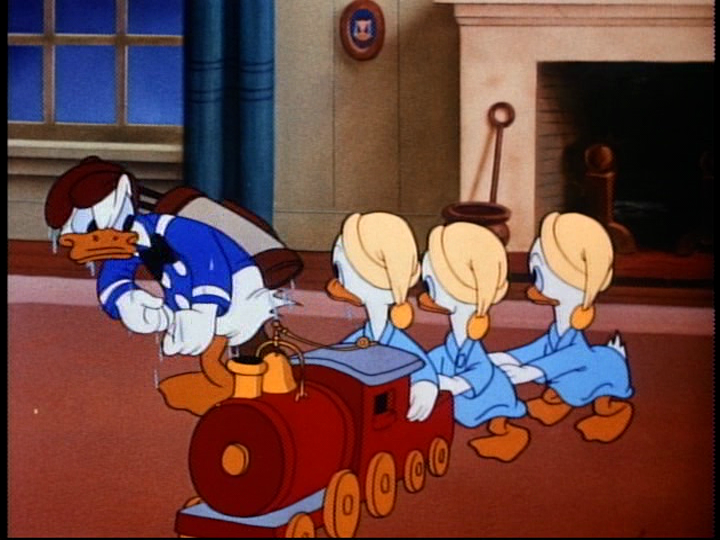
The sun is rising over the hill, shining through Donald’s window while someone is singing for the duck to get out of bed. His alarm then goes off, but he still doesn’t move from his bed, until the alarm clock falls over. He excitedly shoots out of bed to perform his morning exercises before getting ready for his big golf day. He rushes by the nephews and excitedly steps out, only to be greeted with a sudden storm. Dejectedly, he turns around and heads back inside, but stops when the storm suddenly disappears. As he marches off again, the storm returns, and Donald throws his hat down angrily, railing at the rain.

Donald storms back into the house, ready to unleash his frustration on his nephews

Donald storms back into the house, ready to unleash his frustration on his nephews

Donald goes back inside and starts yelling at his nephews, sending them to their room. He then sits by the radio, eating licorice, when he decides to pull out a book on diseases and their symptoms. Coincidentally, an ad for a Dr. Quack starts to play on the radio, warning Donald that he may need a doctor. He starts to flip through the book, and starts seeing symptoms for random diseases (a coated tongue, for instance, forgetting that he did just eat licorice). The nephews see Donald worrying, and decide to play a prank on him, making him believe he really is unwell. Donald, thinking he is unable to see, starts wandering around blindly before collapsing on the floor. The nephews put him on the couch and start attending to his needs before continuing their prank with a squeak toy which Donald believes to be his heart.

Donald, convinced he’s dying, pulls his nephews close and gives him his will, which bequeaths them his precious golf clubs. As Donald lies panicking, he suddenly notices that what he thought was his heart is the squeak toy, and catches his nephews in the act. He storms after them, recalling all they did to torment him, and as the nephews cower in the corner, awaiting his rage, the sun suddenly begins to shine. Forgetting his anger, Donald runs for his golf clubs and sprints outside, although he is struck by lightning the moment he steps out the door.

November 28

November 28, 1947 – The Donald Duck Short Film Chip an’ Dale Premieres in Theaters

vlcsnap-2013-11-28-08h22m53s6

“Doggone freezing weather. A guy never gets a chance to sleep around here.”

On November 28, 1947, the Donald Duck short film Chip an’ Dale premiered in theaters. This short is the first time the two chipmunks have been named, and also marks the first time they are Donald’s adversaries. The short was nominated for an Academy Award, but lost to Warner Brothers’ Tweetie Pie. The short was directed by Jack Hannah, with story by Dick Kinney and Bob North.

A snowstorm is raging outside, and inside his cabin, Donald is trying desperately to stay warm. He notices that the snow has come down his chimney and put out his fire. Out of firewood, he decides to go out with his axe and chop down a nearby dead tree, unaware that Chip and Dale live inside with their stores for the winter. The chipmunks watch as Donald takes off with their home, and follow him into his cabin. They sneak past him to reclaim their nuts, but are unable to grab them before Donald starts the fire. Once again, they try to sneak past him, and decide to put out the fire themselves.

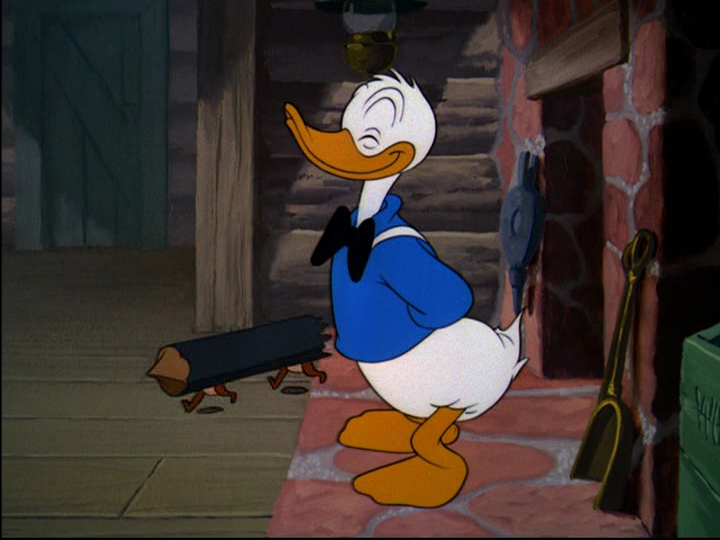
As Donald enjoys the fire he's made, he's unaware that the two chipmunks are taking away the log

As Donald enjoys the fire he’s made, he’s unaware that the two chipmunks are taking away the log

As Donald thinks he’s enjoying the fire, he suddenly notices the log walking right in front of him. He lets them walk out the door, taking the log as they go, and slams the door behind them. The chipmunks take another approach of dropping snowballs down the chimney, putting out the fire. Donald traps the two in a snowball and sends them flying down the roof before starting his fire again. Chip gets the idea of rolling a snowball down a steep hill on a clear collision course with Donald’s cabin. When Donald opens the door, the giant snowball sends him flying into his backdoor, encased in snow. The two chipmunks walk happily away with their log, but not before Dale is able to give Donald a well-placed kick in the rear.

November 11

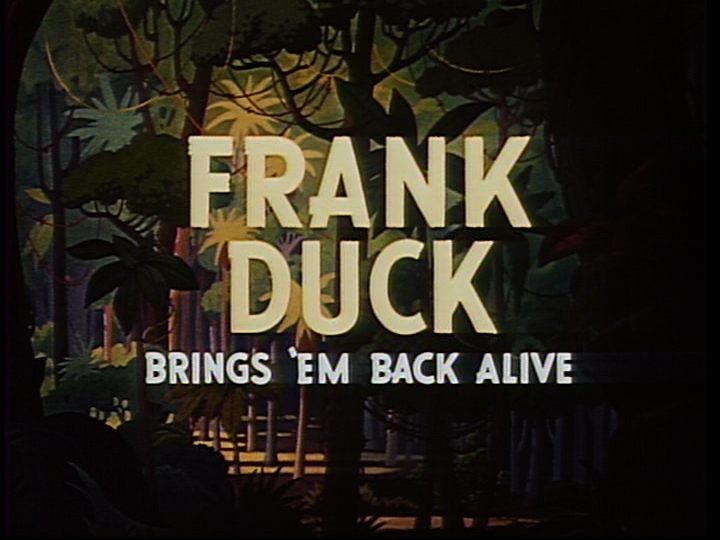
November 11, 1946 – The Donald & Goofy Short Film Frank Duck Brings ‘em Back Alive is Released to Theaters

vlcsnap-2013-11-11-18h59m15s243

“Wanted – wild men. That ought to get me a wild man.”

On November 11, 1946, the Donald & Goofy short film Frank Duck Brings ‘em Back Alive was released to theaters. This is the fifth short of the series starring Donald and Goofy, with six released overall. The short was directed by Jack Hannah, with story by Dick Kinney.

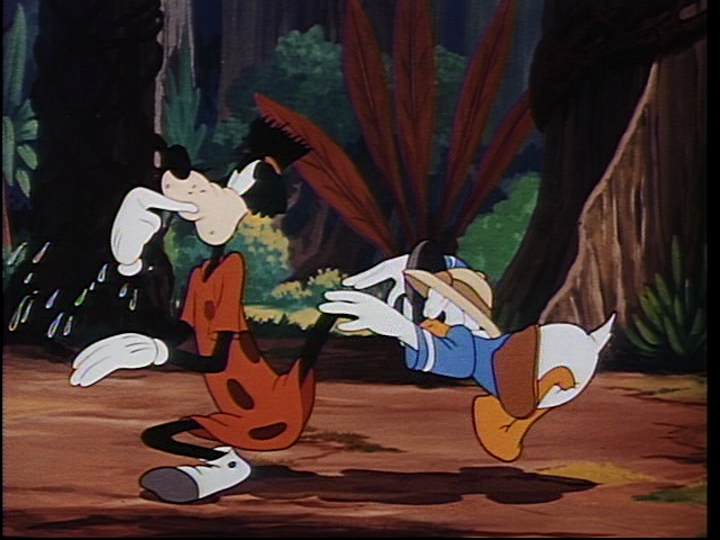
The short begins in the jungle, where “wild man” Goofy is swinging on the vines gracefully, performing various tricks. He soon spies a boat in the nearby river, and watches as it parks on the river’s edge. Donald, going under the guise of Frank Duck, posts up a sign on a nearby tree, announcing that he’s looking for wild men to join the circus. Goofy then decides to leap from the tree with a knife, ready to attack Frank. Unfortunately, as he falls, the rest of the attachments on his Swiss army knife fall out, and as he fixes it, he face-plants deep into the jungle floor.

Frank tries to retrieve the contract, but is unable to grab it before Goofy devours it

Frank tries to retrieve the contract, but is unable to grab it before Goofy devours it

Frank asks Goofy to sign the contract, but as he doesn’t know how to sign, he just scribbles on the dotted line before emptying the pen’s ink onto the paper and eating it like a sandwich. Frank tries to retrieve the contract, but is pushed back by Goofy’s leg. Frank is unable to chase after Goofy, and instead tries to bribe him with food. Goofy is finally tempted by a strawberry shortcake, and falls into Frank’s trap, catching him in a cage. As Frank carries the wild man away, the cage breaks off from its bottom, and Goofy is free, unbeknownst to Frank. Frank then sails away, realizing a bit too late that he’s lost his wild man, and hurries back to catch him again. Goofy takes to the vines again, but ends up tangling himself on a vine and tree branch. Unfortunately, Frank is still unable to catch him, and the chase continues through the jungle. Frank chases Goofy into a lion’s den, and both are soon pursued by the lion. Goofy escapes in Frank’s boat, and Frank is left to become the wild man of the jungle.

October 23

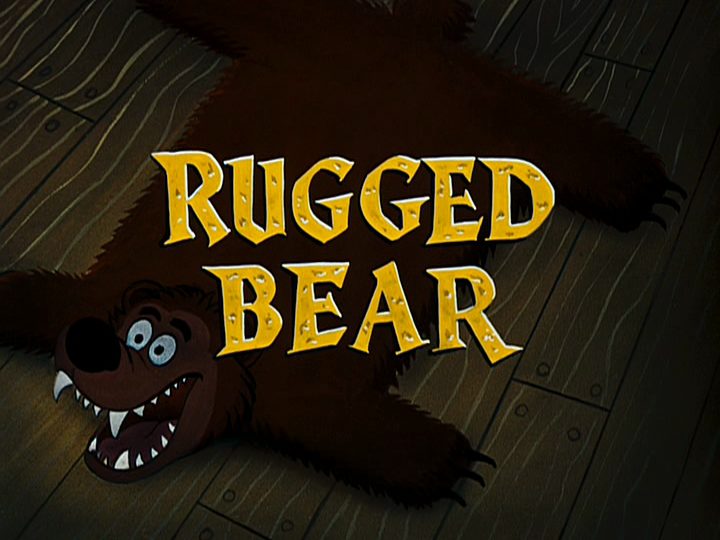
October 23, 1953 – The Donald Duck Short Film Rugged Bear is Released to Theaters

vlcsnap-2013-10-23-18h21m34s193

“This is Bear Country: a quiet, peaceful part of the forest reserved exclusively for Mr. Bear.”

On October 23, 1953, the Donald Duck short film Rugged Bear was released to theaters. This marked the second appearance of Humphrey the Bear overall, and the second of five appearances in Donald Duck short films. The short was directed by Jack Hannah, with story by Al Bertino and Dave Detiege.

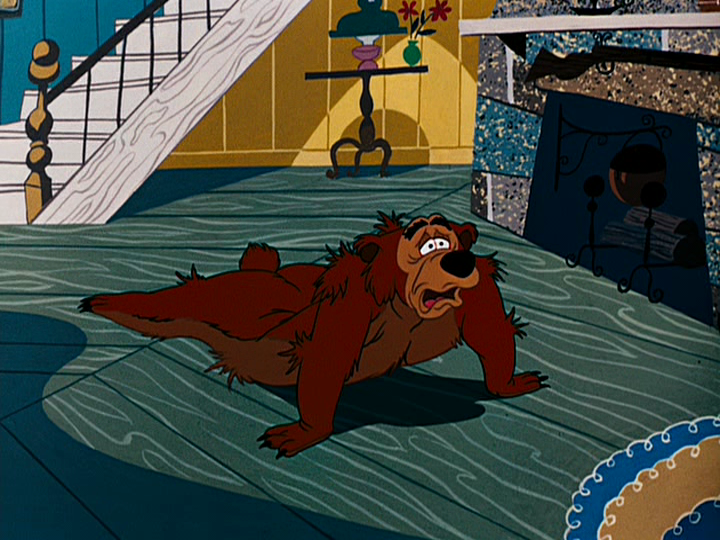
The short begins at a section of the forest for Bear Country, with dozens of bears sleeping soundly. The bears are alerted by the narrator that hunting season has begun, and while they all flee to their cave, Humphrey the Bear continues to sleep. He is soon woken up by flying bullets, and is locked out of the cave when all the other bears seal themselves inside. Humphrey runs crazily around the woods, dodging hunters, and comes across a house in the woods. Once inside, he realizes he’s in a hunting cabin, with guns and stuffed bear heads on the walls. As he tries to escape, he sees Donald walking to the house, holding a shot gun. He frantically tries to hide, and disguises himself as a bearskin rug.

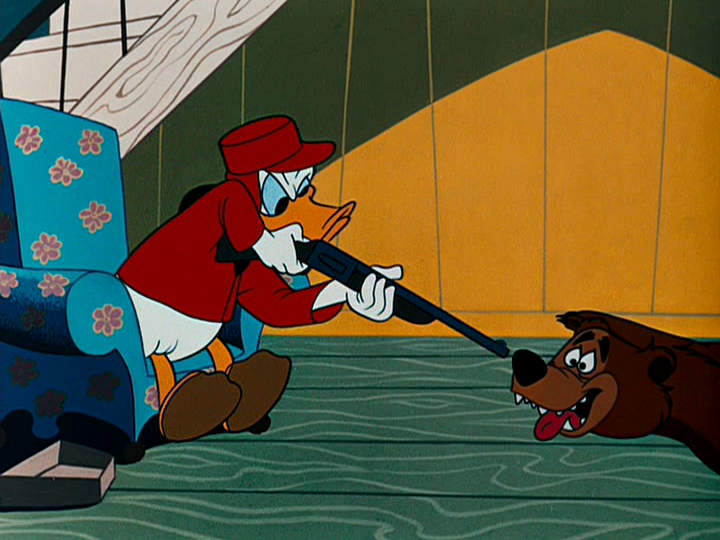
Donald pretends to shoot his bearskin rug, making his "rug" rather nervous

Donald pretends to shoot his bearskin rug, making his “rug” rather nervous

Donald wipes his feet on the nervous bear’s back, and as he sits to clean his shotgun, he pretends to shoot the rug, which causes Humphrey to nearly panic. As Donald decides to light a fire in the fireplace, he uses Humphrey’s nose to light his match. Humphrey barely suppresses a yelp, and when he looks behind him to see where Donald (and, more importantly, the gun) is, he gets his nose stuck in the barrel and has to quietly follow Donald through the house. He manages to free himself when the kitchen door is slammed in his face, and when he tries to sneak away, he finds that hunting season is still occurring, and has to stay inside to stay safe.

Donald returns from getting his snack, and sits on Humphrey’s back in front of the fire. After swallowing a stray bit of Donald’s popcorn, Humphrey gets the hiccups; fortunately, Donald thinks he has the hiccups instead of his rug. After getting a drink of water, Donald returns and decides to take a nap on his rug. A stray spark from the fire jumps out and lands on Humphrey’s back, and he catches on fire, but he masks his scream by turning up the radio, waking Donald, who quickly puts the fire out. Seeing the mess this caused, Donald throws Humphrey into the washing machine. Poor Humphrey emerges after the dry cycle as a giant fur ball, which Donald remedies by cutting off his hair with a yard trimmer. Donald then curls himself up in the rug to fall asleep, much to Humphrey’s dismay.

Humphrey is relieved that Donald has left for the season

Humphrey is relieved that Donald has left for the season

Hunting season soon ends, and the bears clean up the mess the hunters left behind. Donald leaves his hunting cabin, and Humphrey, looking more than a little worse for wear, is relieved that he can finally escape. He hears a strange knocking from the wood box near the fireplace, and is surprised to find that the bear rug he’d rolled up and replaced at the beginning of the season was, in fact, another live bear, who thanks Humphrey for hiding him and taking his place. Humphrey looks at the camera with bloodshot eyes, a look of disbelief on his face.

September 30

September 30, 2003 – The Magic Kingdom Attraction Mickey’s PhilharMagic Opens in Walt Disney World

Walt-Disney-World-Mickeys-Philharmagic-07

“Disney magic meets Disney music in this spectacular 12-minute 3D fantasy adventure starring Donald Duck.”

On September 30, 2003, the Magic Kingdom attraction Mickey’s PhilharMagic opened in Walt Disney World. The attraction is located in Fantasyland, right next to Peter Pan’s Flight, and replaced The Legend of the Lion King. The attraction itself is a 12-minute 3D film, with guests given special 3D glasses in the lobby before entering the theater. There are also special in-house effects that draw the viewer into the film’s adventure. The plot of the film is that Mickey is getting ready to conduct a magic orchestra, but Donald takes Mickey’s Sorcerer’s Hat and decides to take over. Things spin wildly out of control, and Donald is plunged into scenes from beloved Disney films, from Beauty and the Beast to Aladdin. Mickey’s PhilharMagic had a grand opening ceremony on October 8 2003. Similar versions of the attraction were opened in Hong Kong Disneyland on September 12, 2005, and Tokyo Disneyland on January 24, 2011.