RSS Feed

Tag Archives: Color

November 11

November 11, 1946 – The Donald & Goofy Short Film Frank Duck Brings ‘em Back Alive is Released to Theaters

vlcsnap-2013-11-11-18h59m15s243

“Wanted – wild men. That ought to get me a wild man.”

On November 11, 1946, the Donald & Goofy short film Frank Duck Brings ‘em Back Alive was released to theaters. This is the fifth short of the series starring Donald and Goofy, with six released overall. The short was directed by Jack Hannah, with story by Dick Kinney.

The short begins in the jungle, where “wild man” Goofy is swinging on the vines gracefully, performing various tricks. He soon spies a boat in the nearby river, and watches as it parks on the river’s edge. Donald, going under the guise of Frank Duck, posts up a sign on a nearby tree, announcing that he’s looking for wild men to join the circus. Goofy then decides to leap from the tree with a knife, ready to attack Frank. Unfortunately, as he falls, the rest of the attachments on his Swiss army knife fall out, and as he fixes it, he face-plants deep into the jungle floor.

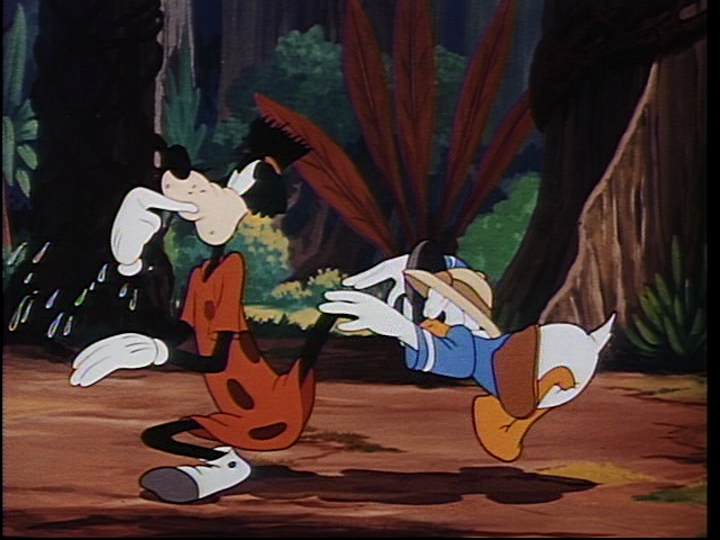
Frank tries to retrieve the contract, but is unable to grab it before Goofy devours it

Frank tries to retrieve the contract, but is unable to grab it before Goofy devours it

Frank asks Goofy to sign the contract, but as he doesn’t know how to sign, he just scribbles on the dotted line before emptying the pen’s ink onto the paper and eating it like a sandwich. Frank tries to retrieve the contract, but is pushed back by Goofy’s leg. Frank is unable to chase after Goofy, and instead tries to bribe him with food. Goofy is finally tempted by a strawberry shortcake, and falls into Frank’s trap, catching him in a cage. As Frank carries the wild man away, the cage breaks off from its bottom, and Goofy is free, unbeknownst to Frank. Frank then sails away, realizing a bit too late that he’s lost his wild man, and hurries back to catch him again. Goofy takes to the vines again, but ends up tangling himself on a vine and tree branch. Unfortunately, Frank is still unable to catch him, and the chase continues through the jungle. Frank chases Goofy into a lion’s den, and both are soon pursued by the lion. Goofy escapes in Frank’s boat, and Frank is left to become the wild man of the jungle.

November 5

November 5, 2001 – The Final Episode of the Animated Series Recess Airs

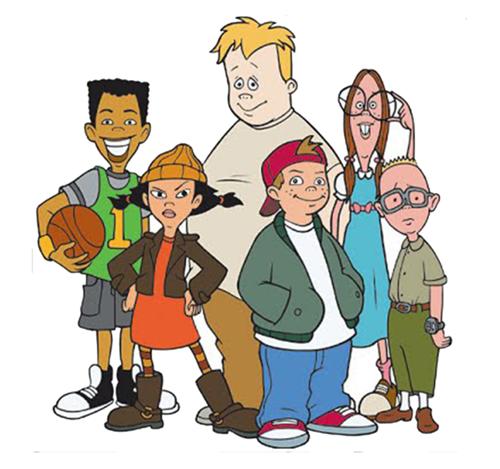
500px-Recess “You know what, guys? Here we are talking about how much we need T.J., when the fact is, I think right now, T.J. needs us.”

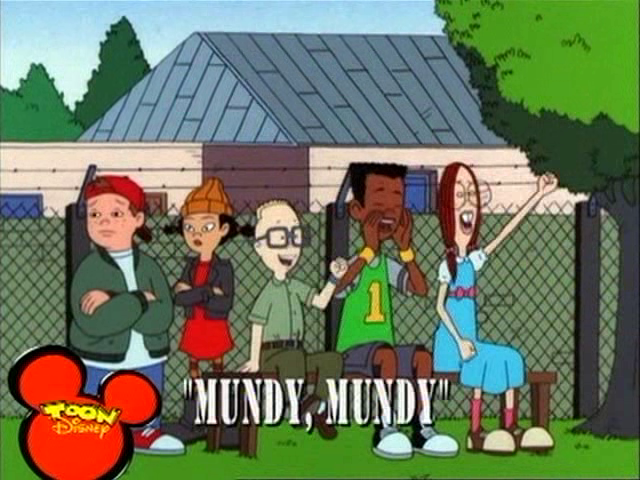
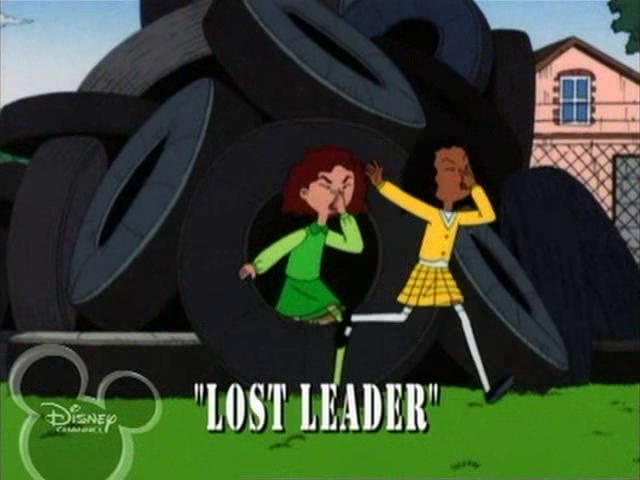
On November 5, 2001, the 65th and final episode of the animated series Recess aired in syndication. Although a popular series, at the time, Disney had a 65-episode rule with its animated series, effectively canceling the series. It was one of the longest running shows on Disney Saturday morning programming block. The final episode was comprised of two segments: Mundy, Mundy and Lost Leader. It starred Andy Lawrence as T.J., Ricky D’Shon Collins as Vince, Pamela Segall as Spinelli, Jason Davis as Mikey, Ashely Johnson as Gretchen, Courtland Mead as Gus, April Winchell as Miss Finster, and Dabney Coleman as Principal Prickly.

vlcsnap-2013-11-05-19h19m47s100

Mundy, Mundy begins with T.J. commenting that the bully Mundy and his cronies are charging kids to play in an area of the playground known as the “Cheese Box.” As Vince kicks the ball in kickball, it ends up nearly hitting a kindergartener, until Mundy catches the ball and saves her. His friends tell him to move before the word spreads that he did something nice. T.J. and his friends, however, see the whole thing, and word spreads like wildfire. Suddenly, everyone thinks he’s a hero and a saint, and they follow him around the playground. His friends threaten T.J. and his gang unless they ruin Mundy’s reputation once again. Gus then pretends to have been gravely injured by, in the hopes that everyone will turn their backs on the former bully. Unfortunately, the plan backfires, and the kids continue to follow Mundy around. Wherever Mundy goes, although he tries to bully other people, he’s seen as a great guy. T.J. has to go to Plan B, and they ask Mundy’s friends for all of the horrible things that Mundy has done through his life. The gang then prints a newspaper detailing all of his misdeeds, but it only turns the playground against T.J. and his friends, rather than against Mundy. T.J. then gets an idea for Mundy to be seen doing a misdeed, and Mundy is given a bat to destroy the Cheese Box. Mundy chickens out at the last minute, unable to destroy the Cheese Box after all. Mundy is now a reformed individual, and he thanks T.J. for his help.

vlcsnap-2013-11-05-18h59m21s104

In Lost Leader, T.J. is the leader of a mission to retrieve the gang’s lucky bat, being held hostage by the Ashleys. Although seemingly well executed, the plan falls apart, as is the Ashleys’ clubhouse. The whole gang is given a week’s detention. T.J. is dejected, as he believes his plans keep falling apart, and he decides to give up planning for good. After his declaration, Lawson challenges T.J. and the gang to a baseball game, but T.J. still refuses to come up with a plan, still wallowing in his failures. The gang attempts to come up with plans individually and compare, but the gang can’t even agree on how to run a meeting. Gretchen’s plan is to come up with robot versions of the Ashleys, Gus suggests they use his dad and his army contacts, Mikey wants to throw the Ashleys a picnic, Spinelli isn’t sure her plan is legal, and Vince refuses to share his plan. The gang realizes that T.J. needs them more than they need him, and decide to work to make T.J. less angry at himself. The group pretends to come up with a plan that won’t involve him. T.J. confronts Gretchen, angered that they called him out as a bad leader, and takes over the plan completely. Once T.J. takes over again, the gang is able to retrieve the lucky bat, and admit to T.J. that their horrible plan was a ruse to get him back in the game again. The gang wins the game against Lawson, and the episode ends with T.J. coming up with another plan.

November 4

November 4, 1949 – The Pluto Short Film Sheep Dog is Released to Theaters

vlcsnap-2013-11-04-16h31m47s204

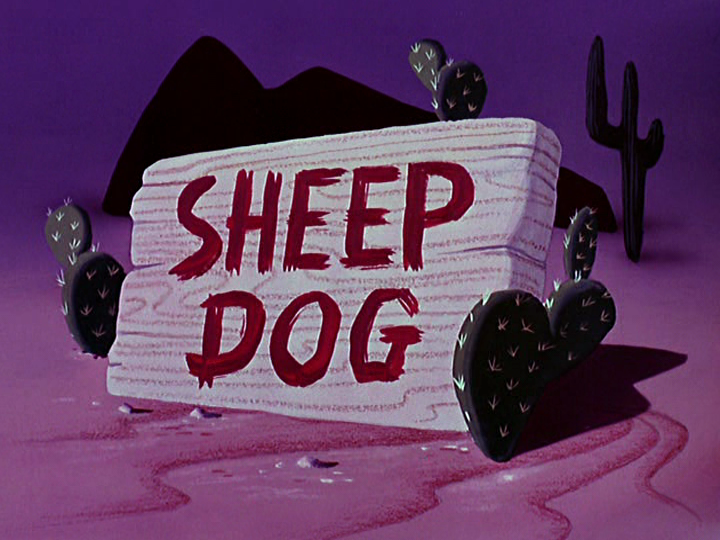
On November 4, 1949, the Pluto short film Sheep Dog was released to theaters. It was directed by Charles Nichols, with story by Eric Gurney and Milt Schaffer.

Pluto is herding his lambs back into their pen for the night, when he hears the cry of a coyote. He makes sure everything is secure before settling down for the night. Meanwhile, the coyote Bent-Tail and his cub are sneaking by, hoping to steal the lambs without Pluto noticing. The cub has a hard time listening to his father, as he is anxious to devour the lambs. Bent-Tail has to reign in Pluto, as the cub thinks Pluto could be a tasty meal as well. As the two sneak past Pluto, Bent-Tail gets the ides to disguise his son as a lamb so he can infiltrate the flock. The cub is able to pull a sleeping lamb to the fence, but wakes the lamb up. The lamb beats up the cub, which starts a chain reaction that ends with Pluto waking up and chasing the coyotes away from the pen.

As another measure of security, Pluto disguises himself as a lamb and settles down next to the flock. The coyotes try again, and the cub pulls Pluto away, thinking he is a giant lamb. Pluto pretends to keep sleeping, and once he is pulled out from under the gate, he chases after Bent-Tail, leaving the cub alone with the rest of the lambs. Pluto is sent on a wild goose chase, which leads back to the farm, where a giant fight breaks out. Bent-Tail manages to make it out with a lamb, and he races up the canyon and back to his cave. Unfortunately, he has only managed to pick up his disguised son, and howls with dismay.

November 3

November 3, 1950 – The Goofy Short Film Hold That Pose is Released to Theaters

vlcsnap-2013-11-03-19h25m49s65

“When the day’s toil is over, are you the type person who drags his weary body home, slumps into a chair feeling beat, bored, bushed, and listless? If so, you need a hobby!”

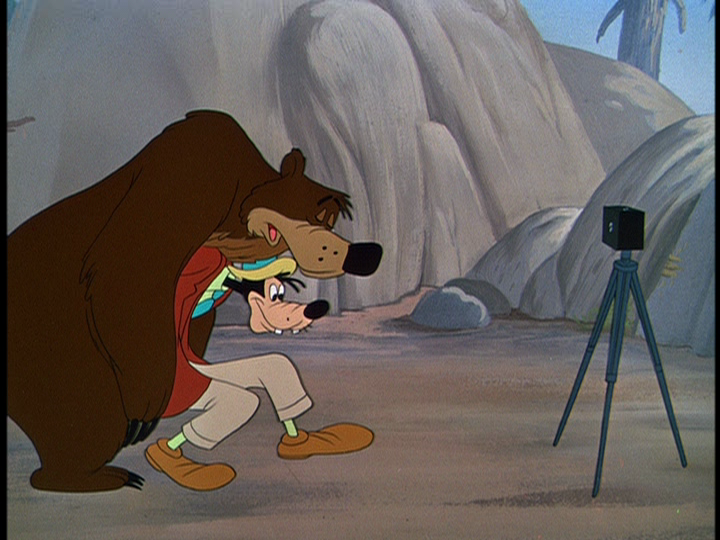
On November 3, 1950, the Goofy short film Hold That Pose was released to theaters. This short marked the first appearance of Humphrey the Bear, who went on to not only be Donald’s nemesis, but have a small series of his own in 1956 with two shorts: Hooked Bear and In the Bag. Hold That Pose was directed by Jack Kinney, with story by Dick Kinney and Milt Schaffer.

The short begins with Goofy falling to the floor after a long day’s work. He crawls into his home and makes his way to his chair while the narrator declares that he needs a hobby. The narrator thinks that Goofy should take up photography, and he soon picks up everything from the photo shop. He takes all the supplies home and creates his own home darkroom, although he electrocutes himself on the red light socket. He spends forever winding his camera roll, but when he finally does, he is able to take his camera outside.

Goofy attempts to prop up the sleeping bear in the bear pit of the zoo for a photo op

Goofy attempts to prop up the sleeping bear in the bear pit of the zoo for a photo op

His first stop is the zoo, where he enters the bear pit, ignoring the signs to keep out. He then attempts to prop up Humphrey the Bear, who is fast asleep, and Humphrey falls on him. He finally gets Humphrey to stand up and stay in place, but for some reason his camera is shooting upside down. When he takes the shot with the flash powder, the powder blows up in Humphrey’s face, and sends Goofy fleeing for his life as Humphrey chases him all over the bear pit. Humphrey escapes the pit, as does Goofy, and continues the chase all over the amusement park. Goofy continues to shoot photos while he runs, even when he boards a taxi driven by Humphrey back to his own apartment. However, in the end, Humphrey and Goofy bond over the photos Goofy has taken, with Humphrey selling autographed pictures of himself for 10 cents.

November 2

November 2, 1997 – Rodgers & Hammerstein’s Cinderella Premieres on The Wonderful World of Disney
vlcsnap-2013-11-02-16h52m43s56

“I doubt if he has any idea how a girl should be treated.” “Like a princess, I suppose.” “No! Like a person, with kindness and respect.”

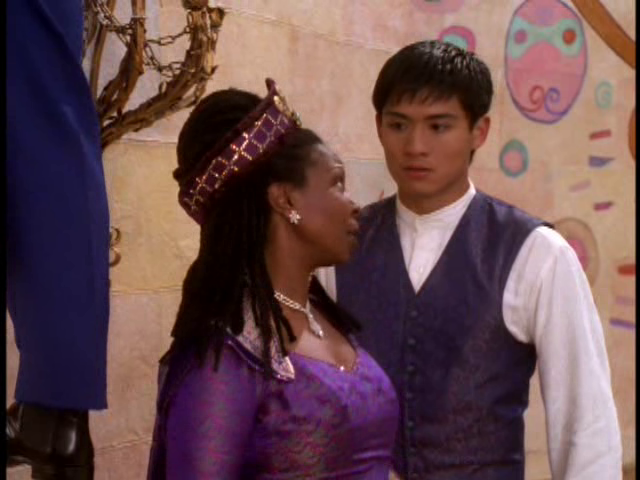
On November 2, 1997, the made-for-television film Rodger’s & Hammerstein’s Cinderella premiered on ABC’s The Wonderful World of Disney programming block. This is the third televised production of the musical, with the first in 1957 with Julie Andrews as Cinderella, and in 1965 with Lesley Ann Warren. This production differed from the first two with the inclusion of three other songs: “The Sweetest Sounds” from No Strings (written by Rodgers), “Falling in Love with Love” from The Boys from Syracuse (written by Rodgers and Hart), and “There’s Music in You” from Main Street to Broadway (written by Rodgers and Hammerstein). The film was ranked number 1 in the ratings for the week of its premiere broadcast, with over 60 million viewers. The film would go on to be nominated for seven Emmy Awards, winning for Outstanding Art Direction for a Variety or Music Program. The film was directed by Robert Iscove, with Whitney Houston given credit as a producer. It starred Brandy as Cinderella, Whitney Houston as the Fairy Godmother, Paolo Montalban as Prince Christopher, Bernadette Peters as the Stepmother, Natalie Desselle-Reid as Minerva, Veanne Cox as Calliope, Whoopi Goldberg as Queen Constantina, Victor Garber as King Maximillian, and Jason Alexander as Lionel.

The story begins in town, with Cinderella following her stepmother and stepsisters with their shopping. She gets distracted by a puppet show about a prince and his princess, and sweet moments between family members and couples that walk about, wishing for a love of her own. A man walks around, just as entranced as Cinderella has been by the tender moments he sees, also longing for his own tender moment with someone special. As she nearly gets run over by a carriage from the palace, he stops to help her, and the two are immediately smitten with each other. He keeps trying to get her attention, but she tries to run away. The two share an awkward moment, as he accidentally offends her, but they realize they share more in common than they realize. She is soon called away by her step-mother, and he tells her he hopes to see her again before he leaves.
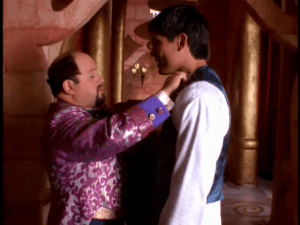
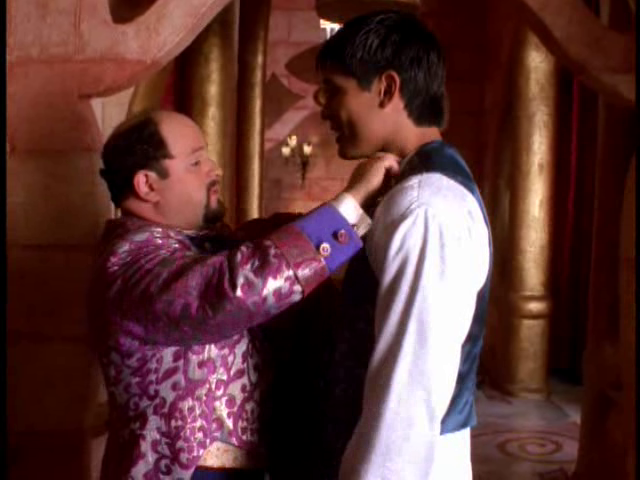
After the prince returns to the palace, his servant Lionel begs him to stop running away and attend to his duties

After the prince returns to the palace, his servant Lionel begs him to stop running away and attend to his duties

The stranger turns out to be Prince Christopher, who has a habit of escaping the palace in disguise as a regular person to explore his kingdom. His servant Lionel discourages him every time, and doesn’t understand why the prince doesn’t want to be a prince. Christopher goes to see his mother and father, who decide to throw him a ball, although Christopher doesn’t want another ball. They believe it’s time he chose a bride and had an heir. He begs them to let him pick his own bride, and fall in love naturally. He leaves again, and the king and queen continue planning the ball. Lionel and members of the palace head to town to announce that the Prince is giving a ball. The town is all abuzz with the news, and start the preparations.

Cinderella and her family arrive home after hearing the news, and her family starts bullying her again, with the step-mother claiming she has “too big a heart” for keeping Cinderella after her father died, as most people told her she should have thrown her out into the street. Cinderella gathers her courage and asks her step-mother to attend the ball, but her stepmother tells her she can’t go, that she should “know her place.” Dejected, she goes into the kitchen to prepare the things her stepsisters demanded, going off into her own daydreams, where she could be all that she wants to be.
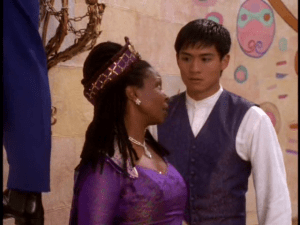
Although Christopher is angry that his mother went ahead and planned the ball behind his back, she refuses to cancel

Although Christopher is angry that his mother went ahead and planned the ball behind his back, she refuses to cancel

Back at the palace, Christopher tries once again to get his mother to cancel the ball, but she refuses. Lionel comes up with the perfect solution: if the prince does not find a bride at the ball, he is allowed to fall in love his own way, in his own time. Christopher and his father agree to the plan, but the queen is less certain of the plan. In Cinderella’s house, the stepmother is helping her daughters primp for the ball, much to their pain and dismay, as their mother’s motto is “beauty knows no pain.” She is certain the prince will pick either Minerva or Calliope as his bride. When Cinderella expresses her opinion of a man loving a woman despite her flaws, the stepmother calls her quaint. The stepsisters are captivated by Cinderella’s idea of love, but the stepmother declares that there’s a huge difference between love and marriage.

As they head out to the ball, Cinderella is left behind, upset that she will be unable to attend, although she tries to convince herself otherwise. She makes a wish to go to the ball, and her fairy godmother suddenly appears at her window, although she mocks her for her dreams, saying dreamers are crazy. When Cinderella says that she’s always dreamed someone would take her away, her fairy godmother says that she’ll have to go about it herself, to not rely on her dreams but to take action. Cinderella then makes a wish to go to the ball, but then says it’s impossible. The fairy godmother then tells her impossible things happen every day by those who believe in the impossible, and sets about to make her dream come true, including a beautiful dress. She warns her, however, that the magic only lasts until midnight, and sends her on her way to the ball.
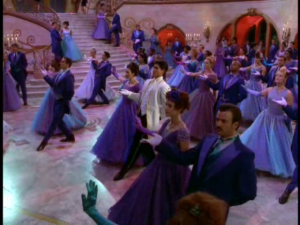
The prince dances with the girls, but is hardly impressed with any of them

The prince dances with the girls, but is hardly impressed with any of them

At the ball, Christopher is already bored, as he hasn’t met one interesting girl yet. The queen believes that he will meet someone tonight, but the king is not so certain. The stepmother tries to seduce Lionel to get her daughters to dance with the prince, but Lionel rebuffs her advances. Minerva gets a chance, but quickly blows it, as does Calliope. Christopher has Lionel speed up the music so he can get the ball over with as fast as possible. Cinderella soon arrives at the ball, and her fairy godmother gives her reassurance that she can handle this, and that she will have to handle it on her own if she wants her wish to come true. Once she enters the ballroom, the prince stops, smitten on first sight. The two begin to dance, much to the amazement of all attendees, who wonder who she is.

Christopher and Cinderella dance their way out into the courtyard, unaware that they’re being watched by Minerva and Calliope, who want to know why the prince would choose her over them. The stepmother, who thinks that Cinderella looks vaguely familiar, tries to get close to her to discover who she is. When the queen asks Cinderella if they know her mother and father, Cinderella suddenly gets frightened and flees, and asks her fairy godmother to leave. The fairy godmother accuses Cinderella of giving up. Christopher follows her out, and the two continue talking, with Christopher admitting that he never wanted to attend in the first place. He then tells her that he knows she’s the one, and able to be himself for the first time. The two share a kiss before the clock strikes midnight, and she suddenly rushes away. Although he chases after her, he is unable to find her, other than the shoe she left on the steps of the palace.
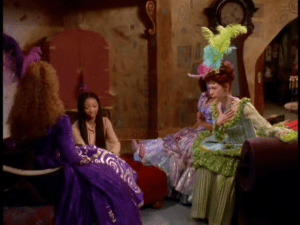
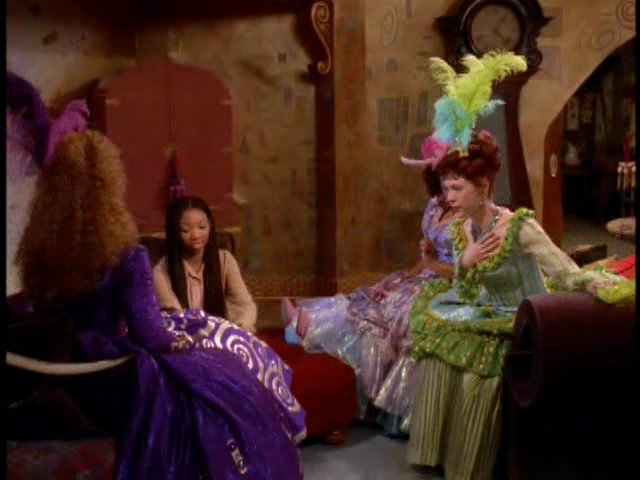
As she tends to her stepfamily, Cinderella asks them questions about the ball

As she tends to her stepfamily, Cinderella asks them questions about the ball

Cinderella dashes through the empty streets, making it back just in time before her family arrives home from the ball. She asks them for details, including details of a “princess” that danced with the prince. She tells them of her dream of the ball, and the stepmother says that she talks as if she was there. As she continues explaining her “dream,” the stepsisters are smitten with her imagination, and the stepmother suddenly realizes that Cinderella was the mysterious woman at the ball. The stepmother suddenly calls it all nonsense, and calls Cinderella nothing but common, and starts insulting her father. Cinderella heads out into the garden and starts talking to her deceased father. Although she promised him to stay and take care of the family, she realizes she can no longer stay and be abused. Her fairy godmother appears, and tells Cinderella that he should know who she is, if she truly loves him. She reassures her that he fell in love with her, not her dress.

Christopher refuses to give up his search for her, and his mother is concerned, wondering if she is really as wonderful as she seems. He believes that she is the one that he needs, and his father tells him to look for as long as it takes. Christopher, with the help of Lionel, decide to search every inch of the kingdom, and try the glass slipper on every maiden’s foot in the kingdom. When they arrive at Cinderella’s house, Calliope and Minerva both fail the test, and the stepmother locks Cinderella in the kitchen. The stepmother then decides to try the shoe on herself, and the shoe fits, although it is too tight of a fit that cuts off her circulation. The prince then asks if there’s anyone else, and while the family tries to hide Cinderella, Lionel opens the kitchen doors, although no one is inside. Saddened, Christopher leaves. As he steps outside, he sees Cinderella once again, spooked by the horses as she tries to run away. She recognizes his voice from the stranger she met in the market, and he has her try on the shoe. Realizing it fits, the two share a kiss. The film ends with the wedding of Cinderella and Christopher, with the whole town celebrating their union.
October 24

October 24, 1994 – The Animated Series Gargoyles Premieres in Disney Afternoon

gargoyles

“One thousand years ago, superstition and the sword rules. It was a time of darkness. It was a world of fear. It was the age of gargoyles.”

On October 24, 1994, the animated series Gargoyles premiered on television in the Disney Afternoon programming block. The series was about a clan of nocturnal creatures known as gargoyles, who turn to stone during the day. After being betrayed, members of the clan are cursed to stay in stone until the castle “rises above the clouds.” In present day, the gargoyles are reawakened when the castle they live is taken to New York and reconstructed atop a billionaire’s skyscraper. The six remaining gargoyles try to adjust to life in modern New York, aided by NYPD detective Elisa Maza, and come into conflict with David Xanatos. 3 seasons, with 78 episodes, aired overall, with the first two seasons airing in the Disney Afternoon, and the third and final season airing on ABC’s One Saturday Morning. The cast included Keith David as Goliath, Edward Asner as Hudson, Salli Richardson as Elisa Maza, Jonathan Frakes as David Xanatos, Marina Sirtis as Demona, and Bill Fagerbakke as Broadway.

October 23

October 23, 1953 – The Donald Duck Short Film Rugged Bear is Released to Theaters

vlcsnap-2013-10-23-18h21m34s193

“This is Bear Country: a quiet, peaceful part of the forest reserved exclusively for Mr. Bear.”

On October 23, 1953, the Donald Duck short film Rugged Bear was released to theaters. This marked the second appearance of Humphrey the Bear overall, and the second of five appearances in Donald Duck short films. The short was directed by Jack Hannah, with story by Al Bertino and Dave Detiege.

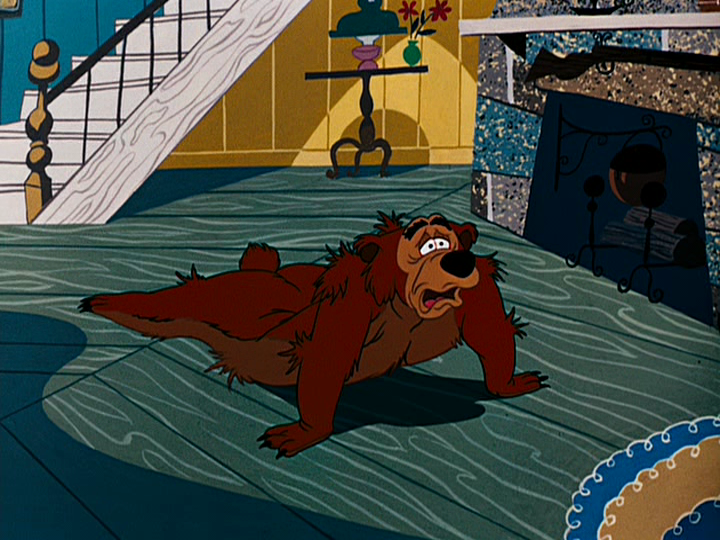
The short begins at a section of the forest for Bear Country, with dozens of bears sleeping soundly. The bears are alerted by the narrator that hunting season has begun, and while they all flee to their cave, Humphrey the Bear continues to sleep. He is soon woken up by flying bullets, and is locked out of the cave when all the other bears seal themselves inside. Humphrey runs crazily around the woods, dodging hunters, and comes across a house in the woods. Once inside, he realizes he’s in a hunting cabin, with guns and stuffed bear heads on the walls. As he tries to escape, he sees Donald walking to the house, holding a shot gun. He frantically tries to hide, and disguises himself as a bearskin rug.

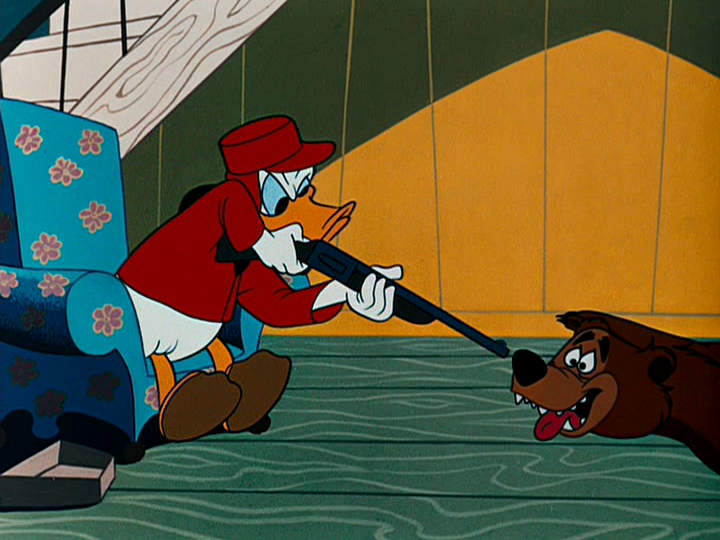
Donald pretends to shoot his bearskin rug, making his "rug" rather nervous

Donald pretends to shoot his bearskin rug, making his “rug” rather nervous

Donald wipes his feet on the nervous bear’s back, and as he sits to clean his shotgun, he pretends to shoot the rug, which causes Humphrey to nearly panic. As Donald decides to light a fire in the fireplace, he uses Humphrey’s nose to light his match. Humphrey barely suppresses a yelp, and when he looks behind him to see where Donald (and, more importantly, the gun) is, he gets his nose stuck in the barrel and has to quietly follow Donald through the house. He manages to free himself when the kitchen door is slammed in his face, and when he tries to sneak away, he finds that hunting season is still occurring, and has to stay inside to stay safe.

Donald returns from getting his snack, and sits on Humphrey’s back in front of the fire. After swallowing a stray bit of Donald’s popcorn, Humphrey gets the hiccups; fortunately, Donald thinks he has the hiccups instead of his rug. After getting a drink of water, Donald returns and decides to take a nap on his rug. A stray spark from the fire jumps out and lands on Humphrey’s back, and he catches on fire, but he masks his scream by turning up the radio, waking Donald, who quickly puts the fire out. Seeing the mess this caused, Donald throws Humphrey into the washing machine. Poor Humphrey emerges after the dry cycle as a giant fur ball, which Donald remedies by cutting off his hair with a yard trimmer. Donald then curls himself up in the rug to fall asleep, much to Humphrey’s dismay.

Humphrey is relieved that Donald has left for the season

Humphrey is relieved that Donald has left for the season

Hunting season soon ends, and the bears clean up the mess the hunters left behind. Donald leaves his hunting cabin, and Humphrey, looking more than a little worse for wear, is relieved that he can finally escape. He hears a strange knocking from the wood box near the fireplace, and is surprised to find that the bear rug he’d rolled up and replaced at the beginning of the season was, in fact, another live bear, who thanks Humphrey for hiding him and taking his place. Humphrey looks at the camera with bloodshot eyes, a look of disbelief on his face.

October 14

October 14, 1938 – The Silly Symphony Farmyard Symphony is Released to Theaters

vlcsnap-2013-10-14-20h15m41s85

“How are ya, toots?”

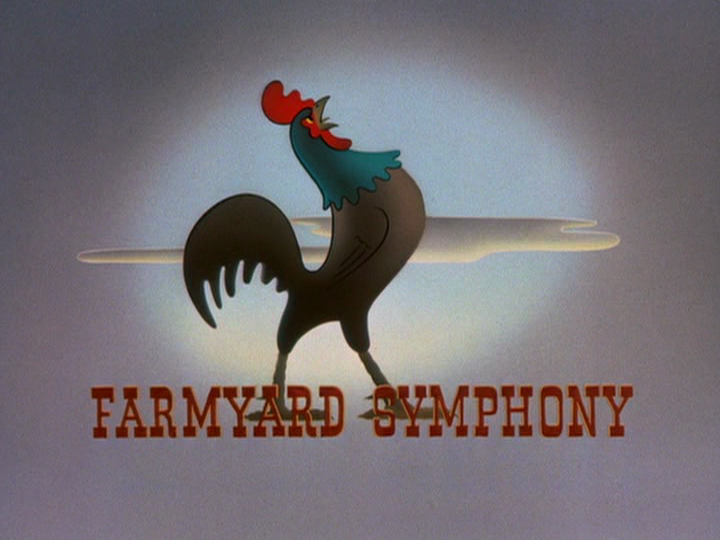
On October 14, 1938, the Silly Symphony Farmyard Symphony was released to theaters. It was based on the story of Chanticleer the rooster, a staple in Middle Ages folklore. Interstingly enough, stories of Chanticleer are usually told with Reynard the Fox, a character that the Disney Studios were looking to make a movie about, which eventually led the way to the 1973 film Robin Hood. The songs featured in this film is “La Donna E’mobile” from the opera Rigoletto by Giuseppe Verdi, “The William Tell Overture” by Gioachino Rossini, and Franz Liszt’s Hungarian Rhapsody. The film was directed by Jack Cutting.

The morning breaks over a pleasant farm, and a rooster is heard crowing with the dawn. Doves exit their nest, a bull scratches his back on a fencepost, and other animals wake up to greet the day. As a calf drinks from his mother’s udder, a baby pig, unable to get milk from his own mother, runs to hopefully get some milk. The claf scares the poor pig away, sending him running into the horse pen. The calf and the foal start running around together, until they spy some geese marching to the barn. The rooster crows again, although he has some trouble crowing to begin with. He marches around his domain as the literal cock of the walk, until he hears the hens snoring. He sneaks into the hen house and lets out a loud crow, waking them with a startle.

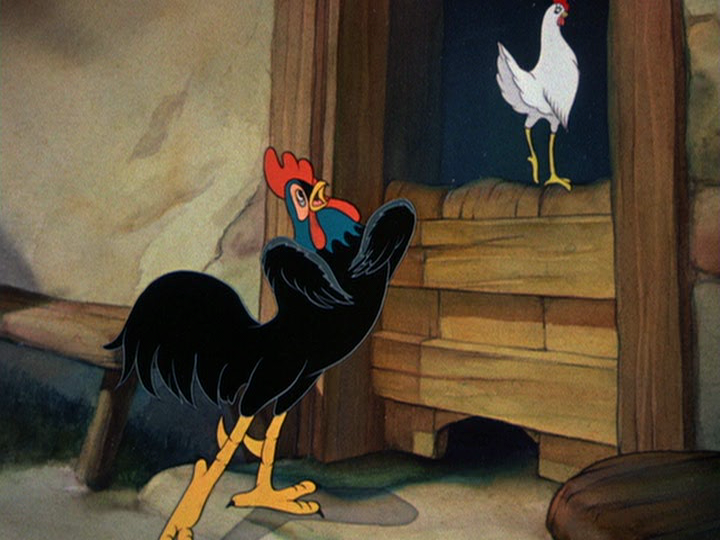
The rooster woos the hen with some serenading

The rooster woos the hen with some serenading

The rooster is attracted to one of the hens, who flirts with him not-so-subtly, but she also flees from his rather pushy nature of running after her. He then serenades her, and the two end up serenading the farm with a duet, with the whole farm eventually joining in. The opera is interrupted by the farmer and his wife calling the animals for feeding time. The baby pig from the beginning is once again unable to get food, and runs around the farm, trying to find a way to get something to eat, but is chased off by all the animals he encounters. He runs into a building, and knocks out all the corn inside, which is soon eaten the baby pig and all of the chicks.

October 5

October 5, 1949 – The 11th Disney Animated Feature Film, The Adventures of Ichabod and Mr. Toad, is Released to Theaters

vlcsnap-2013-10-05-17h16m12s116

“If you were asked to choose the most fabulous character in English literature, who would it be?”

On October 5, 1949, the 11th Disney animated feature film, The Adventures of Ichabod and Mr. Toad, was released to theaters. This was the sixth and final package film released by the studios, until 1977’s The Many Adventures of Winnie the Pooh. The two stories featured in this film were based on The Legend of Sleepy Hollow by Washington Irving, and The Wind in the Willows by Kenneth Grahame; the former was narrated by Bing Crosby, while the latter was narrated by Basil Rathbone. Due to the studios financial situation at the time, expenses were kept down on the film by reusing animation from earlier shorts and films, including the 1937 Silly Symphony The Old Mill. The two parts of the film were originally released separately when released on home video, but were finally combined into the complete feature once again starting with the laserdisc release in 1992. The film was directed by Jack Kinney, Clyde Geronimi, and James Algar, with story by Erdman Penner, Winston Hibler, Joe Rinaldi, Ted Sears, Homer Brightman, and Harry Reeves.

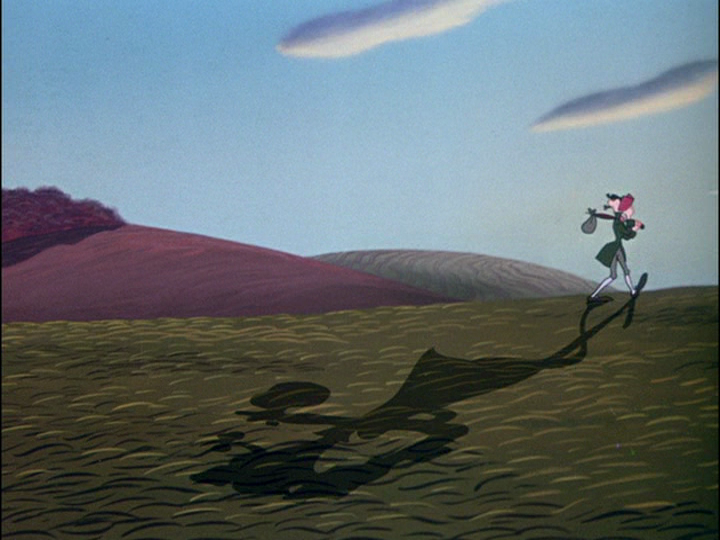
The film opens in a library, with the Basil Rathbone taking the audience through a list of fabulous characters in English literature, before introducing his choice: J. Thaddeus Toad, Esquire. Toad was an incurable adventurer, who only had three friends looking out for him: MacBadger, Mole, and Rat. This certain story begins with Mole being late for tea with Rat, when there is a knock at the door for Rat. He receives a special letter from MacBadger, who requests their presence at Toad Hall. Believing that Toad is once again up to trouble, they arrive to find a frazzled MacBadger, who had been working to put Toad’s affairs in order, as his adventures are driving Toad close to bankruptcy. MacBadger convinces the two of them to stop Toad from his new folly: parading around the countryside with a yellow gypsy cart and a horse named Cyril. When Rat and Mole try to convince Toad to give up his reckless behavior, Toad attempts to flee, when he comes across his new mania: a motor car.

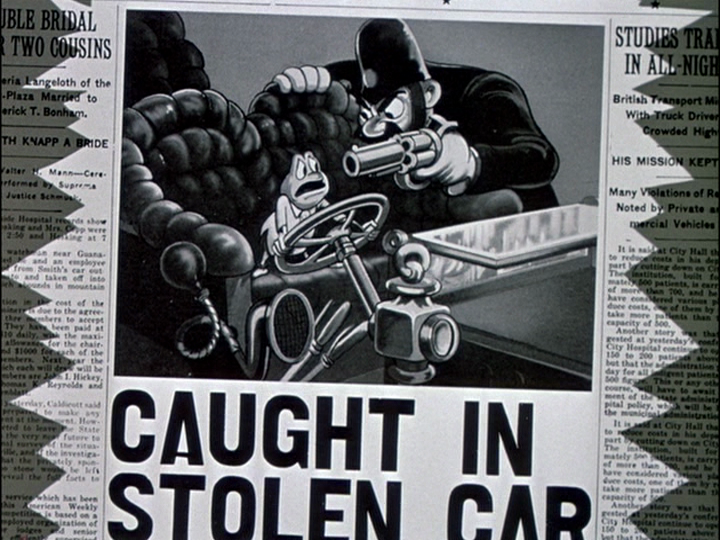
After a drastic attempt to feed his new mania, Toad is found and arrested for driving a stolen car

After a drastic attempt to feed his new mania, Toad is found and arrested for driving a stolen car

Rat and Mole take Toad back to Toad Hall and lock him in his room, keeping him there until the mania passes. That night, Toad sneaks out of the window and steals a motor car, and is promptly arrested. He is taken to court, where he defends himself. Cyril testifies that Toad headed to his place that night, and the two were walking when they saw the motorcar. It parked at a nearby pub, where the weasels driving the car exit. Toad goes inside the pub to buy the car from the weasels, not knowing that the car has been stolen. To pay for the car, he drew up a paper that signed over the deed to Toad Hall. The bartender arrives, tells the court that Toad tried to sell him a stolen motorcar, and Toad is promptly arrested. Around Christmas, Toad is seen serving his sentence in the Tower of London, and vows never to attempt such reckless behavior again. Cyril arrives to help Toad break out of jail, and soon the alarm sounds that Toad has escaped. The police are sent out all over London to find Toad, who is dressed as an old woman. He then boards a train and steals it, attempting to flee. He then jumps the train and lands in the river, but is weighed down by the ball and chain around his ankle.

Rat and Mole are the only people in England that remember Toad fondly, and are surprised to find Toad at their door. When there’s a knock at Rat’s door, Toad asks Rat to hide him, but they find MacBadger at the door. He tells them that Toad Hall has been taken over by the bartender, named Winkie, and the weasels; Winkie had lied on the stand, and Toad is completely innocent. MacBadger comes up with a plan to get the deed from Winkie to prove Toad’s innocence to the court. The four enter Toad Hall stealthily, and while Mole manages to grab the deed from the sleeping Winkie, their plot is foiled by a weasel watchman. A chase ensues around the hall for the deed, and the four manage to make it out of the Hall with the deed. Toad is exonerated, and he vows to be a new Toad, but this doesn’t last, as he shows off his new mania at the end: the airplane.

Bing Crosby narrates while introducing the story of the peculiar schoolteacher, Ichabod Crane

Bing Crosby narrates while introducing the story of the peculiar schoolteacher, Ichabod Crane

Bing Crosby then introduces the character of schoolmaster Ichabod Crane, who he describes as a “scarecrow eloped from a cornfield.” A group of men known as the Sleepy Hollow Boys are seen hanging out at the nearby pub, led by Brom Bones, and they notice Ichabod heading into town. Ichabod’s only weakness is food, and treats those students with great cooks for mothers with favor. He also improves his social standing by joining several societies, including the women’s choral society, where he plays the piano. Brom, who liked to cause mischief, decides to play pranks on Ichabod, although Ichabod doesn’t really mind. However, when Ichabod sets his eyes on Katrina van Tassel, daughter of the richest farmer in the county, Brom ups his pranks, seeing him as his rival.

Katrina invites Ichabod personally to a party at her father’s home for Halloween, and he is excited at the prospect of being Katrina’s beau, much to Brom’s annoyance. Brom then comes up with a plan to get Katrina away from dancing with Ichabod, but Ichabod is able to reclaim Katrina. No matter what Brom does, he is unable to best Ichabod for Katrina’s affections. At midnight, the guests begin to tell ghost stories. Brom realizes that this is his chance, as Ichabod is one of the most superstitious people he knows, believing in the existence of ghosts and spirits. Brom then tells the story of the Headless Horseman, which spooks Ichabod terribly. On his way home, he tries to calm himself by whistling, but is scared by the simplest of things in the woods. At one point, he hears the clattering of another horse’s footsteps, but soon realizes it’s just reeds hitting a log. Nearly driven mad with his worries, he and his horse laugh at his folly, until they hear maniacal laughter nearby, and spot the actual Headless Horseman. Ichabod tries to flee to the bridge, which the Horseman is unable to cross; although Ichabod crossed the bridge, the next morning, all that the townspeople could find was Ichabod’s hat near the bridge, and a shattered pumpkin. Soon after, Brom and Katrina were married, and the townspeople had a new legend.

September 28

September 28, 1935 – The Mickey Mouse Short Film On Ice is Released to Theaters

vlcsnap-2013-09-28-20h40m49s41

“It’s a cinch! Watch me!”

On September 28, 1935, the Mickey Mouse short film On Ice was released to theaters. Clarabelle Cow and Horace Horsecollar make a brief appearance at the beginning of this short; Goofy also sings a snippet of his theme song, “The World Owes Me a Living.” It was directed by Ben Sharpsteen.

Everyone is skating at the nearby frozen river, and as Minnie and Mickey skate together, Mickey keeps a pillow ready for Minnie, as she keeps falling. Mickey then shows off for Minnie, although she warns him to be careful as he trips on a barrel and falls through the ice, but he is able to laugh off the incident. Goofy finds a spot on the river to go ice fishing, using chewing tobacco as bait. The fish chew the tobacco, and as they jump to spit in the spittoon, he attempts to club them. Unfortuantely, one of the fish takes his club and clubs Goofy.

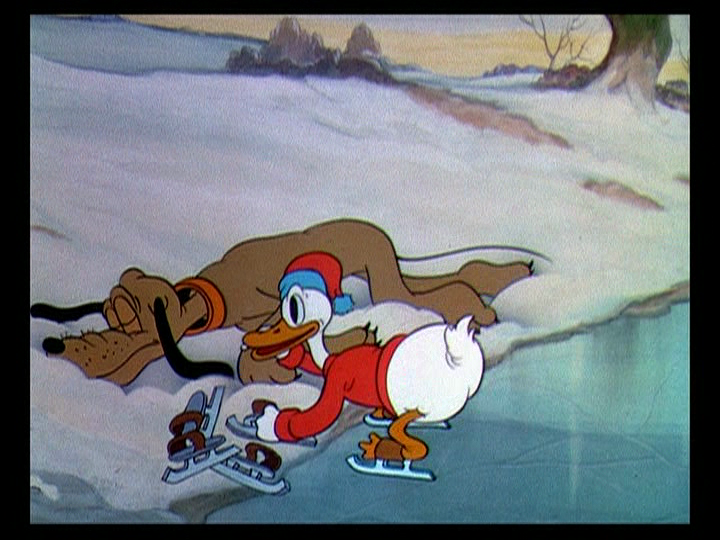
Donald takes skates and ties them to the sleeping Pluto's feet

Donald takes skates and ties them to the sleeping Pluto’s feet

Donald, meanwhile is skating along, when he spies Pluto sleeping on the bank. He decides to play a prank on the dog by placing ice skates on his feet. He then hides and makes cat noises, waking Pluto and sending him flying out on the ice, only to slip and fall thanks to the skates. Donald laughs at Pluto’s misfortune, but Pluto endeavors to master the skates. At one point, Pluto sneezes hard enough to send himself flying into the campfire on the bank, and puts his end into a hole in the ice to cool down. When he removes his tail, he finds that it is completely frozen, and starts chasing it.

Donald attaches himself to a kite and skates around Pluto, mocking him, when a strong wind picks up and sends Donald flying down the pond, and he cries out for help. Mickey spots Donald heading towards a waterfall, and races to save the duck. Mickey is pulled off the ice and scrambles to return to shore, but loses Donald, who sails back into the river and straight into the hole where Goofy is waiting to club fish. Goofy apologizes, stating that he thought Donald was a fish, and Donald angrily yells at Goofy and Pluto, who barks at the duck’s misfortune.