RSS Feed

Tag Archives: Color

September 26

September 26, 1936 – The Silly Symphony Three Blind Mouseketeers is Released to Theaters

vlcsnap-2013-09-26-19h01m35s40

“My traps are set in every room; those mice are marching to their doom. This is the end of the Three Mouseketeers!”

On September 26, 1936, the Silly Symphony Three Blind Mouseketeers was released to theaters. It was directed by Dave Hand

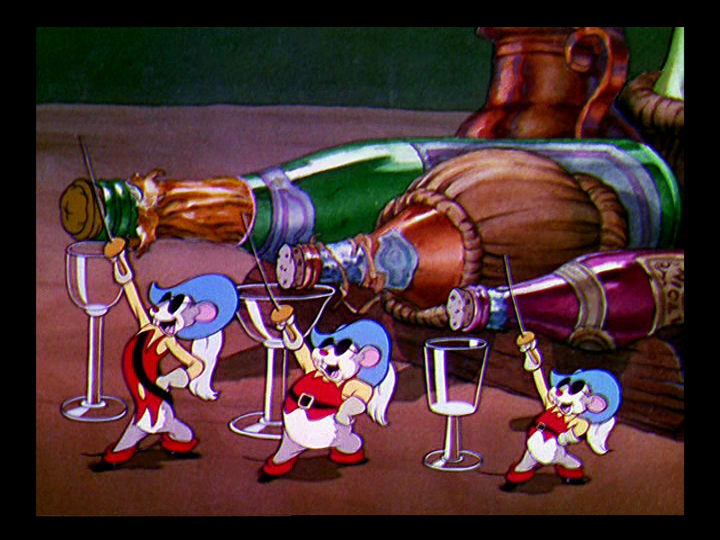
The Three Blind Mouseketeers introduce themselves in song, dancing around and practicing their fencing. They decide to head to the banquet hall to get some cheese, but don’t realize that the evil Captain Katt has set up several traps for them and is hiding in a barrel as he waits for his victory. The three narrowly miss the first trap set in front of the hole in the wall, and separately spring the other traps while retrieving the food, narrowly missing being killed every time. They manage to get away with all off the food, with Captain Katt sleeping in his hiding place, unaware of their victory.

The mice are ready to open champagne, unaware that Captain Katt is sleeping nearby

The mice are ready to open champagne, unaware that Captain Katt is sleeping nearby

As the mice pop open the champagne in victory, they wake Captain Katt, pelting him with the corks from the bottles. He sneaks over to attack the three, and the mice scatter, with one getting trapped under a bowl. Captain Katt then tries to find the mouse under one of the three bowls in front of him, but is unable to. When he finally does, the mouse stabs him in the nose, infuriating him. When he finds that a mouse has been hiding under each one, he goes crazy and chases after them with a hatchet. One of the mice gets his tail stuck in the floor, but is able to use his reflection on a pile of bottles in front of him to make it appear that he has a giant Mouseketeer army at his disposal. Captain Katt is scared away from the banquet hall, and lands in each of his traps as he tries to flee.

September 22

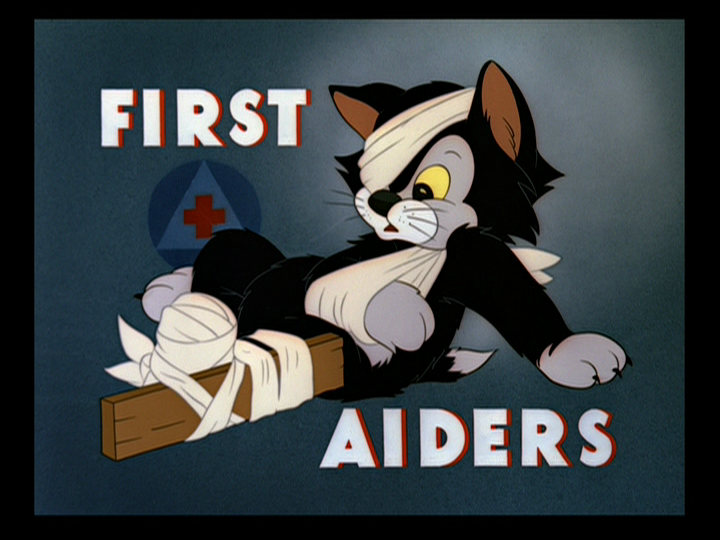
September 22, 1944 – The Pluto Short Film First Aiders is Released to Theaters

vlcsnap-2013-09-22-17h55m20s86

“Now, don’t you two get into any trouble while I’m gone.”

On September 22, 1944, the Pluto short film First Aiders was released to theaters. This short features an appearance of Figaro the cat from Pinocchio; thanks to his popularity, he would also have three shorts in a series of his own. The short was directed by Charles Nichols, with story by Harry Reeves and Rex Cox.

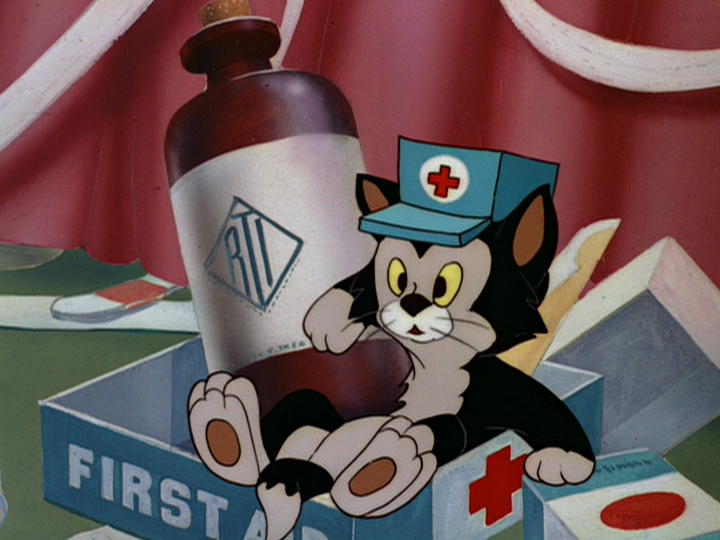
Minnie is reading a first aid manual, trying to create a cravat bandage on her own eye. Pluto uses his own ears to bandage himself as he hears Minnie read out the directions. Minnie’s efforts on herself fail, however, and she asks Figaro and Pluto if one of them would like to help her. Pluto volunteers, as does Figaro, although Pluto is able to push the kitten away into a wash bucket. Minnie then blames Figaro for the mess, and starts to work with Pluto, asking him to hold a bandage. The bandage rolls from Pluto’s mouth, and Figaro chases after the strip, attempting to bring it back to Minnie. As Pluto and Figaro play tug-of-war, Figaro is sent flying across the room into the first aid kit. Minnie once again blames Figaro for the mess.

Figaro gets thrown into the first aid kit, and is blamed for making a mess

Figaro gets thrown into the first aid kit, and is blamed for making a mess

Minnie then attempts to learn about artificial respiration with Pluto as her partner. Pluto lets out large amounts of air as she does so, and accidentally ends up with a cork from a nearby bottle of smelling salts in his mouth. He breathes in the smelling salts uncomfortably, but is unable to breathe out due to the cork. As Figaro laughs at Pluto’s predicament, the cork finally bursts out from Pluto’s mouth, hitting the kitten in the backside. As Minnie’s practice continues, she starts using splints and bandages. As she has him completely splinted, she has to go out and get more bandages. She asks the two to stay out of trouble, and Figaro angelically agrees until Minnie close the door. The kitten then begins to taunt Pluto, who is barely able to stand as he is in the splints. Figaro continues his torture, although he ends up getting beaten up slightly. As they escape outside, Pluto is able to break free of the splints, and the two chase each other around the house. Minnie returns from the store and, seeing Pluto is hurt, begins to use her first aid skills to tend to the dog. Figaro laughs from the stairs, but ends up falling into the splint, bandaged tight. The two end the short making nice, only because Minnie asked them.

September 21

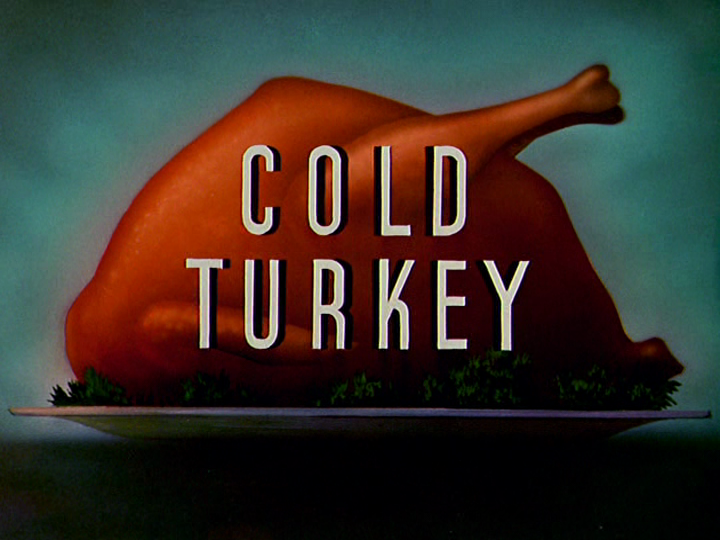
September 21, 1951 – The Pluto Short Film Cold Turkey is Released to Theaters

vlcsnap-2013-09-21-18h16m55s156

“Lurkey’s Turkeys hot, Lurkey’s Turkeys cold, Lurkey’s Turkeys taste good nine days old!”

On September 21, 1951, the Pluto short film Cold Turkey was released to theaters. This is one of three shorts that also stars Milton, the cat nemesis of Pluto, with the others being Puss Cafe and Plutopia. this short also features the famous “Goofy Yell,” performed at a higher pitch by Milton. The short was directed by Charles Nichols, with story by Leo Salkin and Al Bertino.

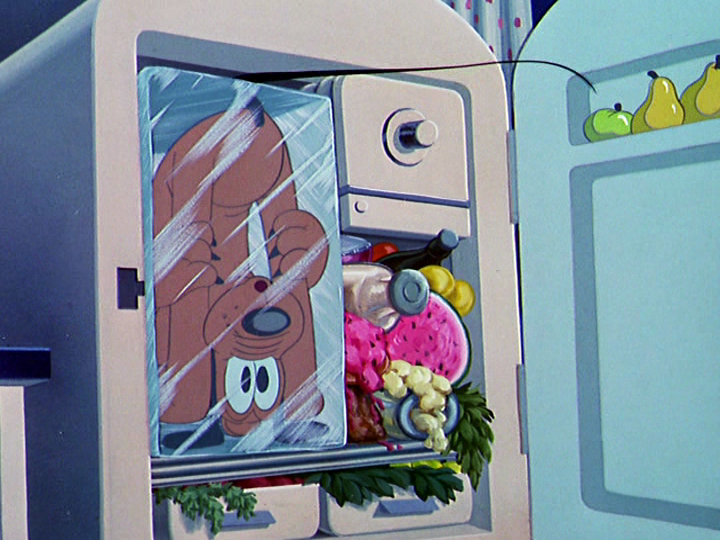
Pluto and Milton are sleeping as a boxing match is being played on the television, when they are woken up by a Lurkey’s Turkeys ad. Craving turkey, the two start searching for turkey, unaware that they will not find it in the television. After receiving a good shock, they realize that they should check the kitchen, as the ad suggests, and start searching every crevice. The two work together to launch Milton up to the cabinet, but the plan goes awry, with Milton being launched into the fridge instead. After he opens up the fridge door, the two find the turkey, but stop working together and end up frighting over it. Pluto ends up closing Milton in the fridge, but the cat escapes with the turkey, closing Pluto in the fridge in retaliation.

Pluto finds himself frozen in the fridge after Milton traps him

Pluto finds himself frozen in the fridge after Milton traps him

Pluto manages to escape the fridge and defrost, and finds Milton trying to cook the turkey over the heating vent. Pluto chases Milton into the television set, where he tries to fry the poor cat, and also starts cooking the turkey. As Milton flees to cool off, Pluto smells something burning, and the two quickly pull the turkey out, although neither can hold onto it for very long, as it has turned red from the heat. The turkey cools and immediately turns black before disintegrating, bones and all. The two stare at the turkey, and start accusing each other of destroying their food. They then mirror the boxing match announcements on television as they start to fight.

September 19

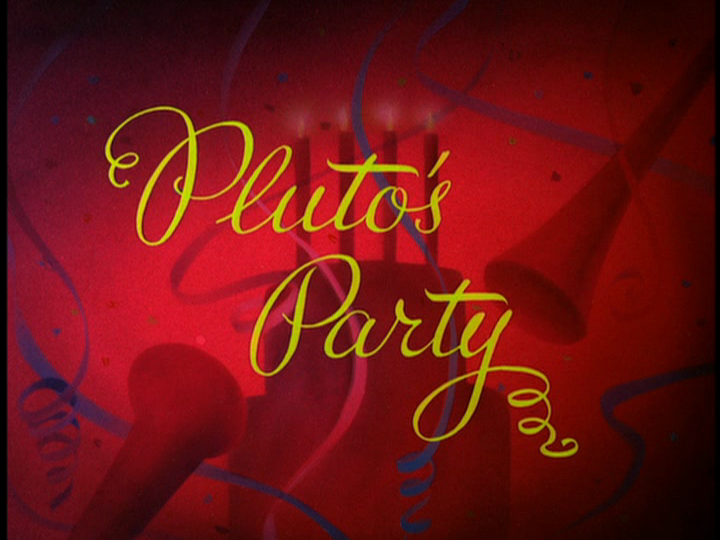
September 19, 1952 – The Mickey Mouse Short Film Pluto’s Party is Released to Theaters

vlcsnap-2013-09-19-03h21m11s223

“Pluto! Come down here! You’re playing too rough!”

On September 19, 1952, the Mickey Mouse short film Pluto’s Party was released to theaters. This is the only short since the 1930s that features Mickey’s nephews. It was directed by Milt Schaffer, with story by Bill Berg and Leo Salkin.

Mickey is coming out of his house with a giant cake, with Pluto trailing not too far behind. It’s revealed to be a birthday cake for Pluto, as it’s the dog’s birthday. As Pluto tries to sneak a bite of the cake, Mickey calls him out, reminding him that he has to take a bath first. Pluto sulks, and tries to sneak away, but is tricked by Mickey into lading into the washbucket. After his bath, he sits at the table again, wearing a fancy collar, and once again tries to steal some cake. Mickey once again calls him out, telling him to wait for his little guests. Pluto pouts, but soon hears the knocking at the garden gate, and rushes over happily.

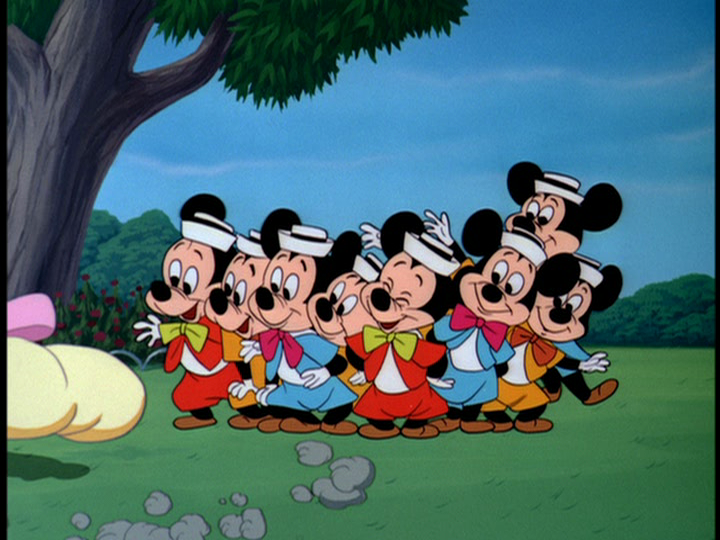
All of Mickey's nephews arrive for the party, bringing Pluto a large bone-shaped present

All of Mickey’s nephews arrive for the party, bringing Pluto a large bone-shaped present

All of Mickey’s nephews rush in excitedly, knocking poor Pluto flat. They bring him what looks like a giant bone for his birthday, and he happily licks them all in turn. When he opens the package, however, it is revealed to be a little red wagon instead. The nephews attach the wagon to Pluto’s collar and try to make him pull them across the yard. They all leave the wagon, distracted by something else, sending Pluto flying towards the cake, which Mickey saves before Pluto can swipe at it, and he ends up crashing into a tree. The nephews start having “fun” with Pluto, torturing the poor dog, alhtough Mickey admonishes the dog for “playing too rough.”

Mickey then has the boys engaged in a game of “Pin the Tail on Pluto.” When it’s Pluto’s turn, one of the boys grabs Pluto by the tail and spins him fast enough that Pluto can’t stand up, let alone walk straight. He ends up wrapped around a tree and, after peeking, thinks he can easily pin the tail on the picture; he doesn’t realize that his own body is perfectly blocking the picture. Pluto then accidentally stabs himself, and flies towards the picture in pain, perfectly placing the tail on the picture, winning the game. Soon after, Mickey calls everyone over for cake, and Pluto is told to make a wish. Pluto then wishes for all the nephews to disappear. After he blows out the candles, the cake suddenly disappears into the mouths of the nephews, leaving Pluto without a slice, and the nephews quickly leave, declaring the party to be over. Poor Pluto is dismayed to find he didn’t get any cake, until Mickey surprises him with the last piece. Pluto gratefully licks Mickey in-between bites of cake.

September 16

September 16, 1933 – The Silly Symphony The Pied Piper is Released to Theaters

vlcsnap-2013-09-16-19h29m13s195

“In the town of Hamelin, many years ago, the citizens were crying out a tearful tale of woe…”

On September 16, 1933, the Silly Symphony The Pied Piper was released to theaters. The short is based on the German tale The Pied Piper of Hamelin, which has been written by the likes of the Brothers Grimm and Robert Browning. The short was directed by Wilfred Jackson, and the score was done by Leigh Harline.

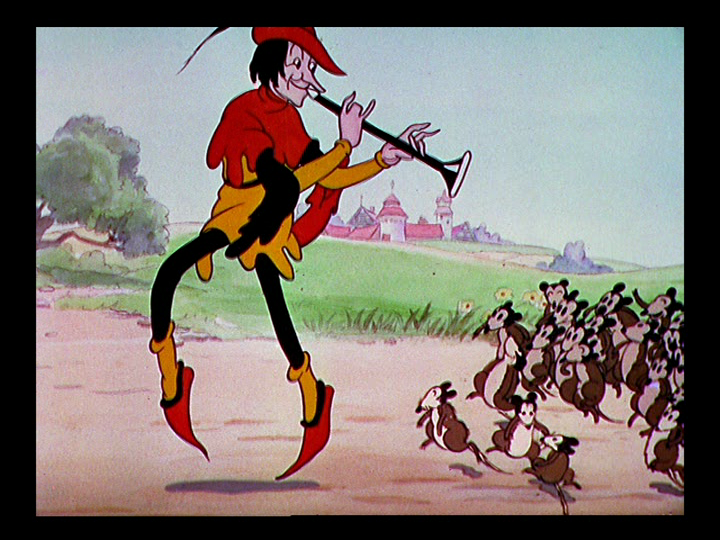
The short begins in the German town of Hamelin, which is under an infestation of rats. The people try all sorts of means to rid themselves of the rats, but to no avail, and the rats begin to devour every bit of food they can find. The citizens complain to the mayor, who agrees that they must get rid of the infestation. As he declares that he will give a large sack of gold to anyone who can get rid of the rats, a Pied Piper, who has just strolled into town, takes on the challenge. The mayor promises him the gold, and the Piper begins to play his instrument. The rats, mesmerized by the tune, follow him away from the town, dancing happily.

The Piper takes the rats skipping out of town, thanks to his magic pipe

The Piper takes the rats skipping out of town, thanks to his magic pipe

The people cheer as he sends the rats on their way, and the Piper makes the rats disappear into an illusion of a giant block of cheese. The Piper heads back to Hamelin to collect his gold, and the mayor refuses to pay, since all the Piper did was “pipe a tune.” Angered, he calls the town dishonest and ungrateful, and declares that he will save the children of the town from becoming such horrible adults. The mayor believes him to be bluffing, but the Piper pipes his magic pipe, calling all the children of the town to leave their chores and follow him. Happily, the children follow him, including two babes just brought by the stork. The townspeople watch in horror as the kids are lead away to the mountains, and the Piper leads them to a place for children called Happyland. They disappear into the mountain, never to be heard from again.

September 14

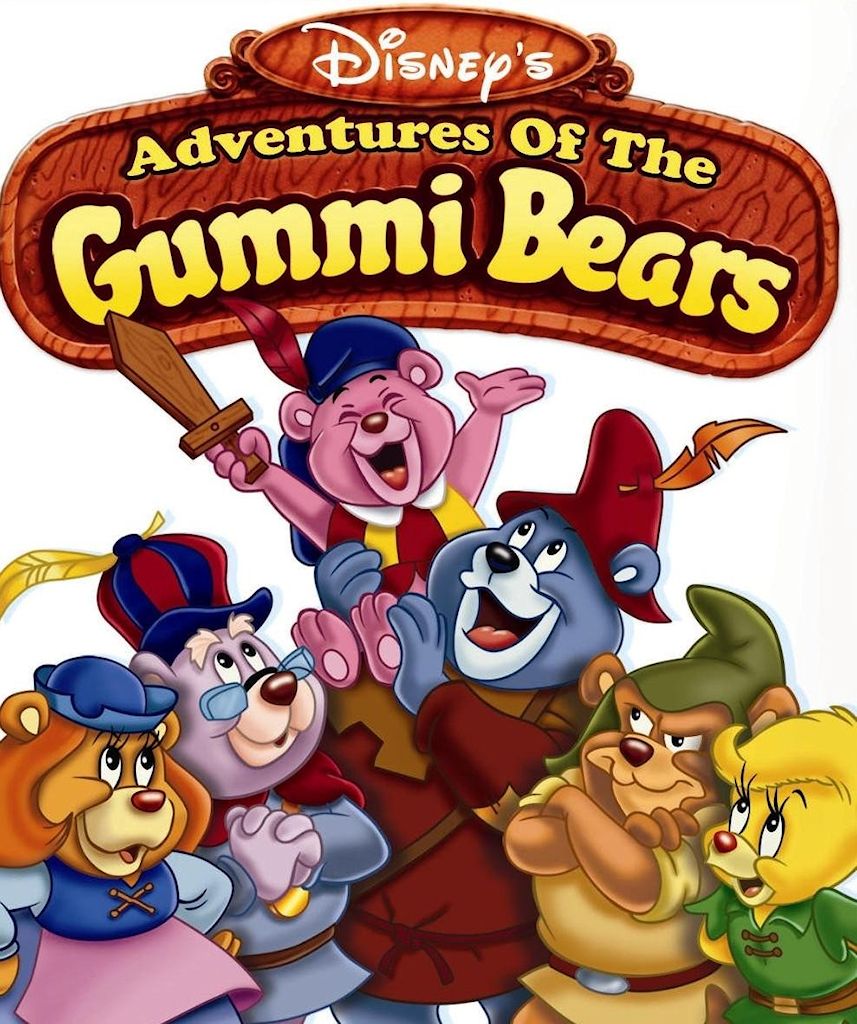
September 14, 1985 – The Animated Series Disney’s Adventures of the Gummi Bears Premieres on NBC
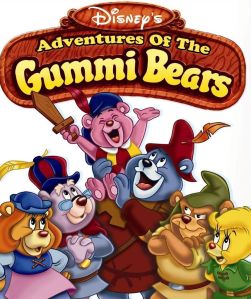
Classic-Cartoons-2-Gummi-Bears

“Gummi Bears, bouncing here and there and everywhere, high adventure that’s beyond compare, they are the Gummi Bears.”

On September 14, 1985, the animated series Disney’s Adventures of the Gummi Bears premiered on NBC. The series was Disney’s first major serialized animated series, setting a precedent for later animated series, including those of the Disney Afternoon lineup. The show was very popular, spanning 65 episodes over 6 seasons. Overall, the series tells the story of the Gummi Bears, a mythical, long-running family that lives in Gummi Glen in the time of the Middle Ages. The bears work to protect the secret of their Gummiberry Juice from Duke Igthorn and his army of ogres, and are assisted in this by Princess Calla and her page Cavin. The series was created by Jymn Magon and Art Vitello, and stars Bill Scott as Gruffi Gummi (replaced by Corey Burton after Scott passed away),  Paul Winchell as Zummi Gummi (replaced by Jim Cummings in the final season), June Foray as Grammi Gummi, Lorenzo Music as Tummi Gummi, Katie Leigh as Sunni Gummi, Noelle North as Cubbi Gummi and Princess Calla, Rob Paulsen as Gusto Gummi, and Michael Rye as Duke Igthorn. Cavin had several voice actors through the show’s run, with Christian Jacobs for Season 1, Brett Johnson for Season 2, David Faustino for Season 3, Jason Marsden for Seasons 4 and 5, and R.J. Williams for Season 6.

The first episode, “A New Beginning,” begins with Duke Igthorn preparing to destroy the Castle Dunwyn with his ogre army. Meanwhile, Cavin sets out to bring lunch to the woodcutters with Unwin, who would rather practice his swordplay. Unwin bullies Cavin, who belittles him for his belief in Gummi Bears, as they are seen as just a fairy tale. Cavin doesn’t realize that he’s being watched by someone. When ogres attack the woodcutters, Cavin is rescued by a mysterious group. He falls off the side of a cliff and is left unconscious. Back at the castle, Princess Calla tries to escape from the castle for some adventure, and finds that Cavin has been left behind.

The Gummis have found Cavin, and while Sunni wants to help him, Gruffi refuses, saying that they’ve already done enough. Zummi realizes that Cavin is wearing a Great Gummi Medallion, and Grammi wonders where a human boy would get such an important medallion. Cavin wakes up and is happily surprised to find that Gummi Bears do exist. The bears flee, but Cavin follows them. The bears once again have to flee from an ogre, and Cavin accidentally ends up in the Gummi Bear house. The bears soon tie Cavin up and plan on interrogating him. They ask where he got the medallion, and when he asks for something to drink, Tummi accidentally gives him Gummiberry Juice. For a short time, Cavin displays great strength, scaring the bears, but once it wears off, the start to talk and become friends. Zummi then takes Cavin to the Great Book of Gummi, and makes him swear on it that he will never tell a living soul about the existence of the Gummi Bears. Sunni and Cubbi then take Cavin exploring with them.

Sunni, Cubbi, and Cavin stumble over Duke Igthorn’s plan to destroy the castle, and Cavin tries to convince the Gummi’s to help rescue the King. Cavin is disappointed that the bears refuse to help, and throws down his medallion in disgust. When Zummi wears it, it begins to glow and drags him to the Great Book of Gummi. The medallion opens the long sealed book and, after reading some of the pages, decide that they should help Cavin in his quest to protect the castle. Cavin is quickly captured by the ogres. Zummi uses an invisibility spell on Gruffi to get Gummiberry juice to Cavin, but the spell begins to wear off. Fortunately, he is able to throw the juice to Cavin, who uses his strength to beat up the ogres. The King is alerted to Igthorn’s scheme, and sends his knights to stop the Duke. The bears and Cavin work together to destroy the catapult and keep the ogres busy. Igthorn manages to intercept the Gummiberry juice from Gavin, and marvels at his strength. The bears and Cavin roll the catapult away, but while Igthorn boasts he doesn’t need the catapult anymore, he is squashed by the boulder once the juice wears off, and is sent flying through the castle. Cavin’s sleeve is caught in the catapult as it rolls towards the castle, but manages to remain unharmed after it crashes into the castle. Calla congratulates Cavin for his bravery, and Cavin almost gives away the secret of the Gummi Bears, but Zummi is relieved to find that Cavin keeps their secret safe. The bears return home, and enter in their brave deed in the Great Book of Gummi.
September 10

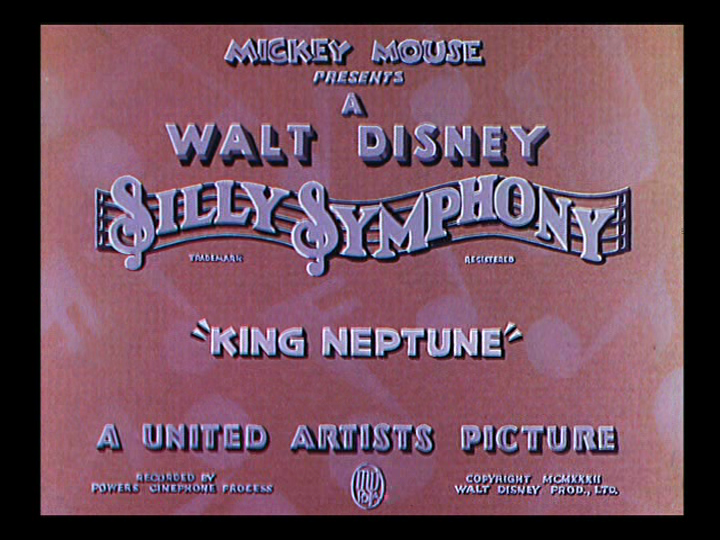
September 10, 1932 – The Silly Symphony King Neptune is Released to Theaters

vlcsnap-2013-09-10-18h19m39s120

“I’m Neptune, the King of the Sea, and a jolly old king am I!”

On September 10, 1932, the Silly Symphony King Neptune was released to theaters. This short briefly features the classical piece “Light Cavalry Overture” by Franz von Suppe. King Neptune was directed by Burt Gillett.

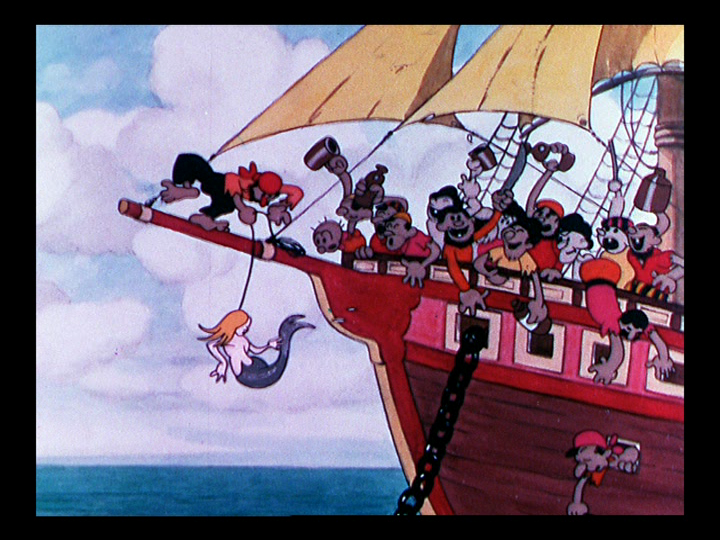
The short begins with Neptune introducing himself to the audience as a ruler with an iron hand who is friends with the sailors. A parade takes place with several sea creatures, and they bring forward some mermaids in a clam shell. They leave the shell and dance about before flirting with the King. The mermaids then travel to the surface and lounge as a pirate ship passes by with several bawdy, drunk pirates. One pirate spies the mermaids and calls out to the rest, and they quickly drop anchor in front of the rock. The mermaids scream in fright, alerting King Neptune, who is greeted with an anchor on the head.

The pirates quickly capture a mermaid and bring her on board

The pirates quickly capture a mermaid and bring her on board

The pirates manage to capture a mermaid, who fights back once she is on deck. The other mermaids sound the alarm, and every sea creature nearby runs to her rescue. A pack of swordfish cut down the mast, but one of the pirates locks the mermaid in a treasure chest amongst all the confusion. The pirates are soon overtaken by the sea creatures, and Neptune finally frees himself from the anchor and sends the ship straight into a whirlpool of his creation. He laughs at the pirates’ misfortune as they are tossed about helplessly, and Neptune lands on top of the ship, causing it to sink to the bottom. The mermaid is freed from the chest, clad in jewels and pearls. The short ends with everyone once again happy in the sea, including jolly old Neptune.

September 8

September 8, 2006 – The Disney Channel Animated Series The Replacements Premieres

The_Replacements_TV_series-577281071-large

“They sent away $1.98, got a superspy mom and a daredevil dude of a dad.”

On September 8, 2006, the Disney Channel animated series The Replacements officially premiered, after a sneak peek on July 28. The series tells the story of orphan siblings Todd and Riley who, after reading an ad in a comic book, sent away for new parents. Their mother is a British superspy named Agent K, while their father is a professional daredevil named Dick Daring. The two are also given a phone to contact Conrad Fleem, who will replace any adult that the kids wish to someone more of their liking. The show lasted for 52 episodes in 2 seasons, ending its run on March 30, 2009. Reruns still show on Disney XD in Canada. It was created by Dan Santat, and stars Nancy Cartwright as Todd, Grey DeLisle as Riley, Daran Norris as Dick Daring, and Kath Soucie as Agent K.

September 4

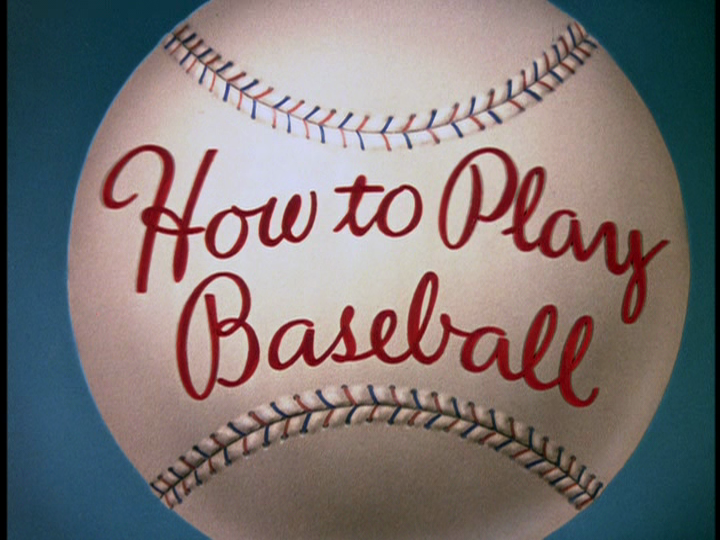
September 4, 1942 – The Goofy Short Film How to Play Baseball is Released to Theaters

vlcsnap-2013-09-04-09h04m42s7

“Baseball: the great American game, the national pastime of millions, both young and old.”

On September 4, 1942, the Goofy short film How to Play Baseball was released to theaters. The short was produced in 12 weeks, coinciding with the release of MGM’s The Pride of the Yankees. It was directed by Jack Kinney.

The short begins with a short introduction of the game, including equipment and the field. Goofy then is seen as a baseball player, with the narrator explaining Goofy’s outfit. Goofy then acts as the pitcher, winding up his arm for the pitch enough to bring him off the ground; he then lands all knotted up and unable to pitch well. The opposing team comes up to bat, and the player rubs dirt all over himself as he prepares for the pitch. The pitcher then throws a curve ball, and the batter, no matter what he does, is unable to hit the ball. The pitcher then throws what’s known as a “spinner,” which saws through the bat and lands in the catcher’s mitt. The pitcher next tries a slow ball, slowing down his speed in a comedic fashion. Try as he might, the batter is unable to hit the ball, tiring himself out quickly.

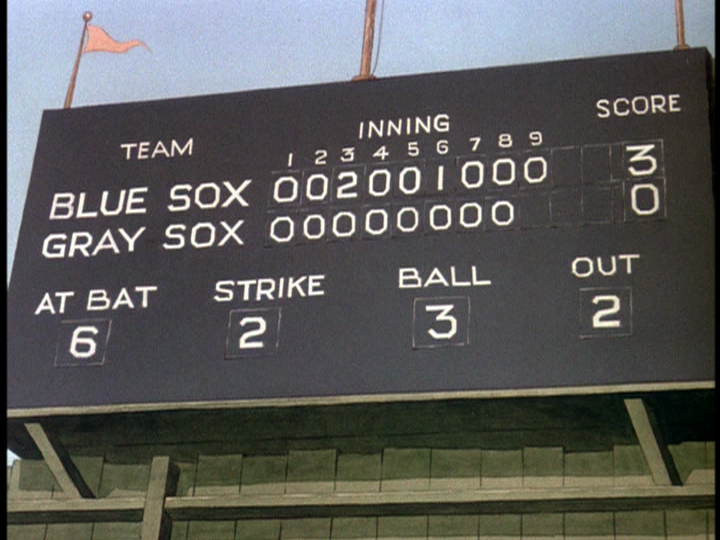
At the last inning of the World Series, the Blue Sox are leading, three to nothing

At the last inning of the World Series, the Blue Sox are leading, three to nothing

The World Series arrives, and the two teams playing are the Blue Sox and the Gray Sox, with the Blue Sox winning 3 to 0 in the ninth inning. The Gray Sox player hits the ball on the third base line and makes it safely to first base, although he trips over several bats and other pieces of equipment on his way there. He then starts to lead on first base, and finds himself caught between first and second while the ball is in motion, but is able to make it to second base. The pitcher then hits the batter, giving the batter a free trip to first base. The next batter bunts the ball, and several Blue Sox players chase after it, only to bump into each other and knock themselves out. The bases are loaded, and the pitcher is losing his nerve. The Gray Sox player hits the ball hard enough the tear the ball apart, and the score is tied as the batter runs for home. As both team members hit home base, it’s up to the umpire to make the call, and he calls the Gray Sox player out, which leads to an all-out brawl between the two teams.


September 3

September 3, 1996 – The Animated Series Quack Pack Premieres

QuackPack

“I feel like quacking so I think I will. I’m gonna quack quack quack until I get my fill.”

On September 3, 1996, the animated series Quack Pack made its debut in the Disney Afternoon lineup. The series centered around Donald Duck and his nephews, who are now teenagers, and given their own personalities, as opposed to how they were portrayed in the DuckTales series. The series itself was considered an extension of the Donald Duck short film series rather than the DuckTales series and comics, with Donald interacting with humans rather than with other anthropomorphic animals. It lasted one season, with only thirty-nine episodes; reruns eventually ran on Toon Disney, but were taken off the air in 2004. Quack Pack starred Tony Anselmo as Donald, Jeannie Elias as Huey, Pamela Adlon as Dewey, E. G. Daily as Louie, Kath Soucie as Daisy, and Roger Rose as Kent Powers.

The first episode, “The Really Mighty Ducks,” begins in the very messy room of the nephews, who sit around reading comic books. Donald stumbles into the room and is amazed at the filth, and demands they make it spotless. The nephews make excuses to not clean up, but Donald, who has been trapped in part of the mess, demands that they clean or else. They stop by Professor Ludwig von Drake’s lab, and ask him for something that will clean the room for them. The three find that he has a “superhero machine,” and decide to use it. The trio emerges as Brain Boy (Dewey), Captain Muscle (Louie), and The Really Incredibly Fast Guy (Huey). The Professor tells them to step back in and return to normal, but the boys refuse, stating that Donald can’t make them do anything anymore, since they have powers and he is “mere mortal.”

The Professor soon receives a call from the President of the International Organization of United Neighbors (IOUN), who asks if he knows of any superheroes. The boys soon volunteer, and the President dubs them the Tremendously Talented Trio of Truly Trusted Troubleshooters, or the T-Squad, for short. The three then go save the world with great fanfare, and are given an outer space station as their headquarters. However, their tasks to save the world are rather mundane, which include retrieving a kite from a tree and finding a man’s lost sock. Back in the boys’ room, Donald is still fuming about the mess they left behind. He then heads to Professor von Drake’s and finds the superhero machine. When he is inside, he is turned into a supervillain named The Duck of Doom, and vows to make the boys clean their room.

Donald flies out and finds the T-Squad’s headquarters, attacking them with a boulder, then a plane. The boys find a note attached to the plane: “Clean your room, or else. Love and kisses, your uncle, the Duck of Doom.” Huey declares that they must fight the Duck of Doom, and sends a note back: “No way, Jose!” The battle rages on, with Donald playing pranks, but the T-Squad doesn’t take him seriously. In a fit of rage, Donald gathers all the televisions in the world and threatens to destroy them all unless the boys clean their room. Daisy, who has a job as a television reporter, appears on the scene to narrate the story, but decides to play the bagpipes when she realizes that she’s not broadcasting to anyone. The head of the IOUN tells the T-Squad they must do something, and the T-Squad decides they have to declare war. Donald then smashes the televisions with a giant hammer when the boys refuse to clean, and when they try to fight their uncle, they are easily defeated.

When they reach their headquarters to find something to defeat him, they realize that they can’t find what they’re looking for, as they’ve left it in a huge mess. The boys soon decide that their uncle may be right, and head back to the Professor’s lab for help. The Professor fixes the machine to make it seem like the entire debacle never happened, and the boys rush home to clean their room, much to Donald’s surprise.