RSS Feed

Tag Archives: 1950s

September 29

September 29, 1958 – The LP Firehouse Five Plus Two – Dixieland Favorites is Released

Firehouse Five

“…the Firehouse Five Plus Two made up in spirit for what they generally lacked in originality.”

On September 29, 1958 the LP album Firehouse Five Plus Two – Dixieland Favorites was released on the Good Time Jazz label. The band was comprised of members of the Walt Disney Studios animation department, including Nine Old Men members Ward Kimball (trombone) and Frank Thomas (piano). The group also included Danny Alguire (cornet), Harper Goff (banjo), Clarke Mallery (clarinet), Monte Mountjoy (drums), and Ed Penner (bass saxophone); it would later include Jimmy MacDonald, George Probert, Dick Roberts, Ralph Ball, and George Bruns. The album contains several Dixieland standards recorded by the band at their peak.

September 21

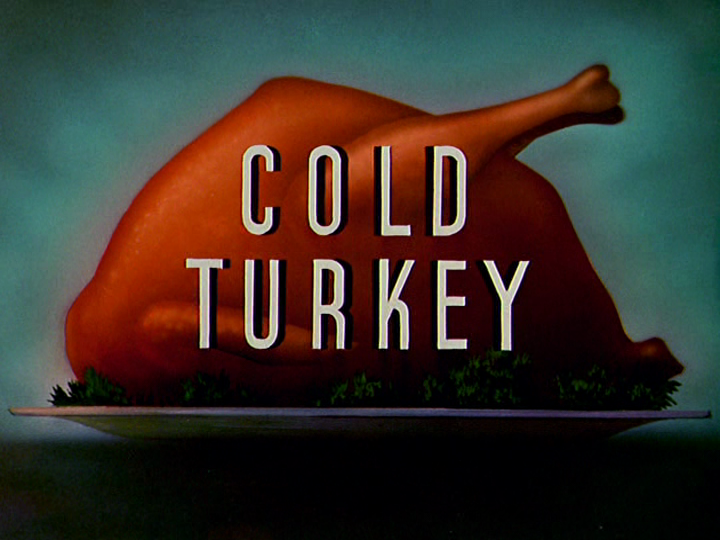
September 21, 1951 – The Pluto Short Film Cold Turkey is Released to Theaters

vlcsnap-2013-09-21-18h16m55s156

“Lurkey’s Turkeys hot, Lurkey’s Turkeys cold, Lurkey’s Turkeys taste good nine days old!”

On September 21, 1951, the Pluto short film Cold Turkey was released to theaters. This is one of three shorts that also stars Milton, the cat nemesis of Pluto, with the others being Puss Cafe and Plutopia. this short also features the famous “Goofy Yell,” performed at a higher pitch by Milton. The short was directed by Charles Nichols, with story by Leo Salkin and Al Bertino.

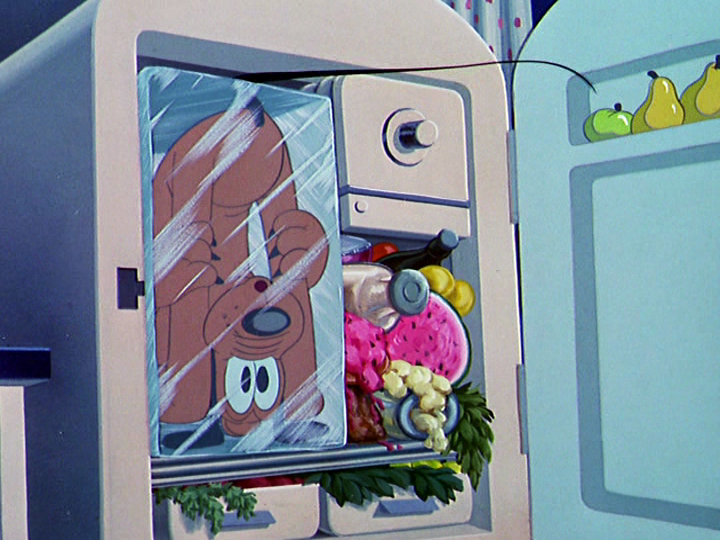
Pluto and Milton are sleeping as a boxing match is being played on the television, when they are woken up by a Lurkey’s Turkeys ad. Craving turkey, the two start searching for turkey, unaware that they will not find it in the television. After receiving a good shock, they realize that they should check the kitchen, as the ad suggests, and start searching every crevice. The two work together to launch Milton up to the cabinet, but the plan goes awry, with Milton being launched into the fridge instead. After he opens up the fridge door, the two find the turkey, but stop working together and end up frighting over it. Pluto ends up closing Milton in the fridge, but the cat escapes with the turkey, closing Pluto in the fridge in retaliation.

Pluto finds himself frozen in the fridge after Milton traps him

Pluto finds himself frozen in the fridge after Milton traps him

Pluto manages to escape the fridge and defrost, and finds Milton trying to cook the turkey over the heating vent. Pluto chases Milton into the television set, where he tries to fry the poor cat, and also starts cooking the turkey. As Milton flees to cool off, Pluto smells something burning, and the two quickly pull the turkey out, although neither can hold onto it for very long, as it has turned red from the heat. The turkey cools and immediately turns black before disintegrating, bones and all. The two stare at the turkey, and start accusing each other of destroying their food. They then mirror the boxing match announcements on television as they start to fight.

September 19

September 19, 1952 – The Mickey Mouse Short Film Pluto’s Party is Released to Theaters

vlcsnap-2013-09-19-03h21m11s223

“Pluto! Come down here! You’re playing too rough!”

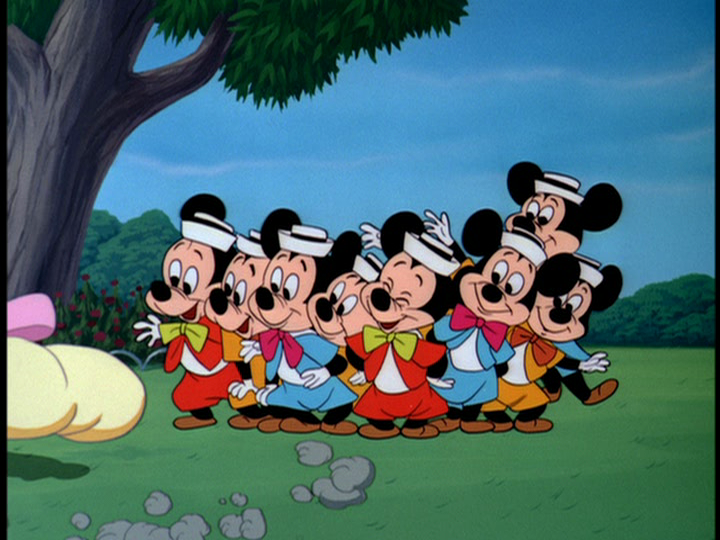
On September 19, 1952, the Mickey Mouse short film Pluto’s Party was released to theaters. This is the only short since the 1930s that features Mickey’s nephews. It was directed by Milt Schaffer, with story by Bill Berg and Leo Salkin.

Mickey is coming out of his house with a giant cake, with Pluto trailing not too far behind. It’s revealed to be a birthday cake for Pluto, as it’s the dog’s birthday. As Pluto tries to sneak a bite of the cake, Mickey calls him out, reminding him that he has to take a bath first. Pluto sulks, and tries to sneak away, but is tricked by Mickey into lading into the washbucket. After his bath, he sits at the table again, wearing a fancy collar, and once again tries to steal some cake. Mickey once again calls him out, telling him to wait for his little guests. Pluto pouts, but soon hears the knocking at the garden gate, and rushes over happily.

All of Mickey's nephews arrive for the party, bringing Pluto a large bone-shaped present

All of Mickey’s nephews arrive for the party, bringing Pluto a large bone-shaped present

All of Mickey’s nephews rush in excitedly, knocking poor Pluto flat. They bring him what looks like a giant bone for his birthday, and he happily licks them all in turn. When he opens the package, however, it is revealed to be a little red wagon instead. The nephews attach the wagon to Pluto’s collar and try to make him pull them across the yard. They all leave the wagon, distracted by something else, sending Pluto flying towards the cake, which Mickey saves before Pluto can swipe at it, and he ends up crashing into a tree. The nephews start having “fun” with Pluto, torturing the poor dog, alhtough Mickey admonishes the dog for “playing too rough.”

Mickey then has the boys engaged in a game of “Pin the Tail on Pluto.” When it’s Pluto’s turn, one of the boys grabs Pluto by the tail and spins him fast enough that Pluto can’t stand up, let alone walk straight. He ends up wrapped around a tree and, after peeking, thinks he can easily pin the tail on the picture; he doesn’t realize that his own body is perfectly blocking the picture. Pluto then accidentally stabs himself, and flies towards the picture in pain, perfectly placing the tail on the picture, winning the game. Soon after, Mickey calls everyone over for cake, and Pluto is told to make a wish. Pluto then wishes for all the nephews to disappear. After he blows out the candles, the cake suddenly disappears into the mouths of the nephews, leaving Pluto without a slice, and the nephews quickly leave, declaring the party to be over. Poor Pluto is dismayed to find he didn’t get any cake, until Mickey surprises him with the last piece. Pluto gratefully licks Mickey in-between bites of cake.

August 28

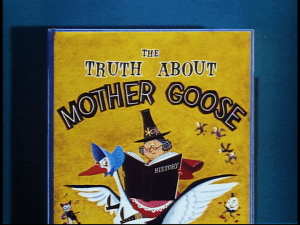
August 28, 1957 – The Special Short Film The Truth About Mother Goose is Released to Theaters
vlcsnap-2013-08-28-10h26m10s24

“What’s the truth about Mother Goose? Let’s clear up all the mystery. Her nursery rhymes from olden times are really part of history.”

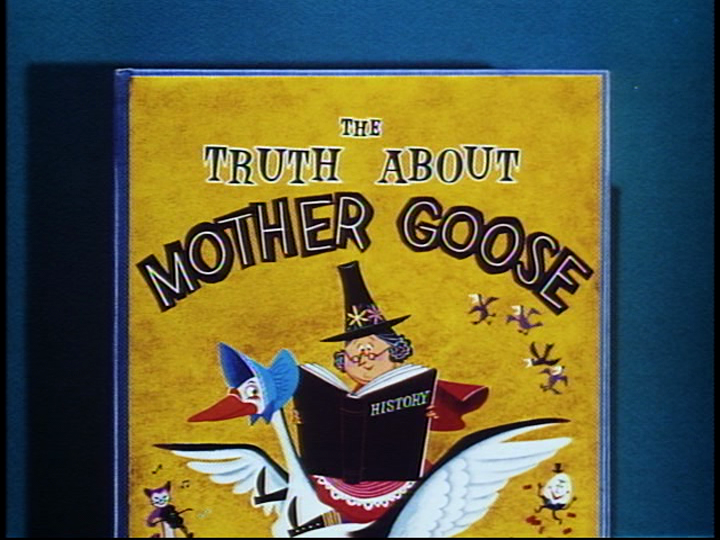
On August 28, 1957, the special short film The Truth About Mother Goose was released to theaters. It was nominated for an Academy Award, but lost to Warner Brothers’ Birds Anonymous. It was directed by Woolie Reitherman and Bill Justice, with story by Bill Peet.

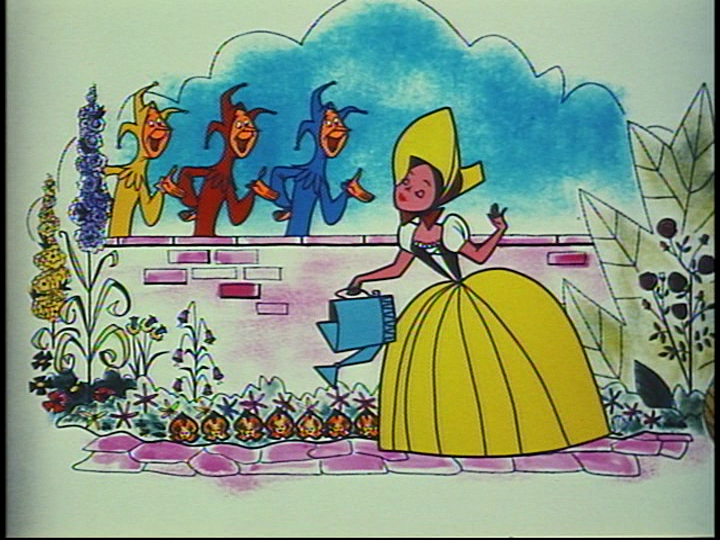
The short is narrated by three jesters and a voice-over narrator, with the jester singing their intention to give the history behind three popular nursery rhymes. They first begin with Little Jack Horner, which actually goes back to 16th century London. The real Jack Horner was the assistant to a city official, who was to deliver a Christmas present to Henry VIII. In this time period, in was a common practice to bake presents of great value into a pie. Knowing this, Jack pulled out from the pie a “plum,” which was a deed to a valuable estate. When Henry VIII found there was no gift, the city official was punished, and Jack ended up living in his stolen estate, although he may have been haunted by a popular rhyme that was gaining ground in London.
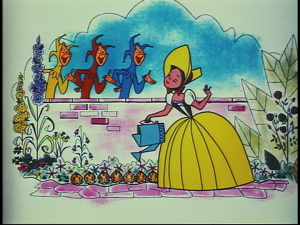
The jesters recite "Mary Mary Quite Contrary" before getting into the history of the rhyme

The jesters recite “Mary Mary Quite Contrary” before getting into the history of the rhyme

The next rhyme, Mary Mary Quite Contrary, is actually about the life of Mary Stuart, also known as Mary, Queen of Scots. She came from France to take over the Scottish throne, which was frowned upon by the Scottish court. The “silver bells” refer to Mary’s elaborately decorated attire, the “cockle shells” were a reference to her love of exotic foods, and the “pretty maids all in a row” were Mary’s ladies in waiting. The narrator then tells the tragic tale of Mary, who married Lord Darnley four years after her arrival in Scotland. Her marriage was unhappy, and when Mary found other lovers in a French poet and a court musician, these men were dispatched. She fell in love with the Earl of Bothwell, and after Darnley’s murder, she and the Earl were married. The Scottish people, outraged at Mary’s behavior, forced her to abdicate the throne, and imprisoned her in Lochleven. After a few months, the jailer’s son helped Mary to escape, and she organized an army to gain back the throne in Scotland, but was defeated. She then fled to England to seek refuge with her cousin, Queen Elizabeth I. Elizabeth soon became jealous of Mary, and was accused of being a traitor to the government. She was then executed, “quite contrary” until the end.

The last nursery rhyme discussed is London Bridge is Falling Down. Old London Bridge was built in 1176 to unite the two parts of London. It was finished in 1209, and a chapel was built over the central pier to sanctify it. Several beautiful buildings were also built on the bridge, and it was named a wonder of the world. Merchants would sell their wares on the lower floors of buildings on the bridge, with the upper stories of the buildings being sold as apartments. Celebrations of great moments in British history were also done on the bridge. Living on the bridge could also be hazardous, with the greatest hazard being fire; the worst fire was the Great Fire of London in 1666, when it broke out from the King’s bakery in Pudding Lane. The bridge would soon be rebuilt, but it never would return to its former glory. Its foundations were breaking from water and fire damage, and it was soon declared a public nuisance, ridiculed in rhyme. The bridge was given the declaration to be demolished on July 4, 1823. A new London Bridge would be built, which still stands today.

August 19

August 19, 1955 – The Donald Duck Short Film Bearly Asleep is Released to Theaters

vlcsnap-2013-08-19-10h11m28s164

“Yes, after we have bid farewell to the summer tourists, and the park is closed for the winter, it is time for our little bear friends to hibernate in their winter cave.”

On August 19, 1955, the Donald Duck short film Bearly Asleep was released to theaters. This is the third of four shorts where Humphrey the Bear is the antagonist of Donald Duck; this is also one of the few Donald Duck shorts filmed in CinemaScope. It was directed by Jack Hannah, with story by Al Bertino and Dave Detiege.

Ranger Donald Duck is waving goodbye to the visitors as they leave the national park. The bears also wave goodbye to the visitors, until Donald calls them all to attention, as it is time for them to hibernate in their cave. Humphrey, however, has been lounging in a nearby hammock, and reluctantly joins the line when Donald kicks him. Donald allows Humphrey to grab a drink of water before joining the bears, then yelps that someone pinched him. Donald throws the glass at Humphrey, telling him to go to sleep, and mutters “I hate bears,” over and over again as he walks back to his cabin.

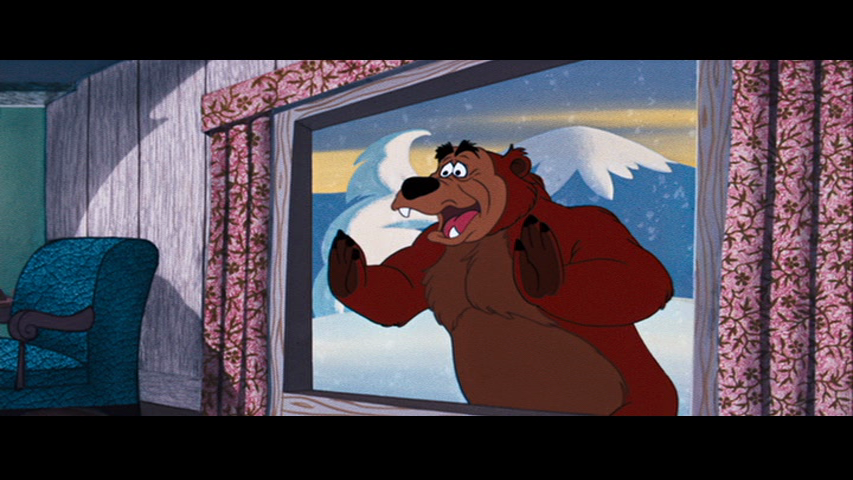
Humphrey is happy to find a place where he can spend his hibernation

Humphrey is happy to find a place where he can spend his hibernation

In the cave, Humprey starts annoying all the other bears with his fidgeting and snoring, and they kick him out into the snow. He finds a log to stay in, except that the rabbit living there kicks him out. He then finds what he thinks is another cave, but is nearly run over by a train running at full-speed. Finally, he comes across the ranger’s cabin and, spying the bunk beds, decides to find a way in. He pretends to sleepwalk into the cabin and crawl into one of the beds, but Donald is suspicious of his behavior, and places a lamp underneath the bed. As Humphrey becomes too warm, he “sleep-climbs” up to the top bunk, but Donald places the open flame of the lamp under the top mattress, and Humphrey leaps into the air in pain. Donald then uses a snowshoe to beat Humphrey out of the house before sealing all the exits.

As Humphrey gazes wistfully into the warm building, he finds that his nose is stuck to the glass of the window. He pulls the glass off as he tries to remove it from his nose, and ends up shutting himself back inside the house and placing the glass back in the window. Spying the snowshoe and its painful spike, Humphrey looks for a place to hide as Donald prepares for a shower. Unfortunately, Humphrey hides in the shower and ends up all wet. Donald finally finds Humphrey hiding and searches all over the house to catch the bear, trapping him in the oven. Donald then sends Humphrey flying out again, along with all other pieces of bear memorabilia. Seeing that Donald threw out a bear dressed as a baby, Humphrey dons the outfit and pretends to be a lost baby left in a basket in front of his old cave. The bears take him in, and his snoring once again keeps the entire cave awake through hibernation.

August 18

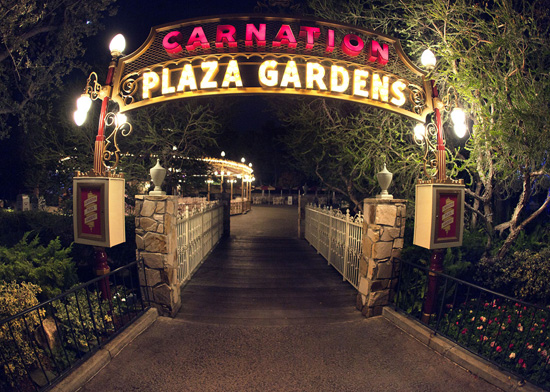
August 18, 1956 – Carnation Plaza Gardens Opens in Disneyland

cpg329400SMALL

On August 18, 1956, the Carnation Plaza Gardens opened in Disneyland. The area, situated between Fantasyland and Frontierland, was home to several entertainment and fast-food stalls, and was home for the Date Nite at Disneyland events, which started in 1957. Several well known swing bands performed at the Gardens, as well as scholastic bands from all over the country. The area was closed in 2012 to make way for the new Fantasyland expansion known as Fantasy Faire; three final Jump, Jive, Boogie Swing Parties were held in the area before it closed on April 30th.

August 11

August 11, 1950 – The Pluto Short Film Food for Feudin’ is Released to Theaters

vlcsnap-2013-08-11-07h45m56s6

“Hey, Pluto!”

On August 11, 1950, the Pluto short film Food for Feudin’ was released to theaters. This is the third short where Chip and Dale play Pluto’s antagonists, as they were usually cast as the antagonists for Donald Duck. A high-pitched version of the Goofy Holler is also used in this short. It was directed by Charles Nichols, with story by Milt Schaffer and Dick Kinney.

On a beautiful fall day, Chip and Dale are gathering acorns for the winter. They have finally reached the level of nuts needed to last them the winter season, and settle down comfortably in their storage tree. Pluto is also in the park, trying to hide his bones. He tries to shove one of his bones in Chip and Dale’s tree, and when he does, the nuts are pushed up to the very top, nearly crushing the chipmunks. When they push the level down, the bone and every collected acorn begins spilling from the tree. Pluto and Chip end up slipping on the acorns and slam into Pluto’s doghouse. Dale, who had been laughing at Chip’s misfortune, also slips on an acorn, falling straight into Pluto’s mouth. Chip frees Dale, and Pluto chases them around the yard.

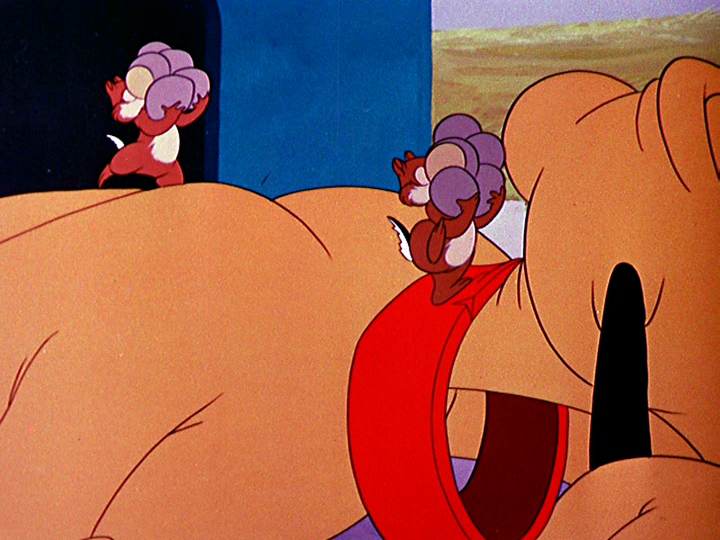
Chip and Dale are unaware Pluto has returned, even as they walk across him to get their acorns back to their tree

Chip and Dale are unaware Pluto has returned, even as they walk across him to get their acorns back to their tree

The chipmunks hide in a nearby garden, and spot all of their acorns in Pluto’s doghouse. As they begin to gather their acorns, they don’t notice that Pluto has returned and settled down for a nap. The two slip on Pluto’s collar, sending the dog chasing after them again. The pair hide in some nearby garden gloves, and after Pluto returns, they use the gloves to lull Pluto to sleep with a massage, only Dale gets caught in Pluto’s grasp. The two then start throwing a ball around to keep Pluto occupied, but they still aren’t able to take their acorns. The two then come up with a plan to tie Pluto to his doghouse, having him drag their acorns back to their tree as they continue to tempt him with the ball. After throwing the ball to send him the other direction, the two make quick work of filling the tree, but when Pluto comes back with the ball, he spots Dale peeking out from one of the gloves. Pluto and Chip struggle, with Pluto ending up wearing the gloves with the fingers all tied up. As Chip and Dale laugh and imitate how Pluto got stuck, the two also end up with their fingers knotted together. The three then have a good laugh at their misfortune.

August 10

August 10, 1951 – The Mickey Mouse Short Film R’Coon Dawg is Released to Theaters

vlcsnap-2013-08-10-18h33m25s38

“Now, some hunters say that a dog sees with his nose. Well, sir, it’s a fact. And when he starts sniffin’ and a-snortin’, his old nose is a-pickin’ up a television picture that’s just a spittin’ image of old Mr. Coon.”

On August 10, 1951, the Mickey Mouse short film R’Coon Dawg was released to theaters. It was directed by Charles Nichols, with story by Ralph Wright and Al Bertino.

In a farm out in the country, a raccoon is seen traipsing about, but flees when he hears footsteps. Mickey then appears with a shotgun, searching for raccoons, with Pluto sleepily sniffing out the creature. Picking up the scent, Pluto pursues that direction, and Mickey quickly follows. The raccoon hears Pluto’s howling, and sets up some tricks to throw the dog from his path. Pluto falls for the first trick, and the second, but continues his chase through the woods. The raccoon quickly tries another plan to get the dog off his trail, but Pluto refuses to let the scent go. After chasing the raccoon into the water, his collar catches on part of a log, and Pluto starts to drown. The raccoon saves his life, but not before setting up another trick to throw the dog off the scent.

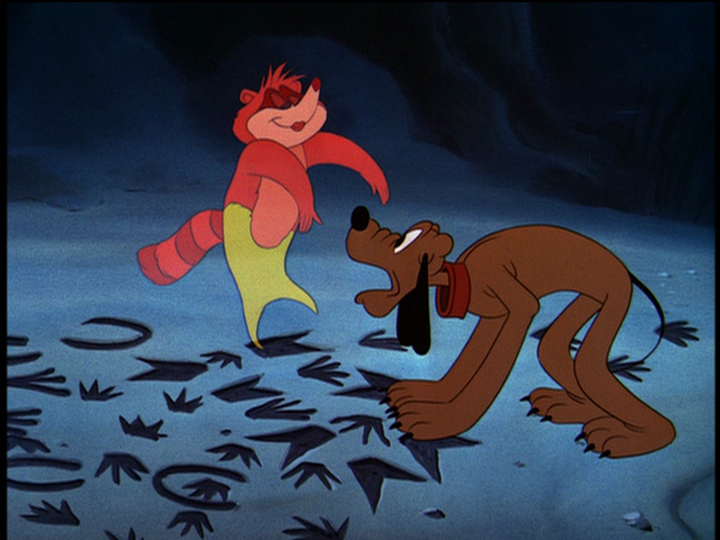
Pluto is momentarily thrown off by the trick the raccoon left for him

Pluto is momentarily thrown off by the trick the raccoon left for him

As Pluto reaches the bank, he is thrown off by prints from a fish, a frog, and a horse, among the raccoon prints. He spots the raccoon laughing at him from the tree, and the raccoon, seeing Mickey with his gun n the other side of the brush, realizes that he’s trapped. Thinking quickly, he steals Mickey’s coonskin cap, using it to pretend that it is a baby. As Mickey attempts to shoot the raccoon, Pluto grabs the gun with his teeth and pulls it away. Sheepishly seeing the raccoon “with child,” the two slink away, while the raccoon relishes in its victory.

August 1

August 1, 1953 – The Donald Duck Short Film The New Neighbor is Released to Theaters

vlcsnap-2013-08-01-17h06m22s235

“It has been man’s constant labor to live in peace with his next-door neighbor, and on the newcomer falls the chore of getting along with the man next door.”

On August 1, 1953, the Donald Duck short film The New Neighbor premiered in theaters. It was directed by Jack Hannah, with story by Nick George and Milt Schaffer.

Donald is moving into his new house, and decides to meet his next door neighbor, Pete. The first meeting, however, is not a smooth one, as Pete is seen dumping all of his trash into Donald’s carefully tended yard. Pete’s dog then destroys Donald’s fence and digs up his tulips. Pete then wanders over to Donald’s house and asks for some ice cubes, but then starts grocery shopping from Donald’s fridge, taking all of Donald’s food. His dog then brings over a note, which asks Donald for a favor. As Donald is distracted, the dog steals Donald’s tea set. Donald angrily goes to confront Pete, when Pete shows up at his door with a bowl of soup. Donald finds in delicious, only to find that it’s what Pete feeds his dog.

Donald rakes up all of the leaves that Pete sent flying into his yard

Donald rakes up all of the leaves that Pete sent flying into his yard

In the spring, Donald is out in his garden, when Pete asks to “borrow” all of Donald’s yard tools. As it begins to rain, Donald runs to find some shelter, when he sees that Pete has left all of Donald’s tools in the rain. The next day, when Pete is trimming his trees, the leaves have spread all over Donald’s yard. Donald quickly gathers the leaves, trying hard not to have a tantrum, and places them in his incinerator, hoping to use the smoke to ruin the clothes on Pete’s laundry line. Pete uses his hose to put out the leaves and spray Donald, but Donald sticks the hose in Pete’s pants and pokes holes in his pants with a rake, with water spraying everywhere. The fight gets ugly enough to make the neighborhood gather and watch, and then it makes front page of the papers. The fight turns into a neighborhood event, much like a sporting event. The two end up building a tall fence between them, which unfortunately falls apart once Pete’s dog starts burrowing in and breaking the foundation. The fight ends with the two moving away from the neighborhood, calling it a draw.

July 26

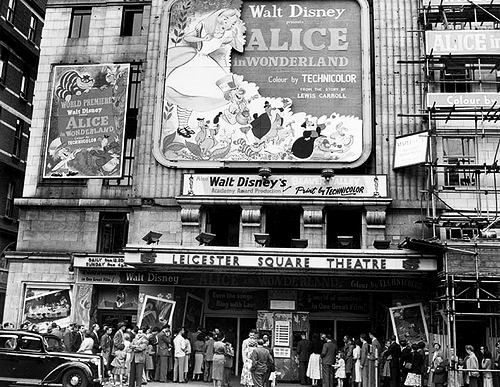
July 26, 1951 – Alice in Wonderland Premieres at London’s Leicester Square Theater

tumblr_m4uyqiKngS1qg35tio1_500

“I give myself very good advice, but I very seldom follow it.”

On July 26, 1951, the world premiere of Walt Disney’s 13th animated feature film Alice in Wonderland took place in London’s Leicester Square Theater. Walt Disney attended the premiere, as did Kathryn Beaumont, the voice of Alice. The film was also due to premiere the same day in New York City, but the date was delayed two days, as it coincided with the release of another adaptation of Lewis Carroll’s work: a feature-length puppet version by French filmmaker Lou Bunin (this film would fail at the box office). Unfortunately, the film was criticized for “Americanizing” a British classic, and was a disappointment on its release, earning only $2.4 million at the box office. Walt Disney would later say that the film failed because the character of Alice had no “heart.” It would find its audience in the 1970s, and became a success on home video.