RSS Feed

Tag Archives: 1950s

February 24

February 24, 1956 – The Donald Duck Short Film Chips Ahoy is Released to Theaters
vlcsnap-2014-02-24-03h50m15s148

“Hey! Wait a minute, stupid! That’s water. Don’t you know you can’t walk on water?”

On February 24, 1956, the Donald Duck short film Chips Ahoy was released to theaters. It was the last short that featured Donald fighting with his nemesis, and the last classic short to feature Chip and Dale. The short was filmed in CinemaScope. It was directed by Jack Kinney, with story by Dick Kinney and Milt Schaffer.

Chip and Dale are sitting on a tree branch, lamenting how hungry they are, when they spy one last acorn on the tree. As they fight over the acorn, it tumbles from their grasp and falls to the water below. Chip then spots a tree in the middle of the river with hundreds of acorns, and the two race down the tree. As the two think of a way to get across the water, Chip spies a ship in a bottle in a nearby shack. Donald then takes a stroll across the dock to get to his boating shack, when he spots Chip and Dale carrying a boat on their backs. When he finds out that the two stole his ship, he fixes to get it back. He uses a fishing pole to reel his ship back in, and starts playing pranks on the two. Dale finally spots that Donald is holding their ship, and Donald catches him. Chip drops the anchor on Donald’s foot, and Donald drops the ship back into the water, and Dale onto the deck. Dale then takes some nearby rope and ties Donald up before jumping onto the ship.
vlcsnap-2014-02-24-04h05m00s49

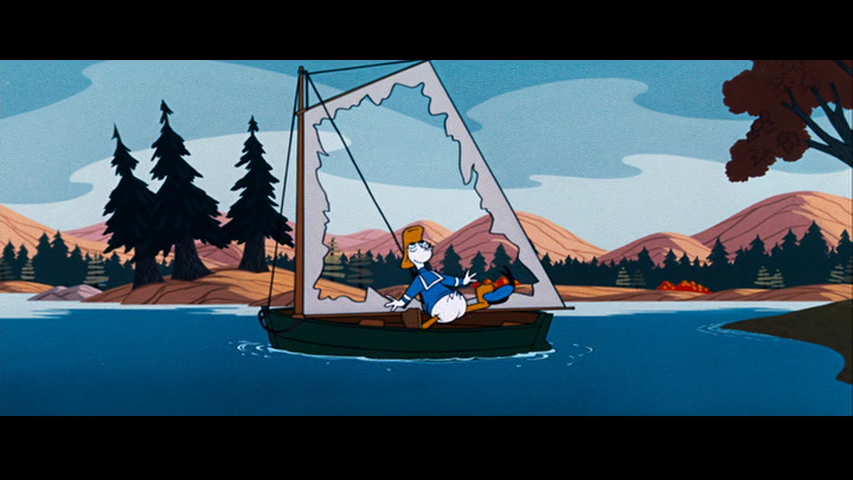
Donald attempts to go after the chipmunks in a variety of boats, all having been tampered with by Dale

Donald then gets into his own boat to go after them, unaware that Dale has already cut Donald’s sail to ribbons. When Donald gets into a canoe, Dale reveals he took care of that too – he burrowed holes into the bottom of the canoe. Donald gets into a rowboat, which Dale already took the screws from. Finally, Donald gets into a speedboat, and when Chip starts to panic, Dale calmly reveals that he tied a rope to the end of the speedboat. When the rope is taut, Donald is sent flying into the acorn tree, sending acorns flying everywhere, including onto the ship. When Donald tries to grab the ship, he slips on the acorns and sends the boys back to shore on a wave. That night, the boys are eating their acorns when Chip looks to see that Donald, still trapped on that little island, has cut down the acorn tree and started building a boat, a sight at which the chipmunks can’t help but laugh.
February 19

February 19, 1956 – Keller’s Jungle Killers Performs at Disneyland

02191956_WDA_TDIDKeller

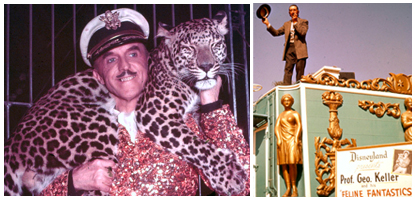
“George J. Keller…demonstrates for the first time the unarmed subjugation of a group of African lions, tigers, leopards, mountain lions, jaguars, black panthers, and a cheetah.”

On February 19, 1956, the circus attraction Keller’s Jungle Killers performed in the short-lived Holidayland area of Disneyland. Occupying the circus tent that once housed the Mickey Mouse Club Circus, the attraction was hosted by George Keller, a former artist and teacher at the Bloomsburg State Normal School, who left education in the early ’50s to perform with his animals full time. These “jungle killers” included lions, tigers, and leopards. The attraction lasted until September 7, 1956.

February 15

February 15, 2005 – The New Walt Disney Records Imprint, Disney Sound, Has its First Release

TMBG_ABC

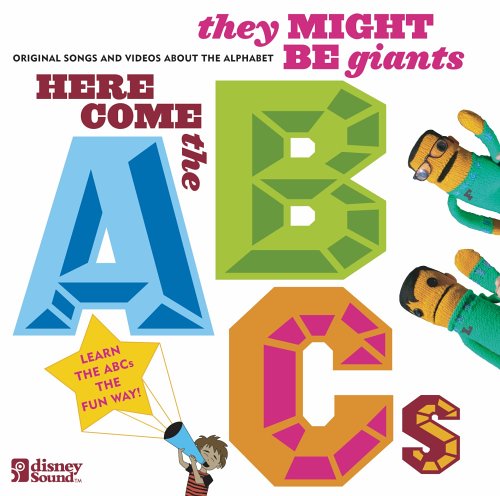
“They Might Be Giants, here come the ABCs!”

On February 15, 2005, the new Walt Disney Records imprint Disney Sound established itself with its first release. Disney Sound, founded in 2004,’s has a mission to create original music the whole family could enjoy, separate from music that was being released through Disney Pearl and the Walt Disney Records main label. Its first release was the album Here Come the ABCs by the alternative band They Might Be Giants. The album was a success, peaking at number one on the Billboard Children’s Music Chart and being certified Gold by the RIAA.

February 10

February 10, 1950 – The Pluto Short Film Pluto and the Gopher Premieres in Theaters

vlcsnap-2014-02-10-04h15m03s165

“Pluto! Stop digging in my flowers!”

On February 10, 1950, the Pluto short film Pluto and the Gopher premiered in theaters. It was directed by Charles Nichols, with story by Dick Kinney and Milt Schaffer.

Pluto is lounging in the garden out back, smelling the few flowers there are, when a lump under the ground creeps through, stealing each and every flower. Pluto tries to keep the flowers from being pulled away, when he realizes that he’s caught a gopher. The gopher bites Pluto’s nose before digging underground again, and taunts Pluto as it digs from one area to the next. As Pluto attempts to dig after him, he is caught by Minnie, who less than thrilled to find him digging up her garden. Minnie then takes a flower inside, unaware that the gopher has been carried in the flowerpot. He tries to run outside, but finds himself trapped in the house. As Pluto lounges on the rug, he gets a rude awakening when he finds the gopher again, and mimics the gopher’s earlier taunts as he chases the critter into the air vent. The gopher then hides in a glove and various other household objects, and ends up being sent all through the house before escaping through the dog door. He digs back outside and ties Pluto down by his own ears, with Pluto angrily muttering to himself as the gopher once again enjoys the flowers.

December 28

December 28, 1955 – The Walt Disney Anthology Episode “Man and the Moon” Premieres

vlcsnap-2013-12-28-18h40m57s95

“After consulting with the scientists, our artists and studio technicians have prepared a factual picture of how the coming conquest of the moon will be accomplished.”

On December 28, 1955, the Disneyland episode “Man and the Moon” premiered on television. Known as a “science-factual” presentation, the episode was part of a series that explored the same ideas that were in the Tomorrowland section of the Disneyland theme park. The episode was directed and produced by Nine Old Men animator Ward Kimball, and written by Kimball, William Bosché, and John Dunn. It features Dr. Wernher Von Braun, who also assisted the creation of the episode as a technical consultant. The episode was rerun in 1959, but was renamed “Tomorrow the Moon.” Like many episodes of Disneyland, the episode was shot in color, although it was broadcast in black and white.

The episode begins with an introduction by Walt, who introduces the rocket ride located prominently in Disneyland’s Tomorrowland. He then takes the audience to a meeting of animators and studio technicians to discuss how to correctly portray an exploration of the moon. Ward Kimball then takes the helm, who begins the study with a history of man’s fascination with the moon. It begins with cave drawings explaining how primitive man thought the moon came to be, then moves on to the individual legends of cultures around the world. The first book dedicated to the moon was Plutarch’s parchment, where he called the moon a smaller earth, populated by demons. In 1609, Galileo Galilei created his telescope and looked at the moon, which led to Johannes Kepler writing his book Somnium. More science-fiction books were written about people’s travels to the moon, including one by Cyrano de Bergerac and Jules Verne. The commentary then moves to mentions of the moon in literature, beginning with Shakespeare, before moving to superstitions and legends.

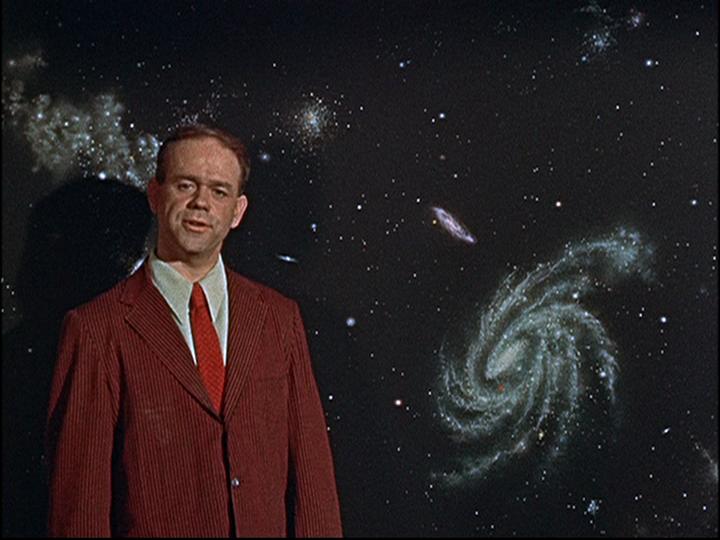
Ward Kimball begins his description of how the universe and the moon was possibly formed

Ward Kimball begins his description of how the universe and the moon was possibly formed

Kimball then moves to how the moon stands in our solar system, and the mystery of how the moon came to be. He explains the legend of the big bang, and then explains the moon’s movement around the Earth, and how it appears to change shape. The moon’s gravitational pull also has an effect on the tides of the ocean. Kimball then shows an image of the moon taken through telescopes and telegraphic lenses, and explains the moon’s appearance. He then introduces Dr. Wernher von Braun, who is on hand to enlighten about plans of a trip around the moon. He describes that the orbit around the moon must be done in two phases to get the ship out into the atmosphere and into the orbit around the moon. He shows a model of a space station in the shape of a wheel. The shape, with the wheel revolving at three revolutions a minute, will create an artificial gravity for the 50 men that will be inside. He then describes how the pieces for the space station will be sent out into space in cargo ships. His explanation is accompanied by detailed illustrations of the ships and crew members that will help assemble the space station. The purpose of the trip around the moon, von Braun clarifies, is to test methods and equipment that will be used on later voyages into deep space, and no landing will be attempted. Timing is quite important on this mission, as the rocket needs to be in line with the moon’s rotation around the Earth. Von Braun then shows a model of how that rocket would possibly look.

Von Braun then introduces a fictionalized account of how the first expedition around the moon would look once all the problems have been solved and the space station has been built. The crew gathers to their places and begin prepping the ship for its journey to the orbit. The firing timer is then engaged, and it is only a few minutes before the ship is fired off to the orbit. The launch occurs without a hitch, and after they are on their way, the crew takes off their helmets and starts checking the view around them to make sure they have the right position. Unfortunately, after a while, Emergency Alarm 2 goes off, and the men discover that a meteorite has hit their second nitric-acid tank. One of the men heads out in the bottle suit to use the robotic arms to fix the leak. The leak is plugged, and the man returns to the ship successfully. As they near the moon, they check to see if they are still in the right position. They find that they might collide with the moon, and use a tape selector to fix the ship’s course by firing rockets for a certain amount of time. As they pass by the moon, the men take photos and make observations of everything on the moon’s surface; as they travel on the dark side of the moon, they fire flares so they are able to still see the surface. They discover some strange readings through their instruments, and take a quick picture before they pass from behind the moon and view the Earth once again. The ship returns to the space station, victorious, and plans are made on the next mission of exploring the moon, and the planet Mars.

December 25

December 25, 1950 – The Christmas Special “One Hour in Wonderland” Premieres on Television

vlcsnap-2013-12-25-19h32m23s212

“We now bring you Walt Disney and his beloved characters in their world television premiere.”

On December 25, 1950, the first Disney television show and the Christmas special “One Hour in Wonderland” premiered on television. The episode was sponsored by Coca-Cola, and was touted as the world television premiere of Walt Disney and his cast of characters. The show had several noticeable guest stars, including Edgar Bergen (with Charlie McCarthy and Mortimer Snerd). The special was presented on NBC, and was actually an advertisement for the animated feature film Alice in Wonderland.

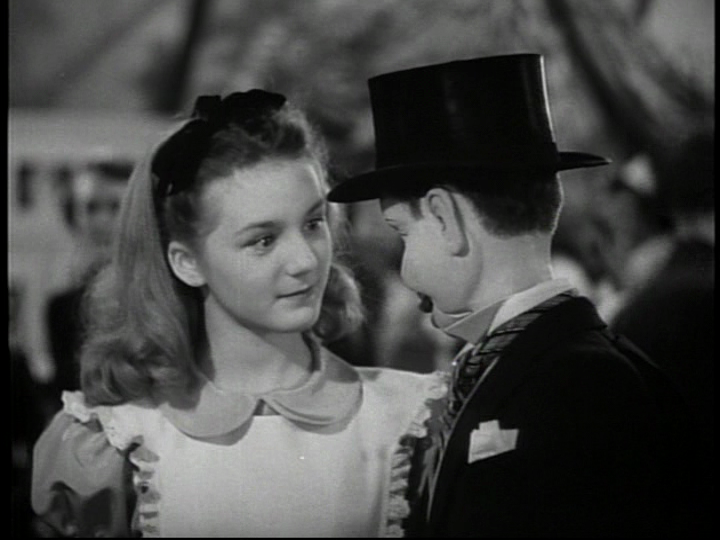
The special begins with Mortimer, Charlie, and Bergen getting ready to attend a tea party at the Walt Disney studios. On the way to the party, Bergen explains the story of Alice in Wonderland, as the voice for Alice has been asking to meet Charlie. They arrive at the studio, and find that Santa has left Walt a model train, which he is showing off to his guests. Walt introduces Kathryn Beaumont to Charlie, who is quite smitten with her on first sight.

Kathryn meets Charlie McCarthy, who is quite taken with the girl at first sight

Kathryn meets Charlie McCarthy, who is quite taken with the girl at first sight

Kathryn takes Charlie to meet Bobby Driscoll, who is surrounded by several girls asking for his autograph. Charlie is unimpressed with Bobby, even though Kathryn mentions that Bobby has won an Academy Award. As Bergen is explaining ventriloquism to the party guests, Walt asks him to sit down. As he does, he accidentally ends up sitting on Donald Duck, who loudly proclaims his pain by his squawking. Walt sends Donald downstairs, much to the disappointment of the guests. Walt then tells a story to the guests about a magic mirror, revealing that he has bought the magic mirror and unveils it to the guests. They call forth the slave of the magic mirror, who doesn’t react well to Charlie’s insults.

Walt then orders that whatever Kathryn wishes, the mirror should do. Kathryn then asks the mirror to see the “Silly Song” segment from Snow White and the Seven Dwarfs, and the mirror happily complies. After the segment, Charlie rudely asks to see a young actor known the world over, and although he speaks of himself, the mirror instead shows a scene from the Mickey Mouse short Clock Cleaners. After this, Kathryn talks to Bobby about what he wishes to see, and Bobby recalls the Uncle Remus stories from Song of the South. After showing the scene of B’rer Rabbit leaving the Briar Patch, Kathryn finds that they’ve been overworking the mirror, and everyone decides to take a break with a bottle of Coca Cola.

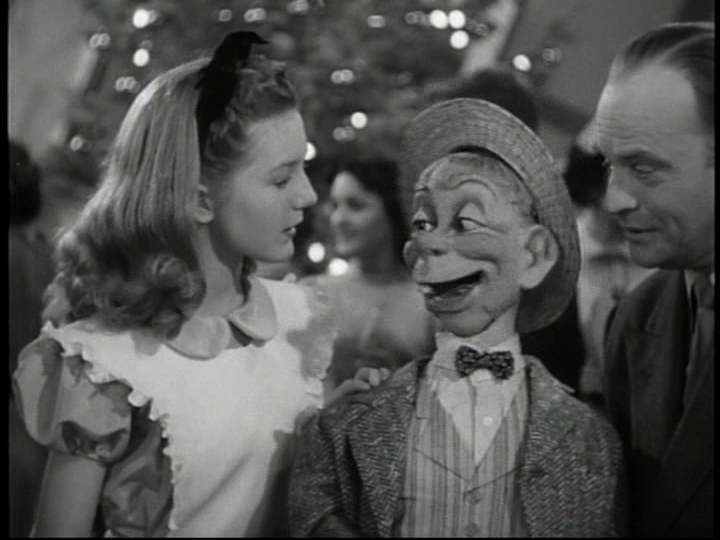
After others have had a chance, Kathryn asks Mortimer to request a vision from the magic mirror

After others have had a chance, Kathryn asks Mortimer to request a vision from the magic mirror

After the break, Kathryn convinces Mortimer to ask the mirror to see something, and the mirror shows the Pluto short film Bone Trouble. After this, Bergen wishes to see the Firehouse Five Plus Two, although he wishes to see them working hard as Disney animators rather than the band. Walt agrees that he wants to see this, and tells Bergen that the band members would never let the music interfere with their work. The mirror complies with Bergen’s request, and the guests are treated to an impromptu performance by the Firehouse Five Plus Two, who ignore their work to play their music as they think Walt is not watching. The men soon receive a note from Walt that they “look great,” and realize that the magic mirror is watching them. Everyone is disappointed that they are unable to see a clip from Alice in Wonderland, as the mirror cuts out before Ward Kimball can show them anything. The mirror makes excuses, as does Walt, but they finally agree to show a small snippet of the film after everyone begs. After the clip, Bergen, Charlie, and Mortimer head home, with Bergen being allowed to take home the magic mirror to keep an eye on Charlie and Mortimer.

December 12

December 12, 1952 – The Goofy Short Film How to Be a Detective is Released to Theaters

vlcsnap-2013-12-12-19h56m20s101

“Every large city offers a wealth of opportunities for a good private detective. The requirements for such a job are quite simple: item number one, he needs office space.”

On December 12, 1952, the Goofy short film How to Be a Detective was released to theaters. It was directed by Jack Kinney, with story by Dick Kinney and Brice Mack.

The short begins with a city at night, with several crimes being committed in one building. One small spot at the top of the building has an “Office to Let” sign, which is soon taken away and replaced with a sign for Johnny Eyeball, Private Eye. Johnny (portrayed by Goofy), has his reading of a Mickey Mouse comic interrupted by a mysterious woman who requests him to “find Al.” She pays him $100, and the police chief appears, telling Johnny to leave the case to the police. A shady weasel approaches Johnny with a gun soon after, and threatens him. Johnny then heads to Al’s Joint, disguised as an old man, but is quickly recognized.

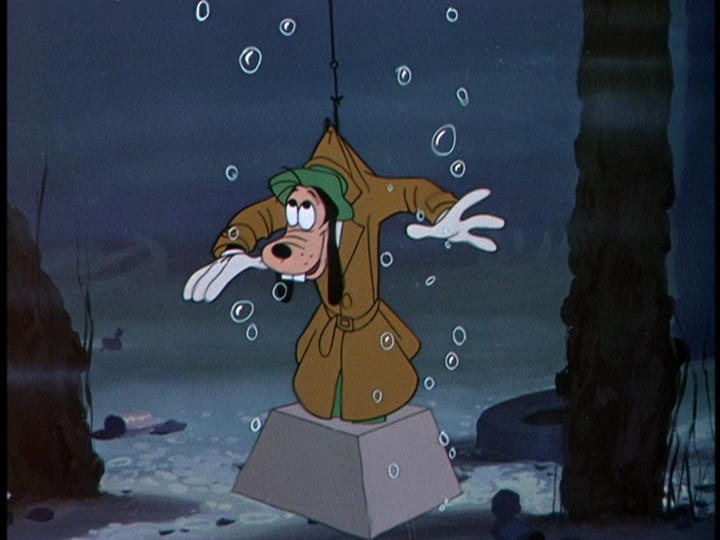
Johnny finds himself "sleeping with the fishes," but is soon pulled out by the police chief

Johnny finds himself “sleeping with the fishes,” but is soon pulled out by the police chief

When Johnny enters the bar, he asks the bartender for information on Al, bribing him with a dollar. The bartender drugs Johnny’s drink with “goof balls,” and Johnny soon finds himself in the bottom of the river wearing cement boots. The chief pulls Johnny out of the river and warns him again to let the police handle this case. Johnny then heads to the Chronicle’s files, but falls down an elevator shaft. He is then kicked out of the morgue, and tries to call the police. Everyone is on the Al case, and they follow a mysterious car in taxis from “Al’s Taxi,” but end up in various dangerous situations, including dodging trains and getting squished between two trucks. The chase continues for a while, which includes gunplay, when all three cars end up crashing into a hay bale. As the weasel, the woman, Johnny, and the police chief pop out of the hay, the woman takes the chief, who is the mysterious Al Muldoon they’ve all been searching for, by the ear and drags him into the nearby building of the Justice of the Peace, who happens to be the weasel. Johnny shrugs, and says simply that this case proves that crime doesn’t pay.

December 7

December 7, 1955 – The Disneyland Episode “The Goofy Success Story” Premieres

vlcsnap-2013-12-07-19h17m19s28

“He’s always been a modest, unassuming fellow, one who’s never let fame go to his head. So this program belongs to him.” – Walt Disney

On December 7, 1955, the Disneyland episode titled “The Goofy Success Story” premiered on ABC. The episode featured a fictionalized account of Goofy’s rise to stardom. Although his original name was “Dippy Dawg,” the name spelled out on his contract changes the spelling of “Dawg” to “Dog.” The episode was directed by Jack Kinney and Wolfgang Reitherman, and was written by Jack Kinney.

The episode begins with Walt introducing the special tribute to Goofy, who praises the character and leads into the animated story. The scene then opens on a theater, with curtains that pull back to reveal Goofy’s face, before revealing more and more curtains. Finally, the narrator takes the audience to Hollywood, where crowds are bustling about and talent scouts are everywhere, looking for the next big star. Goofy then is seen walking down the street, and has just enough money to buy a meal, but decides to spend his money on a Mickey Mouse film instead. As he sits in the theater and watches the short (the 1934 short film Shanghaied), his unique and loud laugh alerts the talent scouts.

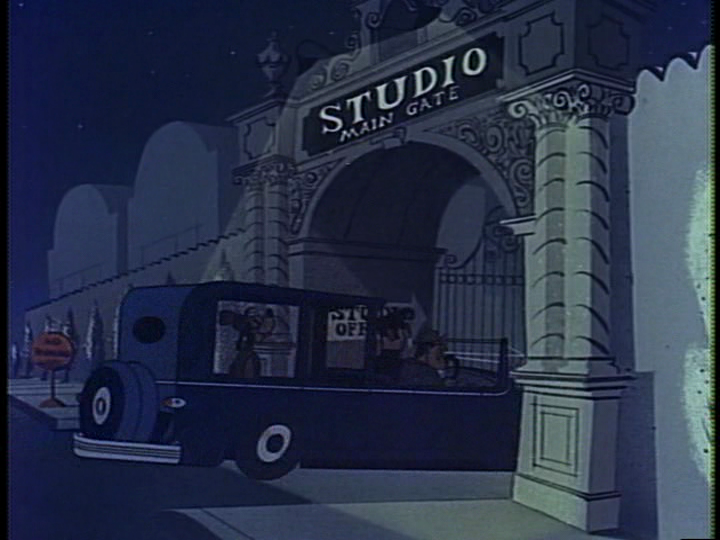
Goofy is soon whisked away to the studio with his "million dollar laugh"

Goofy is soon whisked away to the studio with his “million dollar laugh”

The talent scouts take him away to his first gig, which would eventually become the 1936 short film Moving Day. After the short ends, he is taken to the studio executive’s office to sign an iron-clad contract for $50 a week for 48 years, which he happily accepts. When he signs as Dippy Dog (his original name), the executives are unhappy with his name and decide to change it. The head executive comes up with the name “Goofy,” and Goofy happily accepts. He is paid his first paycheck, and left with nothing but a debt of $8. The executive then shows Goofy an actor’s progress chart, highlighting the rise and inevitable fall of an actor in a poetic fashion. Soon, Goofy is taken to his next picture, the 1937 short film Moose Hunters.

Goofy is soon seen on several magazine covers, and the audience is then taken to his mansion, the Hacienda Goofy. They view him in his bed, surrounded by several television cameras, which takes away all of his privacy, not that he seems to mind as he goes about his daily routine. After his morning swim, he then heads to the studio to film a new short, the 1950 short How to Ride a Horse, although it is seen that he annoys the horse before the short begins (which explains the horse’s distaste for Goofy during the short). After this, awards time has arrived in Hollywood, and Goofy readies himself to get an award, although he is dismayed to find that he has not won a single trophy, losing even to Pluto. He is soon seen alone in the theater, and leaves, depressed, walking out into the stormy streets, recalling his rise to stardom. He finds himself at the shore, and, thinking his life is over, hears the siren voice of the sea. However, he is interrupted by a telegram that provides him with the chance of a lifetime – the 1950 short film Motor Mania. The episode ends with Goofy finally winning his award.

November 3

November 3, 1950 – The Goofy Short Film Hold That Pose is Released to Theaters

vlcsnap-2013-11-03-19h25m49s65

“When the day’s toil is over, are you the type person who drags his weary body home, slumps into a chair feeling beat, bored, bushed, and listless? If so, you need a hobby!”

On November 3, 1950, the Goofy short film Hold That Pose was released to theaters. This short marked the first appearance of Humphrey the Bear, who went on to not only be Donald’s nemesis, but have a small series of his own in 1956 with two shorts: Hooked Bear and In the Bag. Hold That Pose was directed by Jack Kinney, with story by Dick Kinney and Milt Schaffer.

The short begins with Goofy falling to the floor after a long day’s work. He crawls into his home and makes his way to his chair while the narrator declares that he needs a hobby. The narrator thinks that Goofy should take up photography, and he soon picks up everything from the photo shop. He takes all the supplies home and creates his own home darkroom, although he electrocutes himself on the red light socket. He spends forever winding his camera roll, but when he finally does, he is able to take his camera outside.

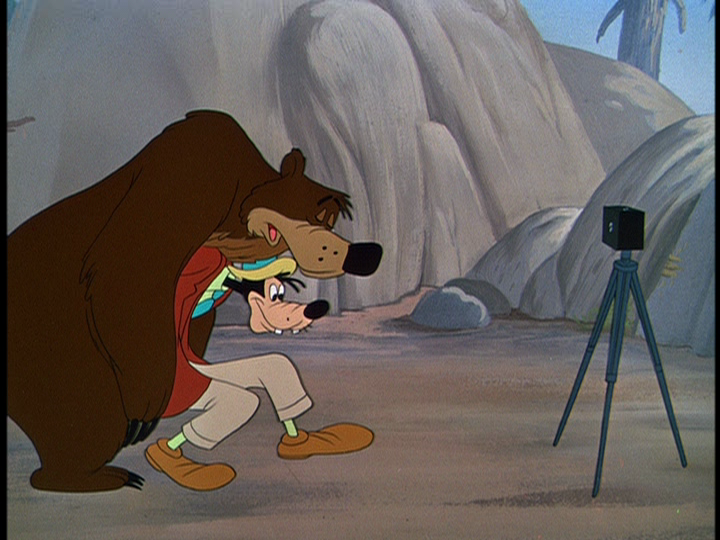
Goofy attempts to prop up the sleeping bear in the bear pit of the zoo for a photo op

Goofy attempts to prop up the sleeping bear in the bear pit of the zoo for a photo op

His first stop is the zoo, where he enters the bear pit, ignoring the signs to keep out. He then attempts to prop up Humphrey the Bear, who is fast asleep, and Humphrey falls on him. He finally gets Humphrey to stand up and stay in place, but for some reason his camera is shooting upside down. When he takes the shot with the flash powder, the powder blows up in Humphrey’s face, and sends Goofy fleeing for his life as Humphrey chases him all over the bear pit. Humphrey escapes the pit, as does Goofy, and continues the chase all over the amusement park. Goofy continues to shoot photos while he runs, even when he boards a taxi driven by Humphrey back to his own apartment. However, in the end, Humphrey and Goofy bond over the photos Goofy has taken, with Humphrey selling autographed pictures of himself for 10 cents.

October 23

October 23, 1953 – The Donald Duck Short Film Rugged Bear is Released to Theaters

vlcsnap-2013-10-23-18h21m34s193

“This is Bear Country: a quiet, peaceful part of the forest reserved exclusively for Mr. Bear.”

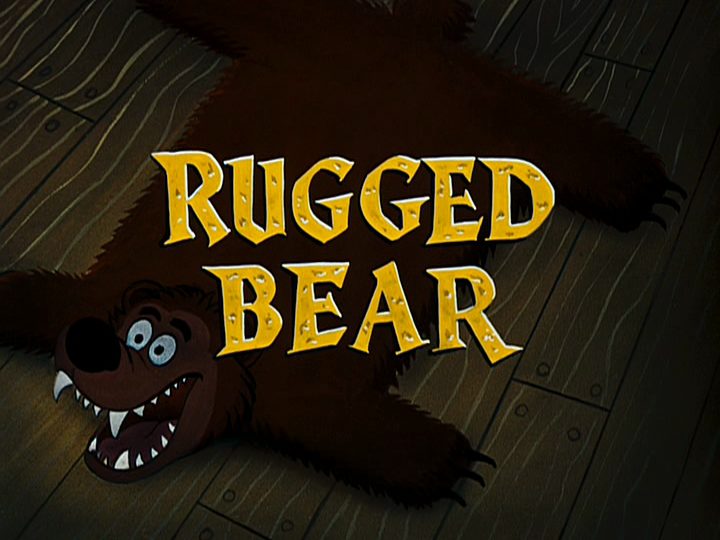
On October 23, 1953, the Donald Duck short film Rugged Bear was released to theaters. This marked the second appearance of Humphrey the Bear overall, and the second of five appearances in Donald Duck short films. The short was directed by Jack Hannah, with story by Al Bertino and Dave Detiege.

The short begins at a section of the forest for Bear Country, with dozens of bears sleeping soundly. The bears are alerted by the narrator that hunting season has begun, and while they all flee to their cave, Humphrey the Bear continues to sleep. He is soon woken up by flying bullets, and is locked out of the cave when all the other bears seal themselves inside. Humphrey runs crazily around the woods, dodging hunters, and comes across a house in the woods. Once inside, he realizes he’s in a hunting cabin, with guns and stuffed bear heads on the walls. As he tries to escape, he sees Donald walking to the house, holding a shot gun. He frantically tries to hide, and disguises himself as a bearskin rug.

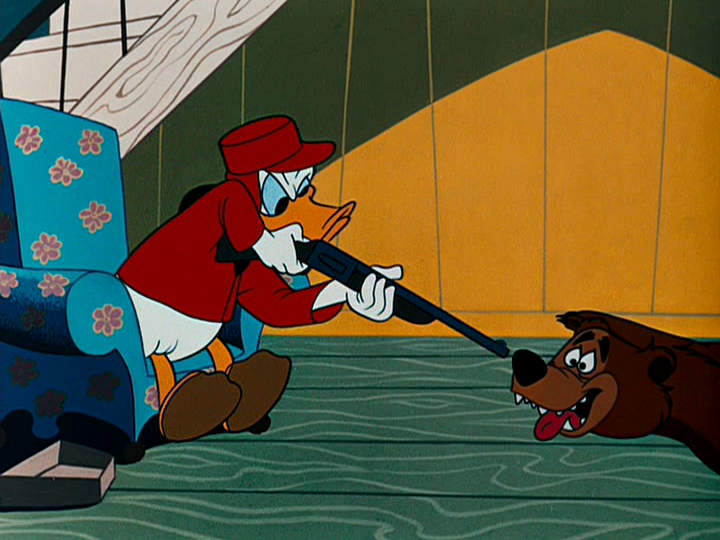
Donald pretends to shoot his bearskin rug, making his "rug" rather nervous

Donald pretends to shoot his bearskin rug, making his “rug” rather nervous

Donald wipes his feet on the nervous bear’s back, and as he sits to clean his shotgun, he pretends to shoot the rug, which causes Humphrey to nearly panic. As Donald decides to light a fire in the fireplace, he uses Humphrey’s nose to light his match. Humphrey barely suppresses a yelp, and when he looks behind him to see where Donald (and, more importantly, the gun) is, he gets his nose stuck in the barrel and has to quietly follow Donald through the house. He manages to free himself when the kitchen door is slammed in his face, and when he tries to sneak away, he finds that hunting season is still occurring, and has to stay inside to stay safe.

Donald returns from getting his snack, and sits on Humphrey’s back in front of the fire. After swallowing a stray bit of Donald’s popcorn, Humphrey gets the hiccups; fortunately, Donald thinks he has the hiccups instead of his rug. After getting a drink of water, Donald returns and decides to take a nap on his rug. A stray spark from the fire jumps out and lands on Humphrey’s back, and he catches on fire, but he masks his scream by turning up the radio, waking Donald, who quickly puts the fire out. Seeing the mess this caused, Donald throws Humphrey into the washing machine. Poor Humphrey emerges after the dry cycle as a giant fur ball, which Donald remedies by cutting off his hair with a yard trimmer. Donald then curls himself up in the rug to fall asleep, much to Humphrey’s dismay.

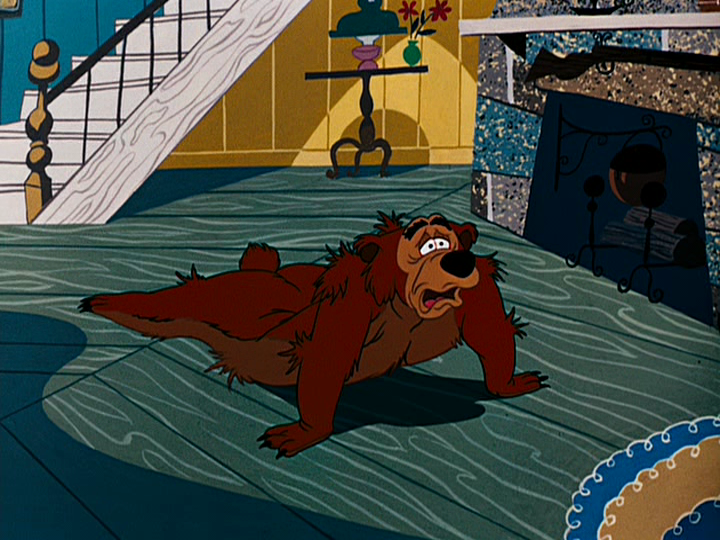
Humphrey is relieved that Donald has left for the season

Humphrey is relieved that Donald has left for the season

Hunting season soon ends, and the bears clean up the mess the hunters left behind. Donald leaves his hunting cabin, and Humphrey, looking more than a little worse for wear, is relieved that he can finally escape. He hears a strange knocking from the wood box near the fireplace, and is surprised to find that the bear rug he’d rolled up and replaced at the beginning of the season was, in fact, another live bear, who thanks Humphrey for hiding him and taking his place. Humphrey looks at the camera with bloodshot eyes, a look of disbelief on his face.