RSS Feed

Tag Archives: 1940s

March 5

March 5, 1948 – The Donald Duck Short Film Drip Dippy Donald Premieres in Theaters
vlcsnap-2015-03-05-18h55m02s82

“I’m so sleepy…”

On March 5, 1948, the Donald Duck short film Drip Dippy Donald premiered in theaters. It was directed by Jack King, with story by Nick George.

Late one evening, Donald is on the bus, snoring away, when he is dropped off at his house. Exhausted, Donald sprints off the bus and goes through his routine before settling into bed. Unfortunately, he is unable to sleep thanks to a lighted advertisement from down the street shinging through his window. He pulls down the blind, but the blind rolls almost instantly back up. He ties the string to the blind down, but moments later, the blind pulls itself back up. When Donald pulls it down for a third time, he pulls it so hard that it comes off the wall. Annoyed, he finally nails it down, and proceeds to drift off to a deep sleep. No sooner has Donald finally settled in that his faucet starts dripping loudly, waking him up once again. The faucet noise starts to taunt him, and he rushes out of bed to turn it off. He then gets back in bed, eyes heavy, but the faucet drips faster than ever, dripping onto his dishes. As he rolls up in his mattress, the drips seem to grow in intensity, sounding like bombs and being strong enough to shake his entire house. Unable to take it anymore, he tries again to turn off the faucet, but ends off breaking off the tap and falling into the sink. He then tries several methods to keep the water from dripping loudly, but none seem to work. In the end, Donald comes up with a rather complicated Rube Goldberg-like contraption to capture each drop of water in a sponge, when his phone rings, letting him know that as he hasn’t paid his water bill, his water has been cut off. Sleep-deprived to the point of madness, Donald hits himself over the head with the phone and his sponge.
 

February 11

February 11, 1949 – The Donald Duck Short Film Donald’s Happy Birthday is Released to Theaters

vlcsnap-2015-02-11-18h17m55s66

“Take my advice, do as I say, save a little money for a rainy day.”

On February 11, 1949, the Donald Duck short film Donald’s Happy Birthday was released to theaters. It was directed by Jack Hannah, with story by Nick George and Bill Berg.

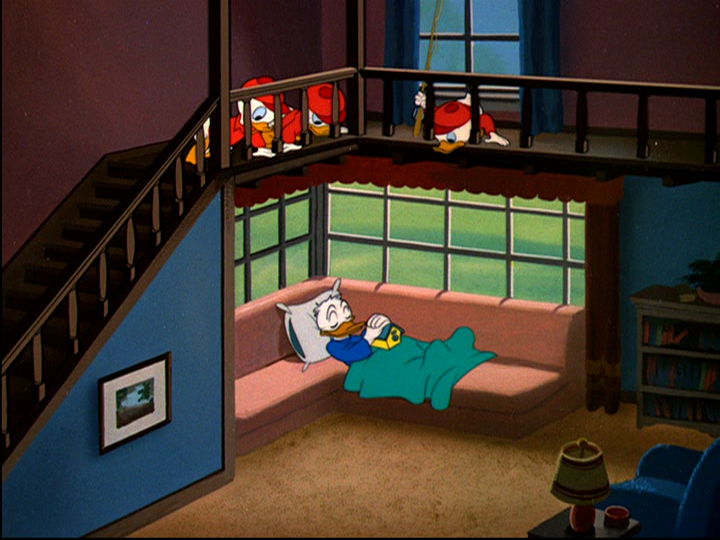
It’s March 13th – Donald’s birthday – and the nephews are squirreled away in their treehouse, trying to figure out what to get their uncle. Finally, they agree on getting Donald a box of cigars, only to realize they don’t have any money. They then decide to do all the yard work, hoping that Donald will give them some money, and end up waking him from his nap in their zeal to clean up his garden. Donald is shocked to see his nephews working, and the boys present him with a bill for $2.98 – the amount for the cigars. The boys are excited and are ready to leave the house, but Donald demands that they put the money in a bank. As Donald heads back to his nap, the nephews sneak in to take the bank, unaware that Donald was awake the entire time.

The boys go to extreme lengths to get their money for Donald's present

The boys go to extreme lengths to get their money for Donald’s present

The boys head back to the treehouse, and Donald spies on them, suspicious. He sneaks inside and catches them in the act of taking money from the bank, and chews them out before taking the bank back inside. The nephews refuse to give up, and decide to try and take it using a fishing rod to lift it out of Donald’s grasp. They manage to get the money after bungling the job, and Donald spies the boys walking out of the cigar store. He catches them in the act, and decides to teach them a lesson about the dangers of smoking by making them smoke the cigars. Unfortunately, after Donald has cleared out the box, he finds the birthday card from the boys. Donald has totally forgotten it’s his birthday, and is so embarrassed at his antics that he shrinks down in shame and jumps out a hole in the treehouse floor.

January 23

January 23, 1942 – The Donald Duck Wartime Propaganda Short Film The New Spirit is Delivered

vlcsnap-2015-01-23-18h14m36s227

“Oh boy! Taxes to beat the Axis!”

On January 23, 1942, the Donald Duck wartime propaganda film The New Spirit was delivered to the Treasury Department under the support of the War Activities Committee. It was directed by Wilfred Jackson and Ben Sharpsteen. This was the first propaganda film for the US Government by the studio since the country’s entry into World War II, and the Treasury Department hoped that Disney could provide a start of the new Revenue Act of 1942 and apply the funds directly to the war effort. The Department paid $40000 for the film, asking for a very short time frame to have the film ready no later than February 15. Although there was concern about using Donald Duck for the short film, Walt had argued that using Donald was similar to MGM using Clark Gable, and Department Secretary Morgenthau agreed. Donald was seen as a cathartic character for most Americans, and his anger and patriotism resonated with a public still reeling from Pearl Harbor.

While Morgenthau was excited about the film, Congress voted to eliminate the $80,000 appropriation the Treasury had submitted to pay for the film and its marketing, as many anti-Roosevelt members thought it was a waste of money and nearly marked Walt as a war profiteer. Fortunately for the studio, The New Spirit resonated with audiences, and was hailed by the media as “an excellent bit of persuasion,” as written by the Chicago Herald-American. A survey was conducted, and 37% of those that had seen the short said it had an effect on how willing they were to pay their taxes, with further members of the audience praising the film and criticizing Congress for its failure to pay the Studio. The New Spirit was also nominated for an Academy Award for Best Documentary at the 15th Academy Awards.

Donald is ready and willing to do whatever it takes to win the war

Donald is ready and willing to do whatever it takes to win the war

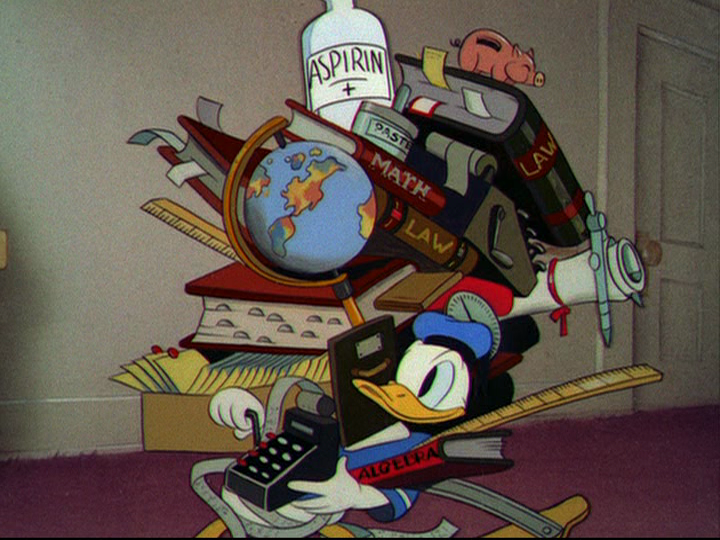
The song “Yankee Doodle Spirit” is playing on the radio, with Donald dancing to its patriotic rhythm. As he listens to the radio program, Donald quickly readies himself for the threat of war. The radio announcer declares that there is something Donald can do for the war effort, and Donald states he will do anything. When Donald hears that the best thing he can do is pay his income tax, at first he is dismayed. The announcer goes on to say that his income tax is vital to the war effort, as the taxes pay for supplies for the troops to beat the Axis Powers. A new simplified form is presented, which is really all that Donald will need, along with a pen, ink, and a blotter. Donald fills out the form, and finds that he owes $13 for his taxes. He is so excited to pay his taxes that he races across the country to Washington DC to pay them in person. The announcer continues with what the taxes will be used for: factories that will make the ammunition and weapons for the soldiers, planes, and battleships.

January 14

January 14, 1949 – The Pluto Short Film Pueblo Pluto is Released to Theaters

vlcsnap-2015-01-14-19h31m47s254

“What’s the matter, old boy? Didn’t you get any souvenirs?”

On January 14, 1949, the Pluto short film Pueblo Pluto was released to theaters. It was directed by Charles Nichols, with story by Eric Gurney and Milt Schaffer.

Out in the desert, Mickey and Pluto speed up to a small tourist town to check out some souvenirs. Mickey spots some buffalo bones, and decides to get one for Pluto before going shopping. Pluto enjoys his bone, until he spots a puppy also trying to enjoy the bone as well. Pluto chases the puppy away, but the puppy decides to steal the bone by using his tail through the floorboards. Pluto chases after the bone, but loses it to the puppy, who then hides among some clay pots. The puppy manages to roll away, but Pluto refuses to lose, and continues to chase the puppy through the desert, until the puppy squeezes into a cactus patch. All Pluto can do is bark from the top of a rock formation, until it breaks from his jumping, sending him into the center of the patch and retrieving his bone. Unfortunately, Pluto has no safe way of getting out, until the puppy comes along to help him. The puppy manages to snake his way out, and uses a rolling clay pot to break a hole through the cactus patch, allowing Pluto to safely get out. Grateful, Pluto shares his bone with the puppy, and takes him home as a souvenir.

January 11

January 11, 1942 – The Wartime Donald Duck Short Film Donald’s Decision is Delivered

vlcsnap-2015-01-06-08h14m30s19

“Enlist in our army of regular war savers today!”

On January 11, 1942, the Donald Duck and educational wartime short film Donald’s Decision was delivered to the National Film Board of Canada. The short reuses animation from two previous Donald shorts: 1938’s Donald’s Better Self, and 1938’s Self Control.

Donald is listening to a radio program urging him to buy war savings certificates, and Donald readily agrees – to do it tomorrow. Donald’s angelic side appears and demands that Donald do it now, as there is no time to waste, and Donald reluctantly follows him. The flag on his mailbox swings around to symbolize the Nazi swastika, announcing the arrival of his devilish side, who tries to convince Donald that the money would be better spent on himself, which would help the Axis powers. Donald is soon caught in a tug of war between the angelic and devilish side. The devilish side traps the angelic side and throws him in the nearby lake, but the angelic side fires back, defeating the devilish side. Donald finally agrees to take his money to the post office to buy war bonds. This is then followed by an animated plea to the citizens of Canada to buy war savings certificates.

January 7

January 7, 1944 – The Special Wartime Short Film The Pelican and the Snipe is Released to Theaters

vlcsnap-2015-01-04-16h11m08s32

“Whenever Monte dreams he’s a dive bomber, it’s little Vidi’s job to pull him out of dives.”

On January 7, 1944, the special short film The Pelican and the Snipe was released to theaters. The short was meant to be included as a segment in The Three Caballeros, but was released as a short film instead. It was directed by Hamilton Luske, and narrated by Sterling Holloway.

The short takes place in Montevideo, Uruguay, at a small lighthouse. Monte the Pelican and Vidi the Snipe have a job watching from the top of the lighthouse, but Monte has a major problem – he flies in his sleep. Vidi is tasked to watch over Monte while he sleeps. Poor tired Vidi falls asleep at one point, and that’s when Monte, dreaming that he’s a dive bomber, dives off the side of the lighthouse. Vidi quickly chases after him, preventing Monte from crashing into several large jagged rocks, flying into a shark’s mouth, and other spectacular scrapes. Night after night, Vidi watches over Monte, with Monte never knowing a thing. In the morning, Monte is annoyed when he finds Vidi so exhausted and sleeping. Poor Vidi can’t sleep during the day, however, thanks to the planes performing maneuvers around the lighthouse.

Vidi's plan to keep Monte in place backfires, and Vidi is taken on a ride

Vidi’s plan to keep Monte in place backfires, and Vidi is taken on an exhausting ride

The next night, Vidi thinks he’s found a solution by tying one of Monte’s legs to one of his. However, all this does is pull Vidi along for the ride when Monte takes off for his sleep-flight adventure. Vidi manages to use the rope to keep Monte out of trouble, but poor Vidi is still exhausted. He comes up with one idea after another, but none of them seem to work, save for connecting Monte to an anchor. Unfortunately, Monte pulls the anchor off when he take flight, and lands in the ocean. Thinking that Vidi has just been playing pranks on him, Monte plans on getting even. Vidi tries to explain, but Monte doesn’t give him a chance to talk, and banishes a heartbroken Vidi from the lighthouse. That night, Monte’s problem resurfaces, and he starts soaring around with the air force, and gets his tail hit by one of the propellers. This jolts him awake, and then it finally dawns on him that he’d been flying in his sleep, and Vidi was only trying to protect him from harm. He then notices Vidi fast asleep on the target for bombing practice, and rushes to save the poor snipe from getting blown to smithereens. In the end, the two find a good solution – they tie Monte’s leg to the lighthouse, letting him circle around the lighthouse in his sleep to his heart’s content.

December 29

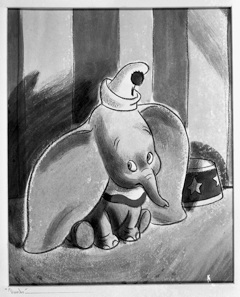
December 29, 1941 – Time Magazine Features a Review of Dumbo

Image taken from the Walt Disney Family Museum

Image taken from the Walt Disney Family Museum

“Now, more than ever, Americans were thankful for what they were about to receive. They were thankful, too, for Dumbo.”

On December 29, 1941, Time Magazine featured a further review of the animated feature film Dumbo, which was released in October of 1941. Critical and public reaction to the film was overwhelmingly positive, and Time Magazine, which had a review of it in October, decided to dedicate the December issue to Dumbo, calling him “Mammal of the Year.” However, due to the events of Pearl Harbor on December 7, 1941, the cover was soon replaced with General Douglas MacArthur, as it was felt that the planned cover might trivialize the struggles of the nation. Thanks to Dumbo’s popularity, the section for the elephant was moved to the cinema section, complete with a behind-the-scenes look at the character and his story that inspired a nation.

December 24

December 24, 1948 – The Donald Duck Short Film Tea for Two Hundred is Released to Theaters

vlcsnap-2014-12-24-20h03m53s25

“Come out of there, you rats! I’ll get ya!”

On December 24, 1948, the Donald Duck short film Tea for Two Hundred was released to theaters. It was nominated for an Academy Award, but lost to the Tom & Jerry short film The Little Orphan. It was directed by Jack Hannah, with story by Nick George and Bill Berg.

On a beautiful day in the mountains, Donald sets up his picnic at his campsite, when the attention turns to the line of ants marching past his picnic blanket. He starts having a bit of fun with one of the ants, with the poor ant struggling to carry all the weight Donald places on its back. The poor ant finally falls, but realizes that Donald is in the possession of some wonderful food. He tells the other ants, and they all set forth to claim the food Donald has laid out. As Donald is taking a nap, the ants stage their attack, working as a team to carry Donald over a cliff while they claim his picnic basket as their own. Donald chases after the ants, trying to reclaim his food, although he struggles as they smartly make their way past him and into their anthill. When he reaches into the anthill, the ants steal his shirt, leaving him embarrassed. As a last resort, he sticks several sticks of dynamite in their anthill, not realizing until it’s too late that he has blown himself off the cliff. The short ends with the ants enjoying one of the cupcakes Donald packed.

December 13

December 13, 1940 – The Donald Duck Short Film Fire Chief Premieres in Theaters

vlcsnap-2014-12-13-17h53m27s13

“So, they was trying to get something over on me.”

On December 13, 1940, the Donald Duck short film Fire Chief premiered in theaters. It was directed by Jack King.

Donald is sound asleep at his fire station, with his snoring waking his nephews. Irritated, they use their slingshots to hit the alarm, waking Donald and sending him flying to his fire truck. He almost starts the engine when he hears his nephews laughing, and realizes he’s been tricked. When he rushes back upstairs to reprimand them, he finds that they’re already asleep. Knowing that they’re just faking it, he decides to get them back, and blows a trumpet to call them to attention, and having them march in step. Unfortunately, as Donald is marching backwards, he falls right through the hole for the fireman’s pole. One of the nephews, not paying attention, crashes into the other two, and all three fall down the hole on top of Donald. He soon sends them to their posts, although he is very critical of the way one of them places coal in the fire. When Donald dumps all the coal in the boiler, the fire becomes intense to the point where the ceiling catches fire, and the alarm sounds. Unaware that it is his own building that it on fire, Donald readies his team. The nephews try to tell Donald that the fire house is on fire, but Donald doesn’t notices until he’s already halfway down the street.

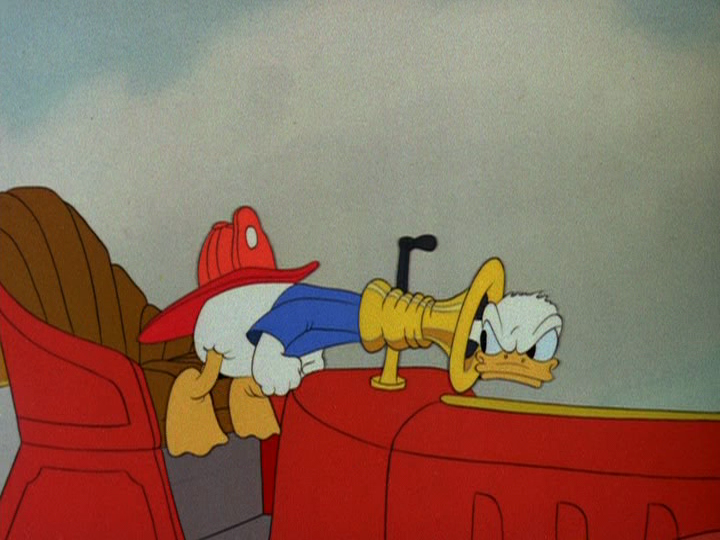
Donald rushes back to the fire at his own station, only to get stuck in the horn after he comes to a sudden stop

Donald rushes back to the fire at his own station, only to get stuck in the horn after he comes to a sudden stop

When Donald makes it back, he gets stuck in the horn, until his nephews get him out. He gets on the ladder and tells the boys to send him up, and they send him up so fast that the ladder disconnects, and Donald is sent high into the sky. He falls to the ground, and the boys are ready with the net, but Donald falls through the chimney of the fire station and into the stove. Donald continues to sound the alarm, and the boys work to put out the fire while Donald stays stuck in the stove. Donald finally manages to break free, but runs into more trouble with the fire house, which ends up knotted and building up behind him. The hose bursts from the water and the pressure, sending Donald flying into a bicycle store. He makes his way back and attempts to take over, although he mistakenly attaches the fire hose to a gasoline pump rather than the fire hydrant. The boys make a run for it, and Donald burns the firehouse, his fire truck, and his helmet to the ground.

December 7

December 7, 1945 – The Pluto Short Film Canine Patrol is Released to Theaters

vlcsnap-2014-12-07-19h34m21s205

On December 7, 1945, the Pluto short film Canine Patrol was released to theaters. The wartime short was dedicated to the dogs of the United States Coast Guard. It was directed by Charles Nichols, with story by Harry Reeves and Tom Oreb.

At a U.S. Coast Guard Patrol Station, Pluto starts his patrol of the beach, when he trips over a spot in the sand. The spot turns out to be an egg buried under the sand, and the egg hatches to reveal a baby turtle. The turtle trips over himself and lands on Pluto’s nose and, thinking Pluto is his mother, nestles up to the dog. Pluto is flattered at this, but is soon alarmed when the turtle heads into the water, not heeding the “no swimming” sign. Pluto then takes the turtle outside of the post, near the “no trespassing” sign, warning him to stay away. The turtle continues to try and walk in, but Pluto comes up with a plan to get the turtle to leave on his own. It works, until the turtle realizes he’s walking towards a farm, and decides to head back to Pluto, who has gone back on patrol. Pluto hears the turtle try to sneak back into the station, and watches the turtle struggle as it sits on his shell, unable to move. The turtle, however, is rather resourceful, and finds a way to move to the shore. Pluto tracks after him and finds a large area of rocks. He searches under each one and, unable to find him, finally sees him swimming joyously. Pluto once again tries to push the turtle out, and doesn’t notice the sign for quicksand. He soon finds himself stuck while the turtle swims around without a care. Seeing Pluto sink into the quicksand, the turtle is alarmed, and grabs Pluto by his collar to pull him out. When that fails, he bites Pluto’s tail, causing the dog to jump out of the quicksand thanks to the pain. The short ends with the turtle pulling Pluto in an inner tube along the shore while swimming away happily.