RSS Feed

February 5

February 5, 1953 – Peter Pan is Released to Theaters
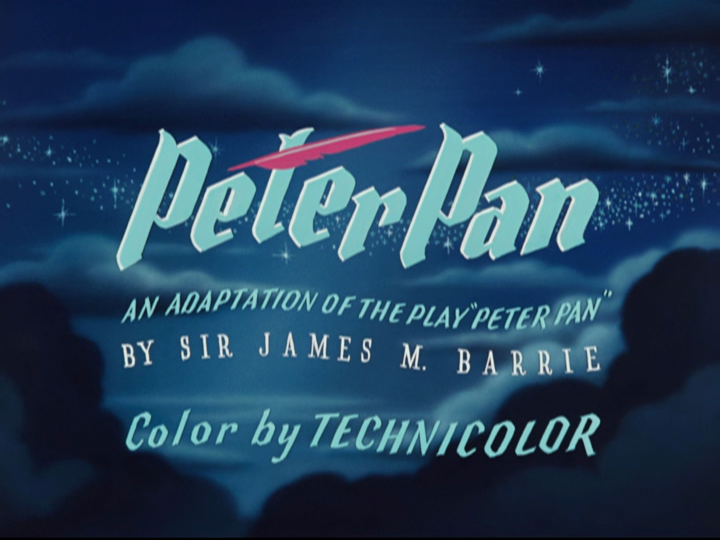
“The Disney version of Peter Pan has another interesting first: it’s the first time a boy was shown as Peter Pan. There’d been a tradition, from the time of Maude Adams on the stage…of women playing Peter Pan. But it was…a tradition that was broken by Walt Disney by showing Peter Pan as a boy. Now, it’s an animated boy, but was really a boy’s voice and he was depicted as a boy, which is what he’s supposed to be.” – Leonard Maltin, Film Critic.

The road to Peter Pan’s release on February 5, 1953, was a long one: production started as early as 1935, with Walt planning to make it his second animated film after Snow White and the Seven Dwarfs. Disney acquired rights to Sir James M. Barrie’s play from the Great Ormond Street Hospital in London (to which Barrie had bequeathed the copyright) in 1939, but the advent of World War II halted production of the film.

In the 1950s, Disney decided it was time to bring the film back into production. Starring Bobby Driscoll as Peter, Kathryn Beaumont as Wendy, Hans Conried as Captain Hook and Mr. Darling, and Bill Thompson as Mr. Smee, the film was directed by Hamilton Luske, Clyde Geronimi, and Wilfred Jackson.

Disney first learned of the story of the boy who never grew up when he saw a touring production of Peter Pan in 1913, and he later starred as Peter Pan in a local production of the play. With almost two decades in development at Disney, the story went through many different treatments, ranging from a first, very dark version—much darker than the original play, and more sinister than a typical Disney feature—to the final product. Disney was determined to release Peter Pan as an animated feature. “The cartoon method gave us many advantages over the stagecraft of Barrie’s day,” Disney once said, “which no amount of pixie dust could cure.” Through animation, many of the play’s conventions could be abandoned: Nana could be shown as a dog instead of a person in a dog costume, the characters could fly realistically without any visible wires or tricks, and the biggest change of all, Tinker Bell was a fully formed physical character, rather than a speck of light traveling across the screen. Through the casting of Bobby Driscoll as the title character, Disney was also able to present Peter as the boy he was supposed to be, rather than a woman playing a young boy. The film was a success upon its first run in 1953, and was rereleased several times in theaters, with its first video release in 1990.
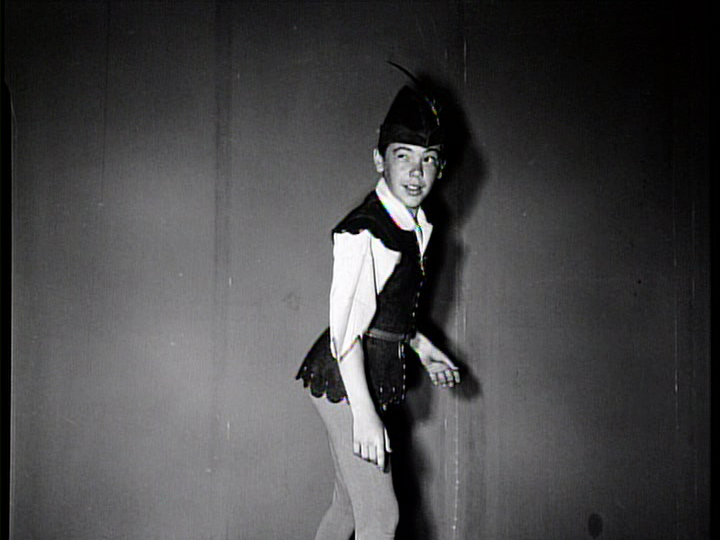
Bobby Driscoll, voice of Peter Pan, dressed for the live-action reference film

Although the actors are only heard on screen as the characters, they actually had to film a second, live-action version of the film for the animators to study. The actors dressed up and performed various scenes to show the animators the action taking place and the small, yet significant, details with each action, such as a turn of the head or how Captain Hook  would hang from a cliff by one hand. “The audience always got confused when we talked about live-action help,” animator Frank Thomas explained, “and we’d say, ‘Well, an artist needs a model, you gotta have something to guide you.’ But it’s also very helpful in little ways of a guy turning and looking back over his shoulder, how far did he turn his head. And you find if you’ve got the real person do it, you saw their arm here would come out as he’d turn, or have something come up to his chin, or some little thing you hadn’t thought of. And very often, that would make the scene come alive.”

Hans Conried as Captain Hook, in a live-action reference still

Frank Thomas was assigned the role of animating Captain Hook, with Milt Kahl animating Peter Pan, and Marc Davis designing and animating Tinker Bell, a character with no lines. “She’s a pure pantomime character, which in itself I think is rather interesting,” Marc Davis said. The various story sketches of Tinker Bell over the years changed in little details, but throughout all the concept drawings, she was a representation of the current ideal of feminine beauty. One persistent rumor is that Tinker Bell was based on Marilyn Monroe. Monroe was just beginning her career when Peter Pan was in production; the Disney animators wouldn’t have been aware of her enough to base a character on her. The actual person who stood in as the live reference model for the pixie was actress Margaret Kerry, who won the role after performing the scene where Tinker Bell preens in a mirror, only to be alarmed at the size of her hips. “They knew that I had the imagination that they needed,” Kerry said, speaking of her audition.

The music of Peter Pan is rather interesting, as many songs were used but ended up on the cutting room floor. One song that is still heard throughout the score, although the actual song was cut, is the crocodile’s theme, also known as “Never Smile at a Crocodile,” which would later go on to be used in a first season episode of The Muppet Show, starring Sandy Duncan. The most famous song from the film, “The Second Star to the Right,” was actually not written for the film; on the contrary, the song was written for Alice in Wonderland, and was known as “Beyond the Laughing Sky.” Another song that was written, but eventually replaced, was known as “The Pirate Song,” which had been storyboarded and demo recorded. The song was sung by the pirates as they try to convince the Lost Boys to join Captain Hook’s crew. The song was eventually replaced by “The Elegant Captain Hook,” which was a shorter song, but has a bit more of a jolly feeling around it.
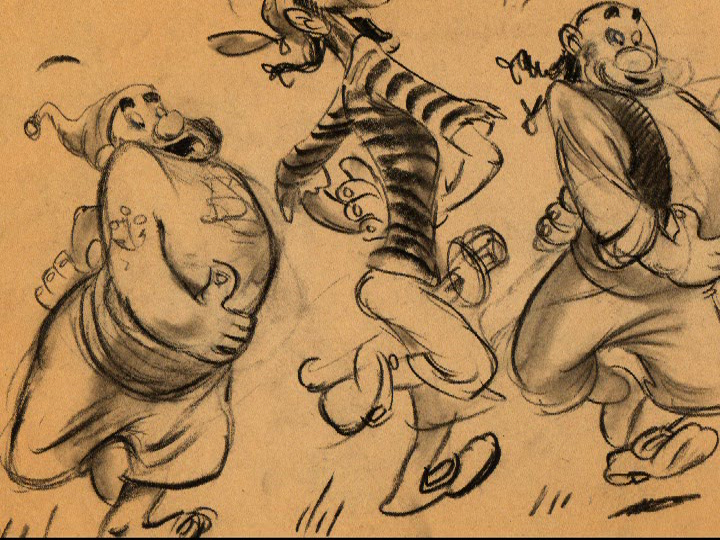
A storyboard picture from the cut song "The Pirate Song," which was replaced by "The Elegant Captain Hook"

The color stylings went through many artists’ hands during the development process. In the 1930s and 1940s, renowned British artist David Hall created beautiful watercolor treatments of the story; he also did extensive work on Alice in Wonderland for the studio. The color styling that is the final film, however, was the work of Disney artist Mary Blair. Her concept art not only influences the color pallet of the film, but also helped identify the moods of certain scenes, including the scene in Mermaid Lagoon where the skies suddenly darken upon the arrival of Captain Hook. Blair’s art for this film was so popular that Disney released a pin set of images from her concept art to honor the 50th anniversary of the film in 2003.
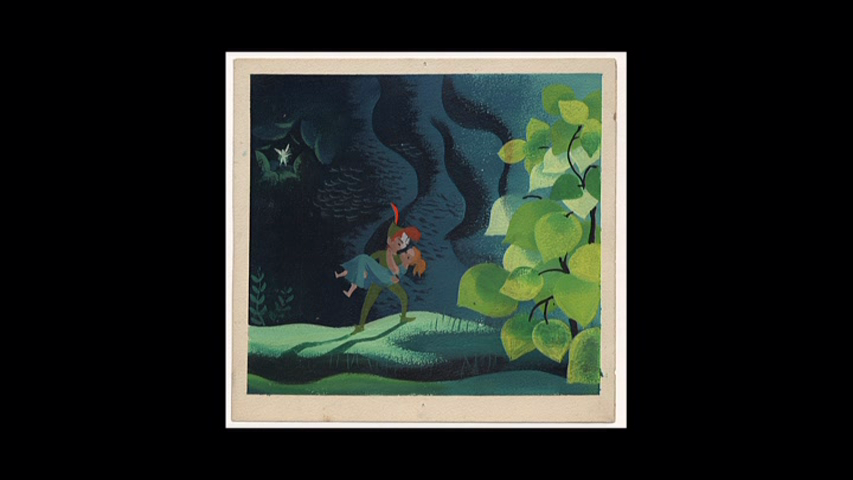
An example of concept art by Disney artist Mary Blair. Notice the color stylings of the characters, and how they compare with the color palate of the film

The story begins with a look at the Darling family, and the narrator explains what each member thinks of the story of Peter Pan. Mary Darling, the mother, believes Peter to be the spirit of youth. George Darling, the father, “Well, Mr. Darling was a practical man,” the narrator informs us. John and Michael Darling believe that Peter is a real person, making him the hero in all of their nursery games. Wendy Darling, the eldest child, not only believes in Peter Pan, but is also regarded as the expert on Peter and all of his adventures. And Nana, the nursemaid, “being a dog, kept all her opinions to herself, and viewed the whole affair with a certain…tolerance.” Mr. Darling, annoyed by Wendy’s constant stories of Peter Pan, decides that it’s time for her to grow up, and that this night would be her last in the nursery. Wendy doesn’t want to leave, especially since Nana has stolen Peter Pan’s shadow, and Wendy wants the nursery window left unlocked in case Peter returns to retrieve it. A worried Mrs. Darling tries to diffuse the situation, and as she and Mr. Darling rush off to a party, her fears are confirmed—the audience sees Peter on the roof of the Darling house.

The most famous image of Peter perched on the roof of the Darling's house

When the children are asleep, Peter enters the nursery and searches for his shadow. Tinker Bell, Peter’s companion, finds it in a drawer, and as it escapes, she is trapped inside. Peter’s pursuit of his shadow around the room turns into a brawl that wakes Wendy. When she sees him trying (and failing) to reattach his shadow with soap, she offers to sew the shadow back on. As she sews, she asks how he lost his shadow in the first place. Peter replies that he comes by the house to listen to the stories. When Wendy tells him that there will be no more stories because she has to grow up and leave the nursery, an angry Peter decides that the only course of action is to take her away to Never Land, where she can continue telling stories to him and the Lost Boys. Thrilled, Wendy offers to give Peter a kiss – an action that causes an alarmed Tinker Bell to finally break out of the drawer and attack Wendy, pulling her hair. As Peter tries to catch Tinker Bell, he accidentally wakes Michael and John, who, excited about the prospect of playing games and fighting pirates, beg to go to Never Land too. Peter agrees to take them all, and teaches them how to fly with faith, trust, and a little bit of pixie dust, and off they go into the London night sky.

The audience’s first view Never Land is a pirate ship, where the crew is sitting restless, wishing that Captain Hook would give up his silly pursuit of Peter Pan and take them back to open waters to pillage and plunder again. Hook instead comes up with a plan to capture the Indian princess, Tiger Lily, and force her to tell them where Peter Pan’s hide out is. In an exchange with his first mate, Mr. Smee, Captain Hook reveals the reason for his pursuit: once when he and Peter Pan were fighting, Peter cut off Hook’s hand (which the pirate has since replaced with a hook) and fed it to a crocodile, who liked the taste of Hook so much that he follows him around hoping to devour the rest of him. Smee tries to talk Hook out of his vendetta, but the moment another crewmember announces sight of Peter Pan, Hook decides to attack him with cannon. Peter orders Tinker Bell to take Wendy and her brothers to safety as he distracts Hook, but Tinker Bell rushes off with other plans.

Tinker Bell finds her way quickly to the hideout of the Lost Boys, and tells them that Peter has sent orders to shoot the fast approaching “Wendy Bird.” Eager to please their leader, the boys rush out and throw various sticks and stones at Wendy, and she falls to the ground. Luckily, Peter arrives just in time to catch her. When the Lost Boys reveal Tinker Bell’s lie, Peter banishes the fairy forever, but makes it a week when Wendy makes a plea on Tink’s behalf. He offers to show Wendy the island, while John leads the Lost Boys on a search for the Indians.

Captain Hook and Smee with the captured Tiger Lily. The coloring was taken from a piece of concept art by Mary Blair

As Peter and Wendy visit the Mermaid Lagoon, they find Hook in a rowboat with the missing princess, and discover that unless Tiger Lily reveals Peter Pan’s hideout, Hook will drown her. Following a sword fight with Hook, which ends with the pirate hanging on a cliff by his hook, with the crocodile waiting impatiently and hungrily below, Peter saves Tiger Lily and takes her back to her camp, with Wendy, forgotten by Peter, trying to fly behind them.

That evening, as Hook sits in his cabin with a horrible cold, humiliated by losing once again to Peter Pan, Smee tells him that “the cook told [him], that the first mate told him, that he heard Pan has banished Tinker Bell.” This reinvigorates Hook, who plans to use Tinker Bell’s jealousy to help him discover Peter Pan’s hideout: “a jealous female can be tricked into anything.” Meanwhile, the Indians are rewarding Peter’s bravery by giving him the name of Chief Little Flying Eagle, and everyone begins to celebrate – all except Wendy, who is sent to go get firewood. Wendy returns to see Tiger Lily flirting with Peter, and she storms away from the party. Tinker Bell, moping nearby, is captured by Smee, who tells her that Hook would like to have a word with her.

Hook tries to charm Tinker Bell, first telling her that he admits defeat and plans to leave Never Land forever, then adding in that Peter has his faults, including bringing Wendy to the island. When he mentions that he knows Wendy has come between Tinker Bell and Peter, she begins to cry, and Hook knows that he has her where he wants her. Under the ruse that the pirates will take Wendy away with them to “save Peter from himself,” Hook tricks Tinker Bell into telling him when Peter is, and then locks her away so she can’t warn Peter of the upcoming attack.

Peter trying to appease Wendy's jealousy after the celebration

Back at the hideout, Wendy, still jealous of Peter’s attention to Tiger Lily, rebuffs him and his show-off attitude. As she gets the Lost Boys ready for bed, she tells her brothers that they will head home in the morning. She tries to act as everyone’s mother, and the Lost Boys decide that they want to return with Wendy, to have a mother as well. An upset Peter tells them that they can leave if they want to grow up, but they can never return to Never Land. Before they can leave, however, they are caught by the pirates and taken to the ship. As the pirates try to convince the Lost Boys to sign up to be pirates, Wendy declares that they will never be pirates—Peter will save them. Hook tells her that a “present” he left in the hideout for Peter (with the tag reading “To Peter with love from Wendy. Do not open till 6 o’clock.”) is a bomb that will blow Peter to smithereens. Upon hearing this, Tinker Bell breaks free from her cell and speeds away to save Peter, managing to tear the bomb away from him as it blows up, destroying his hideout and nearly killing Tinker Bell herself. Peter pleads with her not to die, telling her she means more to him than anything in this world. Hearing the explosion and believing Peter to be dead, Hook makes Wendy walk the plank. The pirates listen for a splash, but when they hear nothing, the entire crew is spooked, believing that their ship is haunted. Peter, alive and well, and joined by Tinker Bell, cuts through Hook’s sails, and the fight to the finish between Hook and Pan begins.
February 4

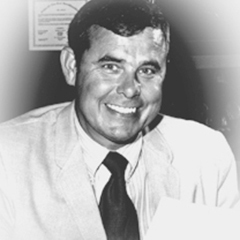
February 4, 1932 – Birth of Disney Legend Bob Allen

Image credit: Disney Legends at Disney Insider

“He was a great, great lover of people, and he showed it. When you met Bob Allen, he acted like you were the first person he ever met.” – Joe Potter, Disney Legend and former Vice President for EPCOT Planning.

Born on February 4, 1932, Disney Legend Bob Allen is best known for his work with Walt Disney World, becoming the Vice President of the park in 1977, as well as being one of Disney’s greatest goodwill ambassadors. He was born in Corona, California, and served in the Navy for four years around the time of the Korean War. After the war, he attended Long Beach State College, majoring in physical education. On a whim, he decided to apply for a job at Disneyland, and in 1955, he began to work in the park as a ride operator. His job was on the Casey Jr. attraction, where he blew a whistle if someone fell off the ride.

Allen moved around to various positions while working at the park, and by 1963, he was the production coordinator at Disneyland. In 1964, Allen moved to Denver, Colorado, spending two years as the manager of the Celebrity Sports Center, a sports facility built by a group of celebrity investors, including Walt Disney and Art Linkletter. Allen also worked as the project manager for the proposed Mineral King resort. Four years later, Allen came back to Disneyland as the director of General Services.

Allen helped prepare for the opening of Walt Disney World in Florida. In 1970, he moved to Florida to work as the director of General Services, and was soon promoted to Vice President of the Resorts Division. On January 1, 1977, Allen was promoted to Vice President of Walt Disney World. Under Allen’s leadership, Walt Disney World was able to thrive, and he continued to work on its long-range plans until his death on November 8, 1987. He was named a Disney Legend at the October 16, 1996, ceremony.


February 3

February 3, 1931 – Silly Symphony Birds of a Feather is Released to Theaters

Directed by Burt Gillett, the Silly Symphony Birds of a Feather was released to theaters on February 3, 1931. A black and white short, the story is of several types of birds and how they react around each other, especially when a hawk steals a chick, and a brave group of crows decides to fight back to rescue it.

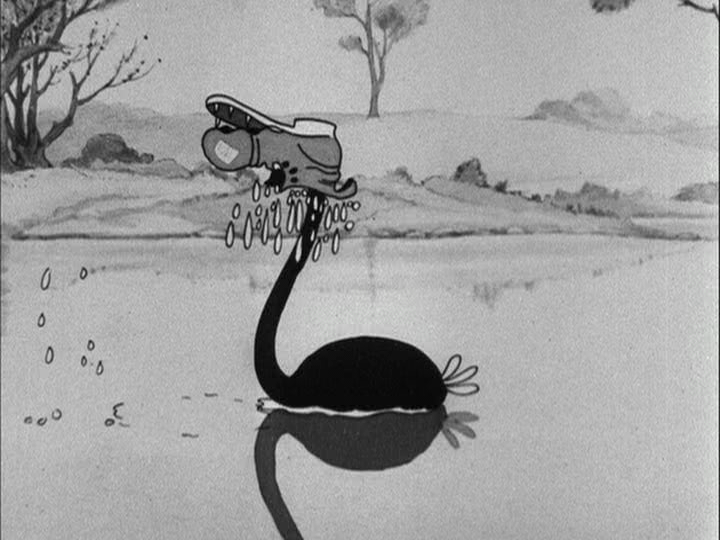
The short opens on a rather idyllic river scene, where three white swans are gliding down a river. They are followed by a black swan, which has two babies as passengers on its back. After the babies decide to swim away, the black swan dives into the water for something to eat, and devours a worm. When it dives again, instead of a worm, it has found a shoelace still attached to a boot, which then lands on its head. The next bird we see is a peacock, preening alongside the water’s edge. After spreading its tail feathers and admiring itself, a duck enters the picture. After observing the narcissistic peacock for a second, the duck sticks its tongue out at the bird, thoroughly distracting it before sailing away.

The swan that accidentally eats a shoelace

The scene then moves to two birds who appear to have harps for tails, beginning the symphony part of this Silly Symphony. The audience travels up a tree, stopping at certain moments to observe the musical habits of the occupants. First, there are several birds chirping the cheerful melody begun by the harp-tailed birds, and above them is a mother bird watching her three eggs hatching. Four hummingbirds buzz around the flowers above them, gathering nectar. The scene travels up a little more, where two birds are trying to continue the melody, but are interrupted by a cuckoo bird, who pops out of several different openings in the tree.

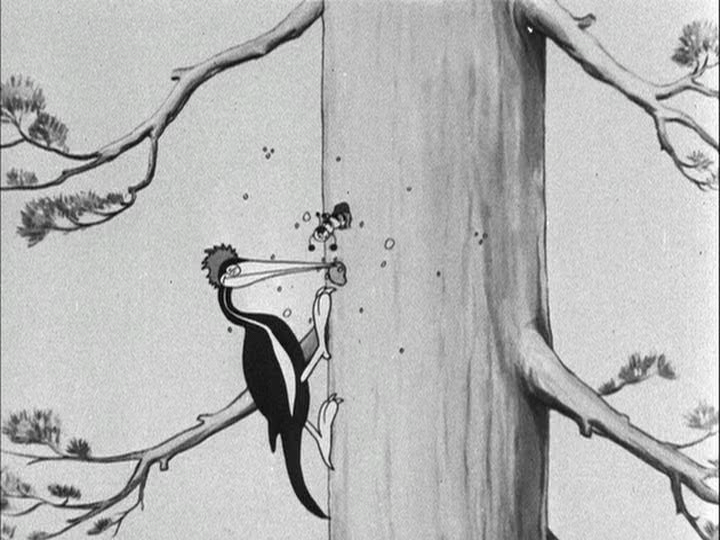
In another tree, a woodpecker tries to peck for food, disturbing a caterpillar that lives in the tree. Annoyed, the caterpillar knocks on the woodpecker’s head, which begins the woodpecker’s pursuit of its possible snack. The woodpecker wins the chase, eating the caterpillar segment by segment.

The woodpecker trying to find food. Little does he know that food is annoyed with his pecking.

A crow flies into the picture, observing another bird giving food to her babies. After the mother bird flies away, the crow climbs into the nest and steals the baby birds’ food, a worm, and flies back to her own nest in the backside of a scarecrow. Her baby crows fight over the worm, which escapes down the leg of the scarecrow and scampers away, only to be pursued by a chicken and her chicks. There are many great gags here, including the worm trying to throw the chickens off by crawling under boots, a pipe, and a can, only to have the hen lift them up with her head and have them land on her chicks. Eventually, the worm crawls into a hole, and the chickens pace and wait, but eventually give up and walk away, except for one chick, who grabs the worm by the end, only to have it crawl up through another hole and bite it on the tail.

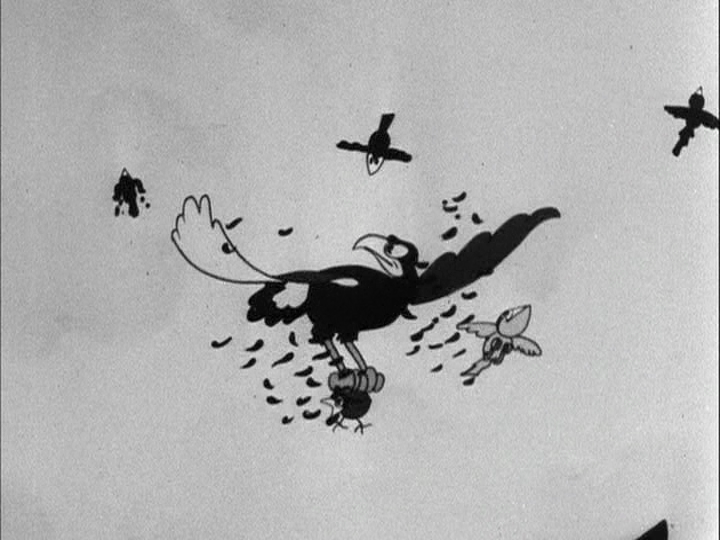
While the chickens look for food, the hen notices the shadow of a hawk circling around them. She desperately gathers her chicks together for safety, but misses the one chick who was still after the worm, who is caught by the hawk. After a crow notices what happens, he calls together his friends, who go after the hawk in formation, dive bombing and attacking it to save the chick.

The formation of crows dive bombing the hawk

Overall, the short isn’t that memorable of all the Silly Symphonies, but there are a few good gags that make it a good short to watch. If you watch them in chronological order, you’re able to see how the animation was improving, but this short still has the more cartoony style that was present in the earlier shorts.

February 2

February 2, 1986 – The Disney Sunday Movie Premieres on Television

“Hi, I’m Michael Eisner, and welcome to The Disney Sunday Movie.”

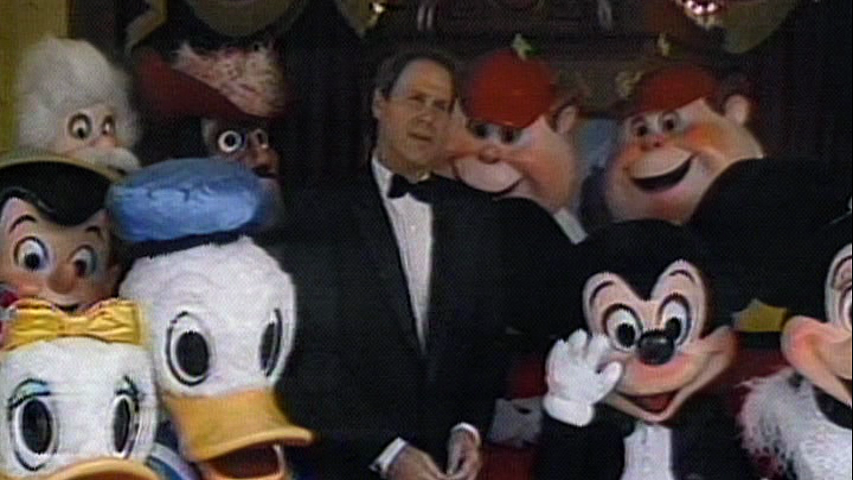
Beginning on February 2, 1986, Disney came back to television with a new anthology series, titled The Disney Sunday Movie. Hosted by then-CEO of the Disney Studios Michael Eisner, it was a way to once again bring the Disney films and original Disney programming to television. The series showcased more than thirty films while on ABC.

The first showing on the show was the movie Help Wanted: Kids. The two-hour television movie was about a couple moving to Arizona for work, only to discover that the new boss is a fan of the traditional family, and the couple does not have kids. The couple decides to hire two children to pretend to be their kids with the involvement of a bit of blackmail.

Michael Eisner as the host of The Disney Sunday Movie

The series faced trouble from the beginning, as it was in competition with 60 Minutes on CBS, as well as their top-rated show Murder, She Wrote. In 1987, ABC cut the show down to an hour, but it still wasn’t able to fare well, having been rated fifty-ninth of eighty-five. On September 11, 1988, the struggling show moved to NBC, renamed The Magical World of Disney, but the ratings were unable to improve. In 1990, the series was cancelled. It was revived again in 1997 on ABC, this time renamed The Wonderful World of Disney.

February 1

February 1, 1956 – A Day in the Life of Donald Duck Premieres on Disneyland.

“You know something Donald? You’re a big international favorite.”

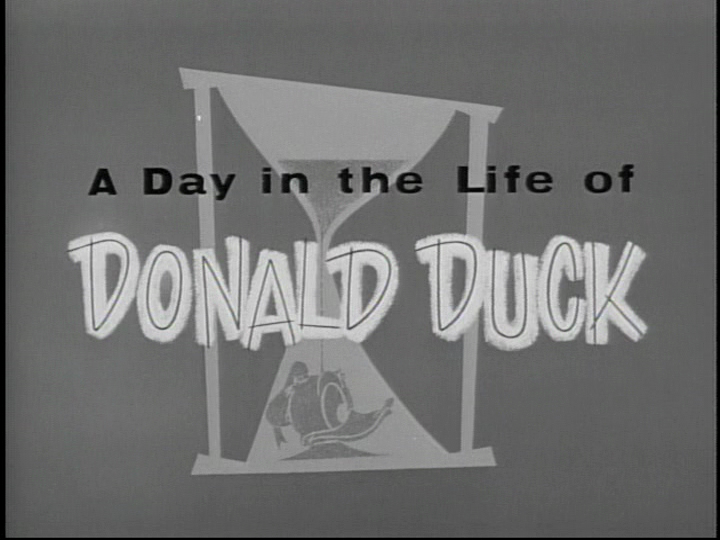
On February 1, 1956, Disneyland audiences spent A Day in the Life of Donald Duck. As Walt Disney explains in the introduction, there have been so many fan letters to Donald, that he thought the audience might want to spend a day with Donald at the studio. Directed by Jack Hannah, with story by Albert Bertino and Dave Detiege, we see how Donald begins his day, as well as his interactions with Jimmie Dodd, Roy Williams, the Mouseketeers, and the most important person in Donald’s life: his voice, Clarence Nash.

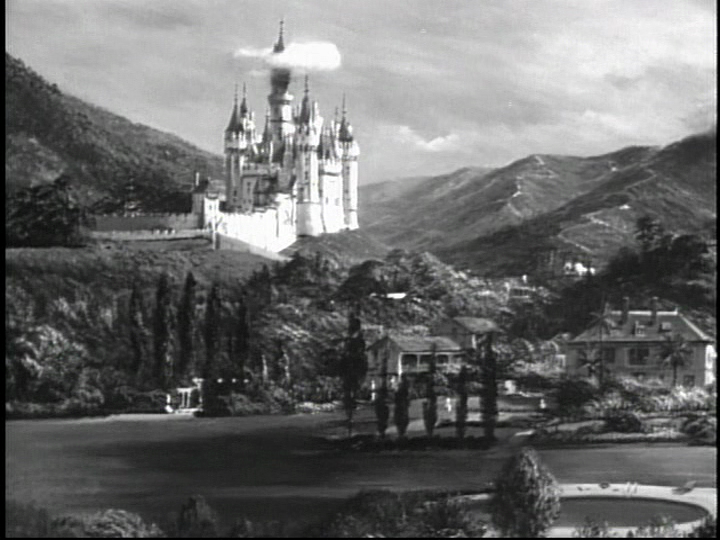
“Donald, like any other average cartoon character, lives a simple, unassuming life in a quiet residential section of Beverly Hills,” Disney tells the audience, showing pictures of the neighborhood. “He resides in a modest little cartoon house. He drives to work in a modest little cartoon car. And if he seems a bit reckless, you must remember that Mr. Duck drives with a cartoon license.” As we see Donald pull into a spot marked “No Parking,” he is immediately confronted by a police officer. Donald, however, folds the car into a tiny packet, tucks it under his hat, and walks to his office.

Donald's "modest" house in Beverly Hills

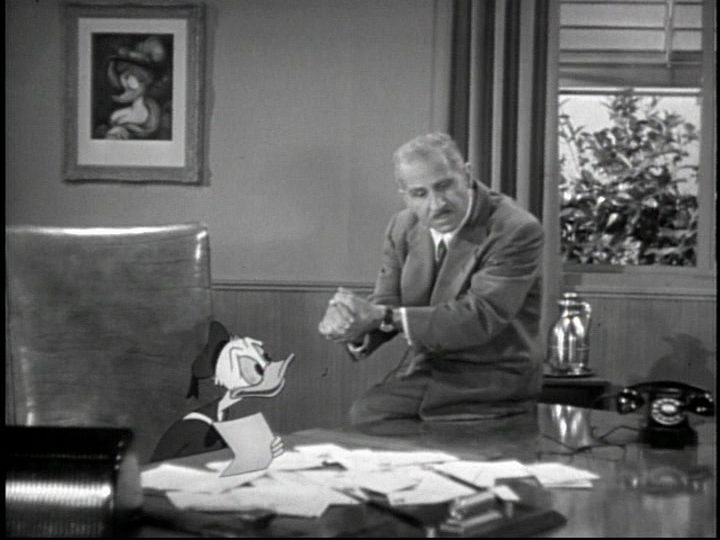
When he arrives at his office, the intercom sounds, and his secretary greets him respectfully as Mr. Duck. Donald responds with, “Just call me Donald, toots. What’s first on my schedule, tootsie?” in keeping with Donald’s personality as a bit of a wolf. She responds that he has fan mail, which he opens eagerly. The letters, however, are not pleasing in Donald’s opinion. One letter openly says, “Dear Donald, I can’t understand a word you say.” This is the last straw in Donald’s opinion, and he demands to speak with his voice, Clarence Nash. Nash comes in with a cheery attitude, which doesn’t change Donald’s mood in the slightest, no matter what Nash does to cheer him up. They end up arguing, with Nash reverting to his Donald Duck voice, even as he pulls out a coonskin cap and starts signing the Davy Crockett theme song. Donald tells him he’s a horrible singer. Nash leaves, with the two still taunting each other, and Donald vows that he’s got to get himself a new voice.

Donald and his voice, Clarence Nash, as Nash shows him a new trick

The next guest to enter is Jimmie Dodd (host of the Mickey Mouse Club), who has written a new song about Donald, inspired by fan art from children all over the world. “They’re so great, they had to have a song written about them,” Jimmie explains, and begins the song, which Donald immediately loves. There are versions of the song sung in different languages with accompanying pictures, including Spanish, French, Italian, and German. The images and tunes are stereotypical for the fifties, but somewhat sweet and fun all the same.

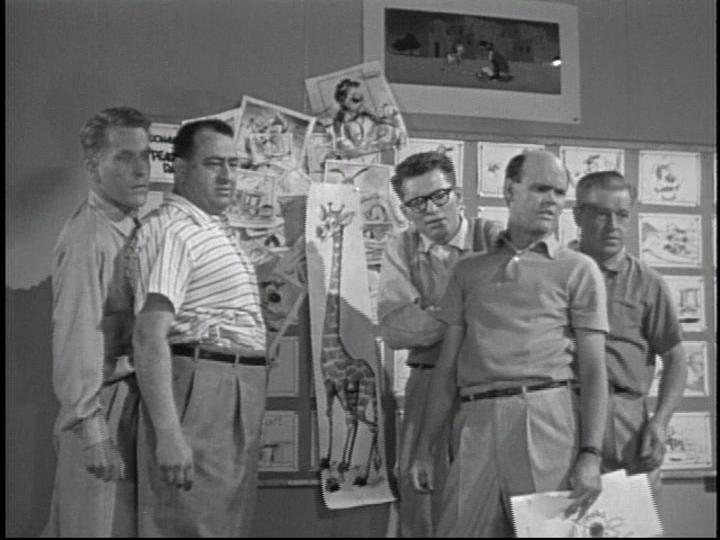
Donald then leaves for an 11 o’clock appointment at the Story Room, and when the storymen hear Donald coming down the hall, they begin to panic, as they fear his temper more than anything. They try to make Donald comfortable, and when they try to show him storyboards for a short entitled Peaceful Day, Donald asks for more birds and butterflies. The storymen overeagerly agree to his requests, to the point that Donald gets annoyed, and demands that there be a short with just him in it. This gets them to thinking, and the audience is then shown the brainstorm: the short, Drip Dippy Donald (originally released March 5, 1948).

The bewildered story team, trying to acquiesce to Donald's requests

Back in his office, Donald receives a call from Walt, who asks him to show the Mousketeers around the studio, as Mickey has remembered that they had never seen it before. Donald eagerly agrees, and runs to meet the Mouseketeers, who surprise Donald by making him an honorary Mouseketeer and giving him his own set of Mickey Mouse ears. As they run around the studio, the kids slip into the Sound Effects Department, closing the door just as Donald is about to get inside, leaving him on the outside as the kids see how sound effects were added to the Donald Duck short, Fire Chief (originally released December 13, 1940). One example they show is when a building is set on fire, the special effects team uses sparklers and crumpled plastic to create the sound of the burning ceiling.

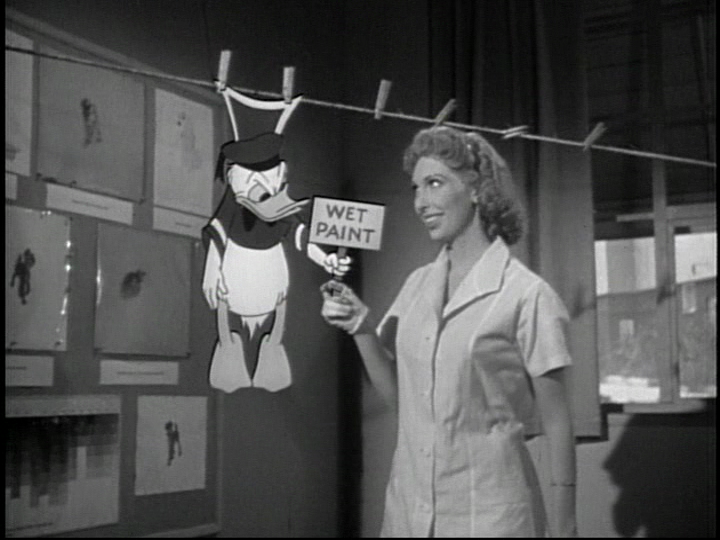
When the short ends, the door opens, and Donald is ready to step inside, until an effects man empties a bucket of water over him, which causes half of Donald’s paint to run. This necessitates a trip to the Ink & Paint Studio, where the painter quickly re-paints Donald and hangs him up to dry, an experience Donald finds quite humiliating. The painter explains that twenty gallons of paint are usually used for a Donald Duck picture, which surprises the kids and causes Donald to remark that he is “very expensive.” She also explains that in one picture, they used just one pint of paint for Donald; the audience is then shown the short The Vanishing Private (originally released September 25, 1942).

Donald and the Painter, with Donald pointing out how humiliating this is for him

After the short, we see the kids with Jimmie Dodd again, singing the new Donald Duck song he wrote. As Donald tries to sing the last line of quacks, he is cut off by Roy Williams, the other host of the Mickey Mouse Club. The kids are excited to see him, and he tells them that he’s practicing drawing the characters. To prove that anyone can draw, Roy asks one of the Mouseketeers to make a scribble on the easel. From her scribble, Roy is able to draw an ostrich. Donald, jealous of the stolen attention, challenges Roy and scribbles on the easel. Roy accepts, and ends up turning Donald’s scribble into a humorous image of Donald Duck. As Donald throws a tantrum and jumps up and down on the teasing picture, the kids flee the room and head into the projection room. “And now, in Donald’s honor – he really is a good scout,” Roy welcomes the kids, “I’d like to dedicate this picture to all you Mouseketeers.” Donald is touched by the tribute, and the audience is then shown the short, Good Scouts (originally released July 8, 1938).

This episode is a must-see for fans of Donald Duck. There are many wonderful gags, and the interaction of Donald with Clarence Nash is enough of a reason to watch. It’s a perfect example of all the temperaments of Donald, with the added bonus of it being set in the real, rather than the cartoon, world.

January 31

January 31, 1986 – Down and Out in Beverly Hills is Released to Theaters

“Yeah, maybe I ought to become a bum. No job, no responsibilities…”

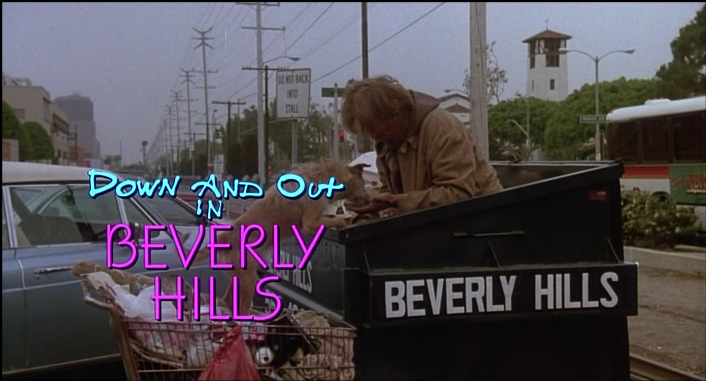
On January 31, 1986, the Touchstone Pictures film Down and Out in Beverly Hills was released to theaters. Based on the French play Boudu sauvé des eaux by Rene Fauchois, the film is about a homeless man who tries to drown himself in a pool of a rich family in Beverly Hills, only to be rescued and taken in by the family, with life-changing results for everyone involved. The film is notable for being the first R-rated film, due to several uses of profanity and nudity, released by the Disney Studios. The film was a financial success for Disney, grossing over $92 million in the U.S. during its run. The film stars Nick Nolte as Jerry Baskin, Richard Dreyfuss as Dave Whiteman, Bette Midler as Barbara Whiteman, with Little Richard as Orvis Goodnight; Little Richard’s appearance in the film, as well as the song “Great Gosh a’Mighty” that he provided for the soundtrack, helped revitalize his career.

The film begins with a gritty look at the overall homeless situation in Beverly Hills, and follows the path of one particular homeless man named Jerry Baskin, who travels with his dog, Kerouac. This is contrasted with the lives of the Whiteman family, as they wake up to begin their day. The family, consisting of Dave Whiteman, his wife Barbara, his son Max, his daughter Jenny, the family dog Matisse, and the maid Carmen, are quite dysfunctional, to say the least. Dave wakes up to see a new tape by his bed: his son is an aspiring filmmaker, who sends his father tapes to let him know how he really feels. Unfortunately, the tapes are just as confused as Max is about himself. Barbara Whiteman, obsessed with yogis, gurus, and acupuncture, has lost romantic interest in her husband, which drives Dave to an affair with Carmen. Jenny, a college student, has been starving herself, much to the concern of her father. And Matisse, the dog, is emotionally disturbed, biting everyone and having to see a dog psychiatrist.

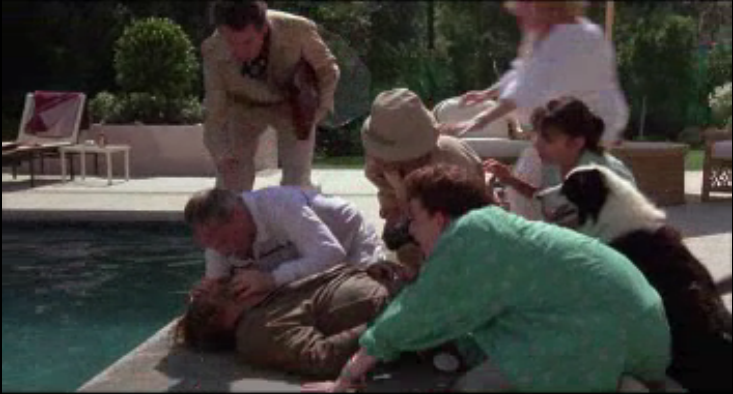
Meanwhile, Jerry is sleeping on a park bench with his dog Kerouac, when the dog spots a woman jogging with a bag of food. Tempted, he runs after her, and decides to follow her home. Jerry wakes up and, finding Kerouac gone, panics and starts roaming the streets looking for him. He ends up in a back alley in a Beverly Hills neighborhood, and decides that he does not wish to live anymore. Entering the Whiteman’s backyard, he fills his pockets with rocks and jumps into the swimming pool. Dave spots this and sprints through the house, screaming “Call 911!” Dave ends up saving Jerry’s life by pulling him out of the pool and giving him CPR. He then offers to let Jerry stay for a while, much to the annoyance of his wife. Surprisingly enough, Jerry is the first person Matisse really takes to, presumably filling the void in Jerry’s life that Kerouac left behind.

The Whiteman Family gathers around as Dave pulls Jerry out of the pool

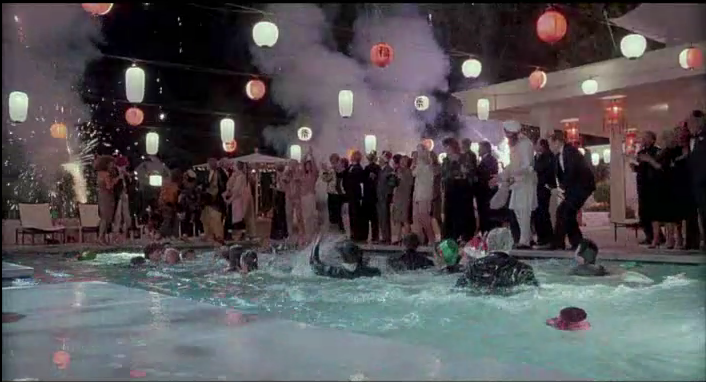
Although many members of the family don’t take too well to Jerry in the beginning, he slowly and surely works his influence throughout them, by telling them his story of how he was arrested for selling draft cards in the sixties, how he was an aspiring actor, and how his little sister died of leukemia, and other aspects of his life story. Through his stay with the Whitemans, he begins to help to solve their various problems and change how they view the world around them. Meanwhile, as open as Dave was in the beginning, his patience is beginning to wear thin when he sees how Jerry seems to be taking his place. For instance, Jerry ends up sleeping with Barbara, which in turn makes her attracted to her husband again. When Carmen sees how Barbara and Dave are intimate again, she sleeps with Jerry, rebuffing Dave’s advances. When Jenny comes home from college for the Christmas holidays, she lets Jerry know she’s on to his schemes, and in turn, he confronts her for her anorexia, and ends up seducing her. This all comes to a head at the New Year’s Party, where Dave ends up exasperated with Jerry to the point of wishing to finish the job Jerry had tried to start in the pool.

As Dave throws Jerry into the pool at the New Year's Party, this begins a chain reaction of people jumping in after them

Although set in Beverly Hills, most of the filming took place on soundstages, or were assembled sets on the Disney backlot. The house used as the Whiteman residence is an actual house in Beverly Hills, and while the daytime exterior shots were filmed at the house, the nighttime shots were filmed at the studio-created duplicate façade, because of various permit restrictions. There were many instances, however, of location work in the film, including Rodeo Drive, Venice Beach, and the Los Angeles International Airport. Overall, the film is a rather funny look at how we never seem to appreciate what we have, and how looking through another person’s eyes can change our perspective completely.

January 30

January 30, 1959 – The Peter Tchaikovsky Story Premieres on Disneyland

“…for just as Sleeping Beauty was held under an evil spell for a long, long time, just so did an evil spell put Tchaikovsky’s genius to sleep for many years, until something wonderful happened to awaken him to his full powers as a composer.” – Walt Disney

Straight from Fantasyland, audiences were treated on January 30, 1959, with The Peter Tchaikovsky Story, a look at the life of Peter Ilych Tchaikovsky, composer of the ballet Sleeping Beauty, whose score inspired the Disney animators to create the animated feature of the same story. The episode also gave audiences a chance to see early clips from the completed film in widescreen, a first on television. This was also the first television show to be simulcast in stereo. The stereo simulcast required the assistance of radio stations, but unfortunately, this could not be accomplished in all markets. Two versions of this episode were prepared, to accommodate those who would be able to use their stereos. Although the episode was originally shown in black and white, the main story was shot in color. The episode was directed by Charles Barton, and stars Grant Williams as the older Tchaikovsky, Rex Hill as the younger Tchaikovsky, Lilyan Chauvin as Fanny Durbach, Leon Askin as Anton Rubinstein, and Narda Onyx as Desiree Artot. The episode also features Galina Ulanova and the Corps de Ballet of the Bolshoi Theater in a production of Tchaikovsky’s Swan Lake.

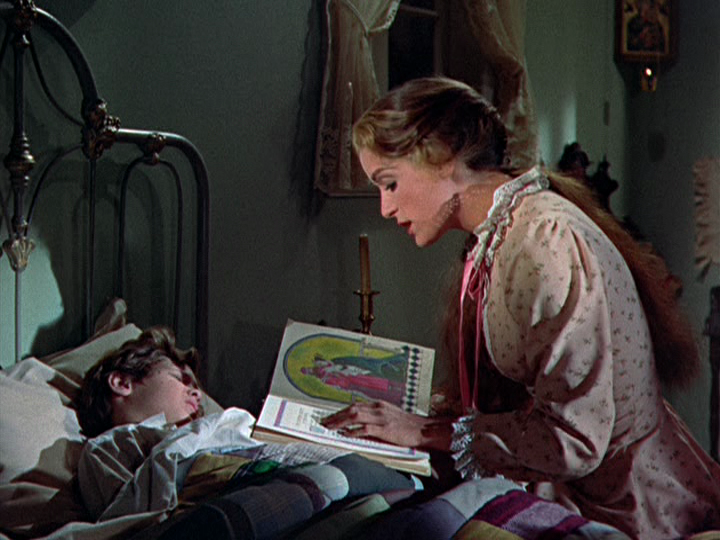
As the narrator relates, Peter Ilych Tchaikovsky was born in Votkinsk, a small provincial town in Russia, in 1840. When we first see Tchaikovsky, his siblings are running around the living room while he sits at the piano, playing. At a young age, he had found happiness in music, particularly the music of Mozart, whom he considered his idol. His mother, however, worried about how much time he spent at the piano, and hired a French governess to teach the children. The governess tries to understand the boy’s love of music, but in the end, she tries to tear him away from the piano to have him play in the sunshine. One evening, Tchaikovsky is troubled by the music that seems to play unending in his head. “Whenever the boy’s soul was stirred,” the narrator explains, “the music would throb in his head until it was almost painful.” The governess hears his painful cries, and decides to soothe him by reading him a story he had never heard before – the story of Sleeping Beauty. Unfortunately, the story did little to put him to sleep; it caused his creative juices to flow, and he snuck down to the piano to compose before being caught by the governess. The next day, Tchaikovsky is dismayed to see that the piano has been locked up, and as he tries to find another way to express the music in his head, he breaks the window after tapping emphatically on it, slicing his hand. His parents allow him to play once more, but this happiness would soon be interrupted.

Young Tchaikovsky (Rex Hill) being read the story of Sleeping Beauty by his governess, played by Lilyan Chauvin

“…contentment was never to be Peter’s fate for very long,” the narrator warns the audience. “Soon, he was to suffer the heaviest blow of his young life. His parents decided to prepare him for a government career at school in St. Petersburg.” Tchaikovsky is seen crying as his mother wishes him farewell, telling him to be a good boy and study hard. As she leaves, the audience is told that Tchaikovsky never saw his mother again, for she died soon after. After this crushing blow, “his musical genius withdrew deep inside him. It went to sleep, like Sleeping Beauty in the fairytale. And, strange to say, like Sleeping Beauty, it would stay dormant for a long time before something wonderful happened to awaken it again.” Seventeen years later, we see Tchaikovsky grown up, working as a lowly copy clerk. He toils away, feeling his life lacks meaning, until he sees an advertisement in the newspaper: the opening of a new conservatory of music, led by the great composer, Anton Rubinstein. This stirs something inside him, and Tchaikovsky decides to enroll in the evening classes for piano and composition.

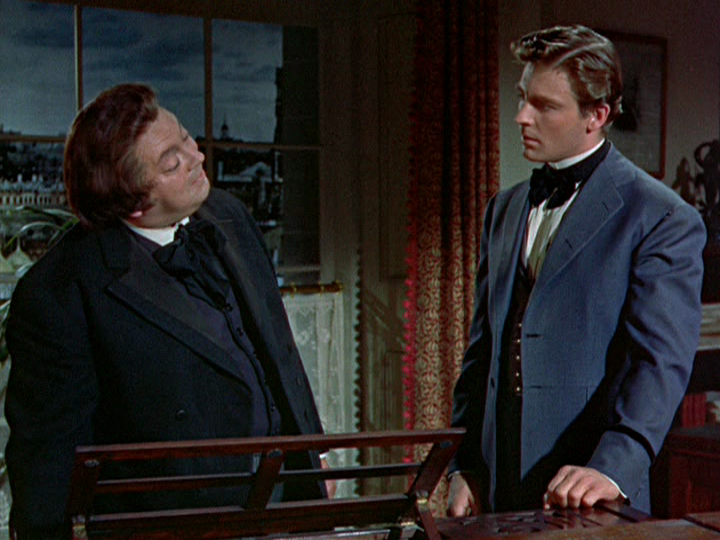
One evening, as he improvises tunes of his own, he is spotted by Rubinstein himself. The composer asks Tchaikovsky if he wishes to make a career of music, to which Tchaikovsky admits he has dreamed of it, but needs to earn his bread. “Bread! Did Bach, Mozart, Beethoven think of bread?” the composer cries. “For music, an artist must be willing to starve.” He gives the young man a test: he plays a theme, and asks him to write variations on it, telling him that not only quality, but quantity counts as well. Inspired, Tchaikovsky works all night on his variations, which unfortunately gets him in trouble at work when he accidentally writes on an official decree with the signature of the prime minister. Immediately dismissed, Tchaikovsky goes back to Rubinstein to submit his variations – all 215 of them. Rubinstein offers to take Tchaikovsky under his wing, an offer Tchaikovsky immediately accepts.

Anton Rubinstein, played by Leon Askin, asks Tchaikovsky, now played by Grant Williams, about his plans in music

Tchaikovsky’s true awakening, the narrator states, was at a performance of the traveling Italian Opera Company, starring a beautiful soprano named Desiree Artot. To try to win her affections, Tchaikovsky writes her a song, which begins a relationship leading to an engagement between the two. This engagement is broken, however, by a letter from Desiree, addressing Tchaikovsky as her dearest friend and informing him that she has married a man in her troupe. Deeply wounded, he vows to never write another note of music, but this was not to be: his genius was too strong to be shut away again. Instead, his love for Desiree was replaced by a new love for the ballet. His first ballet was entitled Swan Lake, and although Tchaikovsky had great hopes for its success, it was a dismal failure. Unable to handle the criticism, Tchaikovsky fled to Europe. He was unable to find any solace while traveling, and so from Naples, he took a steamer back to Russia, where he was troubled by a dream of a memory. He remembered the time in his childhood when his governess soothed him by reading him a fairytale, and how he immediately set to work composing it. Waking with a start, he rummages through his belongings to find the manuscript of Sleeping Beauty someone had sent him, thinking it would be a good idea for a ballet. Inspired once again, he sat down to compose the entire ballet before arriving back in Russia. “And this time,” the narrator says, “his creation was headed for the bright future that was in store for all his wonderful works.”

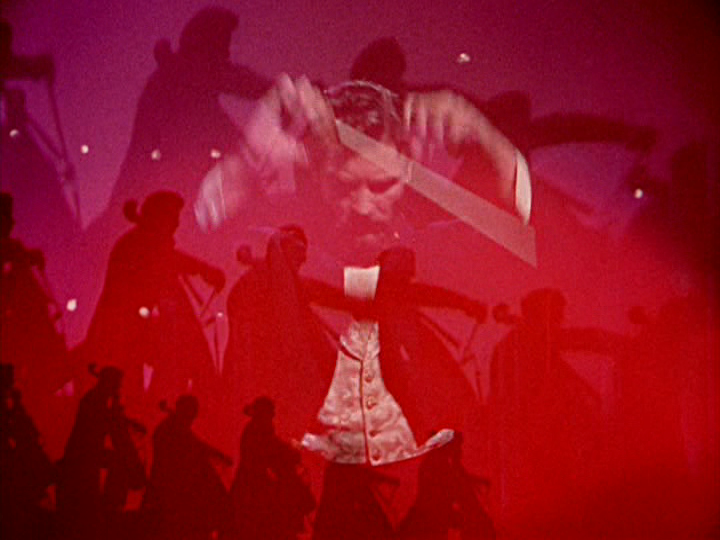
Tchaikovsky conducting the Sleeping Beauty Ballet. The orchestra scenes used are actually reused footage from Fantasia

The rest of the episode is basically an advertisement for the upcoming film version of the story of Sleeping Beauty. “Imagine your living room is a theater,” Disney urges the audience, “and your television set is the theater’s wide screen, as we bring you this romantic sequence from Sleeping Beauty.” In fact, two scenes are played for the audience: the Once Upon a Time sequence, and the rescue of Prince Phillip from the evil clutches of Maleficent, which ends as the evil fairy turns into the dragon. “Well, there’s much more to Sleeping Beauty than the few brief scenes we’ve shown you on this program,” Disney reassures us. “But I can tell you this: like all good fairytales, true love does win out.”

Although not a truly accurate depiction of Tchaikovsky’s life, the episode is a rather good watch, especially to capture the excitement of audiences seeing a new technological advancement when it came to movies. This story of Tchaikovsky’s life is a good story, and told well, even though it comes at the cost of the omission of some facts that may not have been suitable for audiences in that time period.

January 29

January 29, 1915 – Birth of Disney Legend and Storyman Bill Peet

“As Bill Peet himself once said, ‘There were 40 people who were assigned to these jobs in the golden age of Disney animation. Now they were all being performed by one man…me, Bill Peet.’” – Neal Gabler, author of Walt Disney: Triumph of the American Imagination.

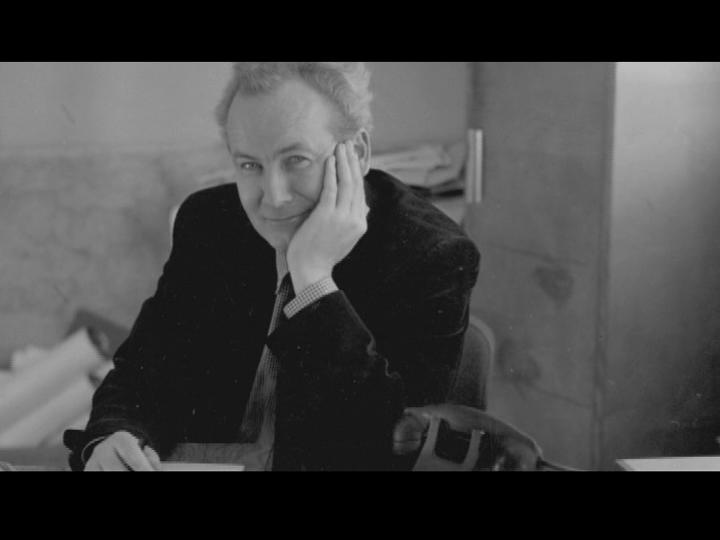
Bill Peet was born on January 29, 1915, in Grandview, Indiana. He showed promise as an artist at an early age, never imagining he could make a living out of bringing fanciful stories to life. “My favorite room in the house was the attic,” Peet wrote in his autobiography, “where I enjoyed filling fat five-cent tablets with a hodgepodge of drawings. Drawing became my number one hobby as soon as I could manipulate a crayon or pencil well enough to put my favorite things on paper…I must have drawn fairly well or I couldn’t have enjoyed it so much.” His drawing hobby, however, got him in trouble at school—he recalled that his margins were so full of drawings, he obviously didn’t pay a lot of attention to his teachers. During high school, he won a scholarship to the Herron Art Institute, now part of Indiana University.

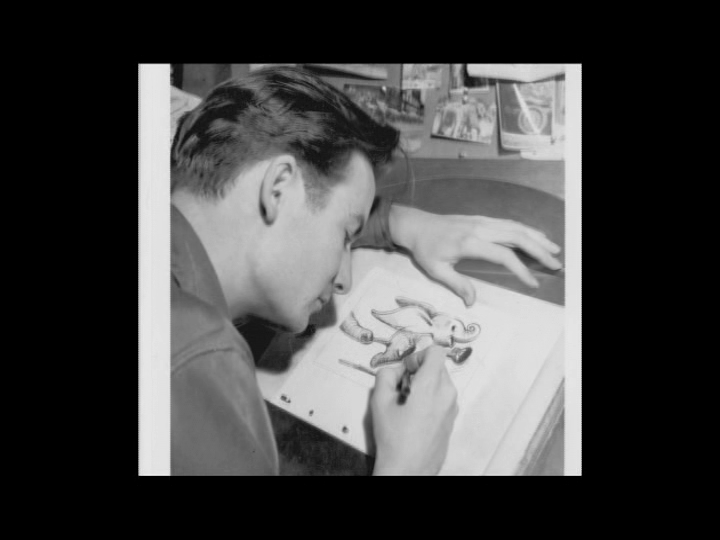
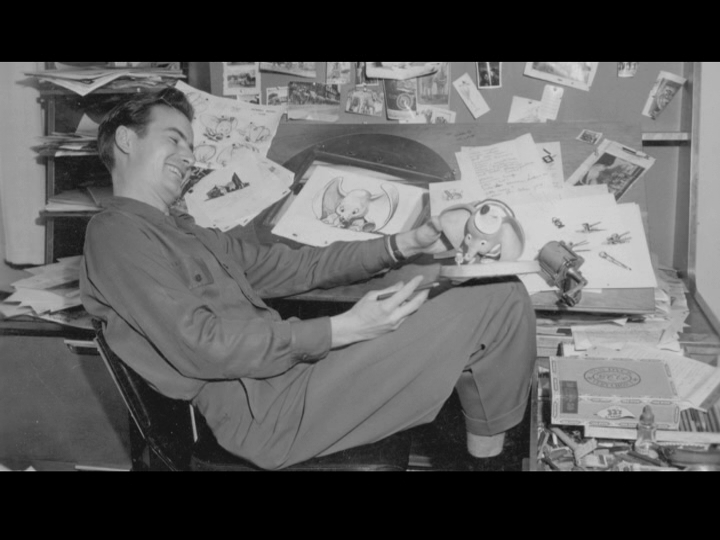
In 1937, Peet moved out West to find work. Jobs were scarce as this was the middle of the Great Depression, but he heard that Disney was looking for artists, so he tried his luck. Peet was hired to be an in-betweener artist, which meant he assisted with the final drawings of characters for Snow White and the Seven Dwarfs. Being an in-betweener meant one was at the bottom rung of the animating ladder, and Peet was very frustrated. He was driven, and he knew that his place was in the story department. He was given his chance about a year later, and the chances he got were highly regarded. One of his scenes was in Dumbo, where the baby elephant is bathed by his mother, and it is regarded as one the best early examples of Peet’s work. From that time, he was one of Disney’s main storymen. As animator Will Finn put it, “[Peet’s] fingerprints are all over the Disney classics as a storyman, from pretty much Pinocchio on.”

Peet working on a scene in the film Dumbo

Whenever there was a story problem in the feature films, Walt Disney would bring it to Peet to fix. Peet’s ability to handle the story department helped free Disney’s interests when he began to diversify between the new medium of television, the parks, and the live action films. While Peet worked on story for films, starting on Fantasia and Sleeping Beauty, his best work was on the film One Hundred and One Dalmatians, where he was the sole developer of the story. Compared to the newer films, like Beauty and the Beast, where there were fifteen people working on the story and storyboards, Peet did all the work by himself. Disney Historian Brian Sibley noted that “Peet was a master storyteller, and he structured [One Hundred and One Dalmatians] to make it a story that is so focused, so controlled…that you follow the story with an effortlessness…so much so, in fact, that Dodie Smith wrote to Bill Peet and said that he had, in fact, improved on her book. Which is quite a complement when you think about it.”

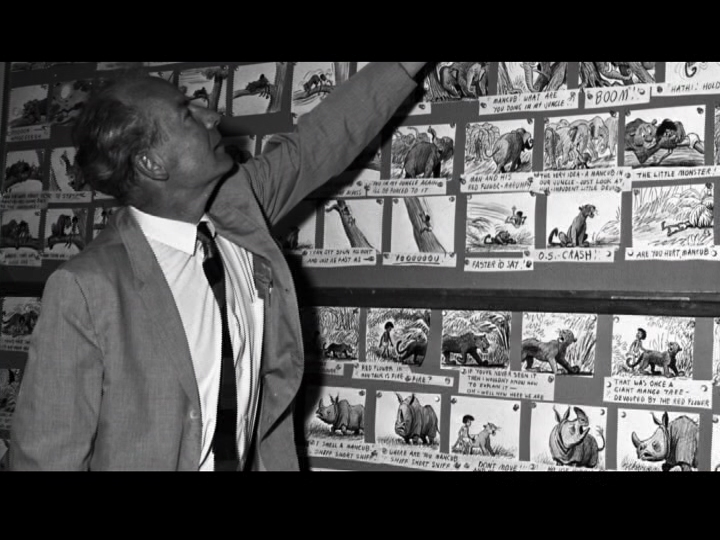
There was always a contentious relationship between Disney and Peet. Peet brought in the 1938 novel The Sword in the Stone to Disney’s attention, and Disney asked Peet to write the screenplay. After Peet complied, Disney approved the film for production. The film, however, did not do very well, which caused Disney to become more critical of Peet’s methods. When Peet began to work on The Jungle Book, which he also had proposed to Disney, he read and reread the book, coming up with the story sketches. The version of the film Peet came up with, however, was not the kind of film Disney wanted to see. The two men, both highly imaginative and stubborn, could not reach an agreement on the film, and after twenty-seven years together, Peet left the studio and never returned.

Peet with the storyboards for the last film he worked on, The Jungle Book

After leaving Disney, Peet began a successful career as a children’s book author. “When it came time for the used book sales,” Peet wrote in his autobiography, “my illustrated [schoolbooks] were best sellers. The kids loved my drawings and I suppose those books could be considered the very first ones I ever illustrated for children.” He wrote over thirty-five stories, which were translated into several languages. In 1989, he released his autobiography, which won several awards, including being named a Caldecott Honor Book. Peet was inducted into the Disney Legends at the October 16, 1996 ceremony. Bill Peet died in 2002 at the age of 87.

A young Peet working with a maquette of the main character Dumbo

Peet had an amazing ability to structure a story. While researching the sketches for One Hundred and One Dalmatians, animator Andreas Deja remarked that he “follow[ed] the sketches and you go, ‘Well, I’ll be…this is impossible. They didn’t change a thing.’ [The scenes] are exactly the way Bill Peet had envisioned it.” Coming from humble beginnings and rising through the ranks at a brisk pace, it’s interesting to see not only the talent that Peet had been born with, but how innate his instincts were when it came to story. Without Peet’s skills to carry on while Walt Disney’s interests diversified, there probably wouldn’t have been Disney animation in the ’60s, which led to the Disney Renaissance. Based on all of the influence Bill Peet had, one could argue that he helped keep the story of Disney animation alive for decades to come.

January 28

January 28, 1944 – Goofy Short Subject How to Be a Sailor is Released.

“Star light, star bright – gosh, I wish I knew where I was tonight.”

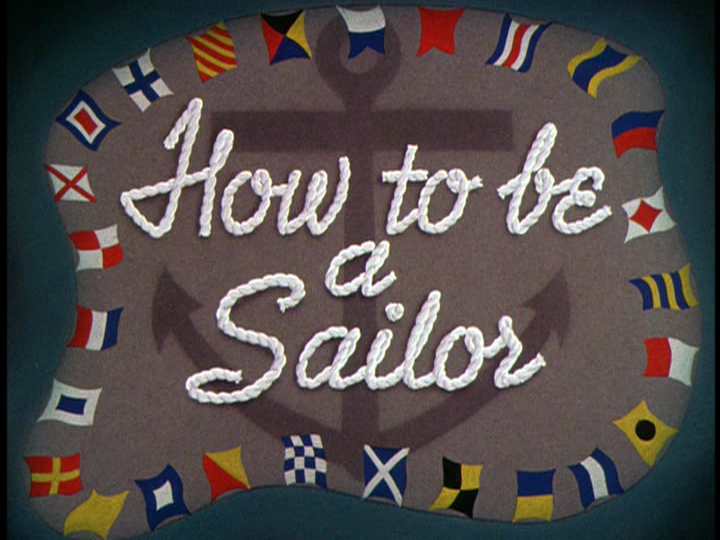
On January 28, 1944, the short How to Be a Sailor was released to theaters. Following in the tradition of the How-To series starring Goofy, the short is an entertaining quick run-through of sailing throughout the ages. The surprising thing about this short is that the ending does deal with World War II, where it is Goofy against the entire Japanese fleet. This section, coupled with the rest of the short, not only gives the audience a good laugh, but also helps establish the feeling of invincibility in the face of fear when it came to the Japanese soldiers and the war. It’s also notable for being the only short of the war shorts to deal with the Navy, as the rest were mostly dealt with Army settings. The short was directed by Jack Kinney, and stars Pinto Colvig as the voice of Goofy, with John McLeish as the narrator.

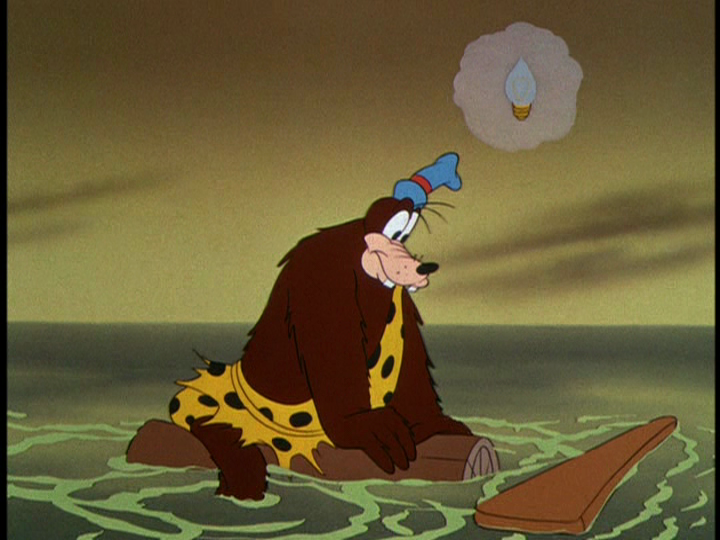
“In the beginning,” the narrator starts off, “the world was all wet. Today, it is still four-fifths wet.” We are introduced to early man – or, early Goofy, as the case would be – who tromps through the woods and through shallow water, before falling into a deep section. Struggling to swim, he comes across a log; he’s unsteady on it, but manages to gain some stability and float along, until he comes across a method of propulsion: a wooden board. Excited, Caveman Goofy takes the board and happily steers himself around in circles.

Caveman Goofy gets an idea of how to propel himself on his log

We fast-forward to Egypt, where we see a boat rowing down the Nile river, and find that Goofy is rowing it by his lonesome, with a contraption that allows him to row the at least twenty oars needed to propel the ship. Soon after, we are sent to visit Viking Goofy, who used the stars as his compass. As Goofy laments that he wish he knew where he was, a constellation of Goofy with a bow and arrow hears his plea and shoots the star arrow, sending Viking Goofy and his boat flying across the ocean to their destination.

The next sequence addresses how 13th Century people viewed the world, and wondered what shape it was in, and the audience sees various shaped globes, ranging from diamonds to cylinders. We then see one of their theories in action: sail West far enough, you would sail off the edge of the world. A Goofy version of King Neptune and two fish peek out from the edge of the world, watching the ship fall, and shake their heads.

Scarier than Pirates of the Caribbean were the Goofy Pirates

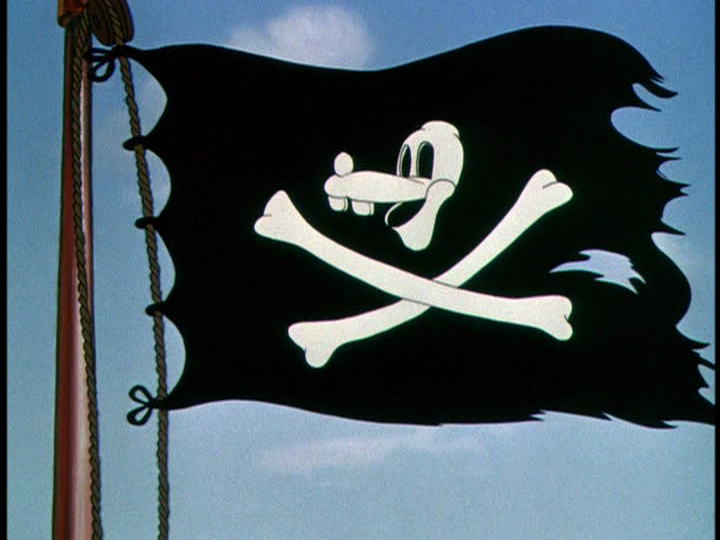
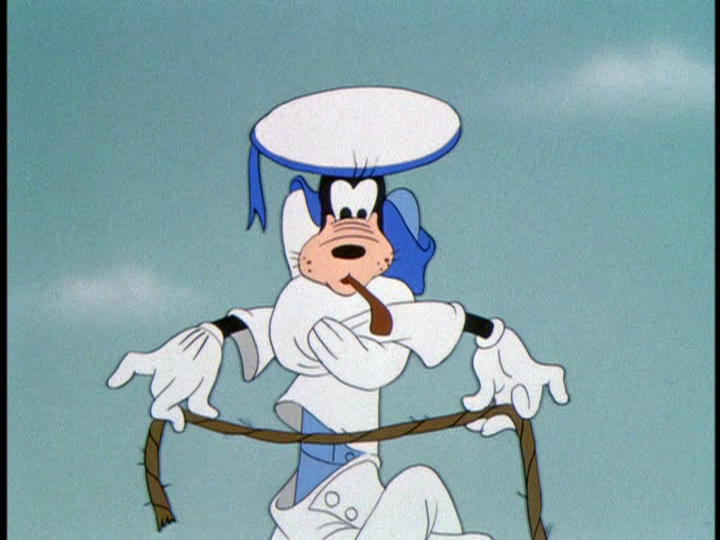
“From the earliest days, sailors were preyed upon by…pirates!” the narrator yelps as the pirate flag is raised. Goofy, a perfect pirate captain with peg-leg and eye-patch, is the victim of a mutiny. His crew pushes out a board, and he is sent to walk the plank, or “feed the sharks.” But a storm hits the next boat the audience sees, and the waves play a game of passing the ship from wave to wave. “For safety’s sake,” the narrator explains, “sailors would lash themselves to the mast.” We then see Goofy tied tightly to the mast, which is unfortunately is struck by lightning and sent crashing through the ship.

The most famous sequence of the short is the flag sequence, where we are taught the alphabet through semaphoring and wigwagging. Goofy tries to keep up with the fast pace of the narrator, but unfortunately wigs where he should have wagged, and his trousers fall around his feet. After hiding behind a sail to fix his situation, he comes out and begins to dance the traditional dances of the sea, including a dance of hoisting the sail, rowing, and being a look out, only he isn’t looking out where he is going. We also see Goofy tying knots, with some literal interpretations by the animators: Goofy ties a square knot (the knots make the shape of a square), then a sheepshank (which “baas” when he pulls on it), and as he slips on the next knot, he knocks himself in the jaw, to which the narrator explains is the “slipknot.”

Goofy finds that knots are a little more complicated than he thought

“And now, through trial and error, the sailor has at last, mastered the sea.” We see sailors on a Navy vessel, dreaming of pin-up girls, when the call to attack is sounded. Goofy picks up a missile to fire, only he slips and is sent out of the ship instead of the weapon, and is seen single-handedly destroying the Japanese fleet, as well as the symbol of the Rising Sun, saving the day.

The real gem of this short is the music, with the use of sea tunes to add humor to the situations. For instance, in the Egypt scene, when Goofy is struggling to row by himself, there is a teasing version of Row, Row, Row Your Boat playing in the background. Goofy, when dancing, also keeps in time with a xylophone version of The Sailor’s Hornpipe, which gives a whimsical addition to the already humorous dancing.

Although considered one of the war shorts, the short can stand up well on its own without the association. The pace is quick, but not overwhelmingly so, and gives the audience one laugh after another. This short is a highly enjoyable piece, and one of the best gems of Goofy’s career.

January 27

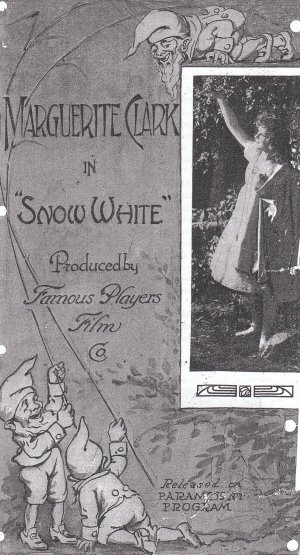
January 27, 1917 – Screening of the play Snow White starring Marguerite Clark

Poster for film. Image credit: wikipedia

“The world of make-believe has always delighted and absorbed me, ever since I was a little boy.” – Walt Disney

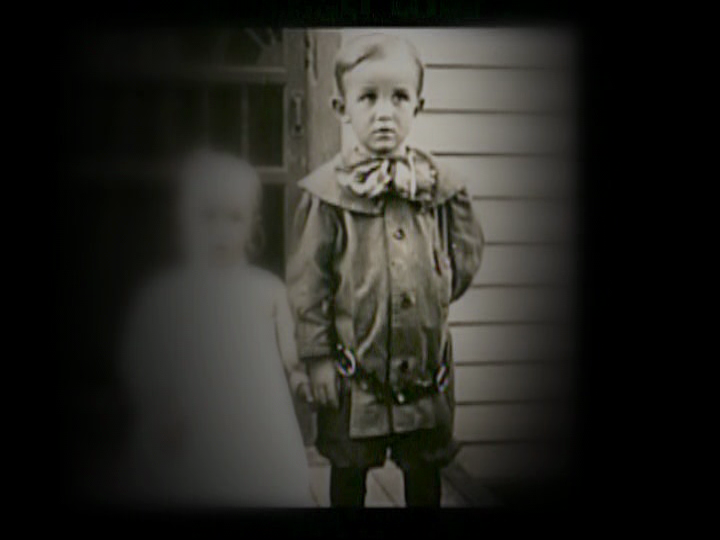
When recalling his early years in many of his interviews, Walt Disney seemed to have a wealth of inspiration as a child, from the fairy tales his grandmother read him, to touring productions of plays, such as Peter Pan, starring Maude Adams. The biggest inspiration for Disney’s choosing Snow White, it has been said, is the film version of the play Snow White, starring silent screen actress Marguerite Clark.

Walt as a young boy

The film, released December 25, 1916, is a silent black and white film, directed by J. Searle Dawley and distributed by Paramount Pictures. Snow White is played by Marguerite Clark, who was well known for her roles as waifs and children; the Queen was played by Dorothy Cumming, with the Prince played by Creighton Hale, and the Witch played by Alice Washburn.

On January 27 and January 28, 1917, a film version of the story was featured in the Kansas City Convention Hall, sponsored by the Kansas City Star. Disney was a newsboy for the paper at that time, and the paper decided to reward their newsboys with a screening in the hall, with 67,000 people eventually showing up. The film was presented on four different screens to oblige the crowd; unfortunately, the projections were hand-cranked, and the projectionists were not in sync. Disney later recalled that he could see on one screen what was going to happen on one of the other screens, but this still left a magical impression on the fifteen-year-old. “My impression of the picture has stayed with me through the years and I know it played a big part in selecting Snow White for my first feature production,” he explained.

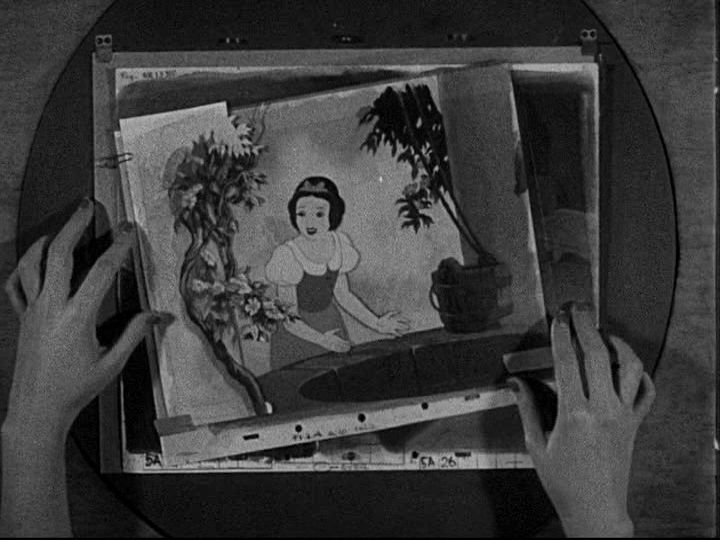
A cel and background for the "folly", Snow White and the Seven Dwarfs

Snow White had always been a favorite story of Disney’s. As he said in a 1953 magazine article in the now-defunct Brief Magazine, Disney’s fascination with fairy tales and make-believe “began when I was a child. Every evening after supper my grandmother would take down from the shelf the well-worn volumes of Grimm’s Fairy Tales and Hans Christian Andersen. We would gather around her and listen to the stories that we knew so well that we could repeat them word for word. Of all the characters in the fairy tales, I loved Snow White best. And when I planned my first full length cartoon, she inevitably was the heroine.” These readings and this film of Snow White no doubt influenced Disney to pick the fantastical story as his first film, or his “folly,” as his critics put it.