RSS Feed

February 15

February 15 1899 – Birth of Disney Legend and Wife of Walt Disney, Lillian Disney
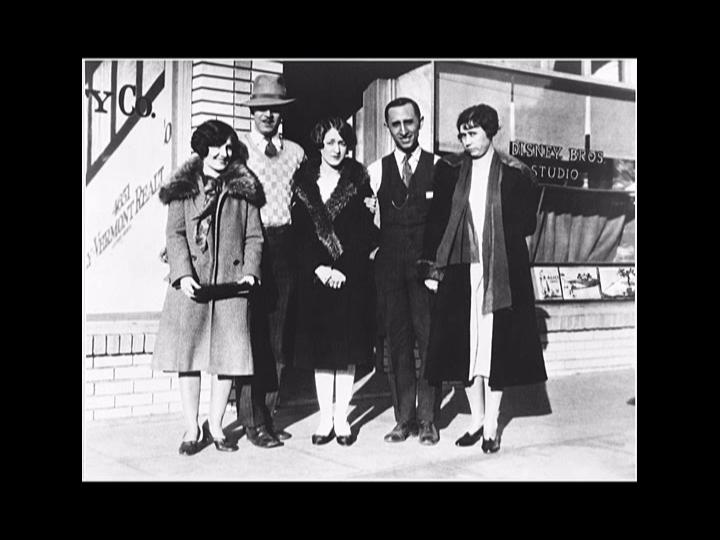
Lillian, far left, stands with Walt, his sister Ruth, Roy, and Roy's wife Edna, in a shot from 1925

“I think my dad fell in love with her almost immediately … she was an independent little lady.” – Diane Disney Miller

Lillian Bounds Disney, wife of Walt Disney, was born in Spalding, Idaho, in 1899 as the tenth and youngest child of the family. In 1923, she traveled to Los Angeles to visit her sister, and a friend of hers recommended her for a job at the Disney Brothers Studio as an ink and paint girl. There was one condition: “Don’t flirt with the boss,” her friend warned her. “He’s all business.” Lillian, however, had no intention of flirting with Walt; this was not a love-at-first-sight romance for either of them, for Walt was too consumed with the business, and Lillian was not impressed with the shabbiness of his clothes. She took the job due to its proximity to her sister’s house and the salary of fifteen dollars a week.

Walt would drive Lillian and another coworker home after long days at the studio. Lillian later said, “When Walt started dropping the other girl off first so he could talk to me, I knew he was interested.” She also admitted that during these rides home, she started to see Walt differently, looking at him “like he was a somebody.” One evening as he dropped her off, he informed her, “I’m going to buy a new suit. When I get it, would it be all right if I called on you?” Lillian said that it would, and when Walt got his new suit in celebration of a check for their films, he arrived at her house and asked her eagerly about the suit. They dated steadily after that, and on July 13, 1925, Walt and Lillian were married. From then on, Lillian worked at the studio only in times of emergency.

One of the major contributions attributed to Lillian involved Walt’s famous creation, Mickey Mouse. While the story of Mickey’s creation has been shrouded in legend and mystery, the one common factor is that Lillian came up with the name for the new character. Walt wanted to name the mouse Mortimer, but Lillian decided that the better name would be Mickey, and he agreed.
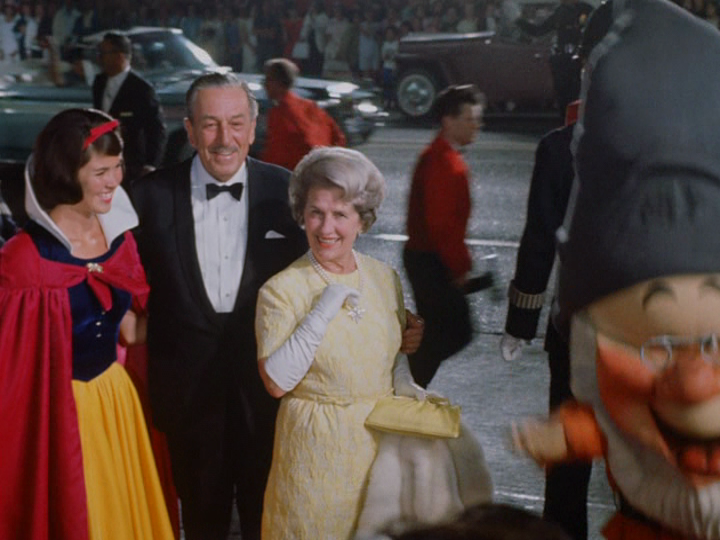
Lillian accompanying Walt to the premiere of Mary Poppins

Lillian was not one to meekly listen to Walt, nor was she one to care about what the press reported about him. Walt once told a reporter that Lillian didn’t care what reporters would say about him. “I keep reporters away from her,” he explained. “She’s given them the lowdown.” Perhaps the success to their long marriage was the fact that Lillian was never overly impressed by Walt and his accomplishments. She did worry when he worked long hours, but overall, she didn’t regard him as a genius, as most people did. Walt, however, would show her affection by either physical actions, such as wrapping an arm around her, or learning how to dance so they could dance together during social functions.

After Walt’s death, Lillian stepped in the public arena to lend support to the Florida Project, which would be renamed Walt Disney World in his honor. She attended the dedication ceremony in 1971, saying, “I think Walt would have approved,” when asked what Walt would have thought of the park. She continued her late husband’s support of education by providing financial gifts to the California Institute of the Arts, particularly to remodel a campus theater in 1993, which was renamed the Walt Disney Modular Theater. In 1987, Lillian announced a $50 million gift to build a symphonic hall for the Los Angeles Philharmonic Orchestra, now known as the Walt Disney Concert Hall. The building was designed by architect Frank Gehry and opened in 2003.

In 1969, Lillian remarried to John L. Truyens, but he unfortunately died in 1981. Lillian herself passed away on December 16, 1997, after suffering a stroke at the age of 98. She was named a Disney Legend in 2003, honoring all of her contributions in support of the company’s growth.

February 14

February 14, 1941 – The Mickey Mouse Short The Little Whirlwind is Released to Theaters

“Well, guess I don’t get the cake, huh?”

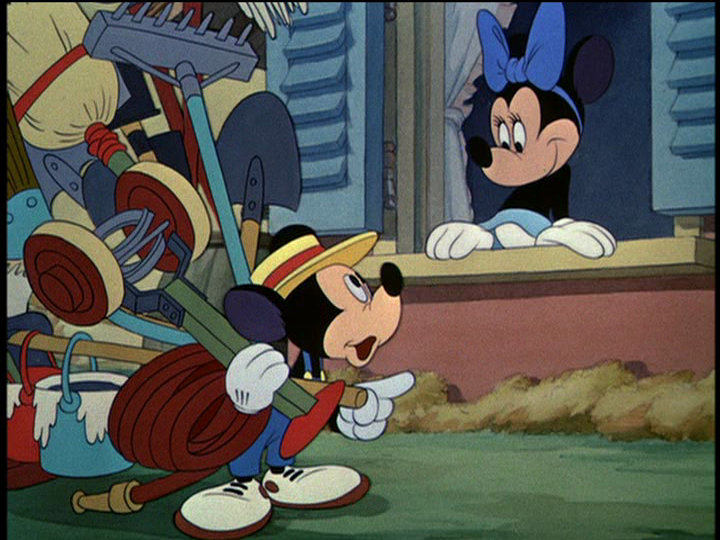
On February 14, 1941, the Mickey Mouse short The Little Whirlwind was released to theaters. Although most shorts that feature Mickey and Minnie are romantic in nature, this short does not feature a romantic plot between the two. This is ironic, as the short was released on Valentine’s Day. Mickey shows up around Minnie’s house and offers to clean her yard in exchange for her freshly made cake, only to have his efforts thwarted by a mischievous little whirlwind. The short was directed by Riley Thomson, with Walt Disney as the voice of Mickey Mouse and Thelma Boardman as the voice of Minnie Mouse.

The short opens with Minnie Mouse in her house, placing her freshly made cake on the windowsill. The scent travels down the road, catching Mickey Mouse’s nose and pulling him toward the window, until Minnie removes the cake and shuts the window, causing Mickey to fall to the ground. He knocks on her window, motioning to the cake she’s made. Angrily, she tells him that she has nothing for loafers, but Mickey offers to clean up her yard. Minnie agrees, but adds that there is to be no more clowning around. Excited about the promise of cake, Mickey grabs all the yard tools he can find, saying, “You won’t know the place when I get through!”

Mickey shows his enthusiasm by gathering every tool he can find

As Mickey begins to rake her leaves with gusto, a little whirlwind begins whirring down the path. Spying Mickey doing his yard work, it decides to have a little fun with him, hiding in the leaf basket and moving it when Mickey’s back is turned. Mickey is slightly confused, but tries to place the leaves in the basket again. Mickey and the basket go back and forth, until Mickey decides the best course of action is to nail it to the ground. He tosses the leaves in, only to have them thrown back at his face as the whirlwind escapes into the air, stealing Mickey’s hat.

After Mickey retrieves his hat, the whirlwind continues to play tricks on him, like stuffing leaves down Mickey’s trousers. As the whirlwind gathers the leaves and has them march behind it, Mickey grabs a bag and sneaks around the back of the house to sneak a surprise attack on the troublemaker. While he is able to capture the whirlwind in the bag, and gives the bag a good kick, the little whirlwind fights back and breaks free, squealing down the road while Mickey chases him. Unfortunately, when we see Mickey again, he’s running away from the wrath of Mama Whirlwind. Thanks to Mickey, Mama Whirlwind tears up the entire countryside as she chases him. Mickey gets caught in Mama Whirlwind, and is then dumped into a fountain before she leaves.

The things a Mama Whirlwind will do to protect her baby obviously include undoing all of Mickey's hard work, and then some

True to Mickey’s word, the yard is unrecognizable now. Minnie finishes decorating the cake, placing a big red cherry on top. She is shocked to see the state of her yard, and calls Mickey a louse. Mickey begins to leave, mentioning off-handedly that he must not get the cake after all. Minnie responds that he does, indeed, get the cake, and when he turns back excitedly, he gets the cake all right – thrown right at his head.

February 13

February 13, 1957 – The Disneyland Episode Tricks of Our Trade Premieres on ABC

“Before our eyes, we have seen an entire industry grow literally from the ground up. And this growth was no accident. It was painstakingly built, step by step, by men with pioneering spirit, who loved this puzzling new art form, and believed in its future.”- Walt Disney.

On February 13, 1957, audiences were treated to a different kind of episode of Disneyland: one that focused on how animated films were able to capture things as realistically as they did. With our host, Walt Disney, we are taken through the “tricks of the trade,” where he explains some of the then-commonplace animation principles, as well as some of technical advances made in the studio, and why they needed to be created. The examples given are obviously staged, but they give the audience a great example of the process used to come to a solution. Animation examples are from Snow White and the Seven Dwarfs, Bambi, and Fantasia. The episode was written by animation veteran Dick Huemer and directed by Wilfred Jackson. It also includes cameos of four of the famed Nine Old Men: Frank Thomas, Ollie Johnston, Marc Davis, and Milt Kahl. The episode refers to the book, The Art of Animation, which was the book that inspired John Lasseter to want to be an animator (please see the January 12th entry for more information).

“Because the animated cartoon comes to life on the screen, it belongs in the field of the motion picture,” Walt explains, as he opens up the episode. “But because it is drawn and painted, it is also one of the graphic arts, like painting. As a matter of fact, it is often referred to as the last of the graphic arts.” Disney then goes to his desk and shows the audience the book The Art of Animation, which was written by Bob Thomas about the Disney Studios. Disney turns to chapter eight, entitled Tricks of Our Trade, and explains that the pupils were their own teachers when it came to the principles of animation. “They had to be, because no one in the world could give them the answer to what they wanted to know,” Disney says, adding that their overall question was: How could animation be improved?

The animators in a classroom after hours, learning more about their own medium by one of their own

The first segment shown is of a group of animators watching a film of overweight comedian Billy House performing a two-step. The animators note that an overweight man moves differently, and that the human body does not move all in one piece. When the film is slowed down, there are many details they recognize that cannot be seen at normal speed. We then see the animators use what they saw to create an animation of the dwarf Happy doing the two-step dance, with the animation principles of weight, contact, follow-through, squash and stretch, and overlapping actions being used effectively. Disney points out while it’s true that thoughts and emotions can be expressed through pantomime, who a character is and what they think can best be revealed by dialogue. The trick of using dialogue is shown through a clip from Show White and the Seven Dwarfs, where Snow White identifies which dwarf is which.

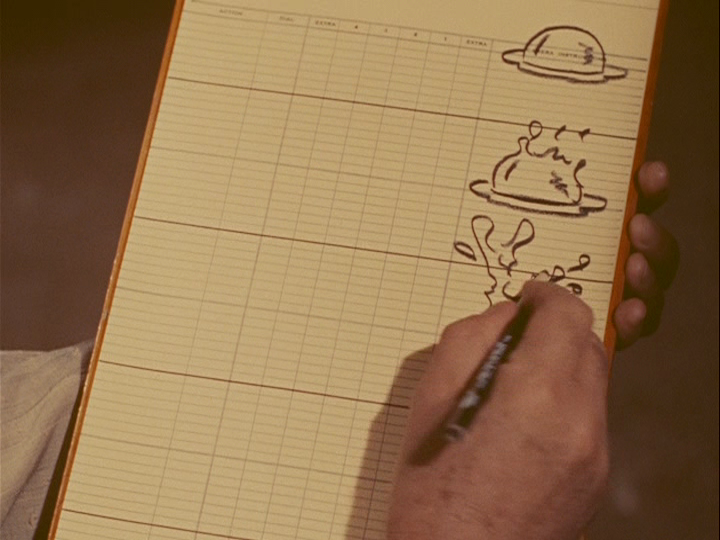
Dan MacManus sketching on an exposure sheet, trying to see how many frames it wll take to draw before the animator can draw the bubble bursting

The next animation technique we look at is effects animation: the trick of making the cartoon characters more believable by using extremely realistic animation of incidental action. There are many clips of animators watching various actions—including a baseball thrown through a window, or a bubble being blown from a pipe—and Disney explains that animating breakage required tremendous attention to detail. This leads into a clip of the earthquake from The Rite of Spring sequence in Fantasia. Continuing with that sequence, we see three effects animators looking at a tub of orange-colored mud, trying to solve three different problems for the creation of earth sequence in The Rite of Spring. Joshua Meador, head of the experiment, uses color chalks and pastels to render the sketch that would give an overall impression of the sequence. Jack Boyd’s assignment is to establish the individual action of a pair of bubbles, verifying his findings with the 2-drawing flipping action. Dan MacManus’s job is to see exactly how many drawings it would take to animate the bursting of a bubble, using an exposure sheet and a stopwatch. The audience then sees the clip from The Rite of Spring in its entirety.

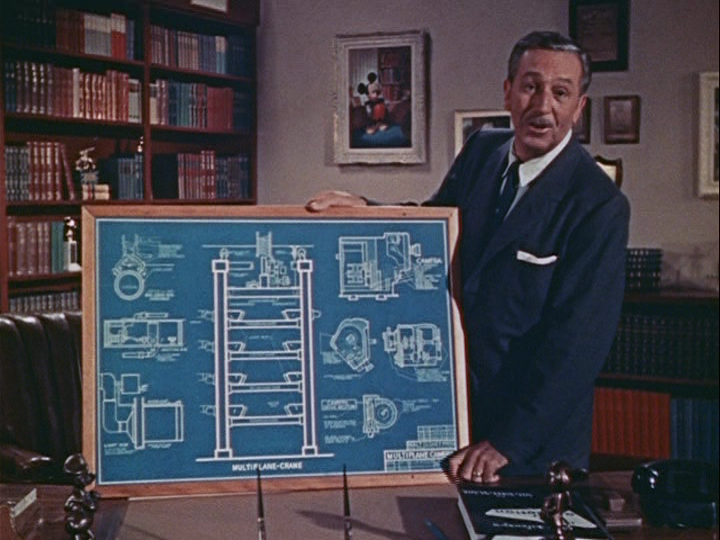
Walt with a blueprint of the Multi-Plane Camera, a Walt Disney Studios invention. Coincidentally, Ub Iwerks had created his own version at his own studio, only it was a horizontal camera

Walt pulls out a picture, calling it a different kind of drawing, which “also came out of our school of self-improvement here at the studio.” The blueprint is of the multi-plane camera, which was first used to great success in the Silly Symphony The Old Mill. Disney explains that the old process for animated films was fairly simple in construction and operation, but the biggest problem was that any dimension the character brought with him or her into the scene disappeared when the character left the frame. Another example used was a painting of a house on a moonlit night, and when the camera zoomed in on the scene, everything got larger, including the moon, which does not happen in reality. The use of the multi-plane camera shows the audience the big difference it makes in that scene. The audience next sees the opening scene of Bambi, and how the multi-plane camera works to give realism to the forest.

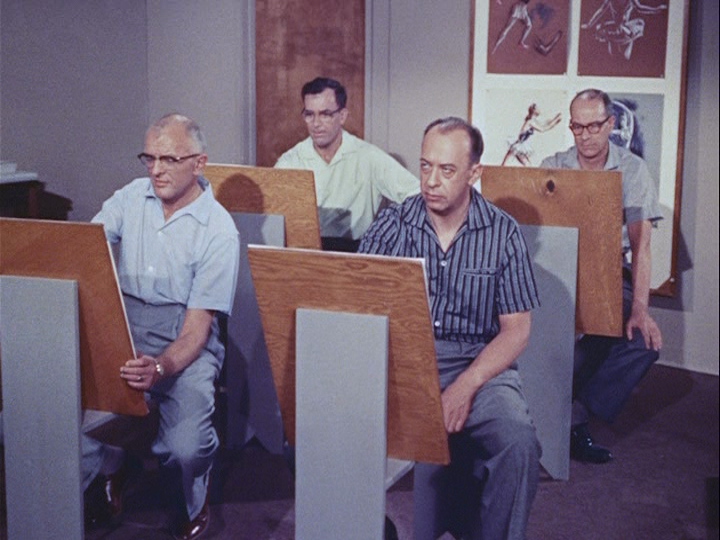
Four of the famous Nine Old Men, studying ballet moves. From Far Left: Milt Kahl, Frank Thomas, Marc Davis, and Ollie Johnston

“Perhaps the thing that distinguishes animated cartoons more than anything else is the trick of caricature,” Disney says. He tells the audience the story of the animation of Dance of the Hours from Fantasia, which involved the use of a live-action model to help the animators see the ballet movement of the dance. The ballet dancer they used was Helene Stanley, who was also the live-action model for Cinderella and Aurora in Sleeping Beauty. In this segment, we see the four of the famous Nine Old Men as they study Stanley’s movements. Kahl discovers that he may not be getting the kick right. Davis asks Stanley to perform it again, and as she does, Kahl makes a comment that the kick should be higher “in order to get all that weight off the ground. She’s no cream puff, you know.” Davis agrees, adding, “Yeah, that is a lot of beef.” These comments grab Stanley’s attention, but she keeps dancing. Thomas steps forward with his drawing and asks if he’s made the trunk too long: at this point, the audience sees that the drawings are those of the animals in the Fantasia sequence, although Stanley still thinks they are talking about her. Kahl responds to Thomas, “Oh, no, that’s what gives it that goofy look. Trunk’s way out of proportion to the rest of her body…it wouldn’t hurt to make [her legs] good and hairy.” These comments finally get the best of Stanley, who grabs her hat and cape and runs to the door, before turning around and seeing the animals they’ve been animating, and laughs before returning to the stage. The episode ends with the ballet segment from Fantasia, with all elephants, ostriches, and hippos.

The episode is wonderful for those who are fans of animation, and wish to see a dramatic look at how the animators were able to teach themselves and develop the new techniques to create better animation. Similar to “lessons learned” when creating computer animation in this generation, this highly recommended episode shows how the animators really had to, and did, step up to blaze a new trail.

February 12

February 12, 1993 – Homeward Bound: The Incredible Journey is Generally Released to Theaters

“It’s my responsibility. I had a responsibility to Sassy to love her and protect her, the same as I have to you, and to Peter, and the same as you have to Jamie.”

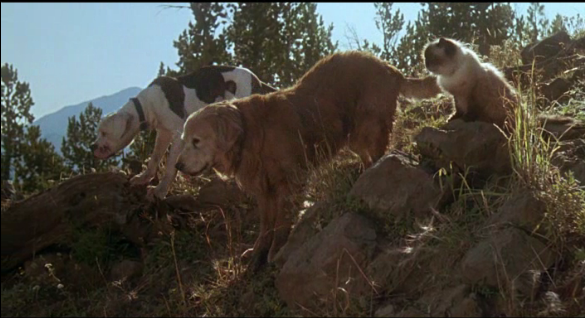
On February 12, 1993, the Walt Disney Studios had their general release of the family film Homeward Bound: The Incredible Journey. The film is a remake of the 1963 Disney film The Incredible Journey, which in turn was based on the best-selling book by Sheila Burnford. The story is of three pets – Chance, an American bulldog puppy; Sassy, a Himalayan cat; and Shadow, a golden retriever – who, afraid they’ve been abandoned by their owners, begin a journey back to their home through the California wilderness. Although the film was set in California, the filming was done in eastern Oregon. In contrast to the original film, the animals in the film speak, although this is one of the rare films were the animals mouths are not made to move in synchronization with what they say. The film stars Michael J. Fox as the voice of Chance (and the narrator of the film), Sally Field as the voice of Sassy, and Don Ameche as the voice of Shadow.  The film also stars Robert Hays as Bob Seaver, Kim Greist as Laura Seaver, Benj Thall as Peter Seaver, Veronica Lauren as Hope Seaver, and Kevin Chevalia as Jamie Seaver. It was directed by Duwayne Dunham, with the screenplay by Caroline Thompson and Linda Woolverton.

The film opens with Chance explaining his past: he was abandoned as a puppy, left to fend for himself on the streets before getting caught and sent to the pound. He was adopted by the newly combined Seaver family (Bob Seaver married Laura, a widow with three children). Chance calls it the place where he got his second chance, and his name; where he was provided with “lots of space, fresh air, plenty of interesting things to explore, and all the underwear [he] could eat.” He introduces the two other pets, Sassy the cat, and Shadow the dog, as well as their humans. Chance explains that the daughter Hope belongs to Sassy, the youngest boy Jamie belongs to Chance (although Chance explains that he doesn’t really need anybody), and Peter, the eldest, belongs to Shadow.

The pets on the porch of Kate's ranch. Shadow (L) eagerly awaits Peter's return, while Chance (M) believes they've been dumped.

The family must go to San Francisco for a little while, leaving the pets behind with a family friend named Kate at her ranch. Peter is not happy with having to leave Shadow behind, asking his new stepfather Bob, “What if he thinks I’ve abandoned him or something?” Bob responds that the time will pass before they know it, and everything will be okay. The pets, however, don’t understand what’s going on: Chance believes they’ve been abandoned, but it doesn’t seem to faze him much, since it had happened to him before. Kate leaves to go on a cattle drive, leaving a note behind for her neighbor about taking care of the pets, but part of the note falls under a table, and the neighbor mistakenly believes Kate took the pets with her. Shadow senses that something is wrong, and decides that he has to get back to Peter. “Something is keeping Peter from coming to me, so I’m gonna go to him,” he explains, and jumps the fence. Sassy follows him reluctantly, and Chance only follows, as he’s been chased by a turkey most of the time on the ranch, and decides to go where it’s turkey-less. “And so began the most perilous journey of our lives,” Chance narrates.

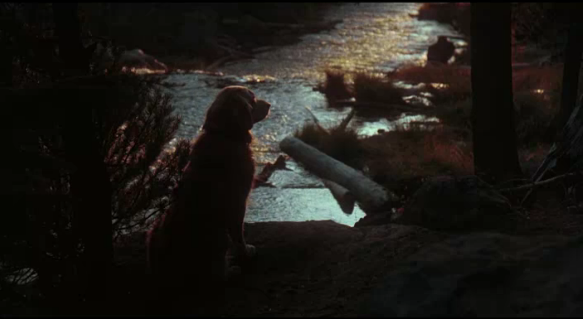
Shadow reassures the two that home is just over the mountain, but when they look over, they notice only more mountains and an expansive wilderness. But they continue, with Chance beginning to admire Shadow’s unwavering faith in Peter. As they begin, they have many brushes with nature, including a skunk and a protective mother bear. When they reach a river, Shadow and Chance have no problem swimming across, but as Sassy tries to climb a log to get to the other side, the log falls, sending Sassy traveling with the current. Although Shadow and Chance race along the riverside and Shadow tries to go into the river to catch her, Sassy ends up going over the waterfall into the rapids. The two dogs wait overnight to see if she’ll come out alive, with Shadow blaming himself for letting Sassy drown. The next morning, Shadow bids Sassy farewell, and the two continue on their journey. A birdwatcher in the woods, however, comes across Sassy washed up on the shore, and takes her in, cleaning her up and feeding her.

Shadow sits near the waterfall, blaming himself for what he believes is Sassy's death

Kate comes home to find that her neighbor believes she took the pets with her, and panics, having to call the family and let them know that the pets are gone. The children are devastated, and Peter blames Bob for making them go to San Francisco and leave the pets behind. Meanwhile, the two dogs come across their next challenge: a mountain lion has been following their tracks. Inspired by the time Chance used a see-saw to catapult Sassy in the backyard, Shadow comes up with a plan to send the lion flying, throwing it into the river. Their triumphant barking alerts Sassy, who is nearby with the birdwatcher, and she runs in their direction, with the three reuniting.

The three run across a lost little girl in the woods, and decide to watch over her during the night, while a search party wanders around, calling out the little girl’s name. In the morning, Shadow hears their calls and alerts them to where the girl is. The rangers with the search party recognize the pets from the posters Bob has made, and decide to take the pets with them to a nearby animal shelter. They alert the family that the pets have been found, but Chance thinks he’s being sent back to the pound and panics, causing Sassy to escape. She comes back to help Shadow and Chance break out, and they run away just as their family is on their way.

The pets look down on their hometown, relieved that they are so close to their family

The pets see home just over the top of a mountain, and travel through train depot, carefully crossing over the tracks, when Shadow falls into a hole as the beam he walks across breaks. At first Chance and Sassy think he may have died from the fall, but he wakes up and tries to walk, finding out his leg is badly injured. The two try to coax Shadow out of the hole, but the walls are slick with mud, and eventually, with the answer that he’s just too old, Shadow lies back on the ground and gives up. Chance tries to tell him that they need him, but Shadow says the only thing they need is to learn to say goodbye.

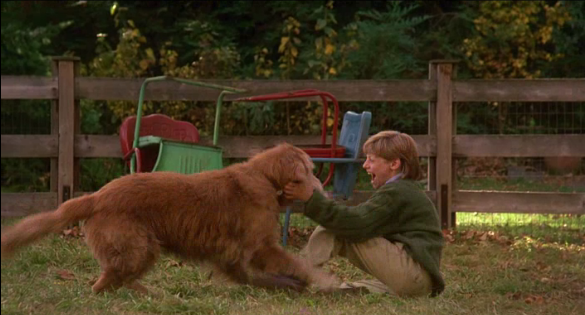
Later, when the family has returned home, still mending from what they believe is their loss, Jamie hears barking in the backyard. He calls out Chance’s name, and Chance comes over the hill, running to Jamie. Sassy appears next, running to Hope. Peter waits for Shadow to appear, but doesn’t see him, and angrily states that Shadow was just too old. Just as he turns to go in the house, a limping Shadow appears, and begins running to make his way back to Peter. Safe and sound, Chance realizes that here, he has the things he never knew he needed: a family, friends, and a home filled with love.

The joyful reunion of Peter and Shadow

February 11

February 11, 1918 – Birth of Disney Legend Blaine Gibson

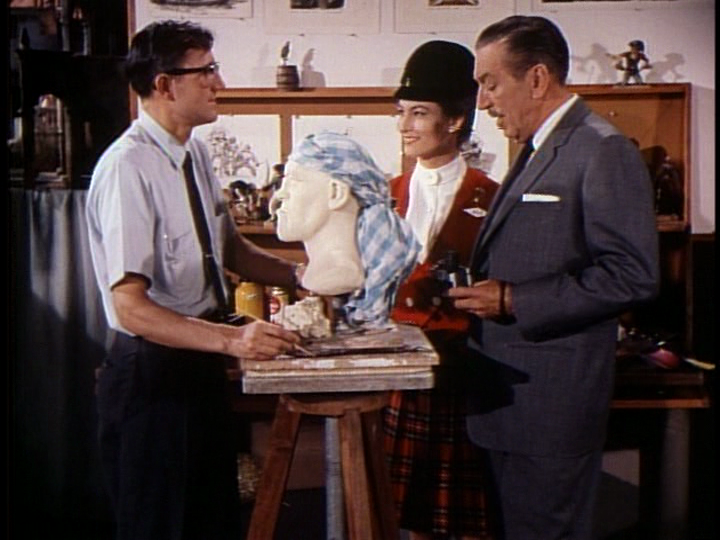
Gibson (L) showing Julie Reihm and Walt Disney one of the scultpures for the Pirates of the Caribbean attraction

“…I was told Walt was expecting me to work on these projects. So I said to myself, ‘what the heck’ and went (to Walt Disney Imagineering). I was never sorry after that.” – Blaine Gibson

Born February 11, 1918, in Colorado, Blaine Gibson joined the Walt Disney studios in 1939, working as an inbetweener and assistant animator. Gibson built up an impressive resume working on the films Fantasia, Bambi, Song of the South, and Peter Pan, just to name a few. Gibson would work on sculpting in his spare time, and when Walt saw an art exhibit with Gibson’s sculptures in 1954, he asked him to help work on special projects for the upcoming Disneyland.

In 1961, after doing part-time work for WED Enterprises, Gibson left the animation arena and began sculpting full time. Gibson ended up heading the sculpture department, working on most of the heads of the Audio-Animatronics characters, including 41 presidents for the Hall of Presidents at Walt Disney World (the last being Bill Clinton), and the pirates for the Pirates of the Caribbean attraction. Gibson makes an appearance in the Wonderful World of Color episode Disneyland 10th Anniversary, showing Disney and Julie Reihm one of the heads of the pirates he’s been working on. Reihm notes that the pirate looks rather angry, to which Gibson responds, “Well, he has to be a tough guy. The pirates were pretty tough.”

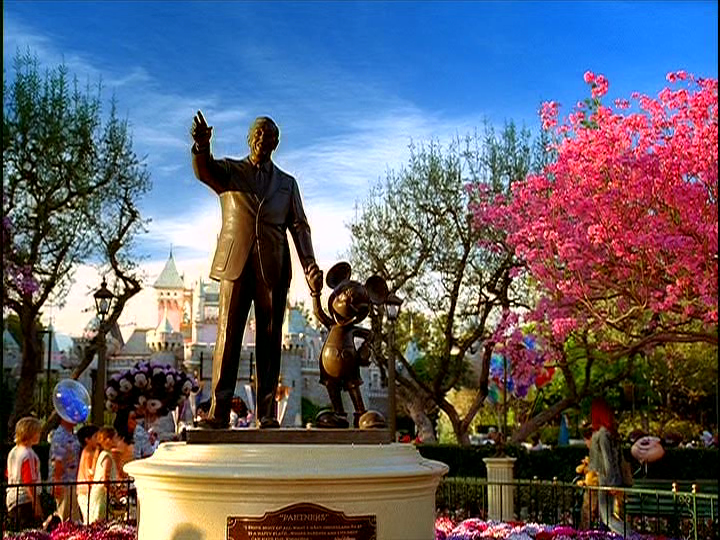
The Partners statue Gibson designed, located in the hub of Disneyland

One of the most recognizable works of Gibson’s is the “Partners” statue in the Central Hub of Disneyland, which depicts Walt Disney holding hands with Mickey Mouse. It was finished in 1993, the same year Gibson was named a Disney Legend, and the statue has become a symbol of Disneyland itself. Gibson retired from the company in 1983, but continues to consult on projects, including The Great Movie Ride in Walt Disney World.


February 10

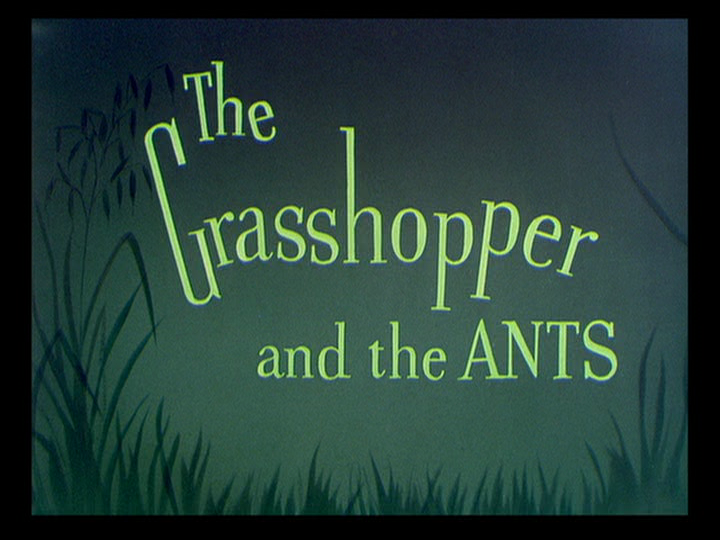
February 10, 1934 – The Silly Symphony The Grasshopper and the Ants is Released to Theaters

“Oh, the world owes me a living…”

In 1934, the Disney Studios released what was to become another wildly popular Silly Symphony, The Grasshopper and the Ants. Based on the fable by Aesop, it was adapted by William Cottrell, directed by Wilfred Jackson, and starred Pinto Colvig as the Grasshopper. Colvig is better known as the original voice of Goofy, and the song in this short, “The World Owes Me a Living,” would become a theme song for Goofy in later shorts. The song was composed by Larry Morey and Leigh Harline, and was so popular that sheet music for the piece was published. The short is also notable for being the first instance of a character turning blue from the cold. Although this is a common idea these days to show how cold the weather is, the Technicolor process was still new in 1934, therefore any color change to show emotion would have been relatively fresh.

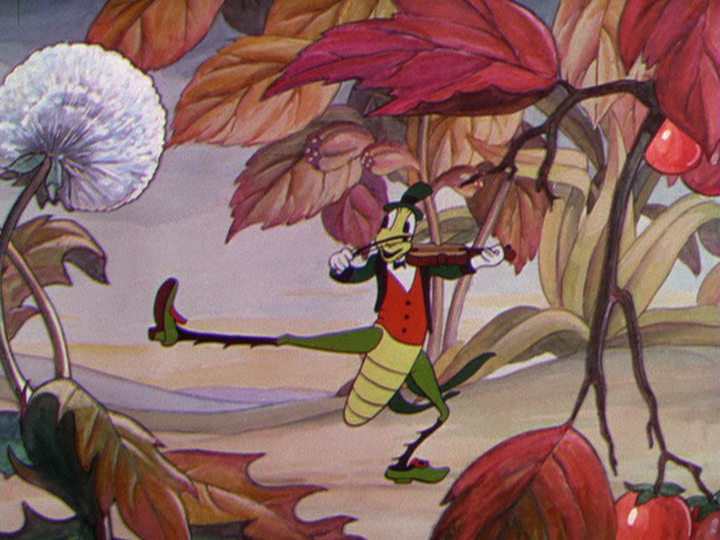
The first shot we see is of the Grasshopper skipping down a flower-filled path, playing his fiddle merrily. As he stops for something to eat and drink, we see that the Grasshopper is actually quite wasteful, taking one bite of a leaf before throwing it away to grab another. He becomes distracted, however, when he sees a hive of ants busily working to store food for the winter, doing such chores as picking off the individual kernels from an ear of corn to chopping up slices of carrots, making it easier to bring the food inside their hollow tree.

The Grasshopper gets a young ant to shirk his work to sing and dance

The Grasshopper begins to laugh at their efforts, and calls over an ant to join him. “Listen,” he tells the ant, “the Good Book says the Lord provides. There’s food on every tree. I see no reason to worry and work, no sir, not me.” With that, he goes into the theme song for this short, “The World Owes Me a Living,” enticing the ant to “play and sing and dance,” to which the impressionable ant agrees, imitating the Grasshopper’s dancing. Unfortunately for the ant, the Queen arrives, shocked to see an ant shirking its duty. The ant, embarrassed at being caught, rushes back to his work at breakneck speed.

The Grasshopper greets the Queen and tries to entice her the way he did the ant, but the Queen is firm. “You’ll change that tune when winter comes and the ground is covered with snow,” she warns him. But the Grasshopper assures her that winter’s a long way off, and begins to sing again. The Queen leaves him to his foolishness, and the Grasshopper continues to sing and dance, and not “spoil his Sunday pants like the other foolish ants.”

The Grasshopper begins to dance his way through the seasons, caring little for the upcoming winter

As he continues to fiddle and dance, the seasons quickly change from summer to autumn, with the leaves beginning to fall. The scene begins to grow more desolate, but the Grasshopper continues to blithely fiddle and dance, unaware that all he considers food is quickly disappearing with the changing of the seasons.

As heavy winds begin to blow, we see the ants finishing up their food gathering, and rushing inside their hollow tree for shelter before it begins to snow. The Grasshopper is seen wandering the snowy fields, searching for any morsel of food, but sadly, the trees are all bare. Finally, he spots one lone leaf on a branch, and just as he is about to grab and devour it, a strong gust of wind swoops in and blows it out of reach. He begins to turn blue from the cold as he keeps walking in the heavy snows, looking for food and shelter. At last, he spies the ants’ tree, and makes his way to the door, spying through the window.

The last piece of food the Grasshopper can find

Inside, every ant is well fed and merry, clinking glasses and enjoying the fruits of their labor. The Grasshopper knocks on the door, but is so weak from hunger and the cold that he faints just before they open the door. The ants carry him inside and warm him while feeding him soup. The Queen makes her way over to the Grasshopper, looking angry at his presence. He tries to make amends for his previous lackadaisical attitude, begging her to not throw him out. “With ants,” she tells him, “just those who work may stay. So take your fiddle.” The Grasshopper, visibly upset, takes his fiddle from her and begins to leave. But the Queen has other ideas: “And play,” she says, giving him the opportunity to earn his keep by entertaining the ants during the long winter. The Grasshopper is more than willing to meet her terms, adding a new verse to his song about his whole change of attitude.

February 9

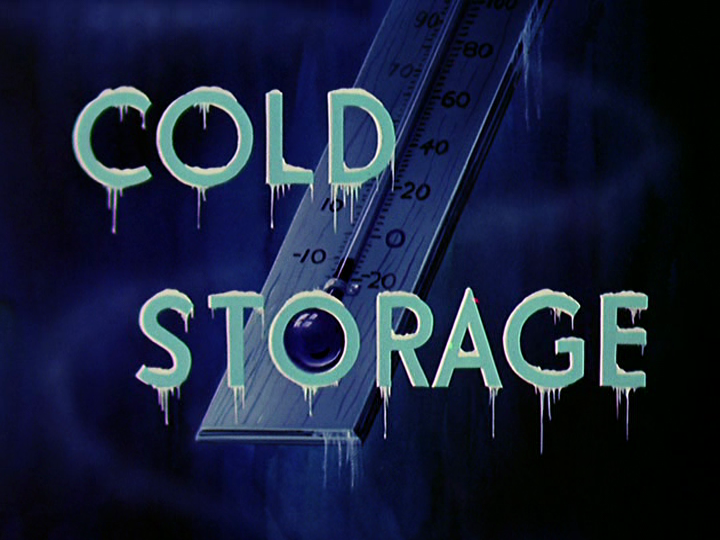
February 9, 1951 – Pluto Short Film Cold Storage is Released to Theaters

On February 9, 1951, the Pluto short film, Cold Storage, was released. The short was directed by Jack Kinney, with the story by Dick Kinney and Milt Schaffer. It was the 46th Pluto short released, the first in 1951, which was the last year of the Pluto short films.

The scene opens on a pond in winter, where a stork is shivering in the cold as his feet are frozen in the pond. He manages to extract himself, and is on the search for somewhere warm to stay, when he spies a doghouse. He quickly takes over, preparing to hibernate. Unfortunately, just as he has found a place to stay, a shivering Pluto makes his way into the yard, hoping to get warm inside his doghouse. He tries to fall asleep in the house, only to find that the stork has pushed him back out into the cold.

Pluto wakes up, alarmed to find himself in the elements again, and attempts to walk back inside. The cunning stork, however, lifts the doghouse so the sleepy Pluto walks right through it without noticing. Pluto, alarmed again at being outside, runs around to the entrance to once again get warm and as he settles down, the house gets up (thanks to the stork) and walks away. Pluto’s anger grows as he finds he cannot enter his own doghouse, no matter how hard he tries. He sees that the house seems to be moving on its own, and fears he’s become ill or crazy.

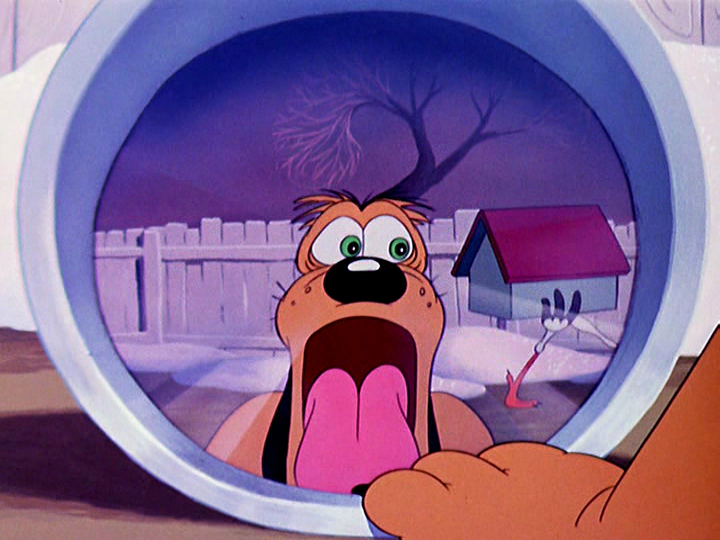
Pluto, checking to see if he's sick, ends up seeing his house walk across the yard

As Pluto checks his vitals, he notices in the reflection of his bowl that the house seems to have sprouted legs and is moving across the yard. He goes into attack mode, but is stopped when the stork’s beak appears in the doorway. As he watches the stork take a drink from the water bowl, Pluto can’t take it any more and begins to bark profusely at the intruder. The stork replies by stepping on Pluto’s snout, silencing the poor pup. As Pluto looks around for his house, he is alarmed to see that the stork has decided to fly away, house and all. When the stork perches on the fence, Pluto knocks him into the yard, only to discover that the stork is now using the house as a cradle, and lulls himself to sleep singing “Rock-a-Bye-Baby.”

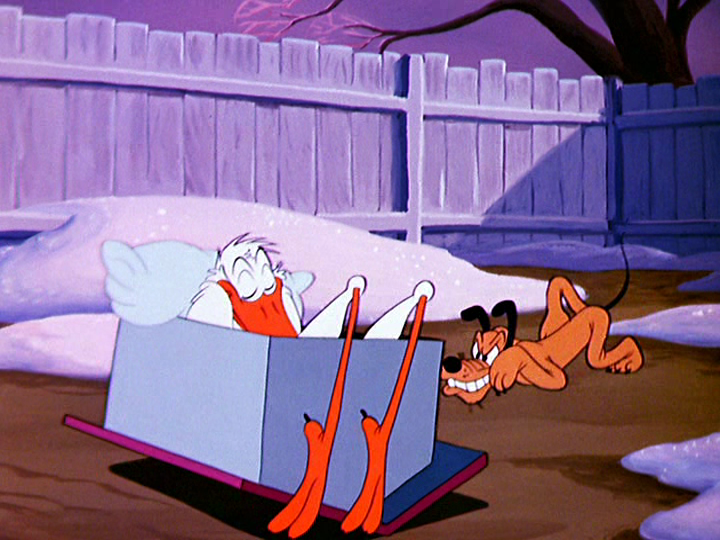
As the stork lulls himself to sleep, Pluto decides to implement a sneak attack

Pluto begins to sneak up on the stork, but the stork is unfazed by the dog, until Pluto attacks him. After Pluto thinks he’s won the fight, he goes inside the doghouse and settles on the pillow, hoping to finally get to sleep. The “pillow,” however, has other plans, walking outside the house and dropping Pluto into the frozen pond. Another fight ensues between the stork and the dog, with each fighting for dominance. Suddenly, the sun bursts out from behind the clouds, quickly signaling the beginning of spring. Just as the two were fighting to get in the doghouse, now the two are fighting to get out, as the temperature rises to an uncomfortable level. Fortunately for Pluto, he is able to come up with a compromise that allows both of them to find relief from the heat..

February 8

February 8, 2001 – Disneyland’s California Adventure Opens

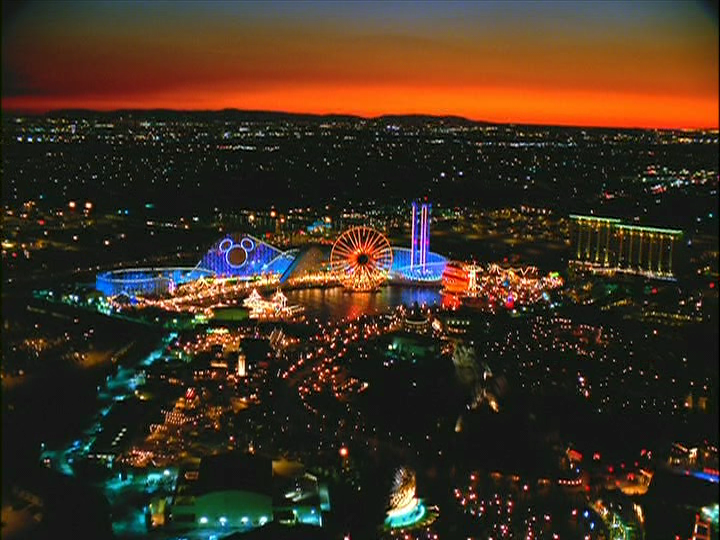
Nightime view of California Adventure in Anaheim, California

“Discover the Disney stories and characters you love in ways you’ve never imagined!”

Opening February 8, 2001, Disneyland’s California Adventure is a theme park in Disneyland, located in Anaheim, California. It was part of a group of changes in Disneyland, and consists of the districts Hollywood Pictures Backlot, The Golden State, “a bug’s land,” Cars Land, and Paradise Pier.

The announcement of California Adventure claimed that it would be a 55-acre park with three districts: one focused on the glitz of old Hollywood, one focused on the nature of California, and one would have a boardwalk feel to it. These lands would later become Hollywood Pictures Backlot, The Golden State, and Paradise Pier, respectively. The success of the Pixar films allowed the building of “a bug’s land” and Cars Land, as well as adding them to other aspects of the park. The early announcement also included Disney’s Grand Californian Hotel and the Disneyland Center, which is a themed retail, dining, and entertainment complex. It was planned to be built in the parking lot of Disneyland.

Paradise Pier, including the roller coaster California Screamin'. Image taken from the Disneyland Park Blog

There are many magical attractions in the California Adventure Park. In the Hollywood Pictures Backlot, guests can get a fright at the Twilight Zone Tower of Terror, have a slapstick adventure with the Muppets at Muppet*Vision 3D, or converse with 150-year-old turtle at Turtle Talk with Crush, from Finding Nemo. Paradise Pier boasts the California Screamin’ rollercoaster, as well as Toy Story Mania!, a 4D midway ride. The Golden State lets guests explore the landscape of California with the Soarin’ Over California Ride, but also gives adults a taste of California wineries with Wine Country Trattoria. “a bug’s land,” based on the hit Pixar film A Bug’s Life, allows younger guests to get a taste of what it’s like to be a bug, and they are able to view the 3D film It’s Tough to Be a Bug. Cars Land is a new 12-acre land that will open in 2012, and will feature locations that were in the Pixar film Cars, including Mater’s Junkyard Jamboree.

February 7

February 7, 1947 – Birth of Disney Legend Wayne Allwine, Former Special Effects Technician and Former Voice of Mickey Mouse

“Wayne was fond of saying, ‘We only carry the torch of these characters for a while, and then we pass it on.’ Well, he just carried it a little bit higher than anyone else.” – Bill Farmer, current voice of Goofy.

Wayne Allwine, best known as the third voice actor of Mickey Mouse, was born on February 7, 1947, in Glendale California. Active on stage and screen from an early age, Allwine ended up performing in bands until 1966, when he began to work for Disney in the mailroom, which was known as “traffic” in those days. Allwine recounts how he got the job at Disney, as well as how he became Mickey Mouse:


“I had wanted to work for Disney since I was a kid, but didn’t know how to get in. Well, one of the bands I was playing with, Tom Jackman’s father – Tom was the leader of the band – his father Bob Jackman ran the music department. And Bob gave me an application and a recommendation, and I started in the mailroom…way, way back when. And the thing that’s funny is a little known fact: Bob Jackman, after Pinto Colvig had left the studio, Bob supplied the voice for Goofy in several of the cartoons. So, in essence, Goofy hired the future Mickey…

“But I started out carrying mail. I saw Walt a couple of times, but we only spokeonce. He was very sick. [But] it was a magic time, it really was. 1966. John McCarthy was running traffic, as the mailroom was called back then, and just said, ‘Take a walk around, see what you wanna do.’ So I walked around, and the first thing I thought of, ‘Well, I’ve done some acting. Wardrobe looks like fun.’ Cause I love clothes, love clothes. Did that for a while. Went back into traffic and said, ‘Gee, I don’t really know what I wanna do, Mac. I might leave. I might leave for a while and just see what’s on the outside.’

“So great. I left, and I got a call about two months after I left, saying, ‘Would you like to come in and learn Jimmy MacDonald’s job?’ Now, at the time, I didn’t know who Jimmy was. ‘Sure. What am I supposed to do?’ ‘Follow Jimmy. Do everything he does.’

“So, I followed Jimmy, and I learned how to do sound effects. Jimmy only voiced Mickey for radio interviews; I think he was on the Dave Letterman show twice. But other than that, he didn’t do Mickey…he was having a rough time and couldn’t really voice Mickey any longer. And the studio had an open audition. An actor didn’t show up. There was a call from the soundstage: ‘Send the kid down. He works with MacDonald.’ Three months later Lou Debney stopped me and said, ‘Kid, you gotta join the Screen Actors Guild. They’re gonna use you.’

 “And that’s how I became Mickey Mouse.”

Allwine provided the voice for Mickey in Mickey’s Christmas Carol (1983), Who Framed Roger Rabbit (1988), Runaway Brain (1995), and The Three Musketeers (2004). He also voiced the character in the television shows Mickey’s Mouse Works, House of Mouse, and Mickey Mouse Clubhouse, as well as in the video game series, Kingdom Hearts. “The main piece of advice that Jim gave me about Mickey helped me keep things in perspective,” Allwine recalled in a 2004 interview with Leonard Maltin. “He said, ‘Just remember, kid, you’re only filling in for the boss.’ And that’s the way he treated doing Mickey for years and years…Mickey’s the real star. You know, you just have to love the little guy while you have him, because he won’t be yours forever.”

Allwine (L) working with some of the special effects tools designed by Jimmy MacDonald (R)

In addition to his voice acting, Allwine was an accomplished sound effects technician, winning an Emmy and a Golden Reel Award for his work in Steven Spielberg’s Amazing Stories, and another Golden Reel Award in 1986 for his contributions to the Disney animated feature The Great Mouse Detective.

One of the little known facts about Allwine is that in real life, he was married to the voice of Minnie Mouse, Russi Taylor. “It was just a total friendship, and the next thing you knew, we were just sort of like, always together,” Taylor said of how their relationship developed. On October 13, 2008, the couple were inducted as Disney Legends.

Mickey (Allwine) and Minnie (Taylor) together

On May 18, 2009, Allwine passed away at the age of 62. The game Kingdom Hearts 358/2 Days, his last vocal project as Mickey, was dedicated in his memory. “Wayne’s dedication to preserving the legacy of the character who began with Walt Disney himself was steadfast,” Tony Anselmo, voice of Donald Duck and close friend, said about Allwine. “He was one of the kindest men I ever knew, a true gentlemen, and funnier than any professional comedian. A truly gifted and talented man.” Allwin’s voice is still heard at parks around the world, as well as on television on the show Mickey Mouse Clubhouse. “It’s a great honor,” Allwine said of voicing Mickey. “It’s a great honor to represent what Walt loved so dearly, and what Jimmy kept alive so well.”


February 6

February 6, 1937 – Release of the Mickey Mouse Short Film Magician Mickey

“Aw, why don’t you go home? Phooey!”

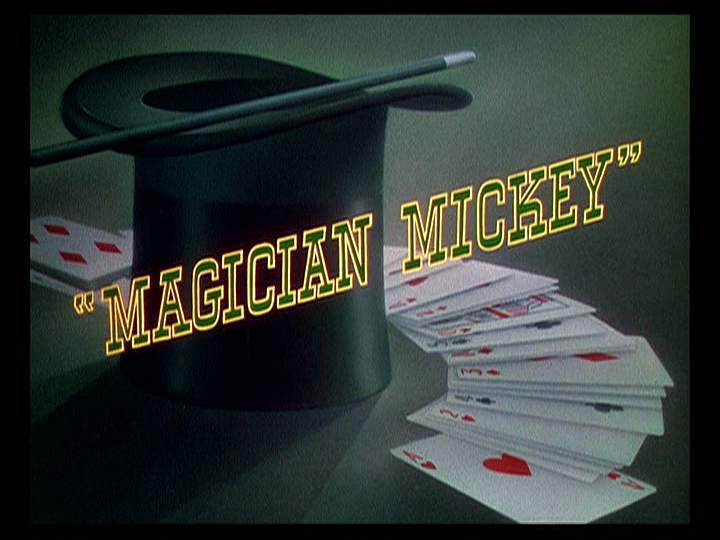
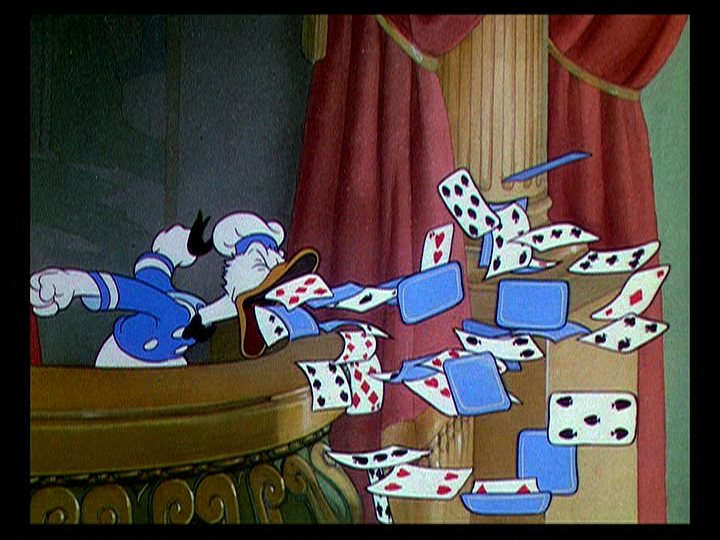
On February 6, 1937, audiences were treated to a cartoon magic show called Magician Mickey, starring Mickey Mouse. Unfortunately for Mickey, Donald Duck decides to attend the show, heckling Mickey from beginning to end with a growing degree of cartoon violence, but Donald learns that Mickey will always get the best of him in the end. The short was directed by David Hand, and stars Walt Disney as Mickey Mouse, Clarence Nash as Donald Duck, and Pinto Colvig as Goofy. As with many of the shorts of this period, this one relies on the use of pantomime, as Mickey and Goofy only have one line each. The short has the added bonus of Donald throwing ten fits, including the ones where he is a kangaroo, a seal, and a monkey—it is a magic show—and with every fit, he spits out cards ending with the ace of hearts sticking out of his mouth.

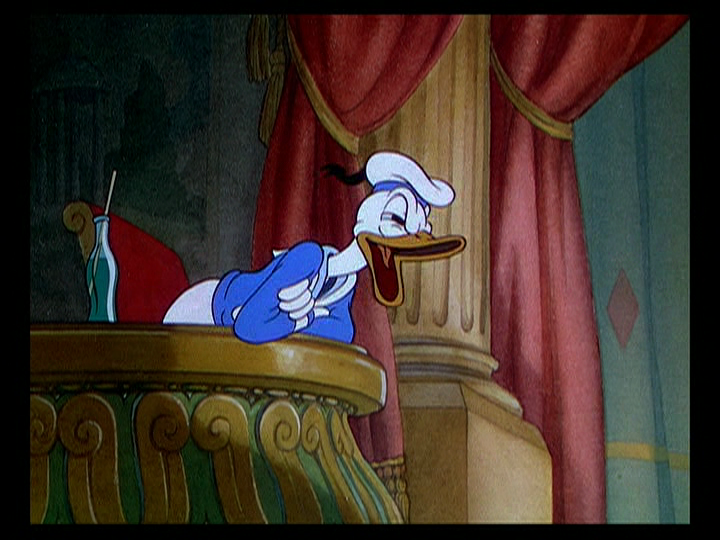
The short opens in a theater, and we see Goofy up in the rafters, setting up the ropes and lights for the show. We then hear applause as Mickey struts onto the stage. His first trick is making his table appear from his hat. He then turns his cloak into a crow, and as the crow flies away, Mickey is startled by hearing loud laughter. As he turns, he sees Donald Duck in a balcony seat, beginning his heckling as Mickey’s personal skeptic, crying, “Aw, phooey.”

Donald Duck, Mickey Mouse's personal heckler

Mickey’s next trick is to release a balloon from his hand, after showing that there was nothing up his sleeve. He releases another one, which suddenly pops over Mickey’s head, drenching him. He glares over at Donald, who spies the other balloon floating over and shoots it with a slingshot. Unfortunately, the balloon turns into a lobster, and begins to fight with Donald. As Donald throws it back at Mickey, Mickey catches it and turns it back into a balloon, which he pops with his magic wand.

Mickey then begins a card trick, but Donald, ever up to mischief, pulls out a bellows and shoots the air in Mickey’s direction, causing the cards to fly all over the place. Mickey amazes the audience by turning the cards into flock of birds, which he then sends into a cage he makes appear out of thin air. He then makes the cage disappear, replacing it with a new deck of cards. Donald proclaims that anyone can do that trick, and as Mickey makes the cards disappear, they reappear shooting out of Donald’s mouth as he throws a fit. Humiliated, he throws his empty soda bottle at Mickey. Unfazed, Mickey makes the bottle float in midair and fill with water, which shoots back at Donald, causing another card-spitting fit.

Mickey makes the cards reappear through Donald's fits, a humiliation not even Donald expected

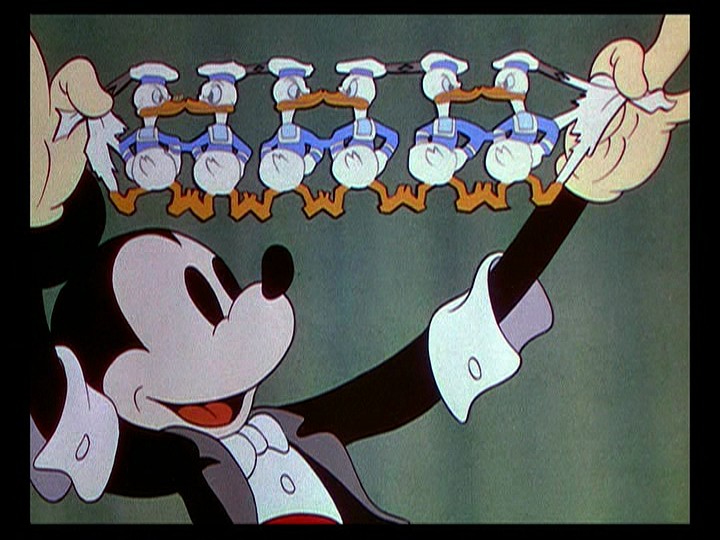
As Mickey bows to the audience, Donald jumps onto the stage and steals the magic wand, trying to use it on Mickey. The wand does give Donald a giant ice cream cone, which spits raspberry ice cream into the duck’s face, causing a third card-spitting fit. As he leaps at Mickey, Mickey catches him and makes him disappear in his hands, turning him into a set of Donald Duck paper dolls, and then into a twisted bullet, which Mickey places into a starter’s pistol. Mickey shoots Donald at an egg on the side table, and by the light of a candle, the audience sees Donald inside the egg, throwing another fit. Mickey grabs the egg and throws it into his hat, and makes Donald reappear by emptying the yolk from the hat.

Magician Mickey and his amazing Donald Duck paper dolls

Angered again, Donald steals the wand again, breaks it in half and throws it on the ground before having another tantrum; this tantrum, however, distracts him from seeing the wand pieces turning into a cactus equipped with boxing gloves. The cactus then begins to punch Donald, with one knockout punch sending him flying offstage. Having enough of the humiliation, but not knowing when to give up, Donald lunges onto the stage, sailing through a hoop Mickey holds up, turning into an assortment of animals as he goes through the hoop over and over. After getting himself back to normal, and seeing Mickey take another bow before the enthralled audience, he spies the pistol in Mickey’s back pocket rips it away and points it at Mickey, who becomes alarmed. “Look out! It’s loaded!” Mickey cries. Donald doesn’t care, but at least he provides the show with an explosive ending.