RSS Feed

Tag Archives: Walt Disney Studios

March 31

March 31, 1945 – Ed Catmull, President of Pixar Animation Studios and Walt Disney Animation Studios, is Born
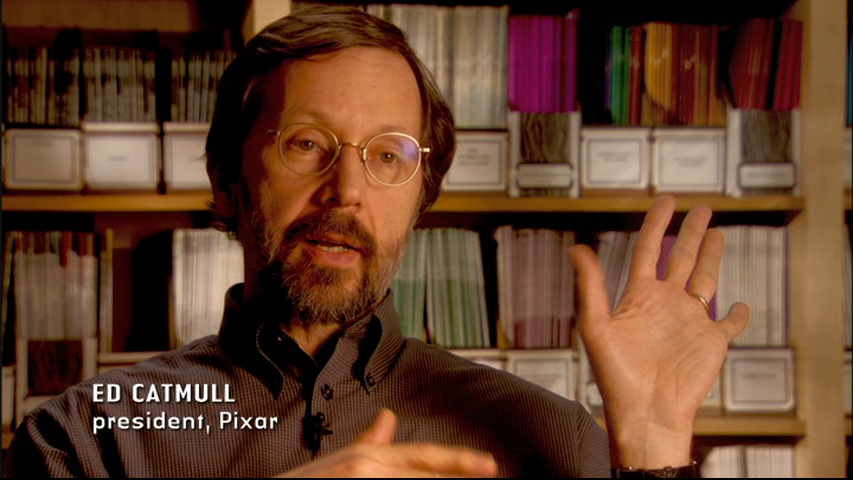
vlcsnap-2013-03-31-08h17m29s92

“I drew a lot; I wanted to be an animator. I wanted to be an artist. But at the same time, I believed that I wasn’t good enough to be an animator, so I switched over to physics and computer science. As soon as I took the first class, I just fell in love with it, it just blew everything else away.”

On March 31, Edwin Earl Catmull was born on March 31, 1945, in Parkersburg, West Virginia. Although he loved to draw from an early age and dreamed of becoming an animator, he believed early on that he didn’t have the talent necessary, and decided to study physics and computer science at the University of Utah. Around the country at that time, funding was given to select universities to pursue computer science, and Catmull participated in one of the first labs in computer graphics. In this lab, Camtull created a short computer-animated film of his own left hand, which ultimately helped in the development in creating curved surfaces and eliminating jagged edges. This film was inducted into the National Archives in December, 2011 as a ground-breaking work. In 1974, Catmull graduated with his PhD. Soon after graduation, Alexander Schure, founder of the New York Institute of Technology, hired Catmull as the head of the computer graphics department in the hopes of creating new tools and products to create computer animation. There, Catmull met Alvy Ray Smith, who became a close collaborator and friend for many years. At NYIT, Catmull and his research group developed several tools that would allow animators to draw and paint directly into the computer, including Tween, Paint, and SoftCel.

The work being done by Catmull and his team was noticed by George Lucas, who hired Catmull to form a new computer division at Lucasfilm. Catmull accepted the offer, and in 1979, he became the Vice President of the computer graphics division. Catmull and Smith, however, were still working toward the goal of a completely computer animated full-length film. Tom Porter, technical director at Pixar noted that, “…Ed and Alvy realized, in order to get in the game, we’ve got to put characters up on the screen, and that meant character animation, and that changed everything right there.” As luck would have it, Catmull ran into John Lasseter at a conference, and Catmull jumped at the chance to bring a real animator to Lucasfilm to help realize the dream of a computer animated film. With Lasseter, the group created the short film The Adventures of Andre and Wally B., along with new software to replicate the squash and stretch movements of traditional animation, which was well received at the 1984 SIGGRAPH conference. Catmull and the team also developed the most powerful graphics computer of the time: the Pixar Image Computer. However, sales of this computer were stagnant, as the software was only sold in limited markets. Catmull and Smith, with Lucas’ blessing, spun off the computer division as Pixar, and struggled to find an investor.
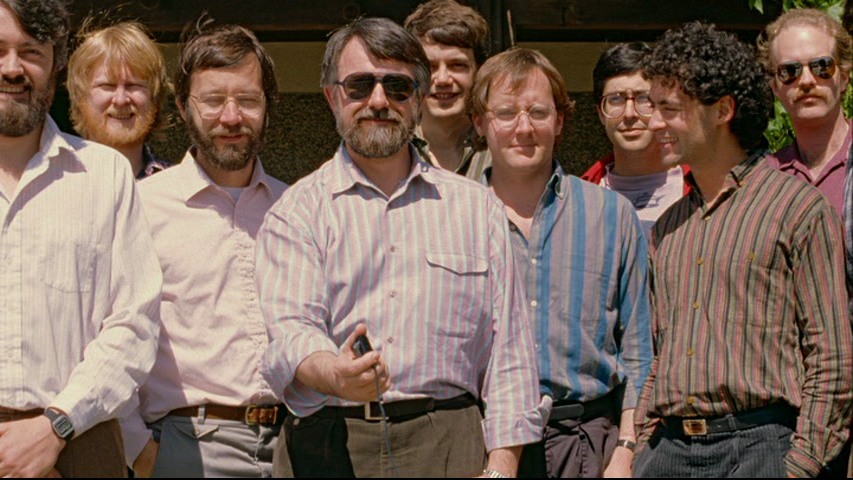
Catmull (L) with the rest of the Pixar team from Lucasfilm

Catmull (L) with the rest of the Pixar team from Lucasfilm

In 1986, their prayers were answered when Steve Jobs heard of Pixar. “That was the first time I met Ed [Catmull], and he shared with me his dream to make the world’s first computer-animated film. And I, in the end, ended up buying into that dream, both spiritually and financially,” Jobs shared in an interview. He launched Pixar, and Catmull was named as Chief Technical Officer. He also helped develop the RenderMan system used in Toy Story and Finding Nemo. In 2006, when Disney acquired Pixar, Catmull was then named the President of Pixar and Disney Animation, and with Lasseter, the two were put in the prime position of bringing the art of 2-D animation back to life. “Everybody at Pixar loves 3-D animation, you know, we helped develop it. But we also love 2-D animation, and to think that 2-D was shut down, and that [Pixar was] used as an excuse to shut it down was awful,” Catmull said about the decision of most animation studios shutting down their traditional animation studios. “We saw this art form being thrown away, so for us, it was just, it was a tragic time.” Bob Iger, CEO of the Walt Disney Studios, wanted to take the studio back to the glory days of animation, and knew that Pixar had the right people to do that. “While we will make 3-D movies, we’re also going to make 2-D movies, cause it’s part of this wonderful heritage that we’ve got here, and it’s a beautiful art form,” says Catmull. “It feels like this [partnership between Disney and Pixar] is the true culmination of the building of Pixar and this amazing company into something which will continue on and continue to make waves in the future.”

March 4

March 4, 1932 – Former Walt Disney Company President and Disney Legend Frank Wells is Born

vlcsnap-2013-03-03-20h54m46s228

“Talk about genius, a genius of an executive…a person who was willing to sublimate his ego and keep it behind the scenes because he knew there was a greater good. There was a greater good not only to the corporation and the stockholders, but to the creative enterprise that Disney was in.” – Don Hahn

On March 4, 1932, Frank G. Wells was born in Coronado, California. Wells and Roy E. Disney were classmates at Pomona College in the early 1950s, and in 1953, Wells became a Rhodes Scholar, earning his BA at Oxford University. In 1969, Wells became Vice President of Warner Brothers, and became its president in 1973 before being named chairman in 1977. In 1982, he left Warner Brothers, and was asked by Disney to join the Walt Disney Company as President and Chief Operating Officer in partnership with Michael Eisner’s offices of Chairman and CEO. As Disney put it, “I thought, you know, Frank’s more of a businessman, and Michael is a little nuts, and the two together kind of in some way made me think of Walt and my dad. So we began saying, ‘How would you two like to take this job?’” Wells was considered the peacemaker between the three strong personalities of Roy E. Disney, Michael Eisner, and Jeffrey Katzenberg. Eisner said of Wells, “Interesting thing about Frank: he carried in his wallet a piece of paper that said, ‘Humility is the ultimate virtue.’” Wells is noted as being instrumental in bringing a new golden age of Disney animation.

Wells was also known as an adventurer, and a goal of climbing the Seven Summits, although he was unable to climb Mt. Everest due to bad weather. Wells’ love of climbing is honored in Disneyland’s Matterhorn Bobsleds, with equipment labeled as part of the “Wells Expedition.” On Easter Sunday, 1994, tragedy struck the studio when it was announced that Wells had perished in a helicopter crash in Nevada’s Ruby Mountains after returning from a ski trip. The building that houses the Disney Archives was renamed in Wells’ memory, and The Lion King was dedicated to him. Wells was named a Disney Legend in 1994.

December 19

December 19, 1925 – Songwriter and Disney Legend Robert B. Sherman is Born

vlcsnap-2012-12-18-19h51m12s0

“When I grew up, I wanted to be a writer. Novels and plays. I used to write poetry.”

On December 19, 1925, songwriter and Disney Legend Robert Bernard Sherman was born in New York City, New York. After traveling cross-country for several years, the Sherman family settled down in Beverly Hills, California, where Sherman excelled in school, on the piano and violin, and in painting and creative writing. As a child, he and his brother Richard put on shows for the neighborhood, which Robert wrote and Richard performed. In 1943, Robert got permission from his parents to join the Army at age 17. He was shot in the knee in 1945, and walked with a cane for the rest of his life. He was awarded several awards during his military service, including the Purple Heart.

After his service, Sherman attended Bard College in New York, majoring in English Literature and painting. His father, Tin Pan Alley songwriter Al Sherman, challenged Sherman and his brother to write a song “that some kid would give up his lunch money to buy.” The two took up the challenge, and a partnership was born. Their song, “Gold Can Buy Anything (But Love),” was recorded by Gene Autry, but didn’t make a huge impact. However, they continued to write. In 1958, the two founded Music World Corporation, a music publishing company, and the two had their first Top Ten hit writing a song for Annette Funicello, “Tall Paul.” This song, among the others they wrote for Funicello, caught the attention of Walt Disney, who hired the Sherman Brothers to work at the Walt Disney Studios. Their first assignment was a song for the new Annette Funicello movie, The Horsemasters, entitled “Strummin’ Song.” The two also wrote for the film The Parent Trap, starring Hayley Mills, and in 1964, they wrote their most well known song: “It’s a Small World (After All).”

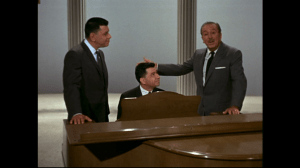
The Sherman Brothers singing a few songs on an episode of the Walt Disney anthology

The Sherman Brothers singing a few songs on an episode of the Walt Disney anthology

In 1965 they became the first songwriters on contract at the Disney Studios. They had their greatest success with the Mary Poppins’ songs “Supercalifragilisticexpialidocious;” Walt’s favorite, “Feed the Birds;” and the Academy Award winner, “Chim Chim Cher-ee.” The two continued to work under Disney until his death in 1966. After this, they worked freelance, still contributing to Disney films, but also on some non-Disney assignments, including Chitty Chitty Bang Bang, The Slipper and the Rose, and Charlotte’s Web. In 2002, Sherman moved from Beverly Hills to London, England, where he continued to write and paint; that year he also had an exhibition of his paintings at the Thompsons’ Gallery on Marylebone High Street, London. He published his autobiographical novel, Moose, in 2008. On November 17, 2008, the Sherman Brothers were awarded the National Medal of Arts, and were inducted as a Disney Legend in 1990. On March 5, 2012, Robert Sherman passed away at the age of 86.

September 29

September 29, 2000 – The Theatrical Feature Remember the Titans is Released to Theaters

“I don’t scratch my head unless it itches, and I don’t dance unless I hear some music; I will not be intimidated.”

On September 29, 2000, the theatrical feature film Remember the Titans was released to theaters. Based on the true story of the 1971 T.C. William Titans football team, the film tells the story of Coach Herman Boone and the struggles he faces as head coach, as well his dealings with Coach Bill Yoast, as they both try to direct the team during the time of racial turmoil in Alexandria, Virginia. The film was a joint production between Walt Disney Pictures and Jerry Bruckheimer Films. The screenplay was written by Gregory Allen Howard, with the film being directed by Boaz Yakin, and starring Denzel Washington as Coach Boone, Will Patton as Coach Yoast, Wood Harris as Julius Campbell, Ryan Hurst as Gerry Bertier, and Hayden Panettiere as Sheryl Yoast.

The movie opens at a funeral in Alexandria, Virginia, 1981. The narrator talks about her father coaching in Virginia, where football is considered bigger than Christmas. The film then goes back to July, 1971, just after schools in Virginia were integrated, with crowds of angry people in front of a store where a white store owner killed a black teenager. Some teenagers are seen playing football, when another student arrives and alerts them about the shooting. Their coach, Bill Yoast, luckily is able to stop them before they get caught up in the fighting. As they arrive back at the school, they are surprised to see Herman Boone, the new assistant coach, in Yoast’s office. After some tense words, Boone reassures Yoast that he comes with one purpose: to win.

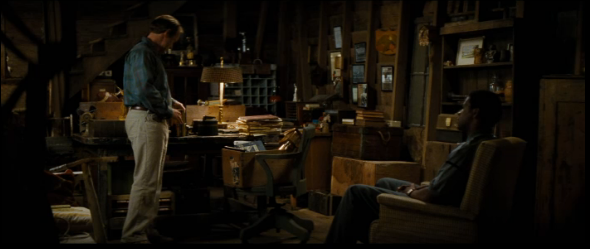
Boone (R) tries to convince Yoast (L) to join his team as the assistant coach, after apologizing for the circumstances but still maintaining that he has the skills to be head coach

The announcement comes soon after: Boone has been placed into the head coaching position by the school board. Boone is against the decision, as he left his position in North Carolina for being passed over due to race, and is against doing the same thing to someone else. Boone goes to Yoast’s house to offer him an assistant coaching position, but Yoast turns it down. He changes his mind when he realizes that the kids he coaches are putting their scholarships on the line.

The students go to football camp at Gettysburg College, with former team captain Gerry Bertier clashing not only with Coach Boone, but particularly with other player Julius Campbell. Boone is constantly making the two teams work together, forcing them to work together as one team. After a run to Gettysburg Battlefield, the two teams slowly begin to work together, with Julius and Gerry beginning to become friends. Unfortunately, when they get back home to Alexandria, the racial tensions they left behind are there to meet them, threatening to tear apart their newly formed team friendships. There’s more news for Boone as well: the moment he loses a game, he will be fired.

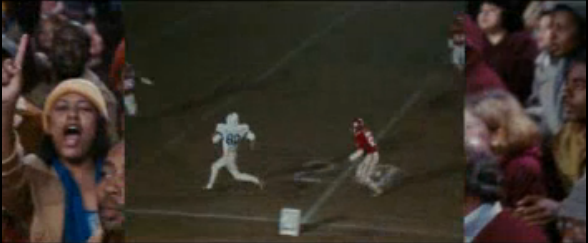
The community slowly begins to rally around the Titans as they go on to win every game they play

After a nearly disastrous first game, the Titans go on to a great winning streak, with the town slowly coming around to support the team. Although Gerry becomes good friends with Julius, his friends and family don’t share his viewpoint. Yoast is also having problems with the people in his life; his friend Coach Tyrell deserts him when Yoast continues to work with Boone, and when his daughter spends time at the Boone’s house, a brick is thrown through the window, which causes Yoast much concern and highlights the tensions between the two coaches. Yoast is put to the test when his nomination to the Hall of Fame is on the line: he will only stay a nominee if he helps throw the next game. In the end, he tells the referees that he knows they’re helping to throw the game, and refuses to contribute any more to the scheme. This loses him the Hall of Fame, but Yoast believes he’s gained something more.

After this game, Gerry is in a terrible car accident during the celebrations, and everyone rushes to the hospital. He becomes paralyzed from the waist down from his injuries, and will only speak to Julius. Julius promises that Gerry will pull through this, and they’ll grow old and fat in the same neighborhood, where race will no longer be an issue. Although Yoast believes that the team should take a break, Gerry refuses to let that happen, saying, “I’m hurt. I ain’t dead.” He then suggests to Yoast about entering the Wheelchair Games.

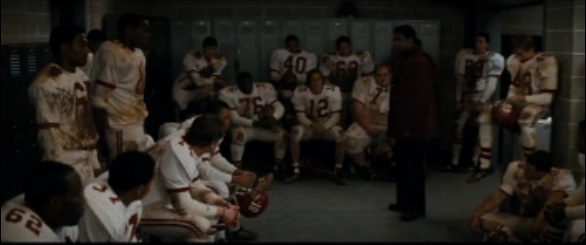
The team sits in the locker room during half-time of the state championship, telling Coach Boone that they came on to the field perfect, and that’s how they want to leave it

The final showdown is between the Titans and Coach Ed Henry for the state title. Not only is the team finally working together, but Yoast comes to the realization that he and Boone can work together, as does Boone. With one final play between the two, the Titans win the game and the state championship. Yoast’s daughter Sheryl continues her narration from the beginning of the film, saying that the Titans had a perfect season, going on to become the 2nd best high school team in the country. Gerry also won a gold medal in shotput in the Wheelchair Games, with coaching from Yoast. 10 years later, he passed away, which brings the audience back to the funeral from the beginning of the film. The film concludes with updates on many of the players, and includes Boone and Yoast, who “became good friends, and they continue that friendship today.”


September 22

September 22, 1984 – Michael Eisner and Frank Wells are Named CEO and President of Walt Disney Studios

L: Frank Wells. R: Michael Eisner

“I thought, you know, Frank [Wells]’s more of a businessman, and Michael [Eisner] is a little nuts, and the two together kind of in some ways made me think of Walt and my dad. So we began saying, ‘How would you two like to take this job?’” – Roy E. Disney

On September 22, 1984, Michael Eisner and Frank Wells were named CEO and President of Walt Disney Studios. Wells, a former classmate of Roy E. Disney’s, had suggested to Disney that Eisner would be a good chairman of the company, with Eisner being seen as having an amazing track record after his stint as the President and COO of Paramount Pictures Corp. Wells came to Disney from Warner Brothers as the Vice Chairman, and served as President and Chief Operating Officer. The two were able to bring Disney back to its glory in an era known as the “Disney Renaissance.” The partnership ended with the Wells’ death on April 3, 1994, with Eisner assuming the presidency on April 4th.

August 28

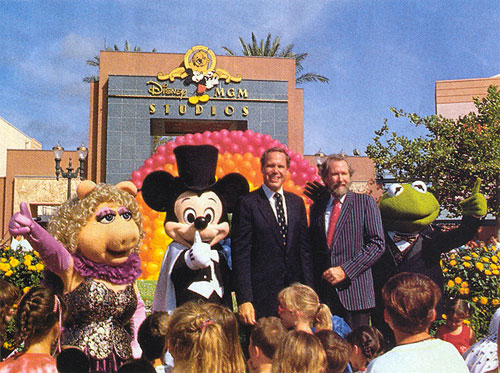
August 28, 1989 – CEO Michael Eisner and Jim Henson Announce Disney’s Plan to Acquire Henson Associates

Image credit: MuppetWiki

“I think hooking up with the Disney company creates such a wonderful force.” – Jim Henson.

On August 28, 1989, Disney CEO Michael Eisner and Jim Henson announced a deal for Disney’s acquisition of Henson Associates. The deal included all characters owned by Henson Associates, excluding the characters from Sesame Street (owned then by the Children’s Television Workshop, now owned by Sesame Workshop). Although the purchase price was not disclosed to the public, it was estimated that the price was about $150 million. The news was announced on an episode of ABC’s Good Morning America by both Eisner and Henson, which was then followed by a news conference at Disney-MGM Studios. The acquisition plan included Henson producing movies, television shows, Disney Channel specials featuring the characters, and attractions for the theme parks. Disney would not only acquire the Henson library, including all Muppet films and special films such as Labyrinth, but would also have exclusive rights to merchandising, publishing, and anything else related to the Muppet characters.

Unfortunately, the plans fell through after Henson’s death in 1990, with Disney and the Henson family clashing over terms. Although the Jim Henson Company was sold to a German corporation called EM.TV, the company bought itself back in 2003, and a new set of negotiations with Disney was opened in 2004. In February of that year, Disney successfully purchased the Muppets and characters of The Bear in the Big Blue House.

June 5

Posted on

June 5, 1934 – Mickey Mouse Trademark Granted for Newspaper Cartoon Strips

Image from the original patent file. Image credit: US Patent Office Website

“[After the loss of Oswald], that’s when [Walt] decided that he would never not own his own work again. That was a crucial moment in his life and career. He knew then that he had to own whatever he did. And he held fast to that the rest of his life.” – Leonard Maltin.

On June 5, 1934, the United States Patent Office granted the Walt Disney studios a trademark of Mickey Mouse for use in books and newspaper comics. The registrant is listed as the Walt Disney Productions, Ltd. at the Hyperion Studios. The original trademark has since lapsed, but has been renewed three times, the last time on July 14, 1994.

When Walt lost the Oswald the Lucky Rabbit character to Charles Mintz in 1928, he was careful to make sure he owned all of his work and vowed “Never again will I work for somebody else.” The company is very careful to protect its trademarks, no doubt due to Disney’s fierce protection of his work after Mickey Mouse’s creation.

April 21

April 21, 2008 – Disney’s New Film Banner, Disneynature, is Announced.

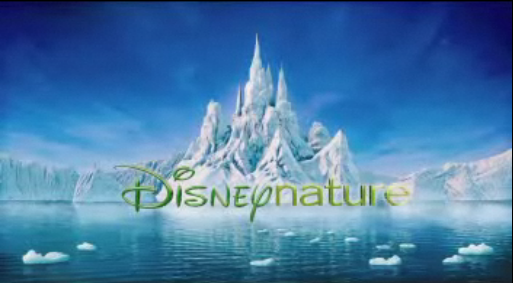
Image Credit: Official Disneynature Site

On April 21, 2008, Disney announced a new production banner, known as Disneynature. Under this banner, Disney releases nature documentaries, which began with the release of Earth on Earth Day, 2009. Other nature documentaries released were  African Cats: Kingdom of Courage, The Crimson Wing: Mystery of the Flamingos, Oceans, Orangutans: One Minute to Midnight, Naked Beauty: A Love Story that Feeds the Earth, and Chimpanzee.

The banner is headquartered in Paris, France, and headed up by Jean-Francois Camilleri, formerly the senior vice president for Walt Disney Studios Motion Pictures France. Disneynature can trace its roots back to Disney’s award-winning True-Life Adventures from the late ’40s to the ’60s, and has received many positive reviews for the films it has released.

April 7

April 7, 1995 – The Documentary, Frank and Ollie, is Shown at the Cleveland Film Festival

“Seemed like you seldom heard Frank’s name without Ollie’s along with it, or Ollie’s without Frank’s name. It was Frank and Ollie.”

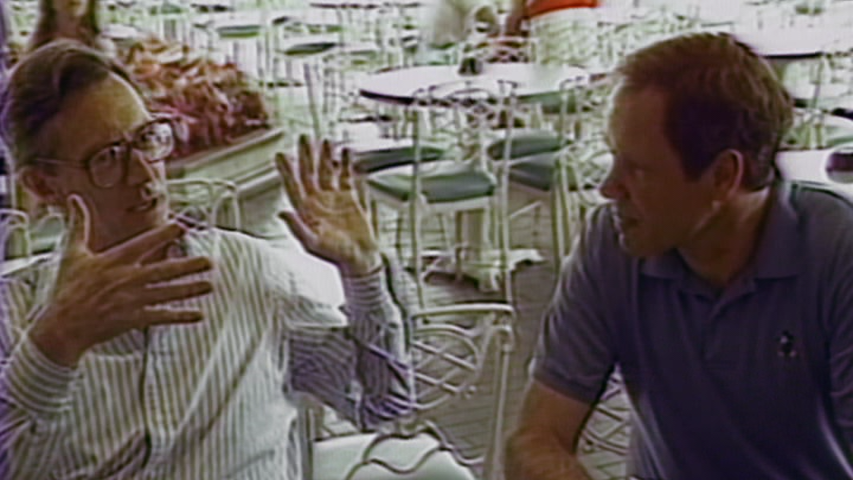
On April 7, 1995, the documentary film, Frank and Ollie, was shown at the Cleveland Film Festival. Written and directed by Frank’s son, Theodore Thomas, it tells the story of Frank Thomas and Ollie Johnston, two members of the elite group of animators at the Disney Studios known as the Nine Old Men.

The documentary is a touching tribute to the friendship of the two, which began at Stanford University in the art department. Through their long tenure at the Walt Disney Studios, the two not only helped pioneer the field of animation, but also used what they learned to help teach other artists, including Brad Bird, who gave them a cameo in The Incredibles. Frank and Ollie goes through their history with the company, from the success of Snow White and the Seven Dwarfs, the studio’s change during World War II, the unexpected death of Walt Disney, and their work on The Jungle Book. The film also shows their daily lives in California, where the two friends were also next-door neighbors.

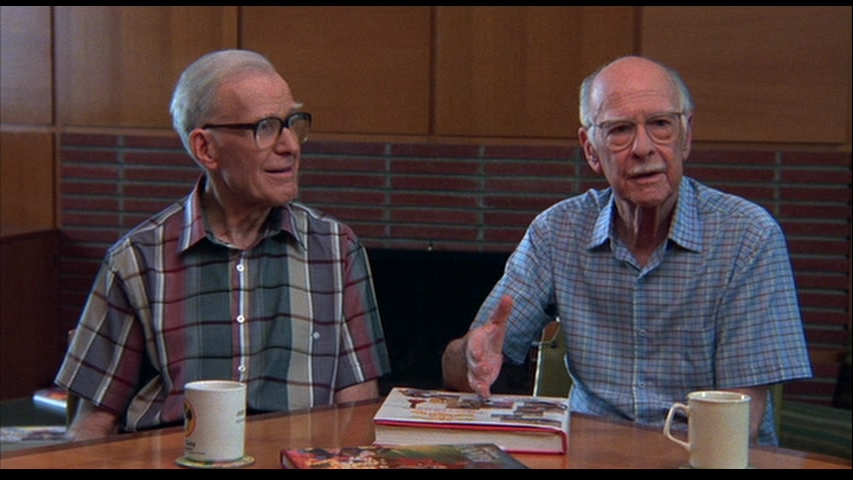
Frank Thomas (L) and Ollie Johnston, sitting down and discussing their memories at the studio

Frank and Ollie premiered at the Sundance Film Festival on January 22, 1995, and then was shown at the Cleveland Film Festival, with a full release to theaters on October 20, 1995, so that the film could be considered for an Academy Award. The documentary received very good reviews upon release, and captures a rare history of life inside the Disney Studios.

January 24

January 24, 2006 – Disney Announces an Agreement to Purchase Pixar for $7.4 Billion

The major players: John Lasseter (L), Steve Jobs, Bob Iger, and Ed Catmull

“…We had to return to the glory days of animation. So I began focusing on how to do that, and it really begins with finding the right people. The more I thought about it, the more I realized that Pixar had more of the right people than probably any other place in the world, from an animation perspective.” – Bob Iger, CEO, the Walt Disney Company.

On January 24, 2006, new CEO Bob Iger announced that Disney had agreed to acquire Pixar for 287.5 million shares of Disney stock, which equaled about $7.4 billion. Because Steve Jobs owned 49.8 percent of Disney shares, his vote was the only one that mattered, and it became a done deal. “We’re convinced that Bob really understands Pixar,” Jobs said in an interview on On The Money, “and we think that we have some appreciation of Disney and love the unique Disney assets, like being able to get the characters in the theme parks and really express them through all of Disney’s incredible assets. And we think we understand how to keep Pixar being Pixar, and how to spread some of that culture around…a few other parts of Disney as well, ’cause we think we’ve got something pretty good going here.”

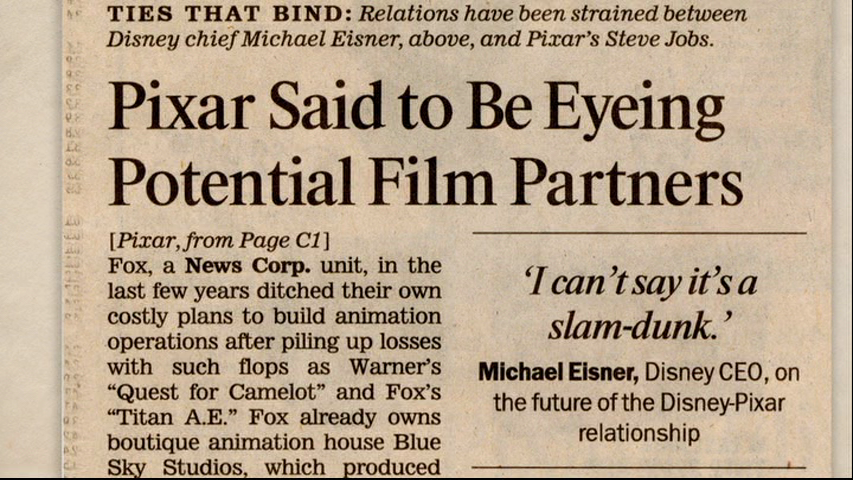
The road to this acquisition was not a smooth one by any means. Although Pixar had been the studio with hit after hit, Jobs was involved in a feud with the Walt Disney Company over the negotiations of their contract. It was public knowledge that Michael Eisner and Steve Jobs were not getting along. Jobs had reached out to Roy Disney for a conversation to share his grievances. Unfortunately for Disney, Jobs had come up with his own solution: After Pixar had completed the terms of the 1997 contract, Pixar would provide no more films for Disney, as long as Eisner was in charge.

Newspaper article declaring Pixar's search for a new distribution partner

As Pixar and Disney approached the end of their deal with no clear solution in sight, the anxious Pixar employees tried to figure out what to do. If they merged with a larger company, they could lose the independent spirit that had made them what they were. The employees “wanted to be an independent company,” Ed Catmull explained, “whereas if we were to become independent, we’d have to take on marketing and distribution, and get another partner, and it would change the culture in ways that we didn’t necessarily want…it was actually unfortunate at that time, because we’d had this phenomenal relationship with Disney all these years, where we were an independent company and they did the distribution and the marketing.” Another source of contention was the fact that Disney could make sequels without Pixar’s involvement. Pixar was heartbroken by this, as they regarded the characters they created like their children – this plan through Disney would make them more like dollar signs than anything else.

Things changed in 2005, when a corporate shakeup within Disney resulted in Eisner’s resignation, and the appointment of Bob Iger as the new CEO of the company. Iger was well known for his accomplishments in the development of Hong Kong Disneyland. Although he could deal well with overseas affairs, it was the domestic affair with Steve Jobs that was more difficult. But Iger was convinced that he would be able to repair the fractured relationship, since Jobs had said that the problem had been between him and Eisner, not the Walt Disney Company as a whole.

Iger’s focus on the rift took a serious turn when he attended the opening of Hong Kong Disneyland in September 2005, a month before he officially became CEO. Iger said that as he watched the opening parade, “[i]t hit me that the characters that were in the parade all came from films that had been made prior to the mid-90s, except for some of the Pixar characters. I felt that I needed to think even more out of the box than I had been thinking, and I had a much greater sense of urgency. I became CEO October 1st. I called Steve around that time and I said I thought we ought to talk, I had some bigger ideas, and that began a long period of discussion, because it was very serious for both sides. He really needed to feel comfortable that Pixar was in the right hands, and, more importantly, respect the talent and the culture.”

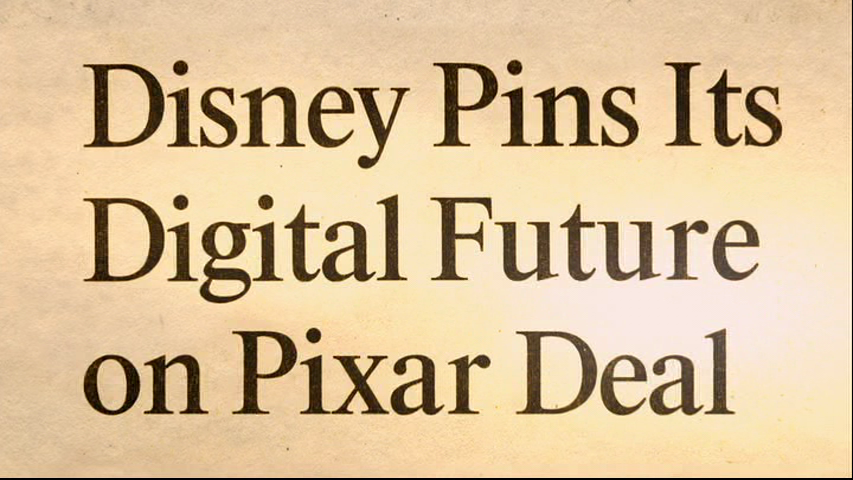
Another newspaper headline, this time with the good news that Pixar and Disney would continue their partnership

Expectations had been high that Iger could repair the fractured relationship, and with the announcement on January 24, Iger had proven that Disney was the best partner there could be for Pixar. The acquisition deal gave Steve Jobs a seat on the board as the largest shareholder, made John Lasseter Chief Creative Officer and principal creative advisor at Walt Disney Imagineering, and elevated Ed Catmull to President of Disney and Pixar Animation Studios. “It feels like this is the true culmination of the building of Pixar and this amazing company into something which will continue on and continue to make waves in the future,” Catmull said about the deal.