RSS Feed

Tag Archives: Short film

June 12

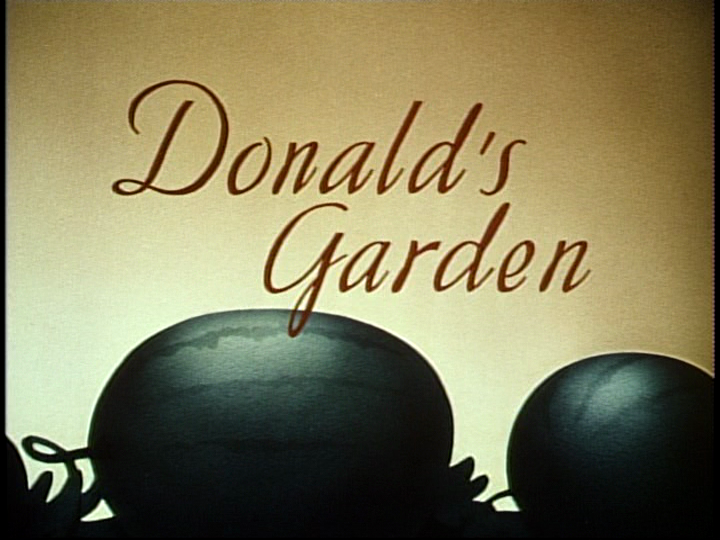
June 12, 1942 – The Donald Duck Short Film Donald’s Garden Premieres in Theaters
vlcsnap-2013-06-12-04h30m20s99

“Exasperating, isn’t it?”

On June 12, 1942, the Donald Duck short film Donald’s Garden premiered in theaters. It was directed by Dick Lundy.

Donald is seen singing while taking care of his prize-winning watermelons. As he goes to get more water from the pump, he seems to misplace the watering can while the water barely comes out from the pipe. When he moves the can closer, the water then pours out, missing the can once again. He moves the can again, and begins to pump out water with vigor, which pushes the can to the edge of the platform. Donald tries to stop the can from falling, but is too late. Angered, he tries again, but the water refuses to come out from the pump. He declares that he’ll show the pump this time, but the water refuses to fill his can, which ends with Donald getting his bill stuck in the pipe, water coming out of his nostrils. He threatens to tear the pump into pieces, and sticks the can right on the pump’s pipe. The pump explodes with water, but does fill the can. Unfortunately, the can breaks, leaving Donald holding nothing but the handle.
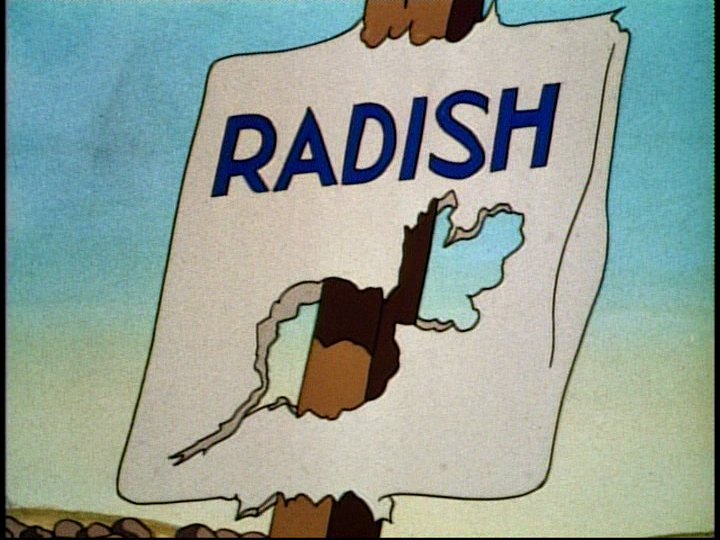
The gopher devours Donald's radishes, including the picture of the crop

The gopher devours Donald’s radishes, including the picture of the crop

The water falls into a hole in the ground, and a nearby gopher pops out of his hole, choking. He dries himself off and angrily walks around until he bumps into a sign for radishes in Donald’s garden. Suddenly hungry, he crawls underground and begins to pull down the radish crop to eat. The gopher then moves to the onions, but dislikes the taste of them. He spies the watermelon and starts to pull a good one away, but is unable to pull it through his hole. Quickly enlarging the hole, he is able to pull away the watermelon crop. Unfortunately, Donald is also harvesting the crop at the other end, and soon finds that his crop is being stolen. He attempts to pull back the crop, and finds the gopher, catching him in his hat. The gopher manages to escape, and Donald is pulled into the hole when trying to retrieve his crop. The gopher traps Donald with the watermelon vine, and decides to take the rest of Donald’s crops. He smiles with satisfaction as he polishes every single last vegetable.
June 11

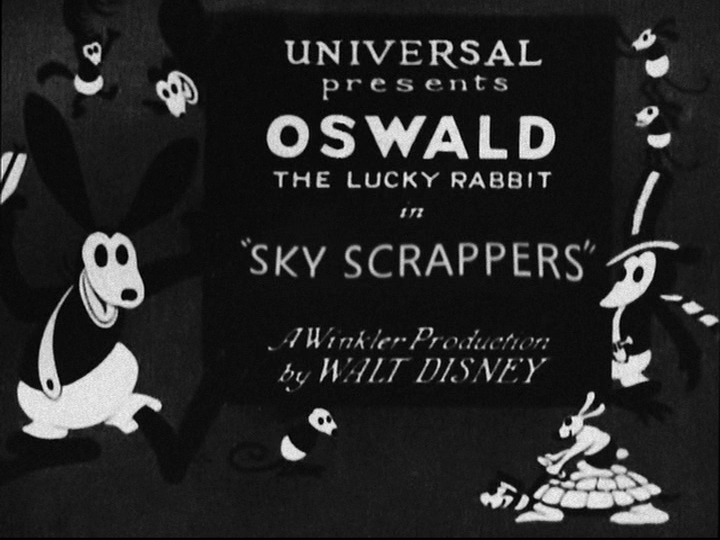
June 11, 1928 – The Oswald the Lucky Rabbit Short Film Sky Scrappers is Released to Theaters

vlcsnap-2013-05-30-01h14m09s134

On June 11, 1928, the Oswald the Lucky Rabbit short film Sky Scrappers was released to theaters. This was the twenty-first Oswald short that was done by Disney. There are several similarities between this short and the 1933 Mickey Mouse short Building a Building.

Oswald and many others are hard at work at a construction site, with Oswald using his strength to carry a barrel of water up several stories. When lunch is announced, he drops the bucket, only to have it fall on his head, soaking him and his lunch. Just then, his girlfriend Ortensia rides by with her box lunches, and offers one to Oswald, who blushes and pays her. He then opens the lunch and enjoys a hot dog, while Ortensia is pleased that someone is enjoying her lunches. As she does this, however, a hungry dog begins to eat the contents of her carrier.

As Oswald and Ortensia kiss, the foreman uses a hook to pull Ortensia away

As Oswald and Ortensia kiss, the foreman uses a hook to pull Ortensia away

The foreman spots the two lovebirds below, and decides that he wants Ortensia to himself, so he uses a hook to pull Ortensia away and bring her to his perch. Ortensia dismisses his advances, and Oswald quickly climbs the rope to her rescue, only to have the rope be disconnected from the top, sending him falling to the ground. Undeterred, Oswald finds another rope and pulls himself to the top, and fights the foreman for Ortensia’s honor. Ortensia watches from the sidelines, and while it looks like the foreman may have Oswald beat, Oswald manages to win it in the end, and he and Ortensia end the short with a kiss.

June 9

Posted on

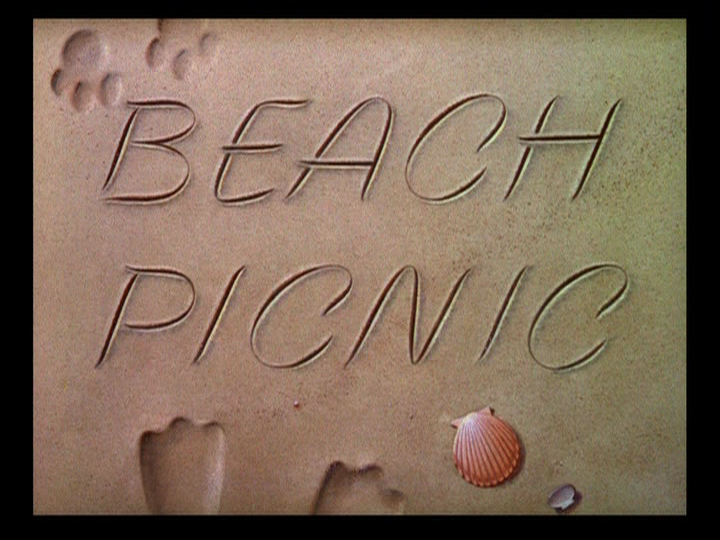
June 9, 1939 – The Donald Duck Short Film Beach Picnic is Released to Theaters

vlcsnap-2013-05-29-23h47m13s183

“Boy! Time for my swim! Come on, Seabiscuit! Let’s go!”

On June 9, 1939, the Donald Duck short film Beach Picnic was released to theaters. This was the first short to be directed by Clyde Geronimi, who would go on to win an award for his work on the 1941 short film Lend a Paw. Although this is a Donald Duck short, more attention is given to Pluto, his co-star. The flypaper gag used in this short is reminiscent of the 1934 short film Playful Pluto.

Donald is enjoying a beautiful day at the beach, setting up a picnic. He then decides to go for a swim, taking his inflatable horse into the water with him. He struggles to stay on the inflatable animal, continuously sliding off into the water. He soon is distracted by a strange noise, and sees Pluto taking a nap, with the tide coming in and covering the dog. Getting an idea, Donald sends the inflatable horse sailing to shore to scare Pluto, mimicking a horse noise for greater effect. The inflatable creature ends up behind a rock, and Pluto walks out to investigate, only to be frightened by the sounds it makes, much to Donald’s glee. Pluto battles with the creature, only to find that it will literally bounce back from his punches. Finally, Pluto chomps down on the inflatable’s nose, but finds himself being filled with air and sent flying around the beach, landing in a shipwreck and having a bell land on his head.

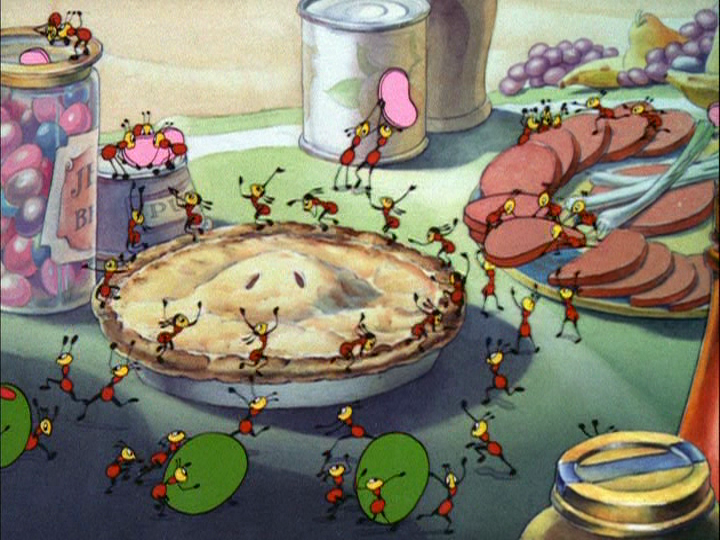
The ants quickly gather the food left out by Donald as he went for a swim

The ants quickly gather the food left out by Donald as he went for a swim

Meanwhile, an ant is surveying the scene of the beach and, seeing Donald’s unattended picnic, alerts all the other ants to “come and get it.” The food is soon carted away, but Donald spots the ants and chases them away. As he devises a plan to catch the ants with flypaper, one lone ant tries to run away with a piece of cake, but is spotted by Pluto, who is still stick in the shipwreck. He frees himself and begins to follow the ant, and the ant finds himself stuck between the flypaper and Pluto, but manages to get Pluto stuck to the flypaper instead. Pluto continues to try and free himself, but manages to remain completely stuck to the flypaper, with Donald laughing hysterically. While Donald’s back is turned, Pluto ends up sending himself flying in the duck’s direction, with the two of them getting stuck to the flypaper. Pluto tries to free Donald, and when he does, Donald ends up rolling all over the flypaper, completely covered. Pluto then licks the duck’s face as Donald throws a tantrum.

June 5

Posted on

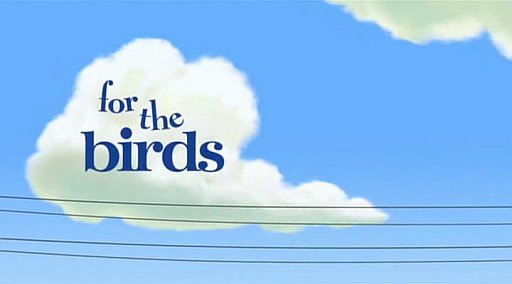
June 5, 2000 – The Pixar Short Film For the Birds Premieres at the Annecy International Animated Film Festival

For_the_Birds

“[For the Birds] began actually as a student film, a long time ago, and I could never bring myself to draw all these little birds that are about to pop up on the screen.” – Director Ralph Eggleston

On June 5, 2000, the Pixar short film For the Birds premiered at the Annecy International Animated Film Festival in Annecy, France. After its showing, it was released alongside Pixar’s fourth animated feature, Monsters, Inc, and would go on to win several awards, including the Academy Award for Best Short Animated Film. According to Pixar, the names of the smaller birds that start the teasing are Bully, Chipper, Snob, and Neurotic. The short was re-rendered into 3D for the 3D theatrical rerelease of Monsters, Inc. in 2012. It was directed by Ralph Eggleston.

A bird flies onto the screen and perches on a nearby telephone wire and makes himself comfortable. He is soon joined by several others, and they all begin to squeak amongst themselves, before they are interrupted by a strange honking noise. They all turn to see a large, rather dopey-looking bird, and they start making fun of him. The big bird doesn’t realize that he’s being made fun of, and decides to join the birds on the wire. As he sits on the wire, it bends underneath his weight, and the birds slide into him. Annoyed, they squawk loudly, and one of the birds pecks him hard in the side, sending the big bird flying off the wire, although still holding on with his feet. The same small bird that pecked the big bird pecks one of the big bird’s toes, and it slips from the wire. The birds then get an idea to keep pecking away until the big bird has let go, with the other birds cheering the main two birds on. A bit too late, one bird realizes that once the big bird lets go, they will all be catapulted into the air. As the birds are shot out of their feathers, the big bird sits up, still rather oblivious to the teasing and the malice, and starts blowing the feathers gently. The smaller birds land on the ground, completely naked, and the big bird laughs hysterically as the birds scamper into the nearby wheat field in shame.

June 2

Posted on

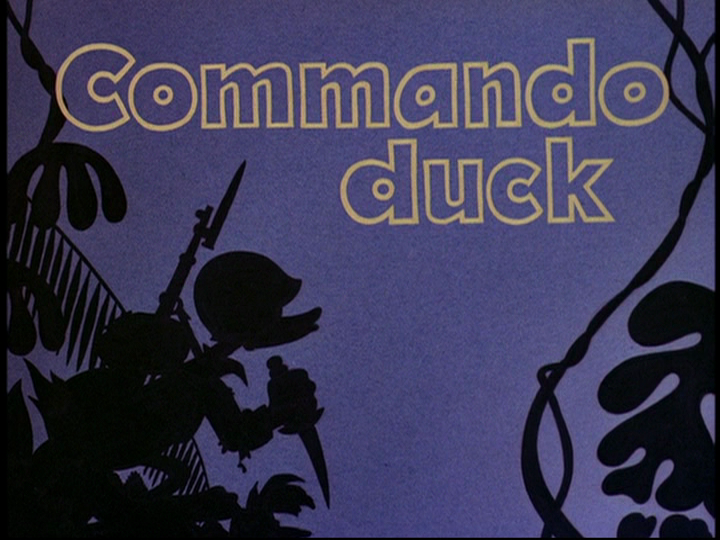
June 2, 1944 – The Donald Duck Short Commando Duck is Released to Theaters

vlcsnap-2013-05-29-23h12m14s177

“Contacted enemy, washed out same. Donald Duck.”

On June 2, 1944, the Donald Duck short film Commando Duck was released to theaters. The short contains several stereotypes of Japanese soldiers, as was common in this time period while the United States was embroiled in war. The short was directed by Jack King.

The short begins with Donald receiving his orders to parachute out of a plane into a forest, where he has to watch out for snipers and alligators to reach his objective and wipe out the enemy. He is then warned that he must complete this mission at all costs, and with trembling knees, parachutes out of plane. His chute gets caught on two tree branches and, thinking he’s safe, unhooks his belt only to find that he is falling several hundred feet into an alligator infested river. Luckily, he is able to save himself and end up on dry land, but with an emergency raft as his only supply.

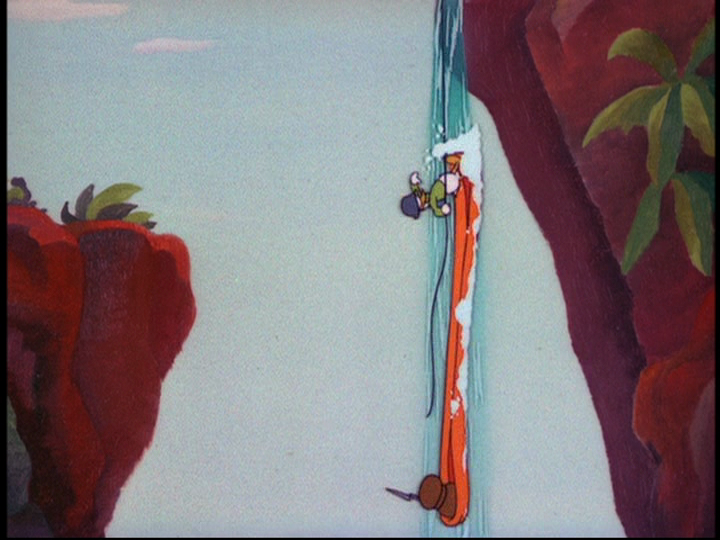
Donald falls down a waterfall after being shot at by Japanese snipers

Donald falls down a waterfall after being shot at by Japanese snipers

Several Japanese snipers are lying in wait on the side of the river, and point their guns at Donald as he passes by in the raft. They fire, but Donald mistakenly believes them to be mosquitoes, until he catches bullets in his helmet. He quickly flees, only to find that a waterfall is nearby, and nearly falls down the falls before roping a rock; the rope is shot by a sniper, and Donald is sent sailing down the falls. Fortunately, the raft saves his life, but fills with so much water that it nearly crushes him. The raft continues to expand with the water, and Donald continues to try and outrun it, as well as remove anything sharp from its path. It gets punctured by a log, and Donald had to outrun water and massive boulders. The boulders, however, send Donald flying into the air and, along with the water, crash into the enemy base, destroying it.

May 30

Posted on

May 30, 1941 – The Pluto Short Film Canine Caddy is Released to Theaters vlcsnap-2013-05-30-02h44m05s90

“Ah, what a swell day for a game of golf! Caddy? Tee up the ball!”

On May 30, 1941, the Pluto short film Canine Caddy was released to theaters. Although now considered a Pluto short, it was originally billed as a Mickey Mouse short film. It was directed by Clyde Geronimi.

Mickey and Pluto are enjoying a nice day on the golf course, and Pluto plays as Mickey’s caddy, teeing up Mickey’s ball. As Mickey prepares to hit the ball, Pluto unintentionally makes a lot of noise, causing Mickey to lose focus. He finally hits the ball, sending it flying across the course, with Pluto in close pursuit. As he waits by the hole, Pluto helps Mickey’s ball land in the hole after it bounces out. On the next hole, Pluto continues his caddying, although Mickey gets his ball stuck in a sand trap. When Mickey hits the ball again, it lands on Pluto, and Mickey warns him not to move, as he needs to play it where it lies. Unfortunately, Mickey is unable to hit the ball from Pluto’s backside, as Pluto shakes from nervousness. Finally, Mickey hits it, but it lands in a gopher hole.

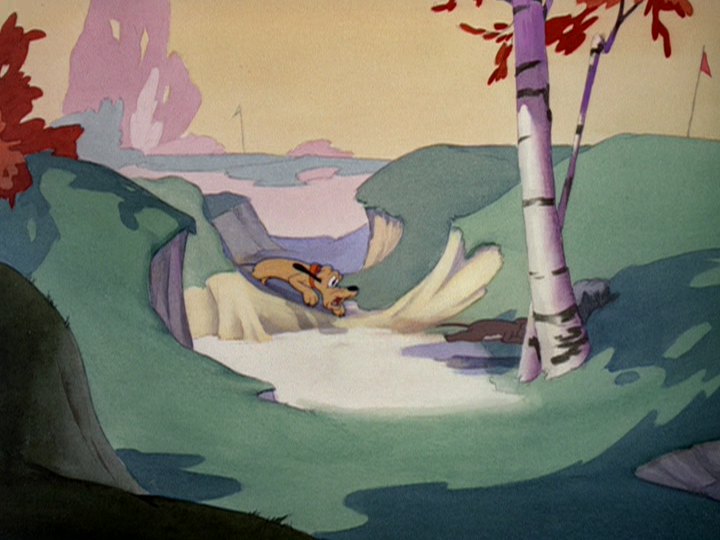
Pluto and the gopher begin their chase all over the course

Pluto and the gopher begin their chase all over the course

When Pluto points out the ball, it comes back up from the ground, eaten like an apple by the gopher. The gopher and Pluto have a confrontation, with the gopher biting Pluto’s tail. Pluto chases the gopher all over the course, trapping it in a tin can, but finding that it has dug a hole and stays hidden underground. The two continue their chase, with the two tearing up the course and angering Mickey as the course is destroyed, but Mickey smiles, saying that Pluto’s just a mutt and leaving it at that.

May 29

Posted on

May 29, 1937 – The Donald Duck Short Film Modern Inventions is Released to Theaters

vlcsnap-2013-05-29-05h06m18s156

“A fine way to act. Why don’t you pick on somebody your own size? You big goon!”

On May 29, 1937, the Donald Duck short film Modern Inventions was released to theaters. This was the first short directed by Jack King, who would go on to direct many of the early Donald shorts. This short was also originally released as a Mickey Mouse cartoon, although Mickey does not make an appearance.

Donald visits the Museum of Modern Marvels, where he is soon face to face with a robot butler, who takes his hat. However, Donald pulls a top hat out of thin air and continues to explore the museum. However, the butler appears again, taking his hat, but Donald pulls another hat from his sleeve. He comes across an automatic bundle wrapper with a sign that says “do not touch,” but Donald responds to this with his trademark “Aw, phooey!” and starts up the machine. The machine then grabs Donald and wraps him up, complete with a bow. When Donald breaks out of the packaging with his trademark anger, the butler appears, grabbing his hat. Donald pulls out yet another hat, and yells at the butler, who turns to retrieve the hat.

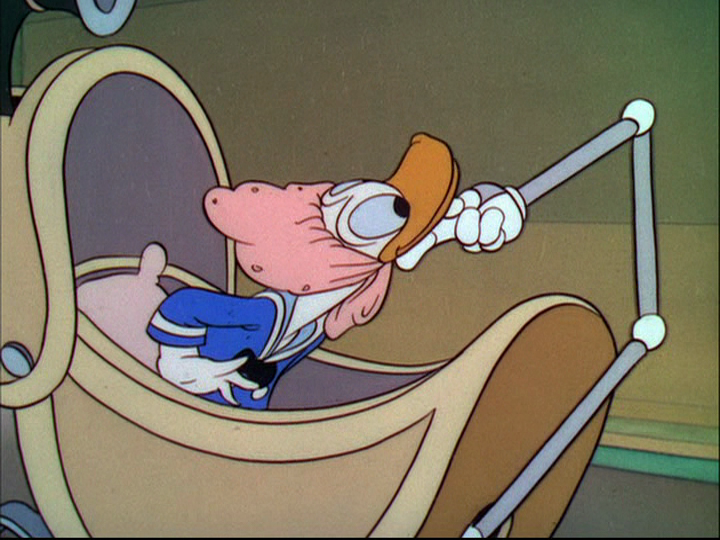
Donald enjoys the attention from the robotic nursemaid

Donald enjoys the attention from the robotic nursemaid

Donald flees, hiding in the robotic nursemaid invention. He at first has a good time while the invention rocks him to sleep and tickles him, but is soon irritated by the invention, and, after the overuse of talcum powder, Donald sneezes himself away from the invention, only to be met by the robot butler to take away yet another hat. Donald pulls out a bowler and continues exploring, ending up at a robotic barber chair. He asks the chair for the works, and it throws him in the air, where he lands with his tail upwards. Unfortunately, this is where the chair harnesses him, and his tail is the side that gets the haircut, rather than his head. Meanwhile, his head is polished as if it were a shoe. As he is finally able to leave, he is greeted by the robot butler, and finally loses his temper as the screen fades out.

May 27

Posted on

May 27, 1933 – The Silly Symphony The Three Little Pigs is Released to Theaters

vlcsnap-2013-05-27-06h01m34s96

“You can play and laugh and fiddle, don’t think you can make me sore, I’ll be safe and you’ll be sorry when the wolf comes to your door!”

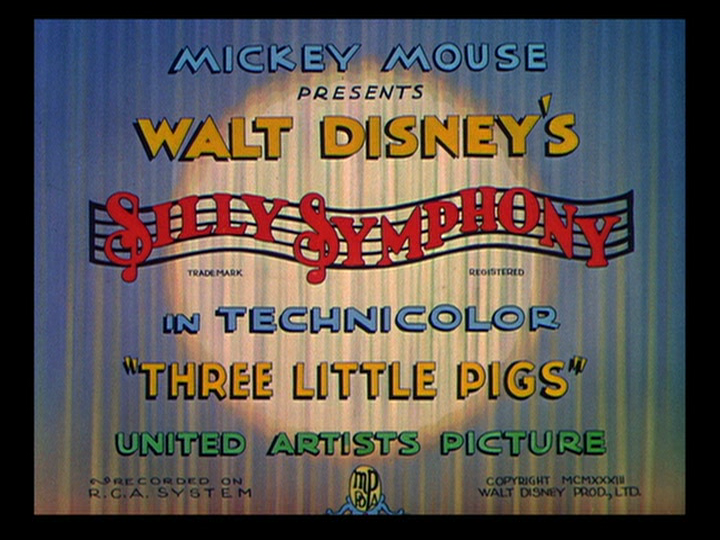
On May 27, 1933, the Silly Symphony The Three Little Pigs was released to theaters. The short was based on the fable of the same name, and became a breakout hit of 1933, with Depression-weary audiences embracing the song “Who’s Afraid of the Big Bad Wolf?” as the anthem of the time, with the wolf representing the Depression and their troubles. The short was also a milestone in animation at the studio in the areas of characterization, score, and song. In most theaters, the short would be placed in top billing, lasting long after the accompanying feature had come and gone; one New York theater manager put beards on the pigs faces in their display, and had the beards “grow” the longer the run was extended. The original version of the short had the Wolf disguised as a Jewish peddler, but has since been removed. It is important to note that ethnic and racial stereotype humor were incredibly common in this time period, and many Jewish producers would incorporate these stereotypes themselves. Three Little Pigs went on to win the Academy Award for Best Cartoon. The short was directed by Burt Gillett.

Fiddler, Fifer, and Practical Pig are making their houses, with Fiddler and Fifer not taking their task too seriously. Practical Pig, however, is mostly concerned with keeping the wolf away, and builds his house of bricks. When his brothers come by to taunt him for working all day, he warns them that he will be safe when the wolf comes, but the two laugh it off, teasing Practical for being afraid of the Wolf. As the pigs dance and sing, the Wolf comes by, scaring the two back into their homes. He goes Fifer’s straw home first, and blows it clear away. Fifer runs to Fiddler’s stick home, and the two hide inside. The wolf then pretends to walk away, and the two begin to sing their song again.

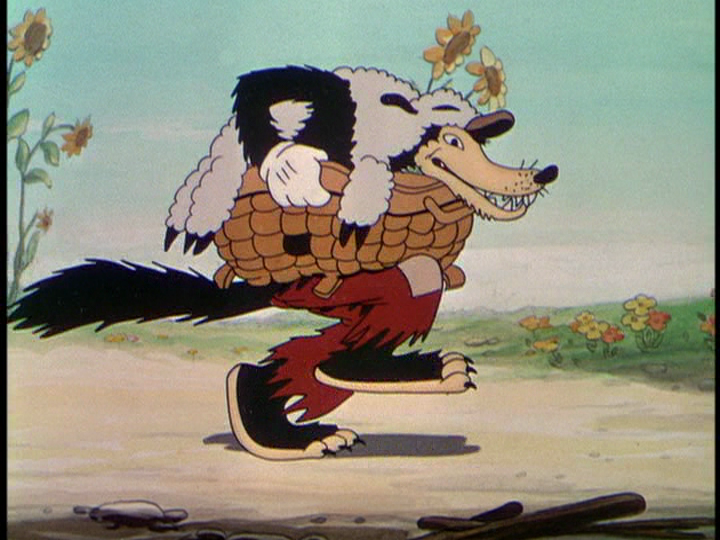
The Wolf tries to use a disguise to trick the pigs into letting him in

The Wolf tries to use a disguise to trick the pigs into letting him in

The wolf appears at the door, pretending to be a lost little sheep that needs help, but the two see right through his disguise. Angered, he blows the house down, and the two flee as fast as they can to Practical’s house. He lectures the two of their folly, but tells them he’s glad they’re safe. The Wolf then arrives as a brush salesman, but Practical Pig doesn’t fall for it. The Wolf then attempts to blow the house down, but is unable to do so. He finally decides to come down the chimney and seize the pigs, unaware that Practical Pig has a large boiling cauldron waiting below filled with turpentine. The wolf falls in and is sent shooting up again from the pain, and scurries down the road, howling. All three pigs end the short singing merrily.

May 25

Posted on

May 25, 1932 – The Mickey Mouse Short Film Mickey’s Revue is Released to Theaters

vlcsnap-2013-05-25-07h34m48s48

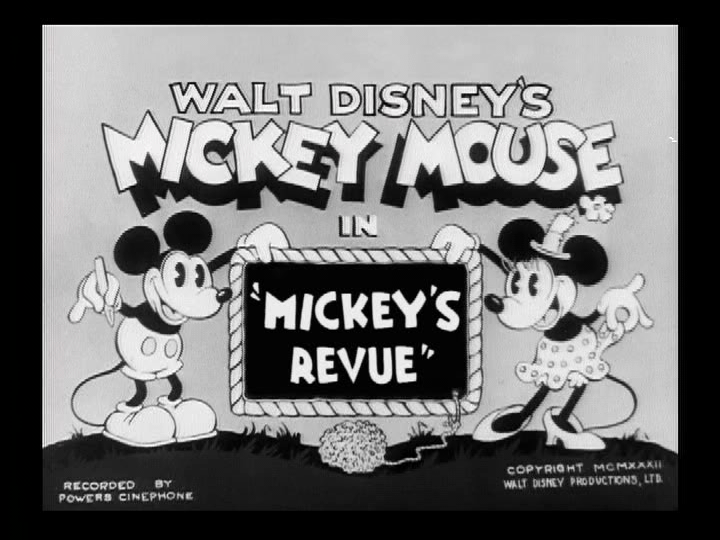
On May 25, 1932, the Mickey Mouse short film Mickey’s Revue was released to theaters. This short is notable for being Goofy’s first appearance, where he is a member of the audience, with his well-known laugh being the first sound he makes. The short was directed by Wilfred Jackson.

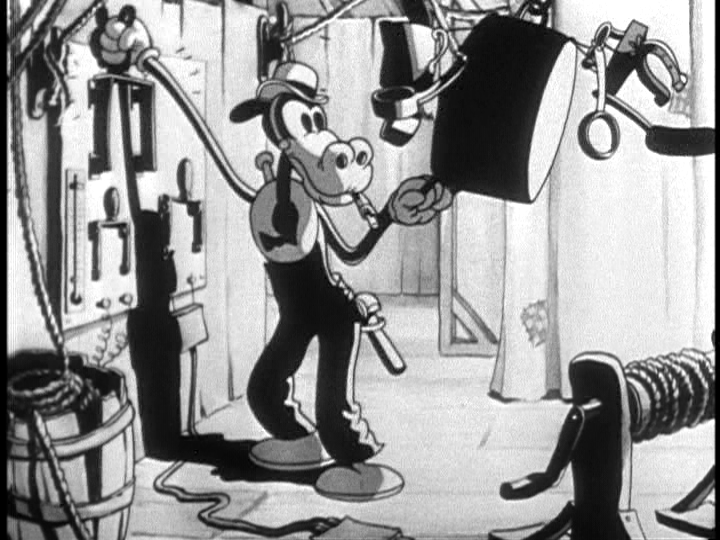
The band plays in the theater, with Mickey as the conductor. Meanwhile, an audience member is loudly cracking open peanuts and chomping them, much to the annoyance of the rest of the audience. The curtain then opens on the show, with Minnie playing a fairy (hoisted by Horace Horsecollar) and waving her magic wand on the flower dancers. Pluto appears on the side of the stage, barking at the dancers, until he is whisked away by a hook. The noisy audience member begins to laugh loudly, creating irritation around the audience again.

Horace Horsecollar creates a stormy scene for the dance performance

Horace Horsecollar creates a stormy scene for the dance performance

The scene changes in the show, and the dancers begin to skate around in the “snow,” which is just Horace chewing up some soda crackers. The curtain falls, and the audience cheers loudly. The next act begins with two dachshunds performing a tap show. Underneath the stage, a cat and her kittens are awakened by the tapping and peer through holes in the stage to see what is going on. Pluto still continues to wander onto the stage, getting pulled off by various means each time. The audience member’s laugh is now growing on two of the crowd members’ nerves, and they hit him on the head with a mallet, knocking him out before they surprising break out into the same kind of laughter they found so annoying.

The third act begins, with Minnie at the piano and Mickey playing various instruments in a one-man-band kind of performance. The kittens from under the stage have wandered amongst the instruments, and begin to play around, creating lively music alongside Mickey and Minnie. Pluto whines backstage, as he wants to chase the kittens, but Horace has him tied to a chair. Finally, Pluto breaks free from Horace, rushing onto the stage and breaking the piano and all of the instruments in the process. This does not prevent a successful end to the show, however, and the audience wildly applauds.

May 21

Posted on

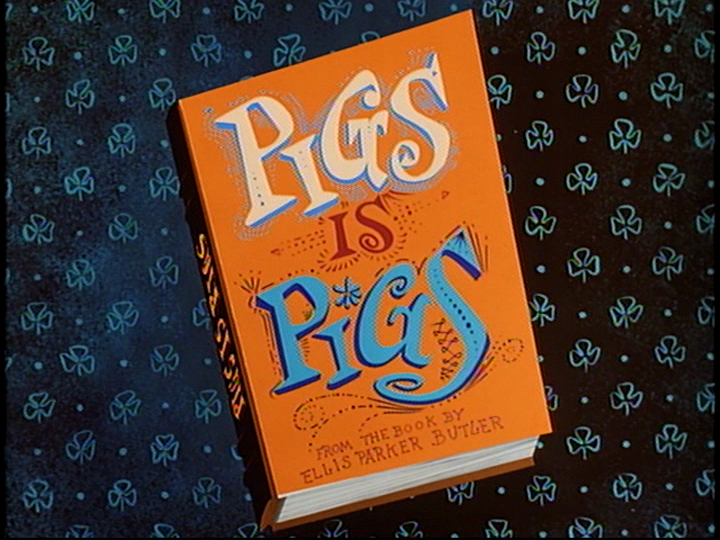
May 21, 1954 – The Special Short Film Pigs is Pigs is Released to Theaters

vlcsnap-2013-05-21-04h26m08s43

“Whenever an agent gets in a debate, and there is an argument over the rate, the agent must wire for a rule and apply, and hold onto the package until they reply.”

On May 21, 1954, the special short film Pigs is Pigs was released to theaters. The short was based on the short story by Ellis Parker Butler, which was first published in 1905. The style of animation used in the short was based on the UPA style of limited animation, which was very popular in this time period. It was directed by Jack Kinney, with story by Leo Salkin and animation by John Sibley. The short was nominated for an Academy Award.

At the Westcote Railway Station, Agent Flannery gets ready for the day. Flannery is known as the best agent there is, as he follows each rule to the letter. One day, he receives a package of two guinea pigs, and, having never seen guinea pigs before, notices that they don’t look like pigs, but he’ll follow the rules for pigs, as “it says [they] are” with “the writing plain to see.” A customer named McMorehouse arrives to pick up the guinea pigs, and is incensed to find that pigs cost four cents more than pets, and argues with Flannery that guinea pigs are pets, not pigs. McMorehouse refuses to pay the extra money, and Flannery states that in the case of a debate between the agent and customer, he’ll have to contact the main office for a ruling; until then, he will have to hold on to the package. McMorehouse storms out, saying that when Flannery finds he’s wrong, he is to send the package to his address.

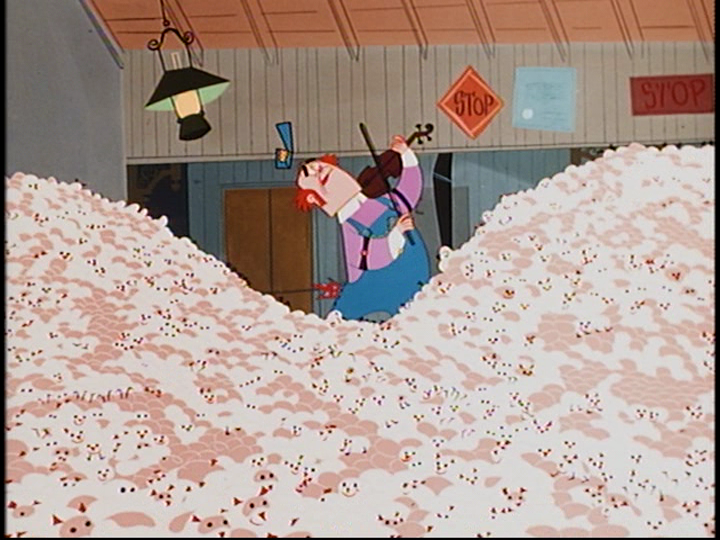
Flannery is swamped by the ever multiplying guinea pigs, and tries to calm them with Irish jigs

Flannery is swamped by the ever multiplying guinea pigs, and tries to calm them with Irish jigs

At the headquarters, the telegram arrives from Flannery and goes through a very regimented process of signing, dating, and copying. Meanwhile, Flannery tries to take care of the guinea pigs, only to find that they have started breeding. He creates a bigger crate for the guinea pigs, as there are now nine, but multiplying fast, with guinea pigs in every drawer and bursting from every place possible. At headquarters, the debate continues, with everyone up to the board of directors trying to determine whether guinea pigs are pigs or pets. They finally determine that guinea pigs are pets, and the lower rate applies. The guinea pigs multiply and multiply, bursting out of the Westcote Station. When Flannery gets the telegram, he rushes to McMorehouse’s home, only to find that that McMorehouse doesn’t live there anymore. He wires the office again, asking what he should do in this situation, as there is no rule for this. Not knowing that they pigs have multiplied into “two million and two,” the office makes a recommendation that the guinea pigs be sent there. Flannery fills six hundred boxcars with guinea pigs and sends them on their way. The guinea pigs are stored everywhere in the whole company, even the president’s office. From that day forward, Flannery refuses to follow the rules to the letter anymore, declaring that all animals will thereby be classified as pets.