RSS Feed

Tag Archives: Feature Film

July 17

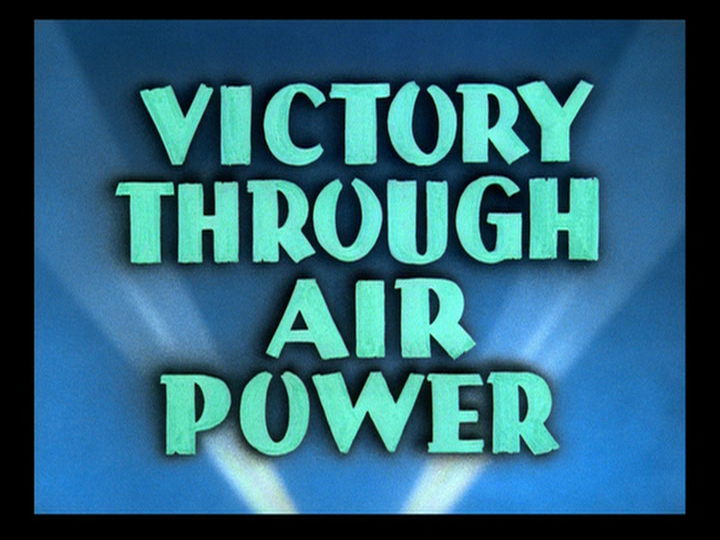
July 17, 1943 – The Film Victory Through Air Power is Released to Theaters
“Our country in the past has struggled through many storms of anguish, difficulty, and doubt. But we have always been saved by men of vision and courage, who opened our minds and showed us the way out of confusion.”

On July 17, 1943, the feature film Victory Through Air Power was released to theaters. The film was based on the book of the same name by Maj. Alexander P. de Seversky, who also served as the on-screen narrator of the film. De Seversky’s book explains how long-range air power could defeat the enemy during World War II. Walt Disney, like many who read the book, was impressed with the material, and it became one of his most ambitious projects. He used the film to educate and send a message to the public rather than to entertain, as at the time the film was released, an Allied victory was anything but certain. H.C. Potter was hired as the live-action director, and David Hand was the Animation Supervisor, with Art Baker as the animation sequence narrator. Critics did not like the film, and RKO, Disney’s film distributor, did not want to release it, so Disney released it through United Artists. The film was nominated for an Academy Award for Best Scoring of a Dramatic or Comedy Picture.

Although the film was not popular with critics, it did the job of presenting the idea of air power to win the war. “[T]he most important response to the movie came from Winston Churchill,” film critic Leonard Maltin explained. “When [Churchill] flew to Quebec for an Allied conference, and learned that President Roosevelt hadn’t seen the movie, he and Air Marshal Tedder prodded him until he ordered that a print be sent to him. H.C. Potter was told by Walt that it was only after Roosevelt saw Victory Through Air Power, that our country made the commitment to long-range bombing. And that, after all, was the reason that Walt committed to making this movie in the first place.”
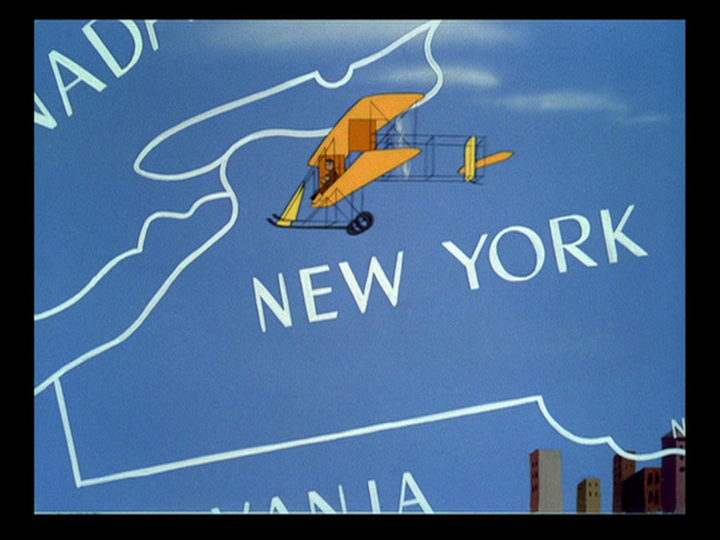
The animated sequence shows the progression of air power, including the first trans-continental flight

The film begins with newspaper clips from past years, beginning with 1919, where men have tried to convince the public about air warfare, and how defense depends on an air army. The film is then dedicated to Billy Mitchell, who was a pioneer in the fight for air power, and the brave airmen of the United States military. The audience then sees the history of flight in an animated sequence, beginning with Orville and Wilbur Wright, and leading into the first air corps, the first aircraft carrier, and the first trans-continental flight. When World War I began, aircraft was used only for observation service, until the installation of the machine gun turned the plane into a weapon. The bomber would soon develop from this idea.

1939 brings about a new war, and American aviation is ready to meet the challenge of the Axis powers. This then leads to the introduction of Maj. de Seversky and his book, Victory Through Air Power. De Seversky began his military education in Russia at age 10, graduating as a lieutenant, and seeking service in 1914. He became a pilot and was assigned flying duties, but was shot down on a night flying mission, resulting in the loss of his right leg at the tender age of 22. Nevertheless, de Seversky became a strong proponent of air power, and the leading ace of air warriors. In 1918, he came to the US and worked for the United States Army, becoming a major in the U.S. Army when he became a citizen in 1928.
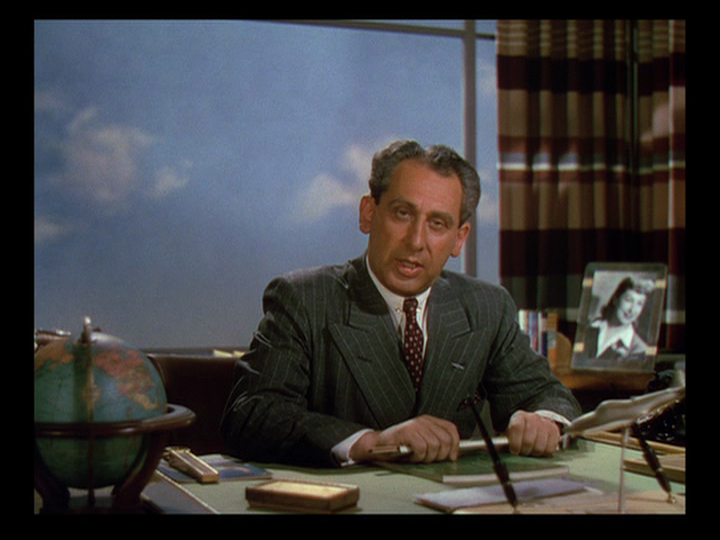
Maj. Alexander de Seversky, who explains to the audience why air power is an absolute necessity to win the war

De Seversky begins his speech to the audience, warning that it’s only a matter of time until the U.S. has its share of civilian casualties, thanks to the advances of air power by other countries. He also declares that everyone must understand the strategy of war. There were formerly two ways to destroy the enemy: one was to destroy the enemy’s entire army to grab their source of power, the other was to sink their navy and enforce a blockade. With the airplane, there is no safe place: the plane can attack quickly over the heads of the enemy forces. Those that could foresee the usefulness of air power were considered crazy and ignored. An example is then shown of how England was supposed to attack the Nazis via sea forces, and the French were to attack via the land. Hitler, however, came in with air power, which allowed him and the Nazi forces to take over France. “Only when it was too late,” de Seversky warns the public, “did the French realize that their whole plan of defense was futile.” The British thought they could stop the Nazis through a blockade, only to find their battleships destroyed by bombers. The Royal Air Force grew out of this tragedy, ready to attack Hitler’s air troops. “As long as a nation controls its own skies, it cannot be invaded,” de Seversky tells us as the moral of the British story.

The audience is then shown the first real battle between air power (Nazis) and sea power (British Navy) over the island of Crete. Crete became the first territory to be conquered completely through air power. This then leads to Pearl Harbor, and how American troops left themselves unprotected against the air power of the Japanese troops, because the American troops were instead prepared for traditional naval warfare. De Seversky explains that the Japanese were imitating the German blitzkrieg, and were able to capture most of the Pacific. American armed forces finally realized that no place on Earth was safe without gaining control of the skies above. The success of American victory through air power demanded two things: to produce a vast amount of weapons of endless variety, and to deliver this equipment to battlefronts all over the face of the Earth.
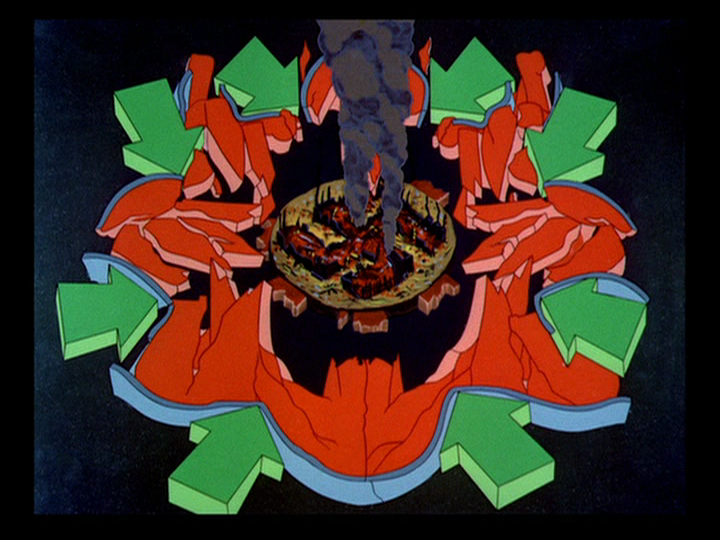
Animated sequences are used through the film to illustrate de Seversky’s points; this image shows how American air power can cut Hitler off at the source, allowing troops to invade

The audience is then introduced to another problem to consider: the transportation of these weapons. America is able to transport across the country with no problem, but gets caught in the slow speeds of shipping to overseas locations. Americans also have to contend with the German submarines. The audience is warned that if Americans fight only on the surface of the Earth, Hitler has all the advantage. Air power would give American forces an advantage and the ability to cut off Hitler’s power at the source. Success will also depend on supply lines, and where American air bases are located. The film ends with a patriotic look at how American forces can use air power and airmen’s skills to win the war. “America should not hesitate to place its destiny in the hands of [the airmen],” de Seversky explains, “for with the strategy of air power, they will make the enemy fight on our terms, against the weapons of our choosing, at our time, but on his soil.”
July 10

July 10, 1981 – The 24th Animated Feature Film, The Fox and the Hound, is Released to Theaters

“My, my, look at that. A fox and a hound, playing together.”

On July 10, 1981, the animated feature film The Fox and the Hound was released to theaters. The film was loosely based on the novel by Daniel P. Mannix, and is notable for being the premiere effort of a new generation of animators, including John Lasseter, who would go on to help create Pixar. The film was directed by Art Stevens, Ted Berman, and Richard Rich. It stars Mickey Rooney as Adult Tod, Keith Mitchell as Young Tod, Kurt Russell as Adult Copper, Corey Feldman as Young Copper, Pearl Bailey as Big Mama, Pat Buttram as Chief, Sandy Duncan as Vixey, Dick Bakalyan as Dinky, Paul Winchell as Boomer, Jack Albertson as Amos Slade, and Jeanette Nolan as Widow Tweed.

The film began production in 1977, but was delayed by a dark part of Disney’s history: Don Bluth and a group of animators defected from the studio, wanting to make films that were reminiscent of the glory days of Disney animation, which they strongly believed couldn’t be done at the Disney studios at that time. There were many arguments in-house about how the film should be handled, with Wolfgang Reitherman, one of the members of the Nine Old Men, championing the idea that the film stay true to the book, which was much darker, ending with the deaths of both Tod and Copper. The film was changed, however, to make it more of a family film.

A baby fox is left by his mother at the edges of the Widow Tweed’s farm for his own protection

The film opens in the forest, where a mother fox is carrying her baby away to safety as she is being chased by dogs. The mother leaves her baby at a nearby farm before running off again; a gunshot is heard soon after. An owl named Big Mama flies down from her perch and calms the orphaned fox; with the help of Boomer the woodpecker and Dinky the finch, they alert the Widow Tweed, who decides to take in the fox and raise him. She names him Tod, after remarking that he is “such a little toddler.” Meanwhile, her next-door neighbor Amos Slade brings home a puppy, who he assures will grow into a hunting dog alongside his other dog, Chief.

Time passes, and Tod is growing nicely, curious about everything in the barn. He causes trouble when he tries to eat one of the chicks, and Abigail the cow kicks over the widow’s bucket of milk. Widow Tweed sends Tod out to play, and he spots Dinky and Boomer, hoping they’ll want to play. Dinky and Boomer, however, are on a mission to capture a caterpillar that keeps escaping their clutches. Tod turns to leave and spots a butterfly; curious, he begins to follow it, leading to Amos’s property. The puppy, now named Copper, smells Tod’s scent, and goes to find out what’s making that strange scent. They meet, and Tod asks Copper if he wants to play hide and seek. The two play for hours, quickly becoming the best of friends, until Copper is called back by Amos, in trouble for leaving.

Tod looks curiously at the sleeping Chief, while Copper continuously warns Tod to stay away

Early the next morning, Tod calls out for Copper to come play, and Copper sneaks past a sleeping Chief to go play in the woods, while Big Mama watches from a tree. Amos notices that Copper has gone missing, and calls out for him. Copper heads home, promising Tod to meet him tomorrow, but instead finds himself tied to his doghouse, unable to wander off again. Tod appears, wondering what happened to his friend, and when Copper says he has to stay home, Tod decides they can just play there. Copper warns Tod about Chief, and when Tod goes to take a look at the older dog, Copper can only hide his eyes. Chief opens his eyes to see Tod and attacks, chasing after the fox. Amos grabs his gun and begins to shoot as his farm erupts into chaos, and Tod races for home, jumping in Widow Tweed’s car as Amos begins to drive after her, shooting at the fox. Amos shoots the milk cans the widow is carrying, so the widow takes his gun and shoots his radiator. Amos threatens that the next time Tod is seen on his property, he will shoot him, and he won’t miss his shot.

Out of concern, the Widow Tweed decides that Tod will need to stay inside from them on. The two look out the window to see Amos, Chief and Copper going off on a hunting trip. Tod sneaks out of the crack in the window, wishing to say goodbye to his friend. Big Mama flies down from her perch and begins to teach Tod the truth about foxes and hounds, declaring that if Tod stays friends with Copper, he’s liable to be stuffed on Amos’s wall. Dinky and Boomer show up and open the door to Amos’s shed, showing Tod all the traps and pelts he has hanging up. Big Mama gives the upset Tod a hug, warning him again that Copper will come back a trained killer, but Tod refuses to believe his friend Copper will end up that way.

Caught trespassing in Amos’ yard again, Tod is chased by Chief and by Copper, and has to make a run for it in the woods

The seasons pass, with Tod waiting for Copper’s return, and Copper being taken out for hunting training. Chief soon becomes jealous that Copper is besting him in hunting. Finally, spring arrives, and Amos heads home. Tod hears Copper’s howling, and is excited, still convinced that Copper is still his best friend. That night, Tod heads over to Amos’s yard, and the two greet each other warmly before Copper warns him that he shouldn’t be there. Tod asks if they’re still friends, but Copper tells him that those days are over. Tod is heartbroken, and Chief wakes up, alerting Amos, who brings out his gun. Tod is chased through the woods, with Copper finding him. Copper leads Amos off the scent, telling Tod that he’ll let him go just this one time. As Tod tries to make his way home, he is caught by Chief on the railroad tracks, just as a train passes by. Chief is knocked from the tall tracks, badly injured. Copper blames Tod for Chief’s injury and swears vengeance. Tod makes his way home to the Widow Tweed, and Amos shows up at her door, ready to kill him. Although the widow is able to keep Amos away, she comes to the conclusion that although she loves Tod, she has to release him into the game preserve.

Tod has trouble acclimating to the woods after being considered a pet for so long. Caught in a storm, he runs into a porcupine, who offers him shelter for the night. Amos notices the widow coming back without Tod, and swears to Copper they’ll get him, showing the hound dog the trap he’ll use to catch him. The next morning, Big Mama is searching for Tod, and runs across a female fox named Vixey, giving Big Mama the idea to play matchmaker with the two. It’s love at first sight for Tod when he sees Vixey, and their romance begins on a rocky road, but the two come to understand their mutual attraction.

Copper steps in front of Amos’ gun, refusing to let his master shoot his friend

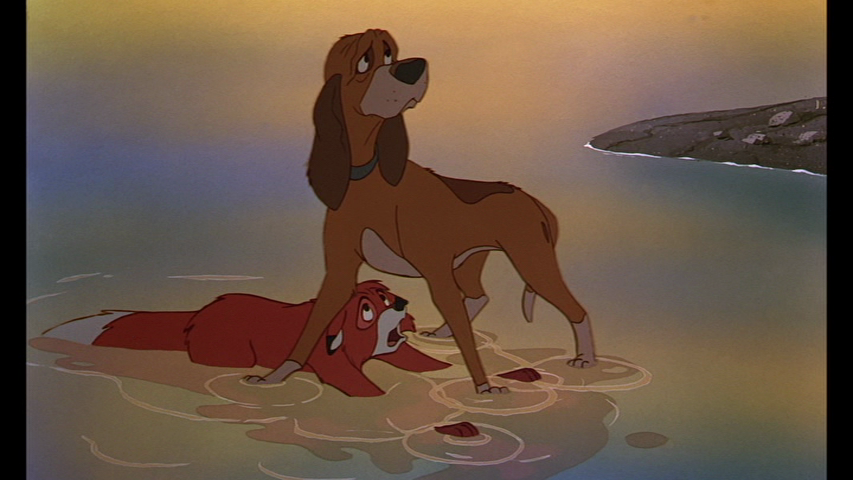
Consumed by revenge, Copper and Amos break into the game preserve to track down and kill Tod. The two set traps out all over the preserve, and Tod eventually comes into their line of sight, narrowly missing getting caught on Amos’s traps. Copper chases after him, with Tod warning Vixey to escape and head for the burrow. The two friends begins to battle it out, but Vixey and Tod end up trapped in their burrow, with Amos on the back end trying to smoke them out. The foxes narrowly escape, with Copper hot on their trail, until Amos and Copper run into a very angry bear. Amos is wounded in the scuffle with the bear, getting his foot caught in a trap. Copper runs to defend his master, and ends up battered by the bear. Tod hears his friend’s cries of pain and leaps into the fight, attacking the bear. Tod ends up in a precarious position over a cliff, and he and the bear fall down into the river below. Tod, fortunately, makes it out alive, although badly injured. Copper finds Todd, and Amos is ready to shoot him, but Copper steps in the way, protecting Tod from Amos’s gun. Amos lets Tod go free, and he and Copper go home.

The Widow Tweed is seen taking care of Amos, who continues to complain and keep his not-so-sunny demeanor. Copper and Chief are seen lying in the yard in their barrels, and Copper reminisces about when Copper and Tod swore to be friends forever. In the distance, Vixey sits with Tod as he watches over the people he once knew.

July 7

Posted on

July 7, 1963 – The Live Action Film Summer Magic is Released to Theaters

“Land of promise, bounteous, this is beautiful, this is beautiful Beulah, in the rocky state of Maine.”

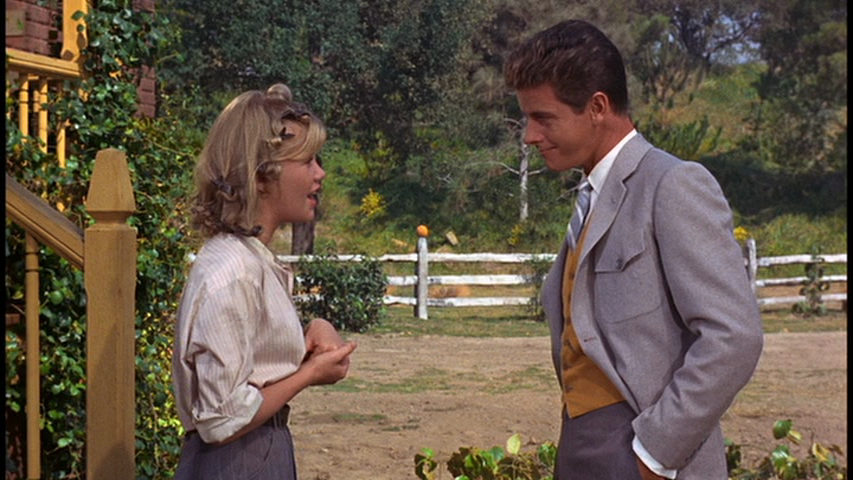
On July 7, 1963, the live action film Summer Magic was released to theaters. The film, based on the book Mother Carey’s Chickens by Kate Douglas Wiggins, is one of the earliest Disney musicals, with music written by Buddy Baker, and songs by the songwriting team the Sherman Brothers, with their song “Ugly Bug Ball” becoming a hit of the year. It was directed by James Neilson, and stars Hayley Mills as Nancy Carey, Burl Ives as Ossian Popham, Dorothy McGuire as Margaret Carey, Deborah Walley as Julia, Eddie Hodges as Gilly, Jimmy Mathers as Peter, Una Merkel as Mariah Popham, and Peter Brown as Tom Hamilton.

The film opens in Boston during the time of Ragtime music. Nancy Carey finds a letter in her front hall, and opens it excitedly, but then gets back to the sad task of packing her house with her brothers, Gilly and Peter. Their father had recently passed away, and the Careys are moving to a smaller house, as they can no longer afford their current residence. Their mother, Margaret, returns from their attorney’s office, with the unfortunate news that the mining stocks they’d counted on to help them are worthless, but she reassures them that they’ll get along fine, although they can’t afford to live in Boston. Nancy excitedly reveals to the family that she wrote the caretaker of a house they’d seen on vacation in Beulah, Maine. The caretaker will allow them to live in the house for $60 a year, and their mother agrees that they should go.

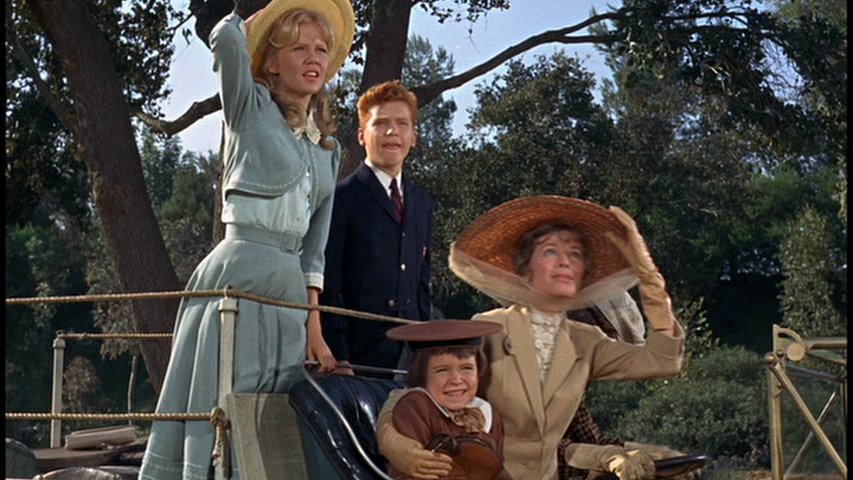
The Careys arriving at the Yellow House in Beulah

The Careys arrive at the “Yellow House,” as they affectionately call it, and meet the caretaker, Ossian Popham. After sorting out some of the “little white lies” in Nancy’s letter (calling her younger brother a “rickety baby,” for one), Mr. Popham allows them to stay and volunteers to help them fix up the house. The Careys soon become acclimated to the small town, with Gilly taking a job as Ossian’s assistant. Peter tries to fit in with the other boys, but is ridiculed and bullied for his Boston-style hair and clothes. Ossian helps Peter out by giving him some “country clothes,” and helps Nancy with all of the supplies she needs. Ossian’s wife, Mariah, is soon suspicious of Ossian’s behavior, and continues to ask if he has actually written the owner of the house, Mr. Hamilton, for permission to allow the Careys to stay there. Ossian continues to avoid her accusations.

The situation gets crazier for the Careys when Peter gets a job taking care of a sheepdog named Sam, who tears through the house and ruins all of Nancy’s wallpaper. Just as they decide that Sam can stay, they learn that another guest will be staying with the Careys: Cousin Julia. This revelation causes great distress for Nancy and Gilly especially, who dislike their cousin immensely for her spoiled attitude. After Julia’s father died, she was adopted by the Fergusons, who felt guilty for selling Julia’s father worthless stocks, the same stocks Nancy’s father invested in. The Fergusons can no longer afford to keep her (“Another unfortunate investment,” Margaret explains), and Margaret asks that Nancy and Gilly keep this a secret from Julia, as the news would devastate her.

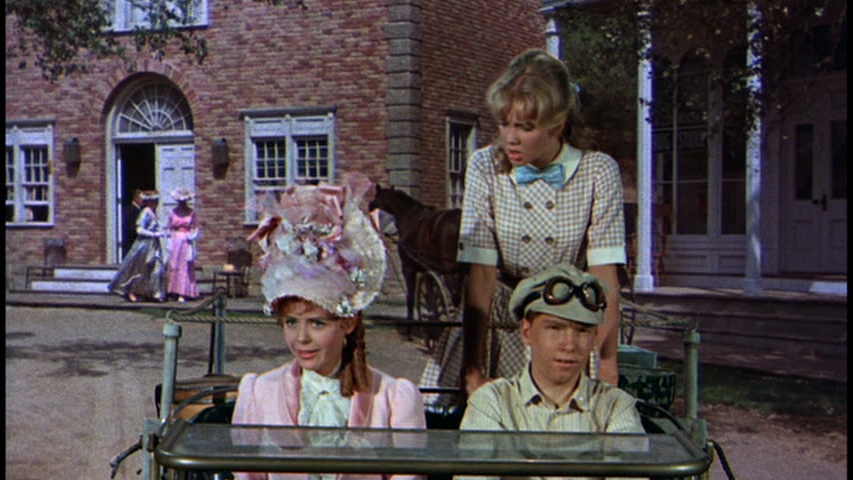
Gilly (Lower Right) and Nancy (Upper Right) drive their cousin Julia to their house; Julia is rather unimpressed with the small town

When Julia arrives, Nancy and Gilly exaggerate every little detail and purposefully try to scare their cousin, pretending that bears will attack their house. After Julia has a good scare when Sam climbs through her bedroom window, Nancy and Gilly try to make peace with her, realizing their pranks may have gone a little too far. Meanwhile, as Margaret tries to face facts with the financials of their situation, Ossian tells them that a letter has arrived from Mr. Hamilton, saying that due to their renovations, he will let them live rent-free, providing they find a suitable place for his mother’s picture. They agree happily, and continue to work on the house. Julia, however, keeps her stuck-up airs and bests Nancy for the attention of the new schoolteacher, Mr. Bryant. Nancy is pushed to her breaking point, and finally tells Julia why she was sent to stay with them. Julia, heartbroken at first, realizes that she wishes to stay with Careys in Beulah, rather than return to the Fergusons, even though they are able to afford to keep her again. Nancy and Julia call a truce and become friends.

Nancy meets a handsome stranger at the house, unaware that she has just met Mr. Hamilton, the owner

The Careys are preparing for their housewarming party on Halloween when a strange man pulls up to the house. Nancy bumps into him and starts telling him the reason for the celebration and the mess the house was in before the Careys took over, unaware that the man she’s talking to is Mr. Hamilton. He soon leaves for town to see Ossian, demanding to know why the Careys are living there, and why Ossian never informed him of anything. Ossian gives Mr. Hamilton all the letters Nancy wrote him, hoping that he will be persuaded by them to let the Careys stay. That evening, as everyone attends the party with their dates, a lonely Nancy shuts herself in her room, refusing to attend alone. Her mother tries to convince her to meet her guests, with Nancy agreeing and putting on a brave face. As she makes her way down the stairs of the house, her shoe falls off and lands right in front of Mr. Hamilton, who has decided to show up with Ossian, and he escorts Nancy to the party. At the party, they unveil what they’ve been told is a picture of Mr. Hamilton’s mother, actually a grim-faced relative of Mariah Popham’s, leaving Mr. Hamilton rather angry. He makes his way over to Nancy, though, and won over by Nancy and her actions, continues to dance with her, an obvious romance blossoming between the two. The film ends with Ossian remarking that “the black cloud has a silver lining.

July 6

Posted on

July 6, 1938 –Actress Luana Patten is Born

On July 6, 1938, Luana Patten was born in Long Beach, California. A model since the age of 3, Patten was picked from hundreds of girls to star in the film Song of the South as Ginny, alongside Bobby Driscoll as Johnny. She would go on to become the first actress to sign a long-term contract with Disney, starring in several films with Driscoll, including Melody Time and So Dear to my Heart. In fact, she and Driscoll were the first long-term contract players at the studio. She also starred in the film Fun and Fancy Free with Edgar Bergen, Charlie McCarthy, and Mortimer Snerd. After taking a brief break to finish high school, Patten returned to the studio for a couple of films, her last role being Nora White in the 1966 film Follow Me, Boys. After leaving the studio, Patten continued to act until 1970, when she retired from the industry. She passed away at the age of 57 in 1996 from respiratory failure.

July 2

Posted on

July 2, 1986 – The 26th Disney Animated Feature, The Great Mouse Detective, is Released to Theaters

“It was the eve of our good queen’s Diamond Jubilee, and the year Her Majesty’s government came to the very brink of disaster.”

On July 2, 1986, the animated feature The Great Mouse Detective was released to theaters. Based on the popular book Basil of Baker Street by Eve Titus, which was in turn based on the stories of Sherlock Holmes by Sir Arthur Conan Doyle, this was the first Disney animated film to use innovative computer generated animation combined with hand-drawn characters, as seen in the final match inside the workings of Big Ben. The film was directed by John Musker, Ron Clements, Dave Michener, and Burny Mattinson. It starred Barrie Ingham as Basil, Val Bettin as Dr. Dawson, Vincent Price as Ratigan, Susanne Pollatschek as Olivia, and Alan Young as Hiram. Vincent Price would later say that this was one of his favorite roles.

The film was originally titled Basil of Baker Street, but the marketing department decided that the name had to be changed to The Great Mouse Detective. The filmmakers disagreed with this decision, and a (fake) memo from the head of the animation department, Peter Schneider, was sent out to everyone, including Jeffrey Katzenberg, who was less than thrilled with its content. The memo stated that due to the renaming of Basil of Baker Street, all the Disney animated films would then be renamed: Snow White became Seven Little Men Help a Girl, Dumbo became The Wonderful Elephant Who Could Fly, and Peter Pan became The Amazing Flying Children. The memo was leaked to the LA Times, and eventually the contents ended up as a category on the hit game show, Jeopardy.

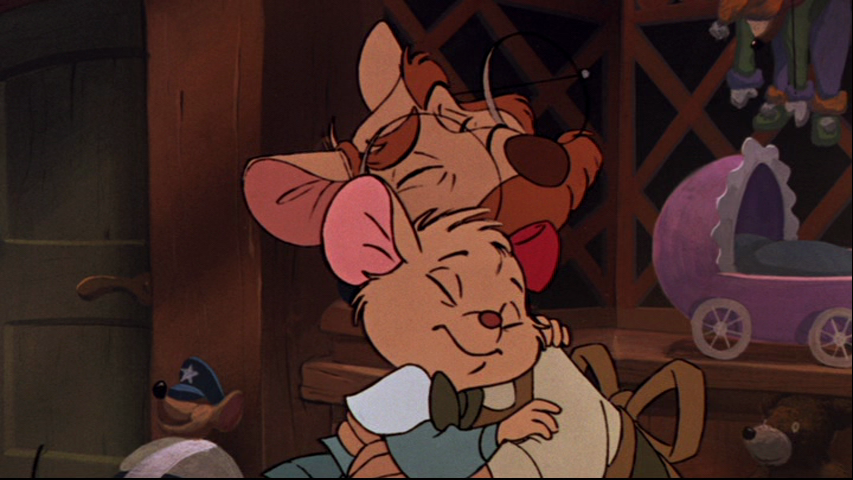
Hiram and Olivia celebrate her birthday, sharing a hug before a stranger appears to kidnap Hiram

The film, set in 1897 London, opens on Flaversham’s toy shop, where Hiram Flaversham is surprising his daughter Olivia for her birthday with an animatronic ballerina. As the two celebrate, a suspicious bat breaks into the store and kidnaps Hiram, while Olivia watches from a hiding place. Shortly after, Dr. David Q. Dawson, who has just returned to London from service in Afghanistan, comes across Olivia, who is searching for a Basil of Baker Street to help find her father. He offers to help her, and they come across 221 ½ Baker Street, where they wait for the detective to arrive.

As they wait, the two are startled by the hurried entrance of a Chinese mouse carrying a gun, only to find that it is Basil wearing a costume. He seemingly ignores Olivia as she tries to explain her case, while he runs around doing various errands. It is only when Olivia mentions that her father was taken by a bat with a pegleg, that Basil agrees to take her case, which he believes will lead him to the capture of the bat’s boss, the evil Professor Ratigan. Across town, Hiram is seen working reluctantly on a project for Ratigan, and when he refuses to work any more, Ratigan threatens to hurt Olivia. At this threat, Hiram decides his only option to protect her is to finish Ratigan’s evil scheme.

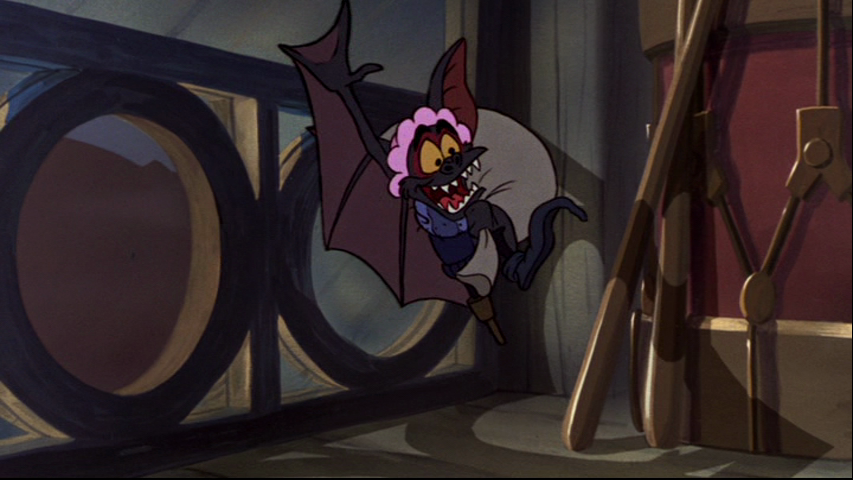
Fidget, Ratigan’s minion, escapes with all he needs for Ratigan’s plan, including Olivia

As Basil, Dawson, and Olivia go over the case, the kidnapping bat, named Fidget, appears in the window, and Olivia shrieks. Basil and Dawson quickly go after the creature, following a trail he left behind. Although Basil tries to force Olivia not to follow the pair, she goes with them to help them on the case. They meet up with a Basset Hound named Toby, who happens to be the dog of famous detective Sherlock Holmes. With Toby tracking the scent, they trail the bat to a human toy store, where he steals uniforms from toy soldiers. They don’t catch him, but they find an important clue to understanding Ratigan’s plan: a list of important supplies.

Using the toys as a distraction, Fidget captures Olivia and escapes. Dawson sadly blames himself for Olivia’s capture, but Basil assures him they will rescue her and stop Ratigan’s schemes. As they race back to Baker Street to plan their attack, Ratigan surprises Hiram with a special visitor that will ensure he finishes his task: Olivia. Ratigan, initially elated that Fidget brought back everything he was supposed to, quickly loses his temper when he finds that Basil of Baker Street is now on the case.

Dawson (L) and Basil disguise themselves as sailors as they infiltrate Fidget’s haunt, the Rat Trap

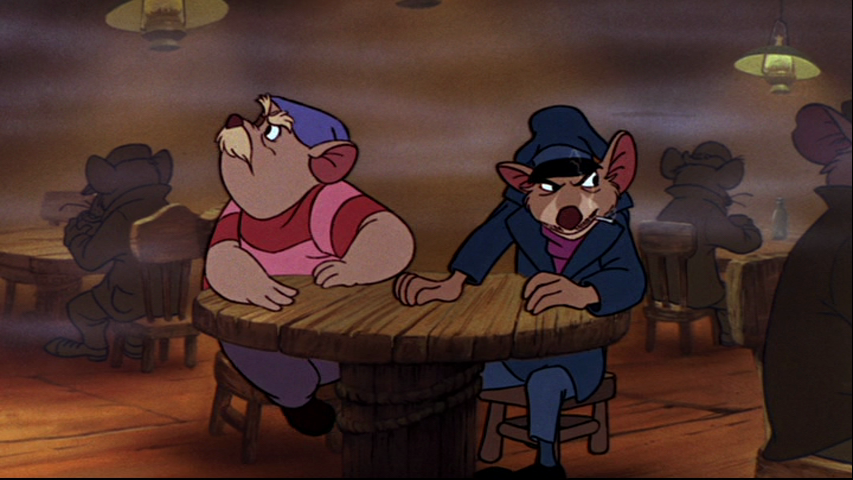
Back at Baker Street, Basil deduces the origin of the list, a seedy club near the waterfront. Disguised as sailors, he and Dawson sneak in to a bar called the Rat Trap, and while Dawson is distracted by the showgirls Basil keeps a careful eye out. Their drinks are drugged by the bartender after they inquire about Ratigan, but they are able to find and follow Fidget, who had stopped in for a drink. As they travel through the sewers, they find the location of Ratigan’s lair. They are caught in a trap when they arrive, and are left to be killed by various torture devices while Ratigan leaves to carry out his plan. Ratigan and his crew quickly head to Buckingham Palace, where Queen Victoria is preparing for her Diamond Jubilee celebration. The members of Ratigan’s gang quickly hijack the guards and bring the queen a “present” – a robotic version of herself. The queen is then captured as Ratigan’s plan becomes clear: Ratigan will use the robot to have the queen name Ratigan as her royal consort, giving him the power to control the throne.

Back at Ratigan’s lair, Basil has seemingly given up, saddened about how Ratigan has outwitted him. As Dawson tries to console him, Basil suddenly gains inspiration from a stray line of Dawson’s lecture. Motivated once again to defeat his adversary, Basil saves the group, and they quickly head to Buckingham Palace, arriving in the nick of time to save the queen from being eaten by Felicia, Ratigan’s pet cat. From backstage, Basil takes over the controls of the robot, exposing Ratigan’s plan and reuniting Olivia with her father again. Unfortunately, Fidget manages to free himself, takes Olivia, and escapes with Ratigan. After they chase each other around the skies of London with Ratigan’s flying contraption and Basil’s use of balloons, Basil and Ratigan’s final showdown takes place within Big Ben. Both Ratigan and Basil fall from the clock tower, but as Olivia, Hiram, and Dawson begin to mourn the detective’s demise, Basil emerges from the clouds, using a propeller from Ratigan’s flying contraption to keep himself airborne.

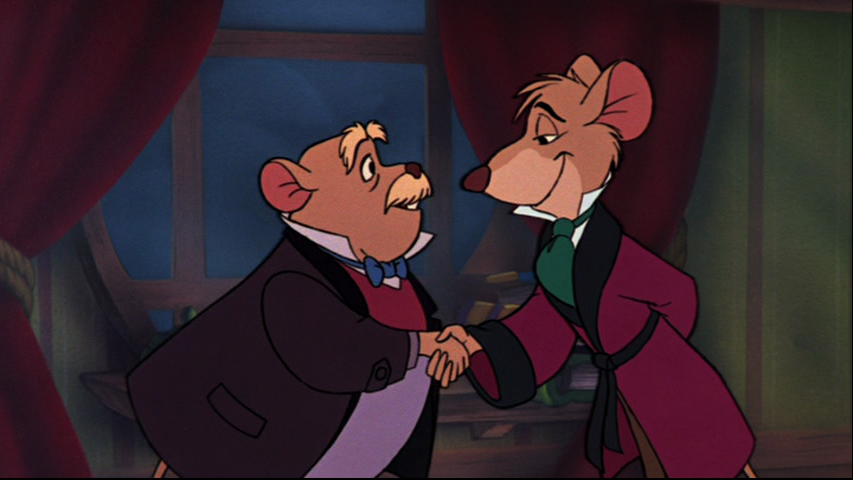
Basil and Dawson form a long partnership after this first case, with Basil asking that Dawson remain as his assistant

Basil and Dawson are honored at the queen’s Jubilee, and Olivia and Hiram depart for home. Dawson plans to find his own place to live in London, but Basil offers him a chance to stay at his flat and be his assistant. Shortly after, a woman appears at their door, imploring them for help. As the camera pans out, Toby is seen at their window, listening in on the case.

June 30

June 30, 1993 – Disney Buys Miramax Films

On June 30, 1993, Disney finalized the deal to buy Miramax Films, which not only had Disney financing future Miramax productions, but also gave Disney access to the more than 200 films in the Miramax library. Miramax founders Harvey and Bob Weinstein sold the studio for $60 million, although they continued to work with Miramax, with Disney having the final say on what they could release. In 2005, the Weinsteins and Disney did not renew their contractual relationship. The main point of their dispute was Michael Moore’s film Fahrenheit 9/11; Disney had not wanted to release it, but many communication errors kept the film under Miramax until the Weinsteins moved it to their own distribution group to release it.

After Disney’s purchase, many successful films were released, including The Piano, The Crow, Little Buddha, Pulp Fiction, Trainspotting, Sling Blade, and The English Patient. In 2009, Disney cut Miramax’s staff and film output about 70 percent, and by January 29, 2010, the studio’s offices were closed, and everything left was moved to Disney’s headquarters in Burbank. In July of that year, the arrangements to sell Miramax began. Ron Tutor and his investment group bought the studio in December 2010 for $660 million.

June 19

June 19, 1998 – The 36th Animated Feature, Mulan, is Released to Theaters

“A single grain of rice can tip the scale. One man may mean the difference between victory and defeat.”

On June 19, 1998, the animated feature Mulan was released to theaters. The story was based on a 2,000-year-old Chinese folktale, and a select group of Disney artistic supervisors spent a three-week trip in China to study the culture and landscape. It was the first feature film to be predominantly produced at the Disney Feature Animation Studio in Walt Disney World, Florida. The film was directed by Barry Cook and Tony Bancroft, and stars Ming-Na Wen as Mulan, with Lea Salonga providing Mulan’s singing voice, B.D. Wong as Shang, Donny Osmond as Shang’s singing voice, Eddie Murphy as Mushu, Miguel Ferrer as Shan-Yu, and Harvey Fierstein as Yao. The film is also notable for its casting choices overseas, namely Jackie Chan playing the role of Shang in the Chinese version.

The movie begins with an attack on the Great Wall of China by the Hun Army. One brave solider lights the signal, then tells Shan-Yu, head of the Hun Army, “Now all of China knows you’re here.” Shan-Yu smiles evilly, takes the flag of the Emperor, burns it, and says simply, “Perfect.” The Emperor declares that troops are needed to protect his people, and sends out a message for new recruits. Mulan, the main character, is then seen writing words on her arm while eating her breakfast before realizing she’s late for her morning chores. Her father is seen praying to the ancestors to help Mulan impress the matchmaker.

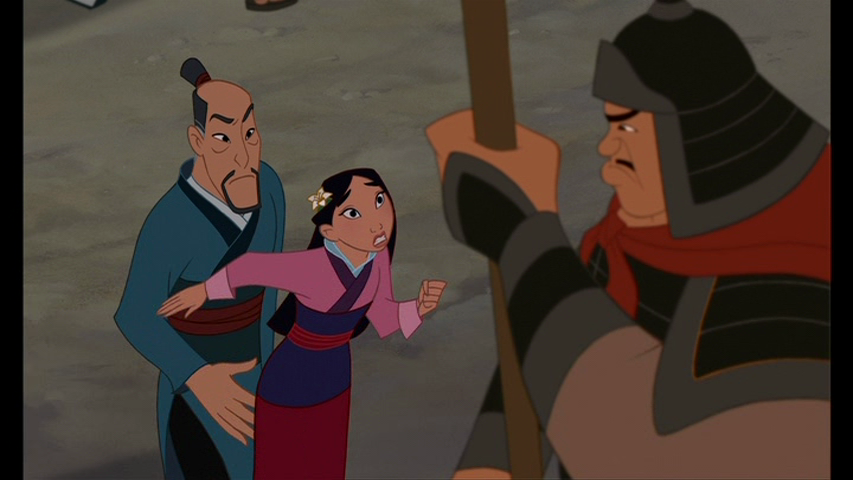
Mulan steps forward, begging the Imperial Army to spare her injured father

Mulan hurries into town, with her mother watching anxiously for her arrival. When Mulan arrives, there’s a great many things that need to be done to get her ready to see the matchmaker. She’s rather nervous, and worried about bringing her family honor. Unfortunately, Mulan starts off on the wrong foot with the matchmaker, and she only stumbles into more problems, concluding with her setting the matchmaker on fire. The matchmaker declares, in front of the entire village, that Mulan will never bring her family honor. At home, her father cheers her up by letting her know that the late-blooming blossom will be the most beautiful of them all. Soon after, the Emperor’s declaration that one man from every family must serve in the Imperial Army is announced, and Mulan’s father, who was injured the last time the Emperor needed soldiers, decides to go to battle. Mulan shames her father by asking for her father to be spared. Knowing her father will never survive if he goes, Mulan steals his armor and takes his place, riding off to the Imperial Army’s camp, even though she knows if she is discovered, she will certainly be killed.

The Fa family’s ancestors awaken, deciding which guardian should go to protect her. Mushu, a dragon that used to be a guardian but was demoted for his bad service, has to go awaken the Great Stone Dragon, but accidentally destroys it. Fooling the family into thinking it’s awakened, Mushu meets up with a cricket (one that the grandmother declared lucky), who tells him that they should go and rescue Mulan. Thinking it’s a good way to get back in the ancestors’ good graces, Mushu decides to make Mulan a war hero. Mulan isn’t so convinced that “a little lizard” can protect her, but Mushu convinces her that he can do the job. When they enter the camp, however, Mushu proves himself to be more of a problem than a help; Mulan ends up getting the entire camp in trouble.

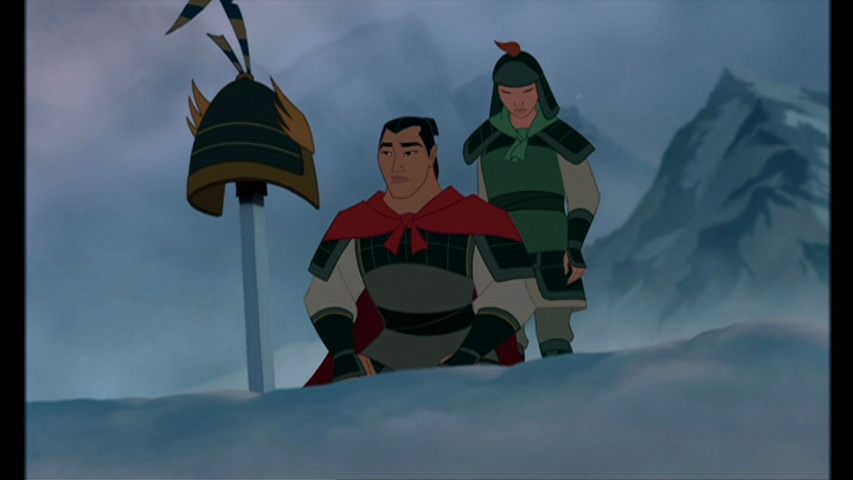
Shang’s troops make a grim discovery as they go through the pass

Shang trains his troops diligently, although the men are rather green to begin, and he reaches the conclusion at one point that Mulan (going under the name Ping) should go home. Determined to stay, Mulan proves her worth, and soon, the whole team is battle-ready. Mulan makes friends with Yao, Ling, and Chien-Po, who become her closest comrades. Mushu pretends to be an officer and gets the team sent out to meet the other Imperial Army troops. When they get to the pass, they find that the village there has been obliterated, including the Imperial Army section led by Shang’s father, the general. They then are caught in a surprise attack by the Huns, but Mulan saves the day by crushing the Hun Army with an avalanche. After she saves Shang from the fast-approaching snow, he realizes she’s been injured in her dealings with Shan-Yu, and a medical tent is set up for her. Unfortunately, her secret is discovered, and Shang is forced to kill her. He decides to spare her life, as she had saved his, and his debt has been repaid. Mulan is then deserted in the pass as the Army moves to the Imperial City.

As Mulan is left behind with her horse, Mushu, and the cricket, the four make the startling discovery that members of the Hun Army are still alive, including Shan-Yu, and are on their way to kill the Emperor. Mulan goes after them to warn Shang, but no one will listen to a woman. When the Huns surprise everyone with a sneak attack and kidnap the Emperor, Shang and his men are at a loss at what to do, but Mulan comes up with a plan: Ling, Chien-Po, and Yao dress up as concubines to infiltrate the palace. Shang joins their plan to help Mulan, and a fight ensues, with Mulan battling one-on-one with Shan-Yu. She manages to defeat and kill him with Mushu’s help, using the fireworks for the ceremony. The Emperor emerges, declaring, “I’ve heard a great deal about you, Fa Mulan. You stole your father’s armor, ran away from home, impersonated a soldier, deceived your commanding officer, dishonored the Chinese army, destroyed my palace, and…you have saved us all.” He gives her the sword of Shan-Yu and the crest of the Emperor in honor of her brave deeds, and everyone in attendance bows in respect. As Mulan leaves, Shang tries to say something profound, but can only say, “You fight good.” Disappointed, but relieved to go home, Mulan decides to return to her family. The Emperor tells Shang off for letting her go, telling him that “you don’t meet a girl like that every dynasty.”

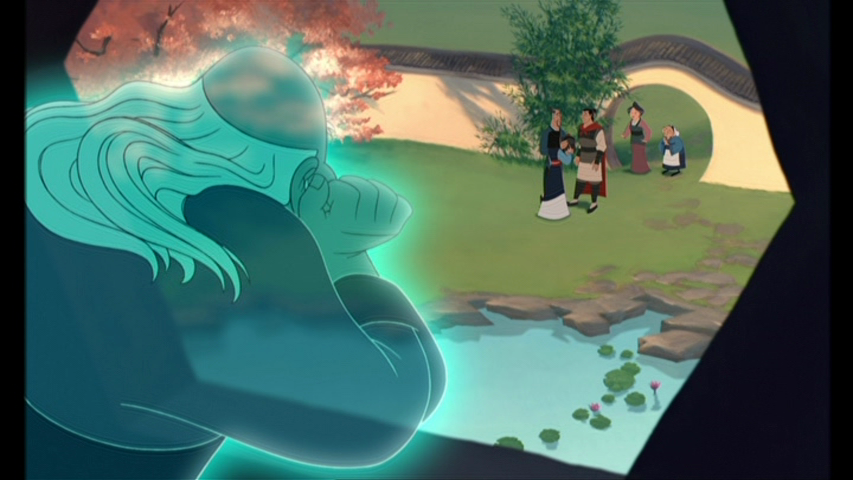
The ancestors watch as all is well with the Fa family

Mulan arrives home with trepidation, unsure at what her father’s reaction will be. He embraces her, just glad to see her home alive. Her grandmother isn’t so happy, wondering why her granddaughter couldn’t bring home a man, when Shang appears, looking for Mulan, under the guise of trying to return her helmet. Mulan asks if he would like to stay for dinner, and a romance appears to bloom between the two. Mushu is reinstated as a guardian, and all the ancestors wake up for a celebration.

June 15

June 15, 2001 – The 41st Animated Feature, Atlantis: The Lost Empire, is Released in Theaters Nationwide

“I will find Atlantis on my own, even if I have to rent a rowboat!”

On June 15, 2001, the animated feature film Atlantis: The Lost Empire was released in theaters nationwide after a premiere at the El Capitan Theater in Hollywood, California. The film was directed by Gary Trousdale and Kirk Wise, with story by Tab Murphy, Gary Trousdale, Kirk Wise, Bryce Zabel, and Jackie Zabel, with treatment by Joss Whedon. It starred the vocal talents of Michael J. Fox as Milo Thatch, Cree Summer as Kida, James Garner as Commander Rourke, Corey Burton as Mole, Claudia Christian as Lieutenant Sinclair, John Mahoney as Preston B. Whitmore, Phil Morris as Professor Sweet, Leonard Nimoy as the King of Atlantis, Jacqueline Obradors as Audrey, Florence Stanley as Wilhelmina Packard, and Jim Varney as Cookie (this was Varney’s last role before his death in 2000). The film did moderately well at the box office, grossing over $186 million worldwide; however, due to the less-than-expected box office, Disney canceled plans for a spin-off television show and a remake of the Submarine Voyage attraction based on the film. It has since become a cult classic among fans for its comic-like animation style.

The film begins with an introduction on how the city of Atlantis was destroyed. The scene then fast-forwards to 1914, at the Smithsonian Museum, where Milo Thatch, cartographer and linguist, is presenting his proposal on finding the lost city and its fabled power source, and bringing it back to the surface. He declares that the team must go to Iceland to find what’s known as the “Shepherd’s Journal,” a book that details a first-hand account of the fabled city. As it turns out, Milo has not been presenting to anyone, but has been practicing his proposal. When he finally tries to present his proposal, the board refuses to believe him, and warns him not to give up a promising career to chase a fairy tale.

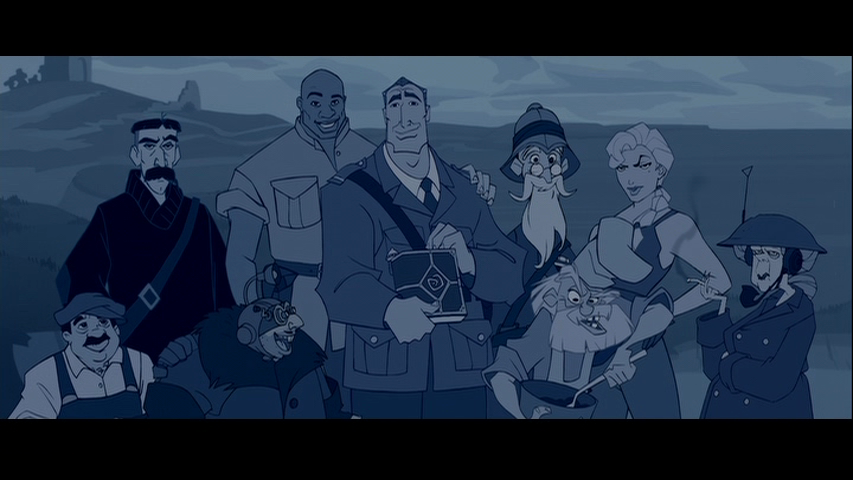
Milo looks at the photo of his grandfather and the crew that helped bring back the Shepherd’s Journal from Iceland

Disheartened, Milo arrives home to find waiting in his apartment Helga Sinclair, who gives him an offer he can’t possibly refuse from her employer, Preston B. Whitmore: a chance to find the lost city of Atlantis. Whitmore was a friend of Milo’s grandfather, who gave Whitmore the Shepherd’s Journal before he died, so Whitmore could pass it to Milo when he was ready. He provides Milo a crew and everything necessary for the journey. Soon, they’re loading the ship and are on their way, with Milo meeting the team that helped bring the journal back in the first place. After a series of tunnels and encounters with terrifying mechanical creatures who destroy the ship, the crew uses an escape pod to reach the ancient city.

Milo, injured in the last mishap, is found by a mysterious young woman who heals his injury. After determining that they speak English, the young woman, Kida, insists that Milo be taken to meet her father, the King. The King is not happy to see visitors, as the law states that they cannot see the city and live. Commander Rourke, the leader of the expedition, asks for at least one night in the city so they can resupply, and the King agrees with apprehension. Milo is then asked to get close to Kida, as she wishes to use the visitors to help her people. She then shows Milo all around the city, while asking questions about the world above. When she discovers he can read Atlantian, she asks him for help to translate a mural she found, which would explain the star she saw when her mother was killed in the flood that seemingly destroyed the city.

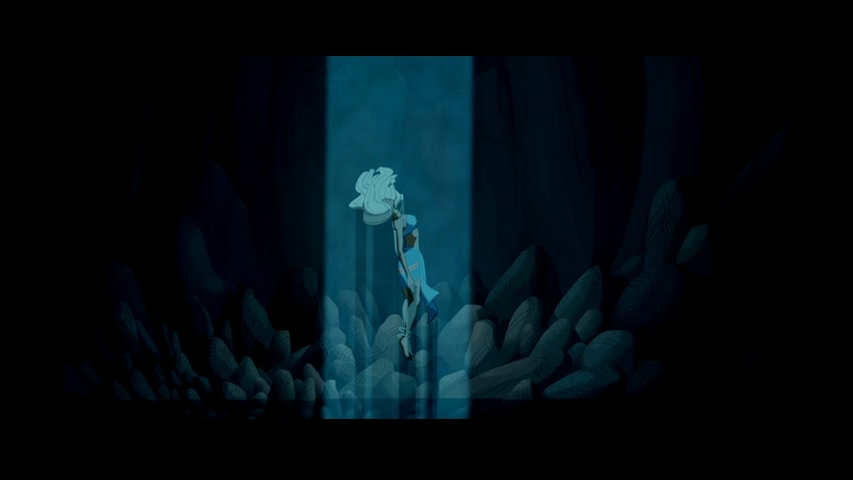
Kida is chosen by the power source to help protect the city

Unbeknownst to Milo, Captain Rourke and his crew have plans of his own that are unsavory: they wish to capture the Heart of Atlantis, which is the power source of the city, and the star Kida saw as a girl. They capture Kida and threaten to kill her unless Milo helps them get what they want. Discovering its hiding place, Rourke, Sinclair, Kida, and Milo enter the cavern. The crystal around Kida’s neck reacts to the power source, and she ends up possessed, floating in the air to meet the light. As the two meet, the source begins to glow brighter, and Kida has become the power source herself. Rourke locks her up, taking her away to be sold to the highest bidder on the surface. As they prepare to leave, members of the crew begin to take Milo’s side, as they believe that what Rourke plans to do is wrong, and they all remain in Atlantis; the whole city begins to die now that the power source is gone. The King, right before he dies, begs Milo to save Kida, who will be lost to the power source forever if Milo doesn’t get to her in time.

Milo and a group of Atlantian soldiers go after Rourke, and after a fierce battle inside the volcano, the mercenaries are defeated, and Rourke is killed by Milo when struck with a crystal shard that has been in contact with the power source. Due to the destruction, the volcano erupts, and Milo and his team scramble to escape. When the lava threatens to destroy the city, Kida emerges, still part of the crystal, and protects the city with a force field. Kida is then released from her bond with the power source, returning to Milo.

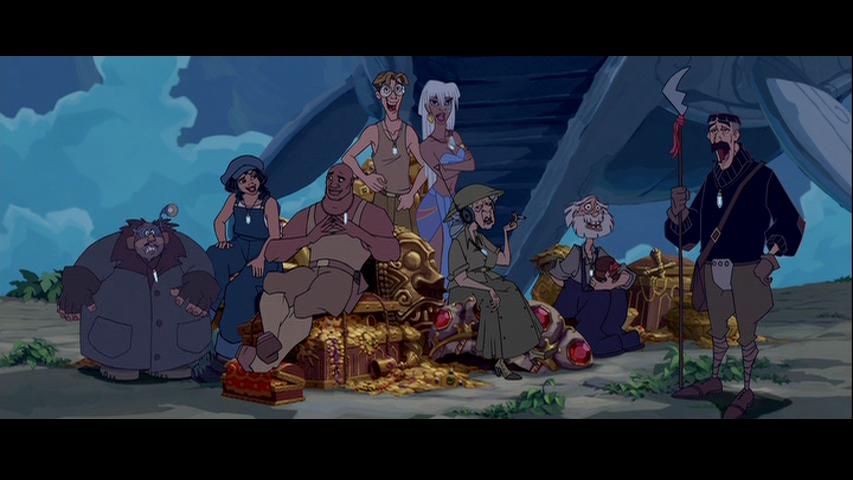
The crew, Milo, and Kida take one last picture together before the crew heads for the surface

The crew returns to the surface, sans Milo, loaded down with lots of ancient treasures. As they meet with Whitmore, all of the crew now very wealthy, he makes them promise to never reveal that they found Atlantis. Milo, who has fallen in love with Kida, decides to remain, and the pair try to rebuild the ancient glory of Atlantis.

June 10

June 10, 1949 – Birth of Disney Legend Kevin “Moochie” Corcoran

“…kids in the audience related more to Corcoran, who created a character who was part All-American boy and part hellion.” – Film Writer Donald Liebenson.

Born on June 10, 1949, in Santa Monica, California, Kevin Anthony Corcoran began his acting career at the tender age of two. In 1956, Corcoran auditioned for a serial on the Mickey Mouse Club called “Adventures in Dairyland,” and won the role of a character named Moochie, a nickname that would stick with him throughout his career at Disney. He was then cast specially by Walt in the sequel serial, “The Further Adventures of Spin and Marty,” as well as “The New Adventures of Spin and Marty.”

Corcoran also appeared in several popular Disney films, with his only starring role as Toby in Toby Tyler, a film about an orphan who runs away to join the circus. He played supporting roles in Old Yeller, The Shaggy Dog, Pollyanna, Swiss Family Robinson, Babes in Toyland, Bon Voyage!, Savage Sam, and A Tiger Walks. Corcoran played the younger brother to actor Tommy Kirk in five Disney films, including Swiss Family Robinson and The Shaggy Dog. Corcoran also voiced Goliath II in the short film of the same name, and was featured in several Disney mini-series and serials, such as Daniel Boone, The Mooncussers, and Johnny Shiloh. After the 1964 film A Tiger Walks, Corcoran mostly retired from acting and attended California State University, getting a degree in theater arts.

Corcoran returned to Disney after college, using his skills behind the camera instead of as an actor, and working as an assistant director and producer on several projects, including Pete’s Dragon. He has also worked as a first assistant director for many television series outside of Disney, including Quantum Leap and Murder She Wrote, also acting as an assistant producer and director on the latter series. Corcoran was inducted as a Disney Legend on October 9, 2006, alongside Tim Considine, David Stollery, and Tommy Kirk.

June 2

Posted on

June 2, 1989 – The Touchstone Film Dead Poets Society is Initially Released to Theaters

“Carpe diem. Seize the day, boys. Make your lives extraordinary.”

On June 2, 1989, the film Dead Poets Society was initially released to theaters, with a general release on June 9th. Distributed by Touchstone Pictures, it won an Academy Award for Best Screenplay for Tom Schulman, who based it on his own life at a private school in Tennessee. It was directed by Peter Weir, and stars Robin Williams as John Keating, Robert Sean Leonard as Neal Perry, Ethan Hawke as Todd Anderson, and Josh Charles as Knox Overstreet.

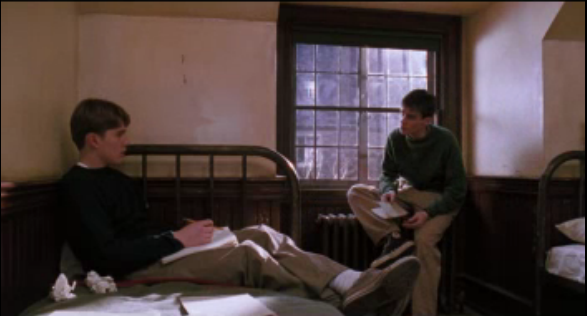
Set in 1959, the movie starts with the beginning of Welton Academy’s traditional opening ceremony, where several of the main characters are seen carrying in banners with the titles “Tradition,” “Excellence,” and “Discipline.” The dean brags about the school’s achievements, calling it the best preparatory school in the United States. He then introduces the new teacher of the English department, Mr. John Keating, who has been teaching in London, and is an alumnus of Welton Academy. We then catch a glimpse of a few of the boys with their parents, and Neal Perry, one of the shining stars of the academy, meets Todd Anderson, his new roommate. Todd’s brother attended Welton, and Neal remarks, “Oh, so you’re that Anderson.”

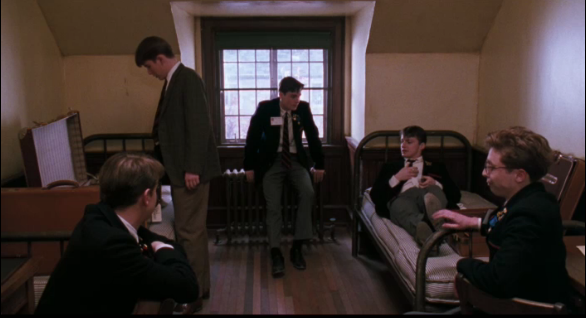
Todd meets Neal and his friends for the first time as they talk about their study group

As Neal and Todd move into their room, Neal’s friends Knox Overstreet, Charlie Dalton, and Steven Meeks appear to talk about their summer and joke about their study group, to which they reluctantly add Richard Cameron, whom they describe as a “boot-licker.” Neal mentions Todd’s brother, who was valedictorian and national merit scholar, which seems to cause Todd some embarrassment. Neal’s father enters the room, and lets Neal know that he will be dropping the school yearbook from his extracurriculars. Neal argues that he’s the assistant editor, but his father will hear none of it, letting Neal know that after Neal graduates medical school and is on his own “then you can do what you damn well please.” Until then, he is to follow only his father’s orders. Neal acquiesces, but looks hurt that he has to give up the yearbook.

The first day of school shows the boys being loaded with what appears to be more work than they can handle, from science, to Latin, to trigonometry. When the boys get into English class, Mr. Keating enters whistling the 1812 Overture, and walks out of the room, to the astonishment of the class. When he tells them to follow, they are confused, but they finally leave. Keating takes them to the main lobby, where he teaches them about the poem “O Captain! My Captain!” by Walt Whitman, and that they may call him “O Captian! My Captain!” if they feel slightly more daring. He then teaches them one of the most important lessons in the film: carpe diem. “We are food for worms, lads,” he reminds them, explaining how life is too short.

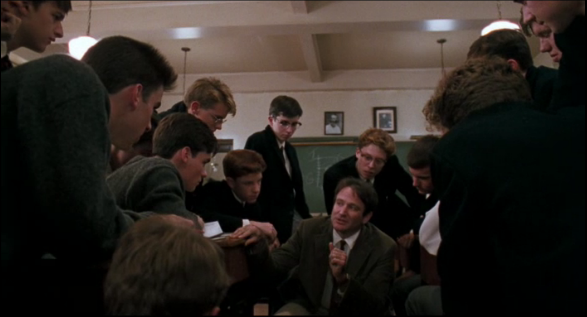
Mr. Keating pulls his class close, explaining the powerful impact language has on life

During the next English class, Neal is asked to read the introduction, and Keating tells them that he can’t stand the introduction, equating it to American Bandstand: “Well, I like Byron, I give him a 42, but I can’t dance to it.” He then asks him to rip out the entire introduction. “In my class, you will learn to think for yourselves again,” he informs them. “You will learn to savor words and language. No matter what anybody tells you, words and language can change the world.”

The boys find Keating’s yearbook, and discover that he was a member of the Dead Poets Society, leaving them to wonder what that means. They approach and ask him what it was, and Keating is a bit hesitant, as he thinks the administration might not favor it. But explains that he and his friends would sit around letting the words of poetry “drip from their mouths like honey.” Neal is inspired to begin the society again, and with the help of Keating and his old poetry book, they decide to meet. Neal asks Todd to come, but Todd is very shy and declines. But Neal persists, and finally the boys sneak out, beginning the first meeting of the Dead Poets Society.

Although Neal is initially elated about discovering his passion, he becomes infuriated that the shy Todd seems to not be effected by anything Mr. Keating has to to say

The English classes continue, with Keating reading Shakespeare in humorous ways from imitating Marlon Brando and John Wayne, to having the students stand on his desk to see things in a new perspective. After class, Neal lets Todd know that he has finally decided what he wants to do with his life: he wants to become an actor. He decides to audition for a production of A Midsummer Night’s Dream, screaming “Carpe Diem!” Neal then chews Todd out for not being stirred up by anything, thinking that Todd has not been affected by anything Mr. Keating has said. Todd argues that when Neal speaks, people listen, and he’s not like Neal. But Neal won’t take that for an answer, and is determined to stir up something in Todd.

Neal then announces he got the part of Puck in A Midsummer Night’s Dream, and forges the letters of permission from his father and the dean. Todd slowly begins to discover a love of writing with Keating’s poetry assignment. Unfortunately, he was unable to come up with a poem he found acceptable to present. Keating pushes him out of his comfort zone, making him come up with a poem on the spot. Keating has finally reached him, and Todd is able to open up.

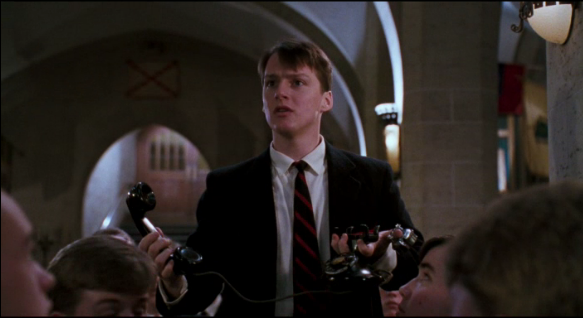
Charlie plays a prank at the assembly, pretending God has called to tell the Dean to admit women in the school

Things begin to go downhill for the Dead Poets Society, when Charlie publishes an article in the school paper in the club’s name to demand that their school go co-ed. He gets himself into trouble by pretending that God has called in the middle of an assembly, saying they should have girls at Welton. Charlie is then punished by getting paddled, but does not give up the members of the club.

Neal begins practices for the play, but comes back one night to find that his father has found out and is furious. He demands that Neal quit, although the play is the next night. “I made a great many sacrifices to get you here, Neal, and you will not let me down,” he warns his son. Neal tells him he will quit, but later that night, he goes to talk with Mr. Keating, who advises him to show his father what’s in his heart, where his passion lies, before opening night. Neal decides to stay with the play, lying to Mr. Keating, saying his father is letting him stay with the play.

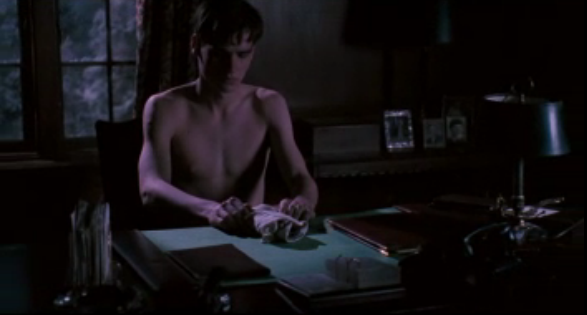
Unable to live the life his father has decided for him, and unable to have a life of his own, Neal resorts to not living at all

Neal shines in the play as Puck, and his father walks in to see the performance, and Neal’s standing ovation. Infuriated by his son’s disobedience, he pulls his Neal out of school, taking him home and informing him that he will be enrolled in military school. Unable to live the life his father has decided for him anymore, Neal takes a gun from his father’s study late that night and shoots himself.

The mood at Welton is somber as they hear the news of Neal’s death. Todd is hysterical, blaming Neal’s father. Mr. Keating is also overcome with emotion when he hears the news, sitting at Neal’s desk and crying. At the request of Neal’s family, the school conducts an investigation as to why he took his life. Charlie accuses Cameron of telling the board of directors all about the club, and Cameron doesn’t deny it, as he wants to save his own skin by putting Mr. Keating on the line. When he tells the group that they should “let Keating fry,” Charlie loses it and punches Cameron, leading to Charlie’s immediate expulsion. When Todd is questioned by the school, they say that it was Mr. Keating’s actions that led to Neal’s death. Mr. Keating is then fired by the school.

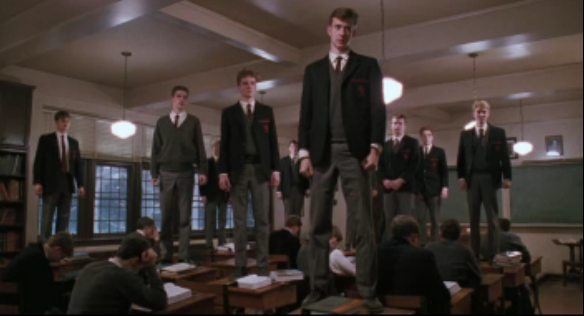
Half of the class stands on their desks, showing their admiration for Mr. Keating, their Captain

The English class is taken over by the Dean, who wants them to read the introduction that they had all ripped out. As Mr. Keating leaves the classroom after collecting his personal belongings, Todd shoots up and admits the truth to Mr. Keating, who tells Todd that he understands. Todd isn’t done, as he gets up on his desk and calls, “O Captain! My Captain!” He is then followed by most of the class, including Knox, Pitts, and Meeks. With a smile, Mr. Keating thanks them, knowing he has made a difference in their lives.