RSS Feed

Tag Archives: Disney Anthology

October 12

October 12, 1911 – Producer, Member of Board of Directors, and Disney Legend Bill Anderson is Born

Bill Anderson

“Family entertainment should be fun; life is melodramatic enough.”

On October 12, 1911, William Hillyard Anderson was born in Smithfield, Utah. Originally wanting to be an actor, Anderson moved to Los Angeles in 1929, scoring minor radio roles while working as a regional sales manager at a subsidiary of Ford. However, with the scarcity of casting calls, he went to study pre-law at Compton Junior College and the University of Southern California while working at Firestone Rubber Company. In 1943, as studios were committed to the war effort, Anderson was hired by the Disney Studios in the production control department. He was soon chosen to oversee the reorganization of the ink and paint department, which then led into a job as the assistant to the Studio’s production manager. Anderson was then named the Studio’s production manager in 1951, and in 1956, he became the Vice President of Studio Operations. Anderson’s projects were numerous, including being the associate producer of such well-beloved classics as Old Yeller, Swiss Family Robinson, and The Apple Dumpling Gang. His producer projects in television included Zorro and The Scarecrow of Romney Marsh. He was named to the Board of Directors in 1960, and in 1966, after Walt Disney passed away, Anderson served on the board of Disney Studio producers who helped keep the studio afloat. Anderson retired in 1984, and in 1997, he passed away from a cerebral hemorrhage. In 2004, he was honored as a Disney Legend for his work in Disney production.

January 30

January 30, 1957 – The Episode of the Disney Anthology Series “All About Magic” Premieres

vlcsnap-2015-01-30-18h57m07s126

“Perhaps there is no art more fascinating than magic.”

On January 30, 1957, the episode of the Disney anthology series “All About Magic” premiered on ABC. It was directed by Hamilton Luske, and starred Hans Conried as the Magic Mirror.

The episode begins in Walt’s office, where he explains about the importance of magic, and takes the audience down to a prop room that is full of magical props. He opens the door with the magic words, and inside Walt uses a few of the props, including levitating a table using his concentration. He introduces them to the Decapitated Princess, who speaks when he utters the magic words. She is startled when he tells her that it’s the mid-20th century, but he quickly calms her back to sleep. Walt then continues his tour of the prop room, and pulls a rabbit out of a hat. Finally, he reveals the magic mirror owned by the Evil Queen in Snow White and the Seven Dwarfs, and summons the slave in the mirror; unfortunately, he arrives upside down. Walt hands the show over to the mirror, who sends Walt away with the magic words. The mirror then panics, as he’s not sure he knows the correct words to bring Walt back. Fortunately, Walt is still in the room, and leaves of his own accord. After doing several sleight of hand tricks, the mirror then introduces the stories and film clips featuring magic, beginning with the Mickey Mouse short film Magician Mickey. Afterwards, he introduces Halloween and the next short film, Trick or Treat. The episode concludes with clips from Cinderella and the Sorcerer’s Apprentice sequence from Fantasia.

January 6

January 6, 1963 – The Walt Disney’s Wonderful World of Color Episode “Three Tall Tales” Premieres

vlcsnap-2015-01-06-17h56m07s58

“And here is your host, Walt Disney.”

On January 6, 1963, the Disney anthology series Walt Disney’s Wonderful World of Color premiered the episode “Three Tall Tales.” The episode, hosted by Walt Disney and Ludwig von Drake, begins with an introductory monologue about Baron von Munchausen, a character from German folklore about a man who was famous for telling tall tales. The series then presents three tall tales told through Disney animation: Casey at the Bat (released August 15, 1946, as part of the animated feature Make Mine Music), The Saga of Windwagon Smith (released on March 16, 1961), and Paul Bunyan (released August 1, 1958).

December 4

December 4, 1957 – The Disneyland Anthology Episode “Mars and Beyond” Airs

vlcsnap-2014-12-04-16h08m50s13

“In this exciting age when everyone seems to be talking about the future possibilities of space travel, there’s much speculation on what we will discover when we visit other worlds.”

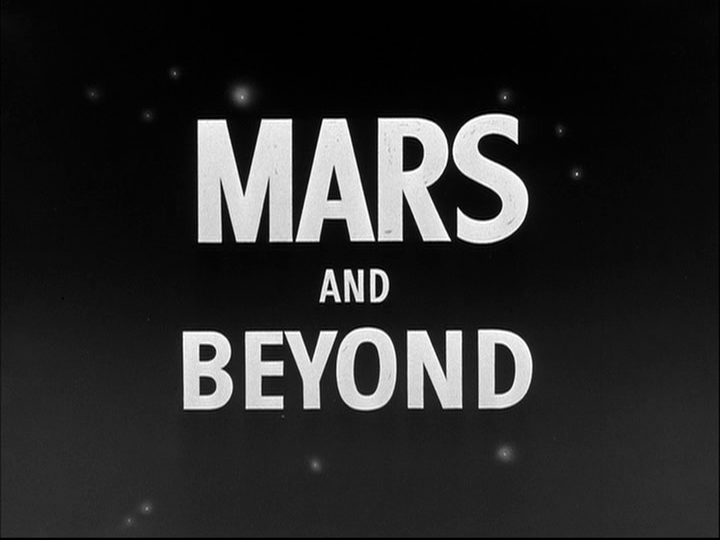
On December 4, 1957, the Disneyland Anthology episode “Mars and Beyond” aired on television. The episode features several well-known technical advisors, including Dr. Ernst Stuhlinger, Dr. E. C. Silpher, and Dr. Wernher von Braun, as they explore the possibilities should man travel to Mars. The episode was later released a featurette in theaters on December 26, 1957, and portions of the film were reedited into a short film called Cosmic Capers, released in England in 1979. The short features several different styles of animation, ranging from the humorous to the more serious. The voices in the animated sequence are all done by Disney veteran Paul Frees. This episode was directed by Ward Kimball, with story by Kimball, William Bosche, John Dunn, Charles Downs, and Con Pederson.

The episode begins with a robot named Garco introducing Walt to the television audience. Walt poses the question of what we will find when we start traveling to other planets. It then goes into the story of man, with each passing age speculating and wondering about their existence and the nature of the world around them. It then explains the process of man’s thoughts and knowledge of the stars movement around the world, leading into a dark world of superstition and stupidity. In the time of the Renaissance, Copernicus came along to prove mathematically that the sun was the center of the universe, not the Earth as was believed. Galileo then proved that the planets were not just specks of light, but spheres just like the Earth. Soon after, people start speculating what life is like on other planets. One of the first to describe the supposed inhabitants of other planets was Bernard de Fontanelle, a Romantic poet. In the 19th century, many people chose Mars as the planet most likely to have inhabitants, as they believed they saw specks of light and interpreted them to be signals to Earth. Several books are written about people meeting Martians, each more fantastical than the previous. At the time of this episode, an eager public is more than willing to read stories about life on other planets, usually with the same formula.

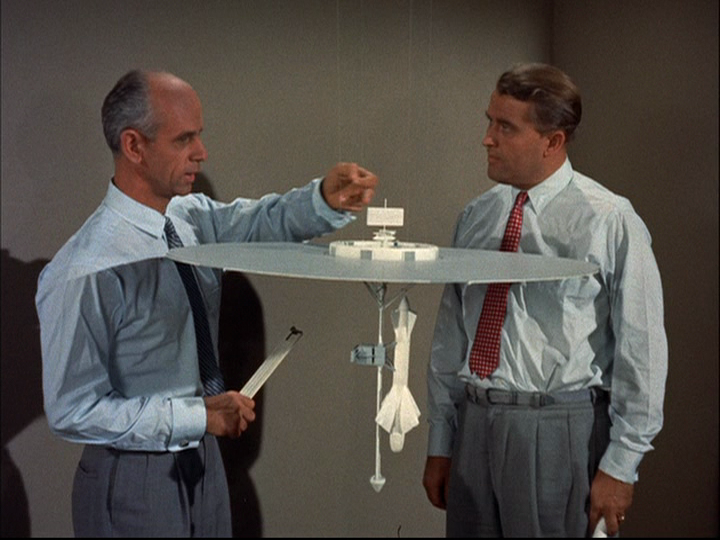
The episode explores possible space travel, with assistance from two well-known scientists

The episode explores possible space travel, with assistance from two well-known scientists

The story then goes to the discussion about other universes, with the Milky Way being one of billions. To give the example about how evolution may be occurring across other planets, the audience is lead into the story of the creation of our own universe, beginning with the Big Bang. The planets are also compared to Earth, and how man would die on each planet, save for the golden zone of Venus, Mars, and the Earth, where it would be possible for man to live. If man were to journey to Mars, life might just be possible, providing that the right resources are provided to sustain life. Mars has always captured the interest of astronomers, and the episode explores the history of the interest of Mars, with the study of the planets’ surface. Dr. E. C. Slipher, a senior astronomer who had worked at the Lowell Observatory in Arizona for over fifty years, is interviewed about potential life on Mars. He explains the facts that astronomers accept, including the size of Mars being half the size of Earth. He introduces a spectrograph, which can help interpret the atmosphere of Mars, and a thermocouple, which can interpret the temperature of Mars. However, photographic evidence of the canals on Mars cannot be obtained due to the Earth’s atmosphere blurring the photo. Although a small amount of information that has been collected, it isn’t enough for astronomers to draw any definite conclusions about Mars, including the conclusion about life on Mars. However, many scientist speculate what life would be like should there be any slight changes to the conditions on the planet. The final part of the program focuses on the possibility of travel to Mars from Earth. Dr. Ernst Stuhlinger and Dr. Wernher von Braun have been working together to create a special atomic type of spaceship that would be able to travel outside the gravitational pull of Earth without using a ton of chemical fuel, with the parts of the spaceship assembled in space after being brought up by conventional rockets. A small atomic reactor will continue to provide heat to power a turbogenerator. A plan is explained for the trip to Mars, which will take a little over 13 months to accomplish, and six ships will be used for the entire expedition.

September 11

September 11, 1957 – The Disney Anthology Episode “The Fourth Anniversary Show” Premieres

vlcsnap-2014-09-11-18h59m34s10

“I remember how his fingers flew over the keys of our battered, old piano, how his face glistened with perspiration as he concentrated on the music, and all the time I could see pictures; I could see his lovely fantasy coming to life on the screen.”

On September 11, 1957, the Disney Anthology episode “The Fourth Anniversary Show” premiered on ABC. Celebrating four years on the air, the episode shows some upcoming projects for the studios, and a stylized flashback sequence. The show also features proposed scenes for a film called The Rainbow Road to Oz, which would have been an adaptation of one of Frank L. Baum’s Oz stories, which Disney owned the rights to; this film was never made. The episode was directed by Sidney Miller and Hamilton S. Luske. It starred the Mouseketeers, Fess Parker, Jerome Courtland, Guy Williams, and Walt Disney as himself and as the voice of Mickey Mouse.

The episode begins with Walt attempting to play “Peter and the Wolf” on the piano. He reflects on how the piano in front of him played an important part in one of the many adventures at the studio, when Sergei Prokofiev came to the studio to work with the animators on a segment. The audience is then taken back in time to a storyboarding meeting in 1938, when the studio was hard at work on Fantasia and Pinocchio. Walt gets a call from Rudy Polk, VP of a talent agency, who tells him that an important composer wants to talk to Walt, and that Prokofiev had Disney in mind when he wrote Peter and the Wolf. Walt agrees, and they work together in a small little studio, although Prokofiev spoke very little English, and Walt spoke no Russian. Polk explains the piece to Walt while Prokofiev plays, and Walt listens intently. Unfortunately, although Walt wanted to work on the story, WWII put a wrench in any non-military stories and films. After the war, they went back to “Peter and the Wolf,” which was one of the first post-war projects. The short subject film is then presented.

Walt is kidnapped by the Mouseketeers and given a surprise anniversary party

Walt is kidnapped by the Mouseketeers and given a surprise anniversary party

After the short, Walt is about to go into an introduction of more classical music in Disney films, when Mouseketeer Cubby shows up at his office door. Walt introduces him, but tells him that they will talk later. He tries to go back to his introduction, but turns to find Cubby still at the door. Walt explains that he’s talking to the Disneyland audience, but Cubby interprets this as an okay to enter, and tells the other Mouseketeers that Walt’s “just sitting on the desk talking.” The Mouseketeers enter and start jabbering away, when Walt tells them to hold on for a second. He then introduces them: Annette, Bobby, Darlene, Karen, and of course, Cubby. They drag him to the Mouseketeer stage, where they surprise him with a party celebrating the anniversary of the Disneyland show. They put on a special show for him about everything they’d seen on the Disneyland television show, and ask him what’s in store for the next year. He answers that there’s more Donald and Goofy adventures, more global adventures, and a new character – Andy Burnett – explained by Fess Parker, with scenes from the new miniseries starring Jerome Courtland. Courtland then serenades the Mousketeers with a new song from the series called “Ladies in the Sky.”

After this, Walt gives a brief overview of what’s next, although Moochie keeps asking about Zorro. He then explains that Zorro will no longer be on Disneyland, but will be its own series. When Moochie asks if Zorro was real, Walt explains that Zorro was a mythical feature, but it soon interrupted by Zorro himself, and soon has a sword fight with a shadowy figure. Zorro, of course, wins, and makes the sign of the Z before he disappears. Walt then decides to leave, and the kids give him a present: a shooting script of the film The Rainbow Road to Oz. The Mousketeers volunteer to take over all the preparations for the film, and who off the characters in their story. They show a scene where the character of the Patchwork Girl (played by Doreen) meets the Scarecrow (played by Bobby) for the first time. Another segment plays, with Darleen singing a song called the “Oz-Can Hop.” Walt agrees to make the film, and then the Mousketeers present another song with a large anniversary cake. Mickey then makes a surprise appearance at the end, noting that the Mousketeers are a great bunch of kids, with which Walt agrees.


August 2

August 2, 2001 – Zorro Actor Guy Williams is Posthumously Awarded a Star on the Hollywood Walk of Fame

GW_Star

“…everyone needs a hero, and for those in my generation, one of the first heroes we remember from television was Guy Williams.” – Leron Gubler, President and CEO of the Hollywood Chamber of Commerce

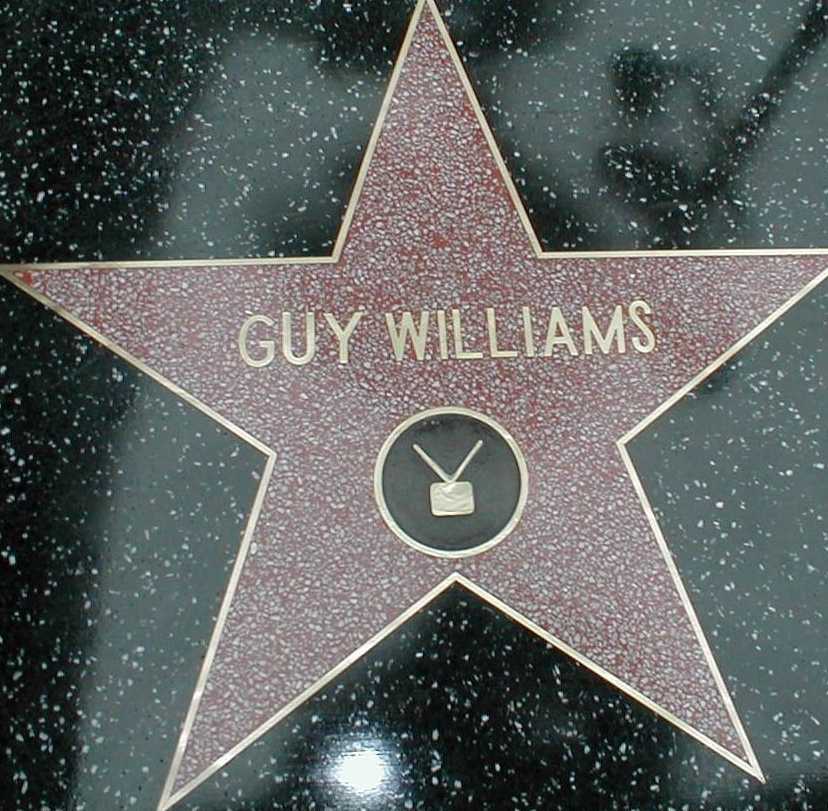
On August 2, 2001, actor guy Williams, best known for his portrayal of the legend Zorro in the segment of the same name in the Disney anthology series, was posthumously awarded a star of the Hollywood Walk of Fame. Through a dedicated grassroots effort, fans of Williams petitioned the Hollywood Chamber of Commerce in 2000, which led to his induction. Over 200 people showed up for the ceremony, including members of Williams’ family, fans, and members of the press, with Williams’ son, Guy Williams Jr., accepting the star for his father.

February 9

February 9, 1964 – Part One of “The Scarecrow of Romney Marsh” Airs on Walt Disney’s Wonderful World of Color
vlcsnap-2013-02-08-22h40m52s172

“Syn? That’s a strange name for a vicar, Mother.”

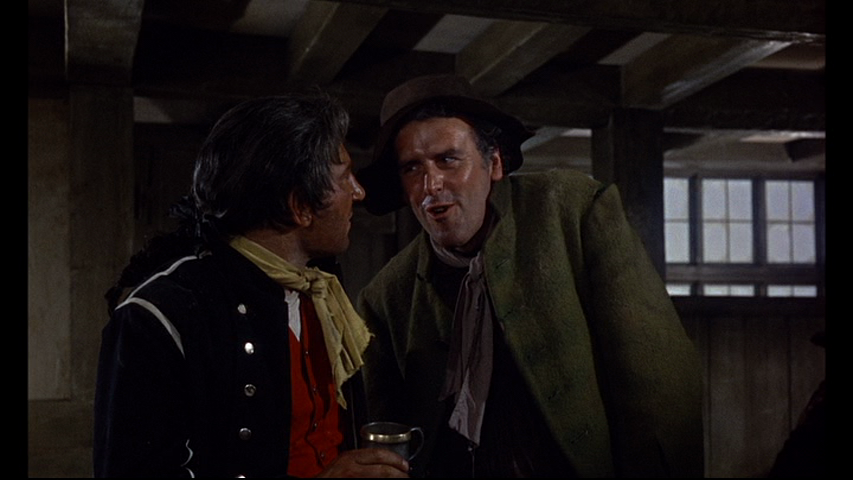
On February 9, 1964, the first of the three-part serial “The Scarecrow of Romney Marsh” aired on the Disney anthology, Walt Disney’s Wonderful World of Color. The serial was based on Christopher Syn by Russell Thorndike and William Buchanan, and was filmed on location in Romney Marsh and Dymchurch, England. The vicar’s church in the serial is an actual church known as St Clement’s Church in Old Romney, and Disney paid for the restoration of the entire building to make it usable for the filming. Although released in the United States as a series, it was filmed to be a full-length feature that was released as a film in Europe. The teleplay was written by Robert Westerby, and directed by James Neilson. It stars Patrick McGoohan as Dr. Syn/The Scarecrow, George Cole as Mr. Mipps, Tony Britton as Simon Bates, Michael Hordern as Thomas Bates, Geoffrey Keen as General Pugh, Kay Walsh as Mrs. Waggett, and Sean Scully as John Bates.

The episode opens with Walt Disney giving the introduction, explaining that Christopher Syn was “a real life Jekyll and Hyde,” as he says. Walt explains that Syn was a respected vicar by day, but fought for justice at night, helping provide for the poor and needy. At night, Syn would disguise himself, earning the nickname “The Scarecrow,” with only his two accomplices ever knowing who he really was.
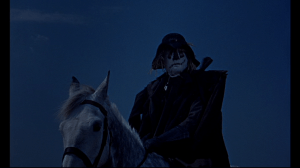
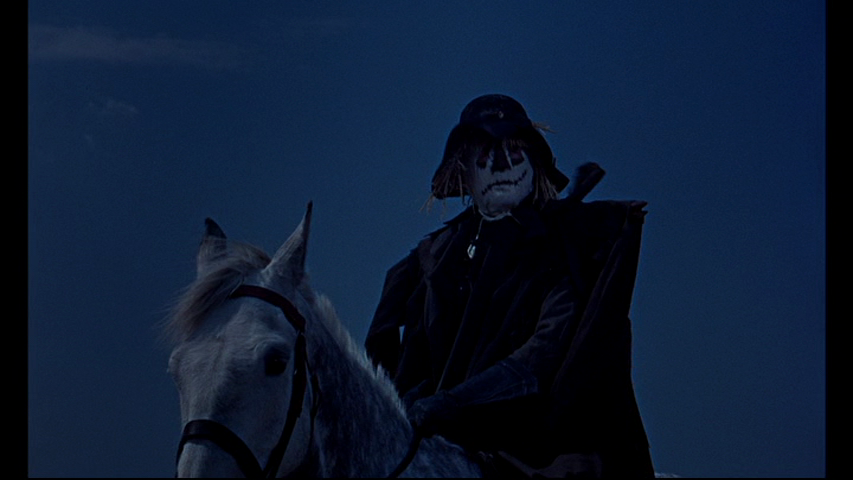
The Scarecrow surveys his men's work with the smuggling of supplies

The Scarecrow surveys his men’s work with the smuggling of supplies

The serial begins late at night, with Syn’s smugglers quickly loading up the carts under the command of the Scarecrow. A scout stationed in a nearby castle gives the warning that a patrol is moving toward the smugglers on the beach. Confronted, the Scarecrow laughs in the patrol’s faces, and escapes them after a long chase. The Scarecrow and his men enter a barn to hide, and when the patrol arrives, intent on catching them, they find no trace of the smugglers, who have carefully concealed themselves. The three men remove their disguises and make their way back to their respective homes.

The next scene shows a bishop is heading into town with General Pugh, another soldier named Brackenbury, and a weary traveler to whom the bishop has offered a ride. The General warns the bishop about the Scarecrow and his men, and the fact that the town protects them, thanks to their actions. As the bishop’s carriage passes through the town, a cane carved with a secret code is dropped as a sign for the men, to let them know when the next job will be. One of the men is rather frustrated that the Scarecrow is the only one allowed to be armed on these missions, and thinks because the rest of the men don’t know his identity, the Scarecrow doesn’t trust them. The innkeeper, Mother Hathaway, reminds him that without the Scarecrow’s generosity, they would still be as poor as mice. The men agree, and then disperse for the evening.
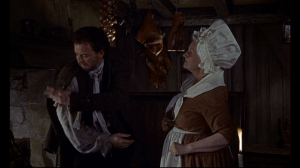
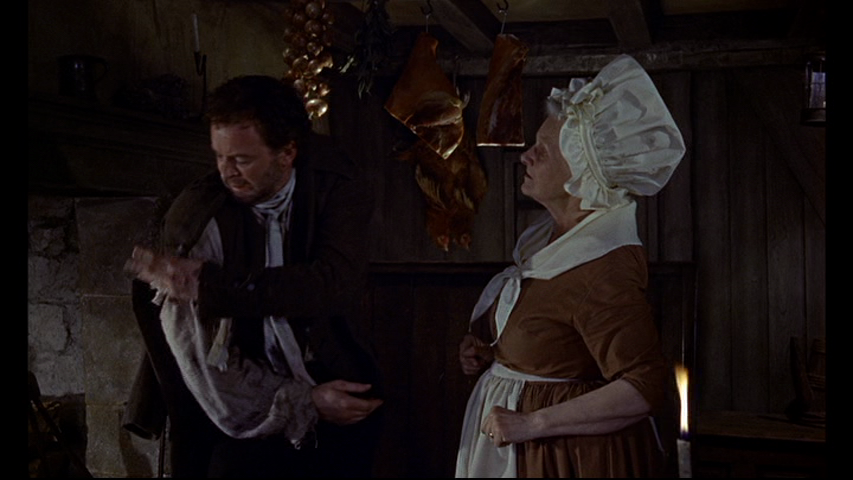
At the advice of Mother Hathaway, Simon Bates goes to find Dr. Syn, the vicar, for help and sanctuary

At the advice of Mother Hathaway, Simon Bates goes to find Dr. Syn, the vicar, for help and sanctuary

The bishop’s carriage is stopped by a small group of the King’s soldiers, who tell the passengers that they’re looking for an American prisoner who preached treason and was to be hanged in Dover, but escaped. The man the bishop gave a ride to is, in fact, the prisoner, who makes a run for it after stealing General Pugh’s plans to destroy the smugglers. The King’s soldiers give chase, shooting the man in the shoulder, but he hides in the bushes and eludes them. The prisoner makes his way to Mother Hathaway’s inn, and she helps by sending him to someone who can help him: the vicar of Dymchurch, Dr. Syn. She sings Syn’s praises to convince him to go, and the prisoner heads on his way.

Dr. Syn sits in his office with his assistant, Mr. Mipps, who questions Syn’s motives, claiming that since the town doesn’t know he’s the Scarecrow, they don’t thank him for it. Syn is just content that the people can live and support their families with what he can provide, thanks to his smuggling. Suddenly there’s a knock at his door – the prisoner has arrived, telling Syn that Mother Hathaway sent him. The prisoner introduces himself as Simon Bates, explains that he’s been sentenced to death for preaching sedition, and asks for sanctuary. Syn wants to help, but knows that they’ll both be in danger if Bates stays, so he has Mipps take Bates to Mrs. Waggett’s inn. Before he leaves, Bates hands over General Pugh’s papers to Syn, saying that he’s heard about the Scarecrow, and that the papers concern him. Syn takes the papers, and finds that troops are to be dispatched to his area to hunt the Scarecrow through any means necessary.
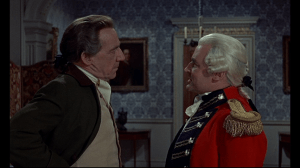
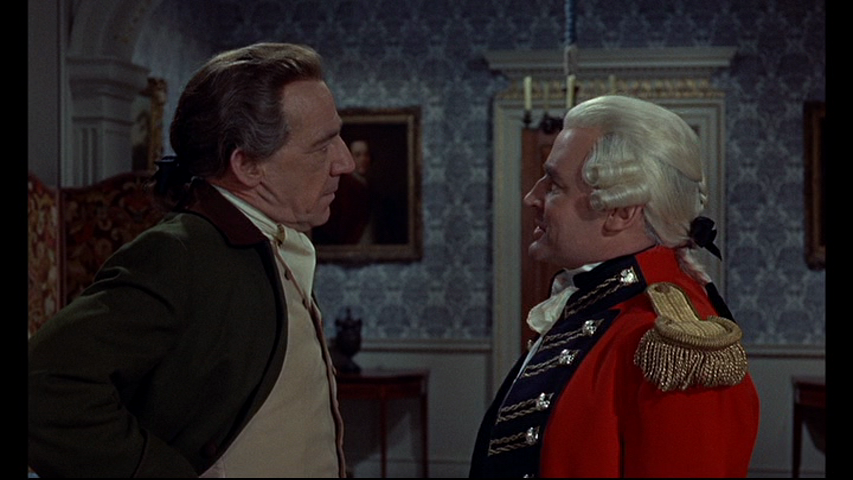
General Pugh (R) and Squire Banks do not see eye to eye, particularly with Pugh's suggested violent methods

General Pugh (R) and Squire Banks do not see eye to eye, particularly with Pugh’s suggested violent methods

The next day, General Pugh meets with wealthy landowner Thomas Banks and Dr. Syn, with Pugh furious that these crimes keep happening in Dymchurch where Banks is the Justice of the Peace. Banks and Pugh do not get along, and Pugh declares that he will use any means necessary to eradicate the Scarecrow. Just then John Banks, Thomas’s son and Syn’s secret accomplice, appears, asking just what means Pugh intends to use. Pugh then claims that he may even target the women of the town, as the “women will talk when they start to lose their menfolk.” When Pugh mentions that the men of the town will be press-ganged into the armed forces, particularly the Navy, Thomas Banks storms out of the room; John then informs Pugh that his brother was press-ganged into the Navy.

As the press gang marches into town, the leader remarks that although Dymchurch is known as good farming country, no man is seen working on his land, even though it’s a Wednesday, a normal workday. They head to the church, where everyone is town is gathered. Mr. Mipps, who has been on the lookout, runs down the watchtower and slips the news to Syn under the pretense of singing the hymn. Syn then begins his sermon, telling the congregation that this mid-week sermon marks the two-day public holiday granted by Banks in honor of the King’s birthday. Just then, one of the Scarecrow’s accomplices runs into the church and throws a note wrapped around a knife at the psalm board. Syn reads the note that has been sent by the Scarecrow, ordering every able-bodied man to leave town immediately and hide in the marshes as the naval press-gang is on its way to take every man they can find. The moment he finishes reading, all of the men flee from the church and run into hiding. When the press gang arrives at the church, they are confused about why there are only women, children, and the elderly in the pews. They harass the members of the church, and when Banks demands that they stop, the leader informs him that they have a free hand with this charge, with orders from Pugh himself, then demands information about the Scarecrow. When Syn reveals that he knows who the leader is – Petty Officer Stubbard – Stubbard smugly informs Syn that he’ll be “dropping anchor” in the town for a while. Syn then sends Mipps to follow the men and keep his eyes on them.
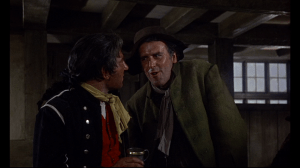
Mr. Mipps, in disguise, pretends that he can help the press-gang capture the Scarecrow

Mr. Mipps, in disguise, pretends that he can help the press-gang capture the Scarecrow

The press gang decides to stay in an inn known as The Silent Woman, run by Mrs. Waggett, who is less than thrilled about their antics. When Stubbard gets fresh with her, she threatens him with a cleaver, and the gang then leaves her alone. As a disguised Mipps drops in and tells Stubbard that there are no able-bodied men in Dymchruch, a young man bursts in frantically, asking Waggett for help as his wife has just gone into labor. The press gang decides to capture the young man and take him. Mrs. Waggett is horrified, but Mipps tells her quietly to leave it to him and to go to the young man’s wife. Mipps pretends that he wants to help the press gang catch the Scarecrow, and lets them know where the Scarecrow will be Thursday. Syn is not thrilled when he finds out about Mipps’ plan to ambush the soldiers, but they still plan to meet Thursday evening, with Syn quickly forming a new plan.

When Thursday night comes, the press gang lies in wait and is surprised and captured by the Scarecrow and his men. The Scarecrow orders the gang blindfolded, and they are taken to a nearby barn, where a young boy is set free to send a letter to General Pugh, while the other men are held captive. Pugh reads the letter and is furious, claiming that if any of the men from the press gang are killed, he’ll hang triple the number of  Dymchurch men. Suddenly, Pugh agrees to make an exchange, but has a plan to catch the Scarecrow. As Scarecrow prepares for the exchange, Mipps appears with Simon Bates, who offered his help after he overheard Mipps’ conversation at the inn. Although initially angry, the Scarecrow decides to accept Bates’ help. As Pugh waits with his men on Smuggler’s Beach, the soldier Brackenbury doesn’t react well to Pugh’s unnecessary violence, ordering that the prisoner be untied. The Scarecrow arrives, with the young man let go, and Pugh’s men ready to attack. Pugh doesn’t know that the Scarecrow’s men are ready to retaliate with smoke bombs, rendering Pugh’s men helpless. When Pugh’s men bring aboard the supposed contraband the Scarecrow was after, they are surprised to see that it is actually the press gang, tied up and placed in barrels. They hear the Scarecrow’s cackle before he rides away.
January 3

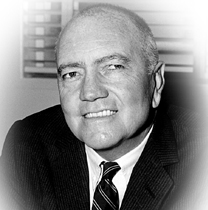
January 3, 1916 – Artist, Director, and Producer Louis “Lou” Debney is Born

Louis Debney as the associate producer for an episode of the Wonderful World of Color

Lou Debney as the associate producer for an episode of the Wonderful World of Color

“I stayed with the Cutting Department…it was then, while we were getting started on the preliminary story sketches and everything…that I was set up to be the man that would assemble all the tests from all the sequences in Snow White.”

On January 3, 1916, Louis Debney was born in Los Angeles, California. At the age of 18, Debney was hired by Disney to work in the Cutting Department, then located at the Hyperion Studio. Debney then became an assistant director on the first full-length feature Snow White and the Seven Dwarfs, with Ben Sharpsteen. With Sharpsteen’s assistance, Debney worked on the last black and white short film, Two-Gun Mickey, released in 1934. Debney continued to assist in directing several features and short films before becoming a producer for The Mickey Mouse Club and Zorro, and a production coordinator on the Disney anthology series, including The Wonderful World of Disney. Debney passed away at the age of 70 on April 11, 1986.

December 17

December 17, 1961 – The Walt Disney’s Wonderful World of Color Episode “Backstage Party” Premieres

vlcsnap-2012-12-16-17h29m40s219

“Oh, the party hasn’t started yet. By the way, folks, these are some of the babes from Babes in Toyland.

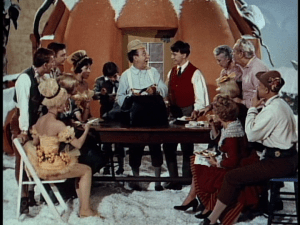
On December 17, 1961, the episode “Backstage Party” from the Disney anthology series Walt Disney’s Wonderful World of Color premiered on television. The episode takes viewers backstage at the Disney Studios, to the celebration of the completion of the upcoming feature film Babes in Toyland, starring Annette Funicello and Tommy Sands. The episode was directed by Jack Donohue and Hamilton S. Luske, with teleplay by Larry Clemmons.

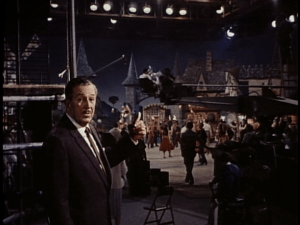
The episode begins with the audience at the front gate, receiving directions to Stage Four, where the party is held. Unfortunately, there are many twists and turns on the way there; the audience progresses through a set with lavish homes, an Old West setting, then the set for the Zorro series, and finally finds Stage Four. Walt greets the audience warmly, and brings them inside to see some of the Babes in Toyland sets. He shows a set with an accompanying film scene, and explains how the set was invented to destroy itself. Moving to another set, Walt explains the music of Babes in Toyland, which was based on Victor Herbert’s original operetta from 1903. After a scene with music, a toy soldier directs the audience to where Walt has gone: to the Forest of No Return. Walt then explains how every piece in the forest was made for the film, including all the rocks and trees. A tree lets Walt know it’s time to head to Stage Two for the shooting of the final scene, and Walt brings us along.

On Stage Two, Walt begins to point out all the important people behind the scenes of filming

On Stage Two, Walt begins to point out all the important people behind the scenes of filming

On Stage Two, Walt points out the important people, from the director, to a stagehand in the rafters who is about to retire, to the actors waiting to shoot the scene. They then shoot the gypsy scene from the film, with Walt and the child actors watching. When the scene is shot, the party begins. A giant cake is brought to the set, along with other tables of food. Walt explains that the backstage party is very democratic – everyone celebrates the wrap of the film together. Annette Funicello comes over to Walt and offers him a glass of lemonade. Walt introduces Annette as Mary Quite Contrary, and Tommy Sands, who plays her romantic interest, Tom the Piper’s Son. Walt then asks Annette to play the hostess while he goes to do some chores. Annette introduces us to Ray Bolger (best known as the Scarecrow in MGM’s The Wizard of Oz), and asks him to perform the old soft-shoe dance he’s well known for: Ida. Many members of the cast and crew begin to dance in the background, although Bolger claims that he’s the “only one in the world who can perform the dance.” He introduces his character in the film as the villain, Barnaby, and Annette introduces Henry Calvin and Gene Sheldon, who play Barnaby’s henchmen, Gonzorgo and Roderigo.

Ed Wynn (C) begins to entertain the various cast and crew members with props

Ed Wynn (C) begins to entertain the various cast and crew members with props

Annette also introduces Ed Wynn, whom she calls “one of the all-time greats of show business.” Wynn entertains the crowd, pulling props from his bag and presenting accompanying jokes. Tommy Kirk (Grumio in the film) presents Wynn with a statue called a “Mousecar,” the Disney version of an Oscar. Annette then introduces Tommy Sands, and many members of the band that are having a jam session on the set. Sands begins to play the bongo drums, much to the amusement of the cast and crew, and sings “Jeepers Creepers.” He introduces Ann Jillian, who serenades the crowd with Henry Calvin. After their song, Annette points out the choreographer, Tommy Mahoney. After a small dance routine, the director Jack Donohue is brought to the middle of the set for a surprise. The whole cast and crew serenade him about the filming experience, then present him with a “jack-in-the-box,” with the model of his own head popping out from the box. The episode ends with one more song about the end of filming.