RSS Feed

Tag Archives: 1950s

June 12

June 12, 1957 – The Monsanto House of the Future Attraction Opens in Disneyland’s Tomorrowland

vlcsnap-2014-06-12-19h28m01s154

“The Home of the Future was always a great one. You’d go in and see all the things that you wondered why you didn’t have them in your home.” – Dick Cook, Former Chairman of the Walt Disney Studios

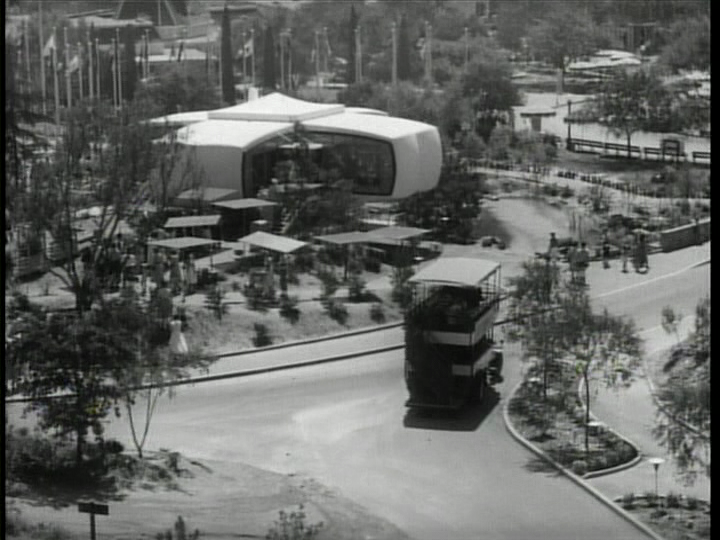
On June 12, 1957, the Monsanto House of the Future attraction opened in Disneyland’s Tomorrowland. Like many attractions at this time, it was meant to be a view of the future; it was built with plastic, and featured many appliances and furniture pieces that were uncommon in homes at the time. In 1967, like many pieces of Tomorrowland, the house began to look dated thanks to advances in technology at the time, and was scheduled to be torn down. However, the house was so well built that it wasn’t able to be destroyed in the regular fashion, as the wrecking ball just bounced off the house; crews had to take the place apart piece by piece. The home was completely demolished by December of 1967.

June 9

Posted on

June 9, 1950 – The Pluto Short Film Puss-Café is Released to Theaters

vlcsnap-2014-06-09-18h54m35s16

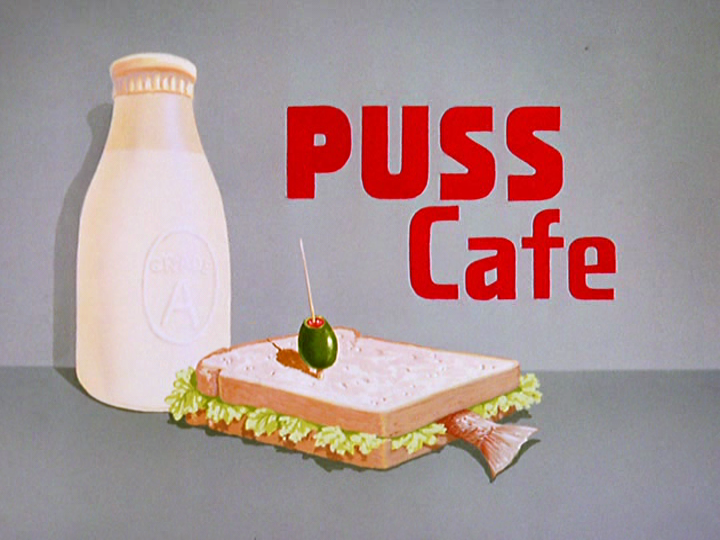
On June 9, 1950, the Pluto short film Puss-Café was released to theaters. It was directed by Charles Nichols, with story by Dick Kinney and Milt Schaffer.

A cat is walking past a fence, when he smells something nice. Ignoring the “beware of dog” sign, he races across town to pick up his bigger, dimwitted feline friend, and the two hurry back to the house, where the first cat points out the three bottles of milk on the porch, the plentiful amount of birds in the birdhouse, and the fish leaping happily in the pond. The bigger cat points out that the owner of the house has a dog, but the first cat doesn’t care, as the welcome mat is laid out in front. The two head over to the milk, but as they open the bottle, Pluto wakes up from his nap in the hammock. When he spots the cats drinking the milk, he leaps after them, but they narrowly escape. With a snort, Pluto locks the door to the yard, then hops back into his hammock.

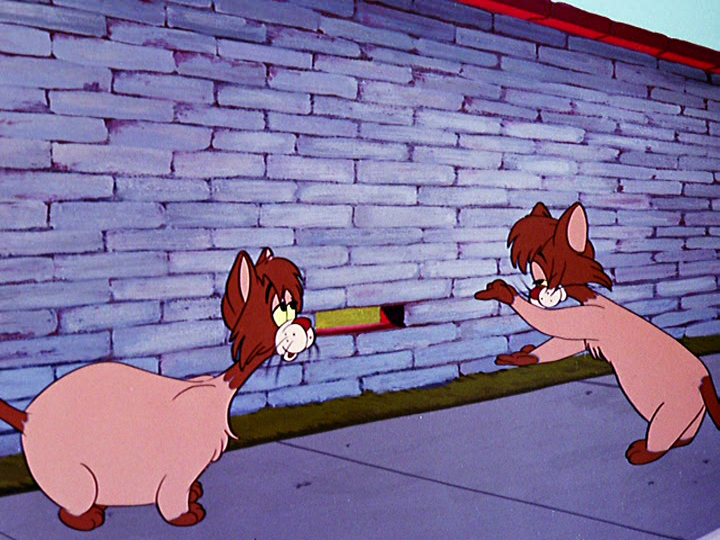
The cats break in a second time through a loose brick in the wall

The cats break in a second time through a loose brick in the wall

As Pluto is snoozing, the cats break back in through a loose brick in the wall, and quietly make their way to the birdhouse. As they get inside the birdhouse, the two begin to fight after the bigger cat accidentally grabs the smaller cat, thinking he was a bird. The two are kicked out by a bird and fall into the hammock, where Pluto begins to fight. Once again, the two are able to escape, just barely. They sneak back in a third time, this time to go after the fish, but they first catapult Pluto from the hammock across town. Pluto ends up catching the two, and they quickly run from the house. Pluto chases them to their hideout, where a third, bigger cat is waiting to beat up Pluto. Pluto flees, and the three cats go back inside their garbage can hideout.

June 8

Posted on

June 8, 1956 – The Donald Duck Short Film How to Have an Accident in the Home Premieres

vlcsnap-2014-06-08-18h29m00s12

“My middle name is Jonah, and Jinx is in there, too. Hoodoo fits me like a glove, but Fate’s my name to you.”

On June 8, 1956, the Donald Duck short film How to Have an Accident in the Home was released. This is the first in a string of education films starring Donald that ran through the late ’50s and early ’60s, and was filmed in Cinemascope. It was directed by C. August Nichols, with story by Jack Kinney and Bill Berg.

The short opens with an introduction by J.J. Fate, who shows off an average neighborhood, and an average citizen who lives there (Donald). Donald, however, encounters several troubles on his way home, including being chased by a streetcar and nearly getting hit with a falling piano. Donald thinks he is safe at home, but Fate reminds the audience that nearly 5 million people suffered injury due to accidents in the home in the past year, and is angry that they all blame him. He shows Donald recklessly using a rocking chair to stand on while hanging a picture, with Donald leaving holes in the wall and falling off the chair. Fate then takes a tour of Donald’s accident-filled house, with cluttered stairs, tangles of wires, several lit cigarettes and pipes, and an iron left on and burning a hole through the ironing board. Due to a leaky pipe letting out gas, when Donald attempts to light his pipe, the house explodes.

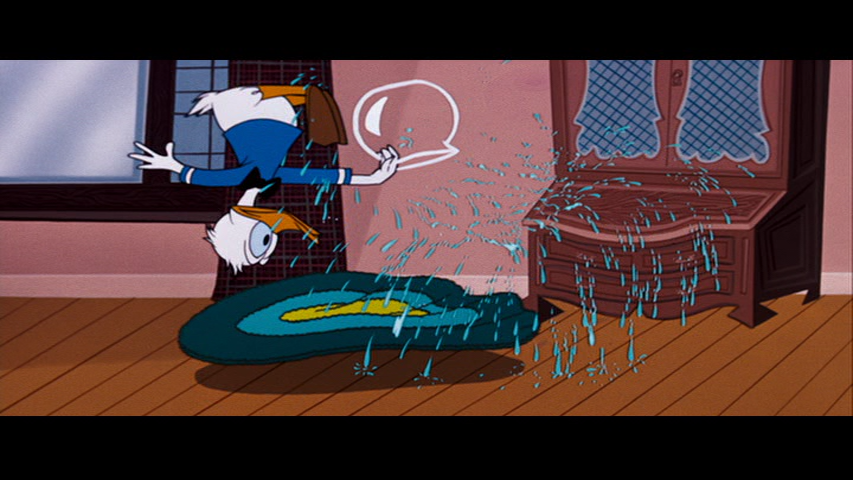
Donald trips on a misplaced throw rug, spilling water from a full fishbowl and literally landing in trouble

Donald trips on a misplaced throw rug, spilling water from a full fishbowl and literally landing in trouble

The next example Fate shows is Donald carrying a full fishbowl and slipping on a throw rug. Fate slows the fall down on the instant replay, and shows each misstep Donald takes to land on the ground with the fishbowl on his head. The next example is Donald in the bathroom, where he slips on soap, gets burned on a vent, and electrocutes himself using his electric razor in the bathtub. Fate explains that, while Donald is an upstanding, average citizen, he takes several chances in his home that should be avoided for safety’s sake. One example is an overloaded circuit with frayed wires, and another is sticking his head in the oven when cooking with gas. Donald continues to have accident after accident, including falling down the stairs in several different ways. Finally, after one nasty fall, Donald decides to clean up his act – literally. He then goes to work, “where it’s safe,” he proclaims, only to have the audience find that he works at the Surefire Dynamite Company. In the end, Fate warns the audience not to blame him for their carelessness.

May 30

Posted on

May 30, 1953 – The Donald Duck Short Film Don’s Fountain of Youth is Released to Theaters

vlcsnap-2014-05-30-18h42m41s0

“Oh no! Uncle Donald’s a baby again!”

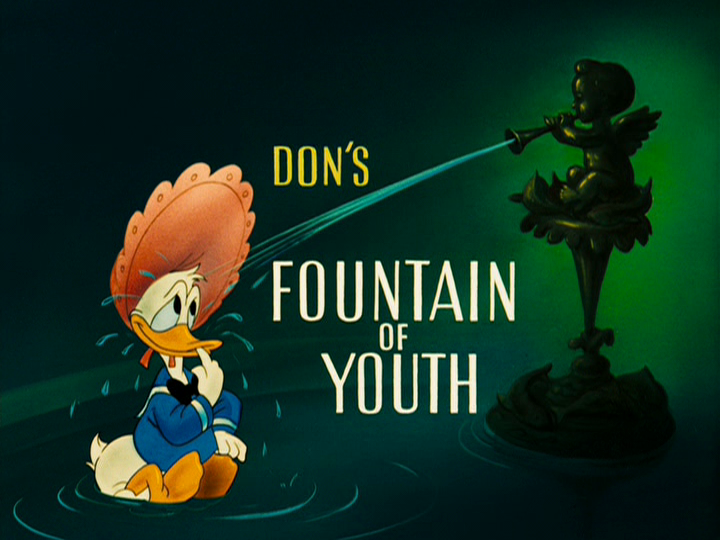
On May 30, 1953, the Donald Duck short film Don’s Fountain of Youth was released to theaters. It was directed by Jack Hannah, with story by Ralph Wright.

Donald is taking the nephews through a tour of the Florida everglades. He is angered that all the boys want to do is read comics, ignoring the scenery around them, but they throw a tantrum when Donald takes their comic book away. Donald then notices that the car is overheating, and rushes to get some water from a nearby spring. As he grabs the water, he notices a nearby sign stating: “This spring was mistaken for the Fountain of Youth by Ponce de Leon 1512.” He gets an idea to play a prank on the boys, and rips off half of the sign, leaving it marking the spring as the Fountain of Youth. Donald then sits in the spring, and pretends to have regressed back to a baby. The boys are dismayed at this, and start calling their uncle a spoiled brat. Upping the ante, Donald grabs an egg from a nearby alligator, and hides in the woods, watching the boys think he’s returned to an egg. The boys cry over their “misfortune.” The alligator wakes up and, spying its missing egg, starts chasing the boys, who frantically try to save their “Uncle Donald.”

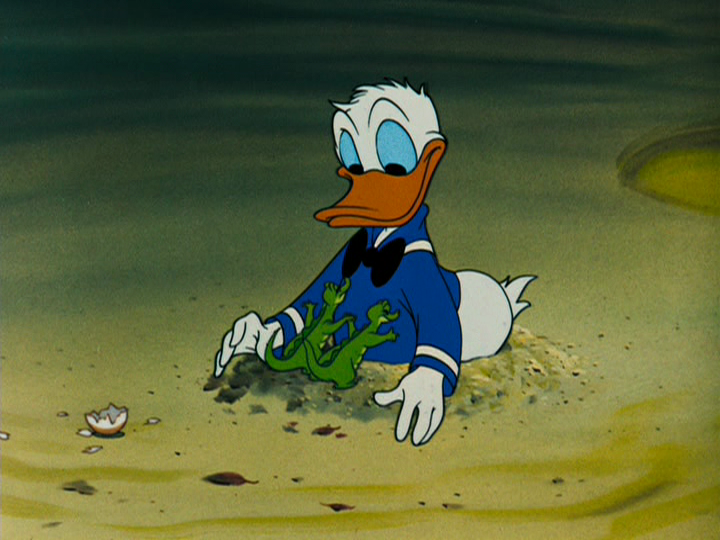
The alligator hatchlings mistakenly think that Donald is their mother, much to Donald's dismay

The alligator hatchlings mistakenly think that Donald is their mother, much to Donald’s dismay

Donald has been knocked out by the alligator’s tail, and lands on her nest, warming her remaining egg. The egg the boys were protecting is knocked from their hands and lands in front of Donald, and both eggs hatch simultaneously. Thinking Donald is their mother, the hatchlings cling to him, although he tries to get away from them. The alligator hears her babies’ cries and starts chasing Donald instead. He manages to escape her by climbing up a tree, which she soon chops down with her teeth. Donald lands on the ground and collapses, and the boys, mourning their uncle, are relieved to find him alive and back to his old self. Donald quickly gathers his nephews and makes a break for it, leaving behind two very heartbroken hatchlings. Fortunately, they find their mother, who calls them close by imitating Donald’s voice.

May 28

Posted on

May 28, 1953 – The Special Short Film Adventures in Music: Melody is Released to Theaters

vlcsnap-2014-05-28-19h24m12s42

“Today’s lesson will be about something we really can’t do without.”

On May 28, 1953, the special short film Adventures in Music: Melody was released to theaters. This was to be the first in a series featuring the character Professor Owl teaching his students about principles of music, but only one other short was made (Toot, Whistle, Plunk, and Boom); the character would become best known for beginning the Disney Sing-A-Long videos. Melody was also the first cartoon filmed in 3D, and was shown in Disneyland’s Fantasyland Theater as a part of the 3D Jamboree, an attraction that remained fairly popular at the park, although 3D films didn’t really catch on in regular theaters. The short was directed by C. August Nichols and Ward Kimball, with story by Dick Huemer.

All the young birds gather at the school birdhouse, where Professor Owl is waiting to take attendance. He then declares that the lesson for the day will be “melody,” much to the enjoyment of the students. He directs them to the melody of nature, including the bird, the cricket, and the willow tree. He also says that there are only two creatures on earth that can sing: birds, and humans. Using a chart, Professor Owl points out the melodies in each stage of a person’s life. He changes the topic soon after to inspiration, with Suzy Sparrow drawing inspiration from love. Penelope Pinfeather sings her song, inspired by the ocean. Another student sings about trains, while another one sings about cowboys. The Canary Sisters sing a song about motherhood, before the class sings a song all about their inspirations. In conclusion, Professor Owl points out that “beautiful symphonies are often created from simple melodies,” and the short ends with an experimental look at music, featuring the beginning piece, “The Bird and the Cricket and the Willow Tree.”

May 16

Posted on

May 16, 1952 – The Goofy Short Film Two-Gun Goofy is Released to Theaters

vlcsnap-2014-05-16-20h16m59s255

“Oh, I’m a-ropin’ and a-ridin’ and a-shootin’ fool, oh I’m as tough and ornery, meaner than a rawhide mule, oh I’m as quick as greasy lightnin’ when I go for my gun. Reach, you mangy buzzards, reach for the sun!”

On May 16, 1952, the Goofy short film Two-Gun Goofy was released to theaters. It was directed by Jack Kinney, with story by Brice Mack and Dan MacManus.

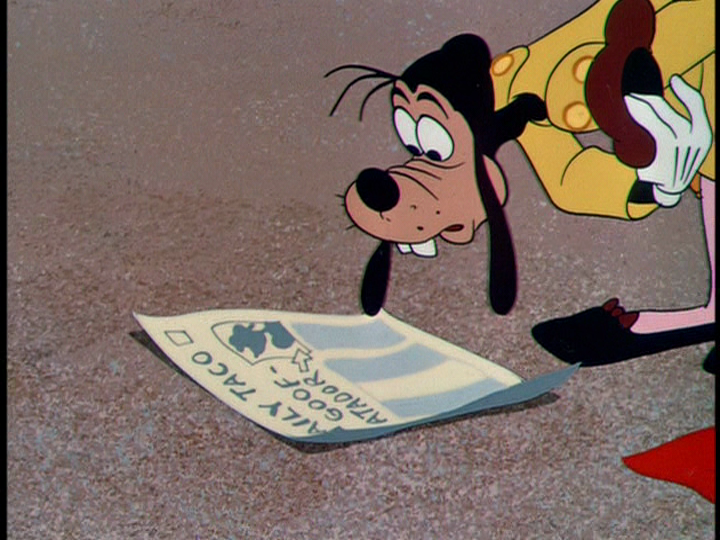
In the old west, the townsfolk are terrorized by Pistol Pete, who rides in and quickly robs the bank before shooting up the town. Meanwhile, Goofy rides through the desert, when he encounters a wanted poster for Pete, with a reward of $10,000, dead or alive. Goofy talks to the poster, claiming he’d get the jump on Pete if he were real. Soon, he encounters Pete robbing a coach, and stops Pete without even realizing it. The members of the coach spread the news of Goofy’s heroic dead, and as Pete races for the town, the folks count on Goofy to win against the villain. Once again, Goofy is able to knock Pete down without being fully aware, but when he realizes that the real Pete is right in front of him, he tries to hide. Mesmerized once again by the woman from the coach, Goofy’s attention is fixed solely on her, and Pete’s attempts to thwart him go unnoticed by the lovesick cowboy. The undertaker gives Pete a large stick of dynamite to destroy Goofy, and Pete sticks it in Goofy’s pants. As Pete tries to get away from the dynamite, he realizes that the only safe place is the jail, where he locks himself in and throws away the key. Goofy is then named the new sheriff of the town, and the short ends when Goofy receives a rather “explosive” kiss from his dream girl from the coach.

May 9

Posted on

May 9, 1953 – The Goofy Short Film For Whom the Bulls Toil is Released to Theaters

vlcsnap-2014-05-09-19h47m23s178

“The bull fight, with its excitement, its pageantry, its color, its enthusiastic fans!”

On May 9, 1953, the Goofy short film For Whom the Bulls Toil was released to theaters. The soundtrack for the short was provided by popular Mexican virtuoso trumpeter, Rafael Méndez. The short is also known for its design by Eyvind Earle, who would go on to great renown in the Disney world as the designer for the film Sleeping Beauty, in addition to being a world renowned artist. The short was directed by Jack Kinney, with story by Brice Mack and Dick Kinney.

The short opens at a Mexican bull fight, with the crowd already cheering joyfully. Meanwhile, Goofy is traveling through Mexico in his jalopy, when he has to stop due to a bull sitting in the middle of the road. Goofy tries to drive the bull off the road, much to the amusement of the Mexican villagers. When Goofy pulls out a red handkerchief to wipe his brow, the bull starts to charge, but Goofy is able to avoid the bull without realizing. The bull continues to charge, but Goofy is oblivious to the near misses he encounters. The crowd cheers Goofy for his matador-like prowess, but Goofy once again doesn’t acknowledge the situation as he drives away. The news of Goofy’s triumph is sent through the country, and Goofy is met with cheering crowds, who quickly grab him and dress him up like a matador.

Thanks to an errant newspaper, Goofy finally understands why he's in the arena in a matador costume

Thanks to an errant newspaper, Goofy finally understands why he’s in the arena in a matador costume

Goofy is taken to the arena, where the crowds are waiting with great excitement. A newspaper falls in front of Goofy’s face, and he finally realizes that he’s not in a Halloween costume, but has to actually fight the bulls. He panics, and as he tries to flee, he ends up in the bull’s pen. He runs out with the bull chasing him, and hides behind a wooden board. He holds on for dear life to the board, now affixed to the bull’s head thanks to its horns getting caught, as the bull rushes around the arena. The bull gets caught on Goofy’s suspenders, and sends Goofy flying around the arena. Goofy tries to get in his car and drive away, but the caught suspenders pull him back, sending him flying into the arena with such force that it physically moves it. When the dust settles, the bull has been knocked out, and Goofy is proclaimed a heroic matador. When Goofy heads home, he tries to sneak past what he thinks is a bull on the road, as he now is terrified of them.

April 28

April 28, 1950 – The Donald Duck Short Film Trailer Horn is Released to Theaters

vlcsnap-2014-04-28-04h17m04s145

“Ah ha! Wake me up, will ya?”

On April 28, 1950, the Donald Duck short film Trailer Horn was released to theaters. It was directed by Jack Hannah, with story by Roy Williams.

Dawn is rising over the forest, and Chip and Dale are sound asleep in their tree, until the sunshine wakes up Chip. Chip runs around outside, skipping at leaping about, when he sees some strange footprints outside. He calls out for Dale, who doesn’t believe that Chip has found some large footprints. They follow the prints to a trailer, and see Donald sound asleep in his bed. Chip then hears a strange noise, and sees Dale jumping up on the car’s horn like it’s a trampoline. The honking wakes Donald, and he grabs Dale. Chip saves Dale by biting Donald’s foot, and an angry Donald goes back into his trailer. The chipmunks laugh at the incident, and soon see Donald leaving the trailer in a bathing suit.

Donald corners the chipmunks after they start toying with him and the diving board

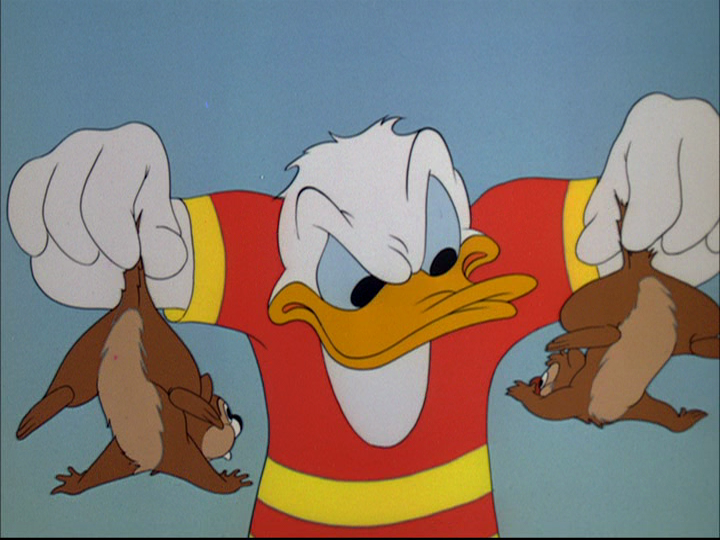
Donald corners the chipmunks after they start toying with him and the diving board

Donald sets up a diving board, and attempts to dive into the nearby lake, when the chipmunks push the diving board forward. Donald lands face-first onto the board, and looks around, confused. He attempts to jump again, when the chipmunks push the board around so that Donald will dive right into his trailer than the lake. After wrecking his trailer, Donald steps out to see the chipmunks laughing, and catches them. He shoves them into his car’s horn and honks it a few times, then throws them into a pie and throws the pie at a tree. Donald laughs and returns to his trailer. Chip, wanting revenge, decides to throw a pine cone into Donald’s cup of coffee, then uses more pine cones to destroy Donald’s breakfast. Donald then uses his car to try and knock them out of the pine tree. He corners them with driving the car onto the tree, but when the chipmunks step off, the tree gives Donald and his car the slingshot effect, sending them flying into a nearby ledge. Donald walks away in a daze, thinking he’s still driving.

April 27

April 27, 1956 – The Humphrey the Bear Short Film Hooked Bear is Released to Theaters
vlcsnap-2014-04-27-11h15m14s160

“Give me that! Now, go fish like a bear!”

On April 27, 1956, the Humphrey the Bear short film Hooked Bear was released to theaters. This was the first of two shorts in Humphrey’s own series; his run unfortunately ended when short films were discontinued in 1965. It was directed by Jack Hannah, with story by Al Bertino and Dave Detiege.

Ranger Woodlore steps out excitedly from his cabin, as the fishing season has begun and the lake is full of happy fishermen. Humphrey the Bear is also fishing, but not as well as those with fishing equipment. Seeing their success, Humphrey runs off to the fish hatchery and grabs all the equipment he can find. Woodlore, who had been measuring the size of the catches to keep the visitors happy, realizes that the lake is running out of fish, and quickly makes his way back to the hatchery. He comes across Humphrey with the stolen gear, and orders Humphrey to go back and “fish like a bear.” He enters the hatchery and fills up a trough with water, and places rainbow trout eggs in the trough. The fish sprout up like weeds, and Woodlore releases the fish into the lake.
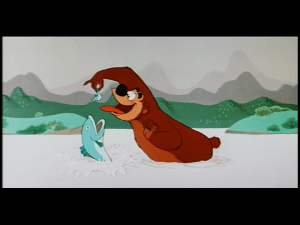
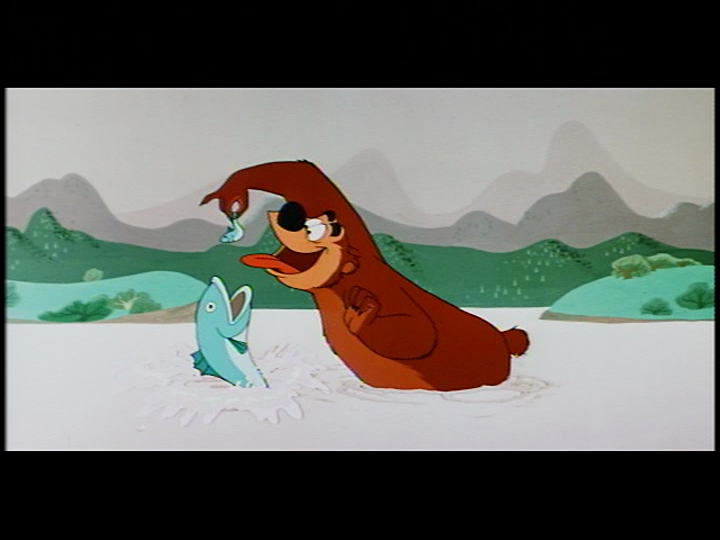
Humphrey finally catches a fish, but it is almost gobbled up by a bigger fish

Humphrey finally catches a fish, but it is almost gobbled up by a bigger fish

Humphrey finally catches a tiny fish, but it is soon eaten by a larger fish. Although he manages to retrieve his tiny catch, he realizes after he let the larger fish go that he can use the tiny fish to catch the bigger fish. His plan works, and he is soon holding two armfuls of fish. When Woodlore comes back to drop in more fish, Humphrey gets overly excited and drops his entire catch, realizing too late what he’d done. He starts to sob, but starts his plan again, until Woodlore makes him drop the small fish because it was “too small.” As Humphrey walks underwater gathering his catches again, he spies a huge fish and tries to catch it, only to find that it was a child’s toy. Desperate, he takes the rudder from a child’s toy ship and ties it to his head, making it appear to the fisherman that there’s a shark in the water. As the fishermen flee, Humphrey starts gathering all of their caught fish.

Humphrey runs across Woodlore again and hides the fish in a nearby container. When he sees Woodlore dumping more fish into the container, he is excited, and drops himself into the container when Woodlore is not looking – not realizing that the “container” is actually a small plane that will air-drop the fish into the lake. Humphrey hangs on to the plane for dear life, but when he sees more fish drop, he tries to catch them, and falls into the lake. Woodlore gets a phone call from the Chief, who informs him that fishing season ended the day before, and Woodlore quickly sends the fisherman packing. Woodlore tells Humphrey that fishing season is over, leaving Humphrey with no fish. He then reveals that hunting season has started, and Humphrey runs around the park, dodging bullets every which way.
March 5

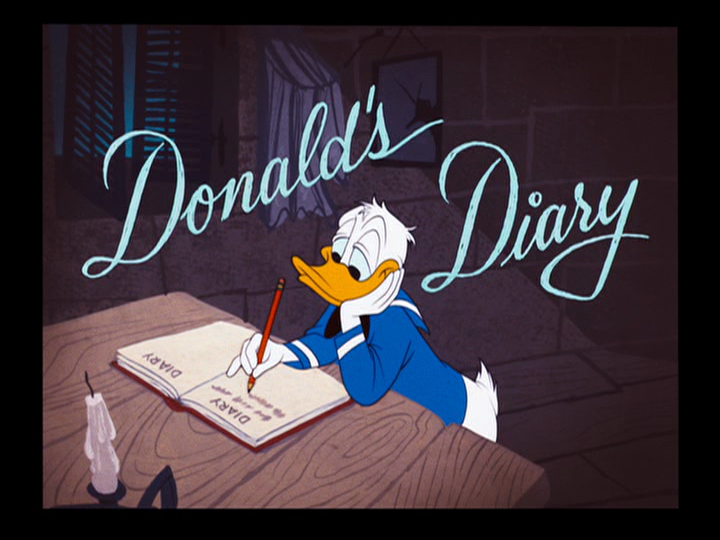
March 5, 1954 – The Donald Duck Short Film Donald’s Diary is Released to Theaters

vlcsnap-2014-03-04-19h03m55s129

“This morning was much like any other morning, and when I took my usual walk, I had no idea that on this day I was destined to find the girl of my dreams.”

On March 5, 1954 , the Donald Duck short film Donald’s Diary was released to theaters. It was directed by Jack Kinney, with story by Brice Mack and Dick Kinney.

The story begins on February 29th, with Donald putting another entry in his diary. He talks about beginning his day, not knowing that this would be the day he would meet the girl of his dreams – who happens to be sitting in her parlor reading “How to Catch a Husband.” Daisy spies him walking, and quickly changes into something more alluring. She steps outside and drops her handkerchief, but Donald, oblivious to her presence, just steps on it and turns a corner. Daisy tries again and again to get his attention, but to no avail, until she ends up tying him up in a tree. The two end up dating in a quick courtship, and he is soon invited to meet her family, which consists of less than ideal relatives. Finally, Donald believes it to be the day to ask Daisy to marry him, and arrives at her house.

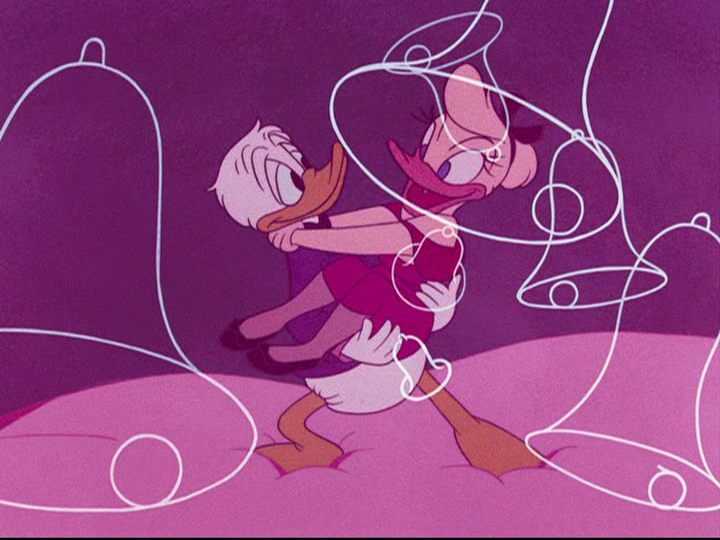
While waiting for Daisy, Donald dreams of what their married life would be like

While waiting for Daisy, Donald dreams of what their married life would be like

He waits hours for Daisy to be ready, and falls asleep in the process. He dreams of her saying yes, and their ensuing wedding. They take a honeymoon, unfortunately with her brothers, and is soon angry that her engagement ring is rather small. As they move into their dream cottage, Donald realizes that her whole family has moved in with them. When he wakes up the next morning, he is shocked to see Daisy has let herself go so quickly. He arrives home from work, and as he greets his wife, she takes his wallet and all of his cash, and burns dinner. Her family then arrives and eats all of the dinner, leaving nothing for him. He realizes that marriage is not for him, feeling that he’d lose his identity. He wakes up from his nightmare and flees her house as fast as he can. He then finishes his diary entry, which reveals that he ran away to join the French Foreign Legion.