RSS Feed

Tag Archives: 1940s

December 5

December 5, 1941 – The Donald Duck Short Film Chef Donald is Released to Theaters
vlcsnap-2014-12-05-18h06m15s59

“Cooking is as simple as A, B, C, with a Mother Mallard’s recipe!”

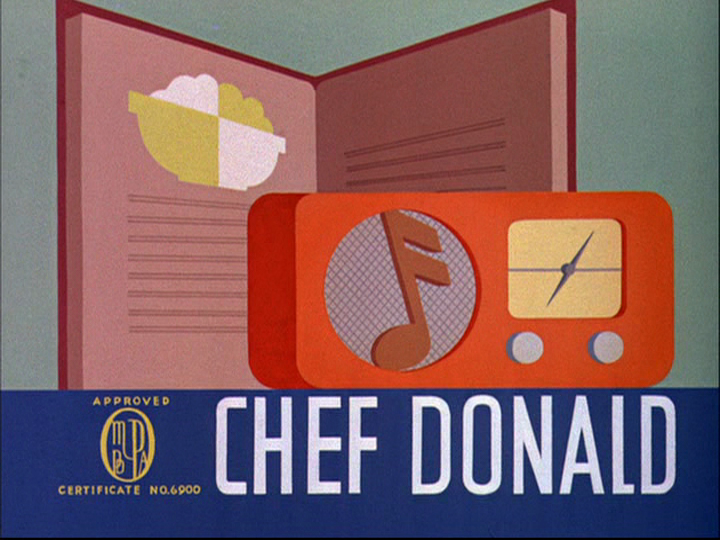
On December 5, 1941, the Donald Duck short film Chef Donald was released to theaters. It was directed by Jack King.

Donald is listening to the radio while adding pages to his cooking scrapbook with rubber cement, accidentally adding a recipe for roast duck. He removes it before his favorite cooking show starts, and he hears the recipe for the day: waffles. Hungry, Donald quickly sets aside the rubber cement and gets ready to cook. As he goes to add the baking powder, he accidentally adds the rubber cement. When he tries to add the batter into his waffle iron, the batter refuses to leave the bowl. He then gets the bowl and mixing spoon stuck to the iron, and as he tries to unstick them, he knocks over his ironing board, and the iron presses his chef’s hat flat. Once again, he tries to mix the batter, but the strength of the batter and the amount of turns he gave it with his spoon give the spoon a propeller effect, and the bowl chases Donald around the room. The bowl catches the cord of the waffle iron and takes it for a spin before wrapping it around Donald. After the bowl finishes flying, Donald angrily attacks the batter, and gets his head stuck in the bowl. As he wriggles around, he ends up getting his tail stick in the waffle iron, cooking his tail instead. Still unaware of his mistake, Donald uses desperate measures to separate the batter from the bowl, using an axe and various other tools. The axe bounces off the batter and sends Donald flying up to the ceiling, where the hit of the axe creates a crack that travels through the entire house, and goes far enough to send the bowl flying at Donald’s head. Donald tries throwing the batter out the door, only to have the batter get caught on the doorknob and flying back in, trapping Donald in a web of batter. Angry, Donald decides to go to the radio station and let his temper get the best of him.
November 26

November 26, 1943 – The Donald Duck Short Film Home Defense is Released to Theaters

vlcsnap-2014-11-26-15h12m55s193

“Hey, you! Attention! Display your chevrons! Surrender your weapons, gentlemen! You’re a disgrace to the service!”

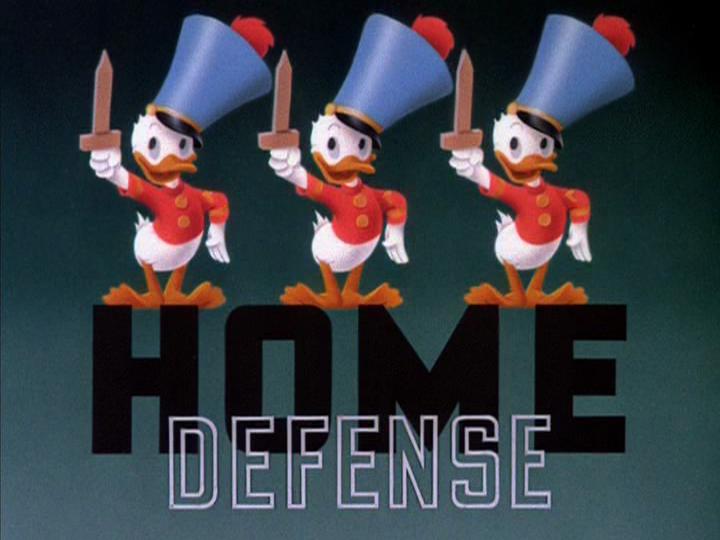
On November 26, 1943, the Donald Duck short film Home Defense was released to theaters. It was directed by Jack King.

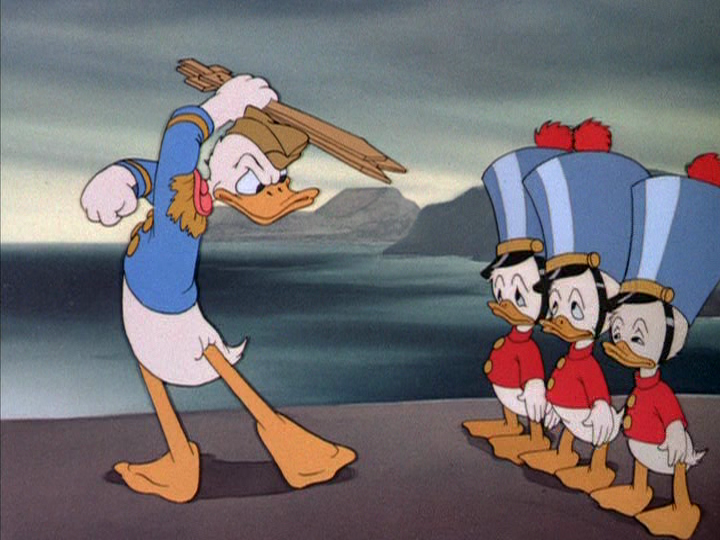
From his listening post, Donald is falling asleep while his nephews sleep soundly in their tent. Donald tries desperately to stay awake, but fails, dropping his trumpet while he falls to the ground. He ends up snoring into the trumpet, making it sound and waking his nephews, who are shocked to see Donald shirking his duties. They decide to play a prank on their uncle, and send a model airplane flying around the listening post. The sound wakes Donald up, and he believes that there’s a bomber right above them. The nephews then set up their guns, although Donald takes over and shoots the model plane down while the nephews laugh. Donald then sees some parachuters from the plane (another part of the nephews’ prank), and hides in a flowerbed while the nephews make sounds or battle.

Finding that his nephews tricked him, Donald takes away their chevrons and weapons, dismissing them from his service

Finding that his nephews tricked him, Donald takes away their chevrons and weapons, dismissing them from his service

After one of the dummies lands on Donald’s nose, he realizes the ruse and decides to get back at his nephews by dismissing them from his gun crew. He ignores the tears of his nephews as they march away sadly, and is left alone at his post. Later, he hears a bug buzzing around the post and believes that it’s his nephews playing another prank. When he realizes this isn’t the case, he believes that they are under attack, and quickly calls the boys to help. He restores them to the service, and they set up the cannon to be pointed at the listening post’s speaker, much to the surprise of the bug, who barely manages to escape. The nephews try to warn Donald before setting off the cannon, but Donald refuses to listen, and his ears are blown out from the cannon fire into the speaker. The nephews laugh as Donald throws a tantrum at his misfortune.

November 14

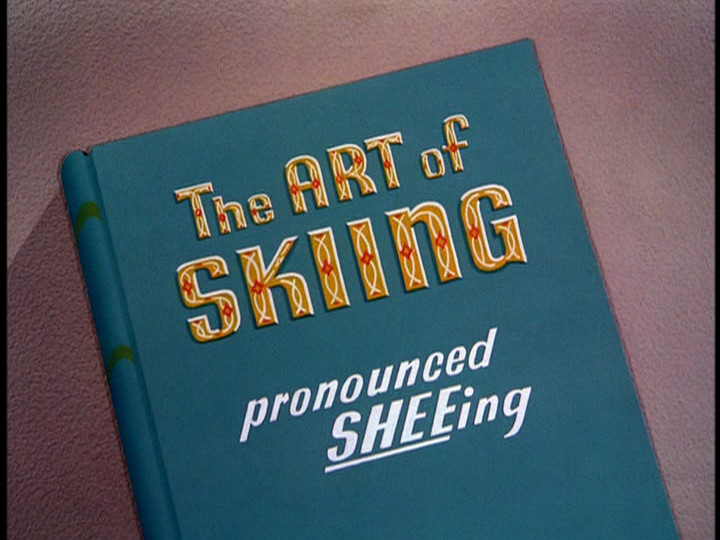
November 14, 1941 – The Goofy Short Film The Art of Skiing Premieres in Theaters

vlcsnap-2014-11-14-18h44m16s60

“Skiing is fast becoming the most popular of all winter sports. And small wonder, for there is no finer conquest than that of a mountain clad in its glorious winter mantle of glittering white.”

On November 14, 1941, the Goofy short film The Art of Skiing premiered in theaters. It was directed by Jack Kinney.

The short begins at the Sugar Bowl Lodge, with Goofy fast asleep inside, clad in several blankets and jackets to keep him warm, as his breath turns to ice. His alarm goes off and he slowly wakes up, removing several hot water bottles. As the narrator explains the skier’s proper attire, Goofy slowly gets dressed, and goes straight back to sleep. The narrator wakes him up again, and he dons a sweater and hat before setting off on his skiing adventure, forgetting his trousers. He tries to pull them on over his skis, but of course he has some difficulty. Finally, he is ready to ski, and he ungracefully gets off the lift. He tries to follow the narrator’s instructions, but ends up in a tangled mess. He heads on his first ski, only to go backwards down the hill and finds himself dangling from a cliff, his head caught inside one of his skis. Goofy then tries to climb up a hill and ends up climbing up too far before falling and creating patterns in the snow. When Goofy attempts to do a jump turn, he is separated from his skis and ends up crossing paths with them several times before they bury him in the snow. He attempts to slalom down a hill and crashes into a tree, then slams into the side of a cliff. He finally tries the ski jump, although his skis end up flying faster than he does, and he tries to reclaim them midair, using them like wings. Eventually he crashes into his room in the ski lodge, falling right back to sleep.

November 4

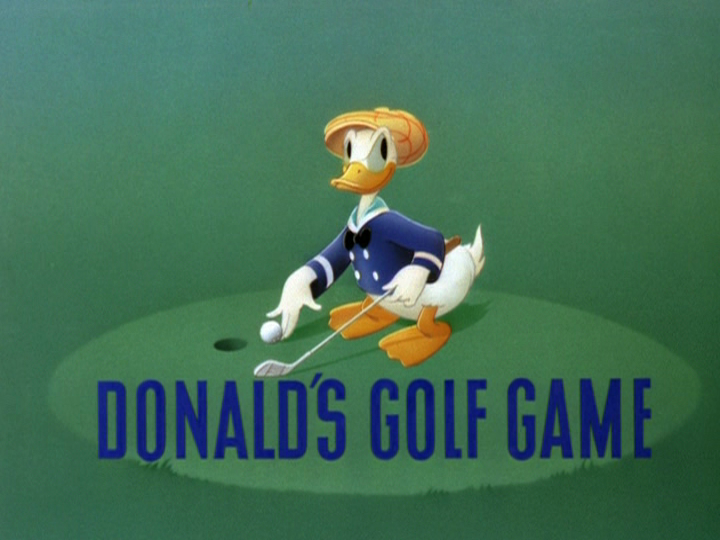
November 4, 1938 – The Donald Duck Short Film Donald’s Golf Game is Released to Theaters

vlcsnap-2014-11-04-19h24m38s56

“Ah, what a perfect day for a perfect game of golf.”

On November 4, 1938, the Donald Duck short film Donald’s Golf Game was released to theaters. It was directed by Jack King.

Donald is gleefully walking onto the course, with his nephews carrying his rather heavy golf bag. The boys set up his tee, and Donald takes a swing, only to be interrupted by a bird chirping. He yells at the bird, and gets back to swing, when the boys interrupt him by loudly blowing their noses. Donald angrily makes his way over, but they protest that they have colds. Donald retaliates by shutting their beaks with clothespins. Unfortnautely, just as Donald gets ready to once again hit the ball, the nephews sneeze their clothespins off, hitting him on the back of the head and getting one attached to his tail. He angrily breaks his club at the boys’ antics, not noticing that they packed in his bag a box of “Goofy Golf Clubs” that play 1,000 tricks. They take a club to give to Donald, and as Donald prepares to hit the ball, he doesn’t realize that the club turned into a net, scooping up the ball instead of sending it on a long drive. They hand him another club, which becomes an umbrella that takes Donald up into the sky and produces its own rain.

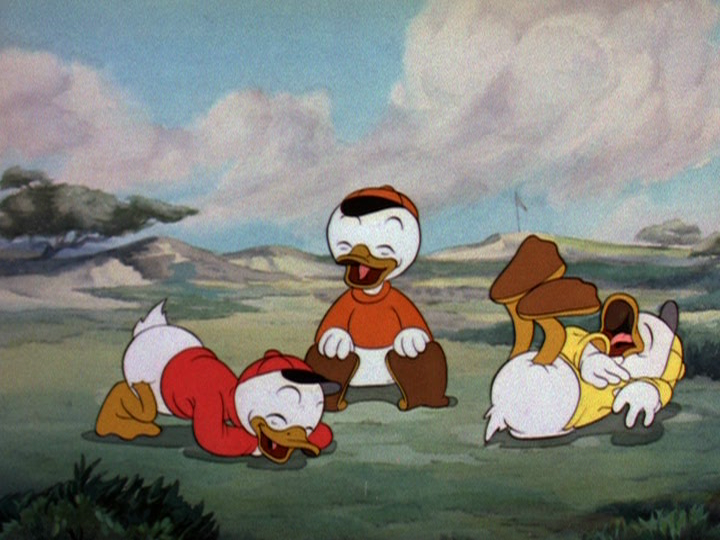
The nephews laugh themselves silly over the pranks they pull on their Uncle Donald

The nephews laugh themselves silly over the pranks they pull on their Uncle Donald

The nephews are beside themselves with laughter, but vamoose when they see Donald making his way over. As they hide from their uncle, they spot a grasshopper, which they hide in a golf ball. When Donald isn’t looking, they replace his ball with the trick ball. As Donald continues his game, the ball jumps away from him, and Donald angrily tries to bat it with his club. When the ball jumps out into the water, the boys provide him an inner tube so he can go after it, and pull the plug when Donald is out far enough. Even so, Donald tries to play his ball through the water, sending it flying to the hole. He chases after it on land and finally finds the grasshopper in the ball, setting it free. He lands on his face on the green, and the nephews decide to play their own hybrid game of golf and pool, sending balls flying into the pocket after torturing Donald in various ways. Angered, he takes another trick club and throws it at the boys, which turns into a boomerang and flies right back into Donald, sending him flying face-first into a hole.

November 1

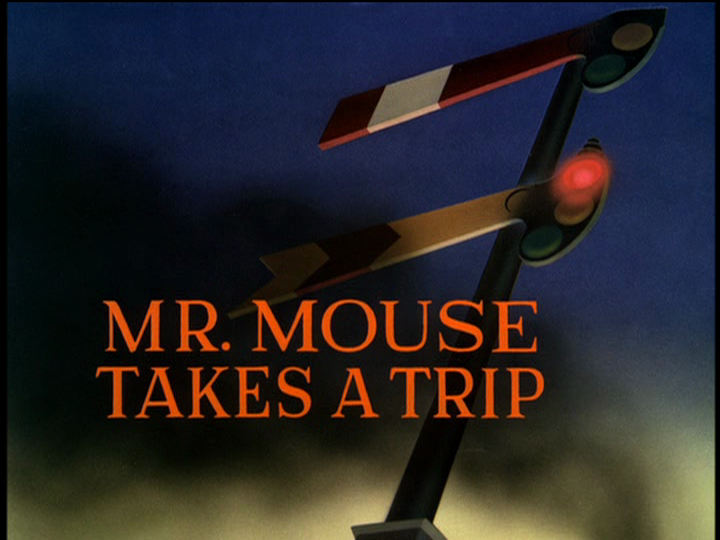
November 1, 1940 – The Mickey Mouse Short Film Mr. Mouse Takes a Trip is Released to Theaters

vlcsnap-2014-11-01-19h02m06s81

“All alone, without your dog.”

On November 1, 1940, the Mickey Mouse short film Mr. Mouse Takes a Trip was released to theaters. It was directed by Clyde Geronimi.

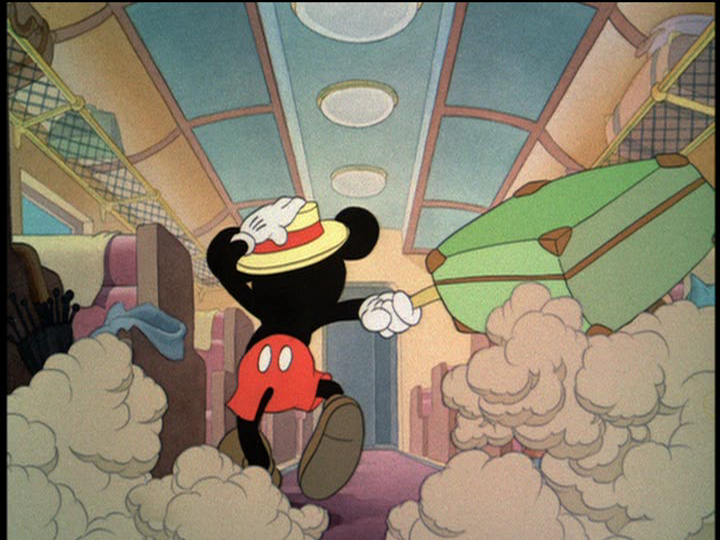
It’s vacation time for Mickey, and he stands at the Burbank train station with Pluto, and both are nearly swept away as the train arrives. However, the moment they board, they are kicked off by Conductor Pete, who informs them that no dogs are allowed. A few minutes later, Mickey gets ready to board again, hiding Pluto in his suitcase. However, Pluto is much too heavy for Mickey to carry, and he runs off with just the handle. Mickey runs back to grab the suitcase and barely manages to make the train. As Mickey sits in his seat, he carefully unfolds Pluto from the suitcase, but has to quickly place him back in as Pete comes around to check tickets. Mickey hands Pete his tickets, shaking from nervousness. Pete takes Mickey’s suitcase and throws it in the top compartment, causing Pluto to bark angrily. Mickey tries to cover it up, but Pete is suspicious. Pete makes the sound of a cat, and the ruse is revealed.

As Pete discovers Pluto hidden in the suitcase, Mickey takes Pluto and runs as fast as he can away from the situation

As Pete discovers Pluto hidden in the suitcase, Mickey takes Pluto and runs as fast as he can away from the situation

Mickey flees the scene with Pluto, and Pete follows in hot pursuit. Thinking he’s found them, he grabs someone in a compartment, and ends up with the frightened woman beating him with her corset. He falls into another compartment – where Mickey and Pluto are actually hiding – and apologizes for his behavior before he realizes that he’s been tricked again. He tries to tear them apart as the train goes through a tunnel, but is unaware that he’s fighting only a mattress in the dark. He spots someone (Mickey and Pluto again) in a conductor’s coat and asks if they’ve seen Mickey and Pluto, and Mickey points him in the other direction. Realizing he’s the conductor, Pete chases after the pair once more. Pete accidentally attacks the woman from before, giving Mickey and Pluto enough time to don another disguise. However, he is able to see through their disguise again, and Pluto gets caught in a mail stand outside. As Mickey runs after him, the two end up off the train, with Pete throwing their luggage out after them. Mickey looks around and is amazed to find that the pair landed in Pomona – just where they wanted to go.

October 26

October 26, 1945 – The Donald Duck Short Film Cured Duck is Released to Theaters

vlcsnap-2014-10-26-18h39m54s20

“Temper, temper, shame on you! You never see me lose my temper, do you?”

On October 26, 1945, the Donald Duck short film Cured Duck was released to theaters. It was directed by Jack King, with story by Roy Williams.

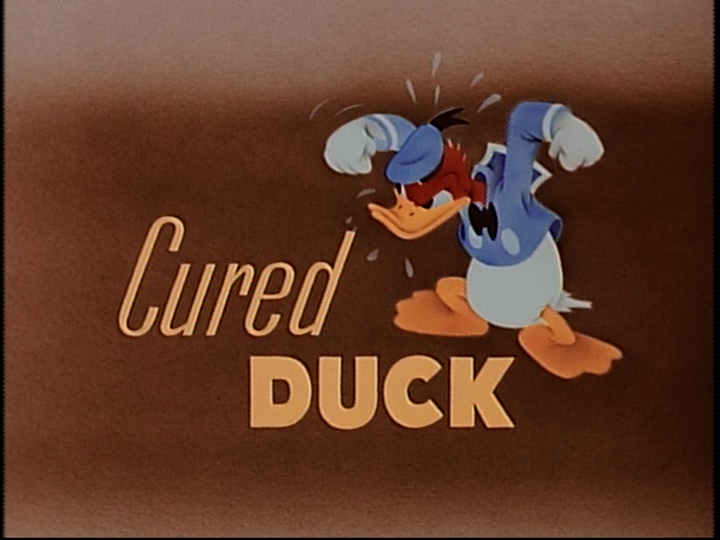
Donald is walking down the street with a cigar, blowing smoke hearts as he heads to Daisy’s house. She gets herself ready as she sees him approach, although she is less than happy about his cigar smoke. He tries to open the window for her, and is angered when it is sealed shut. He throws a tantrum, breaking all of her belongings. Having had enough, she admonishes him for his temper, and gives him an ultimatum: she won’t go out with him again until he controls his temper. Donald dejectedly walks away, and comes across a newspaper ad for a mail-order temper cure. His package soon arrives, and enclosed is an insult machine from the Tootsberry Institute of Temperism, which tells him that if Donald can withstand its insults for ten minutes and still control his temper, he will be cured. The machines is really rough with Donald, and loses it after 30 seconds. The tests get more and more rough, but finally, Donald is able to pass the test and receive his certificate. He jumps in his car and drives back to Daisy’s, and she tests him with opening the window again, and although he has problems, he manages to get the window open and doesn’t lose his temper after all the mishaps. When she shows up with a new hat, he laughs at the ridiculousness of it, and she loses her temper, beating him over the head with a broom.


October 18

October 18, 1946 – The Educational Film The Story of Menstruation is Delivered

SoM_1

“So, as we see now, menstruation is just one routine step in a normal and natural cycle that is going on continuously within the body.”

On October 18, 1946, the educational film The Story of Menstruation was delivered to International Cellucotton Co. (now known as Kimberly-Clark). It was produced through a partnership with Kotex Products. It became a staple of health education classrooms for decades, using animation to depict the changes in a woman’s body through puberty. The film runs about ten minutes.

The film begins with a conversation about glands, namely the pituitary gland, which produces growth hormones. Between the ages of 11 to 17, the pituitary gland sends a new maturing hormone through a woman’s body, particularly to the ovaries. An explanation is given of a woman’s sexual reproduction hormones, and the cycle of an egg. It then goes to describe regularities when it comes to a period, and how timing can go off due to fatigue, catching a cold, or becoming emotionally upset. It reminds girls to keep a calendar for their cycle, and introduces a booklet called “Very Personally Yours,” which was handed out upon viewings of this film. It also dispels any theories that women should not shower or exercise during their period. The booklet also provides exercises to help with cramping, and advises healthy living every day to help keep the body running smoothly.

October 15

October 15, 1943 – The Figaro Short Film Figaro and Cleo is Released to Theaters

vlcsnap-2014-10-15-18h49m53s101

“Although she’d make a dainty little dish…”

On October 15, 1943, the Figaro short film Figaro and Cleo was released to theaters. This is the first of a handful of shorts that features the popular character from the animated feature film Pinocchio, with Figaro continuing to star in an additional six short films. The short was directed by Jack Kinney.

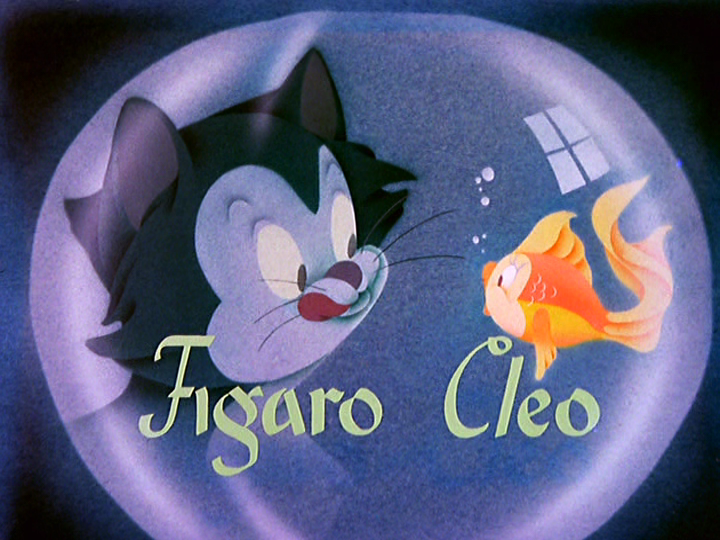
Figaro is waiting to be fed his supper, and is angered that more attention is being paid to Cleo, the goldfish. Hungry, Figaro eyes Cleo, but tells himself that he’d rather die. However, his hunger gets the best of him, and he decides to hunt after her. He then decides to play with the broom instead, much to the annoyance of the maid. He tries to get her attention, but she brushes him away. He lands in the living room and decides to play with a ball of yarn instead, finding himself in more trouble; when the maid punishes him by giving him no milk, Figaro decides that now is the time to eat Cleo. He waits until the coast is clear, then approaches Cleo with a makeshift fishing rod that uses his tail. When the maid catches him, he accidentally hooks the side of the fishbowl, but she frees him and scolds him again. Tired, the maid decides to take a nap, leaving Figaro with nothing to do but to go after Cleo. She wakes up to find him face-first in the bowl, and she ties his tail to her chair to keep him out of trouble before nodding off again. Unfortunately, her snoring causes the bowl to travel closer to the trapped Figaro, and he ends up freeing himself and falling into the bowl. The maid wakes up to find him in drowning in the bowl, and she quickly pulls him out and revives him. She makes sure that the two of them finally get along, and Cleo and Figaro seal their friendship with a kiss. In the end, the maid gives Figaro his milk.

October 3

October 3, 1941 – The Pluto Short Film Lend a Paw is Released to Theaters

vlcsnap-2014-10-03-20h12m35s101

“Save him, Pluto! Save the poor little kitty!”

On October 3, 1941, the Pluto short film Lend a Paw was released to theaters, although under the Mickey Mouse banner. It is the remake of the 1933 Mickey Mouse short film, Mickey’s Pal Pluto, and was dedicated to the nonprofit Tailwagger Foundation “in recognition of its work in lending a paw to man’s animal friends.” The short was directed by Clyde Geronimi. It would go on to win the Academy Award for Best Animated Short Film at the 14th Academy Awards.

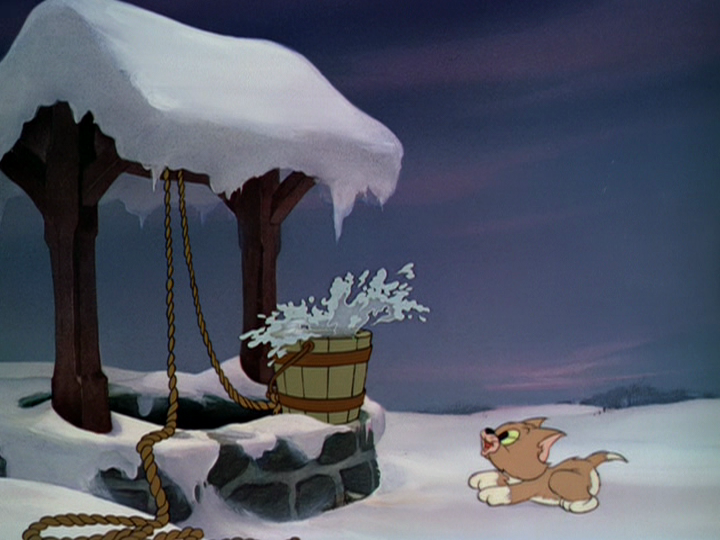
On a snowy day, Pluto is sniffing around when he hears mewing from inside a bag floating on a patch of ice down the creek. He jumps in to rescue the kitten, and takes it to shore, although he isn’t too happy about the bag’s contents. The kitten follows him, wanting nothing more than to be his friend, and ends up in Pluto’s house. Pluto greets Mickey, and Mickey automatically greets the kitten, incurring Pluto’s jealousy. Mickey takes care of the kitten, and the little Devil inside jumps out of Pluto’s head and tells him that he needs to get rid of the kitten. Pluto’s Angel, however, steps in and tries to guide Pluto back to the proper path. The Devil gets rid of the Angel and convinces Pluto to get rid of the kitten by making it appear that he ate Mickey’s goldfish. Unfortunately, the plan goes wrong, and the bowl crashes onto the floor. Mickey, suspicious, asks the fish who did it, and she immediately points her fin at Pluto. Mickey kicks Pluto out of the house, leaving him in the show. Pluto sits in the snow, crying.

The kitten's ball bounces into the well bucket, leading the kitten to certain danger

The kitten’s ball bounces into the well bucket, leading the kitten to certain danger

A bit later, the kitten is chasing after a ball when it goes out the doggy door, and bounces into the bucket at the well. The kitten jumps into the bucket, and both he and the bucket land in the well. Pluto watches as the kitten struggles to stay above water, and Pluto’s Angel tells him to rescue the kitten. The Devil steps in again and tells Pluto to let the kitten drown. In the end, Pluto’s Angel beats up the Devil, and demands that Pluto save the kitten, which he does. Mickey is alerted to the danger by Pluto’s cry, and Mickey saves the kitten and Pluto. Mickey warms Pluto back up in the house, and the kitten gives him a grateful lick. Pluto’s Angel then reminds him that “kindness to animals…will be rewarded in the end.”

September 20

September 20, 1946 – The Donald Duck Short Film Lighthouse Keeping is Released to Theaters

vlcsnap-2014-09-20-20h16m31s169

“Hahaha, ain’t I a devil?”

On September 20, 1946, the Donald Duck short film Lighthouse Keeping was released to theaters. It was directed by Jack Hannah, with story by Harry Reeves and Jesse Marsh.

Donald is trying to read his book by the light of the lighthouse, but is having difficulty as the light only passes by so often. After being annoyed by the inability to read properly, he decides to play a prank on a sleeping pelican on a nearby rock, holding the light so it shines directly on the pelican’s face. The pelican grabs his nest and tries to move, but Donald moves the light again, angering the pelican. As Donald laughs, he hears the door knock, and he goes to answer it. The pelican rushes inside and blows out the candle in the lighthouse. The pelican continues to fight Donald over the light, until Donald grabs the pelican to throw him over the railing at the top. The pelican is able to use his beak to swing him back onto the balcony, sending Donald flying over the railing. Fortunately for the duck, a wave brings him right back to the top, and the two resume their fight over the light.

vlcsnap-2014-09-20-20h22m13s250

As the pelican has Donald trapped in his bill, he takes Donald to the balcony to drop him off the edge

Donald thinks he gains the advantage hiding in a trunk, not realizing that he’s hiding in the pelican’s beak. The pelican carefully walks to the balcony and sends Donald over the edge, but Donald only pretends to fall, and the fight once again resumes. The pelican then tricks Donadl into running into a glass door, knocking the duck out and giving the pelican a chance to extinguish the flame. The pelican traps Donald in his beak again, and Donald starts hitting the pelican with a mallet. The mallet breaks apart, with the head landing on the top of the pelican’s beak, and he uses this to beat Donald senseless. He soon loses the mallet head, and Donald uses it to light it on fire, making the pelican release him. The fight over the light continues once more, until the sun comes up. Eager to win, Donald closes the blinds, and the two continue their fight over the lighting of the lighthouse candle.