RSS Feed

March 6

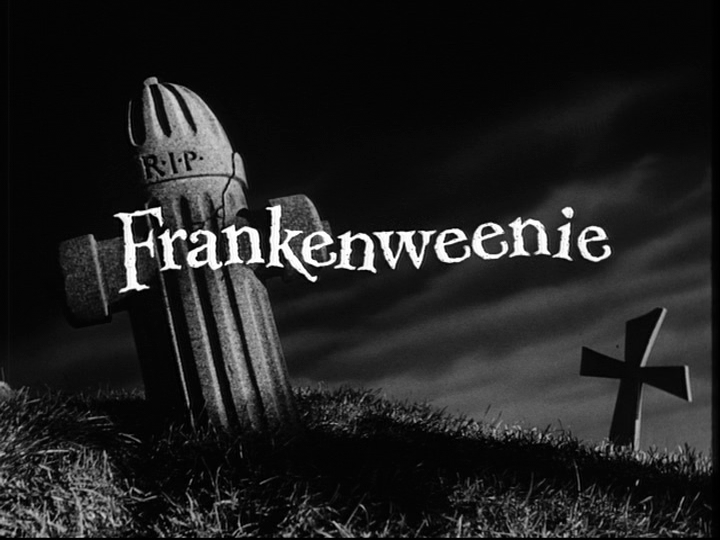
March 6, 1992 – Tim Burton’s Short Film, Frankenweenie, is Released With the Live-Action Film, Blame it on the Bellboy.
“I guess we can’t punish Victor for bringing Sparky back from the dead.”

Tim Burton’s Frankenweenie, although completed in 1984, was released on a double bill with the live-action film, Blame it on the Bellboy, on March 6, 1992. Filmed in black and white, the short is an homage to horror films of the 1930s, with Mary Shelley’s Frankenstein as its base inspiration. The short is the story of a young boy named Victor Frankenstein, who brings his dog back to life after a tragic accident. The short was directed by Tim Burton, with the screenplay by Lenny Ripps, and stars Barret Oliver as Victor Frankenstein, Shelley Duvall as Susan Frankenstein, Daniel Stern as Ben Frankenstein, and Sparky as himself. Tim Burton was fired from Disney after the film was finished; studio heads felt the film was too scary for young audiences and that resources had been wasted making the short. A new full-length version of this short, which will be closer to Tim Burton’s original story idea, is set for release in October 2012.

The short opens with a film entitled “MONSTERS from Long Ago” by Victor Frankenstein, starring Sparky as the titular monster. The camera pans out to see the Frankenstein family and some friends watching a home movie. Meanwhile the son, Victor, goes outside to play with his dog, Sparky. Victor throws a baseball and Sparky, running to retrieve it, is struck by a car.
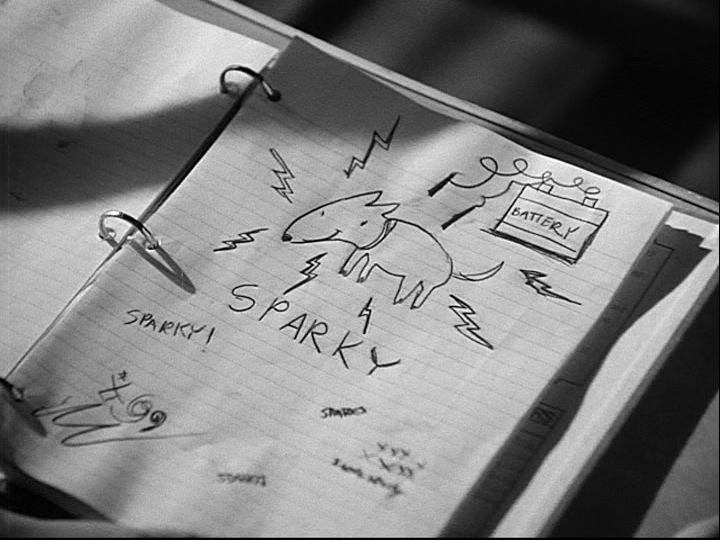
Victor is inspired by his teacher's science experiment

The next scene shows Victor and his parents in a pet cemetery, paying their last respects to Sparky. Victor falls into a deep depression. When his friends ask if he’ll get another dog, Victor says that he doubts that he could ever find another one like Sparky. In science class, Victor is unable to pay attention, as he draws pictures of Sparky in his notebook. The science teacher, however, is about to give a lesson on electricity and the central nervous system, pulling out a frog corpse. When the teacher proposes introducing electricity into the frog’s system, Victor suddenly pays attention. Seeing the frog’s legs move, Victor is inspired, thinking that this is the way to bring Sparky back.

Victor reads several books for research, including Life After Death, On Death and Dying, Modern Chemistry, and Electricity and the Creation of Life. He then begins gathering appliances in the house, beginning with the toaster, until he has constructed a lab in his attic. One night, after pretending to be ready for bed, Victor pulls a shovel out from under his bed and sneaks out to the pet cemetery to dig up Sparky. He hurries home through the rain with Sparky’s corpse and sets about trying to bring the dog back to life, in the same manner as his namesake, Dr. Frankenstein. But nothing seems to happen. Victor brings the corpse back downstairs, believing that he has failed, until he feels the dog licking his hand.
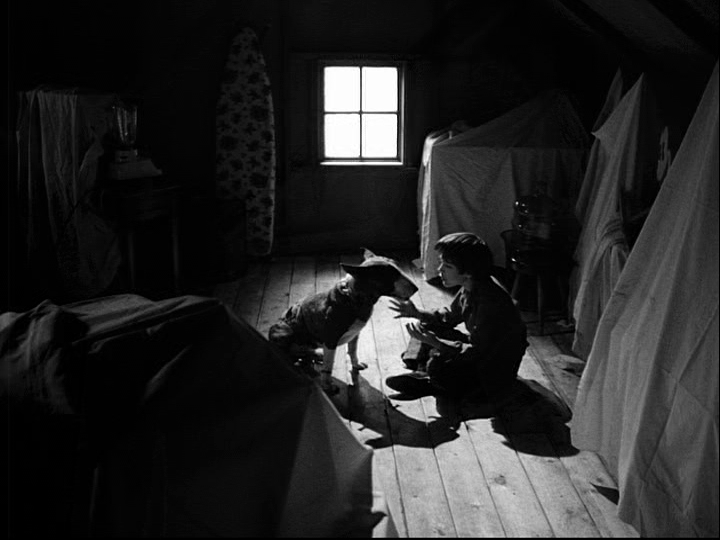
Ben Frankenstein discovers Sparky and Victor hiding out in the attic, unbeknownst to the pair

The next morning, Victor claims he doesn’t feel very well and asks to stay home from school. His parents see right through his charade, and send him off, but Victor waits until they both leave for work, then stays home to play with Sparky, who stays hidden away in the attic. While Victor naps, however, Sparky leaves the attic and goes outside to explore. He climbs into the open window of the next-door neighbor’s shed, only to scare the poor man inside, who sets Sparky into accidentally terrorizing the neighborhood before running back inside the house. Victor’s parents are questioned about their dog when they come home from work, and the father offers to check their house for any dogs. He discovers that Sparky is, in fact, alive. He drags the mother inside to see for herself that Sparky has been brought back to life.

The family sits around the kitchen table, wondering how to deal with this situation, and the implications of it. They are unable to sleep that night, wondering how exactly does a parent deal with their son playing God. They decide to keep Sparky in the house and walk him at night, so people don’t see him and become alarmed. The neighbors, however, start to ignore the Frankensteins, as they know something strange is going on. The father decides that they might as well just introduce the neighbors to Sparky that night, for “the longer they wait, the worse it will be.”
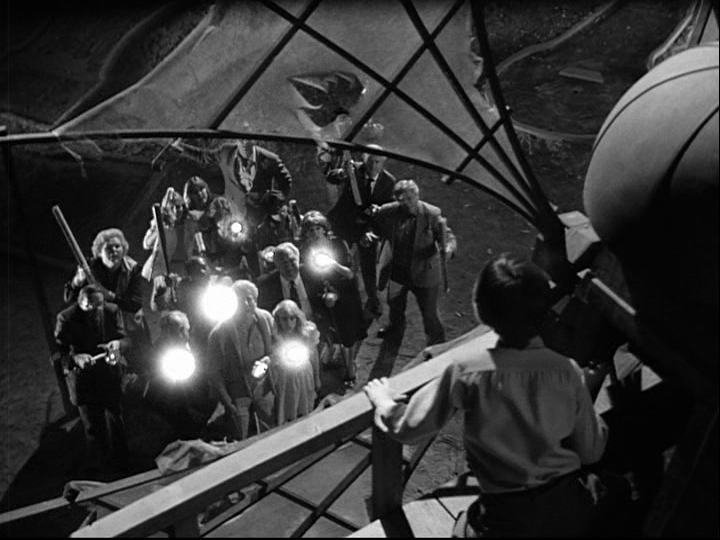
The angry mob of neighbors stands outside the old miniature golf course windmill, demanding "the monster"

The neighbors are seen gathered in the Frankenstein’s living room, with Mr. Frankenstein trying to reassure them that they’ve been seeing the same plain old Sparky. Upon seeing Sparky, however, the neighbors immediately lose their heads in fright, and Sparky runs out the dog door. Victor follows the dog, and the neighbors decide that their best course of action is to kill Sparky. Sparky escapes into the ruins of an old miniature golf course, and runs up to the windmill, with Victor calling his name from the gate. Victor slips through the gate and tries to retrieve Sparky. The neighbors stand as an angry mob outside the windmill, demanding to have their vengeance, while one neighbor pulls out a lighter and sets the old windmill ablaze. Victor and Sparky are trapped inside the burning building, and while everyone stands and watches with horror, they are suddenly amazed to see Sparky pull Victor out of the windmill. As his parents pull Victor away, the windmill suddenly begins to fall apart, trapping Sparky in the wreckage. Victor can only watch as Sparky dies once more.

Lights flash, and Victor is surrounded by car headlights, with one neighbor proclaiming that if Victor brought Sparky back to life before, he can do it again. Inspired by Sparky’s bravery at saving Victor, everyone is ready to start their engines and use their car batteries to give Sparky a jumpstart. Their plan is a success, and Sparky once again is brought back to life.
March 5

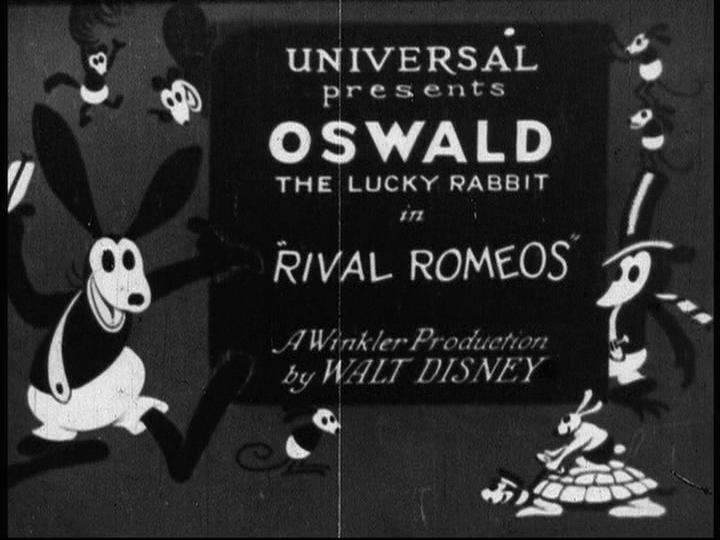
March 5, 1928 – The Oswald the Lucky Rabbit Short Film, Rival Romeos, is Released Through Universal Pictures

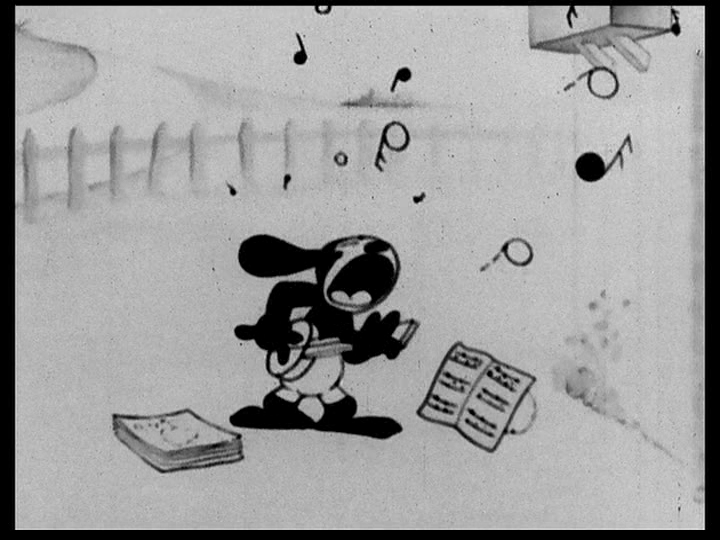
On March 5, 1928, Universal Pictures released a new Oswald the Lucky Rabbit short silent film entitled Rival Romeos. Oswald was Disney’s first animated hit after the Alice Comedies, and soon became very popular, along with such characters as Felix the Cat. Patterned after the leading swashbuckling actor of the day, Douglas Fairbanks, Oswald was an easily frustrated rabbit, and the shorts relied on slapstick and subtle humor: the sheet music Oswald produces, if one looks closely, include the names of Hot Lips and Hot Mama. This was the 15th of out 26 Oswald shorts created by the Disney Studios before Charles Mintz took Oswald away. Many elements in this short are seen in some of the early Mickey Mouse and Silly Symphony films, including the goat used as a gramophone (seen in Steamboat Willie), the main character fighting a rival for the lady’s affections (as seen in Mickey’s Rival), and the main characters kicking each other for being idiotic (as seen in The Wise Little Hen)

A clearly smitten Oswald is on his way to see his girlfriend, Ortensia the Cat, holding a bouquet of daisies and traveling slowly in his jalopy. He starts playing a game of “She Loves Me, She Loves Me Not” with the flowers, before dreaming of Ortensia again. Behind him, in a much nicer car, is Oswald’s rival, also armed with a bouquet, dreaming of Ortensia. His own lovestruck mood is broken by the sight of Oswald, and he angrily honks his horn at the rabbit.

The rival finds a way to get ahead of Oswald, for now

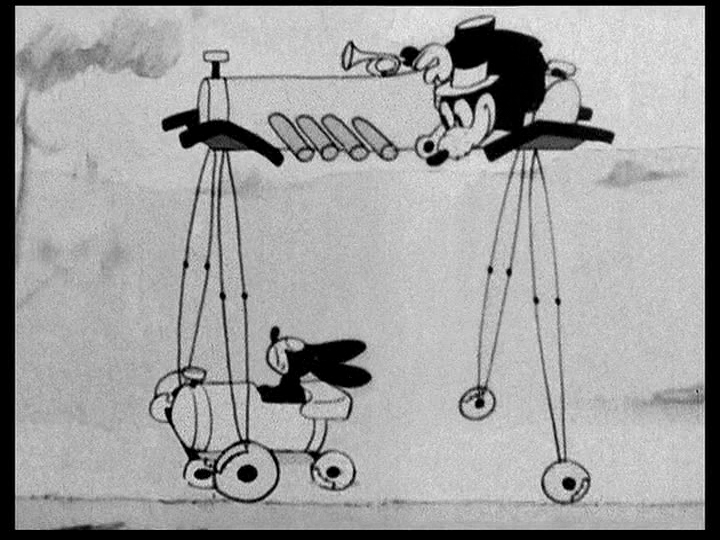
Oswald turns to see this rival, and turns up his nose at him, unconcerned. He continues at his leisurely pace, refusing to move, though his rival starts to throw a fit. The rival pulls a lever, which raises the car, allowing the rival to sail above Oswald and land comfortably in front of him, then he speeds off like a shot.

The rival is eventually stopped by giant patch of mud covering the road. The rival orders his car to go across, but the car refuses, allowing Oswald to catch up. Oswald and his car laugh at the rival, then jump into the puddle with enthusiasm, splashing around and sending mud flying toward the rival. Oswald and his car then take off to continue the trip to his girlfriend’s house. The rival’s car carefully hikes up its skirts and treads cautiously through the mud, with the rival determined not to be beaten. Unfortunately, the car slips on some mud, and they land in the puddle with a mighty splash.

Oswald beginning to serenade Ortensia

Oswald arrives at Ortenisa’s house, heart aflutter, and begins to serenade her with on his banjo. She hears him and steps out onto the balcony, smitten by Oswald’s attempt at romance. While Oswald isn’t looking, however, a hungry goat steps into the front yard, salivating at the sheet music lying on the ground, and begins to snack on some of it, while meanwhile a gentle breeze blows around the sheet music Oswald is currently trying to play. The clearly frustrated rabbit takes out a pin to nail the music to the rock he’s using to prop the music up, only to find that the “rock” is a snoozing pig who, stabbed by the pin, runs off, taking the music with him.

Oswald then sees that the goat has eaten the rest of the music, and is now eyeing his banjo with great interest, before devouring it. Oswald grabs the bit of the banjo sticking out of the goat’s mouth to pull it out, but sends it flying down into the goat’s stomach. Oswald angrily tells off the goat, but the goat doesn’t seem to care, nor wish to give back the banjo. Oswald then tries begging and crying, explaining that he’s trying to woo Ortenisa, but the goat only laughs, infuriating the rabbit. As a last attempt, Oswald strangles the goat and sticks his hand down its throat in order to retrieve the instrument, only to get sucker-punched by the goat. He kicks the goat in the stomach, and notices that music notes come out. Inspired, he opens the goat’s mouth, pulls on his tail, and uses the goat as a sort of gramophone to play his love songs.

Poor Ortensia is caught in the middle of two unyielding suitors

Oswald’s attempts at romance are not beloved by all, for the music wakes up Ortensia’s father, who begins to throw things out the window to stop the noise. Oswald and the goat run for cover, and as Oswald hides behind his car, the rival finally makes it to Ortensia’s house and honks his horn to alert the girl. Ortensia steps outside and waves, and both suitors bow to her, but she stands between the two, with the “Romeos” pulling on her arms as they each try to convince her to date him instead of the other guy. Poor Ortensia stands there as they keep pulling and pulling out her arms like ropes, until they finally let her go. She yells at the two of them before angrily walking away, and the two suitors begin to argue. While arguing, which escalates into physical fighting, they don’t notice that Ortensia has been taken away by a third suitor, and as they watch her drive away, the two agree to kick each other for being so moronic.

March 4

March 4, 1914 – Birth of Disney Legend Ward Kimball, One of the Nine Old Men

“I checked out a scene of Ward Kimball’s animation on Cinderella, and it had some of his rough notes on the scene. He had done the mice in the scene, and Cinderella was also in the scene, but the note to his assistants was, ‘The stooge enters here,’ and the stooge was Cinderella. I think [Kimball] had a certain attitude toward the straighter characters…he lived for the comedy and the counterpoint to the [straight character.]” – Animation Director John Musker.

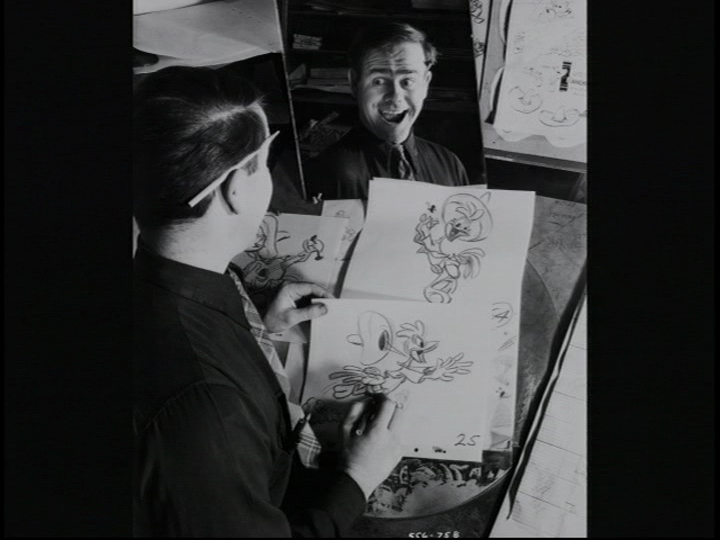
Ward Walrath Kimball, known as one of Disney’s famed Nine Old Men, was born on March 4, 1914, in Minneapolis, Minnesota. He attended the Santa Barbara School of Art in California, with an ambition of becoming a magazine illustrator. But after catching a screening of Walt Disney’s Three Little Pigs, Kimball quickly put together a portfolio and headed straight to Disney Studios, which he joined in 1934.

Kimball’s animation style, with his focus on comedy, and the emotion he was able to infuse in his drawings was quickly noticed in the studio, One of the most well-known characters he developed was Jiminy Cricket in Pinocchio, which was a bit of a gift from Walt after one of Kimball’s scenes was cut from Snow White and the Seven Dwarfs. Kimball remarked on this: “I spent eight months on it. It was all cleaned up and ready to be inked and painted. Walt sensed it stalled the plot at that point. So he called me to his office and said, ‘Ward, I hate to say this, but I’m going to have to take out this soup sequence.’ Of course, I was crestfallen, but right away he came in and said, ‘But I’ve got a little character in our next picture and we’re going to call him Jiminy Cricket. I’d like to have you be the animation supervisor on this.’ My first impression of him was, ‘This ugly insect.’ I said, ‘How can that guy carry the picture?’ My only answer to this is I’ve got to make him look funny. Walt didn’t really want a clown-looking cricket. As he put it, ‘Make him cute, Kimball.’”

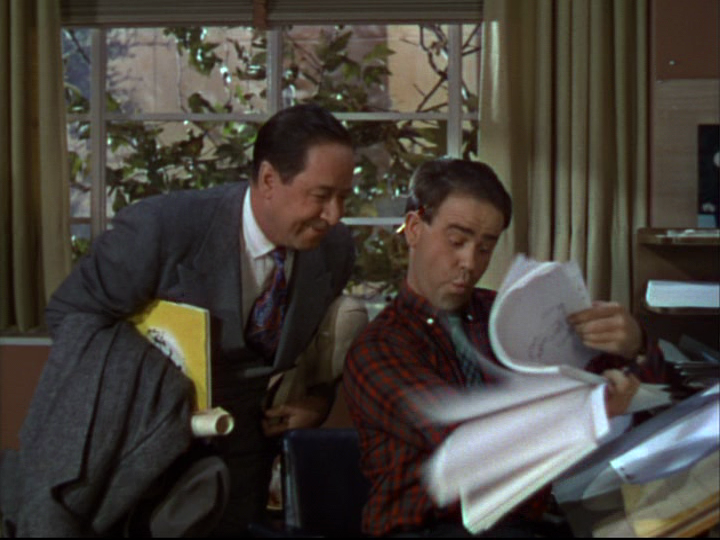
Kimball (R) in a scene from The Reluctant Dragon, showing Robert Benchley how animated characters move

Along with many of the Nine Old Men that created the rules of modern animation, he continued to learn throughout his entire career. “An artist always goes back to the source,” he said wisely. “If he’s drawing animals, he looks at the giraffes and the lions; he caricatures them, but he starts out drawing realistically. Like on Bambi, the guys used to go down at the zoo and see how the animals acted.”

Kimball also animated Tweedledee and Tweedledum in Alice in Wonderland, and Lucifer in Cinderella, as well as the Academy Award-winning shorts Tootle, Whistle, Plunk and Boom – the first Cinemascope cartoon – and It’s Tough to Be a Bird. Kimball branched out of animation for the Disneyland show, producing and directing three episodes about space: Man in Space (which discusses the history of rockets), Man and the Moon (about man’s fascination with the moon), and Mars and Beyond (narrated by Paul Frees and discusses the possibility of life on other planets). Kimball also expanded into the story division, and helped write the script for the live-action film, Babes in Toyland.

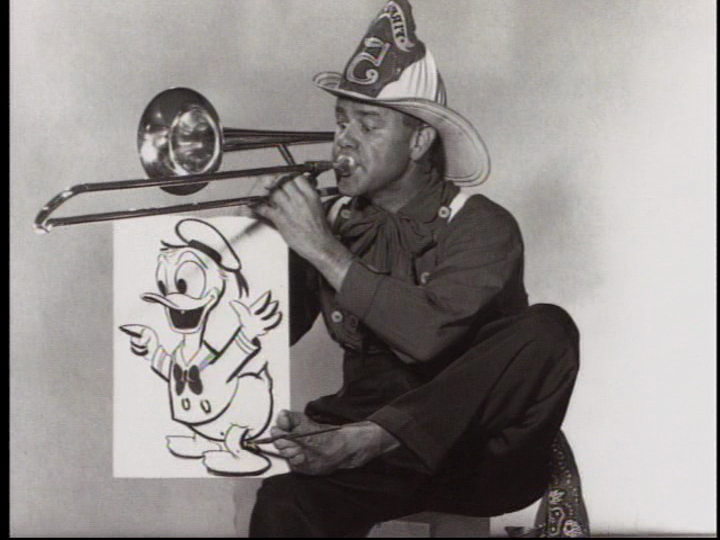
Kimball brought his unique sense of humor to every aspect of his life, including performing with the famous Firehouse Five Plus Two

Kimball had many interests beyond animation. A railroad buff, his enthusiasm for his hobby spurred Walt to set up a backyard railroad of his own. Kimball was also a fantastic trombone player, and played in the famous group, “Firehouse Five Plus Two,” most notably with Frank Thomas, another member of the Nine Old Men. He was awarded as a Disney Legend at the ceremony in 1989, and his plaque honors his sense of humor by adding an extra finger to the hand holding the wand. Ward Kimball passed away on July 8, 2002, in Los Angeles, California.


March 3

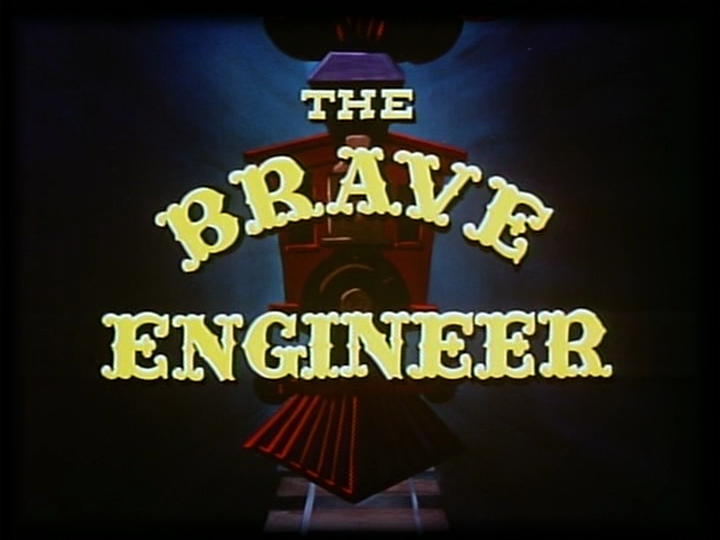
March 3, 1950 – The Special Cartoon, The Brave Engineer, is Released to Theaters

“Ah, ‘tis morning, and all the trains in the railroad yard are fast asleep. All except Casey’s. His engine is slow asleep.”

 On March 3, 1950, The Brave Engineer, a  special short subject cartoon, was released to theaters. Based on the “Ballad of Casey Jones,” by T. Lawrence Seibert and Eddie Newton, the short tells the story of engineer Casey Jones, who will stop at nothing to deliver the mail on time. The ballad was based on a real-life engineer, John Luther “Casey” Jones, who died stopping a train and saving many lives in the process. The story was adapted by Dick Kinney and Dick Shaw, with the musical score by Ken Darby, and stars the vocal talents of Jerry Colonna (also known for playing the March Hare in Disney’s Alice in Wonderland) and The King’s Men singers.

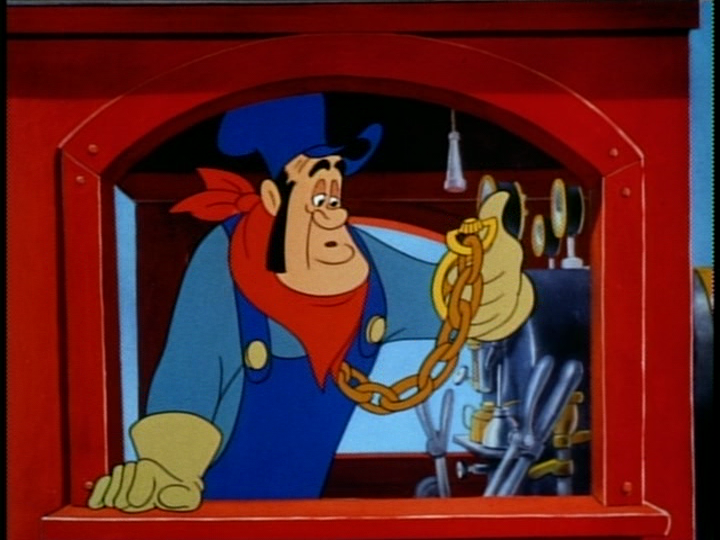
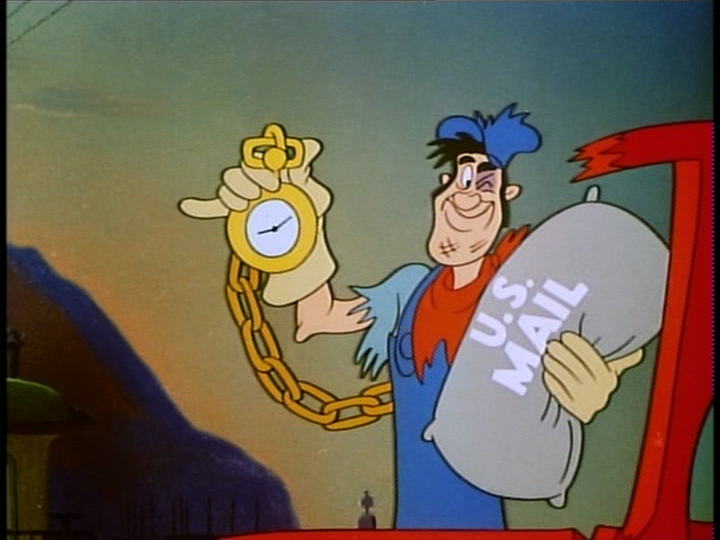
Casey checks his watch for the time, only to realize he's already late

The sun rises over the railroad yard, and the camera zooms in on Casey Jones’ engine, as Casey slowly wakes up, and is alarmed by the time shown on his stopwatch. Once signaling he’s ready, Casey takes off like a shot, with the track switches moving as rapidly as possible to match Casey’s speed. Casey’s many close calls cause his poor brakeman to collapse in exhaustion and nerves.

Casey first problem on his route to deliver the mail is a flood that has been building up for five or six weeks. Considerably slowed by the rain, Casey climbs on the roof of the train and paddles with a shovel, but despite his efforts, the western mail is “exactly eight hours late.” When the train emerges from the flood, it is covered by the roof of a house, with an attached laundry line, but it quickly rids itself of the burden and the excess water, and immediately speeds ahead to its next destination.

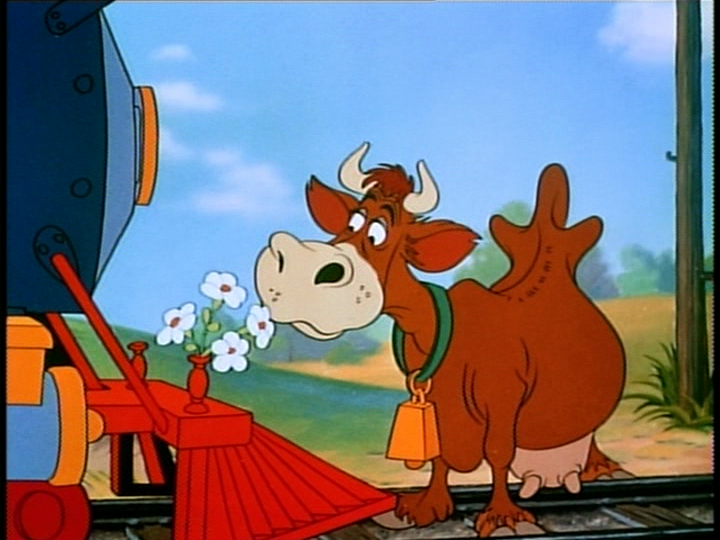
Close call for the cow

Unfortunately, it is not smooth sailing for Casey, as there is a cow standing in the middle of the tracks. Casey brakes hard, and the train stops just inches from the cow. Casey screams at the cow to move, pulling out his stopwatch and proclaiming that he’s late. Offended by Casey calling her “old cow” and “bossy,” the cow saunters off as slowly as she possibly can. Casey barely waits for her to clear the tracks before he speeds past her, leaving the cow clutching a telephone pole for dear life.

Casey is feverishly shoveling coal into the engine when his next problem arises: a bandit has just tied a helpless maiden onto the tracks. Casey climbs out to the front of the engine and scoops up the girl, with the bandit cursing him. Casey continues to up his speed, although he realizes, as he travels around a mountain track, he’s going too fast. As he travels through a tunnel, the audience sees another bandit getting ready to blow up the train tracks. The dynamite explodes just as Casey travels over the bridge, but Casey’s engine doesn’t give up, and just climbs up the steep sides of the mountain.

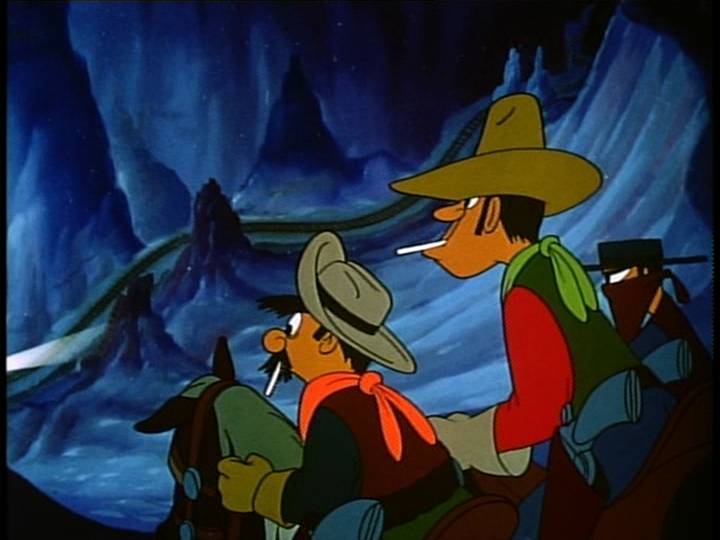
A gang of bandits, lurking in the shadows, watching Casey's train

As the train speeds through a tunnel, a gang of bandits lurk in the shadows, ready to jump the train and rob it. Still shoveling coal, Casey doesn’t notice that the robbers are now in the engine, guns drawn, until one is nearly shoveled into the furnace. Angered by this new interruption, Casey attacks the gang with his shovel. He continues to battle the bandits almost nonchalantly as he keeps on shoveling more coal into the engine. He successfully beats the gang, but he’s alarmed to see how late he is when he looks at his watch.

Desperate to make it on time, Casey shovels the coal into the furnace crazily, causing the engine to overheat. After running out of coal, Casey throws anything he can into the furnace, still overheating until gears and gauges explode. The train begins to fall apart, with Casey trying to hold it all together, and the tracks melt. While otherwise occupied, the brave engineer doesn’t notice another train coming toward him on the same track. Casey’s train is heading toward it like a bullet, and the conductor of Casey’s train runs to warn Casey, but Casey can’t hear him, and the trains collide in a cloud of black smoke.

Casey makes it through his sheer determination...and a lot of luck

The mailman waiting at the station thinks Casey is not going to make the stop today, when all of a sudden, the last remaining pieces of Casey’s train appear, with Casey holding the mail. According to Casey’s watch, Casey made it “On Time…Almost.”

March 2

March 2, 1951 – The Donald Duck Short Film, Dude Duck, is Released to Theaters

“D. Duck, Rover Boy, number six.”

 On March 2nd, 1951, the new Donald Duck short, Dude Duck, was released to theaters. In this short, Donald takes his vacation at a dude ranch, but ends up assigned to a horse that does not want him as a rider. As with many of the shorts featuring Donald and an animal, there is a lot of humor in the mutual animosity between the duck and the horse. The short was directed by Jack Hannah, with story by Ralph Wright and Riley Thompson, and stars Clarence Nash as the voice of Donald.

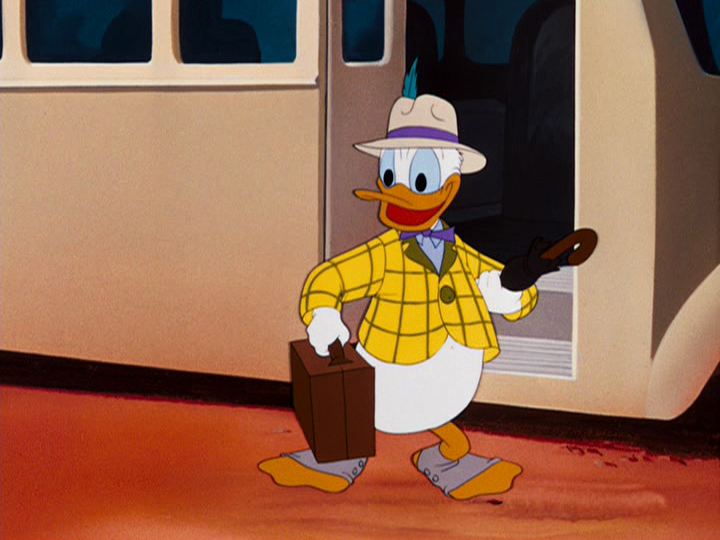
Donald steps off the bus, admiring his surroundings

The audience is taken to the Bar-None Dude Ranch, where the horses are seen relaxing in their stalls, except for one playing horseshoes with his own shoes, whose name is Rover Boy. A bus horn sounds, and a group of beautiful women step out excitedly, ready for their vacation, which causes Rover Boy to wolf whistle and quickly put his shoes back on. Donald is the last to step off the bus, and slowly begins to explore the ranch.

Meanwhile, Rover Boy is busily primping, hoping one of the girls will pick him as her steed. They take little notice of him, however; no matter how much he whistles and pounds his hooves on the fence for their attention. Soon, all the girls are off riding, while Rover Boy stands at the fence, visibly upset.

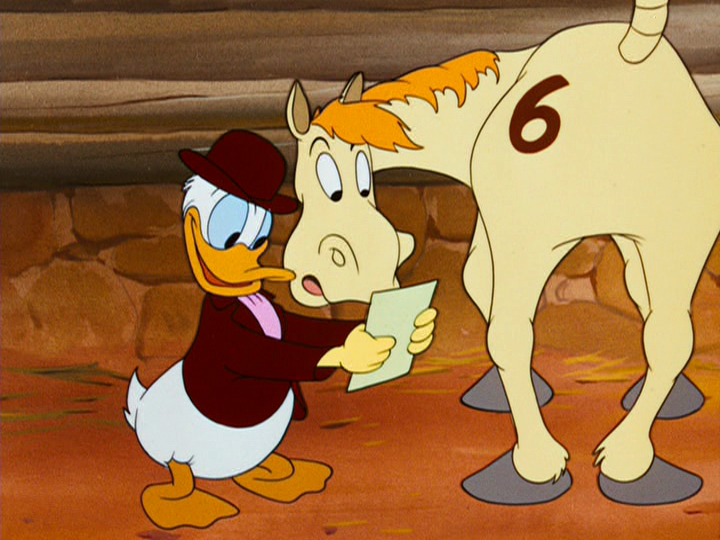
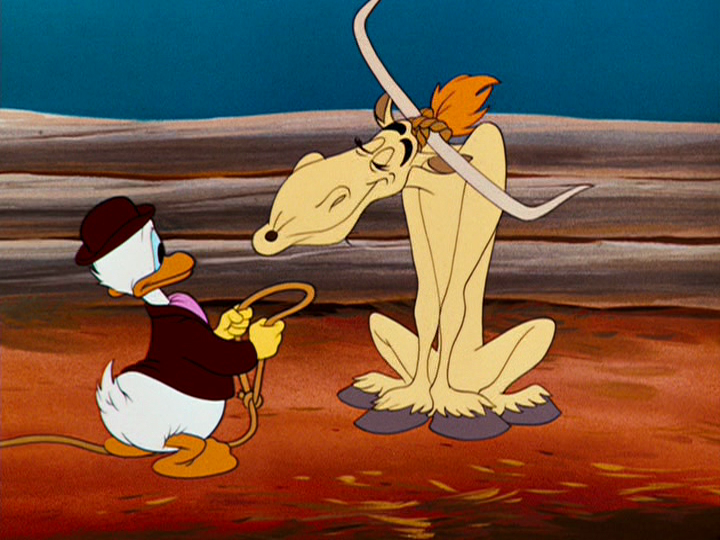
Donald has found his horse - Rover Boy can't believe Donald's his rider

He soon hears whistling, and looks up to see Donald, who is dressed in formal riding gear. Donald approaches Rover Boy, and he studies Donald’s outfit before bursting into peels of laughter. Donald doesn’t seem to notice, but instead walks in the gate and reads the sheet with his name and assigned horse. The horse stops laughing, alarmed that Donald is his assigned rider. He attempts to hide, unsuccessfully, but Donald insists that they get going.

Now desperate to be rid of Donald, Rover Boy fakes an injured leg and a broken back, as well as having no teeth, a horrible cough, heart palpitations, and ultimately, death. Donald rushes to grab some water to help revive the horse, only to have the horse quickly move out of the way as he throws the water. Donald senses something’s amiss, and pulls an apple from his pocket to tempt the horse. Rover Boy tries to fight the temptation of the treat, but ends up taking it from Donald’s hand, chewing it as he still feigns death. Donald then pulls a trumpet from his coat, and the horse quickly is revived, standing in race position. Donald pulls out a starter’s pistol and fires it, and Rover Boy takes off like a shot, before realizing that he gave up his ruse, causing Donald to begin to laugh.

Donald then throws down the saddle and points the gun at his steed, ordering him to put on the saddle. Rover Boy refuses, and Donald begins shooting at the creature’s feet, causing him to jump around the yard. Quickly, he puts on the saddle, and Donald twirls the gun, thinking he’s won, until the gun slips from his finger, leaving only a metal ring. The horse, seeing an opportunity, takes off the saddle. Donald tries to threaten him again, only to find his gun is gone.

"Moo."

Undeterred, Donald grabs a lasso and begins to chase Rover Boy behind some hay bales, but stops when he sees that Rover Boy has attached bull horns to his hair, and gives his pursuer a haughty “Moo.” He whispers in Donald’s ear, presumably telling him where his “horse” has gone, and Donald races on, until he realizes he’s been duped.

Thoroughly frustrated at this point as only Donald can be, he pursues the horse again, with Rover Boy hiding behind some other hay bales and pretending that he’s gone galloping off. Donald almost falls for it, until he looks down and sees the horse. Thinking fast, Donald stands behind the other side of the bales and laments that the horse got away from him, and he’d better go home, then pretends to walk away. The horse falls for this easily, and begins to laugh, thinking he’s gotten rid of the duck. He is then alarmed at the sound of galloping, and a woman’s voice (which the audience is able to see is Donald doing a spot-on imitation) asking for that “big beautiful number 6.” Excited, Rover Boy races out, only to be caught in Donald’s lasso. Calmly, Donald ties the other end of the rope to a post and waits, while the horse is still running wildly.

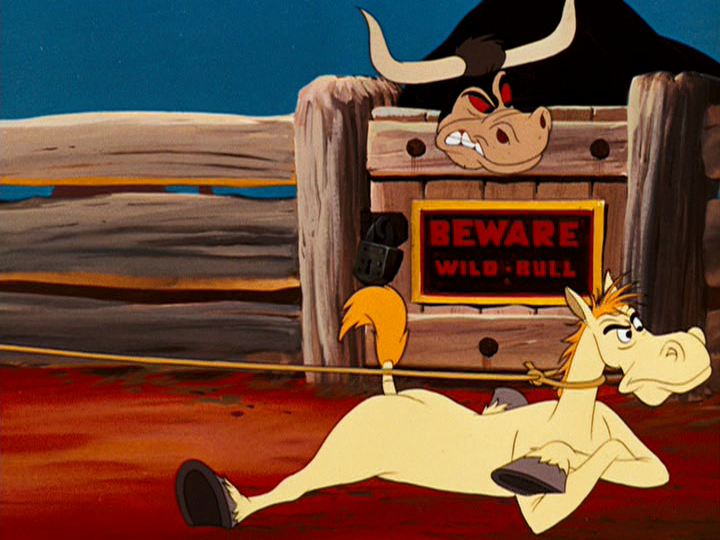
Rover Boy comes up with an evil scheme as he passes the bull pen

Rover Boy is suddenly pulled to a stop, falls to the ground, and can only say, “Oh, no.” Donald laughs at this situation and begins to pull the horse in; unfortunately, the horse passes by the wild bull pen, giving him a wicked idea. We see the horse run to the fence, quietly observing his little plan, while Donald still blissfully pulls on the rope. The horse tilts the bull’s horns in the direction of Donald’s tail, and with Donald giving the rope one final pull, the audience sees only Rover Boy’s reaction, but hears Donald give out a loud scream, and a whistle that indicates the duck shot straight up into the air. He lands on the now saddled bull and rides off into the old west, just as he wanted to in the first place.

March 1

March 1, 1924 – The First Alice Comedy, Alice’s Day at Sea, is Released to Theaters


“It would be a big opportunity for her and would introduce her to the profession in a manner that few children could receive.” – Walt Disney’s letter to Virginia Davis’ mother

On March 1, 1924, after a long process of putting all the pieces of the company in place, the Disney Brothers Studio had their first release of the first of the series of Alice Comedies, entitled Alice’s Day at Sea.

The first six Alice Comedies began with a long  live-action segment, then went into the cartoon. The seventh film had a change of format, when Disney scrapped the live-action introductions. In this first film, Alice goes to the seashore with her dog and falls asleep in a rowboat, and in her dreams, she battles marina wildlife and finds a shipwreck.

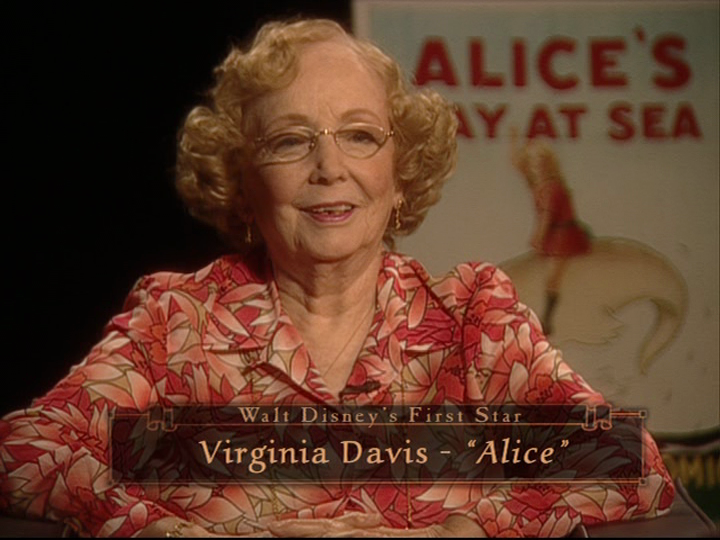
Disney's first star: Virginia Davis

Virginia Davis, the first actress to portray Alice in the Alice comedies, was still living in Kansas City, Missouri, when Walt made his way out to California to create his animation studio. Fortunately, Disney was able to convince her family to move out to California, with Virginia recalling, “Oh, what a salesman [Disney] was…my mother fell for it, but she liked him because she sensed a sincerity in his mind. She really liked him very much; she saw great things in Walt.” When they were ready to film Alice’s Day at Sea, Virginia recalled, “…that film, we came from Missouri, I had never seen the ocean, and all of a sudden there was that sand, and all the ocean…I loved it, I just loved it.”

Walt animated the films by himself, and was able to deliver the first film on December 26, 1923, ahead of schedule, and was able to collect on the offer from Margaret Winkler of $1500. However, Walt was not happy with how it had turned out, and Winkler agreed, telling him that it was only “satisfactory,” but she encouraged Walt by telling him to inject more humor into the shorts. Fortunately, Walt kept producing the shorts, and each one was better than the one preceding it.

February 29

February 29, 1940 – The Last Silly Symphony, The Ugly Duckling, Wins the Academy Award for Best Animated Short Subject

At the 12th Academy Awards, held at The Coconut Grove in Los Angeles on February 29, 1940, the Walt Disney Studios and RKO Radio were awarded an Academy Award for their final Silly Symphony, The Ugly Duckling. The short was up against Detouring America by Warner Brothers, Place on Earth by MGM, and The Pointer, also by the Walt Disney Studios and RKO Radio.

First released April 7, 1939, it was a remake of the 1931 Silly Symphony of the same name, and was the only Silly Symphony ever remade. The story and animation were significantly different from the 1931 short, which shows the tremendous strides in animation the Disney Studios had made in those nine years. Instead of the slapstick and gags they relied so heavily on in the early days of the studio, the 1939 version shows how they were able to make their character emote and become fully fleshed out.

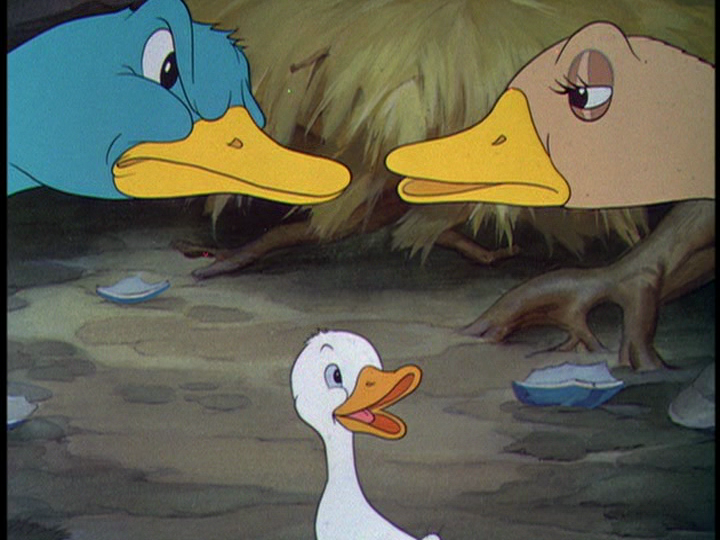
The scene when the father and mother discover the odd looking duckling. Notice the characterization of the characters, which was rather nonexistant in the 1931 short

The plot of this short is based on the Hans Christian Andersen tale, and tells the story through music of a duckling shunned by his family, as he is considered by his parents to be ugly. The duckling, ashamed, tries to find a mother that will accept him the way he is. It’s easy to see, after watching this short, why it would win an Academy Award – it truly was a high note for the Silly Symphonies in which to go out.


February 28

February 28, 1942 – Pluto Short Film Pluto, Junior is Released to Theaters


Pluto, Junior, a Pluto short film, was released by the Disney Studios on February 28, 1942. Directed by Clyde Geronimi and with the voice talent of Pinto Colvig, the short shows a different side of Pluto as a father to a rambunctious puppy that is so much like him in curiosity and ending up in precarious situations.

The short opens on a sunny day, and snoring is heard as the audience sees a ball rolling back and forth across the lawn. As the camera zooms out, we see Pluto and Junior, fast asleep in their respective doghouses, with the ball rolling in between their snores. Pluto’s snore is a bit too strong, and pushes the ball straight into Junior’s nose, startling him awake. Eyeing the ball bouncing up and down, Junior decides that it’s playtime, only to end up being more bullied by the ball than actually playing with it. The ball slips and lands in Pluto’s mouth, who ends up choking on the toy. Seeing his father awake, Junior barks enthusiastically, hoping his father will want to play. Pluto, however, is too tired, and angrily growls at the puppy, scaring the poor thing.

Junior ends up stuck to a stray balloon in the yard

As the puppy rolls backward from trying to get away from Pluto, he ends up rolling onto a balloon, which sticks to him and causes his ears to stand up from the static electricity. Curious, he turns around to sniff the balloon, and ends up trying to attack it, only to pull away the string and let the balloon fly across the yard, landing in Pluto’s mouth. Pluto unwittingly fills the balloon with air as he snores, and Junior, now thinking the balloon is an enemy, tries to sneak up on it, only to be scared of his own growing reflection in the balloon. Junior finally gets the courage to bite it, and it explodes. The sound makes Pluto shoot through the roof of his doghouse.

Junior, meanwhile, ended up in a patch of dandelions from the force of the explosion, and when he sneezed away the dandelion fluff, a worm landed on his head, and is not happy about his new location. Junior tries to pull the worm from his face, only to have it stuck in more humorous positions, such as around his eye like a monocle. Junior finally flings the worm away, and goes after it like a shot, determined to fight it. The chase goes all over the backyard and up a tree, where a hungry bird is waiting to devour the worm.

The hungry bird comically welcomes the worm to walk straight into his mouth

As the bird tries to chase the worm, it accidentally grabs a hold of Junior’s tail, and Junior angrily chases the bird in revenge. The bird flies around with Junior on its tail, until the puppy falls and lands into a sock on the laundry line, with only a feather as his spoils of war. He looks down to see that the ground is so far away, and begins yelping helplessly. Pluto wakes to see Junior in his precarious position and rushes to try and save him.

As Pluto pulls on the laundry line, the line stops when a knot prevents it from moving. Pluto tries his best to get the line to move, and finds himself being carried out on the line and having to walk it like a tightrope. After one daring swing, he ends up flying through the air and landing in some socks, only to have the socks snap away from their pins. Pluto then uses his tail to stay on the rope, and Junior, impressed, begins to cheer his father on. Still trying to rescue the pup, Pluto tries to pull his way down the laundry line, until Junior is right on top of him. Unfortunately, Junior’s enthusiastic wagging hits Pluto’s nose, and he lets out a mighty sneeze, sending both of them into the laundry tub.


February 27

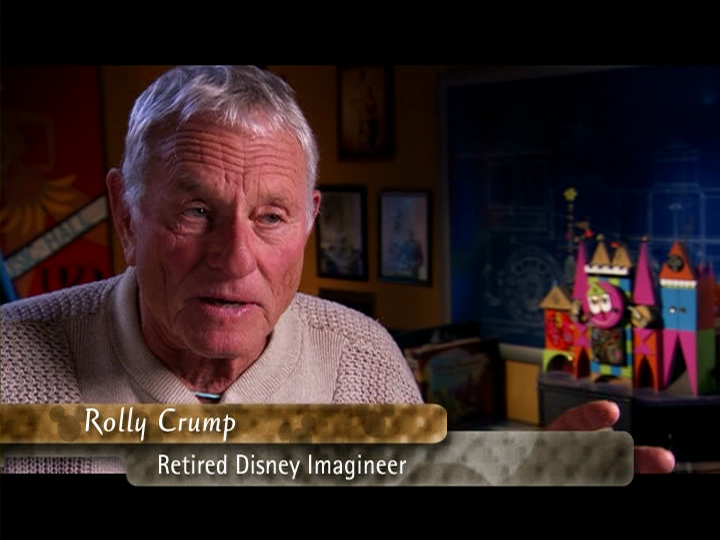
February 27, 1930 – Birth of Imagineer and Disney Legend Rolly Crump

To get a handle on this spirited, multi-talented Disney designer, think: Leonardo da Vinci’s Universal Man.

Born February 27, 1930, in Alhambra, California, Roland “Rolly” Crump became one of the most imaginative people in the Imagineering field. He began working at Disney in 1952, leaving a job as a dipper in a ceramic factory to become an inbetweener artist. He eventually became an assistant animator, with his work including the films Peter Pan, Lady and the Tramp, and Sleeping Beauty.

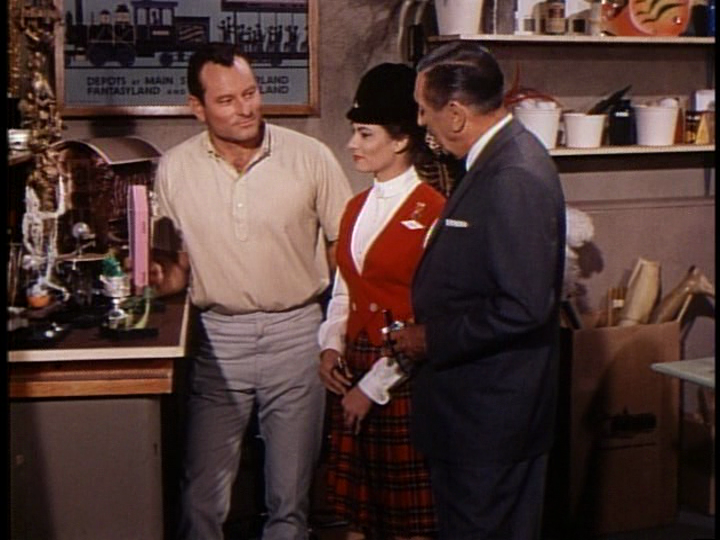
Crump (L) on the 10th Anniversary Show, explaining the upcoming attraction known as the Museum of the Weird

In 1959, Crump moved over to WED Enterprises, designing some of the most popular attractions at Disneyland, including The Haunted Mansion and the Enchanted Tiki Room. Crump even appeared on the Disneyland 10th Anniversary episode, where he explained the idea of a Museum of the Weird (which eventually morphed into part of the Haunted Mansion), where the Imagineers would collect weird things from around the world. “I did a candle man that was melting, I did a chair that stood up and talked,” Crump said of the humble beginnings of the Museum of the Weird. “And while I’m working on all of this, the management at WED and the art directors said, ‘That stuff’s too weird, Walt’s not gonna like that.’ They put all my stuff on a table against a wall in a corner. Finally Walt said, ‘Well, is that it?’ And Dick Irvine said, ‘Yes, Walt, that’s it.’ He said, ‘What’s this stuff in the corner?’ He and I both sat in front of this stuff, and I took him through it. He said, ‘It’s weird.’…The next morning I come to work at 7:30, Walt’s sitting at my chair in the same clothes he was wearing when he left that afternoon the day before, and he said, ‘I didn’t sleep last night…because of all the weird stuff you showed me.’”

Crump also was a key designer for many of the Disney attractions at the New York World’s Fair, particularly the Tower of the Four Winds Marquee for the It’s A Small World attraction. Crump designed the animated clock for the attraction when it was moved to Disneyland.

In 1970, Crump left Disney to become a consultant at other theme parks, including Busch Gardens in Florida and California. In 1976, he returned to Disney as a project designer for Epcot, particularly the “Wonders of Life” and “The Land” pavilions. He left again in 1981, launching the Mariposa Design Group, which created many themed attractions around the world. In 1992, he came back to Disney again, and he again worked with the Epcot pavilions, redesigning and refurbishing the lands there. Crump then retired from Disney in 1996, although he continues to create and dream up new interesting attractions. He was inducted as a Disney Legend at the 2004 ceremony.


February 26

February 26, 1942 – Walt Disney is Awarded the Irving G. Thalberg Memorial Award, and Fantasia Gets Two Special Oscars

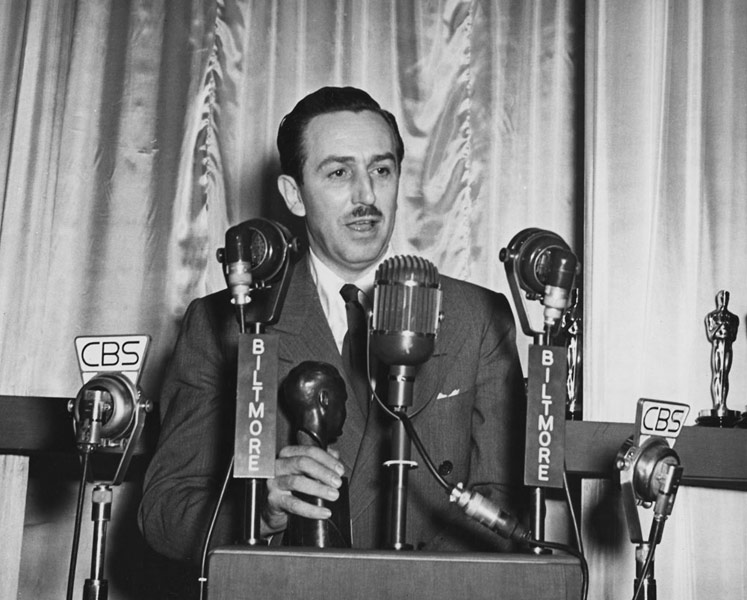
Walt Disney receiving the Irving G. Thalberg Memorial Award

At the 14th Annual Academy Awards, held on February 26, 1942, at the Biltmore Hotel in Los Angeles, it appeared to be a banner year for the Walt Disney Studios. Although Fantasia had not been the commercial success Walt had hoped it would be, it had still been a major innovation when it came to the process of sound in motion pictures. At his awards ceremony, Leopold Stokowski, the conductor of the film, was awarded a special Academy Award; a special Academy Award was presented to Walt Disney, William Garity, John N. A. Hawkins, and the RCA Manufacturing Company for the film, as well. On top of this, Walt Disney was fourth recipient of the Irving G. Thalberg Memorial Award.

The Irving G. Thalberg Award honors those “creative producers whose bodies of work reflect a consistently high quality of motion picture production.” It honors Irving Thalberg, who, at the age of twenty-three, became the vice president and head of production for Louis B. Mayer. Before he died of pneumonia at the age of 37, his work had made MGM one of Hollywood’s most prestigious studios. Disney became the fourth recipient of the award, and although he only had about three feature films and several shorts under his belt, it showed that Disney had made many strides in the fields of animation and motion pictures.

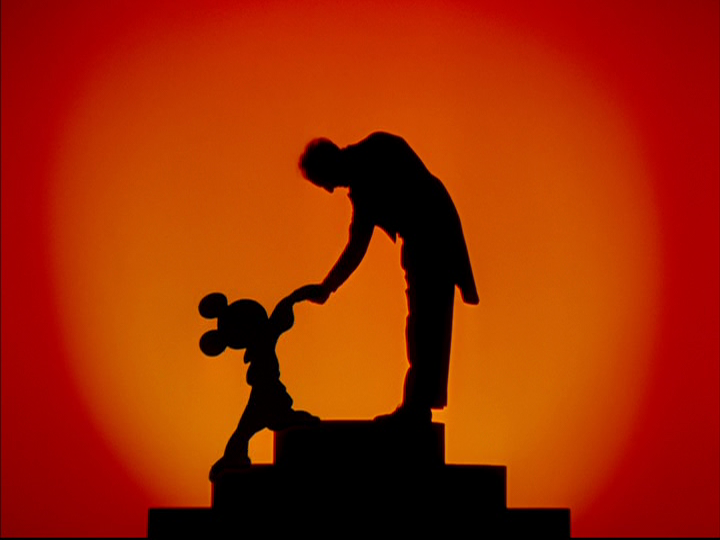
Leopold Stokowski in the iconic image from Fantasia

Leopold Stokowski and his associates were given a special award by the Academy “for their unique achievement in the creation of a new form of visualized music in Walt Disney’s production, Fantasia, thereby widening the scope of the motion picture as entertainment and as an art form.” The other special award—given to Disney, technicians William Garity and John N. A. Hawkins, and RCA—was for “their outstanding contribution to the advancement of the use of sound in motion pictures through the production of Fantasia.” The RCA stereo system that had been honored was truly remarkable for its day, and helped create a concert-like atmosphere for the audience. It was a very expensive system, requiring special equipment to be installed in theaters, which meant that the film originally opened in only 14 theaters.