RSS Feed

June 14

June 14, 1959 –Vice-President Richard M. Nixon and Family Dedicate the Monorail at Disneyland

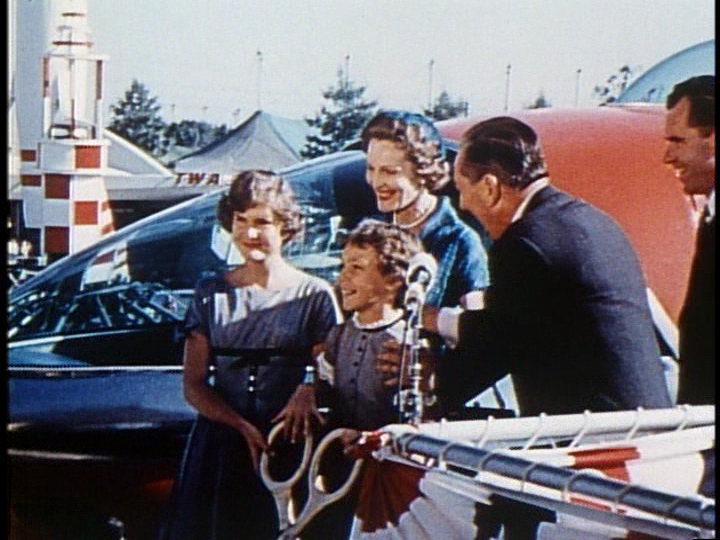
“On the gala celebration of the completion of the project, the Richard Nixon family were on hand to snip the ribbon. Here we were with our monorail, the forerunner of rapid transit of the future, all checked out and ready to go, but somebody forgot to check out the scissors.” – Walt Disney, Disneyland 10th Anniversary Special.

On June 14, 1959, the Monorail was dedicated at Disneyland by Vice-President Richard M. Nixon and his family, with his daughters Tricia and Julie using oversized scissors to cut the ribbon. The scissors, unfortunately, would not cut the ribbon, but with a quick tear, the ride was dedicated and ready to set off. This was Nixon’s second visit to Disneyland; his first visit was shortly after the park was first opened.

The Monorail had been part of an expansion project for the park, which included such attractions as the Matterhorn. Originally known as the Disneyland-Alweg Monorail system (Alweg was the name of the German transportation company that aided in its creation), the Monorail has the distinction of being the first daily operating monorail in the United States. At first, it only traveled around Tomorrowland, but the track was expanded to the Disneyland Hotel in 1961. The ride has been expanded many times over the years, with the Mark III trains added to the ride in 1968, and Mark V trains added between the years 1986 to 1988 (the Mark IV trains were added to the Walt Disney World Resort). The most recent updates to the ride were the refurbishments of the trains beginning in 2007 and ending in 2009. Disney had envisioned the Monorail as a form of public transport in the future, but as his idea came around the time America was becoming more enamored with the automobile, the ride remained in Disney Parks.

June 13

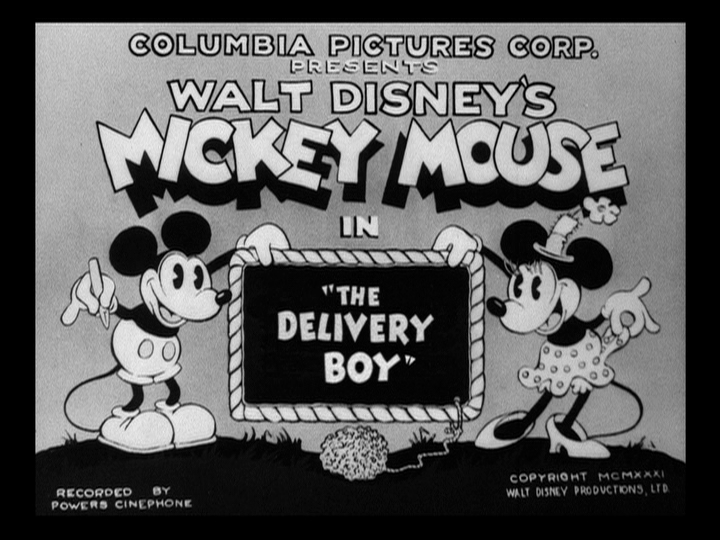
June 13, 1931 – The Mickey Mouse Short The Delivery Boy is Released to Theaters

“In the shade of the old apple tree…”

On June 13, 1931, the Mickey Mouse short film The Delivery Boy was released to theaters. The short was directed by Burt Gillett, and starred the vocals of Walt Disney as Mickey Mouse and Marcellite Garner as Minnie Mouse.

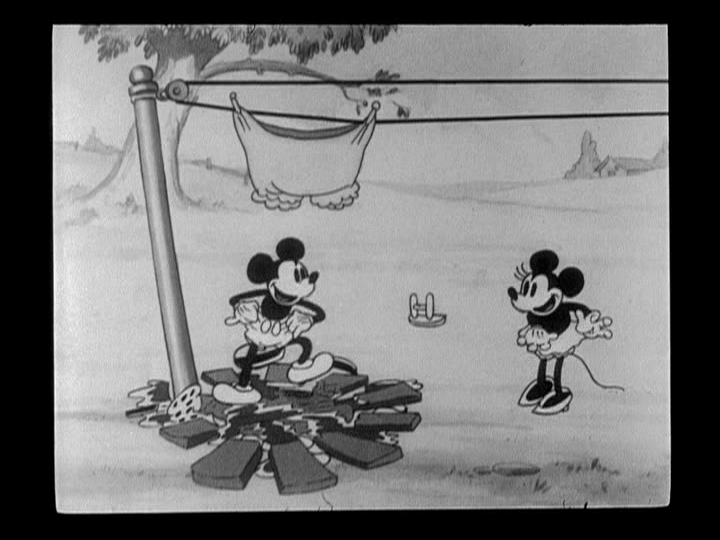
Mickey is seen sitting uncomfortably on an express wagon filled with various musical instruments, with Pluto running alongside excitedly. Mickey is sitting on the keys of a piano, playing a song as he bounces down the path. He stops the wagon as he spies Minnie Mouse, who is doing a load of laundry and singing to herself. Mickey jumps into her yard, with Minnie unaware that he’s been watching her. Unfortunately for her, a goat has been eating her clothes as she wrings them out, and she ends up fighting the goat for her girdle.

Mickey breaks the washtub after Minnie catches on to his jape, and the two begin to dance

Mickey comes up with a plan to greet Minnie: he ties one end of her bloomers on the laundry line closed, then leaps in and pushes himself as if he were in a boat. He begins to sing behind her, and hides in the bloomers when she turns around. He then pulls on her tail and plays it like a guitar string, but she catches on this time that he’s in the bloomers. She pulls him over on top of the tub and opens the closed end, making Mickey fall and break the washtub. The two then begin to dance to an upbeat song, and although Mickey ends up crashing into a tree, they continue to dance happily.

Pluto, meanwhile, has wandered into a puddle of tar, immediately getting stuck. He tries to pull himself out, but only seems to make his situation worse. While they dance, Minnie gives Mickey a kiss, and he leaps around giddily, ending up punching a beehive as if it were a punching bag before returning her kiss, then leaping away giddily again. He kicks the beehive in the end, which lands on his donkey’s tail, and the bees sting the beast, making it kick the wagon fill of instruments.

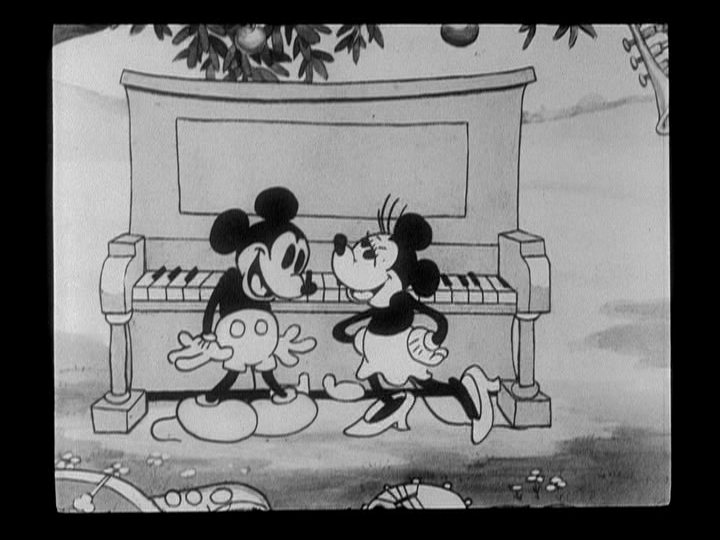
The pair has a very flirtatious conversation as Minnie coaxes him to play the piano

Most of the instruments land in a nearby farm, on the animals’ heads, and the piano lands near Mickey and Minnie. Minnie responds with glee, and asks Mickey if he can play. He responds modestly, and she eggs him on to play something. The two continue flirting, with Mickey saying he has to be coaxed to play the piano. Minnie responds with a smile that she’s coaxing him. He begins to play “Stars and Stripes Forever,” with Minnie joining him, and the two make it a jazzy duet where there share a kiss at the end.

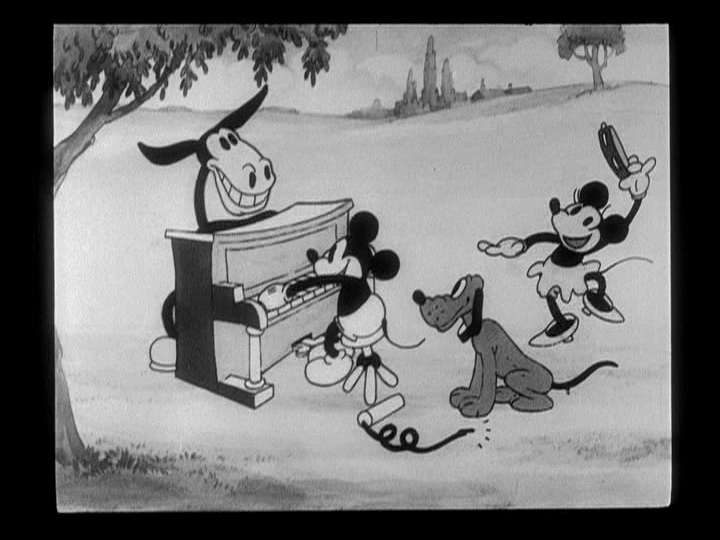
All the farm animals join in on their rendition with the instruments that landed in their barnyard, and Mickey begins to join the barnyard animals in their playing while Minnie carries on with the piano. Pluto, on the other hand, has gotten himself out of the tar, and passes signs that say “Danger! Blasting!” “Achtung! Dynamite!” “Peligro! T.N.T!” and various other languages. But Pluto pays them no mind, and stumbles upon two men lighting a stick of dynamite and throwing it away. Thinking they want to play fetch, Pluto runs after the stick and brings it back. The men dive into a barrel of tar as they try to avoid the blast.

Mickey is oblivious to the surprise his dog has brought him as he continues to play and sing with Minnie and his donkey

As everyone continues dancing merrily, Pluto brings the stick of dynamite to Mickey, who doesn’t notice what Pluto’s brought him. Pluto begins to chew on the stick, but gets distracted by a pack of fleas that have fled from the scene. Suddenly, the dynamite goes off, sending Mickey, Minnie, and the donkey flying sky high. Fortunately, they all land safely and continue dancing.

June 12

June 12, 1928 – Disney Legend and Songwriter Richard M. Sherman is Born

“I was all of seventeen in a terrible, terrible depression, and I decided to take a walk. And as I walked, I was hearing music, and I was wondering, ‘Where is this music coming from?’ And I realized it was coming from my own head. So I darted back to the apartment where we had a little piano, and started picking it out on the piano. There was this feeling I had. I’d never done that before…and my father said, ‘What are you doing here? What is this?’ and I said, ‘This is something I felt, I had to say it. This is what I feel.’” – Richard M. Sherman

Born on June 12, 1928, Richard M. Sherman was the youngest son of Rosa and Al Sherman, the latter a songwriter in what was known as “Tin Pan Alley,” an area in New York City that published popular music that dominated the market from the late 19th century to the early 20th century. The Shermans moved to Beverly Hills, California, in 1937. Richard’s interest in music developed in school, where he studied several instruments, including the flute, the clarinet, the piccolo, and the piano.

In 1958, Richard teamed up with his brother Robert, writing the song “Tall Paul” for Disney star Annette Funicello. It was a top-ten hit, eventually peaking at #7 on the Billboard Hot 100 chart, which caught the attention of Walt Disney. He contacted the Sherman Brothers and hired them to write for the Disney Studios as staff songwriters. The brothers wrote several songs for Disneyland, including their most well-known song “it’s a small world (after all).” They reached their greatest success with the film Mary Poppins, writing the hits “Feed the Birds,” “Supercalifragilisticexpialidocious,” and the Oscar winning “Chim Chim Cher-ee.” The brothers worked for Walt Disney until his death in 1966, and left the company in 1982 after writing songs for Epcot.

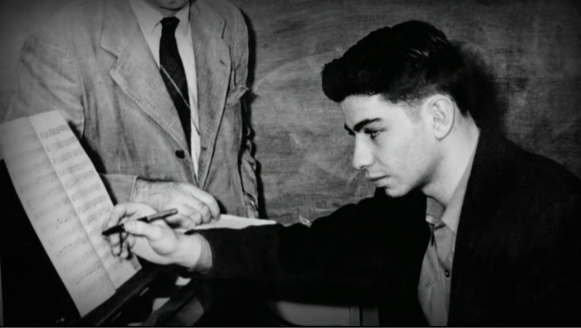
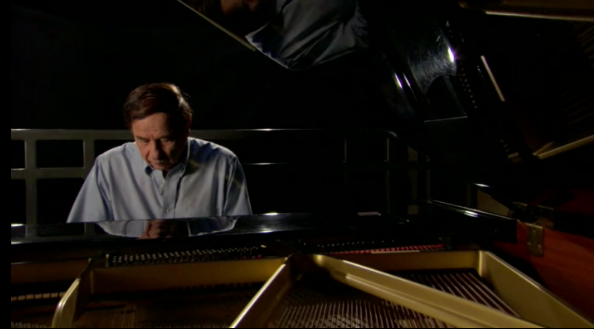
Richard playing one of his compositions in the documentary The Boys: The Sherman Brothers Story

The brothers worked on many projects outside of Disney, including the songs for the film Chitty Chitty Bang Bang and Charlotte’s Web, as well as the hit song “You’re Sixteen,” notable for being a Top Ten hit twice, first by Johnny Burnette in 1960 and Ringo Starr in 1973. Although the brothers had their greatest successes as a team, individually they have contributed greatly to the fields of music and literature. Richard released a CD in 2010 called “Forgotten Dreams,” a compilation of his piano compositions. One of his compositions, titled, “Make Way for Tomorrow Today,” was used in the movie Iron Man 2. The brothers were honored in 1990 as Disney Legends, and were awarded the National Medal of Arts in 2008. As Richard once put it, “We both really didn’t necessarily want to be songwriters. What I wanted to be was a great symphonic composer.” The brothers’ life story was chronicled in the 2009 documentary The Boys: The Sherman Brothers’ Story, which told the tale of how they ended up bound together and delighted the children of the world with their fantastical songs.

June 11

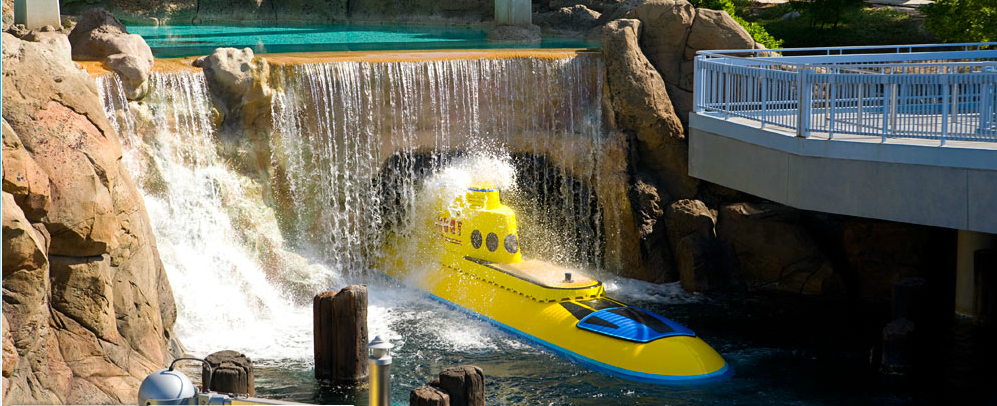
June 11, 2007 – The Finding Nemo Submarine Voyage Attraction Opens

Image Credit: Official Disneyland Website

“Immerse yourself in the world of Disney-Pixar’s Finding Nemo on this fascinating submarine voyage!”

On June 11, 2007, the Finding Nemo Submarine Voyage attraction opened at Tomorrowland in Disneyland. It is a redesign of the Submarine Voyage attraction, which closed in 1998. Guests board the Nautical Exploration and Marine Observation Institute’s research submarine (known as N.E.M.O.), and are able to look out portholes to see a newly erupting volcano and a stunning underwater environment. One of the first views that will delight fans of the movie Finding Nemo is the dentist’s niece Darla swimming around in the coral, holding a baggie containing a fish.

In 1998, after the original Submarine Voyage was closed, it was reported by Paul Pressler, Disneyland’s president at the time, that the ride would be redone with a new theme by 2003. After the box-office failure of Atlantis: The Lost Empire, plans to use that film as the theme were shelved. The success of the Pixar film allowed the attraction to be rebuilt with the Finding Nemo theme.

There’s something for guests above and below the water. Under, guests can put on “sonar headphones,” giving them the ability to hear the fish chatter among themselves, especially as the guests follow Marlin on his search to find Nemo. Onshore, the seagulls from the movie perch on a nearby buoy, shouting their familiar call of “Mine! Mine! Mine!” Guests can also watch the voyage on the “SubCam,” manned by a member of the N.E.M.O. Institute.

June 10

June 10, 1949 – Birth of Disney Legend Kevin “Moochie” Corcoran

“…kids in the audience related more to Corcoran, who created a character who was part All-American boy and part hellion.” – Film Writer Donald Liebenson.

Born on June 10, 1949, in Santa Monica, California, Kevin Anthony Corcoran began his acting career at the tender age of two. In 1956, Corcoran auditioned for a serial on the Mickey Mouse Club called “Adventures in Dairyland,” and won the role of a character named Moochie, a nickname that would stick with him throughout his career at Disney. He was then cast specially by Walt in the sequel serial, “The Further Adventures of Spin and Marty,” as well as “The New Adventures of Spin and Marty.”

Corcoran also appeared in several popular Disney films, with his only starring role as Toby in Toby Tyler, a film about an orphan who runs away to join the circus. He played supporting roles in Old Yeller, The Shaggy Dog, Pollyanna, Swiss Family Robinson, Babes in Toyland, Bon Voyage!, Savage Sam, and A Tiger Walks. Corcoran played the younger brother to actor Tommy Kirk in five Disney films, including Swiss Family Robinson and The Shaggy Dog. Corcoran also voiced Goliath II in the short film of the same name, and was featured in several Disney mini-series and serials, such as Daniel Boone, The Mooncussers, and Johnny Shiloh. After the 1964 film A Tiger Walks, Corcoran mostly retired from acting and attended California State University, getting a degree in theater arts.

Corcoran returned to Disney after college, using his skills behind the camera instead of as an actor, and working as an assistant director and producer on several projects, including Pete’s Dragon. He has also worked as a first assistant director for many television series outside of Disney, including Quantum Leap and Murder She Wrote, also acting as an assistant producer and director on the latter series. Corcoran was inducted as a Disney Legend on October 9, 2006, alongside Tim Considine, David Stollery, and Tommy Kirk.

June 9

Posted on

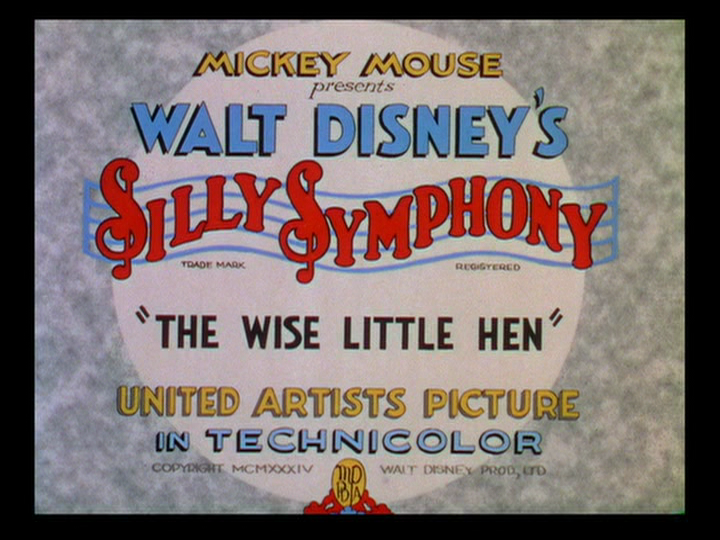
June 9, 1934 – The Silly Symphony The Wise Little Hen Premieres in Theaters

“Who, me? Oh, no! I’ve got a bellyache!”

On June 9, 1934, the Silly Symphony The Wise Little Hen premiered in theaters. It was based on the folk tale The Little Red Hen, and was directed by Wilfred Jackson. It is notable for the debut of Donald Duck, voiced by Clarence “Ducky” Nash; it also stars Florence Gill as the Wise Little Hen, and Pinto Colvig as Peter Pig.

“There once was a wise little hen, who worried now and then, for fear that she’d be found in need when winter came again,” begins the narration in song for the short. The hen is seen stepping out her front door while all of her chicks play in the yard. With a basket of corn under her arm, she sets out to plant the kernels, and decides to ask her neighbors to help her plant her corn. She first stops at Peter Pig’s house, where Peter is playing an accordion and dancing a jig. But when she asks him for help, Peter feigns a stomachache and starts moaning. When she’s not looking, Peter sneaks a smile to the audience.

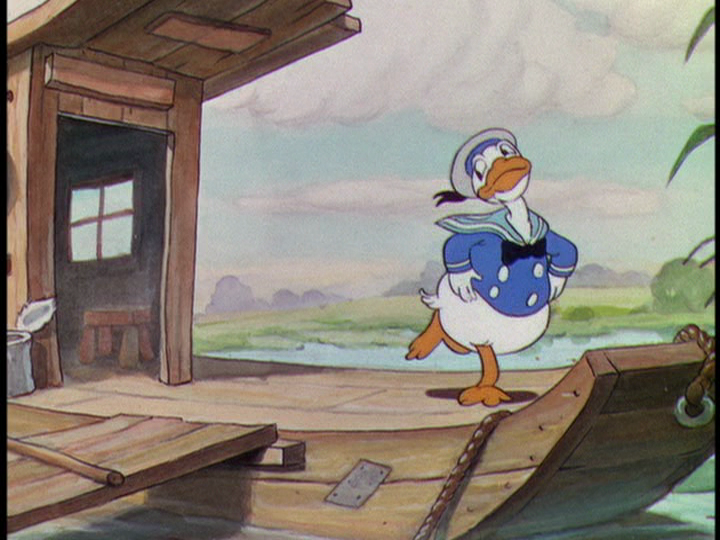
The first appearance of Donald Duck

Upset, but not discouraged, the hen moves on to Donald Duck’s houseboat, where he is also seen jovially dancing. When she asks for help, Donald also feigns a stomachache and begins to moan, also giving the audience a smile when she isn’t looking. Again, she is saddened by this, but decides she’ll just have to do it alone. With the help of her chicks, they dig the rows and plant the corn kernels.

The corn soon sprouts, and the hen and her chicks are excited to see how their crop has grown. She decides to visit Peter Pig and Donald Duck, to ask if they will help her harvest her crop. She finds the two at the “Idle Hour Club,” dancing and singing. When she asks for their help, once again, the two fake stomachaches, and go into their clubhouse, moaning. Part of their clubhouse wall falls down, revealing the two shaking hands and laughing at their supposed deception.

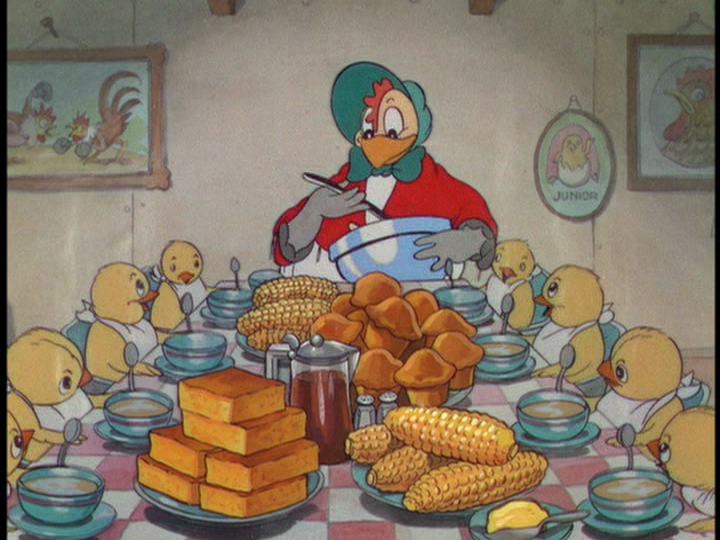
The hen and her chicks enjoying their corn feast that they alone planted and harvested

The hen winks at her chicks, getting an idea. She goes out and harvests her corn, and is soon seen at her oven, cooking and preparing many corn dishes. The entire family is shown around the dinner table, with the table piled high with delicious food, and everyone eating heartily. The Wise Little Hen looks out to see the pig and the duck dancing once again, and they feign stomachaches the moment they spot her, with more symptoms, like seeing spots. The hen asks them if they’ll help her eat her corn, and when they readily agree, she hands them a bottle of castor oil – for tummy aches. The singing narrators let us know that “she’ll eat the corn herself,” with Donald and Peter seen kicking each other for their foolishness.

June 8

Posted on

June 8, 1951 – The Donald Duck Short Test Pilot Donald Premieres in Theaters
“Get out of there, stupid. It belongs to him!”

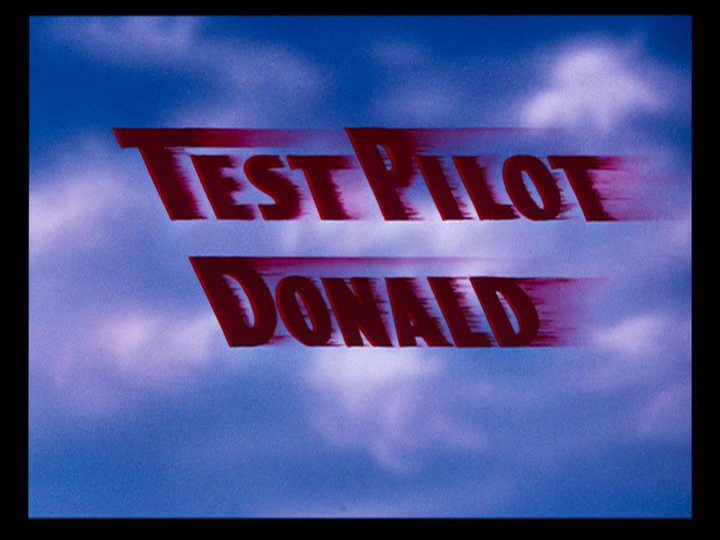
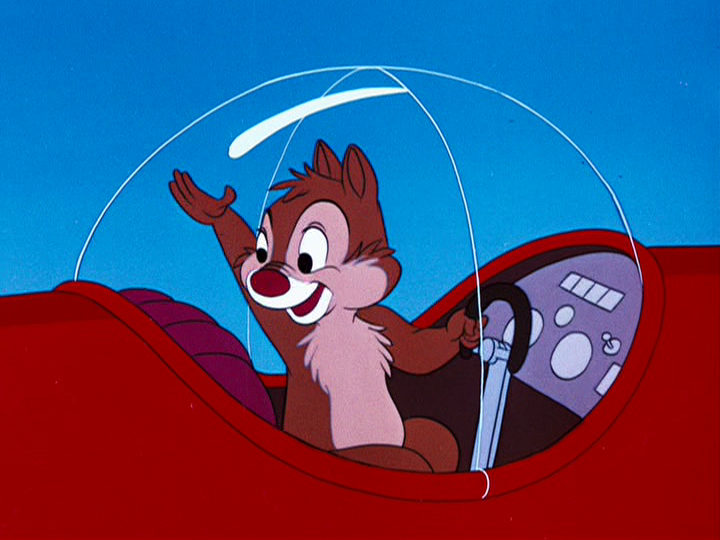
On June 8, 1951, the Donald Duck short film Test Pilot Donald premiered in theaters. This was the 10th short in which Donald had to deal with the antics of Chip and Dale. The short was directed by Jack Hannah, with story by Bill Berg and Nick George, and music by Paul Smith.

A red airplane is zooming through the clouds, and Donald is seen manning the controls, getting ready for a dive. He successfully completes the dive, then checks off his list that the plane is able to maneuver well. As the camera pans back, the audience sees that Donald is only manning a model airplane while camping out in the middle of a park. He sets the plane in for a landing on a pillow, and showers the model with affection.
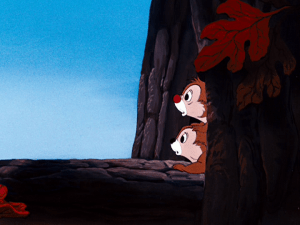
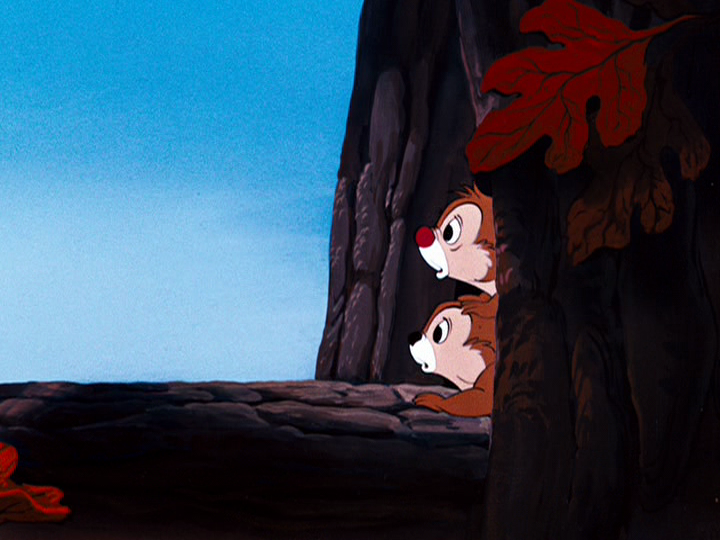
The pair scurries for cover when the model starts to fly a little too close to their tree

From a nearby tree, Chip and Dale are seen admiring the airplane, too, although they scurry for cover when it seems that the plane gets too close to their branch. The plane does eventually get stuck in the tree, with Donald angrily trying to get it free from the branches. As Donald tugs on the string, smoke shoots out of the tail, flying directly into the chipmunks’ hiding place. Dale comes out and, seeing the plane sitting there, decides that this is his chance to fly the plane.

Dale scrambles to the cockpit, only to have Chip pull on his tail. He points out that the plane belongs to Donald, who is still vigorously pulling on the string. Dale doesn’t care, and when Chip isn’t looking, Dale climbs in and starts playing around in the cockpit, when one button causes the plane to shoot off, leaving Chip stunned. Donald just thinks he got it loose, unaware that Dale is flying around happily, pretending he is a real pilot. He steps out of the cockpit and sits out on the wing, with Chip covering his eyes, thinking that Dale could fall at any second.
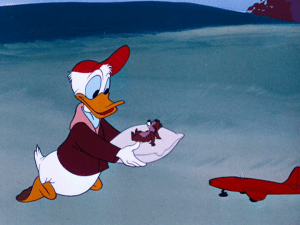
Donald is rather surprised that his plane doesn’t come in for the safe landing, but Dale does instead

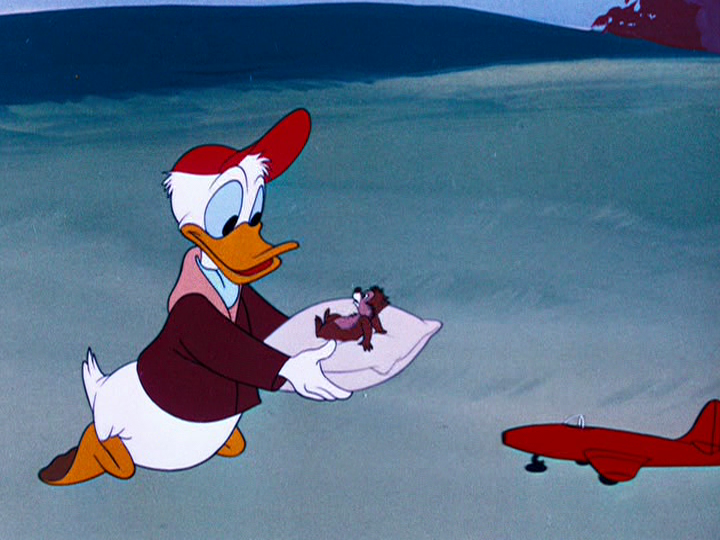
Dale finally looks down to see the danger he’s in, scrambles back into the cockpit, and tries to stop the plane. Donald is confused as to why his plane is running around strangely, and when he holds the pillow out for the plane, Dale ends up tumbling out onto the pillow, much to the surprise of Donald. Donald is immediately infuriated, but soon becomes saddened to see his plane is damaged.

As he fixes the wheel, Dale takes a look inside the engine, and begins to fix the model from the inside. Donald is surprised by this, and shuts Dale inside the plane, annoyed that the critter had the nerve to mess with his model. He then plays a prank on Dale, sending the chipmunk shooting out the tailpipe into a pitcher, where Donald keeps him trapped. Chip runs down from his perch to free his best friend, but is still mad that Dale did something so foolish.
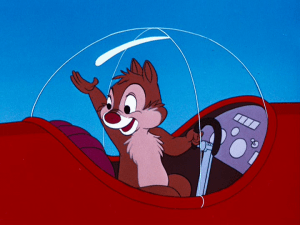
Dale gives his pal a wave as he flies past, unintentionally causing Chip more misery than joy at the situation

As Chip tries to free Dale, Dale digs his way out and gets back in the plane, taking off as Donald tries to fix it. He begins to fly around wildly, waving at Chip as he passes by and sends him flying over the grass. Donald can only watch as his plane has been taken hostage, and flees as he realizes that Dale is going to use him for target practice. Chip just gives up and goes back to his tree while Donald decides to seek revenge.

As Chip continues to taunt the duck, Donald uses a fishing rod to catch the plane and pull it to a stop. Dale, caught, continues to fight, and ends up taking Donald “water skiing” across the pond, while Chip just looks on, frustrated at his friend’s antics. Donald finally catches up with the plane in the air, but Dale parachutes out, leaving the plane without a pilot. The fishing rod gets caught around the top of a building, leaving Donald to fly around in circles for hours, all through the night. Dale points this out as the chipmunks try to sleep, but Chip is still aggravated at his friend’s stupidity.
June 7

Posted on

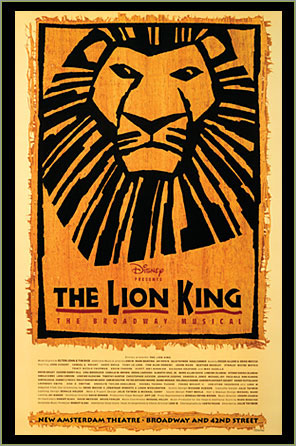
June 7, 1998 – The Lion King Wins Six Tony Awards

Image Credit: The Official Website for the Tony Awards

 “Tom [Schumacher] and I want to thank the Tony committee and the theater community for embracing this show and honoring us this way.” – Peter Schneider

On June 7, 1998, the 52nd Annual Tony Awards were held at Radio City Music Hall in New York. The Lion King musical walked away with six awards, including Best Musical, beating out Ragtime, Side Show, and The Scarlet Pimpernel. The Lion King also won Best Direction of a Musical for director Julie Taymor, Best Choreographer for Garth Fagan, Best Scenic Design for a Musical for Richard Hudson, Best Costume Design for a Musical for Julie Taymor and Michael Curry, and Best Lighting Design of a Musical for Donald Holder.

The musical, based on the animated film released in 1994, was a phenomenon when released on Broadway, smashing records and earning rave reviews. Julie Taymor, the director, was the first female to receive a Tony for Best Direction of a Musical. “Julie Taymor is a goddess; we’re eternally grateful for your courage, your passion, and the genius that is your gift,” Tom Schumacher announced upon receiving the Tony Award for Best Musical. Using her studies in pre-Bunraku puppetry in Japan, Taymor also helped to create the costumes for the musical, with a variety of masks and puppets used to portray the animals in the show; this unique design helped set the musical apart from the movie.

June 6

Posted on

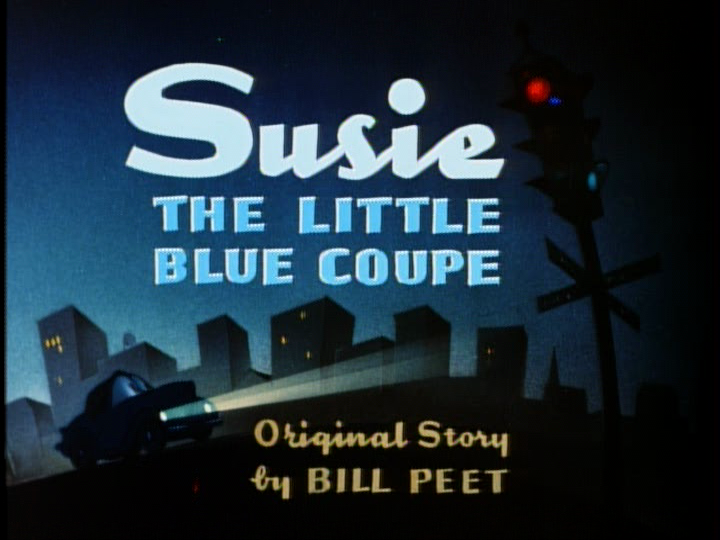
June 6, 1952 – The Special Short Susie, the Little Blue Coupe, is Released to Theaters

“Susie was a happy little car, as she glided down the avenue.”

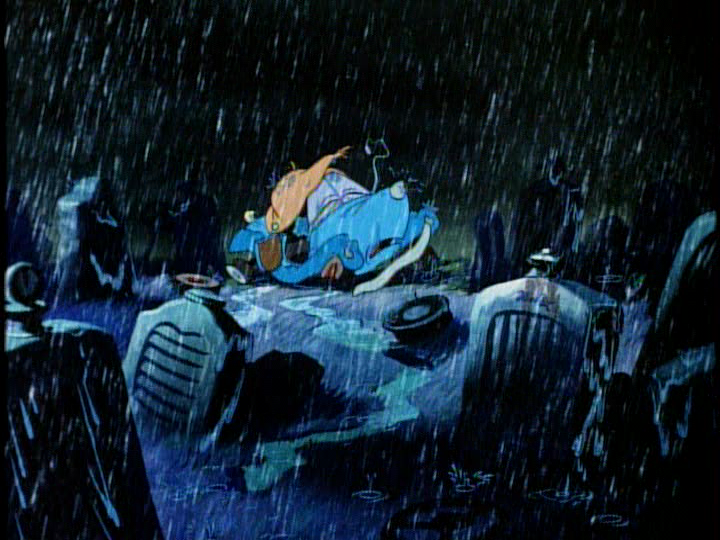
On June 6, 1952, the special short film Susie, the Little Blue Coupe, was released to theaters. It was based on an original story by Bill Peet, with the adaptation to film done by Peet and Don da Gradi. The short was directed by Clyde Geronimi, with music by Paul Smith, and narration provided by Sterling Holloway. The anthropomorphized look of the cars is said to have been an inspiration for the look of the characters in the Pixar films Cars and Cars 2.

“This is the story of Susie,” the narrator begins, with Susie seen in the front showroom of Miller Motors. She had many admirers stop and stare, for she was a beautiful blue coupe. Susie is seen flirting through the window, even giving one of her admirers a wink. One day, a man in a brown suit spotted Susie, and fell in love with her immediately. Susie was thrilled to be sold to the man, and has a cheerful strut as she drives down the road.

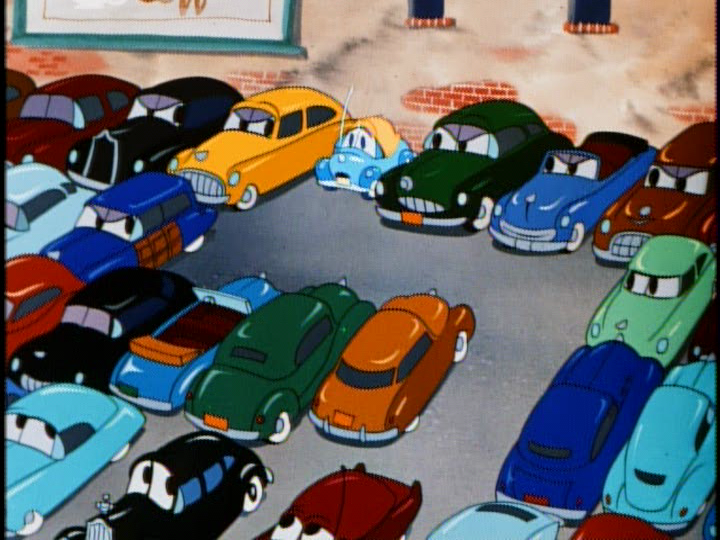
Much smaller than the other cars, Susie huddles in an empty space, intimidated by the others’ mean stares

As Susie entered the main roads, however, she was too slow for the other cars, nearly getting run off the road several times, but she was finally able to maneuver her way around with ease. She also ended up at the Parking Lot, trying to make friends with the big limousines and the big, fancy cars, although they did not take a liking to her. At the end of the day, she was just happy being back in her own garage, with the owner’s cat asleep on her roof.

Years go by, and Susie has not aged gracefully. Her carburetor is having trouble, and her slow speed causes traffic to back up for miles. She goes into Joe’s Garage for a checkup, and when the mechanic lets the owner know that she needs a new overhaul, the owner just says sadly that all he needs is a new car, leaving Susie to be abandoned in a used car lot, on sale for $95.

After the accident, Susie is carted off to where all cars go to die – the junkyard

A rather unsavory looking fellow walks around the car lot, checking out the cars available, when he spots Susie with a smile. He goes to check her out, and decides to buy her. Now, she was driving “back streets and dark alleys,” left out in the cold at night, feeling abused and depressed. One fateful night, as she was left alone on the street as usual, Susie is stolen, and is then pursued by the police. Susie’s captor runs a red light, sending her crashing into a trolley. Susie is then carted away to the junkyard.

Susie sits through the seasons in the junkyard, until one day she is spotted by a young boy, who buys her for $12.50. With the help of his friends, they take her apart and put her back together again, so she’s better than new. Susie speeds down the road, happy to be loved by an owner.

June 5

Posted on

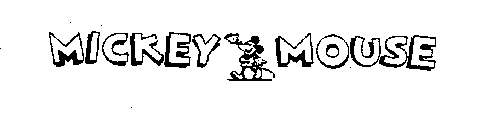
June 5, 1934 – Mickey Mouse Trademark Granted for Newspaper Cartoon Strips

Image from the original patent file. Image credit: US Patent Office Website

“[After the loss of Oswald], that’s when [Walt] decided that he would never not own his own work again. That was a crucial moment in his life and career. He knew then that he had to own whatever he did. And he held fast to that the rest of his life.” – Leonard Maltin.

On June 5, 1934, the United States Patent Office granted the Walt Disney studios a trademark of Mickey Mouse for use in books and newspaper comics. The registrant is listed as the Walt Disney Productions, Ltd. at the Hyperion Studios. The original trademark has since lapsed, but has been renewed three times, the last time on July 14, 1994.

When Walt lost the Oswald the Lucky Rabbit character to Charles Mintz in 1928, he was careful to make sure he owned all of his work and vowed “Never again will I work for somebody else.” The company is very careful to protect its trademarks, no doubt due to Disney’s fierce protection of his work after Mickey Mouse’s creation.