RSS Feed

Category Archives: Uncategorized

July 14

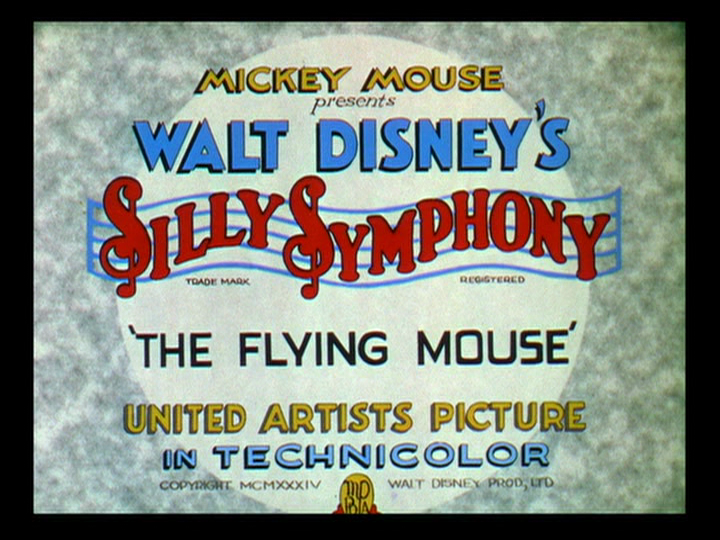
July 14, 1934 – The Silly Symphony The Flying Mouse is Released to Theaters

“Please, I wanna fly like the birds!”

On July 14, 1934, the Silly Symphony The Flying Mouse was released to theaters. It featured a popular song called “You’re Nothin’ But a Nothin’,” composed by Larry Morey and Frank Churchill, which would later be released on sheet music. The short was directed by Dave Hand.

The short opens on a warm spring day at a quaint pumpkin house, with a mother mouse giving her youngest child a bath while her children play see-saw on a mushroom. One of her children is sitting away from everyone, admiring the birds he sees fly high in the sky. His greatest desire is to fly, and he imagines himself soaring through the sky with a beautiful pair of wings. He comes up with the idea to attach leaves to his arms, then calls over for his brothers’ attention. He runs off a branch, attempting to fly, and falls like a rock face-first into a pit of mud. His siblings laugh, but he decides that all he needs is a higher jumping point, and climbs up a flower. As he lifts into the sky, a gust of wind comes his way, and he falls into the tub of water from his sister’s bath, splashing the water everywhere, which causes his sister’s clothes to shrink.

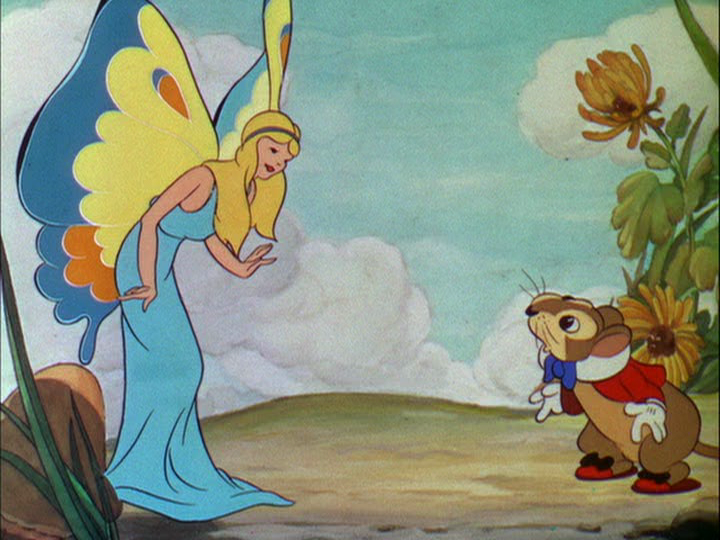
The astonished mouse meets the fairy, who wishes to reward him for his brave deed

After a good spanking from his mother, he runs away to cry as his other siblings laugh at his folly. Suddenly, the mouse hears a cry for help from a beautiful butterfly caught in a spider web, with the spider licking his chops. He saves the butterfly, who turns out to be a beautiful fairy, and offers to grant him one wish for his kindness. Without hesitation, he tells her that he wants to fly. She warns him that mice were never meant to have wings, but after he pleads again, she grants him his wish. He kisses her hand in gratitude, and goes to join the birds in their flying dances. However, although he can fly, he is not welcome at the birds’ party, and is soon all alone. He decides to go surprise his family.

As he flies down, the family members are startled by his shadow, thinking he’s a predator, and they hide inside and throw items at him until he flees. Alone, the mouse ends up in a cave full of bats, who welcome him as one of their own, calling him brother. When the mouse cries that he’s not their brother, they tell him that since he’s not a mouse, and if he’s not a bat, then he’s a nothing. He runs as fast as he can away from the cave, and cries, realizing the wings have only brought him unhappiness. From one of his tears, the fairy reappears, asking why he’s so sad. He tells her he wishes he could die. The fairy tells him to cheer up and be happy that he’s himself, and if he does so, life will smile on him. She then removes his wings, and he’s so happy he kisses her hand once again in gratitude before running home to greet his family.

July 13

July 13, 1925 – Walter Elias Disney Marries Lillian Bounds

“We shared a wonderful, exciting life, and we loved every minute of it. He was a wonderful husband to me, and wonderful and joyful father and grandfather.” – Lillian Bounds Disney

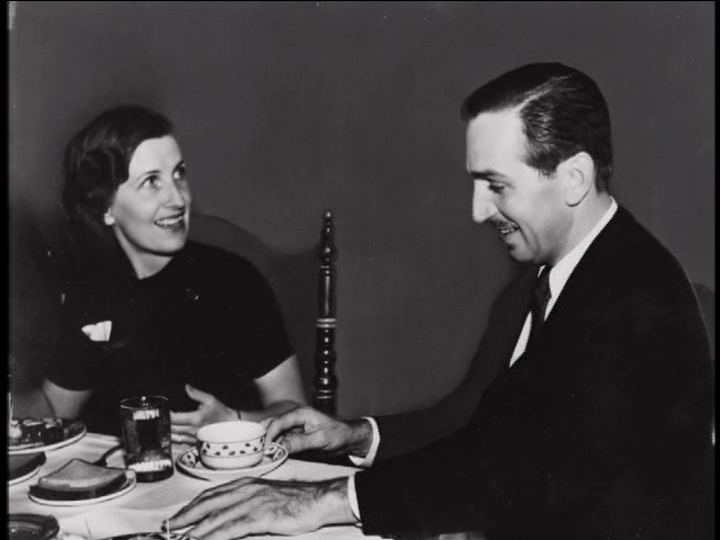
On July 13, 1925, Walt Disney married Lillian Bounds in a small ceremony at Bounds’ brother’s house, with Lillian wearing a lavender gown. They had a year-long courtship beforehand, with Walt coming by Lillian’s house often, long drives in his beloved Moon roadster, and dinner at Hollywood tearooms, and Walt proposed indirectly by asking Lillian to pitch in to either buy a new car or a ring; when Lillian said that she wanted the ring, Walt (with Roy’s help) bought a ¼ carat diamond on a platinum band surrounded by sapphires for seventy-five dollars. The couple remained married for 41 years, until Walt’s death in 196.

July 12

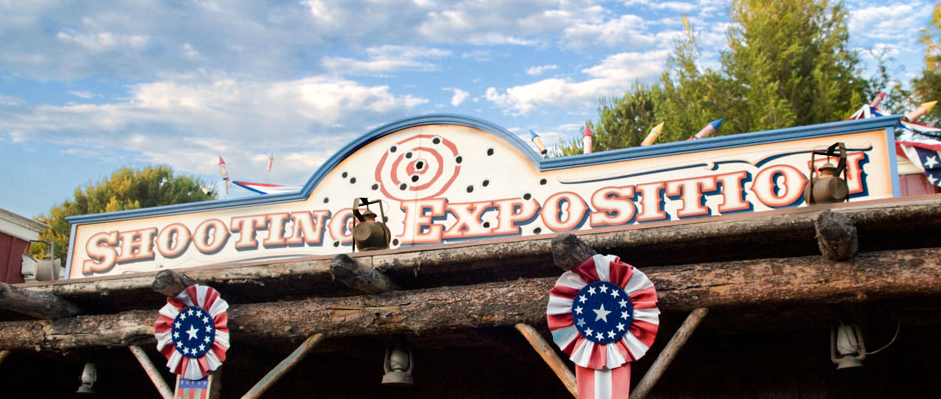
July 12, 1957 – The Frontierland Shooting Gallery Opens in Disneyland

Image Credit: Official Disneyland Website

“Practice your sharp shooting skills at this interactive infrared-rifle arcade.”

On July 12, 1957, the Frontierland Shooting Gallery attraction opened in Disneyland’s Frontierland. Set in the town of Boothill in the 1850s, guests could take a rifle and shoot various Wild West themed targets, including tombstones, cacti, and skeletons. The gallery was closed in 1985, and opened again as the Frontierland Shootin’ Arcade on March 29, 1985, with the entire attraction becoming electronic. The original attraction has guests use lead pellets with .54 caliber Hawken rifles, with the bullets chipping the paint from the targets, requiring the attraction to be repainted nightly.

July 11

July 11, 1947 – The Donald Duck Short Film Donald’s Dilemma is Released to Theaters

“Donald Duck! You are the greatest singer in the world!”

On July 11, 1947, the Donald Duck short film Donald’s Dilemma was released to theaters. Surprisingly, although the title is Donald’s Dilemma, the short is really about the problems Daisy Duck faces when Donald is hit on the head by a flowerpot. The short was directed by Jack King, with the story by Roy Williams, and stars Clarence Nash as Donald Duck and Gloria Blondell as Daisy.

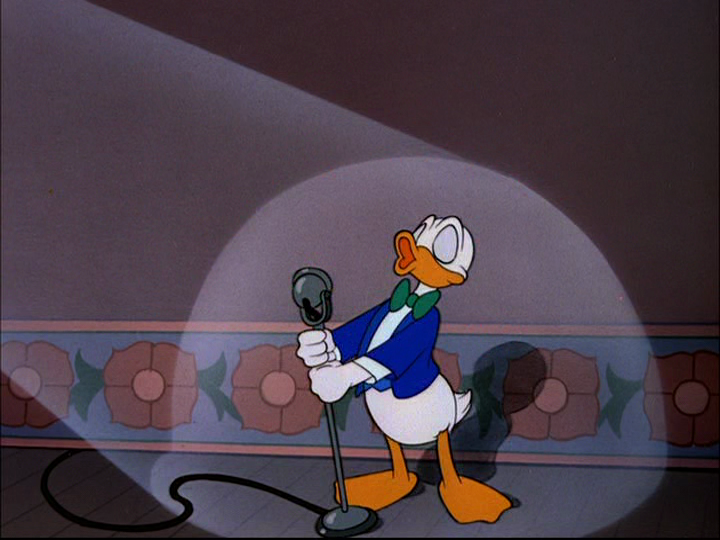
The short opens at the office of psychiatrist Dr. Sigmund Frump, P.D.Q., R.S.V.P., C.O.D., S.O.S., P.M., A.M., P.S., P.P.S., M.O. Sitting at his desk is Daisy Duck, holding a flower. She begins to explain about how she and Donald were taking a walk on a beautiful spring day, when a flowerpot fell from the 99th floor of a tall building and landed smack on Donald’s head. She tried to revive him, but Donald had somehow become someone else: the greatest singer in the world. He grabbed a broom and began to croon “When You Wish Upon a Star” like Frank Sinatra. Unfortunately, Donald has no recollection of Daisy.

Donald becomes a crooner with his rendition of “When You Wish Upon a Star” in the style of Frank Sinatra

As Daisy tried to get Donald’s attention, a theatrical agent snapped Donald up, leaving the flower that hit Donald on the head lying at Daisy’s feet, “a symbol of my lost love,” as she tells the doctor. She never saw him again after that day, except in advertisements, on labels, in society columns, and on marquees. Donald is then seen holding a concert, with the sounds of women swooning in the background. Daisy found that she could not sleep, eat, or even want to live anymore.

Hearing that Donald will sing at Radio City, Daisy rushed there, but it was too late – by the time she hit the box office, the tickets were all sold out. She waited at the stage door, but she was shut out by all the fans that rushed to meet him. Night after night, she waited by the stage door. Finally, she tried to get by the doorman by pleading, disguises, and by force, but she was still unable to see her sweetheart. Then, as luck would have it, she ran into him one night quite by chance. She pleaded with him, telling him how much she missed him, but Donald still didn’t recognize her. After he left her, she decided that maybe it was time to seek therapy to get over Donald.

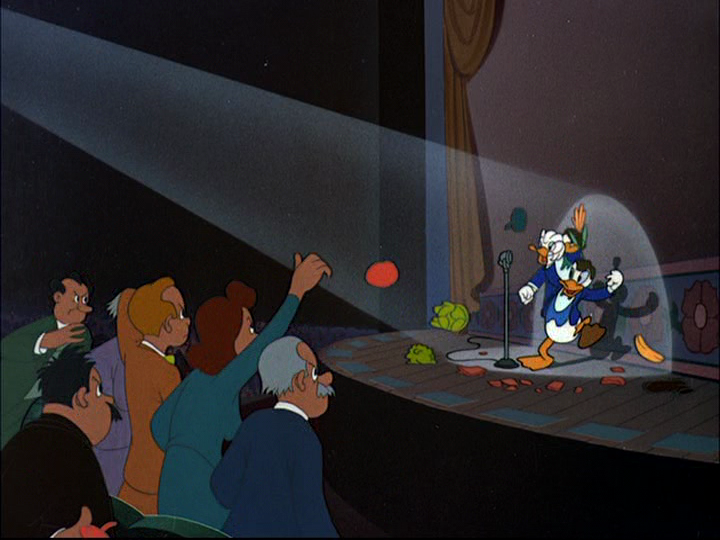
Donald immediately returns to his normal voice, and the crowd begins to throw rotten fruit and vegetables in their anger

The doctor tells her that the hit on the head undoubtedly caused the change, and he can help her, but she has a big decision to make: does she want the world to have Donald and his beautiful voice, or does she want him back again for herself? Without hesitation, Daisy responds that she wants him all to herself, getting rather violent in her haste. He then informs her how to get her Donald back. As she arrives at the stage door with the flower in a flowerpot, she climbs to the top of the theater and drops the flowerpot on his head. On impact, Donald loses his magical voice and is heckled by the audience. He is thrown outside right at Daisy’s feet, where he pulls her into his arms and asks his sweetheart where she’s been.

July 10

July 10, 1981 – The 24th Animated Feature Film, The Fox and the Hound, is Released to Theaters
“My, my, look at that. A fox and a hound, playing together.”

On July 10, 1981, the animated feature film The Fox and the Hound was released to theaters. The film was loosely based on the novel by Daniel P. Mannix, and is notable for being the premiere effort of a new generation of animators, including John Lasseter, who would go on to help create Pixar. The film was directed by Art Stevens, Ted Berman, and Richard Rich. It stars Mickey Rooney as Adult Tod, Keith Mitchell as Young Tod, Kurt Russell as Adult Copper, Corey Feldman as Young Copper, Pearl Bailey as Big Mama, Pat Buttram as Chief, Sandy Duncan as Vixey, Dick Bakalyan as Dinky, Paul Winchell as Boomer, Jack Albertson as Amos Slade, and Jeanette Nolan as Widow Tweed.

The film began production in 1977, but was delayed by a dark part of Disney’s history: Don Bluth and a group of animators defected from the studio, wanting to make films that were reminiscent of the glory days of Disney animation, which they strongly believed couldn’t be done at the Disney studios at that time. There were many arguments in-house about how the film should be handled, with Wolfgang Reitherman, one of the members of the Nine Old Men, championing the idea that the film stay true to the book, which was much darker, ending with the deaths of both Tod and Copper. The film was changed, however, to make it more of a family film.
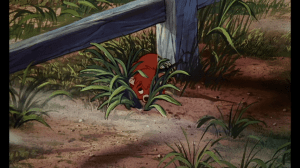
A baby fox is left by his mother at the edges of the Widow Tweed’s farm for his own protection

The film opens in the forest, where a mother fox is carrying her baby away to safety as she is being chased by dogs. The mother leaves her baby at a nearby farm before running off again; a gunshot is heard soon after. An owl named Big Mama flies down from her perch and calms the orphaned fox; with the help of Boomer the woodpecker and Dinky the finch, they alert the Widow Tweed, who decides to take in the fox and raise him. She names him Tod, after remarking that he is “such a little toddler.” Meanwhile, her next-door neighbor Amos Slade brings home a puppy, who he assures will grow into a hunting dog alongside his other dog, Chief.

Time passes, and Tod is growing nicely, curious about everything in the barn. He causes trouble when he tries to eat one of the chicks, and Abigail the cow kicks over the widow’s bucket of milk. Widow Tweed sends Tod out to play, and he spots Dinky and Boomer, hoping they’ll want to play. Dinky and Boomer, however, are on a mission to capture a caterpillar that keeps escaping their clutches. Tod turns to leave and spots a butterfly; curious, he begins to follow it, leading to Amos’s property. The puppy, now named Copper, smells Tod’s scent, and goes to find out what’s making that strange scent. They meet, and Tod asks Copper if he wants to play hide and seek. The two play for hours, quickly becoming the best of friends, until Copper is called back by Amos, in trouble for leaving.
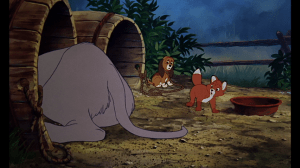
Tod looks curiously at the sleeping Chief, while Copper continuously warns Tod to stay away

Early the next morning, Tod calls out for Copper to come play, and Copper sneaks past a sleeping Chief to go play in the woods, while Big Mama watches from a tree. Amos notices that Copper has gone missing, and calls out for him. Copper heads home, promising Tod to meet him tomorrow, but instead finds himself tied to his doghouse, unable to wander off again. Tod appears, wondering what happened to his friend, and when Copper says he has to stay home, Tod decides they can just play there. Copper warns Tod about Chief, and when Tod goes to take a look at the older dog, Copper can only hide his eyes. Chief opens his eyes to see Tod and attacks, chasing after the fox. Amos grabs his gun and begins to shoot as his farm erupts into chaos, and Tod races for home, jumping in Widow Tweed’s car as Amos begins to drive after her, shooting at the fox. Amos shoots the milk cans the widow is carrying, so the widow takes his gun and shoots his radiator. Amos threatens that the next time Tod is seen on his property, he will shoot him, and he won’t miss his shot.

Out of concern, the Widow Tweed decides that Tod will need to stay inside from them on. The two look out the window to see Amos, Chief and Copper going off on a hunting trip. Tod sneaks out of the crack in the window, wishing to say goodbye to his friend. Big Mama flies down from her perch and begins to teach Tod the truth about foxes and hounds, declaring that if Tod stays friends with Copper, he’s liable to be stuffed on Amos’s wall. Dinky and Boomer show up and open the door to Amos’s shed, showing Tod all the traps and pelts he has hanging up. Big Mama gives the upset Tod a hug, warning him again that Copper will come back a trained killer, but Tod refuses to believe his friend Copper will end up that way.
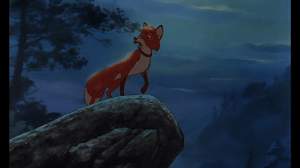
Caught trespassing in Amos’ yard again, Tod is chased by Chief and by Copper, and has to make a run for it in the woods

The seasons pass, with Tod waiting for Copper’s return, and Copper being taken out for hunting training. Chief soon becomes jealous that Copper is besting him in hunting. Finally, spring arrives, and Amos heads home. Tod hears Copper’s howling, and is excited, still convinced that Copper is still his best friend. That night, Tod heads over to Amos’s yard, and the two greet each other warmly before Copper warns him that he shouldn’t be there. Tod asks if they’re still friends, but Copper tells him that those days are over. Tod is heartbroken, and Chief wakes up, alerting Amos, who brings out his gun. Tod is chased through the woods, with Copper finding him. Copper leads Amos off the scent, telling Tod that he’ll let him go just this one time. As Tod tries to make his way home, he is caught by Chief on the railroad tracks, just as a train passes by. Chief is knocked from the tall tracks, badly injured. Copper blames Tod for Chief’s injury and swears vengeance. Tod makes his way home to the Widow Tweed, and Amos shows up at her door, ready to kill him. Although the widow is able to keep Amos away, she comes to the conclusion that although she loves Tod, she has to release him into the game preserve.

Tod has trouble acclimating to the woods after being considered a pet for so long. Caught in a storm, he runs into a porcupine, who offers him shelter for the night. Amos notices the widow coming back without Tod, and swears to Copper they’ll get him, showing the hound dog the trap he’ll use to catch him. The next morning, Big Mama is searching for Tod, and runs across a female fox named Vixey, giving Big Mama the idea to play matchmaker with the two. It’s love at first sight for Tod when he sees Vixey, and their romance begins on a rocky road, but the two come to understand their mutual attraction.
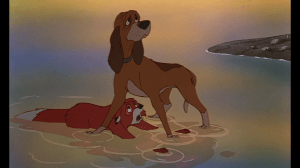
Copper steps in front of Amos’ gun, refusing to let his master shoot his friend

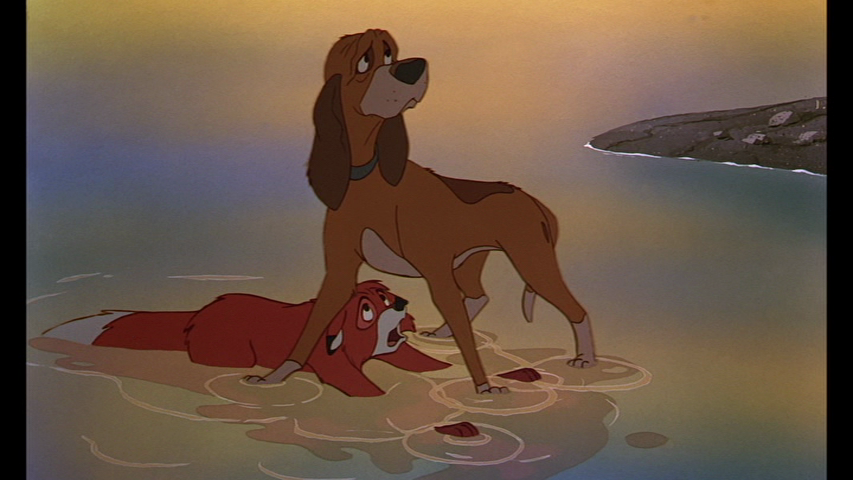
Consumed by revenge, Copper and Amos break into the game preserve to track down and kill Tod. The two set traps out all over the preserve, and Tod eventually comes into their line of sight, narrowly missing getting caught on Amos’s traps. Copper chases after him, with Tod warning Vixey to escape and head for the burrow. The two friends begins to battle it out, but Vixey and Tod end up trapped in their burrow, with Amos on the back end trying to smoke them out. The foxes narrowly escape, with Copper hot on their trail, until Amos and Copper run into a very angry bear. Amos is wounded in the scuffle with the bear, getting his foot caught in a trap. Copper runs to defend his master, and ends up battered by the bear. Tod hears his friend’s cries of pain and leaps into the fight, attacking the bear. Tod ends up in a precarious position over a cliff, and he and the bear fall down into the river below. Tod, fortunately, makes it out alive, although badly injured. Copper finds Todd, and Amos is ready to shoot him, but Copper steps in the way, protecting Tod from Amos’s gun. Amos lets Tod go free, and he and Copper go home.

The Widow Tweed is seen taking care of Amos, who continues to complain and keep his not-so-sunny demeanor. Copper and Chief are seen lying in the yard in their barrels, and Copper reminisces about when Copper and Tod swore to be friends forever. In the distance, Vixey sits with Tod as he watches over the people he once knew.
July 9

Posted on

July 9, 1932 – The Silly Symphony The Bears and the Bees is Released to Theaters

On July 9, 1932, the Silly Symphony short film The Bears and the Bees was released to theaters. The short was directed by Wilfred Jackson.

The short opens in the woods, where a bear and her two cubs are seen sleeping next to a river. The cubs wake up and begin to tussle, in turn waking up their mother, who roars at them before returning to her sleep. The cubs run off to play in the woods, and one of the cubs falls head first onto a rock and gets a rather large bump on his forehead. The other cub runs over and soothes the sibling’s injury before finding a berry bush and pulling off berries for a snack.

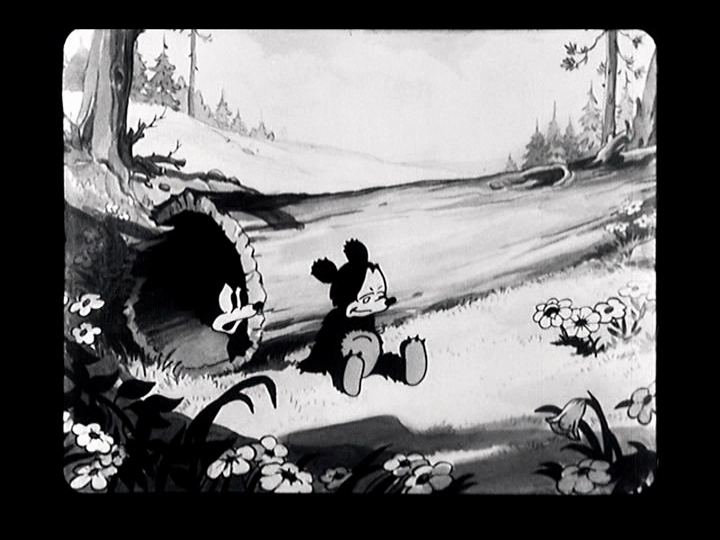
The cubs are bullied by a big black bear and take to hiding in a hollow log nearby

A nearby roaring alerts them, and a large black bear emerges from his cave, growling angrily. He runs to attack the two cubs before eating from what appears to be his berry bush. When the cubs approach to grab just one berry to eat, the black bear startles them and sends them hurrying to a nearby log, where one of them begins to cry at the meanness of the other bear. The other cub tries to cheer the sibling by giving it flowers to eat. When a bee emerges from one of the flowers and begins to buzz around, the cubs follow it curiously.

The cubs spot a flower garden, with bees buzzing all around collecting nectar and taking it back to their hive in a hollowed-out tree. After the bees leave the hive, the cubs poke around inside it, delighted to know that the hive contains honey. They begin to eat the honey in the hive eagerly, until a bee comes back and sees them and sounds the alert to the other bees. Angrily, the swarm grows and immediately heads back to protect the hive.

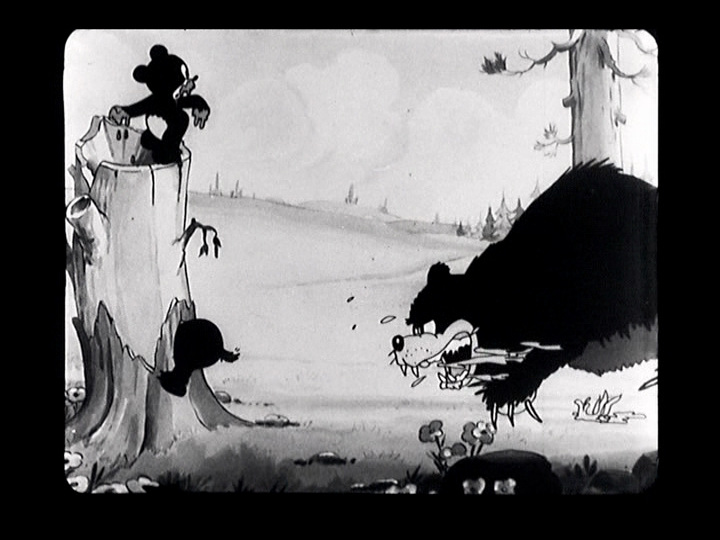
Meanwhile, the angry black bear has spotted the cubs and their honey, and decides he wants it for himself. He charges at the tree and throws the cubs aside, where they can only watch as the swarm heads for the hive and the black bear. The bees attack the bear, covering him with stings while his head is stuck in the hole in the tree. The bees continue their attack, stinging him with points from a plant and a tree branch, before delivering the final blow, sending the bear running for his life. The cubs take advantage of the bees’ disappearance and continue to eat from the now destroyed hive, enjoying all the leftover honey.

July 8

Posted on

July 8, 1938 – The Donald Duck Short Good Scouts is Released to Theaters

“You call that a tree? Shame on you! I’ll show you a man-sized tree!”

On July 8, 1938, the Donald Duck short film Good Scouts was released to theaters. The short was directed by Jack King, and stars Clarence Nash as the voice of Donald and his nephews.

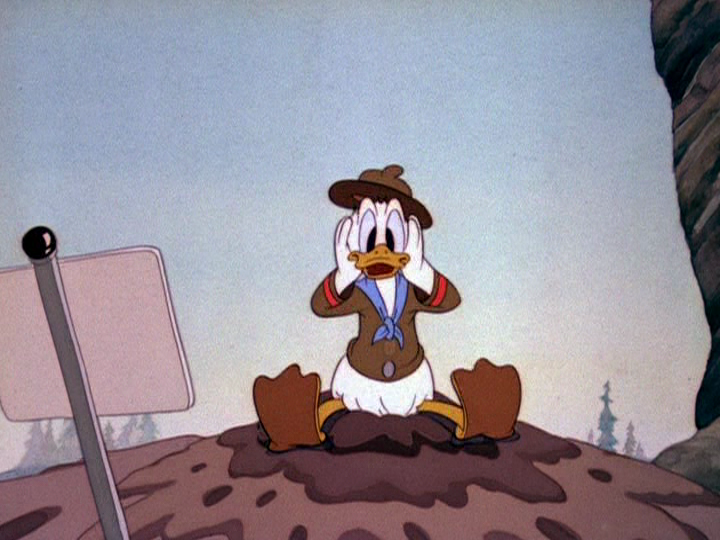
The short opens at Yellowstone National Park, with Donald and his nephews on a scouting expedition. The group marches through the park and settles on a place to set up camp. One of the nephews excitedly runs off to chop firewood, but Donald stops him before he can really do anything, shaming him for trying to chop down a pine sapling. Donald finds what he considers a “man-sized tree” and prepares to chop it down. The nephew notices a sign on the trunk, indicating that it’s a petrified tree, and tries to stop his uncle, but Donald won’t hear of it. He takes a giant swing, and finds himself reverberating from the impact.

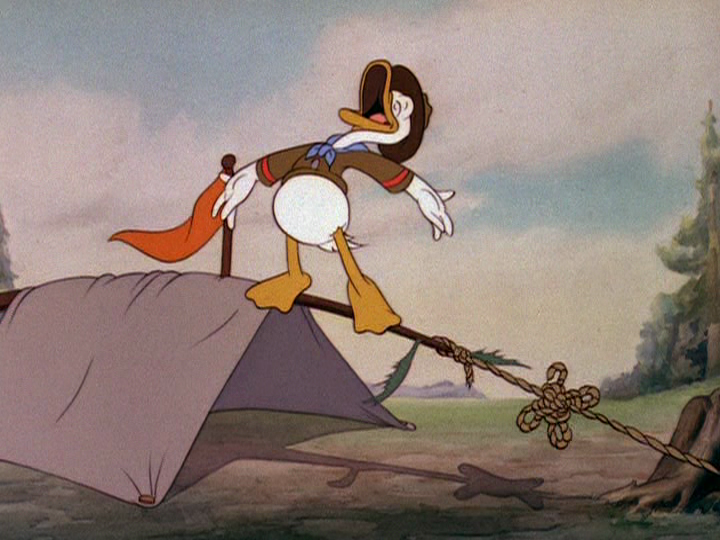
After he stops shaking, Donald looks over to see his nephews struggling to pitch a tent. Berating them and saying they can’t do anything, he pushes them aside and begins to set up the tent, lassoing the top of a pine tree and tying the rope to a rock before knotting it tightly and placing the tent canvas over the bent tree branch. The nephews cheer at their uncle’s victory, but the victory is short-lived when the knot comes undone and sends Donald flying into their food supply. His nephews laugh, and Donald remarks to the audience “That’s gratitude for you.”

As Donald begins to fling the food away, he spies a bottle of ketchup and gets a wicked idea to trick his nephews. He pours the ketchup on himself and pretends he’s dying; the nephews immediately run to their first aid kit and bandage him completely, blinding him and leaving him unable to move his arms and legs properly. Donald stumbles around and lands face-first into a jar of honey. A bear approaches their camp, and with Donald unable to move and covered with honey, the bear begins to lick the honey from Donald’s feet.

Donald just realized that he has fallen on top of the geyser Old Reliable, and it is just about to be set off

Finding that it is indeed a bear after him and not his nephews, Donald hightails it out of there, with his bandages coming loose. The bear grabs one end of a bandage, pulling Donald back from falling off a cliff. The nephews, hiding from the bear, tell Donald they’ll save him, and use to axe to cut his bandage. What none of them realize is that Donald has fallen right on top of the geyser Old Reliable, right as it’s about to blow. The geyser lets loose, and sends Donald flying back into the reaches of the bear. The boys try various methods to save their uncle, including logs and boulders. A large boulder is sent flying up to the top of the geyser’s spout, and the bear climbs on it to chase Donald.


Later that night, the boys wish their uncle good night before they go to sleep in their tent. Donald, unfortunately, is still trapped at the top of the geyser’s blast, with the bear pursuing him as the moon shines high in the sky. All the poor duck can do is sound his whistle as for help.

July 7

Posted on

July 7, 1963 – The Live Action Film Summer Magic is Released to Theaters

“Land of promise, bounteous, this is beautiful, this is beautiful Beulah, in the rocky state of Maine.”

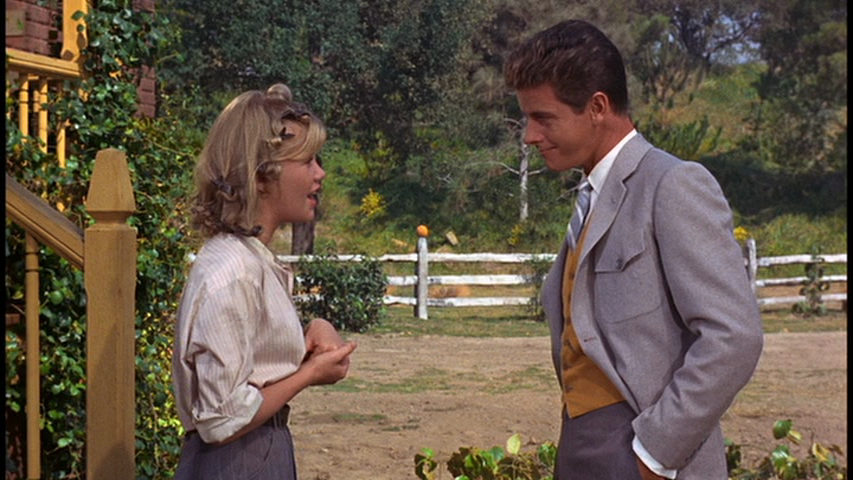
On July 7, 1963, the live action film Summer Magic was released to theaters. The film, based on the book Mother Carey’s Chickens by Kate Douglas Wiggins, is one of the earliest Disney musicals, with music written by Buddy Baker, and songs by the songwriting team the Sherman Brothers, with their song “Ugly Bug Ball” becoming a hit of the year. It was directed by James Neilson, and stars Hayley Mills as Nancy Carey, Burl Ives as Ossian Popham, Dorothy McGuire as Margaret Carey, Deborah Walley as Julia, Eddie Hodges as Gilly, Jimmy Mathers as Peter, Una Merkel as Mariah Popham, and Peter Brown as Tom Hamilton.

The film opens in Boston during the time of Ragtime music. Nancy Carey finds a letter in her front hall, and opens it excitedly, but then gets back to the sad task of packing her house with her brothers, Gilly and Peter. Their father had recently passed away, and the Careys are moving to a smaller house, as they can no longer afford their current residence. Their mother, Margaret, returns from their attorney’s office, with the unfortunate news that the mining stocks they’d counted on to help them are worthless, but she reassures them that they’ll get along fine, although they can’t afford to live in Boston. Nancy excitedly reveals to the family that she wrote the caretaker of a house they’d seen on vacation in Beulah, Maine. The caretaker will allow them to live in the house for $60 a year, and their mother agrees that they should go.

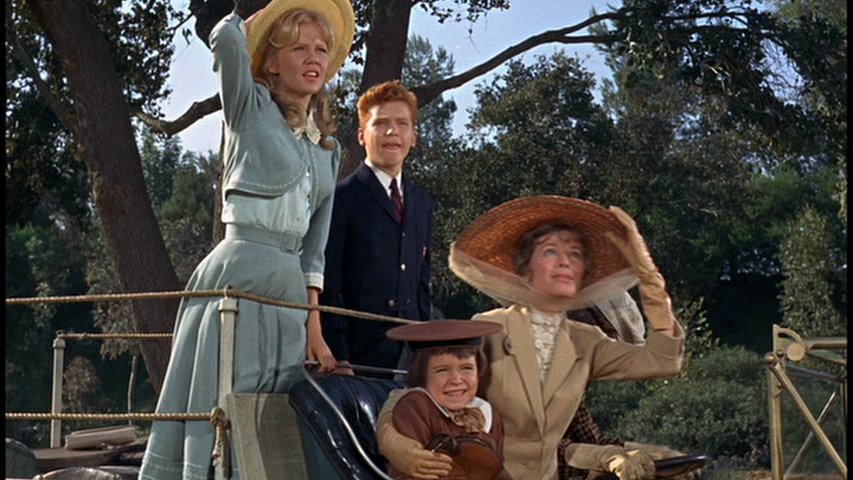
The Careys arriving at the Yellow House in Beulah

The Careys arrive at the “Yellow House,” as they affectionately call it, and meet the caretaker, Ossian Popham. After sorting out some of the “little white lies” in Nancy’s letter (calling her younger brother a “rickety baby,” for one), Mr. Popham allows them to stay and volunteers to help them fix up the house. The Careys soon become acclimated to the small town, with Gilly taking a job as Ossian’s assistant. Peter tries to fit in with the other boys, but is ridiculed and bullied for his Boston-style hair and clothes. Ossian helps Peter out by giving him some “country clothes,” and helps Nancy with all of the supplies she needs. Ossian’s wife, Mariah, is soon suspicious of Ossian’s behavior, and continues to ask if he has actually written the owner of the house, Mr. Hamilton, for permission to allow the Careys to stay there. Ossian continues to avoid her accusations.

The situation gets crazier for the Careys when Peter gets a job taking care of a sheepdog named Sam, who tears through the house and ruins all of Nancy’s wallpaper. Just as they decide that Sam can stay, they learn that another guest will be staying with the Careys: Cousin Julia. This revelation causes great distress for Nancy and Gilly especially, who dislike their cousin immensely for her spoiled attitude. After Julia’s father died, she was adopted by the Fergusons, who felt guilty for selling Julia’s father worthless stocks, the same stocks Nancy’s father invested in. The Fergusons can no longer afford to keep her (“Another unfortunate investment,” Margaret explains), and Margaret asks that Nancy and Gilly keep this a secret from Julia, as the news would devastate her.

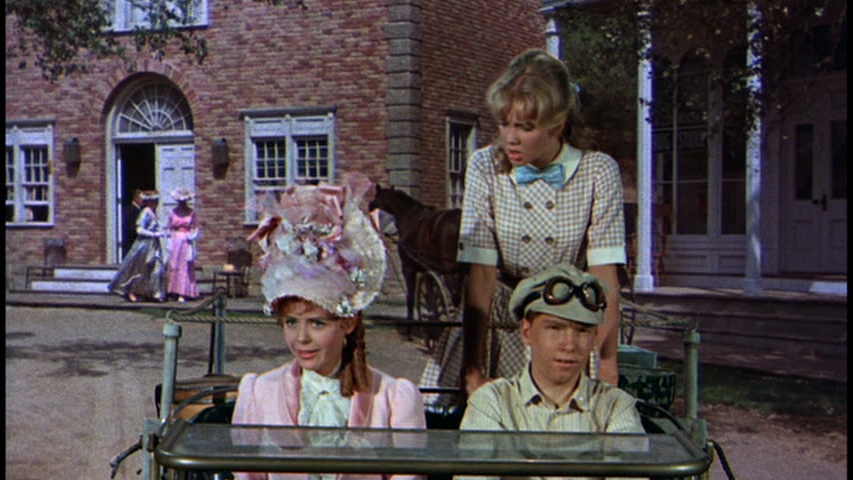
Gilly (Lower Right) and Nancy (Upper Right) drive their cousin Julia to their house; Julia is rather unimpressed with the small town

When Julia arrives, Nancy and Gilly exaggerate every little detail and purposefully try to scare their cousin, pretending that bears will attack their house. After Julia has a good scare when Sam climbs through her bedroom window, Nancy and Gilly try to make peace with her, realizing their pranks may have gone a little too far. Meanwhile, as Margaret tries to face facts with the financials of their situation, Ossian tells them that a letter has arrived from Mr. Hamilton, saying that due to their renovations, he will let them live rent-free, providing they find a suitable place for his mother’s picture. They agree happily, and continue to work on the house. Julia, however, keeps her stuck-up airs and bests Nancy for the attention of the new schoolteacher, Mr. Bryant. Nancy is pushed to her breaking point, and finally tells Julia why she was sent to stay with them. Julia, heartbroken at first, realizes that she wishes to stay with Careys in Beulah, rather than return to the Fergusons, even though they are able to afford to keep her again. Nancy and Julia call a truce and become friends.

Nancy meets a handsome stranger at the house, unaware that she has just met Mr. Hamilton, the owner

The Careys are preparing for their housewarming party on Halloween when a strange man pulls up to the house. Nancy bumps into him and starts telling him the reason for the celebration and the mess the house was in before the Careys took over, unaware that the man she’s talking to is Mr. Hamilton. He soon leaves for town to see Ossian, demanding to know why the Careys are living there, and why Ossian never informed him of anything. Ossian gives Mr. Hamilton all the letters Nancy wrote him, hoping that he will be persuaded by them to let the Careys stay. That evening, as everyone attends the party with their dates, a lonely Nancy shuts herself in her room, refusing to attend alone. Her mother tries to convince her to meet her guests, with Nancy agreeing and putting on a brave face. As she makes her way down the stairs of the house, her shoe falls off and lands right in front of Mr. Hamilton, who has decided to show up with Ossian, and he escorts Nancy to the party. At the party, they unveil what they’ve been told is a picture of Mr. Hamilton’s mother, actually a grim-faced relative of Mariah Popham’s, leaving Mr. Hamilton rather angry. He makes his way over to Nancy, though, and won over by Nancy and her actions, continues to dance with her, an obvious romance blossoming between the two. The film ends with Ossian remarking that “the black cloud has a silver lining.

July 6

Posted on

July 6, 1938 –Actress Luana Patten is Born

On July 6, 1938, Luana Patten was born in Long Beach, California. A model since the age of 3, Patten was picked from hundreds of girls to star in the film Song of the South as Ginny, alongside Bobby Driscoll as Johnny. She would go on to become the first actress to sign a long-term contract with Disney, starring in several films with Driscoll, including Melody Time and So Dear to my Heart. In fact, she and Driscoll were the first long-term contract players at the studio. She also starred in the film Fun and Fancy Free with Edgar Bergen, Charlie McCarthy, and Mortimer Snerd. After taking a brief break to finish high school, Patten returned to the studio for a couple of films, her last role being Nora White in the 1966 film Follow Me, Boys. After leaving the studio, Patten continued to act until 1970, when she retired from the industry. She passed away at the age of 57 in 1996 from respiratory failure.

July 5

Posted on

July 5, 1988 – The Maelstrom Boat Ride Opens in Epcot’s Norway

Image credit: Official Walt Disney World Website

 “Exploring Norway’s heritage isn’t going to be smooth sailing, so buck up like a Viking would!”

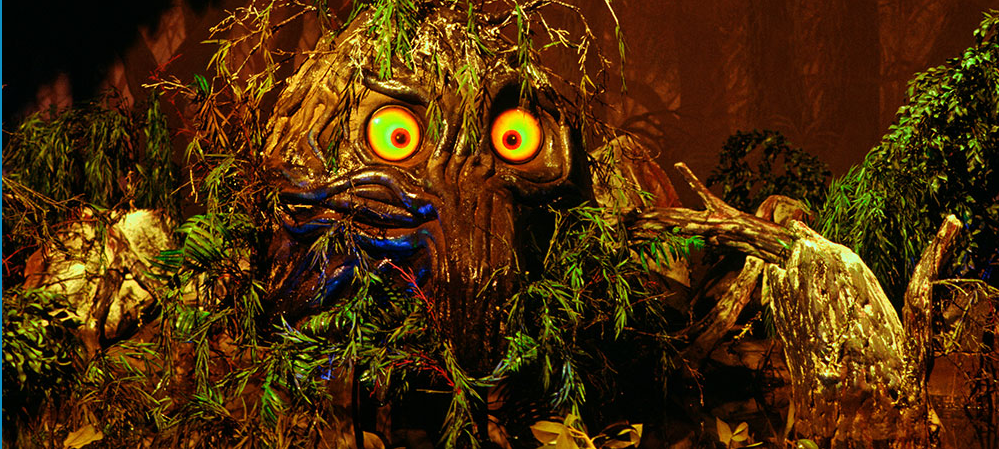
On July 5, 1988, the Maelstrom boat ride attraction opened in Norway in Epcot’s World Showcase. The guests explore Norway from past to present, as they ride in Viking-inspired longboats through scenery that changes from fjords to swamps, and meet trolls, polar bears and pirates. The ride climaxes with the boats plummeting backwards down rapids and narrowly missing a waterfall. After dodging all the obstacles, the guests are treated to a five-minute film about the beauty of present-day Norway.