RSS Feed

Category Archives: Uncategorized

July 24

July 24, 1942 – The Donald Duck Short Film Donald’s Gold Mine is Released to Theaters

“Quack quack quack quack, quack quack quack quack, excavating for a mine…”

On July 24, 1942, the Donald Duck short film Donald’s Gold Mine was released to theaters. It was directed by Dick Lundy, and stars Clarence Nash as the voice of Donald.

The Lucky Duck Mine is hard at work, and Donald is inside, singing a song as he shovels rocks into his cart. His donkey decides to join in the singing (although he is very off-key), much to Donald’s annoyance, and he shoves the cart into the donkey to silence him. The donkey shoves the cart right back, sending a shovel full of rocks down Donald’s throat. Donald tries to trick the donkey into shoving all the rocks out of his stomach, but once he does, he gives the donkey a “Thanks, pal” before giving him another sharp kick.

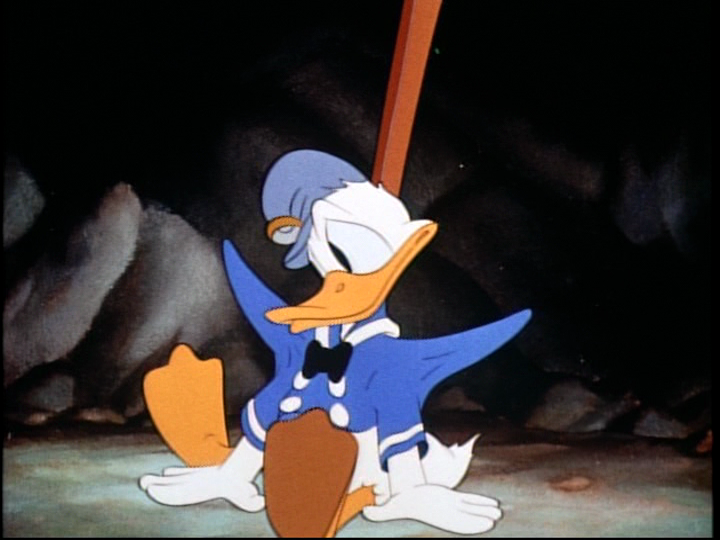
Donald finds the pickaxe stuck in his shirt after a slip from a boulder

Donald then takes a pickaxe and starts to mine, but slips on a boulder and ends up wearing the pickax, which is stuck beneath his shirt. He struggles to remove it, but to no avail, and the donkey continues to bray at the duck’s misfortune. He finally manages to remove to the pickax, which sticks into the ceiling and brings down a multitude of gold nuggets, which land in his cart.

Suddenly seeing dollar signs, Donald climbs into his cart and laughs maniacally at his good fortune, throwing pieces into the air while crying out that he’s rich. Unfortunately, the pieces spook the donkey, who takes off flying with Donald stuck in the cart; Donald and his cargo get dumped in the ore drop shaft when the donkey comes to a sudden stop. The donkey runs to see Donald getting caught in the ore drop process, narrowly missing being crushed over and over again. The donkey comes out to the finish, seeing Donald processed as a 24K gold block, and brays once again at the duck’s misfortune.

July 23

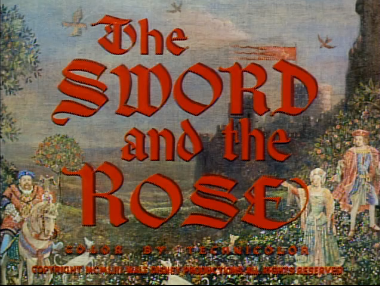
July 23, 1953 – The Live Action Film The Sword and the Rose is Released to Theaters

“Because I like him. And if I liked him not, you’d fall in love with him.”

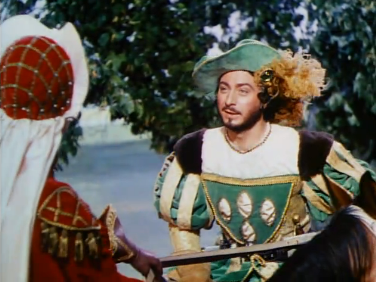
On July 23, 1953, the live-action adventure film The Sword and the Rose was released to theaters. Based on the 1898 novel When Knighthood Was in Flower by Charles Major, it was the third and most elaborate live-action film to be created with the blocked-up funds that Disney had amassed in England during World War II. A policy had been passed that money made in England during the war could not be brought back to the United States, and the Disney Studios used those funds to create Treasure Island, Robin Hood and His Merrie Men, and The Sword and the Rose. The film was directed by Ken Annakin, and starred Richard Todd as Charles Brandon, Glynis Johns as Mary Tudor, James Robertson Justice as Henry VIII, Michael Gough as the Duke of Buckingham, and Jean Mercure as King Louis.

The film is set at Windsor Castle in the early years of the reign of King Henry VIII, and begins with a wrestling match between the English and the French. Henry’s sister, Princess Mary Tudor, appears as he is watching the match, and goes to greet her brother. Henry is not happy that the English are losing to the French, and when he asks if anyone can beat the French, a newcomer to the court named Charles Brandon offers his services. The Duke of Buckingham, vying for the affections of the fair Mary, first tries to wrestle the French, and is successful. Mary, eyeing Brandon, asks her brother how he thinks the newcomer would fare against Buckingham. The two set up their scuffle, and Brandon emerges as the victor, much to the delight of Mary.

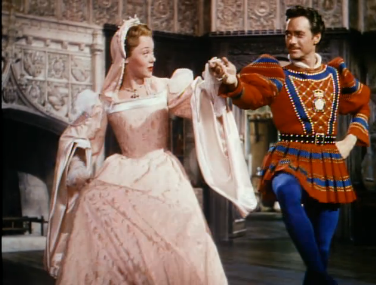
Mary invites Brandon for a private dance in her chambers, highlighting a growing attraction between the two

Brandon is made the Captain of the Guard, thanks to his efforts and the persuasion of Mary. Brandon, however, did not want to stay in England; rather, he wished to seek his fortune in the New World. One of Brandon’s friends warns him not to fall in love with Mary, but Brandon assures his friend that he will do no such thing. Mary is set up to marry King Louis of France, but clearly does not wish to be; she is also pursued by the Duke of Buckingham, who commands the Tower of London. However, Mary is rather intrigued by Brandon, and arranges to have a private dance with him in her chambers. Brandon is invited to the princess’s party, which angers Buckingham, who dislikes Brandon simply for being a commoner. When Mary picks Brandon for her dancing partner in the opening dance, this seals Brandon’s fate, as far as Buckingham is concerned.

The flirting between Brandon and Mary continues, nearly resulting in a kiss between the two during a hunting expedition. While this is going on behind King Henry’s back, he is continuing to arrange the marriage of his sister to the aging King Louis, hoping that this arrangement will provide peace between the two nations. Lady Margaret, Mary’s lady in waiting, worries about Mary’s pursuit of a commoner, but Mary angrily warns her that “Mary Tudor will marry a beggar if she chooses.” When she rushes to find Brandon, she finds that he has resigned from his post and set of for Bristol to board a ship for the New World. Heartbroken, yet determined, Mary dresses as a boy and follows him, telling him that she intends to sail away with him. The pair finally share their first kiss, and attempt to set sail, but her identity is soon exposed and the two are sent back ashore.

The heir to the French throne, who has not made his attempt to woo Mary subtle in the least, threatens her that she will remain to be his after King Louis dies

When King Henry gets wind of what happened, Brandon is arrested and sent to the Tower of London. Mary pleads with her brother to save Brandon, and promises to even marry King Louis. Buckingham also comes up with the promise that Mary can marry anyone she chooses after Louis dies. Brandon is to be freed after she marries Louis, and she asks Buckingham, whom she believes to be her truest friend, to inform Brandon of the deal, since she is not permitted to see him. Buckingham, however, plans to help Brandon arrange an “escape,” but then have him murdered as he does so. Mary continues to cause mischief, having King Louis drink lots of wine and be active, deteriorating his already frail health. His heir declares to Mary that she is never to leave, as he claims her for his own after the king dies. She sends Lady Margaret to England to find Buckingham and rescue Brandon, but is greeted with grim news, as Buckingham declares that Brandon’s body lies at the bottom of the Thames. Buckingham declares that he will go to France to rescue her himself. Brandon’s friends, however, find Brandon is alive and well, and retrieve him from his hiding spot.

Mary leaves with Buckingham, and he informs her that Brandon is dead. Still consumed with his love for her, Buckingham takes her to rest at a church and tries to force Mary to marry him. She tries to struggle, but he threatens to take her back to the French if she does not agree. Brandon arrives just in time to rescue Mary and the two escape. Brandon notices that they are being pursued by Buckingham’s men, and in ends with a climactic swordfight between Buckingham and Brandon, with Brandon emerging victorious. True to his word, although rather reluctant, King Henry allows Mary to marry whomever she wants, and the king makes Brandon the Duke of Suffolk.

July 22

July 22, 1994 – The Twilight Zone Tower of Terror Opens at Disney-MGM Studios

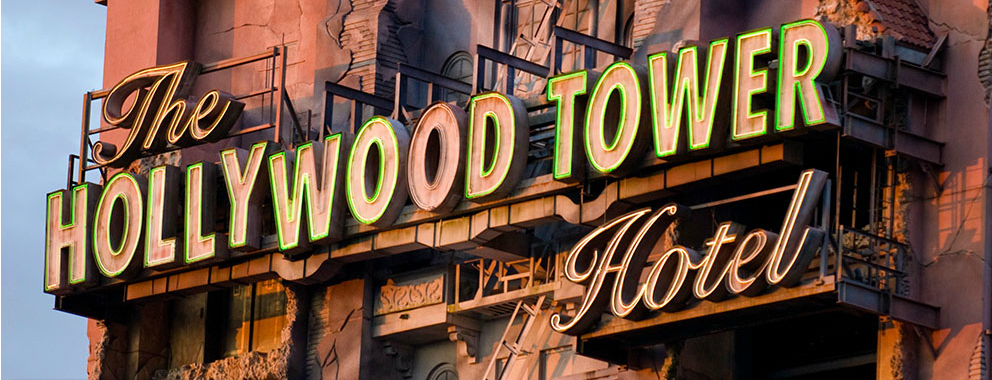
Image Credit: Official Walt Disney World Website

“Ah, but this is no ordinary hotel. Its phantom elevator is located beyond the fifth dimension, the one that crosses over into The Twilight Zone.”

On July 22, 1994, the Twilight Zone Tower of Terror attraction opened on Sunset Boulevard in the Disney-MGM Studios (later renamed Disney’s Hollywood Studios Theme Park) of Walt Disney World. The attraction, located in the Hollywood Tower Hotel, is a drop-tower thrill ride based on the classic television show The Twilight Zone. Legend has it that the hotel, a well-known hotspot for members of the Golden Age of Hollywood, was hit by a storm on Halloween night, 1939. Five unlucky passengers in the elevator disappeared when lightning struck the building, sending them to the Twilight Zone.

Guests enter the decaying hotel for a tour of the lobby, the library, and the boiler room. Guests hear narration by Rod Serling, the original narrator of the classic show, as they enter the elevator; at the last word of his narration, the elevator begins its drop sequence, which is “randomly selected by the Tower itself.” At the end of the drop, the elevator returns to the basement, letting the passengers exit after a final narration from Serling.

July 21

July 21, 1942 – The Animated Educational Film Food Will Win the War is Delivered to the Department of Agriculture

“In many lands, towns are ravaged – countrysides laid waste by ruthless Axis hordes. Farms, cattle, and crops have been destroyed. Ruin, destitution, hunger stalk the helpless victims of the cruel aggressor.”

On July 21, 1942, the Disney Studios delivered the animated educational film Food Will Win the War to the U.S. Department of Agriculture. At the time, the studios were producing many animated educational shorts, which still had the Disney touch in their animation and gags. These shorts, like this one, were also used to help build morale. The film was directed by Hamilton Luske, and is narrated by Fred Shields.

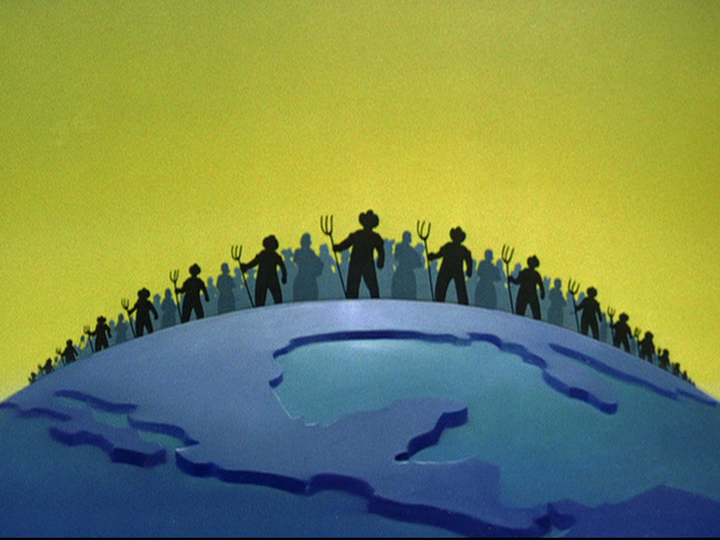
The film begins with the declaration that the world is aflame, as the members of the united nations are at war. Images cross the screen of war-torn towns, with a couple sitting, staring at what was once their home. However, a light of hope appears in the sky, called the Hope of American Agriculture. America is filled with abundant farmlands, and the animation shows that every single affected country can fit within the U.S., proving that there is enough abundant farmland and crops to help these crippled countries. There are 30 million farmers, with their wives and children, ready to help these countries in need, “twice as many as the Axis has soldiers,” the narrator states.

The farmers, their wives, and their children stand on the surface of the globe, ready to use their crops as weapons to help win the war

The farmers receive their own patriotic segment that portrays them as important soldiers in the battle, with tools (farm machinery), regiments of trucks, and divisions of corn pickers, all while working under the stress of war. One crop example is wheat; the narrator explains that the crop for the year is 52,800,000,000 pounds of wheat. “If all this wheat were made into flour,” he says, “there’d be enough to snow under the entire German Panzer Army.” The narrator moves on to the importance of corn, soybeans, potatoes, tomatoes, various vegetables and fruits, dairy, meat, and eggs, using humor for their examples. The farmers are then lauded for their important job, as a part of the war effort as much as any solider: Their food will help win the war.

July 20

July 20, 1951 – The Donald Duck Short Film Lucky Number is Released to Theaters

“Flash! Here it is, ladies and gentlemen. Get your tickets ready for the big drawing of the new Zoom V-8, the super car of the continent!”

On July 20, 1951, the Donald Duck short film Lucky Number was released to theaters. It was directed by Jack Hannah, with the story by Nick George and Bill Berg. It stars Clarence Nash as the voices of Donald, Huey, Dewey, and Louie.

It’s a lovely day at Donald’s Service Station, and Donald is outside cleaning the pumps while his nephews are fixing a car in the garage. The radio announcer interrupts their activities, announcing that it’s time to declare a winner for the drawing of a new car. The boys call their uncle over, and he holds up his ticket excitedly; unfortunately, he is off by only one number. He drops the ticket angrily and marches back to his chores.

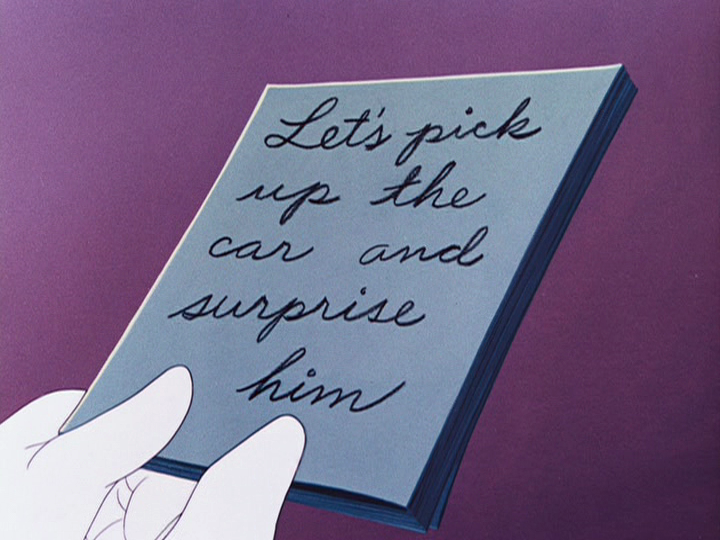
One of the nephews writes a note to the others to keep his idea a secret from Uncle Donald

Just as Donald leaves the garage, the announcer says there’s been a slight error, and declares Donald’s number the winner. The nephews grab Donald’s discarded ticket and decide to surprise him by picking up the car themselves. The announcer continues that the winner must be at the car lot by two o’clock, or a new winner will be drawn. Realizing they only have ten minutes to get there, the nephews quickly fix their car and speed out of the garage, much to the annoyance of Donald, who yells at them as they pass.

It’s smooth sailing at first for the trio, but they soon realize they’re out of gas. They quickly drive back to the service station, where Donald is not happy to see them. Without any money to pay for the gas, Donald refuses to fill their car, pushing them into a billboard of the Zoom V-8, the very car Donald has won. The nephews come up with a quick plan, and attack the billboard with a saw.

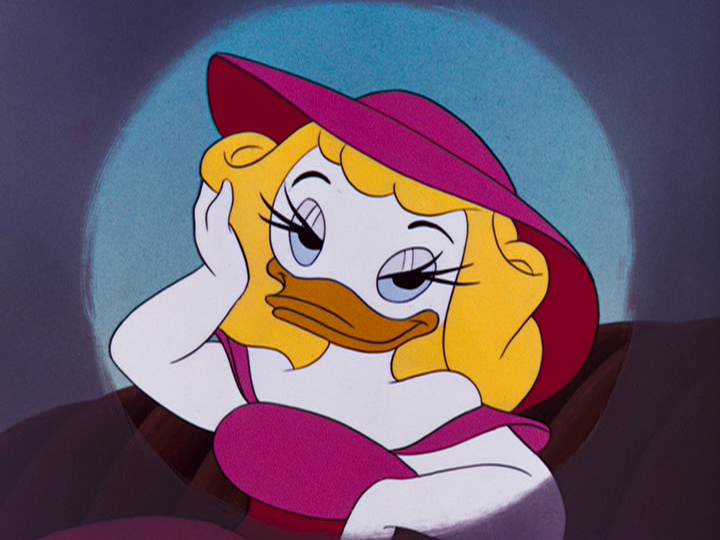
One of the nephews disguises himself as a beautiful woman so he can trick Donald into filling the car with gas

Disguised as the new car, and one of the nephews dressed as a woman, Donald doesn’t hesitate to help the “lady” out, and the nephews quickly drive away, with Donald still daydreaming. Realizing he’s been tricked, he runs inside just as the phone rings. The man on the other end lets Donald know that his nephews are coming back with a big surprise for him, and he decides he’s going to get them back.

Grabbing a big barrel of oil sludge, he waits until the trio comes back with the new car. Thinking that he’s been tricked again, he covers the new car in the sludge, then pours gasoline on the three to “wash them off.” He then overinflates the car’s tires, while the nephews can only watch in horror. The final blow is when he crushes the car, sending the wheels flying into the air. As Donald laughs at his handiwork, the radio announcer tells everyone that Donald Duck must be enjoying his new car, taking it out for a spin in the country. Realizing what he’s done, he faints, and his nephews can only shrug.

July 19

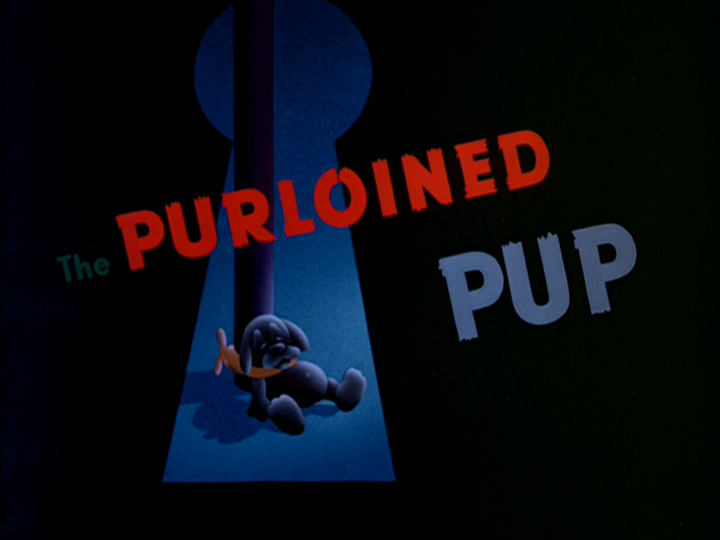
July 19, 1948 – The Pluto Short Film The Purloined Pup is Released to Theaters

“Dog Stealer Takes Baby Pup! 10,000 Bones Ransom Asked”

On July 19, 1948, the Pluto short film The Purloined Pup was released to theaters. In this short, Pluto’s main antagonist (and sometimes rival for a female’s affections), Butch, plays the part of a dognapper. The short was directed by Charles Nichols, with the story by Harry Reeves and Jesse Marsh.

A newspaper flashes across the screen, with the news that a puppy named Ronnie has been dognapped. The police suspect Butch, a paroled dognapper seen in the vicinity, and put rookie police dog Pluto on the case. Pluto sniffs out the trail, and comes across Ronnie’s collar. Thinking he’s close, he sneaks past some heavy pipes and spies Butch in front of an abandoned mansion, viciously chewing on a bone.

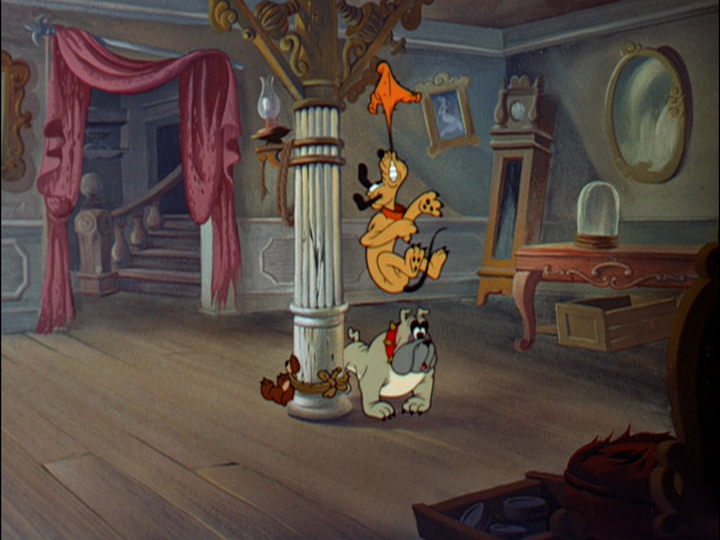
Several times, Pluto is able to avoid detection by Butch while trying to rescue Ronnie

Pluto comes up with a plan of action, buries his capture kit, and slips into the nearby moat to swim past Butch. He makes his way into the house just as Butch returns, and pretends to be a lion-skin rug to avoid detection. Butch enters a room and closes the door, and Pluto peeks through the keyhole to see Ronnie weeping and tied to a column. Butch threatens to hurt the puppy for the noise he’s making and walks out of the room, leaving the door open. Pluto sneaks in, but the sound of the door closing alerts Butch, who tries to pick up the stranger’s scent. Pluto, fortunately, is once again able to avoid detection.

As Butch leaves again, Pluto frees the puppy, who barks happily, giving away the rescue. Butch pursues the two into the pipes near the mansion, and ends up thinking that Pluto is in one of the pipes, when he is actually tormenting himself thanks to a U-shaped pipe. Butch then spies the puppy coming out of its hiding place, but Pluto is able to pull the pup away before Butch can hurt him. During a chase across the pipe-filled yard, Pluto grabs his capture kit and sets it up, trapping Butch in a straight-jacket, muzzle, and handcuffs. Ronnie, now safe, leads Butch by the rope to his muzzle to the police station where he happily turns the criminal in.

July 18

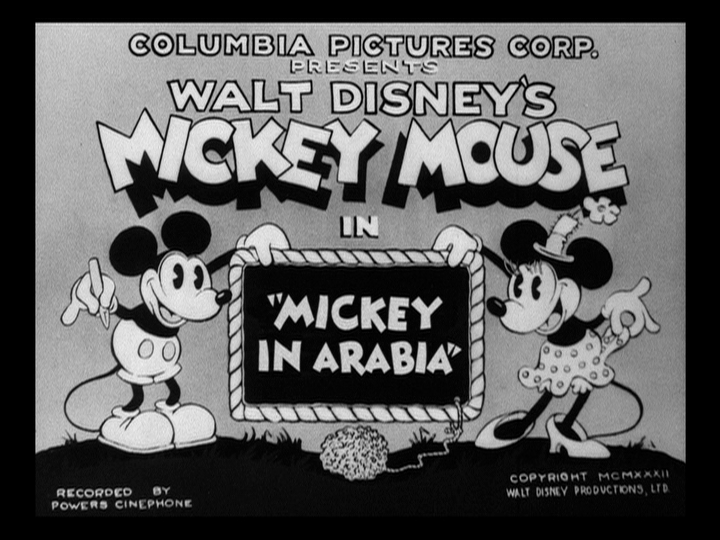
July 18, 1932 – The Mickey Mouse Short Film Mickey in Arabia is Released to Theaters


“Alley-oop!”

On July 18, 1932, the Mickey Mouse short film Mickey in Arabia was released to theaters. The short was directed by Wilfred Jackson, and stars Walt Disney as Mickey Mouse and Marcellite Garner as Minnie Mouse.

Mickey and Minnie are vacationing in the Middle East, and are seen riding a rather unusual camel through the desert. They enter a city and pull to a stop, looking around at the strange new sights, including a snake charmer taming several cobras. Mickey and Minnie leave the camel to drink from a nearby beer barrel, and the two explore the city and take pictures. As Minnie is setting up a shot, an evil sheik captures  and rides off with her, while Mickey attempts to pursue them on his drunken camel.

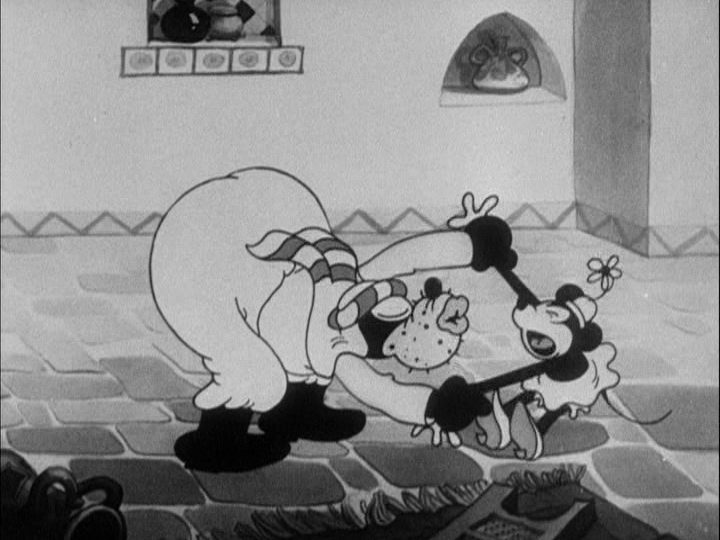
Minnie struggles to avoid kissing the sheik, who has kidnapped her and taken her to his castle

Minnie is taken to the sheik’s castle, where the sheik tries to get Minnie to kiss him, but to no avail. Mickey climbs the castle walls to come to Minnie’s rescue, diving in the room and kicking the sheik out of the way. As he and Minnie try to flee, the sheik’s soldiers stop them at every turn. The sheik, blinded by his turban, pulls out two pistols and begins to fire wildly, while every member of his army hides in terror.

Mickey hides Minnie in a vase and tries to open the door, only to find it locked. The sheik, finally removing his turban from his eyes, throws a sword at Mickey, but misses thanks to Minnie’s scream. Mickey grabs the sword, not realizing he’s grabbed only the hilt, and charges at the sheik. Suddenly realizing that the sword’s blade is missing, Mickey ducks, tripping the evil sheik and sending him flying. Angered, the sheik throws all sorts of swords at the mouse, who dodges them. Mickey hides behind a board, where all the swords land, and throws all of them back at the sheik, tearing the shiek’s clothes to shreds in the process.

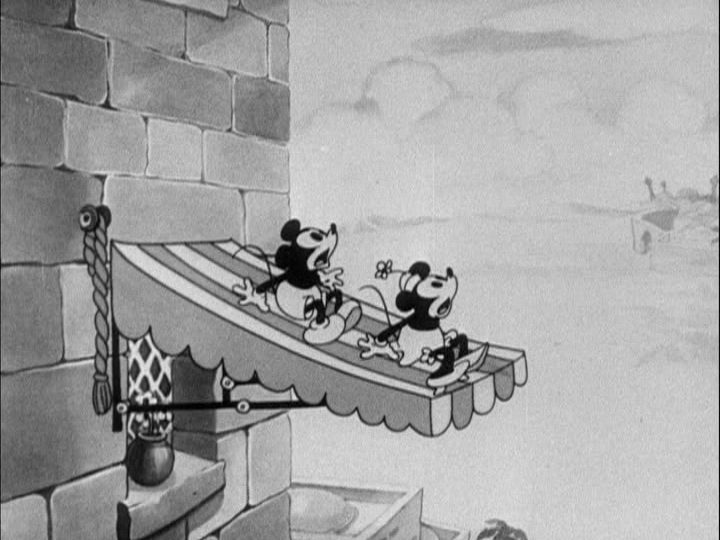
Mickey and Minnie watch in horror as the sheik has followed them and attempts to jump onto their perch

As the sheik pursues them in his holey long-johns, Mickey grabs Minnie and the vase she is hiding in and they flee up a tower. Mickey trips on the roof, sending Minnie flying. He saves her by her hat, but ends up falling from the roof himself. The lucky pair land on a veranda blind. The sheik leaps after them, but Mickey pulls the blind in, and the sheik lands head first in the sand. The guards throw their spears at the two as well, but with another pull of the blind, the spears land on the sheik instead. The happy couple jumps from their perch onto their camel’s back and ride off into the desert.

July 17

July 17, 1943 – The Film Victory Through Air Power is Released to Theaters

“Our country in the past has struggled through many storms of anguish, difficulty, and doubt. But we have always been saved by men of vision and courage, who opened our minds and showed us the way out of confusion.”

On July 17, 1943, the feature film Victory Through Air Power was released to theaters. The film was based on the book of the same name by Maj. Alexander P. de Seversky, who also served as the on-screen narrator of the film. De Seversky’s book explains how long-range air power could defeat the enemy during World War II. Walt Disney, like many who read the book, was impressed with the material, and it became one of his most ambitious projects. He used the film to educate and send a message to the public rather than to entertain, as at the time the film was released, an Allied victory was anything but certain. H.C. Potter was hired as the live-action director, and David Hand was the Animation Supervisor, with Art Baker as the animation sequence narrator. Critics did not like the film, and RKO, Disney’s film distributor, did not want to release it, so Disney released it through United Artists. The film was nominated for an Academy Award for Best Scoring of a Dramatic or Comedy Picture.

Although the film was not popular with critics, it did the job of presenting the idea of air power to win the war. “[T]he most important response to the movie came from Winston Churchill,” film critic Leonard Maltin explained. “When [Churchill] flew to Quebec for an Allied conference, and learned that President Roosevelt hadn’t seen the movie, he and Air Marshal Tedder prodded him until he ordered that a print be sent to him. H.C. Potter was told by Walt that it was only after Roosevelt saw Victory Through Air Power, that our country made the commitment to long-range bombing. And that, after all, was the reason that Walt committed to making this movie in the first place.”
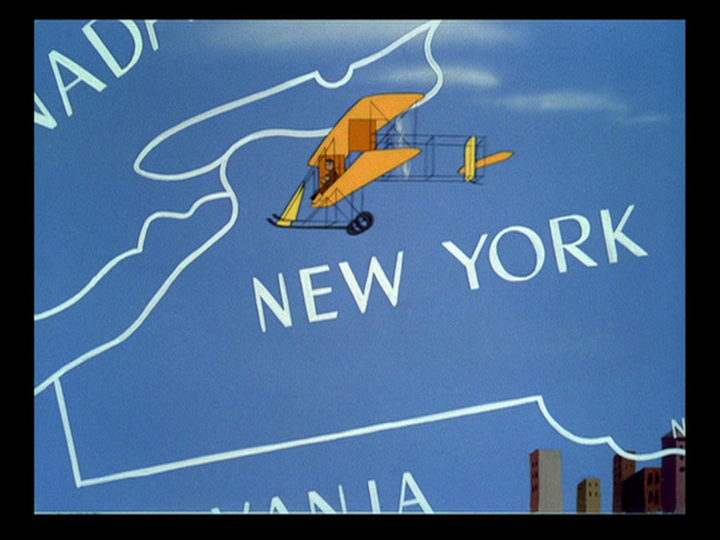
The animated sequence shows the progression of air power, including the first trans-continental flight

The film begins with newspaper clips from past years, beginning with 1919, where men have tried to convince the public about air warfare, and how defense depends on an air army. The film is then dedicated to Billy Mitchell, who was a pioneer in the fight for air power, and the brave airmen of the United States military. The audience then sees the history of flight in an animated sequence, beginning with Orville and Wilbur Wright, and leading into the first air corps, the first aircraft carrier, and the first trans-continental flight. When World War I began, aircraft was used only for observation service, until the installation of the machine gun turned the plane into a weapon. The bomber would soon develop from this idea.

1939 brings about a new war, and American aviation is ready to meet the challenge of the Axis powers. This then leads to the introduction of Maj. de Seversky and his book, Victory Through Air Power. De Seversky began his military education in Russia at age 10, graduating as a lieutenant, and seeking service in 1914. He became a pilot and was assigned flying duties, but was shot down on a night flying mission, resulting in the loss of his right leg at the tender age of 22. Nevertheless, de Seversky became a strong proponent of air power, and the leading ace of air warriors. In 1918, he came to the US and worked for the United States Army, becoming a major in the U.S. Army when he became a citizen in 1928.
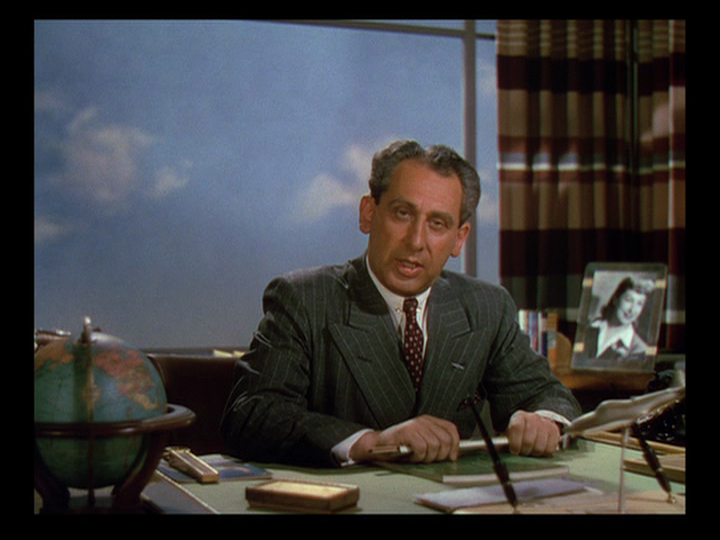
Maj. Alexander de Seversky, who explains to the audience why air power is an absolute necessity to win the war

De Seversky begins his speech to the audience, warning that it’s only a matter of time until the U.S. has its share of civilian casualties, thanks to the advances of air power by other countries. He also declares that everyone must understand the strategy of war. There were formerly two ways to destroy the enemy: one was to destroy the enemy’s entire army to grab their source of power, the other was to sink their navy and enforce a blockade. With the airplane, there is no safe place: the plane can attack quickly over the heads of the enemy forces. Those that could foresee the usefulness of air power were considered crazy and ignored. An example is then shown of how England was supposed to attack the Nazis via sea forces, and the French were to attack via the land. Hitler, however, came in with air power, which allowed him and the Nazi forces to take over France. “Only when it was too late,” de Seversky warns the public, “did the French realize that their whole plan of defense was futile.” The British thought they could stop the Nazis through a blockade, only to find their battleships destroyed by bombers. The Royal Air Force grew out of this tragedy, ready to attack Hitler’s air troops. “As long as a nation controls its own skies, it cannot be invaded,” de Seversky tells us as the moral of the British story.

The audience is then shown the first real battle between air power (Nazis) and sea power (British Navy) over the island of Crete. Crete became the first territory to be conquered completely through air power. This then leads to Pearl Harbor, and how American troops left themselves unprotected against the air power of the Japanese troops, because the American troops were instead prepared for traditional naval warfare. De Seversky explains that the Japanese were imitating the German blitzkrieg, and were able to capture most of the Pacific. American armed forces finally realized that no place on Earth was safe without gaining control of the skies above. The success of American victory through air power demanded two things: to produce a vast amount of weapons of endless variety, and to deliver this equipment to battlefronts all over the face of the Earth.
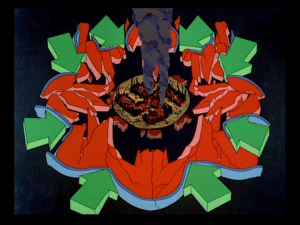
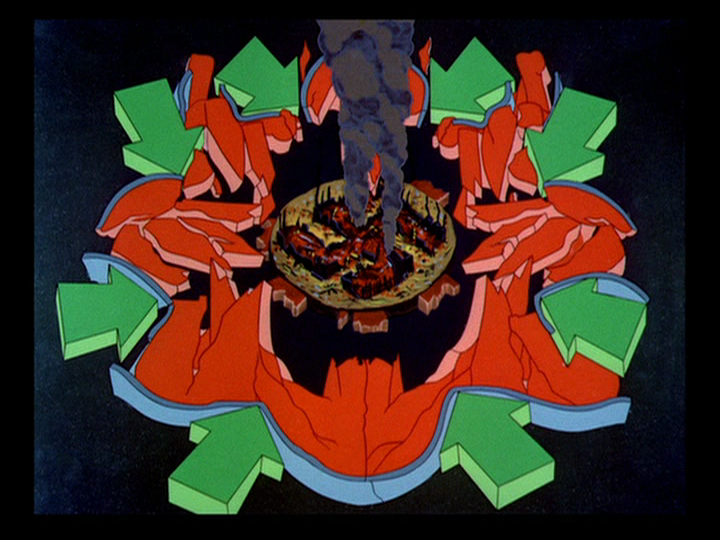
Animated sequences are used through the film to illustrate de Seversky’s points; this image shows how American air power can cut Hitler off at the source, allowing troops to invade

The audience is then introduced to another problem to consider: the transportation of these weapons. America is able to transport across the country with no problem, but gets caught in the slow speeds of shipping to overseas locations. Americans also have to contend with the German submarines. The audience is warned that if Americans fight only on the surface of the Earth, Hitler has all the advantage. Air power would give American forces an advantage and the ability to cut off Hitler’s power at the source. Success will also depend on supply lines, and where American air bases are located. The film ends with a patriotic look at how American forces can use air power and airmen’s skills to win the war. “America should not hesitate to place its destiny in the hands of [the airmen],” de Seversky explains, “for with the strategy of air power, they will make the enemy fight on our terms, against the weapons of our choosing, at our time, but on his soil.”
July 16

July 16, 1954 – The Donald Duck Short Film Dragon Around is Released to Theaters

“Uh oh! This tree has to go!”

On July 16, 1954, the Donald Duck short film Dragon Around was released to theaters. This is the 14th short in which chipmunks Chip and Dale play antagonists to Donald Duck. The short was directed by Jack Hannah, with story by Nick George and Roy Williams. It stars Clarence Nash as the voice of Donald, Dessie Flynn as the voice of Dale, and James MacDonald as the voice of Chip.

The short begins with Dale reading a discarded book of fairy tales at a rather unkempt area of the park. Dale is excited when he comes across a tale of a knight fighting a dragon, and he pretends to be a knight. A sudden rattling knocks him from his perch, and he looks around for the source. He sees the shadow of what appears to be a dragon on the side of a hill, and runs for cover in his tree. He tells Chip in a hurry what he saw, but when he pulls the other chipmunk to see, the “dragon” is gone. Chip chastises him for his imagination.

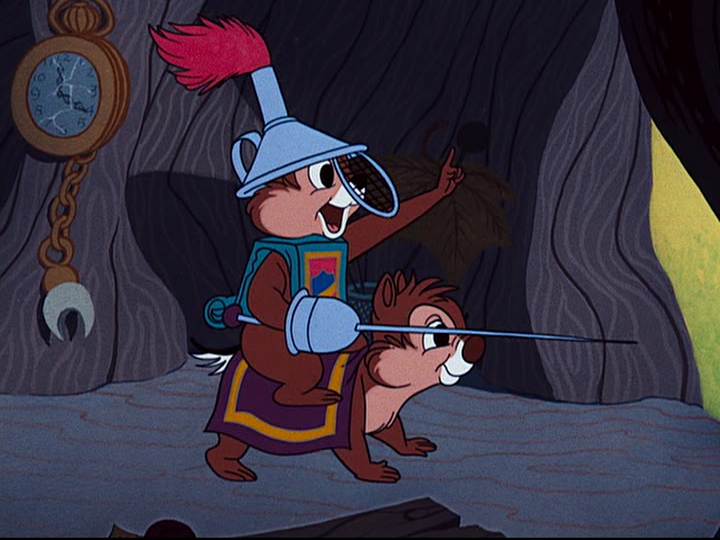
With a bit of ingenuity, the chipmunk duo prepare to defend their tree

Just then, another rattling rolls around, and the two see the “dragon” on the side of a hill again. As they flee, the source of the shadow is revealed: Donald comes rolling around the hills in a steam shovel, helping prepare another freeway. The only thing in his way is the tree where Chip and Dale live. Quickly, they gather branches and try to attack the steam shovel to protect their tree, but that has little effect. Donald notices the duo’s attacks and scares them with the steam shovel. The pair lands right next to the fairy tale book, which gives Chip an idea, and the two run off to prepare. After a bit of arts and crafts, the pair emerges as a brave knight on his trusty steed, ready to protect their castle.

Donald fixes his steam shovel with a way to spurt fire from its mouth, and the fairy tale begins to become too real for the chipmunks, who flee. When Donald takes a break, they decide to sneak up on the “dragon,” unaware that Donald has been playing with them the entire time. Donald continues to attack their tree, and the duo crashes a boulder into the steam shovel, followed by barrels of tar. The tar rips out the steam shovel’s teeth, and Donald, his temper rising, captures the two and locks them in his tool box while he tries to knock down the tree.

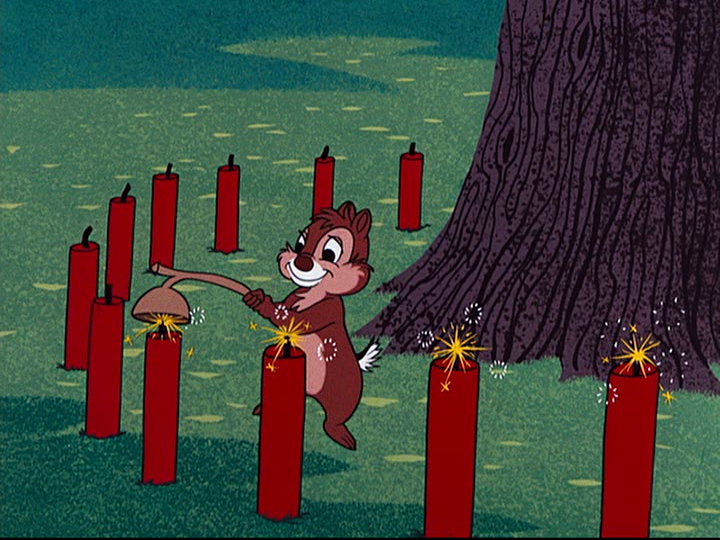
Donald uses dynamite as a last ditch effort to destroy the tree; Dale goes around and extinguishes each stick while Donald isn’t looking

Chip and Dale saw their way out of their tool box and, using a couple of wrenches, they undo every screw they can find. Donald races towards the tree at full speed, unaware that the steam shovel is falling apart as he goes. When he reaches the tree, Donald is left with nothing but his head to smack into the tree trunk. Losing his temper, Donald grabs sticks of dynamite and arranges them around the tree, getting ready to blast them out. As he covers his ears from the eventual blast, Dale goes around extinguishing each stick, and Chip gathers them up, placing them where the steps in a ladder would be. They fool Donald into chasing Dale up the ladder while Chip lights the fuses, and Donald is sent flying high into the sky as the dynamite blows.

July 15

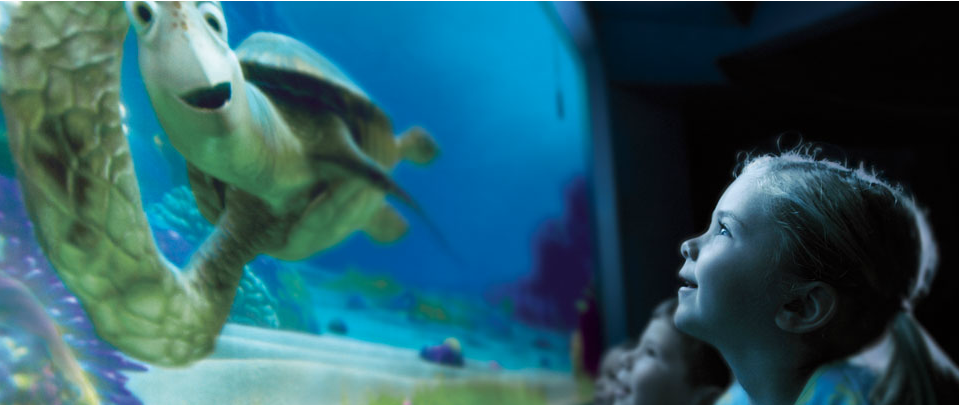
July 15, 2005 – The Turtle Talk with Crush Attraction Opens at Disneyland

Image Credit: Official Disneyland Website

“Have an in-depth chat with Crush, the totally awesome sea turtle from the Disney-Pixar film, Finding Nemo.”

On July 15, 2005, the interactive attraction Turtle Talk with Crush opened in Disney’s California Adventure’s Hollywood Land. The Disneyland version was based on the Walt Disney World attraction that opened on November 16, 2004. The attraction allows guests to have an improvisational conversation with Crush, the sea turtle featured in the Disney-Pixar film Finding Nemo. Guests enter a movie-theater styled room, with children being allowed to sit on the carpet up front for a better view. A moderator gives a brief introduction, and helps Crush to select audience members to chat with. Brief cameos of other Finding Nemo characters may appear during the attraction.

The attraction is a blend of computer animation, image projection, and improvisation, with real-time animation used for the live conversations. Each show is unique, as Crush communicates directly with the audience members; Crush is even able to pick out children to converse with by calling them out by what they wear. The attraction has become popular enough to warrant a copy in Tokyo DisneySea, and the Disney Dream’s Animator’s Palate restaurant.