RSS Feed

Monthly Archives: April 2013

April 10

April 10, 1992 – The Live-Action Musical Film Newsies is Released to Theaters
News1

“Pulitzer and Hearst, they think we’re nothing! Are we nothing? No!”

On April 10, 1992, the live-action musical film Newsies was released to theaters. Based on a true story of the Newsboys’ Strike of 1899, the film tells the story of Jack Kelly and his band of newsboys (“newsies”) who take on Joseph Pulitzer (owner of the newspaper The World) when Pulitzer decides to up the price that the newsies pay to buy their papers to sell on the street. The film was a box office flop, but has since gained a strong cult following, and has been turned into a successful Broadway musical. Newsies was the directorial debut of Kenny Ortega, with screenplay by Bob Tzudiker and Noni White, and music written by Alan Menken and Jack Feldman, with underscore by J.A.C. Redford. It stars Christian Bale as Jack Kelly, David Moscow as David Jacobs, Bill Pullman as Bryan Denton, Robert Duvall as Joseph Pulitzer, and Ann-Margaret as Medda.

Set in New York City in 1899, the story begins with the newsies waking up to begin their day at the Newsboy’s Lodging House. They sing about “carrying the banner,” discussing the best ways of selling papers and lamenting the bad headlines they have to pedal, as they suffer if they can’t sell every paper. Leader Jack “Cowboy” Kelly rallies the boys’ spirits, especially after outsmarting the notorious Delancey Brothers, who torment the newsies and hide behind their uncle, who provides the newsies their papers. Observing this are new newsboys David and his little brother, Les. Les immediately admires Jack, but David is much more reserved. Jack and David strike up a reluctant partnership, with Jack wanting to capitalize on Les’s cuteness, and David needing to learn the ropes. As David, Les, and Jack head out to hawk the headline, Jack gives David the first important lesson: “Headlines don’t sell papes, newsies sell papes.”
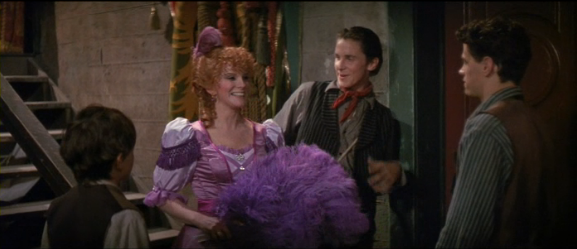
Jack introduces David and Les to Medda, a friend of his, who protects them from Warden Snyder

Jack introduces David and Les to Medda, a friend of his, who protects them from Warden Snyder

As the newsies head out to their task, Joseph Pulitzer sits in his office, angered over the horrible headline in his publication. He and his team are trying to come up with a way to put more money in his pocket. Meanwhile Jack, David, and Les are sidetracked at a boxing match, where they soon have to flee when Jack’s appearance catches the attention of Warden Snyder, who calls Jack “Sullivan” and threatens to take him back to “the Refuge.” The three take shelter in Irving Hall, where Jack tells the two why Synder was chasing him – Jack escaped from the refuge, which is a jail for kids. They are soon discovered in Irving Hall by the owner, singer Medda Larkson, a friend of Jack’s who lets them stay until Snyder is done looking for them. Jack then reveals why he’s called “cowboy” – he longs to move to Santa Fe, where his parents are supposedly looking for a ranch. That evening, David and Les head home, with Jack accompanying them. He meets David’s family and joins them for dinner, and immediately falls for David’s sister, Sarah. David reveals to Jack that he had to start working to support his family, as his father was injured and lost his job as a result, as he had no union to protect him. David and Jack soon become best friends, finally understanding each other.

The next morning, the newsies are dismayed to find that Pulitzer’s grand solution to get more money is to charge the newsies more for their papers. Inspired by his talk with David about his father, Jack believes that the best course of action for the newsies is to go on strike, beginning the formation of a newsboys union. David tries to talk him out of this, but is soon roped in as the advisor to Jack’s plans, with Jack attempting to gather all the newsboys in New York. With Jack as the voice of the people, and David as the brains of it all, the strike is effectively on. Jack’s first action is to bring the demands of the newsboys to Pulitzer himself – unfortunately, this does not go well. They soon catch the attention of reporter Bryan Denton, who takes Jack, Les, and David to lunch to discuss their plans, advising them that they need to make their story worth being in the papers.
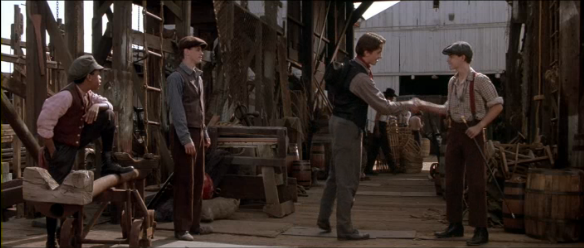
Jack, David, and Boots head to Brooklyn to meet with famous newsie Spot Conlon, who has reservations about the strike

Jack, David, and Boots head to Brooklyn to meet with famous newsie Spot Conlon, who has reservations about the strike

The other newsies are sent out as ambassadors to gather the other newsies in the city, and Jack, Boots, and David head to Brooklyn to convince influential newsie Spot Conlon to join. Spot is not convinced that Jack’s newsies are going to follow through on their threat of strike, even though David claims that Spot is the key to creating a real newsboy union. When they prove that they won’t run at the first sign of danger, Spot may be convinced to join. The boys prove that they are in it for the long haul when they trash the distribution center, but at a price, as their friend, the crippled Crutchy, is taken by the Delancey Brothers and beaten, then taken to the Refuge. Jack and David head to the Refuge late at night to break Crutchy out, but Crutchy refuses to go, as his already injured leg is worse from the beating. When the newsies attempt to trash the distribution center again, members of the Irish Mob are there to greet them. Fortunately, Spot Conlon stays true to his word, with Spot and the Brooklyn newsies assisting Jack and his boys. The newsies have another victory in their strike, and Denton takes a picture after their triumph. Jack then decides that to get the attention of the other papers, the newsboys will have a rally with every newsboy across the city.

With his picture in the paper, Snyder identifies Jack, and heads to the Newsboys’ Lodging House to find the runaway, but the newsboys cover for Jack and keep him safe. Snyder then heads to Pulitzer directly, using his information on Jack to get the police to charge in at the raid and grab Jack. After Snyder’s appearance at the Lodging House, Jack runs to David’s apartment and sleeps in the stairway outside Sarah’s room. The two share breakfast on the roof, with Sarah visibly upset when Jack talks about how he’s ready for the strike to end and he can leave for Santa Fe. The rally is held at Irving Hall, which is soon crashed by Snyder and the police, who arrest several newsies, including Jack. At the trial, the truth about Jack comes out: his real name is Francis Sullivan, with his father a convicted criminal currently in prison, and his mother passed away. Jack is sent back to the Refuge until the age of 21, and the newsies gather to hear from Denton that none of the newspapers reported on the rally, nor will they cover any strike news. Denton then says he’s been reassigned, and is leaving New York. With so many blows, the newsies fall into depression, and David takes over leadership, trusting no one but the newsies from now on.
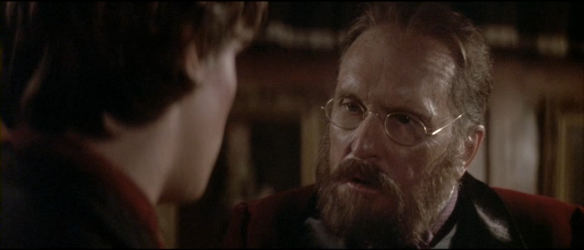
Pulitzer threatens Jack that, should he not work for him, David and his family will suffer

Pulitzer threatens Jack that, should he not work for him, David and his family will suffer

David plans a rescue of Jack from the Refuge, but sees that he is taken to Pulitzer’s, who offers Jack a chance for a new life, so long as he starts selling papers again. When Jack refuses, Pulitzer threatens David and his family, which has Jack agreeing in order to save his friend. The newsies are dismayed and angered when they see that Jack has crossed over the picket line, with David especially hurt by the betrayal. Jack redeems himself when he protects Sarah, Les, and David from the Delancey Brothers. Having broken his agreement with Pulitzer, Jack now firmly rejoins the newsies union. The group then heads to Denton’s, where he reveals that all of the children working in New York are listening to the newsies, and they plan to print their own paper, revealing the truth to all of New York, secretly using one of Pulitzer’s old presses to print their paper.

The newsies wait nervously for the child workers of the city to arrive to strike, and when they do, they arrive by the hundreds, shouting for the world (and the World) to hear. Jack is then called in to see Pulitzer, who demands that Jack give the name of the person who printed the Newsies Banner. When Jack reveals that Pulitzer owns the press on which it was printed, Pulitzer is speechless. He is powerless against all of the children of New York, and Jack heads back to the crowd, announcing their victory. The kids from the Refuge are free, and Snyder is imprisoned for fraud, as he would steal the funding meant for the children and put it in his own pocket. Crutchy reveals that Governor Theodore Roosevelt stormed in and demanded that things at the Refuge be set right. Denton then tells Jack that Roosevelt has offered Jack a ride to the train station to head to Santa Fe. Jack heads to the train station, leaving a heartbroken David, Les, and Sarah. Things quickly return to normal, with the kids resuming their duties as newsies, when Jack suddenly returns, admitting that he now knows where he belongs.
April 9

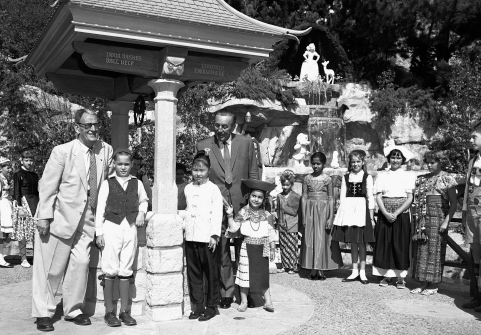
April 9, 1961 – Walt Disney Dedicates Snow White Grotto

SnowWhiteGrotto_D23

Stars from stage, screen, television and show business in general, as they visit the Park, are planning to make their contributions along with the public as they pass the Wishing Well and admire the beauty of the latest addition to the Disneyland scene.”

On April 9, 1961, Walt Disney dedicated the Snow White Grotto in Disneyland. The idea for the grotto came from a slight dilemma: Disney had received marble figures of the characters from Snow White and the Seven Dwarfs, but the statues were all of the same size. Designer John Hench came up with a smart solution of proportions, using the illusion of height and distance by placing Snow White at the top of the scene, having her stand over the other characters. When the scene is viewed from the footbridge, Snow White appears to be perfectly in proportion with the dwarfs. Also featured is the Wishing Well, seen in the opening scenes of the film, inscribed with “Your wishes will help children everywhere.” In 1983, the original voice of Snow White, Adriana Castelotti, was asked to come in and rerecord “I’m Wishing” for the New Fantasyland opening. The song is heard over the waterfall, and echoing back from the well.

April 8

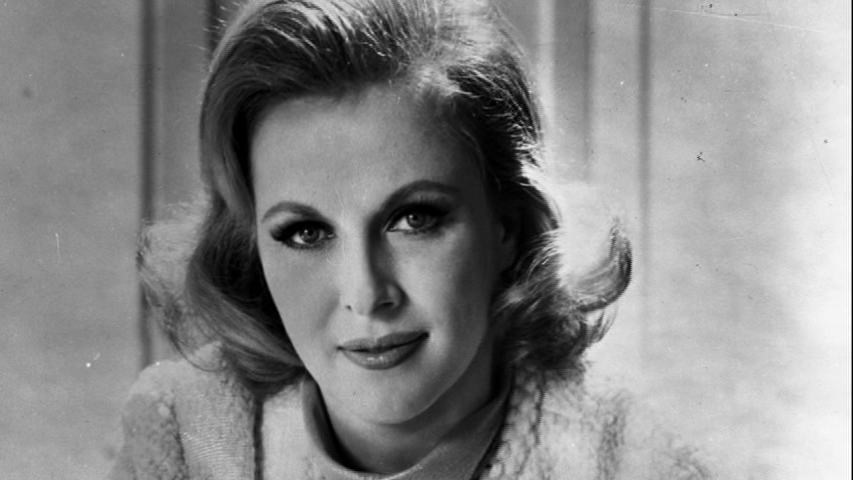
April 8, 1941 – Child Actress, Singer, and Mouseketeer Darlene Gillespie is Born

vlcsnap-2013-04-07-20h53m36s156

The Mickey Mouse Club would provide a chance for the world to at last partake of [Gillespie’s] God-given vocal talent.” – Jennifer Armstong,author of Why? Because We Still Like You: An Oral History of The Mickey Mouse Club.

On April 8, 1941, Darlene Faye Gillespie was born in Montreal, Canada. At the age of two, her family moved to Los Angeles, California. She began singing lessons at age 10 after moving the church congregation to tears, and began dance lessons at age 11. In 1955, Gillespie auditioned for The Mickey Mouse Club, singing “The Ballad of Davy Crockett” for her audition piece, and was hired at the tender age of fourteen. She was on the red-string team for all three seasons of the show, and starred in several serials, including Corky and White Shadow and The New Adventures of Spin and Marty. She began a recording career after the show was cancelled, but none of her singles, though critically acclaimed, became hits. She was also cast as Dorothy in a proposed live-action film based on the Oz stories by Frank L. Baum, but this film never came to fruition. After a few stints in television, Gillespie retired from acting to become a nurse. In 1997, she came back to the public view, as she and her husband, Jerry Fraschilla, were accused of shoplifiting, and in 1999 she was sentenced to two years in prison for fraud, thanks to her involvement in a check-kiting scheme with Fraschilla, but was released after three months. Gillespie found herself in trouble once again in 2005, as she and her husband were indicted for trying to defraud a company of nearly $320,000 in class-action settlement funds.

April 7

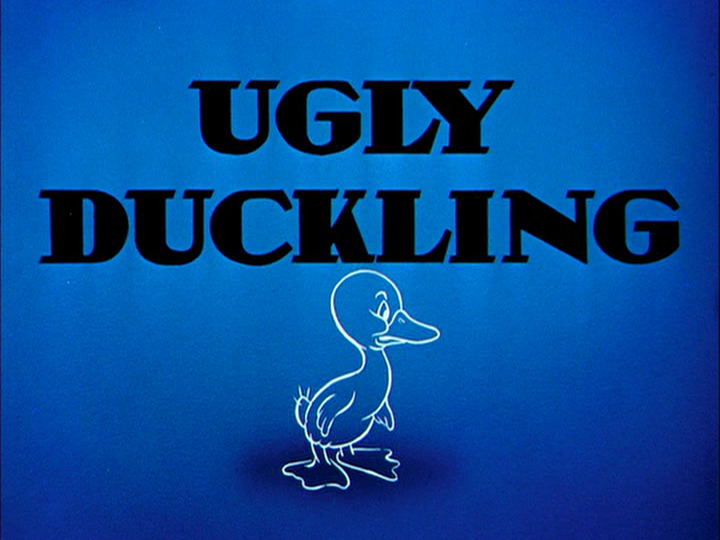
April 7, 1939 – The Final Silly Symphony, The Ugly Duckling, is Released to Theaters

vlcsnap-2013-04-07-10h08m47s102

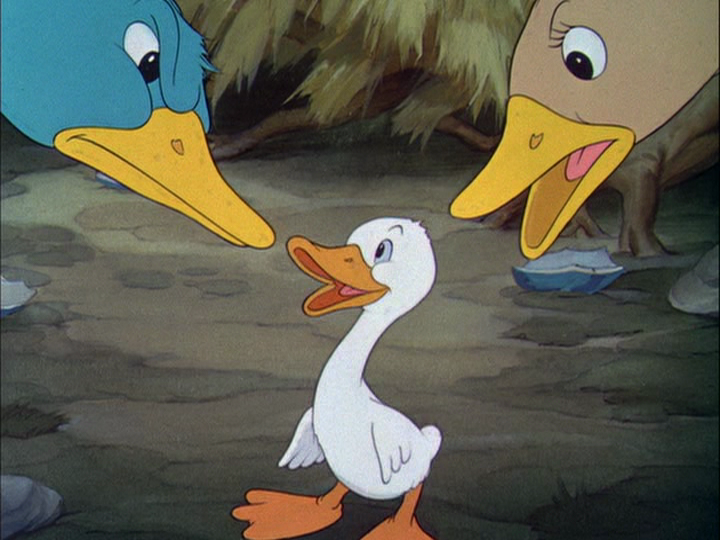
On April 7, 1939, the final Silly Symphony, The Ugly Duckling, was released to theaters. It is a color remake of the 1931 Silly Symphony, originally directed by Wilfred Jackson. Both shorts were based on the story by Hans Christian Andersen. The 1939 short film won an Academy Award for Best Cartoon at the 12th Academy Awards. It was directed by Jack Cutting.

A father duck is nervously pacing the ground as he waits for his wife’s eggs to hatch. He tries to console her as she sits in the nest, bored with waiting, while the father duck paces so much he creates a hole in the ground. The sound of sudden quacking alerts him, and he is delighted to see his offspring. He gathers the ducklings into his arms and kisses them excitedly, then kisses his wife. Much to their surprise, there’s another egg in the nest that is about to hatch, and when it does, the ducks are surprised to see a strange looking and sounding “duckling” emerge from the shell.

Father and mother duck look at their strange duckling with suspicion

Father and mother duck look at their strange duckling with suspicion

The father looks at his wife accusingly, and the two argue before the mother slaps the father. He leaves angrily, and the mother has her ducklings follow her into the pond. The ugly duckling follows the ducks, but the mother wants nothing to do with him. She viciously quacks at him, and he looks at his own reflection in the pond, confused as to why he looks so different and is so unwanted. He begins to cry and wanders away, trying to find where he belongs. He stumbles upon a cuckoo bird’s nest, but is immediately chased away by the mother cuckoo as he tries to eat their food.

He soon runs into a duck decoy in another pond, and takes to it as if it were his mother. Unfortunately, the duck decoy hits him on the head, making him believe that it also does not like him. He wanders away and cries loudly. His cries are soon overheard by a mother swan and her cygnets. The cygnets try to cheer him up, and he is amazed to see birds that look like himself. The mother then calls her babies over, and he is sad once again, thinking he needs to leave, but the mother swan takes him under her wing, welcoming him to his new family. The swan family sails away, and he soon spies the duckling family, who calls him over, but he swims away, perfectly content being a swan.

April 6

April 6, 1947 – Actor John Ratzenberger is Born

john-1

“[Ratzenberger’s] the ultimate Pixar character actor. He’s someone so clear, I know that guy after only two lines of dialogue. Having him in every film is like our Hitchcock cameo.” – Animator and Director Pete Doctor

On April 6, 1947, John Deszo Ratzenberger was born in Bridgeport, Connecticut. In 1971, he moved to London, where he worked as a house framer and began his acting career. His first role was in the 1976 film The Ritz. Throughout the ’70s and ’80s , Ratzenberger continued to score minor and major film roles in such films as Superman, Superman II, Star Wars Episode V: The Empire Strikes Back, and Ghandi. In 1982, he auditioned for a new sitcom series: Cheers. Although he originally auditioned for the role of Norm Peterson, he came up with the role of Cliff Clavin, the bar’s “know-it-all.” The series ran for eleven seasons, and reached critical acclaim. In 1995, Ratzenberger was cast in Pixar’s first full-length computer animated feature Toy Story as the piggy bank Hamm, and soon after became a recurring “lucky charm” for the studio, having a part in every Pixar film to date. Animator and director Andrew Stanton said in an interview, “We were at a press junket for Toy Story at Marino del Rey, and all the talent were invited to join us for a celebratory cigar and toast. John hung out with us all night. He was so much fun, I remember saying, ‘Let’s have him be in a film again.’” Ratzenberger has stated that “every time I get Pixar on the line, I just drop whatever I’m doing and get over to the studio.” He will soon be heard in Pixar’s Monster’s University, reprising his role of the Abominable Snowman.

April 5

April 5, 1930 – Opera Singer, Actress, and Disney Legend Mary Costa is Born

vlcsnap-2013-04-04-21h50m11s123

“Walt Disney called me, and he said, ‘You have a warm, warm voice, and it expresses love from your heart. Also, your voice is so naturally placed that you can use your signing voice as an extension of speech…I want you to drop all of the colors and the things that you feel about Briar Rose to your vocal palette, and I want you to paint with your voice.’”

On April 5, 1930, Mary Costa was born in Knoxville, Tennessee. Her family moved to Los Angeles, California, where, after high school, she entered the Los Angeles Conservatory of Music, studying with Gaston Usigli. She was featured on Edgar Bergen’s radio show with his character Charlie McCarthy. In 1952, she auditioned for the role of Princess Aurora in Sleeping Beauty. Walt Disney called her personally to let her know that she won the role. In 1958, Costa met acclaim when she filled in for Elisabeth Schwarzkopf at a concert in the Hollywood Bowl, and was then given the lead of her first operatic production, The Bartered Bride. Costa then made her debut at the Glyndebourne Festival. She would go on to perform at the Metropolitan Opera, the royal Opera House, and the Bolshoi in Moscow, as well as in several television appearances. In 1989, she received the Lifetime Achievement Award from the Licia Albanese Puccini Foundation, and in 1999, she was named a Disney Legend. In 2003, Costa was appointed to the National Council on the Arts by President George W. Bush, where she served until 2007.

April 4

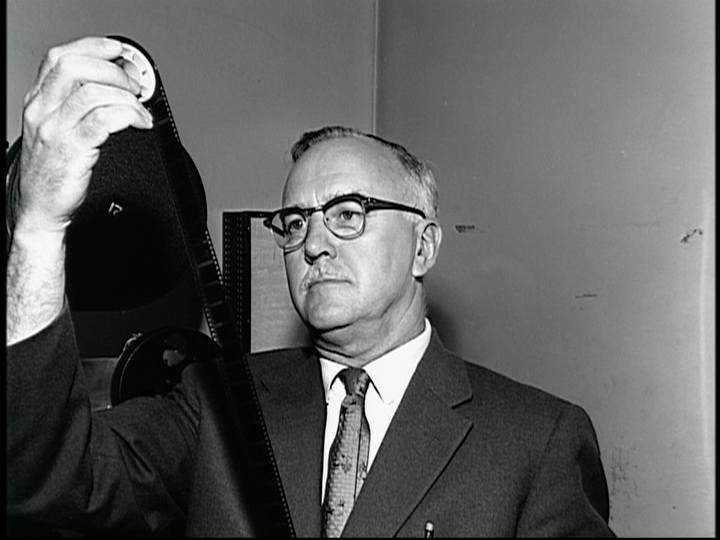
April 4, 1960 – Ub Iwerks Wins a Technical Achievement Award

vlcsnap-2013-04-03-21h40m50s240

“To Ub Iwerks of Walt Disney Prods. for the design of an improved optical printer for special effects and matte shots.”

On April 4, 1960, the 32nd Academy Awards were held at the RKO Pantages Theater in Hollywood, Califomia. Having rejoined the Disney Studios in 1940 in a technical capacity, Ub Iwerks was awarded a Class III Technical Achievement Award for the design of an improved optical printer for special effects. This printer would be adapted for the creation of the sodium traveling matte process in 1956. This traveling matte process helped revolutionize the combination of live-action and animation, using a three-strip Technicolor camera and specially designed prism, and won Ub another Technical Achievement Award at the 37th Academy Awards in 1965.

April 3

April 3, 2007 – Hilary Duff’s Fourth Studio Album, Dignity, is Released Through Hollywood Records

Dignity 1

“Where’s your, where’s your, where’s your dignity? I think you lost it in the Hollywood hills. Where’s your, where’s your, where’s your dignity? Can’t buy respect but you can pick up that bill.”

On April 3, 2007, actress and singer Hilary Duff’s fourth studio album, titled Dignity, was released through Hollywood Records. The album’s content was based on her life events between the release of her 2004 album and this one, which included a stalker, a breakup with her boyfriend of two years, and her parents’ divorce after 22 years of marriage. This album was also different from her previous albums in that Duff wrote all but one song on the album; before she mainly selected songs and contributed writing to a few.

To promote the album, a two-part documentary titled Hilary Duff: This is Now premiered on MTV on April 3, 2007. Critical response for the album was mainly positive, with the album debuting at number 3 on the Billboard 200 Charts, selling 140,000 copies in its first week. There were three singles released: “Play with Fire,” which peaked at number 31 on the US Billboard Hot Dance Club Play chart; “With Love,” which peaked at number 24 on the Billboard Hot 100 chart, number 1 on the Billboard Hot Dance Club Play chart, and number 25 on the Billboard Pop Songs chart; and “Stranger,” which peaked at 1 on the Billboard Hot Dance Club Play Chart, number 83 on the Billboard Pop Songs chart, and number 97 on the Billboard Hot 100 chart.

April 2

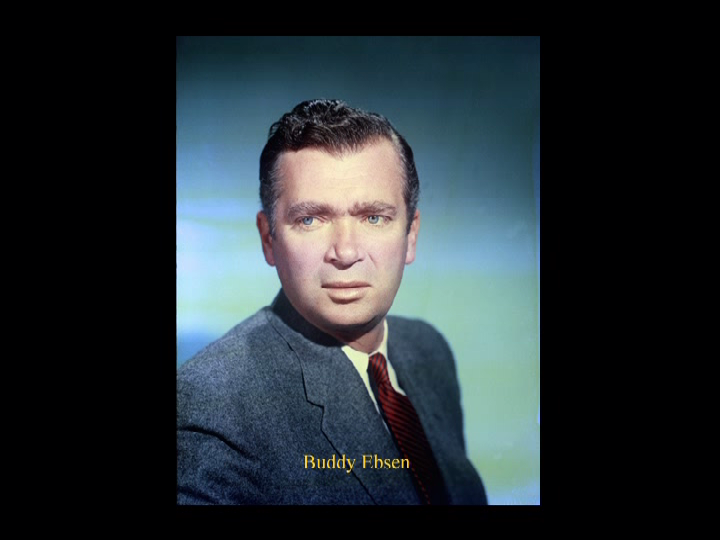
April 2, 1908 – Actor, Dancer, and Disney Legend Buddy Ebsen is Born

vlcsnap-2013-04-01-21h16m17s201

“Buddy [Ebsen] said that it was really difficult for him [to lose the role], but once he saw Fess [Parker] on screen, he knew that Walt had made the right decision.” – Paul F. Anderson, author of The Davy Crockett Craze.

On April 2, 1908, Christian Rudolph “Buddy” Ebsen, Jr., was born in Belleville, Illinois. At the age of ten, his family moved to Florida, where he and his siblings learned how to dance at their father’s dance studio in Orlando. Although he had aspirations to be a doctor, the collapse of the Florida land boom in the 1920s forced him to leave the University of Florida and head to New York City to become a dancer. He and his sister, Vilma Ebsen, became a dual act in vaudeville as “The Baby Astaires.” This led to a screen test by MGM, and they each signed a two-year contract with MGM, making their screen debut in Broadway Melody of 1936. While this would be Vilma’s only film, Ebsen’s career took off as a dancer in several films.

In 1939, Ebsen was cast in The Wizard of Oz as the Scarecrow, but swapped roles with Ray Bolger, who was originally cast as the Tin Man. However, Ebsen’s involvement in the film was short-lived, as he experienced an allergic reaction to the aluminum dust in the make-up, and was forced to leave the film. During World War II, Ebsen became a Lieutenant, Junior Grade in the Coast Guard, and after the war, he resumed his acting career in the new medium of television. In 1954, Ebsen starred in one of his more well-known roles: George Russel in Walt Disney’s Davy Crockett. Originally, Ebsen was tapped to play Davy Crockett, but Walt Disney, after seeing Fess Parker in a bit part in the sci-fi film Them was convinced that Parker was the man to play Crockett. Ebsen was then cast in the role of Russel. For Disney, Ebsen also stared in The One and Only, Genuine, Original Family Band as Calvin Bower, and the serial “Corky and White Shadow” on the Mickey Mouse Club. Ebsen would also dance on film for the staff to study and create Audio-Animatronics. In 1962, Ebsen scored his most famous role of Jed Clampett on the long-running sitcom, The Beverly Hillbillies. In 1973, he starred in another series, Barnaby Jones. In 1993, Ebsen was named a Disney Legend. He passed away in 2003 at the age of 95.

April 1

April 1, 1938 – The Silly Symphony Moth and the Flame is Released to Theaters

vlcsnap-2013-03-31-21h36m47s0

On April 1, 1938, the Silly Symphony Moth and the Flame was released to theaters. It was directed by Burt Gillett.

A lamp outside “Ye Olde Costume Shoppe” has attracted a swarm of moths who dance around the light. A pair lands on the windowsill and peer into the shop, thinking of the clothes inside as a massive feast. They find a way in and begin to eat, but unexpectedly attract the attention of the other moths, who quickly dive in and devour every piece of clothing in sight.

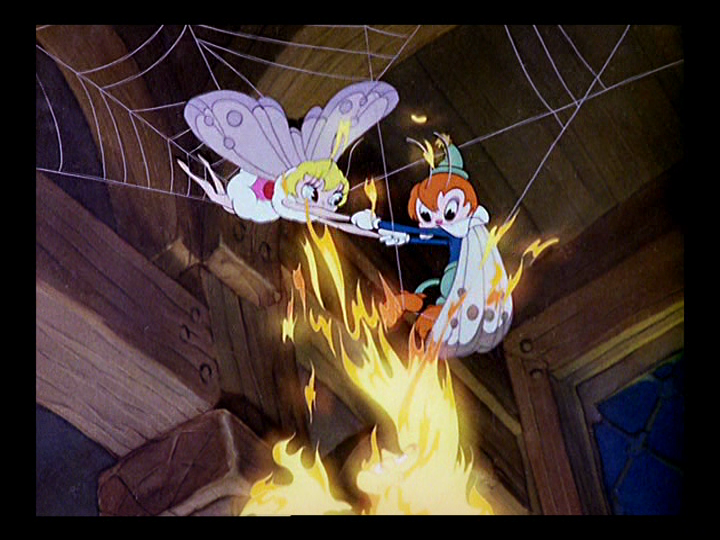
One young moth couple has a romantic date near a feathered hat, sharing a kiss. The girl tries to get the boy to chase her, and is rather put out when he decides to eat a bowler instead. Nearby, a flame on a candle spies the moth and laughs, then begins to dance, moving the girl moth’s shadow around and catching her attention. He draws her closer, and she dances dangerously close to the flame, burning the candle down to practically nothing. The flame jumps around, following her, and she puts him out with a fire insurance policy. However, he burns right through it and continues his pursuit, until she is stuck in a spider’s web.

The boy moth tries desperately to free his girlfriend, with the flame always close behind

The boy moth tries desperately to free his girlfriend, with the flame always close behind

The boy moth, seeing her in trouble, runs to her rescue, but is quickly chased away by the flame. He then uses a nearby glass of water to douse the flame, but is unsuccessful, then accidentally uses the highly flammable benzene, which gives the flame greater strength. Finally, he gathers the attention of all the other moths, who use a bagpipe filled with water to bring the flame down. Using other instruments in the shop, they work to quickly kill the flame, and the boy is able to free the girl. Together again, the two share a kiss.