RSS Feed

Monthly Archives: June 2012

June 10

June 10, 1949 – Birth of Disney Legend Kevin “Moochie” Corcoran

“…kids in the audience related more to Corcoran, who created a character who was part All-American boy and part hellion.” – Film Writer Donald Liebenson.

Born on June 10, 1949, in Santa Monica, California, Kevin Anthony Corcoran began his acting career at the tender age of two. In 1956, Corcoran auditioned for a serial on the Mickey Mouse Club called “Adventures in Dairyland,” and won the role of a character named Moochie, a nickname that would stick with him throughout his career at Disney. He was then cast specially by Walt in the sequel serial, “The Further Adventures of Spin and Marty,” as well as “The New Adventures of Spin and Marty.”

Corcoran also appeared in several popular Disney films, with his only starring role as Toby in Toby Tyler, a film about an orphan who runs away to join the circus. He played supporting roles in Old Yeller, The Shaggy Dog, Pollyanna, Swiss Family Robinson, Babes in Toyland, Bon Voyage!, Savage Sam, and A Tiger Walks. Corcoran played the younger brother to actor Tommy Kirk in five Disney films, including Swiss Family Robinson and The Shaggy Dog. Corcoran also voiced Goliath II in the short film of the same name, and was featured in several Disney mini-series and serials, such as Daniel Boone, The Mooncussers, and Johnny Shiloh. After the 1964 film A Tiger Walks, Corcoran mostly retired from acting and attended California State University, getting a degree in theater arts.

Corcoran returned to Disney after college, using his skills behind the camera instead of as an actor, and working as an assistant director and producer on several projects, including Pete’s Dragon. He has also worked as a first assistant director for many television series outside of Disney, including Quantum Leap and Murder She Wrote, also acting as an assistant producer and director on the latter series. Corcoran was inducted as a Disney Legend on October 9, 2006, alongside Tim Considine, David Stollery, and Tommy Kirk.

June 9

Posted on

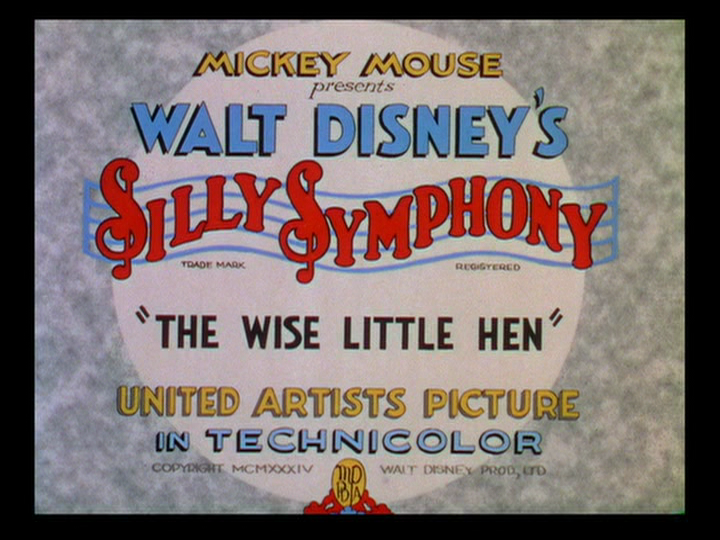
June 9, 1934 – The Silly Symphony The Wise Little Hen Premieres in Theaters

“Who, me? Oh, no! I’ve got a bellyache!”

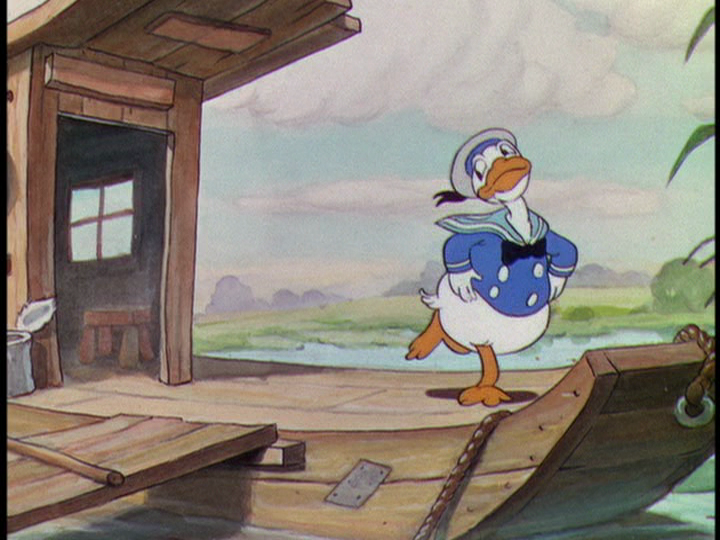
On June 9, 1934, the Silly Symphony The Wise Little Hen premiered in theaters. It was based on the folk tale The Little Red Hen, and was directed by Wilfred Jackson. It is notable for the debut of Donald Duck, voiced by Clarence “Ducky” Nash; it also stars Florence Gill as the Wise Little Hen, and Pinto Colvig as Peter Pig.

“There once was a wise little hen, who worried now and then, for fear that she’d be found in need when winter came again,” begins the narration in song for the short. The hen is seen stepping out her front door while all of her chicks play in the yard. With a basket of corn under her arm, she sets out to plant the kernels, and decides to ask her neighbors to help her plant her corn. She first stops at Peter Pig’s house, where Peter is playing an accordion and dancing a jig. But when she asks him for help, Peter feigns a stomachache and starts moaning. When she’s not looking, Peter sneaks a smile to the audience.

The first appearance of Donald Duck

Upset, but not discouraged, the hen moves on to Donald Duck’s houseboat, where he is also seen jovially dancing. When she asks for help, Donald also feigns a stomachache and begins to moan, also giving the audience a smile when she isn’t looking. Again, she is saddened by this, but decides she’ll just have to do it alone. With the help of her chicks, they dig the rows and plant the corn kernels.

The corn soon sprouts, and the hen and her chicks are excited to see how their crop has grown. She decides to visit Peter Pig and Donald Duck, to ask if they will help her harvest her crop. She finds the two at the “Idle Hour Club,” dancing and singing. When she asks for their help, once again, the two fake stomachaches, and go into their clubhouse, moaning. Part of their clubhouse wall falls down, revealing the two shaking hands and laughing at their supposed deception.

The hen and her chicks enjoying their corn feast that they alone planted and harvested

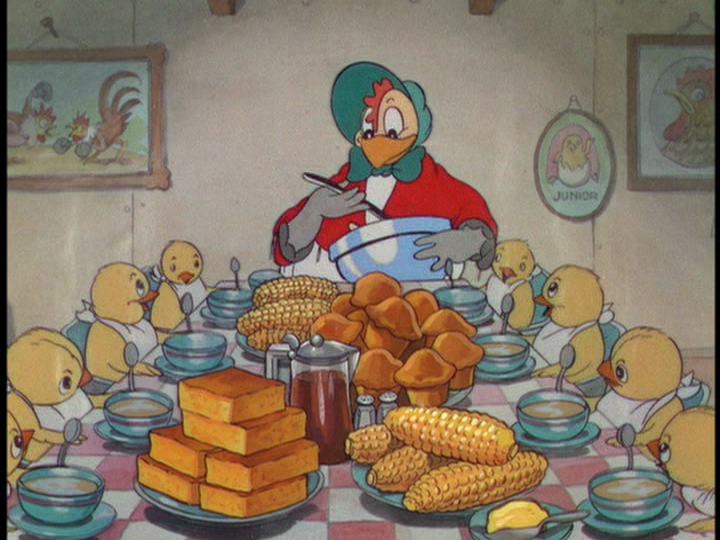
The hen winks at her chicks, getting an idea. She goes out and harvests her corn, and is soon seen at her oven, cooking and preparing many corn dishes. The entire family is shown around the dinner table, with the table piled high with delicious food, and everyone eating heartily. The Wise Little Hen looks out to see the pig and the duck dancing once again, and they feign stomachaches the moment they spot her, with more symptoms, like seeing spots. The hen asks them if they’ll help her eat her corn, and when they readily agree, she hands them a bottle of castor oil – for tummy aches. The singing narrators let us know that “she’ll eat the corn herself,” with Donald and Peter seen kicking each other for their foolishness.

June 8

Posted on

June 8, 1951 – The Donald Duck Short Test Pilot Donald Premieres in Theaters

“Get out of there, stupid. It belongs to him!”

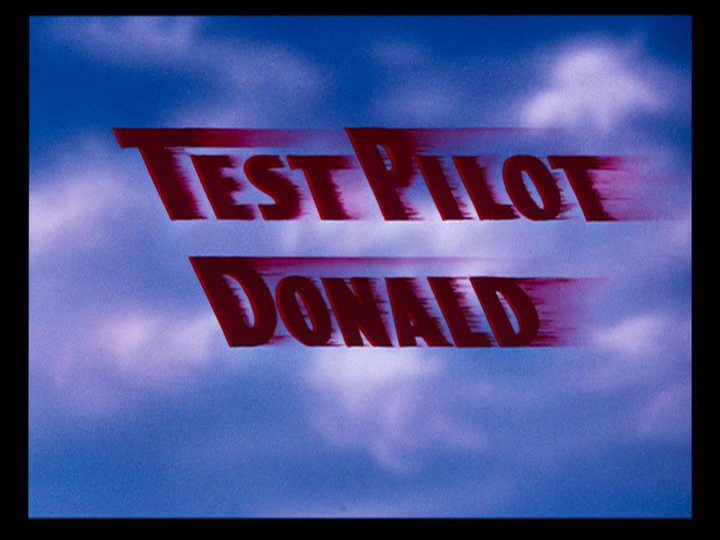
On June 8, 1951, the Donald Duck short film Test Pilot Donald premiered in theaters. This was the 10th short in which Donald had to deal with the antics of Chip and Dale. The short was directed by Jack Hannah, with story by Bill Berg and Nick George, and music by Paul Smith.

A red airplane is zooming through the clouds, and Donald is seen manning the controls, getting ready for a dive. He successfully completes the dive, then checks off his list that the plane is able to maneuver well. As the camera pans back, the audience sees that Donald is only manning a model airplane while camping out in the middle of a park. He sets the plane in for a landing on a pillow, and showers the model with affection.

The pair scurries for cover when the model starts to fly a little too close to their tree

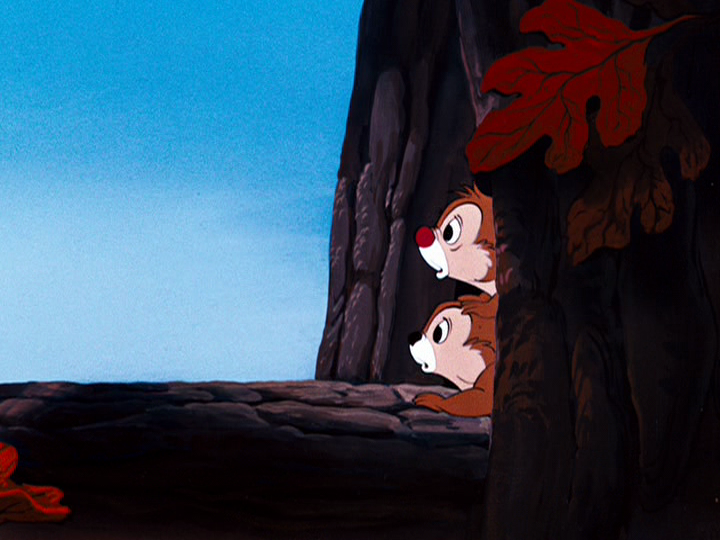
From a nearby tree, Chip and Dale are seen admiring the airplane, too, although they scurry for cover when it seems that the plane gets too close to their branch. The plane does eventually get stuck in the tree, with Donald angrily trying to get it free from the branches. As Donald tugs on the string, smoke shoots out of the tail, flying directly into the chipmunks’ hiding place. Dale comes out and, seeing the plane sitting there, decides that this is his chance to fly the plane.

Dale scrambles to the cockpit, only to have Chip pull on his tail. He points out that the plane belongs to Donald, who is still vigorously pulling on the string. Dale doesn’t care, and when Chip isn’t looking, Dale climbs in and starts playing around in the cockpit, when one button causes the plane to shoot off, leaving Chip stunned. Donald just thinks he got it loose, unaware that Dale is flying around happily, pretending he is a real pilot. He steps out of the cockpit and sits out on the wing, with Chip covering his eyes, thinking that Dale could fall at any second.

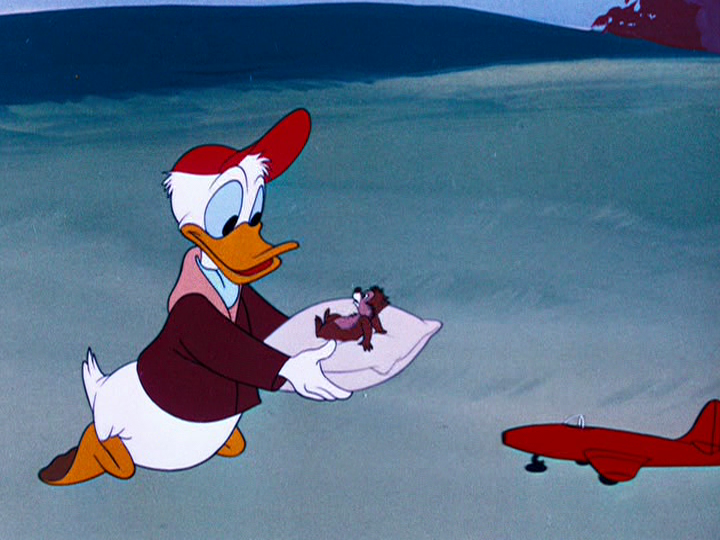
Donald is rather surprised that his plane doesn’t come in for the safe landing, but Dale does instead

Dale finally looks down to see the danger he’s in, scrambles back into the cockpit, and tries to stop the plane. Donald is confused as to why his plane is running around strangely, and when he holds the pillow out for the plane, Dale ends up tumbling out onto the pillow, much to the surprise of Donald. Donald is immediately infuriated, but soon becomes saddened to see his plane is damaged.

As he fixes the wheel, Dale takes a look inside the engine, and begins to fix the model from the inside. Donald is surprised by this, and shuts Dale inside the plane, annoyed that the critter had the nerve to mess with his model. He then plays a prank on Dale, sending the chipmunk shooting out the tailpipe into a pitcher, where Donald keeps him trapped. Chip runs down from his perch to free his best friend, but is still mad that Dale did something so foolish.

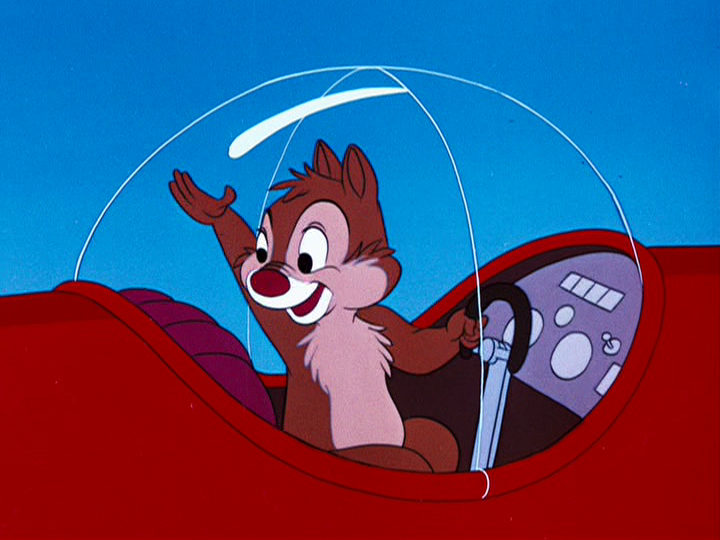
Dale gives his pal a wave as he flies past, unintentionally causing Chip more misery than joy at the situation

As Chip tries to free Dale, Dale digs his way out and gets back in the plane, taking off as Donald tries to fix it. He begins to fly around wildly, waving at Chip as he passes by and sends him flying over the grass. Donald can only watch as his plane has been taken hostage, and flees as he realizes that Dale is going to use him for target practice. Chip just gives up and goes back to his tree while Donald decides to seek revenge.

As Chip continues to taunt the duck, Donald uses a fishing rod to catch the plane and pull it to a stop. Dale, caught, continues to fight, and ends up taking Donald “water skiing” across the pond, while Chip just looks on, frustrated at his friend’s antics. Donald finally catches up with the plane in the air, but Dale parachutes out, leaving the plane without a pilot. The fishing rod gets caught around the top of a building, leaving Donald to fly around in circles for hours, all through the night. Dale points this out as the chipmunks try to sleep, but Chip is still aggravated at his friend’s stupidity.

June 7

Posted on

June 7, 1998 – The Lion King Wins Six Tony Awards

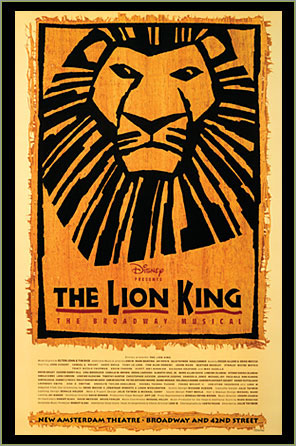
Image Credit: The Official Website for the Tony Awards

 “Tom [Schumacher] and I want to thank the Tony committee and the theater community for embracing this show and honoring us this way.” – Peter Schneider

On June 7, 1998, the 52nd Annual Tony Awards were held at Radio City Music Hall in New York. The Lion King musical walked away with six awards, including Best Musical, beating out Ragtime, Side Show, and The Scarlet Pimpernel. The Lion King also won Best Direction of a Musical for director Julie Taymor, Best Choreographer for Garth Fagan, Best Scenic Design for a Musical for Richard Hudson, Best Costume Design for a Musical for Julie Taymor and Michael Curry, and Best Lighting Design of a Musical for Donald Holder.

The musical, based on the animated film released in 1994, was a phenomenon when released on Broadway, smashing records and earning rave reviews. Julie Taymor, the director, was the first female to receive a Tony for Best Direction of a Musical. “Julie Taymor is a goddess; we’re eternally grateful for your courage, your passion, and the genius that is your gift,” Tom Schumacher announced upon receiving the Tony Award for Best Musical. Using her studies in pre-Bunraku puppetry in Japan, Taymor also helped to create the costumes for the musical, with a variety of masks and puppets used to portray the animals in the show; this unique design helped set the musical apart from the movie.

June 6

Posted on

June 6, 1952 – The Special Short Susie, the Little Blue Coupe, is Released to Theaters

“Susie was a happy little car, as she glided down the avenue.”

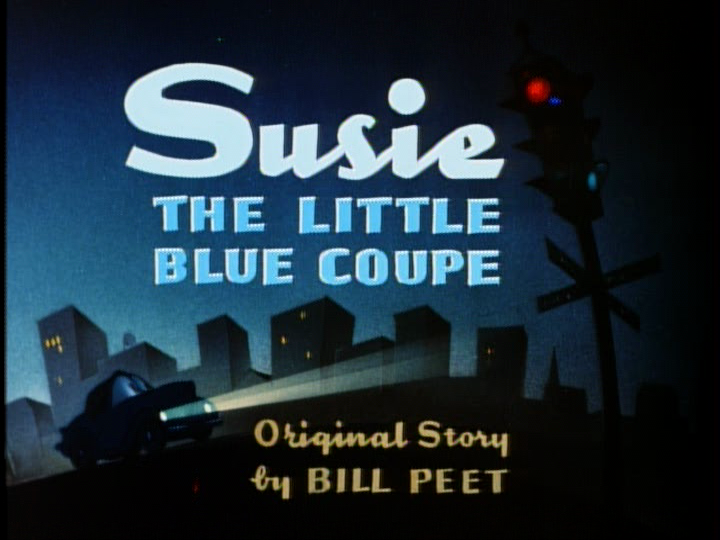
On June 6, 1952, the special short film Susie, the Little Blue Coupe, was released to theaters. It was based on an original story by Bill Peet, with the adaptation to film done by Peet and Don da Gradi. The short was directed by Clyde Geronimi, with music by Paul Smith, and narration provided by Sterling Holloway. The anthropomorphized look of the cars is said to have been an inspiration for the look of the characters in the Pixar films Cars and Cars 2.

“This is the story of Susie,” the narrator begins, with Susie seen in the front showroom of Miller Motors. She had many admirers stop and stare, for she was a beautiful blue coupe. Susie is seen flirting through the window, even giving one of her admirers a wink. One day, a man in a brown suit spotted Susie, and fell in love with her immediately. Susie was thrilled to be sold to the man, and has a cheerful strut as she drives down the road.

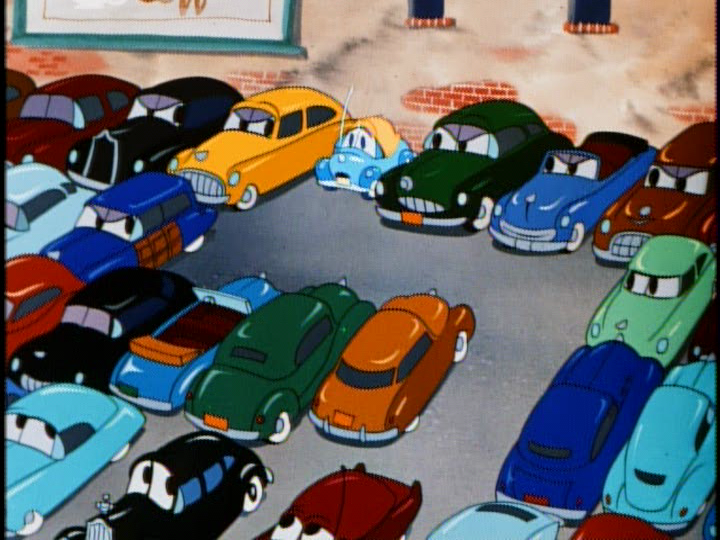
Much smaller than the other cars, Susie huddles in an empty space, intimidated by the others’ mean stares

As Susie entered the main roads, however, she was too slow for the other cars, nearly getting run off the road several times, but she was finally able to maneuver her way around with ease. She also ended up at the Parking Lot, trying to make friends with the big limousines and the big, fancy cars, although they did not take a liking to her. At the end of the day, she was just happy being back in her own garage, with the owner’s cat asleep on her roof.

Years go by, and Susie has not aged gracefully. Her carburetor is having trouble, and her slow speed causes traffic to back up for miles. She goes into Joe’s Garage for a checkup, and when the mechanic lets the owner know that she needs a new overhaul, the owner just says sadly that all he needs is a new car, leaving Susie to be abandoned in a used car lot, on sale for $95.

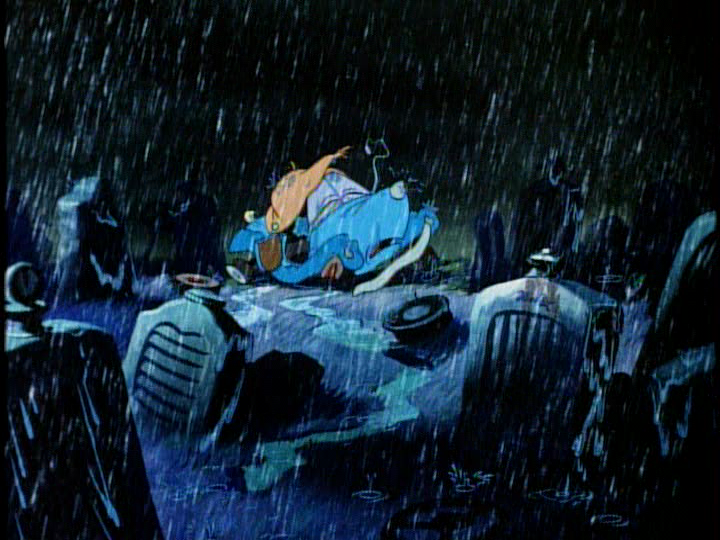
After the accident, Susie is carted off to where all cars go to die – the junkyard

A rather unsavory looking fellow walks around the car lot, checking out the cars available, when he spots Susie with a smile. He goes to check her out, and decides to buy her. Now, she was driving “back streets and dark alleys,” left out in the cold at night, feeling abused and depressed. One fateful night, as she was left alone on the street as usual, Susie is stolen, and is then pursued by the police. Susie’s captor runs a red light, sending her crashing into a trolley. Susie is then carted away to the junkyard.

Susie sits through the seasons in the junkyard, until one day she is spotted by a young boy, who buys her for $12.50. With the help of his friends, they take her apart and put her back together again, so she’s better than new. Susie speeds down the road, happy to be loved by an owner.

June 5

Posted on

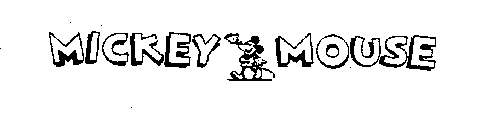
June 5, 1934 – Mickey Mouse Trademark Granted for Newspaper Cartoon Strips

Image from the original patent file. Image credit: US Patent Office Website

“[After the loss of Oswald], that’s when [Walt] decided that he would never not own his own work again. That was a crucial moment in his life and career. He knew then that he had to own whatever he did. And he held fast to that the rest of his life.” – Leonard Maltin.

On June 5, 1934, the United States Patent Office granted the Walt Disney studios a trademark of Mickey Mouse for use in books and newspaper comics. The registrant is listed as the Walt Disney Productions, Ltd. at the Hyperion Studios. The original trademark has since lapsed, but has been renewed three times, the last time on July 14, 1994.

When Walt lost the Oswald the Lucky Rabbit character to Charles Mintz in 1928, he was careful to make sure he owned all of his work and vowed “Never again will I work for somebody else.” The company is very careful to protect its trademarks, no doubt due to Disney’s fierce protection of his work after Mickey Mouse’s creation.

June 4

Posted on

June 4, 1990 – The Walt Disney World Dolphin Resort Opens

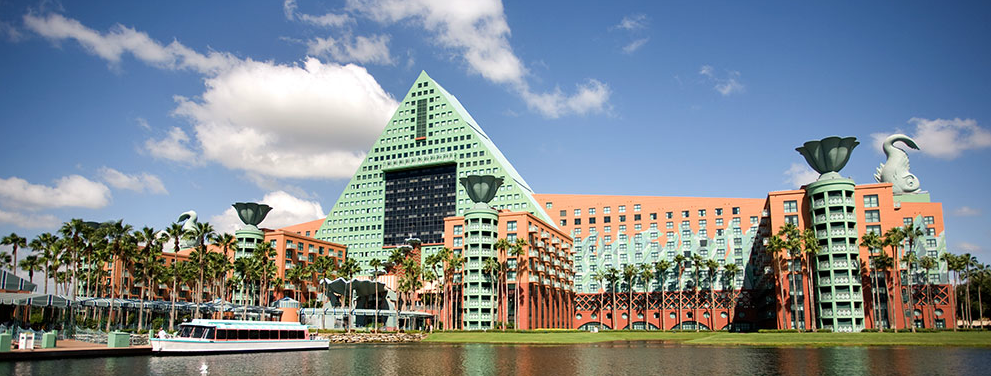
Image Credit: Official Walt Disney World Site

“Inspired by Florida itself, the [Walt Disney World Dolphin Resort] features distinctive architectural silhouettes, punctuated by elaborate fountains and towering palm trees, on grass expanses and white sand-shored Crescent Lake.”

On June 4, 1990, the Walt Disney World Dolphin Resort opened in the Epcot area of Walt Disney World. Designed by Michael Graves, and operated by Sheraton Hotels and Resorts, the Dolphin Resort resides on the edge of Crescent Lake, across from its sister hotel, the Walt Disney World Swan Resort. Its name derives from the pair of dolphins on the rooftop, both 56-feet tall.

The resort’s rooms are luxurious, each equipped with a 32-inch flat screen television, wireless Internet access, and sophisticated décor. Although Dolphin World is considered “other select deluxe hotels” in resort type, guests are still offered complimentary transportation to and from the park, Extra Magic Hours, and on-site Disney ticket desks. There are also many activities for guests of all ages if one doesn’t want to visit the park one day, including such amenities as five different swimming pools, a Mandara Spa, and jogging trails.

June 3

Posted on

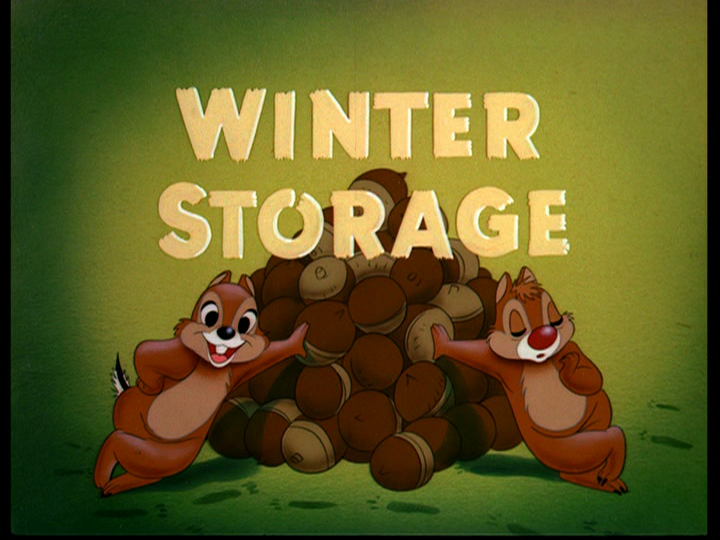
June 3, 1949 – The Donald Duck Short Winter Storage is Released to Theaters

“Oh boy, oh boy! I finally got them!”

On June 3, 1949, the Donald Duck short film Winter Storage was released to theaters. It features Chip and Dale as Donald’s adversaries, their third short with Donald. It was directed by Jack Hannah, with the story by Bill Berg and Nick George, and music by Oliver Wallace. It featured Clarence Nash as the voice of Donald, and James MacDonald as the voices of Chip and Dale.

It’s autumn in the woods, and Chip is busy, storing nuts in a giant oak tree for the approaching winter. According to his calendar, it’s October 7th, and he hasn’t gotten very far with his collection. He passes by a matchbox in the tree that seems to be snoring, and opens it to find Dale fast asleep. Chip kicks the matchbox out onto the main branch, and Dale quickly sets to work picking the acorns from the tree. As Chip collects, he is suddenly thrown off stride by an acorn cap hitting his head.

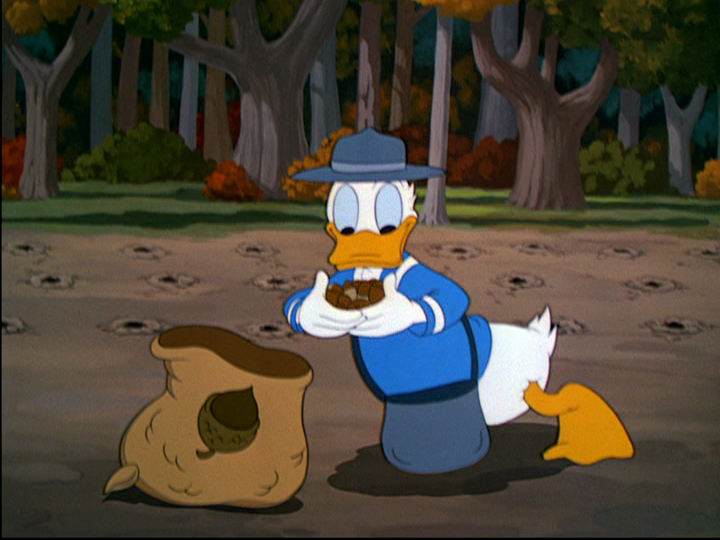
Donald with his bag of acorns to plant in the area

Chip storms out to ask Dale where the acorn went, and Dale points to the tree – every acorn is gone, save for their caps. Chip grabs Dale and pulls him to the calendar, explaining that they have to collect enough food before December 1st, otherwise it will be an awful winter. He then begins to pace, wondering what they’re going to do about their food problem. The pair hears a strange sound outside, and rush out to see Donald standing near their tree, holding a map marking an area that needs to be seeded. With him is a giant bag of acorns used for planting.

The pair becomes excited, and they rush down the tree, digging up the acorns Donald has planted, intending to them back to their food pile. Dale, being a bit slow-witted, decides to replant the acorns, following Donald’s example. When Chip finds out what Dale has done, he gives him a good hard kick before coming up with the next plan: following the acorn bag and collecting the nuts. Dale, however, pulls a loose string from the bottom of the acorn bag and lets all the nuts spill out over Chip, who is not the least bit amused.

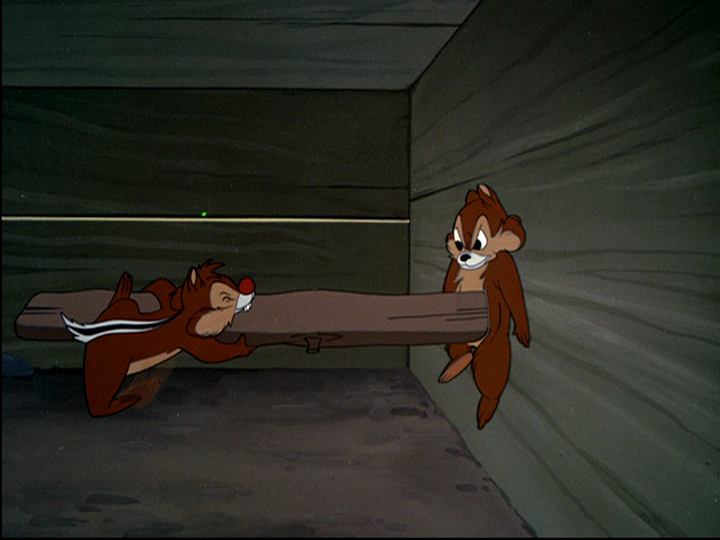
Although he has the best intentions, Dale accidentally traps both of them in the box again

Donald looks to see that his bag is entirely empty, and spots the two chipmunks creeping away with all the acorns in their own bag. He carefully follows them and sets out a trap to catch them, after taking the bag back, but Chip is able to spot the trick. However, Dale unwittingly gets Chip caught in the box, and when Chip makes a successful attempt to free himself, it’s Dale that gets both of them trapped inside.

As Donald rushes over to see his capture, the two dig into the dirt and tunnel out of the box, only to find themselves under it again when Donald has moved it. The two begin to argue, and Donald looks under the box to see his capture. He moves the box away, just observing their little quarrel, wondering if they’ll notice that they are, this time, free. The two face away from each other, silent, and Donald provokes the fight again by pulling Chip’s tail. This causes their argument to become physical, but Dale accidentally ends up punching Donald in the eye.

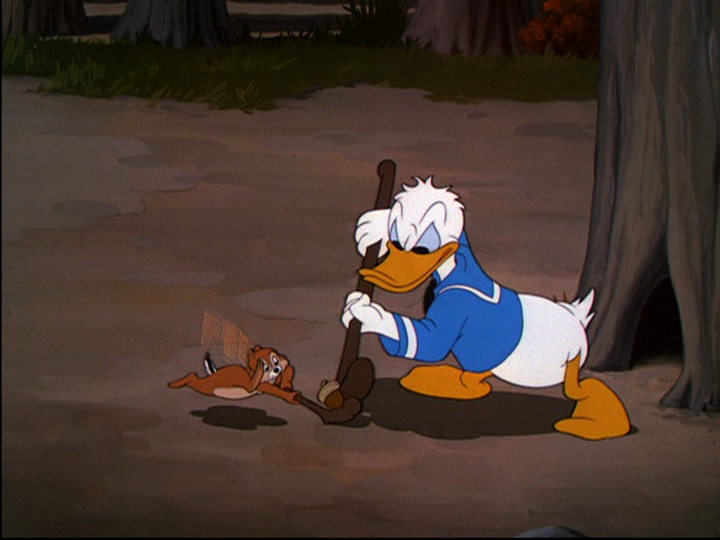
Donald begins to play a game of hockey with the pair with the stolen acorns

The two critters escape and make their way back to the tree with more acorns, and Donald hot on their tails. They begin to play a game of hockey with Donald, trying to shoot the nuts into the hole at the base of the tree. A sudden avalanche of nuts, directed by the chipmunks, approaches, and Donald has no time to prepare. The poor duck is knocked out, and seemingly driven mad, and the two chipmunks are happy they have enough food for the winter.

June 2

Posted on

June 2, 1989 – The Touchstone Film Dead Poets Society is Initially Released to Theaters
“Carpe diem. Seize the day, boys. Make your lives extraordinary.”

On June 2, 1989, the film Dead Poets Society was initially released to theaters, with a general release on June 9th. Distributed by Touchstone Pictures, it won an Academy Award for Best Screenplay for Tom Schulman, who based it on his own life at a private school in Tennessee. It was directed by Peter Weir, and stars Robin Williams as John Keating, Robert Sean Leonard as Neal Perry, Ethan Hawke as Todd Anderson, and Josh Charles as Knox Overstreet.

Set in 1959, the movie starts with the beginning of Welton Academy’s traditional opening ceremony, where several of the main characters are seen carrying in banners with the titles “Tradition,” “Excellence,” and “Discipline.” The dean brags about the school’s achievements, calling it the best preparatory school in the United States. He then introduces the new teacher of the English department, Mr. John Keating, who has been teaching in London, and is an alumnus of Welton Academy. We then catch a glimpse of a few of the boys with their parents, and Neal Perry, one of the shining stars of the academy, meets Todd Anderson, his new roommate. Todd’s brother attended Welton, and Neal remarks, “Oh, so you’re that Anderson.”
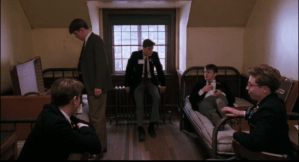
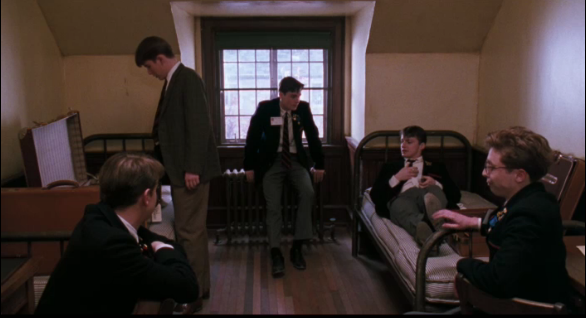
Todd meets Neal and his friends for the first time as they talk about their study group

As Neal and Todd move into their room, Neal’s friends Knox Overstreet, Charlie Dalton, and Steven Meeks appear to talk about their summer and joke about their study group, to which they reluctantly add Richard Cameron, whom they describe as a “boot-licker.” Neal mentions Todd’s brother, who was valedictorian and national merit scholar, which seems to cause Todd some embarrassment. Neal’s father enters the room, and lets Neal know that he will be dropping the school yearbook from his extracurriculars. Neal argues that he’s the assistant editor, but his father will hear none of it, letting Neal know that after Neal graduates medical school and is on his own “then you can do what you damn well please.” Until then, he is to follow only his father’s orders. Neal acquiesces, but looks hurt that he has to give up the yearbook.

The first day of school shows the boys being loaded with what appears to be more work than they can handle, from science, to Latin, to trigonometry. When the boys get into English class, Mr. Keating enters whistling the 1812 Overture, and walks out of the room, to the astonishment of the class. When he tells them to follow, they are confused, but they finally leave. Keating takes them to the main lobby, where he teaches them about the poem “O Captain! My Captain!” by Walt Whitman, and that they may call him “O Captian! My Captain!” if they feel slightly more daring. He then teaches them one of the most important lessons in the film: carpe diem. “We are food for worms, lads,” he reminds them, explaining how life is too short.
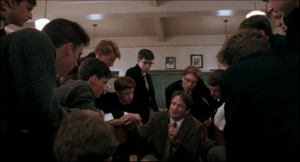
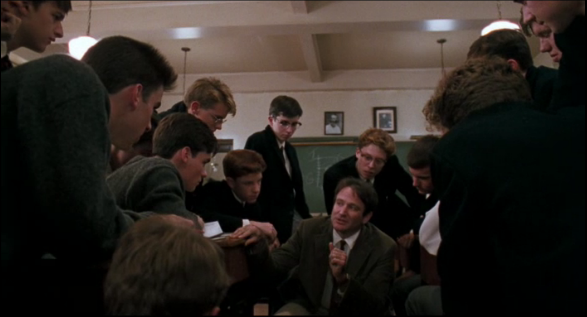
Mr. Keating pulls his class close, explaining the powerful impact language has on life

During the next English class, Neal is asked to read the introduction, and Keating tells them that he can’t stand the introduction, equating it to American Bandstand: “Well, I like Byron, I give him a 42, but I can’t dance to it.” He then asks him to rip out the entire introduction. “In my class, you will learn to think for yourselves again,” he informs them. “You will learn to savor words and language. No matter what anybody tells you, words and language can change the world.”

The boys find Keating’s yearbook, and discover that he was a member of the Dead Poets Society, leaving them to wonder what that means. They approach and ask him what it was, and Keating is a bit hesitant, as he thinks the administration might not favor it. But explains that he and his friends would sit around letting the words of poetry “drip from their mouths like honey.” Neal is inspired to begin the society again, and with the help of Keating and his old poetry book, they decide to meet. Neal asks Todd to come, but Todd is very shy and declines. But Neal persists, and finally the boys sneak out, beginning the first meeting of the Dead Poets Society.
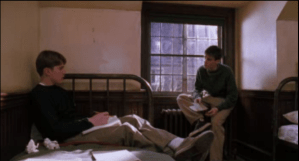
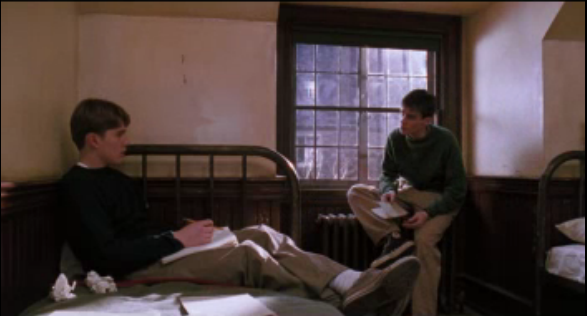
Although Neal is initially elated about discovering his passion, he becomes infuriated that the shy Todd seems to not be effected by anything Mr. Keating has to to say

The English classes continue, with Keating reading Shakespeare in humorous ways from imitating Marlon Brando and John Wayne, to having the students stand on his desk to see things in a new perspective. After class, Neal lets Todd know that he has finally decided what he wants to do with his life: he wants to become an actor. He decides to audition for a production of A Midsummer Night’s Dream, screaming “Carpe Diem!” Neal then chews Todd out for not being stirred up by anything, thinking that Todd has not been affected by anything Mr. Keating has said. Todd argues that when Neal speaks, people listen, and he’s not like Neal. But Neal won’t take that for an answer, and is determined to stir up something in Todd.

Neal then announces he got the part of Puck in A Midsummer Night’s Dream, and forges the letters of permission from his father and the dean. Todd slowly begins to discover a love of writing with Keating’s poetry assignment. Unfortunately, he was unable to come up with a poem he found acceptable to present. Keating pushes him out of his comfort zone, making him come up with a poem on the spot. Keating has finally reached him, and Todd is able to open up.
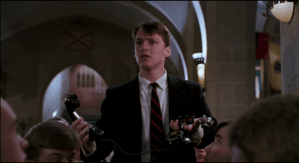
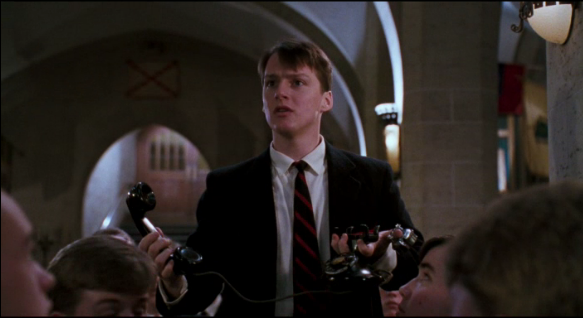
Charlie plays a prank at the assembly, pretending God has called to tell the Dean to admit women in the school

Things begin to go downhill for the Dead Poets Society, when Charlie publishes an article in the school paper in the club’s name to demand that their school go co-ed. He gets himself into trouble by pretending that God has called in the middle of an assembly, saying they should have girls at Welton. Charlie is then punished by getting paddled, but does not give up the members of the club.

Neal begins practices for the play, but comes back one night to find that his father has found out and is furious. He demands that Neal quit, although the play is the next night. “I made a great many sacrifices to get you here, Neal, and you will not let me down,” he warns his son. Neal tells him he will quit, but later that night, he goes to talk with Mr. Keating, who advises him to show his father what’s in his heart, where his passion lies, before opening night. Neal decides to stay with the play, lying to Mr. Keating, saying his father is letting him stay with the play.
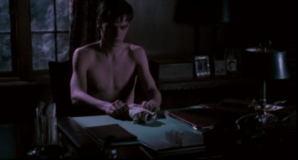
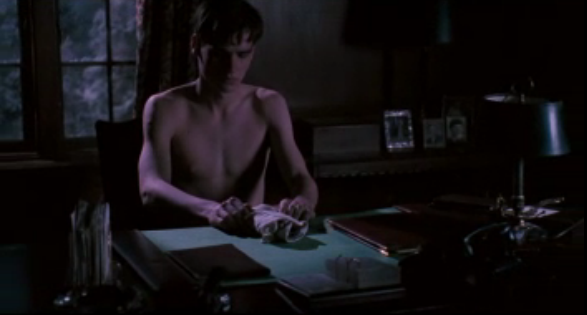
Unable to live the life his father has decided for him, and unable to have a life of his own, Neal resorts to not living at all

Neal shines in the play as Puck, and his father walks in to see the performance, and Neal’s standing ovation. Infuriated by his son’s disobedience, he pulls his Neal out of school, taking him home and informing him that he will be enrolled in military school. Unable to live the life his father has decided for him anymore, Neal takes a gun from his father’s study late that night and shoots himself.

The mood at Welton is somber as they hear the news of Neal’s death. Todd is hysterical, blaming Neal’s father. Mr. Keating is also overcome with emotion when he hears the news, sitting at Neal’s desk and crying. At the request of Neal’s family, the school conducts an investigation as to why he took his life. Charlie accuses Cameron of telling the board of directors all about the club, and Cameron doesn’t deny it, as he wants to save his own skin by putting Mr. Keating on the line. When he tells the group that they should “let Keating fry,” Charlie loses it and punches Cameron, leading to Charlie’s immediate expulsion. When Todd is questioned by the school, they say that it was Mr. Keating’s actions that led to Neal’s death. Mr. Keating is then fired by the school.
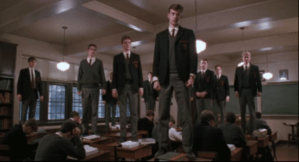
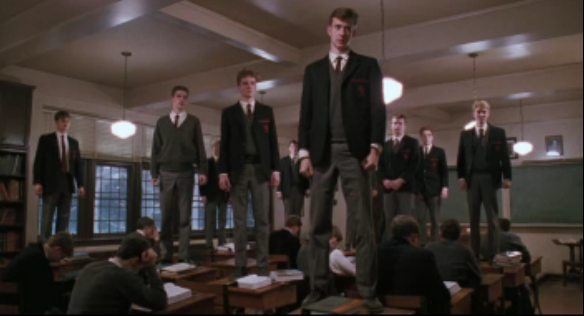
Half of the class stands on their desks, showing their admiration for Mr. Keating, their Captain

The English class is taken over by the Dean, who wants them to read the introduction that they had all ripped out. As Mr. Keating leaves the classroom after collecting his personal belongings, Todd shoots up and admits the truth to Mr. Keating, who tells Todd that he understands. Todd isn’t done, as he gets up on his desk and calls, “O Captain! My Captain!” He is then followed by most of the class, including Knox, Pitts, and Meeks. With a smile, Mr. Keating thanks them, knowing he has made a difference in their lives.

June 1

Posted on

June 1, 1989 – Typhoon Lagoon Opens at Walt Disney World

Image Credit: Official WDW Website

 “Escape to a tropical paradise where you’ll discover a storm of fun in the sun. Disney’s Typhoon Lagoon water park is the place to go for aquatic thrill-seekers of all ages.”

 On June 1, 1989, the 56-acre water park, Typhoon Lagoon, opened at Walt Disney World. It is one of two water parks at the resort, the other being Blizzard Beach. The water park includes Castaway Creek (a 2,000 foot-long inner tube ride), Gang Plank Falls (a group inner tube ride), Humunga Kowabunga (speed slide flumes), Storm Slides (body slides), Mayday Falls (tube slide flume ride), Keelhaul Falls (another tube slide flume ride, through a cave), Forgotten Grotto (a cave walkway through Mt. Mayday), and Overlook Pass (a walkway across Mt. Mayday with waterfalls).

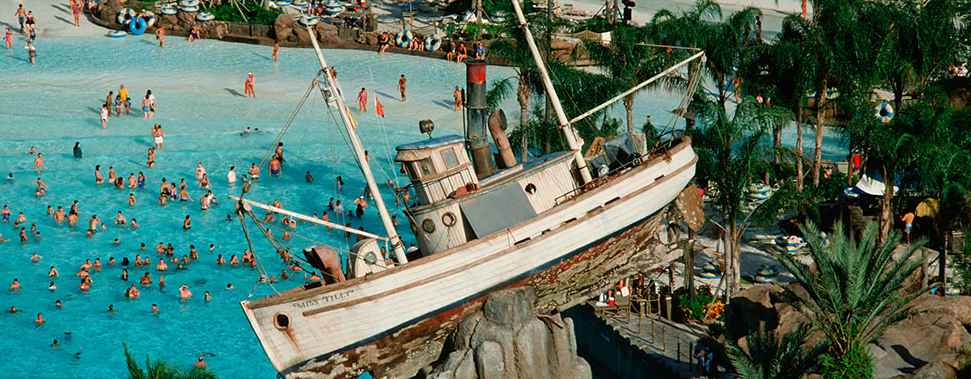
The legend of Typhoon Lagoon is that it was created by an epic storm, with boats tossed around like toys, and surfboards flying into trees. The typhoon created Mt. Mayday, complete with its many waterslides, and a tropical paradise surrounding it. It also created the park’s icon: Miss Tilly. Miss Tilly was a shrimp boat that ended up at the top of Mt. Mayday, and that’s where she stays to this day. Every half hour, a geyser at the top of the mountain blows, trying to dislodge the boat.