RSS Feed

Monthly Archives: February 2012

February 9

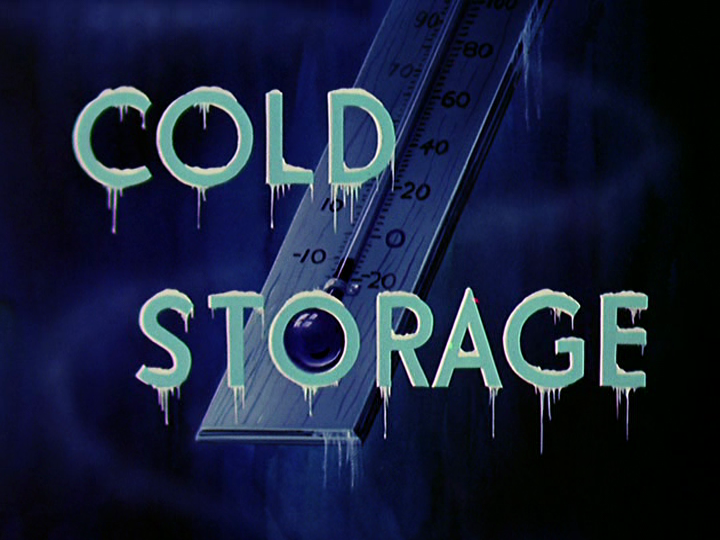
February 9, 1951 – Pluto Short Film Cold Storage is Released to Theaters

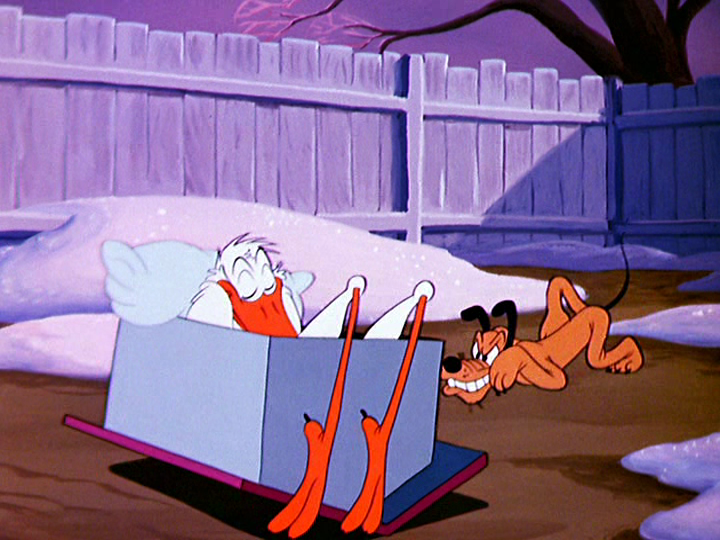
On February 9, 1951, the Pluto short film, Cold Storage, was released. The short was directed by Jack Kinney, with the story by Dick Kinney and Milt Schaffer. It was the 46th Pluto short released, the first in 1951, which was the last year of the Pluto short films.

The scene opens on a pond in winter, where a stork is shivering in the cold as his feet are frozen in the pond. He manages to extract himself, and is on the search for somewhere warm to stay, when he spies a doghouse. He quickly takes over, preparing to hibernate. Unfortunately, just as he has found a place to stay, a shivering Pluto makes his way into the yard, hoping to get warm inside his doghouse. He tries to fall asleep in the house, only to find that the stork has pushed him back out into the cold.

Pluto wakes up, alarmed to find himself in the elements again, and attempts to walk back inside. The cunning stork, however, lifts the doghouse so the sleepy Pluto walks right through it without noticing. Pluto, alarmed again at being outside, runs around to the entrance to once again get warm and as he settles down, the house gets up (thanks to the stork) and walks away. Pluto’s anger grows as he finds he cannot enter his own doghouse, no matter how hard he tries. He sees that the house seems to be moving on its own, and fears he’s become ill or crazy.

Pluto, checking to see if he's sick, ends up seeing his house walk across the yard

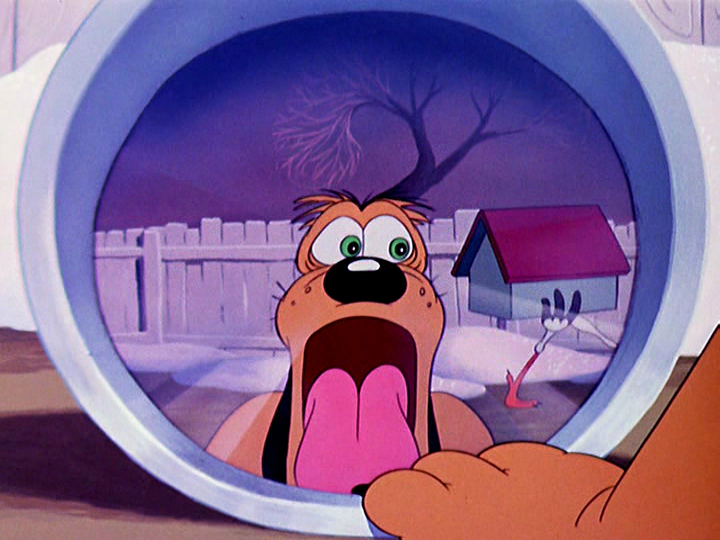
As Pluto checks his vitals, he notices in the reflection of his bowl that the house seems to have sprouted legs and is moving across the yard. He goes into attack mode, but is stopped when the stork’s beak appears in the doorway. As he watches the stork take a drink from the water bowl, Pluto can’t take it any more and begins to bark profusely at the intruder. The stork replies by stepping on Pluto’s snout, silencing the poor pup. As Pluto looks around for his house, he is alarmed to see that the stork has decided to fly away, house and all. When the stork perches on the fence, Pluto knocks him into the yard, only to discover that the stork is now using the house as a cradle, and lulls himself to sleep singing “Rock-a-Bye-Baby.”

As the stork lulls himself to sleep, Pluto decides to implement a sneak attack

Pluto begins to sneak up on the stork, but the stork is unfazed by the dog, until Pluto attacks him. After Pluto thinks he’s won the fight, he goes inside the doghouse and settles on the pillow, hoping to finally get to sleep. The “pillow,” however, has other plans, walking outside the house and dropping Pluto into the frozen pond. Another fight ensues between the stork and the dog, with each fighting for dominance. Suddenly, the sun bursts out from behind the clouds, quickly signaling the beginning of spring. Just as the two were fighting to get in the doghouse, now the two are fighting to get out, as the temperature rises to an uncomfortable level. Fortunately for Pluto, he is able to come up with a compromise that allows both of them to find relief from the heat..

February 8

February 8, 2001 – Disneyland’s California Adventure Opens

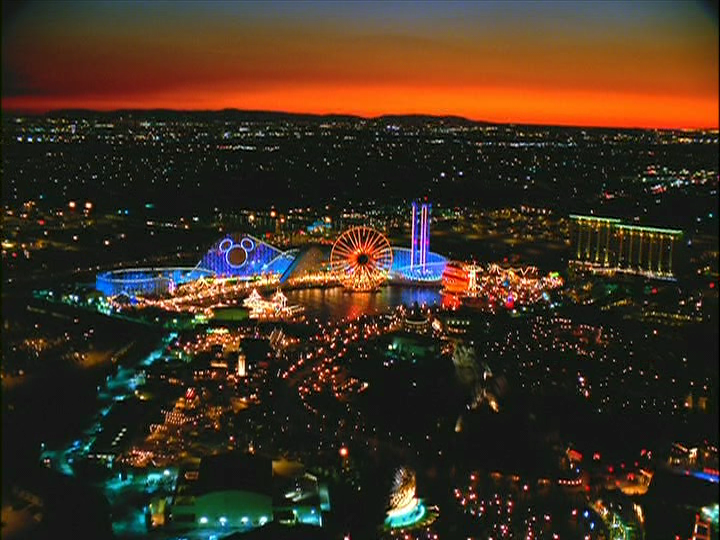
Nightime view of California Adventure in Anaheim, California

“Discover the Disney stories and characters you love in ways you’ve never imagined!”

Opening February 8, 2001, Disneyland’s California Adventure is a theme park in Disneyland, located in Anaheim, California. It was part of a group of changes in Disneyland, and consists of the districts Hollywood Pictures Backlot, The Golden State, “a bug’s land,” Cars Land, and Paradise Pier.

The announcement of California Adventure claimed that it would be a 55-acre park with three districts: one focused on the glitz of old Hollywood, one focused on the nature of California, and one would have a boardwalk feel to it. These lands would later become Hollywood Pictures Backlot, The Golden State, and Paradise Pier, respectively. The success of the Pixar films allowed the building of “a bug’s land” and Cars Land, as well as adding them to other aspects of the park. The early announcement also included Disney’s Grand Californian Hotel and the Disneyland Center, which is a themed retail, dining, and entertainment complex. It was planned to be built in the parking lot of Disneyland.

Paradise Pier, including the roller coaster California Screamin'. Image taken from the Disneyland Park Blog

There are many magical attractions in the California Adventure Park. In the Hollywood Pictures Backlot, guests can get a fright at the Twilight Zone Tower of Terror, have a slapstick adventure with the Muppets at Muppet*Vision 3D, or converse with 150-year-old turtle at Turtle Talk with Crush, from Finding Nemo. Paradise Pier boasts the California Screamin’ rollercoaster, as well as Toy Story Mania!, a 4D midway ride. The Golden State lets guests explore the landscape of California with the Soarin’ Over California Ride, but also gives adults a taste of California wineries with Wine Country Trattoria. “a bug’s land,” based on the hit Pixar film A Bug’s Life, allows younger guests to get a taste of what it’s like to be a bug, and they are able to view the 3D film It’s Tough to Be a Bug. Cars Land is a new 12-acre land that will open in 2012, and will feature locations that were in the Pixar film Cars, including Mater’s Junkyard Jamboree.

February 7

February 7, 1947 – Birth of Disney Legend Wayne Allwine, Former Special Effects Technician and Former Voice of Mickey Mouse

“Wayne was fond of saying, ‘We only carry the torch of these characters for a while, and then we pass it on.’ Well, he just carried it a little bit higher than anyone else.” – Bill Farmer, current voice of Goofy.

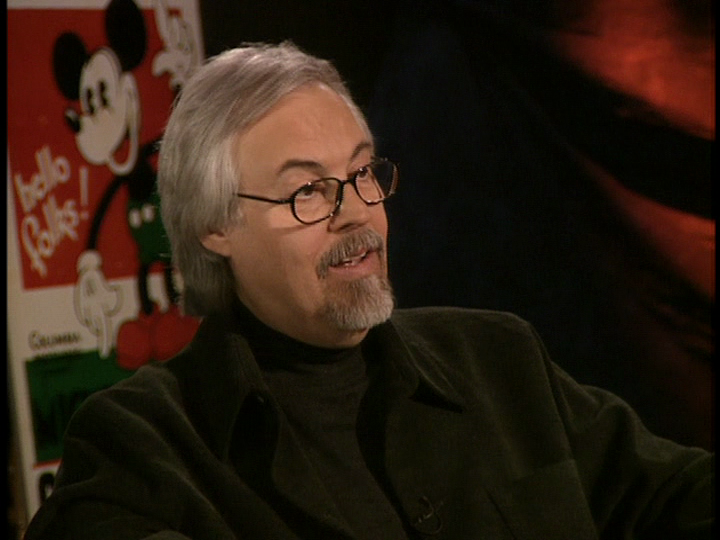
Wayne Allwine, best known as the third voice actor of Mickey Mouse, was born on February 7, 1947, in Glendale California. Active on stage and screen from an early age, Allwine ended up performing in bands until 1966, when he began to work for Disney in the mailroom, which was known as “traffic” in those days. Allwine recounts how he got the job at Disney, as well as how he became Mickey Mouse:


“I had wanted to work for Disney since I was a kid, but didn’t know how to get in. Well, one of the bands I was playing with, Tom Jackman’s father – Tom was the leader of the band – his father Bob Jackman ran the music department. And Bob gave me an application and a recommendation, and I started in the mailroom…way, way back when. And the thing that’s funny is a little known fact: Bob Jackman, after Pinto Colvig had left the studio, Bob supplied the voice for Goofy in several of the cartoons. So, in essence, Goofy hired the future Mickey…

“But I started out carrying mail. I saw Walt a couple of times, but we only spokeonce. He was very sick. [But] it was a magic time, it really was. 1966. John McCarthy was running traffic, as the mailroom was called back then, and just said, ‘Take a walk around, see what you wanna do.’ So I walked around, and the first thing I thought of, ‘Well, I’ve done some acting. Wardrobe looks like fun.’ Cause I love clothes, love clothes. Did that for a while. Went back into traffic and said, ‘Gee, I don’t really know what I wanna do, Mac. I might leave. I might leave for a while and just see what’s on the outside.’

“So great. I left, and I got a call about two months after I left, saying, ‘Would you like to come in and learn Jimmy MacDonald’s job?’ Now, at the time, I didn’t know who Jimmy was. ‘Sure. What am I supposed to do?’ ‘Follow Jimmy. Do everything he does.’

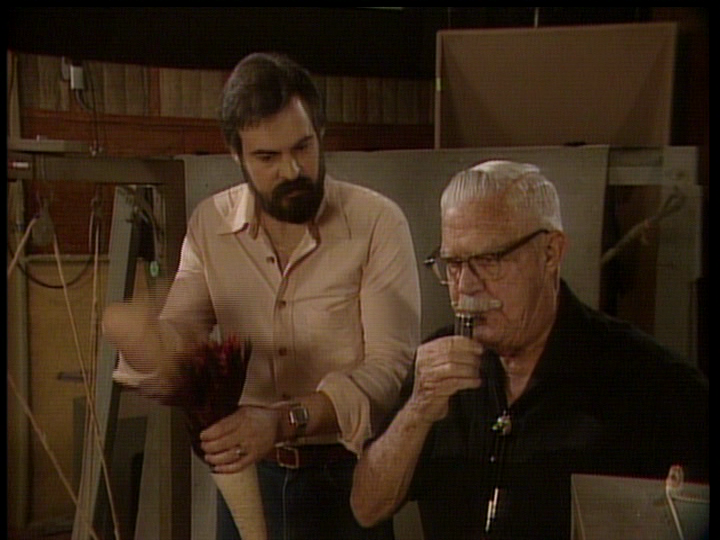
“So, I followed Jimmy, and I learned how to do sound effects. Jimmy only voiced Mickey for radio interviews; I think he was on the Dave Letterman show twice. But other than that, he didn’t do Mickey…he was having a rough time and couldn’t really voice Mickey any longer. And the studio had an open audition. An actor didn’t show up. There was a call from the soundstage: ‘Send the kid down. He works with MacDonald.’ Three months later Lou Debney stopped me and said, ‘Kid, you gotta join the Screen Actors Guild. They’re gonna use you.’

 “And that’s how I became Mickey Mouse.”

Allwine provided the voice for Mickey in Mickey’s Christmas Carol (1983), Who Framed Roger Rabbit (1988), Runaway Brain (1995), and The Three Musketeers (2004). He also voiced the character in the television shows Mickey’s Mouse Works, House of Mouse, and Mickey Mouse Clubhouse, as well as in the video game series, Kingdom Hearts. “The main piece of advice that Jim gave me about Mickey helped me keep things in perspective,” Allwine recalled in a 2004 interview with Leonard Maltin. “He said, ‘Just remember, kid, you’re only filling in for the boss.’ And that’s the way he treated doing Mickey for years and years…Mickey’s the real star. You know, you just have to love the little guy while you have him, because he won’t be yours forever.”

Allwine (L) working with some of the special effects tools designed by Jimmy MacDonald (R)

In addition to his voice acting, Allwine was an accomplished sound effects technician, winning an Emmy and a Golden Reel Award for his work in Steven Spielberg’s Amazing Stories, and another Golden Reel Award in 1986 for his contributions to the Disney animated feature The Great Mouse Detective.

One of the little known facts about Allwine is that in real life, he was married to the voice of Minnie Mouse, Russi Taylor. “It was just a total friendship, and the next thing you knew, we were just sort of like, always together,” Taylor said of how their relationship developed. On October 13, 2008, the couple were inducted as Disney Legends.

Mickey (Allwine) and Minnie (Taylor) together

On May 18, 2009, Allwine passed away at the age of 62. The game Kingdom Hearts 358/2 Days, his last vocal project as Mickey, was dedicated in his memory. “Wayne’s dedication to preserving the legacy of the character who began with Walt Disney himself was steadfast,” Tony Anselmo, voice of Donald Duck and close friend, said about Allwine. “He was one of the kindest men I ever knew, a true gentlemen, and funnier than any professional comedian. A truly gifted and talented man.” Allwin’s voice is still heard at parks around the world, as well as on television on the show Mickey Mouse Clubhouse. “It’s a great honor,” Allwine said of voicing Mickey. “It’s a great honor to represent what Walt loved so dearly, and what Jimmy kept alive so well.”


February 6

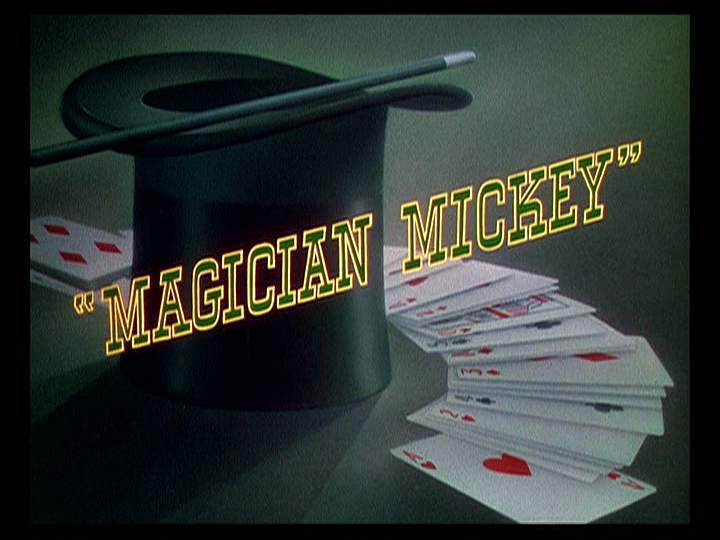
February 6, 1937 – Release of the Mickey Mouse Short Film Magician Mickey

“Aw, why don’t you go home? Phooey!”

On February 6, 1937, audiences were treated to a cartoon magic show called Magician Mickey, starring Mickey Mouse. Unfortunately for Mickey, Donald Duck decides to attend the show, heckling Mickey from beginning to end with a growing degree of cartoon violence, but Donald learns that Mickey will always get the best of him in the end. The short was directed by David Hand, and stars Walt Disney as Mickey Mouse, Clarence Nash as Donald Duck, and Pinto Colvig as Goofy. As with many of the shorts of this period, this one relies on the use of pantomime, as Mickey and Goofy only have one line each. The short has the added bonus of Donald throwing ten fits, including the ones where he is a kangaroo, a seal, and a monkey—it is a magic show—and with every fit, he spits out cards ending with the ace of hearts sticking out of his mouth.

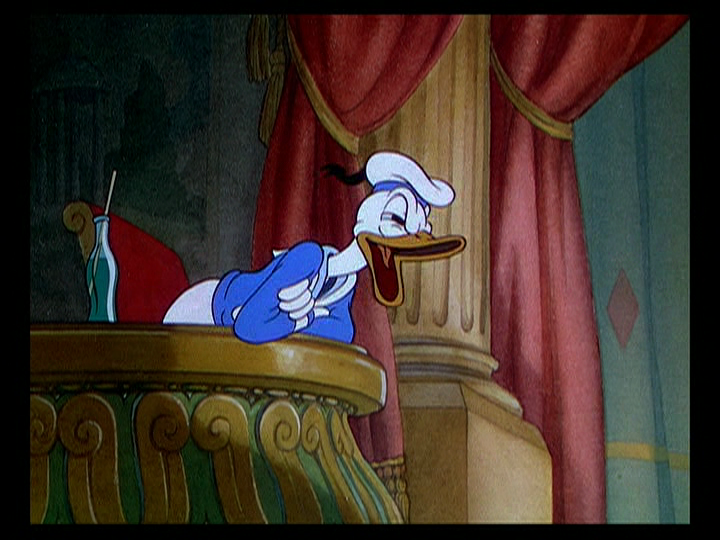
The short opens in a theater, and we see Goofy up in the rafters, setting up the ropes and lights for the show. We then hear applause as Mickey struts onto the stage. His first trick is making his table appear from his hat. He then turns his cloak into a crow, and as the crow flies away, Mickey is startled by hearing loud laughter. As he turns, he sees Donald Duck in a balcony seat, beginning his heckling as Mickey’s personal skeptic, crying, “Aw, phooey.”

Donald Duck, Mickey Mouse's personal heckler

Mickey’s next trick is to release a balloon from his hand, after showing that there was nothing up his sleeve. He releases another one, which suddenly pops over Mickey’s head, drenching him. He glares over at Donald, who spies the other balloon floating over and shoots it with a slingshot. Unfortunately, the balloon turns into a lobster, and begins to fight with Donald. As Donald throws it back at Mickey, Mickey catches it and turns it back into a balloon, which he pops with his magic wand.

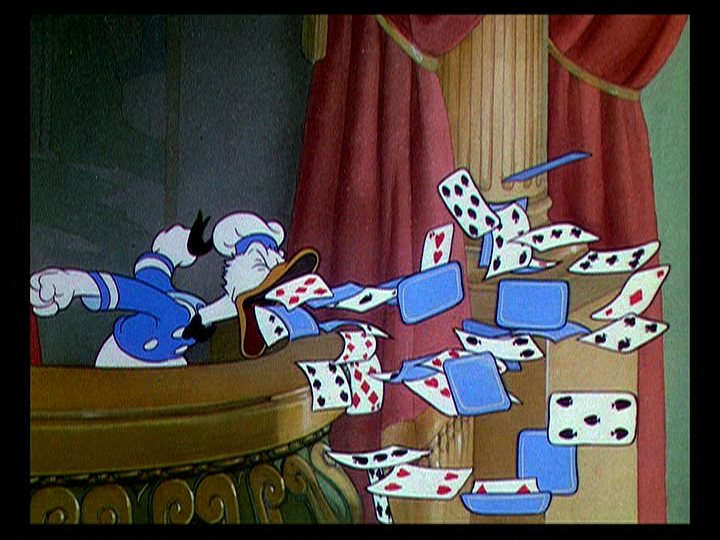
Mickey then begins a card trick, but Donald, ever up to mischief, pulls out a bellows and shoots the air in Mickey’s direction, causing the cards to fly all over the place. Mickey amazes the audience by turning the cards into flock of birds, which he then sends into a cage he makes appear out of thin air. He then makes the cage disappear, replacing it with a new deck of cards. Donald proclaims that anyone can do that trick, and as Mickey makes the cards disappear, they reappear shooting out of Donald’s mouth as he throws a fit. Humiliated, he throws his empty soda bottle at Mickey. Unfazed, Mickey makes the bottle float in midair and fill with water, which shoots back at Donald, causing another card-spitting fit.

Mickey makes the cards reappear through Donald's fits, a humiliation not even Donald expected

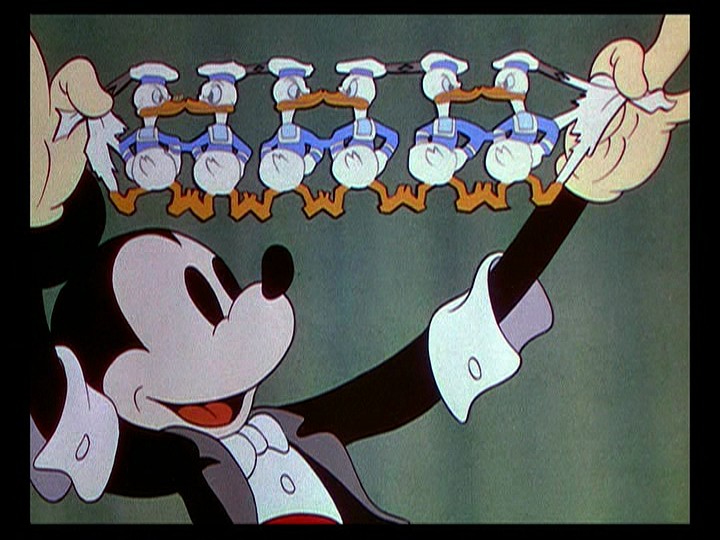
As Mickey bows to the audience, Donald jumps onto the stage and steals the magic wand, trying to use it on Mickey. The wand does give Donald a giant ice cream cone, which spits raspberry ice cream into the duck’s face, causing a third card-spitting fit. As he leaps at Mickey, Mickey catches him and makes him disappear in his hands, turning him into a set of Donald Duck paper dolls, and then into a twisted bullet, which Mickey places into a starter’s pistol. Mickey shoots Donald at an egg on the side table, and by the light of a candle, the audience sees Donald inside the egg, throwing another fit. Mickey grabs the egg and throws it into his hat, and makes Donald reappear by emptying the yolk from the hat.

Magician Mickey and his amazing Donald Duck paper dolls

Angered again, Donald steals the wand again, breaks it in half and throws it on the ground before having another tantrum; this tantrum, however, distracts him from seeing the wand pieces turning into a cactus equipped with boxing gloves. The cactus then begins to punch Donald, with one knockout punch sending him flying offstage. Having enough of the humiliation, but not knowing when to give up, Donald lunges onto the stage, sailing through a hoop Mickey holds up, turning into an assortment of animals as he goes through the hoop over and over. After getting himself back to normal, and seeing Mickey take another bow before the enthralled audience, he spies the pistol in Mickey’s back pocket rips it away and points it at Mickey, who becomes alarmed. “Look out! It’s loaded!” Mickey cries. Donald doesn’t care, but at least he provides the show with an explosive ending.


February 5

February 5, 1953 – Peter Pan is Released to Theaters
“The Disney version of Peter Pan has another interesting first: it’s the first time a boy was shown as Peter Pan. There’d been a tradition, from the time of Maude Adams on the stage…of women playing Peter Pan. But it was…a tradition that was broken by Walt Disney by showing Peter Pan as a boy. Now, it’s an animated boy, but was really a boy’s voice and he was depicted as a boy, which is what he’s supposed to be.” – Leonard Maltin, Film Critic.

The road to Peter Pan’s release on February 5, 1953, was a long one: production started as early as 1935, with Walt planning to make it his second animated film after Snow White and the Seven Dwarfs. Disney acquired rights to Sir James M. Barrie’s play from the Great Ormond Street Hospital in London (to which Barrie had bequeathed the copyright) in 1939, but the advent of World War II halted production of the film.

In the 1950s, Disney decided it was time to bring the film back into production. Starring Bobby Driscoll as Peter, Kathryn Beaumont as Wendy, Hans Conried as Captain Hook and Mr. Darling, and Bill Thompson as Mr. Smee, the film was directed by Hamilton Luske, Clyde Geronimi, and Wilfred Jackson.

Disney first learned of the story of the boy who never grew up when he saw a touring production of Peter Pan in 1913, and he later starred as Peter Pan in a local production of the play. With almost two decades in development at Disney, the story went through many different treatments, ranging from a first, very dark version—much darker than the original play, and more sinister than a typical Disney feature—to the final product. Disney was determined to release Peter Pan as an animated feature. “The cartoon method gave us many advantages over the stagecraft of Barrie’s day,” Disney once said, “which no amount of pixie dust could cure.” Through animation, many of the play’s conventions could be abandoned: Nana could be shown as a dog instead of a person in a dog costume, the characters could fly realistically without any visible wires or tricks, and the biggest change of all, Tinker Bell was a fully formed physical character, rather than a speck of light traveling across the screen. Through the casting of Bobby Driscoll as the title character, Disney was also able to present Peter as the boy he was supposed to be, rather than a woman playing a young boy. The film was a success upon its first run in 1953, and was rereleased several times in theaters, with its first video release in 1990.
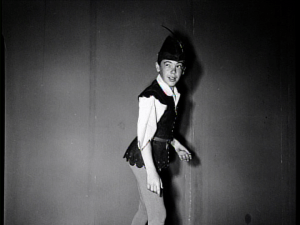
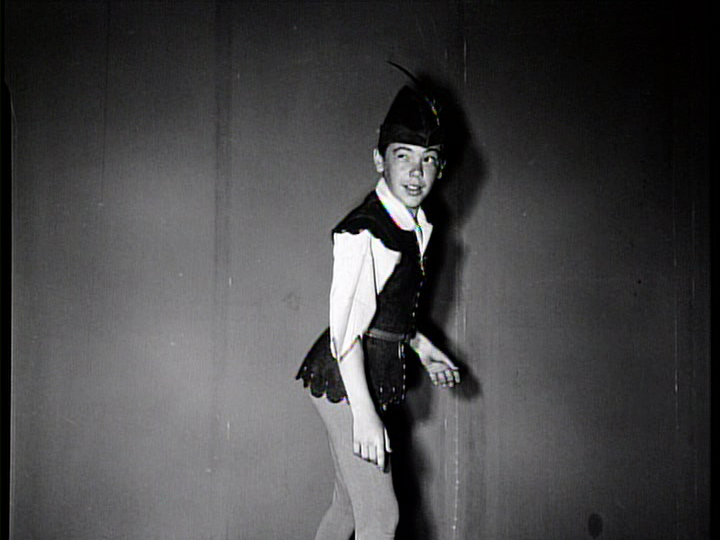
Bobby Driscoll, voice of Peter Pan, dressed for the live-action reference film

Although the actors are only heard on screen as the characters, they actually had to film a second, live-action version of the film for the animators to study. The actors dressed up and performed various scenes to show the animators the action taking place and the small, yet significant, details with each action, such as a turn of the head or how Captain Hook  would hang from a cliff by one hand. “The audience always got confused when we talked about live-action help,” animator Frank Thomas explained, “and we’d say, ‘Well, an artist needs a model, you gotta have something to guide you.’ But it’s also very helpful in little ways of a guy turning and looking back over his shoulder, how far did he turn his head. And you find if you’ve got the real person do it, you saw their arm here would come out as he’d turn, or have something come up to his chin, or some little thing you hadn’t thought of. And very often, that would make the scene come alive.”
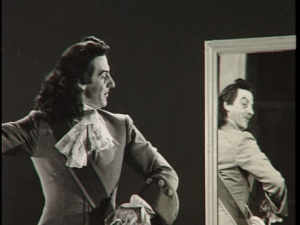
Hans Conried as Captain Hook, in a live-action reference still

Frank Thomas was assigned the role of animating Captain Hook, with Milt Kahl animating Peter Pan, and Marc Davis designing and animating Tinker Bell, a character with no lines. “She’s a pure pantomime character, which in itself I think is rather interesting,” Marc Davis said. The various story sketches of Tinker Bell over the years changed in little details, but throughout all the concept drawings, she was a representation of the current ideal of feminine beauty. One persistent rumor is that Tinker Bell was based on Marilyn Monroe. Monroe was just beginning her career when Peter Pan was in production; the Disney animators wouldn’t have been aware of her enough to base a character on her. The actual person who stood in as the live reference model for the pixie was actress Margaret Kerry, who won the role after performing the scene where Tinker Bell preens in a mirror, only to be alarmed at the size of her hips. “They knew that I had the imagination that they needed,” Kerry said, speaking of her audition.

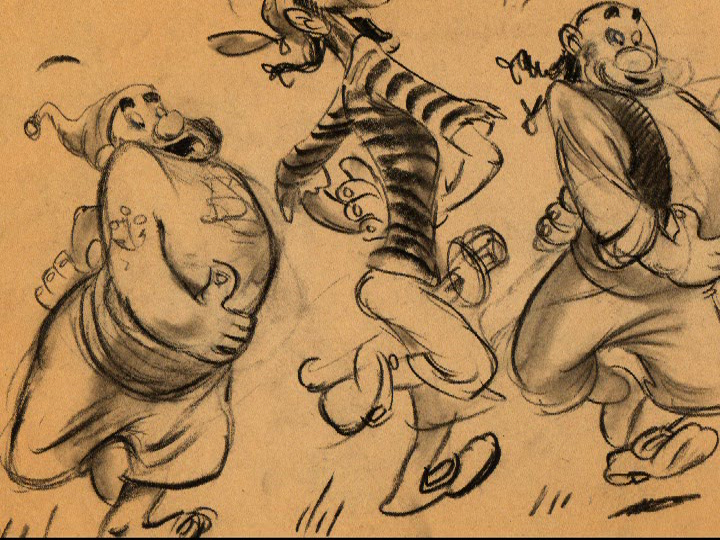
The music of Peter Pan is rather interesting, as many songs were used but ended up on the cutting room floor. One song that is still heard throughout the score, although the actual song was cut, is the crocodile’s theme, also known as “Never Smile at a Crocodile,” which would later go on to be used in a first season episode of The Muppet Show, starring Sandy Duncan. The most famous song from the film, “The Second Star to the Right,” was actually not written for the film; on the contrary, the song was written for Alice in Wonderland, and was known as “Beyond the Laughing Sky.” Another song that was written, but eventually replaced, was known as “The Pirate Song,” which had been storyboarded and demo recorded. The song was sung by the pirates as they try to convince the Lost Boys to join Captain Hook’s crew. The song was eventually replaced by “The Elegant Captain Hook,” which was a shorter song, but has a bit more of a jolly feeling around it.
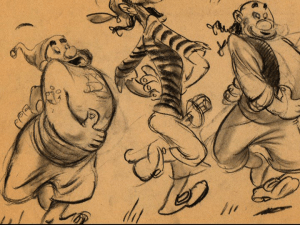
A storyboard picture from the cut song "The Pirate Song," which was replaced by "The Elegant Captain Hook"

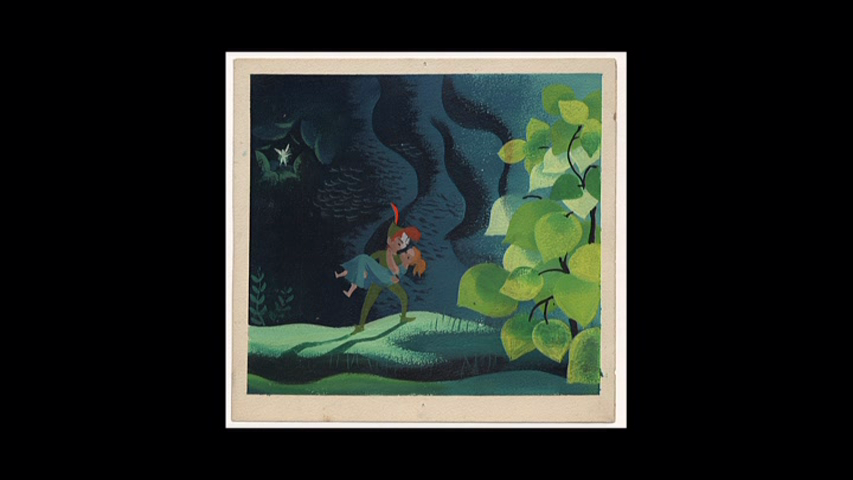
The color stylings went through many artists’ hands during the development process. In the 1930s and 1940s, renowned British artist David Hall created beautiful watercolor treatments of the story; he also did extensive work on Alice in Wonderland for the studio. The color styling that is the final film, however, was the work of Disney artist Mary Blair. Her concept art not only influences the color pallet of the film, but also helped identify the moods of certain scenes, including the scene in Mermaid Lagoon where the skies suddenly darken upon the arrival of Captain Hook. Blair’s art for this film was so popular that Disney released a pin set of images from her concept art to honor the 50th anniversary of the film in 2003.
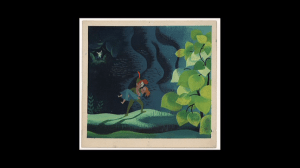
An example of concept art by Disney artist Mary Blair. Notice the color stylings of the characters, and how they compare with the color palate of the film

The story begins with a look at the Darling family, and the narrator explains what each member thinks of the story of Peter Pan. Mary Darling, the mother, believes Peter to be the spirit of youth. George Darling, the father, “Well, Mr. Darling was a practical man,” the narrator informs us. John and Michael Darling believe that Peter is a real person, making him the hero in all of their nursery games. Wendy Darling, the eldest child, not only believes in Peter Pan, but is also regarded as the expert on Peter and all of his adventures. And Nana, the nursemaid, “being a dog, kept all her opinions to herself, and viewed the whole affair with a certain…tolerance.” Mr. Darling, annoyed by Wendy’s constant stories of Peter Pan, decides that it’s time for her to grow up, and that this night would be her last in the nursery. Wendy doesn’t want to leave, especially since Nana has stolen Peter Pan’s shadow, and Wendy wants the nursery window left unlocked in case Peter returns to retrieve it. A worried Mrs. Darling tries to diffuse the situation, and as she and Mr. Darling rush off to a party, her fears are confirmed—the audience sees Peter on the roof of the Darling house.
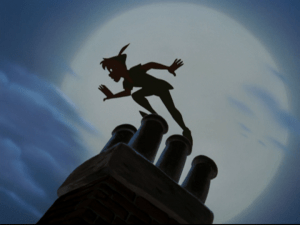
The most famous image of Peter perched on the roof of the Darling's house

When the children are asleep, Peter enters the nursery and searches for his shadow. Tinker Bell, Peter’s companion, finds it in a drawer, and as it escapes, she is trapped inside. Peter’s pursuit of his shadow around the room turns into a brawl that wakes Wendy. When she sees him trying (and failing) to reattach his shadow with soap, she offers to sew the shadow back on. As she sews, she asks how he lost his shadow in the first place. Peter replies that he comes by the house to listen to the stories. When Wendy tells him that there will be no more stories because she has to grow up and leave the nursery, an angry Peter decides that the only course of action is to take her away to Never Land, where she can continue telling stories to him and the Lost Boys. Thrilled, Wendy offers to give Peter a kiss – an action that causes an alarmed Tinker Bell to finally break out of the drawer and attack Wendy, pulling her hair. As Peter tries to catch Tinker Bell, he accidentally wakes Michael and John, who, excited about the prospect of playing games and fighting pirates, beg to go to Never Land too. Peter agrees to take them all, and teaches them how to fly with faith, trust, and a little bit of pixie dust, and off they go into the London night sky.

The audience’s first view Never Land is a pirate ship, where the crew is sitting restless, wishing that Captain Hook would give up his silly pursuit of Peter Pan and take them back to open waters to pillage and plunder again. Hook instead comes up with a plan to capture the Indian princess, Tiger Lily, and force her to tell them where Peter Pan’s hide out is. In an exchange with his first mate, Mr. Smee, Captain Hook reveals the reason for his pursuit: once when he and Peter Pan were fighting, Peter cut off Hook’s hand (which the pirate has since replaced with a hook) and fed it to a crocodile, who liked the taste of Hook so much that he follows him around hoping to devour the rest of him. Smee tries to talk Hook out of his vendetta, but the moment another crewmember announces sight of Peter Pan, Hook decides to attack him with cannon. Peter orders Tinker Bell to take Wendy and her brothers to safety as he distracts Hook, but Tinker Bell rushes off with other plans.

Tinker Bell finds her way quickly to the hideout of the Lost Boys, and tells them that Peter has sent orders to shoot the fast approaching “Wendy Bird.” Eager to please their leader, the boys rush out and throw various sticks and stones at Wendy, and she falls to the ground. Luckily, Peter arrives just in time to catch her. When the Lost Boys reveal Tinker Bell’s lie, Peter banishes the fairy forever, but makes it a week when Wendy makes a plea on Tink’s behalf. He offers to show Wendy the island, while John leads the Lost Boys on a search for the Indians.
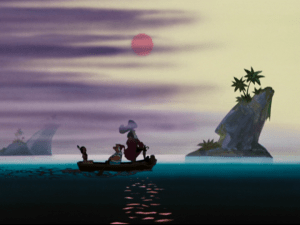
Captain Hook and Smee with the captured Tiger Lily. The coloring was taken from a piece of concept art by Mary Blair

As Peter and Wendy visit the Mermaid Lagoon, they find Hook in a rowboat with the missing princess, and discover that unless Tiger Lily reveals Peter Pan’s hideout, Hook will drown her. Following a sword fight with Hook, which ends with the pirate hanging on a cliff by his hook, with the crocodile waiting impatiently and hungrily below, Peter saves Tiger Lily and takes her back to her camp, with Wendy, forgotten by Peter, trying to fly behind them.

That evening, as Hook sits in his cabin with a horrible cold, humiliated by losing once again to Peter Pan, Smee tells him that “the cook told [him], that the first mate told him, that he heard Pan has banished Tinker Bell.” This reinvigorates Hook, who plans to use Tinker Bell’s jealousy to help him discover Peter Pan’s hideout: “a jealous female can be tricked into anything.” Meanwhile, the Indians are rewarding Peter’s bravery by giving him the name of Chief Little Flying Eagle, and everyone begins to celebrate – all except Wendy, who is sent to go get firewood. Wendy returns to see Tiger Lily flirting with Peter, and she storms away from the party. Tinker Bell, moping nearby, is captured by Smee, who tells her that Hook would like to have a word with her.

Hook tries to charm Tinker Bell, first telling her that he admits defeat and plans to leave Never Land forever, then adding in that Peter has his faults, including bringing Wendy to the island. When he mentions that he knows Wendy has come between Tinker Bell and Peter, she begins to cry, and Hook knows that he has her where he wants her. Under the ruse that the pirates will take Wendy away with them to “save Peter from himself,” Hook tricks Tinker Bell into telling him when Peter is, and then locks her away so she can’t warn Peter of the upcoming attack.
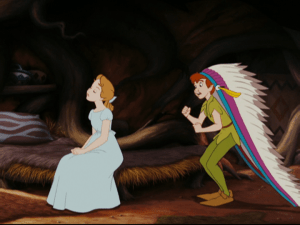
Peter trying to appease Wendy's jealousy after the celebration

Back at the hideout, Wendy, still jealous of Peter’s attention to Tiger Lily, rebuffs him and his show-off attitude. As she gets the Lost Boys ready for bed, she tells her brothers that they will head home in the morning. She tries to act as everyone’s mother, and the Lost Boys decide that they want to return with Wendy, to have a mother as well. An upset Peter tells them that they can leave if they want to grow up, but they can never return to Never Land. Before they can leave, however, they are caught by the pirates and taken to the ship. As the pirates try to convince the Lost Boys to sign up to be pirates, Wendy declares that they will never be pirates—Peter will save them. Hook tells her that a “present” he left in the hideout for Peter (with the tag reading “To Peter with love from Wendy. Do not open till 6 o’clock.”) is a bomb that will blow Peter to smithereens. Upon hearing this, Tinker Bell breaks free from her cell and speeds away to save Peter, managing to tear the bomb away from him as it blows up, destroying his hideout and nearly killing Tinker Bell herself. Peter pleads with her not to die, telling her she means more to him than anything in this world. Hearing the explosion and believing Peter to be dead, Hook makes Wendy walk the plank. The pirates listen for a splash, but when they hear nothing, the entire crew is spooked, believing that their ship is haunted. Peter, alive and well, and joined by Tinker Bell, cuts through Hook’s sails, and the fight to the finish between Hook and Pan begins.
February 4

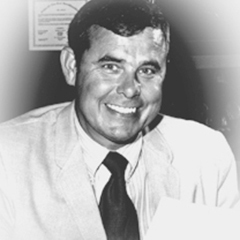
February 4, 1932 – Birth of Disney Legend Bob Allen

Image credit: Disney Legends at Disney Insider

“He was a great, great lover of people, and he showed it. When you met Bob Allen, he acted like you were the first person he ever met.” – Joe Potter, Disney Legend and former Vice President for EPCOT Planning.

Born on February 4, 1932, Disney Legend Bob Allen is best known for his work with Walt Disney World, becoming the Vice President of the park in 1977, as well as being one of Disney’s greatest goodwill ambassadors. He was born in Corona, California, and served in the Navy for four years around the time of the Korean War. After the war, he attended Long Beach State College, majoring in physical education. On a whim, he decided to apply for a job at Disneyland, and in 1955, he began to work in the park as a ride operator. His job was on the Casey Jr. attraction, where he blew a whistle if someone fell off the ride.

Allen moved around to various positions while working at the park, and by 1963, he was the production coordinator at Disneyland. In 1964, Allen moved to Denver, Colorado, spending two years as the manager of the Celebrity Sports Center, a sports facility built by a group of celebrity investors, including Walt Disney and Art Linkletter. Allen also worked as the project manager for the proposed Mineral King resort. Four years later, Allen came back to Disneyland as the director of General Services.

Allen helped prepare for the opening of Walt Disney World in Florida. In 1970, he moved to Florida to work as the director of General Services, and was soon promoted to Vice President of the Resorts Division. On January 1, 1977, Allen was promoted to Vice President of Walt Disney World. Under Allen’s leadership, Walt Disney World was able to thrive, and he continued to work on its long-range plans until his death on November 8, 1987. He was named a Disney Legend at the October 16, 1996, ceremony.


February 3

February 3, 1931 – Silly Symphony Birds of a Feather is Released to Theaters

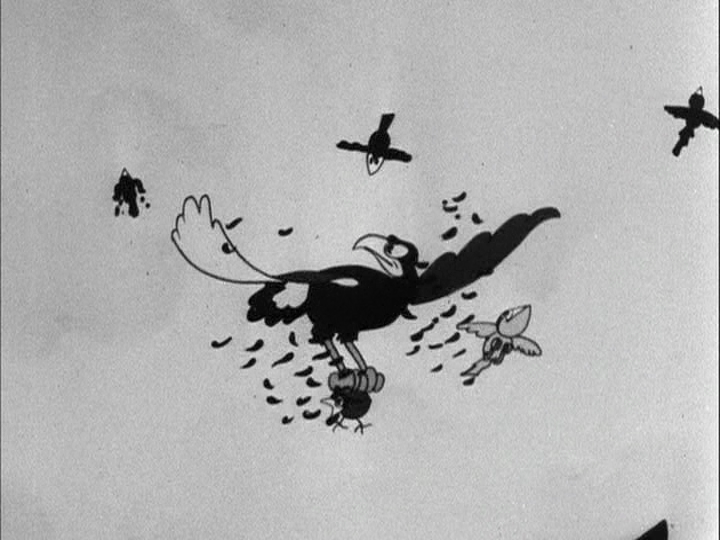
Directed by Burt Gillett, the Silly Symphony Birds of a Feather was released to theaters on February 3, 1931. A black and white short, the story is of several types of birds and how they react around each other, especially when a hawk steals a chick, and a brave group of crows decides to fight back to rescue it.

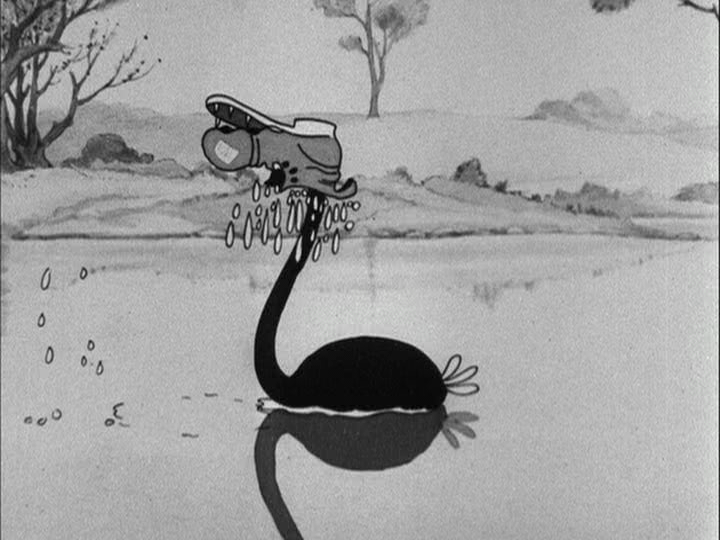
The short opens on a rather idyllic river scene, where three white swans are gliding down a river. They are followed by a black swan, which has two babies as passengers on its back. After the babies decide to swim away, the black swan dives into the water for something to eat, and devours a worm. When it dives again, instead of a worm, it has found a shoelace still attached to a boot, which then lands on its head. The next bird we see is a peacock, preening alongside the water’s edge. After spreading its tail feathers and admiring itself, a duck enters the picture. After observing the narcissistic peacock for a second, the duck sticks its tongue out at the bird, thoroughly distracting it before sailing away.

The swan that accidentally eats a shoelace

The scene then moves to two birds who appear to have harps for tails, beginning the symphony part of this Silly Symphony. The audience travels up a tree, stopping at certain moments to observe the musical habits of the occupants. First, there are several birds chirping the cheerful melody begun by the harp-tailed birds, and above them is a mother bird watching her three eggs hatching. Four hummingbirds buzz around the flowers above them, gathering nectar. The scene travels up a little more, where two birds are trying to continue the melody, but are interrupted by a cuckoo bird, who pops out of several different openings in the tree.

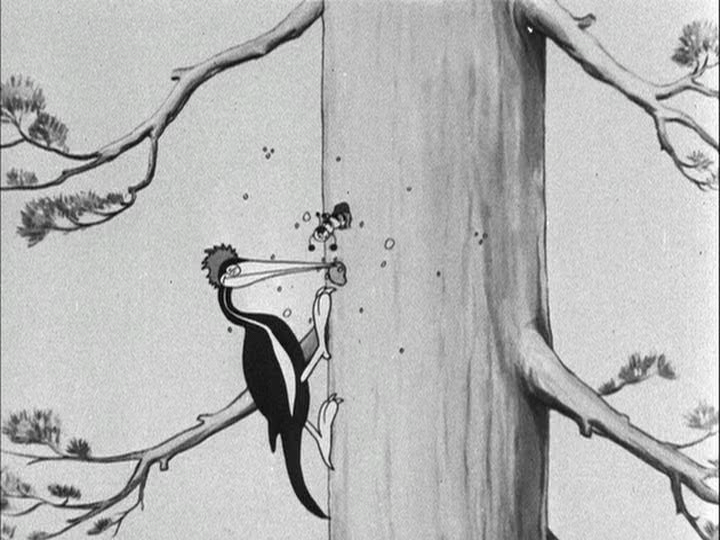
In another tree, a woodpecker tries to peck for food, disturbing a caterpillar that lives in the tree. Annoyed, the caterpillar knocks on the woodpecker’s head, which begins the woodpecker’s pursuit of its possible snack. The woodpecker wins the chase, eating the caterpillar segment by segment.

The woodpecker trying to find food. Little does he know that food is annoyed with his pecking.

A crow flies into the picture, observing another bird giving food to her babies. After the mother bird flies away, the crow climbs into the nest and steals the baby birds’ food, a worm, and flies back to her own nest in the backside of a scarecrow. Her baby crows fight over the worm, which escapes down the leg of the scarecrow and scampers away, only to be pursued by a chicken and her chicks. There are many great gags here, including the worm trying to throw the chickens off by crawling under boots, a pipe, and a can, only to have the hen lift them up with her head and have them land on her chicks. Eventually, the worm crawls into a hole, and the chickens pace and wait, but eventually give up and walk away, except for one chick, who grabs the worm by the end, only to have it crawl up through another hole and bite it on the tail.

While the chickens look for food, the hen notices the shadow of a hawk circling around them. She desperately gathers her chicks together for safety, but misses the one chick who was still after the worm, who is caught by the hawk. After a crow notices what happens, he calls together his friends, who go after the hawk in formation, dive bombing and attacking it to save the chick.

The formation of crows dive bombing the hawk

Overall, the short isn’t that memorable of all the Silly Symphonies, but there are a few good gags that make it a good short to watch. If you watch them in chronological order, you’re able to see how the animation was improving, but this short still has the more cartoony style that was present in the earlier shorts.

February 2

February 2, 1986 – The Disney Sunday Movie Premieres on Television

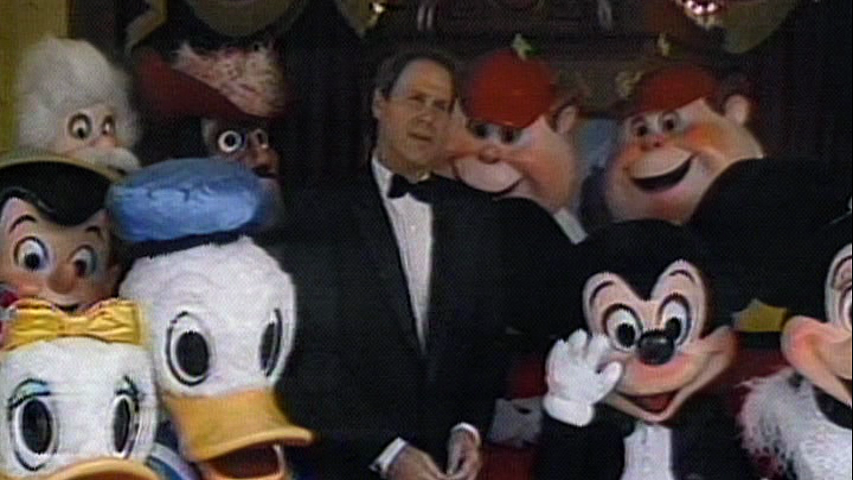
“Hi, I’m Michael Eisner, and welcome to The Disney Sunday Movie.”

Beginning on February 2, 1986, Disney came back to television with a new anthology series, titled The Disney Sunday Movie. Hosted by then-CEO of the Disney Studios Michael Eisner, it was a way to once again bring the Disney films and original Disney programming to television. The series showcased more than thirty films while on ABC.

The first showing on the show was the movie Help Wanted: Kids. The two-hour television movie was about a couple moving to Arizona for work, only to discover that the new boss is a fan of the traditional family, and the couple does not have kids. The couple decides to hire two children to pretend to be their kids with the involvement of a bit of blackmail.

Michael Eisner as the host of The Disney Sunday Movie

The series faced trouble from the beginning, as it was in competition with 60 Minutes on CBS, as well as their top-rated show Murder, She Wrote. In 1987, ABC cut the show down to an hour, but it still wasn’t able to fare well, having been rated fifty-ninth of eighty-five. On September 11, 1988, the struggling show moved to NBC, renamed The Magical World of Disney, but the ratings were unable to improve. In 1990, the series was cancelled. It was revived again in 1997 on ABC, this time renamed The Wonderful World of Disney.

February 1

February 1, 1956 – A Day in the Life of Donald Duck Premieres on Disneyland.

“You know something Donald? You’re a big international favorite.”

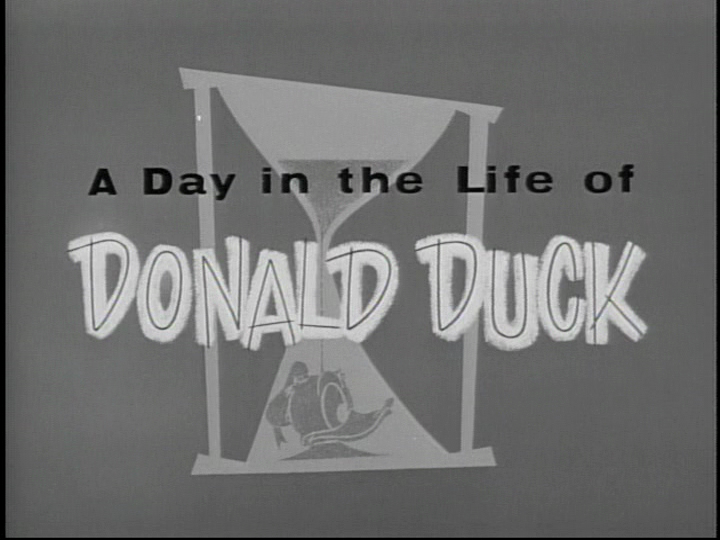
On February 1, 1956, Disneyland audiences spent A Day in the Life of Donald Duck. As Walt Disney explains in the introduction, there have been so many fan letters to Donald, that he thought the audience might want to spend a day with Donald at the studio. Directed by Jack Hannah, with story by Albert Bertino and Dave Detiege, we see how Donald begins his day, as well as his interactions with Jimmie Dodd, Roy Williams, the Mouseketeers, and the most important person in Donald’s life: his voice, Clarence Nash.

“Donald, like any other average cartoon character, lives a simple, unassuming life in a quiet residential section of Beverly Hills,” Disney tells the audience, showing pictures of the neighborhood. “He resides in a modest little cartoon house. He drives to work in a modest little cartoon car. And if he seems a bit reckless, you must remember that Mr. Duck drives with a cartoon license.” As we see Donald pull into a spot marked “No Parking,” he is immediately confronted by a police officer. Donald, however, folds the car into a tiny packet, tucks it under his hat, and walks to his office.

Donald's "modest" house in Beverly Hills

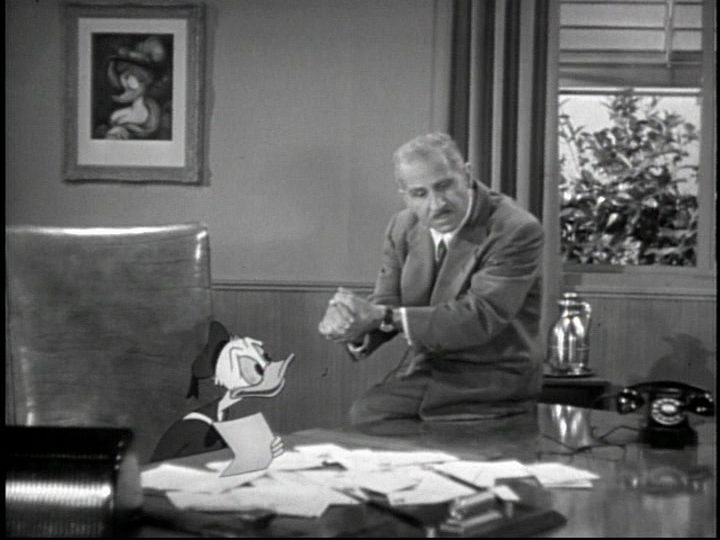
When he arrives at his office, the intercom sounds, and his secretary greets him respectfully as Mr. Duck. Donald responds with, “Just call me Donald, toots. What’s first on my schedule, tootsie?” in keeping with Donald’s personality as a bit of a wolf. She responds that he has fan mail, which he opens eagerly. The letters, however, are not pleasing in Donald’s opinion. One letter openly says, “Dear Donald, I can’t understand a word you say.” This is the last straw in Donald’s opinion, and he demands to speak with his voice, Clarence Nash. Nash comes in with a cheery attitude, which doesn’t change Donald’s mood in the slightest, no matter what Nash does to cheer him up. They end up arguing, with Nash reverting to his Donald Duck voice, even as he pulls out a coonskin cap and starts signing the Davy Crockett theme song. Donald tells him he’s a horrible singer. Nash leaves, with the two still taunting each other, and Donald vows that he’s got to get himself a new voice.

Donald and his voice, Clarence Nash, as Nash shows him a new trick

The next guest to enter is Jimmie Dodd (host of the Mickey Mouse Club), who has written a new song about Donald, inspired by fan art from children all over the world. “They’re so great, they had to have a song written about them,” Jimmie explains, and begins the song, which Donald immediately loves. There are versions of the song sung in different languages with accompanying pictures, including Spanish, French, Italian, and German. The images and tunes are stereotypical for the fifties, but somewhat sweet and fun all the same.

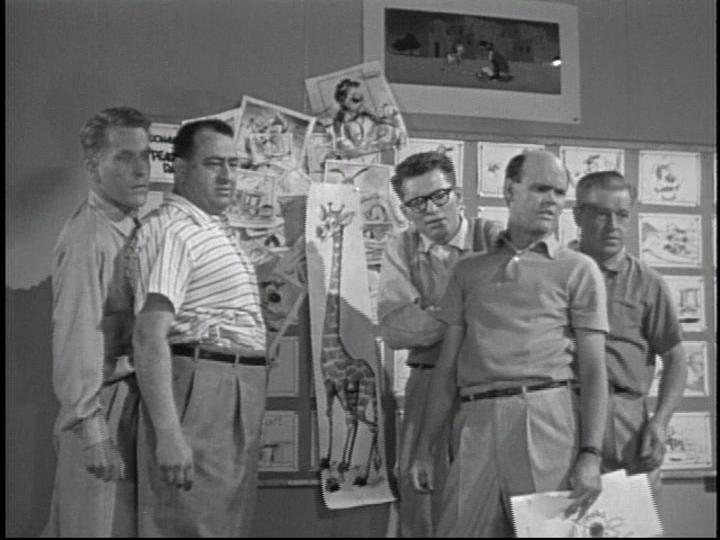
Donald then leaves for an 11 o’clock appointment at the Story Room, and when the storymen hear Donald coming down the hall, they begin to panic, as they fear his temper more than anything. They try to make Donald comfortable, and when they try to show him storyboards for a short entitled Peaceful Day, Donald asks for more birds and butterflies. The storymen overeagerly agree to his requests, to the point that Donald gets annoyed, and demands that there be a short with just him in it. This gets them to thinking, and the audience is then shown the brainstorm: the short, Drip Dippy Donald (originally released March 5, 1948).

The bewildered story team, trying to acquiesce to Donald's requests

Back in his office, Donald receives a call from Walt, who asks him to show the Mousketeers around the studio, as Mickey has remembered that they had never seen it before. Donald eagerly agrees, and runs to meet the Mouseketeers, who surprise Donald by making him an honorary Mouseketeer and giving him his own set of Mickey Mouse ears. As they run around the studio, the kids slip into the Sound Effects Department, closing the door just as Donald is about to get inside, leaving him on the outside as the kids see how sound effects were added to the Donald Duck short, Fire Chief (originally released December 13, 1940). One example they show is when a building is set on fire, the special effects team uses sparklers and crumpled plastic to create the sound of the burning ceiling.

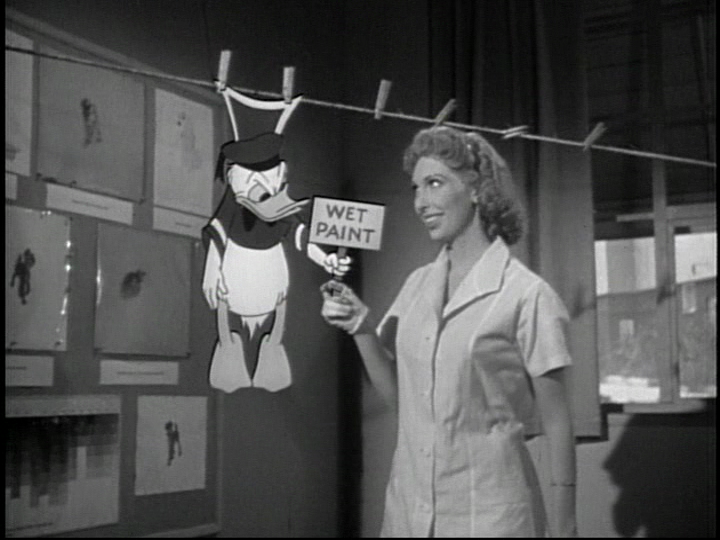
When the short ends, the door opens, and Donald is ready to step inside, until an effects man empties a bucket of water over him, which causes half of Donald’s paint to run. This necessitates a trip to the Ink & Paint Studio, where the painter quickly re-paints Donald and hangs him up to dry, an experience Donald finds quite humiliating. The painter explains that twenty gallons of paint are usually used for a Donald Duck picture, which surprises the kids and causes Donald to remark that he is “very expensive.” She also explains that in one picture, they used just one pint of paint for Donald; the audience is then shown the short The Vanishing Private (originally released September 25, 1942).

Donald and the Painter, with Donald pointing out how humiliating this is for him

After the short, we see the kids with Jimmie Dodd again, singing the new Donald Duck song he wrote. As Donald tries to sing the last line of quacks, he is cut off by Roy Williams, the other host of the Mickey Mouse Club. The kids are excited to see him, and he tells them that he’s practicing drawing the characters. To prove that anyone can draw, Roy asks one of the Mouseketeers to make a scribble on the easel. From her scribble, Roy is able to draw an ostrich. Donald, jealous of the stolen attention, challenges Roy and scribbles on the easel. Roy accepts, and ends up turning Donald’s scribble into a humorous image of Donald Duck. As Donald throws a tantrum and jumps up and down on the teasing picture, the kids flee the room and head into the projection room. “And now, in Donald’s honor – he really is a good scout,” Roy welcomes the kids, “I’d like to dedicate this picture to all you Mouseketeers.” Donald is touched by the tribute, and the audience is then shown the short, Good Scouts (originally released July 8, 1938).

This episode is a must-see for fans of Donald Duck. There are many wonderful gags, and the interaction of Donald with Clarence Nash is enough of a reason to watch. It’s a perfect example of all the temperaments of Donald, with the added bonus of it being set in the real, rather than the cartoon, world.