RSS Feed

Tag Archives: Short film

July 16

July 16, 1954 – The Donald Duck Short Film Dragon Around is Released to Theaters
“Uh oh! This tree has to go!”

On July 16, 1954, the Donald Duck short film Dragon Around was released to theaters. This is the 14th short in which chipmunks Chip and Dale play antagonists to Donald Duck. The short was directed by Jack Hannah, with story by Nick George and Roy Williams. It stars Clarence Nash as the voice of Donald, Dessie Flynn as the voice of Dale, and James MacDonald as the voice of Chip.

The short begins with Dale reading a discarded book of fairy tales at a rather unkempt area of the park. Dale is excited when he comes across a tale of a knight fighting a dragon, and he pretends to be a knight. A sudden rattling knocks him from his perch, and he looks around for the source. He sees the shadow of what appears to be a dragon on the side of a hill, and runs for cover in his tree. He tells Chip in a hurry what he saw, but when he pulls the other chipmunk to see, the “dragon” is gone. Chip chastises him for his imagination.
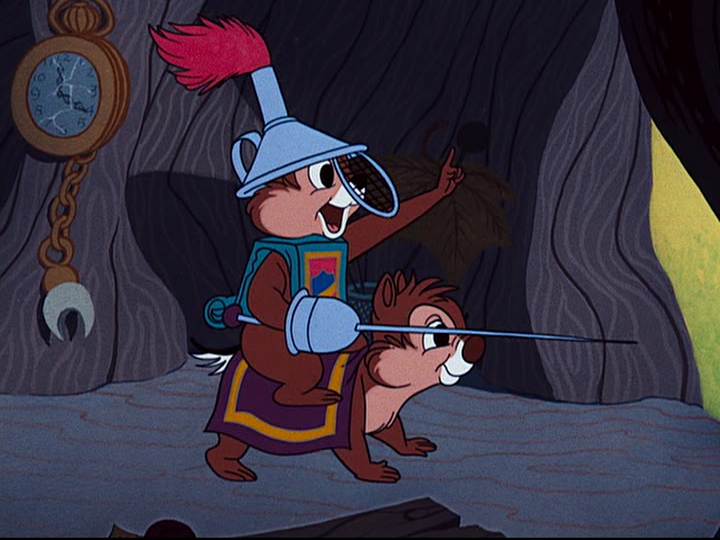
With a bit of ingenuity, the chipmunk duo prepare to defend their tree

Just then, another rattling rolls around, and the two see the “dragon” on the side of a hill again. As they flee, the source of the shadow is revealed: Donald comes rolling around the hills in a steam shovel, helping prepare another freeway. The only thing in his way is the tree where Chip and Dale live. Quickly, they gather branches and try to attack the steam shovel to protect their tree, but that has little effect. Donald notices the duo’s attacks and scares them with the steam shovel. The pair lands right next to the fairy tale book, which gives Chip an idea, and the two run off to prepare. After a bit of arts and crafts, the pair emerges as a brave knight on his trusty steed, ready to protect their castle.

Donald fixes his steam shovel with a way to spurt fire from its mouth, and the fairy tale begins to become too real for the chipmunks, who flee. When Donald takes a break, they decide to sneak up on the “dragon,” unaware that Donald has been playing with them the entire time. Donald continues to attack their tree, and the duo crashes a boulder into the steam shovel, followed by barrels of tar. The tar rips out the steam shovel’s teeth, and Donald, his temper rising, captures the two and locks them in his tool box while he tries to knock down the tree.
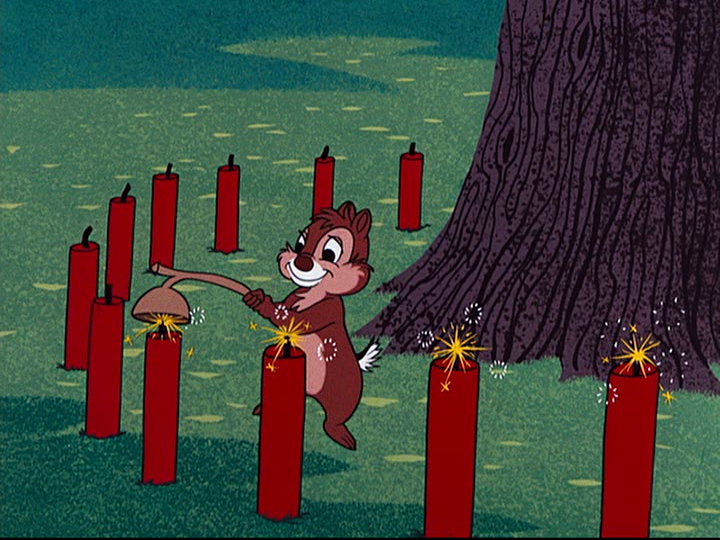
Donald uses dynamite as a last ditch effort to destroy the tree; Dale goes around and extinguishes each stick while Donald isn’t looking

Chip and Dale saw their way out of their tool box and, using a couple of wrenches, they undo every screw they can find. Donald races towards the tree at full speed, unaware that the steam shovel is falling apart as he goes. When he reaches the tree, Donald is left with nothing but his head to smack into the tree trunk. Losing his temper, Donald grabs sticks of dynamite and arranges them around the tree, getting ready to blast them out. As he covers his ears from the eventual blast, Dale goes around extinguishing each stick, and Chip gathers them up, placing them where the steps in a ladder would be. They fool Donald into chasing Dale up the ladder while Chip lights the fuses, and Donald is sent flying high into the sky as the dynamite blows.
July 14

July 14, 1934 – The Silly Symphony The Flying Mouse is Released to Theaters

“Please, I wanna fly like the birds!”

On July 14, 1934, the Silly Symphony The Flying Mouse was released to theaters. It featured a popular song called “You’re Nothin’ But a Nothin’,” composed by Larry Morey and Frank Churchill, which would later be released on sheet music. The short was directed by Dave Hand.

The short opens on a warm spring day at a quaint pumpkin house, with a mother mouse giving her youngest child a bath while her children play see-saw on a mushroom. One of her children is sitting away from everyone, admiring the birds he sees fly high in the sky. His greatest desire is to fly, and he imagines himself soaring through the sky with a beautiful pair of wings. He comes up with the idea to attach leaves to his arms, then calls over for his brothers’ attention. He runs off a branch, attempting to fly, and falls like a rock face-first into a pit of mud. His siblings laugh, but he decides that all he needs is a higher jumping point, and climbs up a flower. As he lifts into the sky, a gust of wind comes his way, and he falls into the tub of water from his sister’s bath, splashing the water everywhere, which causes his sister’s clothes to shrink.

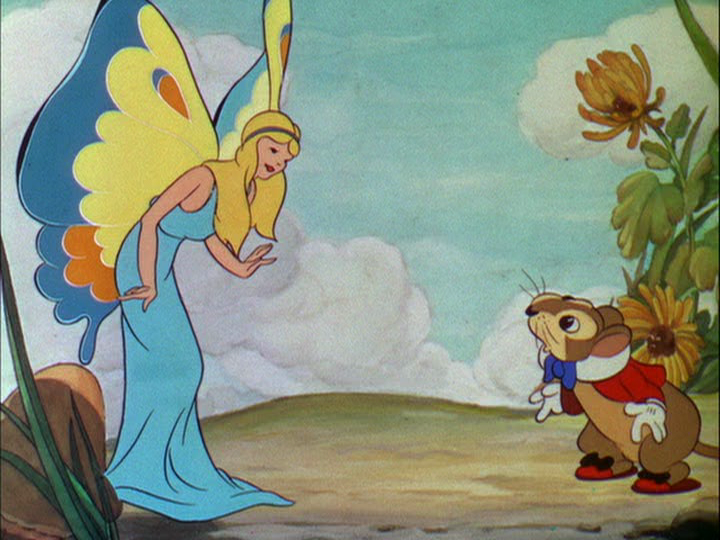
The astonished mouse meets the fairy, who wishes to reward him for his brave deed

After a good spanking from his mother, he runs away to cry as his other siblings laugh at his folly. Suddenly, the mouse hears a cry for help from a beautiful butterfly caught in a spider web, with the spider licking his chops. He saves the butterfly, who turns out to be a beautiful fairy, and offers to grant him one wish for his kindness. Without hesitation, he tells her that he wants to fly. She warns him that mice were never meant to have wings, but after he pleads again, she grants him his wish. He kisses her hand in gratitude, and goes to join the birds in their flying dances. However, although he can fly, he is not welcome at the birds’ party, and is soon all alone. He decides to go surprise his family.

As he flies down, the family members are startled by his shadow, thinking he’s a predator, and they hide inside and throw items at him until he flees. Alone, the mouse ends up in a cave full of bats, who welcome him as one of their own, calling him brother. When the mouse cries that he’s not their brother, they tell him that since he’s not a mouse, and if he’s not a bat, then he’s a nothing. He runs as fast as he can away from the cave, and cries, realizing the wings have only brought him unhappiness. From one of his tears, the fairy reappears, asking why he’s so sad. He tells her he wishes he could die. The fairy tells him to cheer up and be happy that he’s himself, and if he does so, life will smile on him. She then removes his wings, and he’s so happy he kisses her hand once again in gratitude before running home to greet his family.

July 11

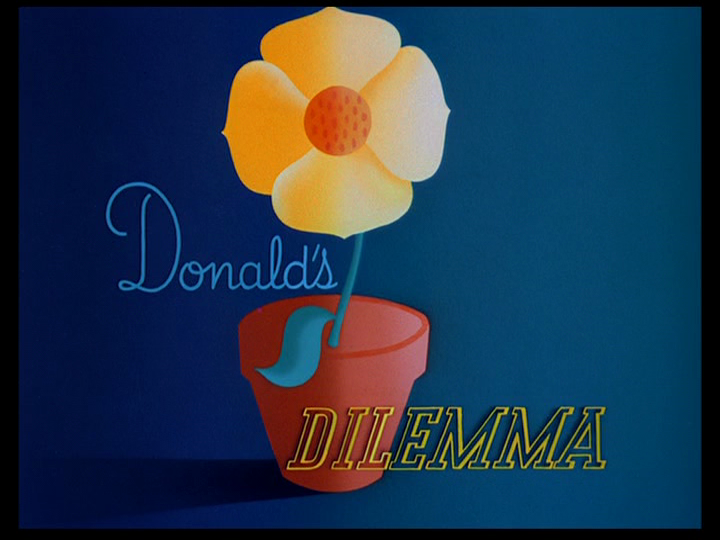
July 11, 1947 – The Donald Duck Short Film Donald’s Dilemma is Released to Theaters

“Donald Duck! You are the greatest singer in the world!”

On July 11, 1947, the Donald Duck short film Donald’s Dilemma was released to theaters. Surprisingly, although the title is Donald’s Dilemma, the short is really about the problems Daisy Duck faces when Donald is hit on the head by a flowerpot. The short was directed by Jack King, with the story by Roy Williams, and stars Clarence Nash as Donald Duck and Gloria Blondell as Daisy.

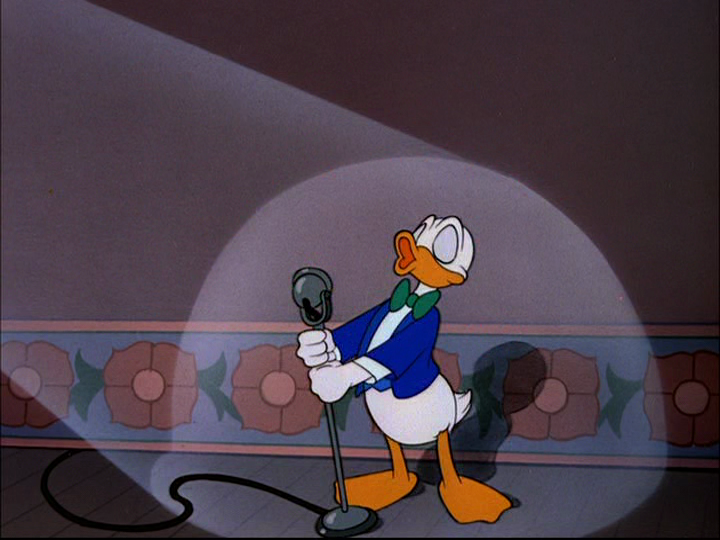
The short opens at the office of psychiatrist Dr. Sigmund Frump, P.D.Q., R.S.V.P., C.O.D., S.O.S., P.M., A.M., P.S., P.P.S., M.O. Sitting at his desk is Daisy Duck, holding a flower. She begins to explain about how she and Donald were taking a walk on a beautiful spring day, when a flowerpot fell from the 99th floor of a tall building and landed smack on Donald’s head. She tried to revive him, but Donald had somehow become someone else: the greatest singer in the world. He grabbed a broom and began to croon “When You Wish Upon a Star” like Frank Sinatra. Unfortunately, Donald has no recollection of Daisy.

Donald becomes a crooner with his rendition of “When You Wish Upon a Star” in the style of Frank Sinatra

As Daisy tried to get Donald’s attention, a theatrical agent snapped Donald up, leaving the flower that hit Donald on the head lying at Daisy’s feet, “a symbol of my lost love,” as she tells the doctor. She never saw him again after that day, except in advertisements, on labels, in society columns, and on marquees. Donald is then seen holding a concert, with the sounds of women swooning in the background. Daisy found that she could not sleep, eat, or even want to live anymore.

Hearing that Donald will sing at Radio City, Daisy rushed there, but it was too late – by the time she hit the box office, the tickets were all sold out. She waited at the stage door, but she was shut out by all the fans that rushed to meet him. Night after night, she waited by the stage door. Finally, she tried to get by the doorman by pleading, disguises, and by force, but she was still unable to see her sweetheart. Then, as luck would have it, she ran into him one night quite by chance. She pleaded with him, telling him how much she missed him, but Donald still didn’t recognize her. After he left her, she decided that maybe it was time to seek therapy to get over Donald.

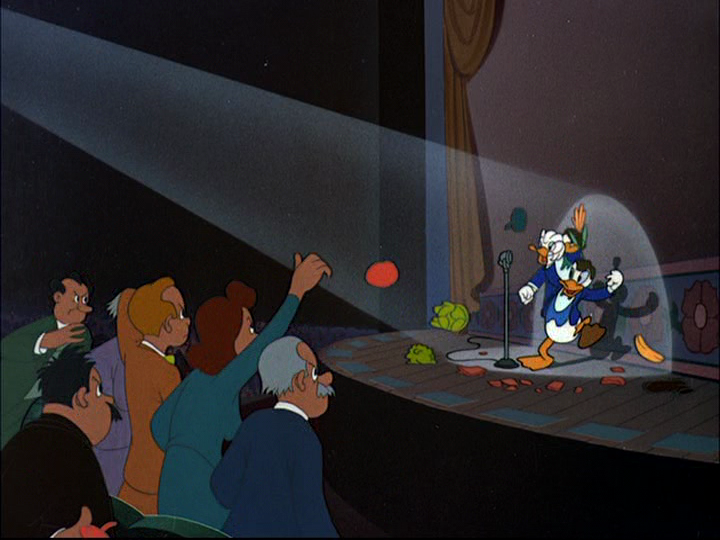
Donald immediately returns to his normal voice, and the crowd begins to throw rotten fruit and vegetables in their anger

The doctor tells her that the hit on the head undoubtedly caused the change, and he can help her, but she has a big decision to make: does she want the world to have Donald and his beautiful voice, or does she want him back again for herself? Without hesitation, Daisy responds that she wants him all to herself, getting rather violent in her haste. He then informs her how to get her Donald back. As she arrives at the stage door with the flower in a flowerpot, she climbs to the top of the theater and drops the flowerpot on his head. On impact, Donald loses his magical voice and is heckled by the audience. He is thrown outside right at Daisy’s feet, where he pulls her into his arms and asks his sweetheart where she’s been.

July 9

Posted on

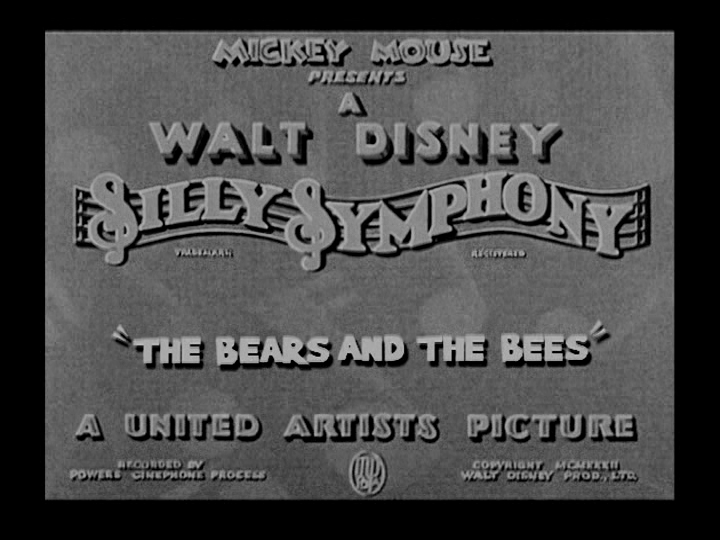
July 9, 1932 – The Silly Symphony The Bears and the Bees is Released to Theaters

On July 9, 1932, the Silly Symphony short film The Bears and the Bees was released to theaters. The short was directed by Wilfred Jackson.

The short opens in the woods, where a bear and her two cubs are seen sleeping next to a river. The cubs wake up and begin to tussle, in turn waking up their mother, who roars at them before returning to her sleep. The cubs run off to play in the woods, and one of the cubs falls head first onto a rock and gets a rather large bump on his forehead. The other cub runs over and soothes the sibling’s injury before finding a berry bush and pulling off berries for a snack.

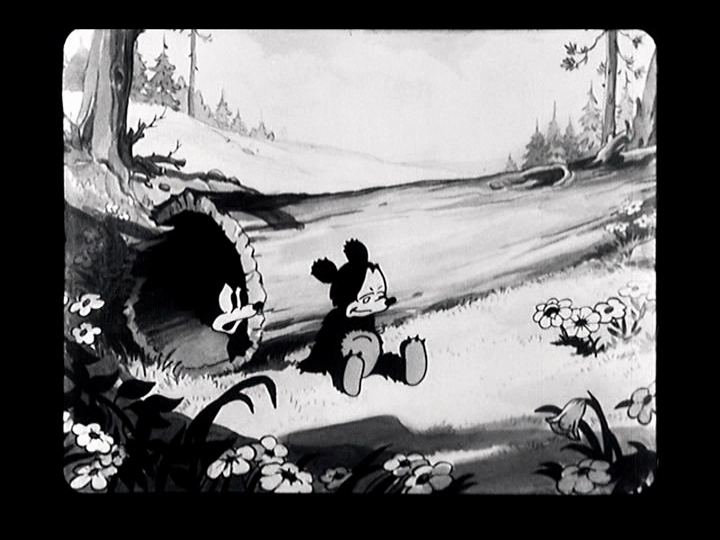
The cubs are bullied by a big black bear and take to hiding in a hollow log nearby

A nearby roaring alerts them, and a large black bear emerges from his cave, growling angrily. He runs to attack the two cubs before eating from what appears to be his berry bush. When the cubs approach to grab just one berry to eat, the black bear startles them and sends them hurrying to a nearby log, where one of them begins to cry at the meanness of the other bear. The other cub tries to cheer the sibling by giving it flowers to eat. When a bee emerges from one of the flowers and begins to buzz around, the cubs follow it curiously.

The cubs spot a flower garden, with bees buzzing all around collecting nectar and taking it back to their hive in a hollowed-out tree. After the bees leave the hive, the cubs poke around inside it, delighted to know that the hive contains honey. They begin to eat the honey in the hive eagerly, until a bee comes back and sees them and sounds the alert to the other bees. Angrily, the swarm grows and immediately heads back to protect the hive.

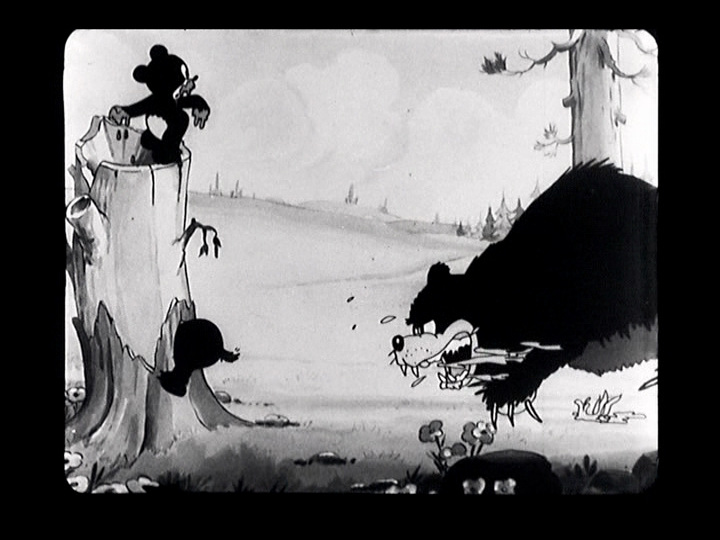
Meanwhile, the angry black bear has spotted the cubs and their honey, and decides he wants it for himself. He charges at the tree and throws the cubs aside, where they can only watch as the swarm heads for the hive and the black bear. The bees attack the bear, covering him with stings while his head is stuck in the hole in the tree. The bees continue their attack, stinging him with points from a plant and a tree branch, before delivering the final blow, sending the bear running for his life. The cubs take advantage of the bees’ disappearance and continue to eat from the now destroyed hive, enjoying all the leftover honey.

July 8

Posted on

July 8, 1938 – The Donald Duck Short Good Scouts is Released to Theaters

“You call that a tree? Shame on you! I’ll show you a man-sized tree!”

On July 8, 1938, the Donald Duck short film Good Scouts was released to theaters. The short was directed by Jack King, and stars Clarence Nash as the voice of Donald and his nephews.

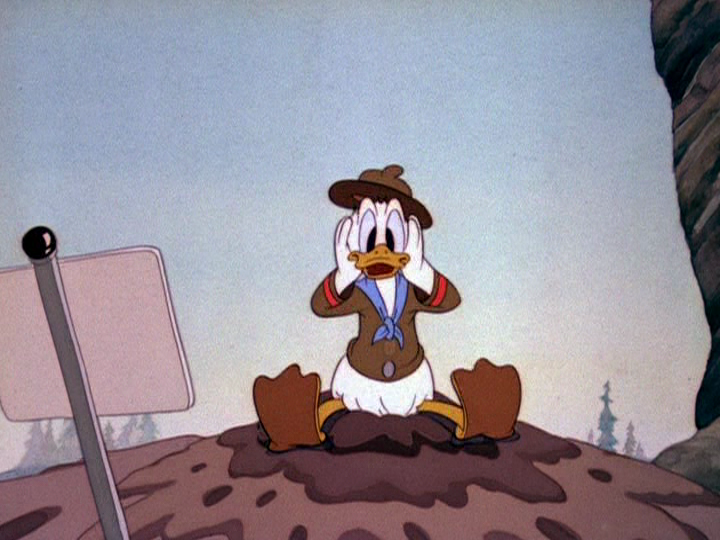
The short opens at Yellowstone National Park, with Donald and his nephews on a scouting expedition. The group marches through the park and settles on a place to set up camp. One of the nephews excitedly runs off to chop firewood, but Donald stops him before he can really do anything, shaming him for trying to chop down a pine sapling. Donald finds what he considers a “man-sized tree” and prepares to chop it down. The nephew notices a sign on the trunk, indicating that it’s a petrified tree, and tries to stop his uncle, but Donald won’t hear of it. He takes a giant swing, and finds himself reverberating from the impact.

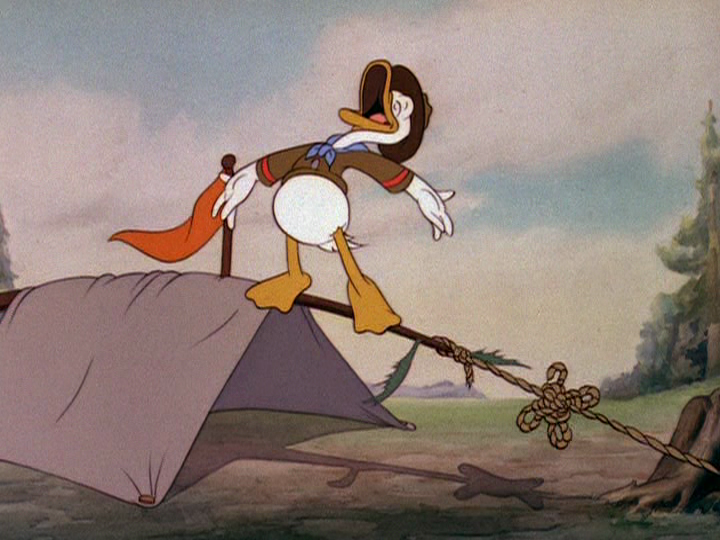
After he stops shaking, Donald looks over to see his nephews struggling to pitch a tent. Berating them and saying they can’t do anything, he pushes them aside and begins to set up the tent, lassoing the top of a pine tree and tying the rope to a rock before knotting it tightly and placing the tent canvas over the bent tree branch. The nephews cheer at their uncle’s victory, but the victory is short-lived when the knot comes undone and sends Donald flying into their food supply. His nephews laugh, and Donald remarks to the audience “That’s gratitude for you.”

As Donald begins to fling the food away, he spies a bottle of ketchup and gets a wicked idea to trick his nephews. He pours the ketchup on himself and pretends he’s dying; the nephews immediately run to their first aid kit and bandage him completely, blinding him and leaving him unable to move his arms and legs properly. Donald stumbles around and lands face-first into a jar of honey. A bear approaches their camp, and with Donald unable to move and covered with honey, the bear begins to lick the honey from Donald’s feet.

Donald just realized that he has fallen on top of the geyser Old Reliable, and it is just about to be set off

Finding that it is indeed a bear after him and not his nephews, Donald hightails it out of there, with his bandages coming loose. The bear grabs one end of a bandage, pulling Donald back from falling off a cliff. The nephews, hiding from the bear, tell Donald they’ll save him, and use to axe to cut his bandage. What none of them realize is that Donald has fallen right on top of the geyser Old Reliable, right as it’s about to blow. The geyser lets loose, and sends Donald flying back into the reaches of the bear. The boys try various methods to save their uncle, including logs and boulders. A large boulder is sent flying up to the top of the geyser’s spout, and the bear climbs on it to chase Donald.


Later that night, the boys wish their uncle good night before they go to sleep in their tent. Donald, unfortunately, is still trapped at the top of the geyser’s blast, with the bear pursuing him as the moon shines high in the sky. All the poor duck can do is sound his whistle as for help.

June 29

June 29, 1935 – The Silly Symphony Who Killed Cock Robin? is Released to Theaters

“Who killed Cock Robin? Who got him with a shot and put him on the spot? Who killed Cock Robin and vanished like a phantom in the night?”

On June 29, 1935, the Silly Symphony short film Who Killed Cock Robin? was released to theaters. The short was a modern take on the popular nursery rhyme, which was believed to be a satirical comment on the fall of Sir Robert Walpole, who was falsely accused of corruption and imprisoned in the Tower of London. He was eventually released and became the first Prime Minister of Great Britain, but was met once again with opposition and was forced to resign. The short was directed by David Hand, and stars Billy Bletcher as the voice of the judge, and Martha Wentworth as the voice of Jenny Wren. The short is also notable for the many celebrity caricatures; Jenny Wren is a caricature of popular actress Mae West.

The short opens with Cock Robin whistling and playing a guitar outside the home of Miss Jenny Wren. Jenny steps out onto her balcony to listen to the music, and Cock Robin begins to croon. A shadow of a bird with a bow and arrow is seen against the trees, firing an arrow straight into Cock Robin’s chest. He swoons a bit, then plummets to the ground, with everyone looking. Everyone comes out, alarmed at what just happened, and the police are called in to investigate. The medics take Cock Robin away on a stretcher.

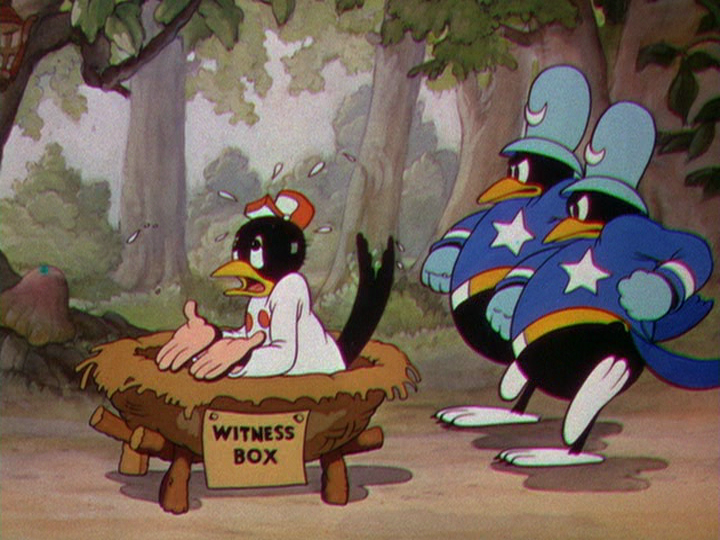
The Crow appears as the first witness, but keeps insisting that he doesn’t know anything

The court case begins, with the judge asking who killed Cock Robin. A scared crow is sitting in the witness box, and when asked, answers that he doesn’t know who killed him. When shown Cock Robin’s body, the crow turns deathly white and tries to flee. He reiterates that he knows nothing about the case, and is hauled off to jail as they pull out the next witness, Legs Sparrow. Legs won’t answer the questions, so the next witness, the Cuckoo Bird, is called. The Cuckoo Bird isn’t a reliable witness, however, so they decide to move on, with everyone rather frustrated that nobody knows.

Jenny Wren steps forward as the next witness, entrancing the entire court. She tells the judge that she wants to see justice done, as somebody took out her Robin. When she suggests that somebody ought to be hanged for the crime, the judge, very taken with Miss Wren, demands that all three suspects be hanged for the crime. Out of nowhere, another arrow flies in, taking the judge’s hat and nailing it against a tree. The judge looks up to see the real culprit, Cupid. Cupid informs them all that he shot Cock Robin, but Robin isn’t dead, he’s just fallen for Jenny and landed on his head. Jenny asks Robin to kiss her, and he wakes up, giving her a smooch.

June 27

June 27, 1952 – The Goofy Short Film Teachers are People is Released to Theaters

“The person upon whose capable shoulders rests the responsibility for their education is that unsung hero, the teacher.”

On June 27, 1952, the Goofy short film Teachers are People was released to theaters. It was directed by Jack Kinney, with story by Dick Kinney and Brice Mack. The short was narrated by Alan Reed, who would go on to fame as the voice of Fred Flintstone. When this short was released, the idea that a school would be bombed or that dangerous weapons would be brought in a school was an outlandish one; needless to say, attitudes have changed a great deal since then.

The short opens with the narrator explaining how school has become a vital part of every child’s life. We then see a mother dragging her reluctant son George to school, dressed in a smart suit and sailor cap, holding an apple for his teacher. When he reaches his clubhouse in the front yard, he quickly changes and emerges in somewhat “cooler” attire. We then see the other children walking to school, “whetting their appetites for knowledge” (splashing through rain puddles) and “forming friendships for the future” (a boy is seen carrying all of a pretty girl’s schoolbooks).

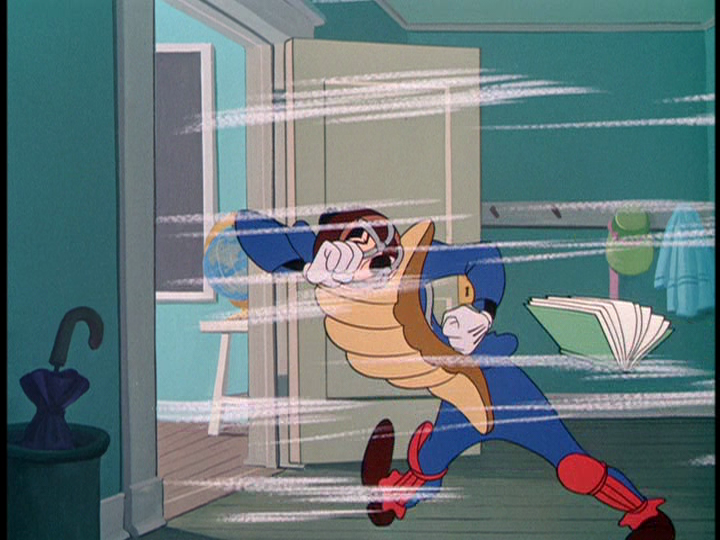
Goofy, as the brave educator, prepares himself as he enters a classroom full of chaos

As the audience’s attention turns to the school, the doors open to reveal the educator, played by Goofy. He steps forward as the crossing guard is letting the kids cross the road, but unfortunately Goofy gets stuck in the middle of the road as the cars speed past. The audience then sees his classroom: the children have gone wild, throwing books and ink, making a complete mess of the room. Before Goofy enters, he dons an umpire’s outfit, ready to tackle anything that comes his way. He calms everyone down, and the students begin to sing a good morning song.

As Goofy erases a demeaning doodle from the board, a little mirror pops out of his jacket, allowing him to see George attempting to hit the teacher with his slingshot. Goofy ducks just in time, and demands that George put all of his toys and pranks into the drawer in his desk. George reluctantly puts in his slingshot, and various weapons, including fireworks, a pocketknife, and a grenade. The grenade shocks Goofy, and he carefully places it in a nearby bucket of water. As Goofy calls roll, we see the students continuing to play pranks on each other. When he calls for George, he sees George sneaking out the window to go fishing, and quickly pulls him back inside.

An oblivious Goofy is unaware that his student George is causing mischief behind his back

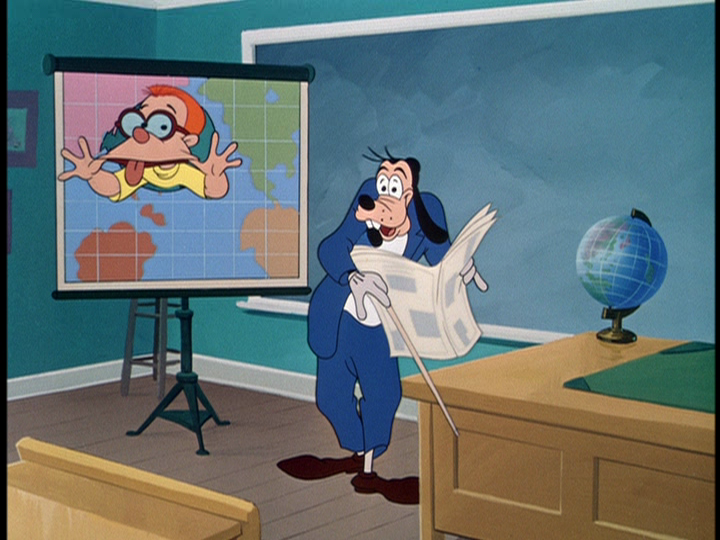
Goofy then calls for homework, and the students begin to place apples on the teacher’s desk. One apple seems to be missing, and when Goofy wonders who is absent, he looks over to see George at his place in the corner, eating his apple. George then begins to run the chalk down the chalkboard, making an annoying squeaking sound. Goofy cuts him off before the geography lesson, and pulls down the map. While he tries to give the geography lesson, the students have their books propped up, but are playing with various toys behind them. George then cuts a hole in the map, making faces at his fellow students.

When the bell sounds for lunch, the student stampede outside, making a mess of the playground. Goofy hears a group of his students whispering, and when he goes over to hear their conversation, he blushes at the obscene nature of the joke. The students return from lunch as if they were forcibly marched, and Goofy has to drag George inside. When the spelling lesson begins, Goofy asks George to spell the word “cat.” George attempts to cheat off his neighbor’s paper, but when the student pulls it away, George pulls a squirt gun on him. The student misspelled the word on purpose, so George ends up squirting the student in the face.

Poor Goofy is reaching the end of his rope as George squeaks the chalk during his punishment

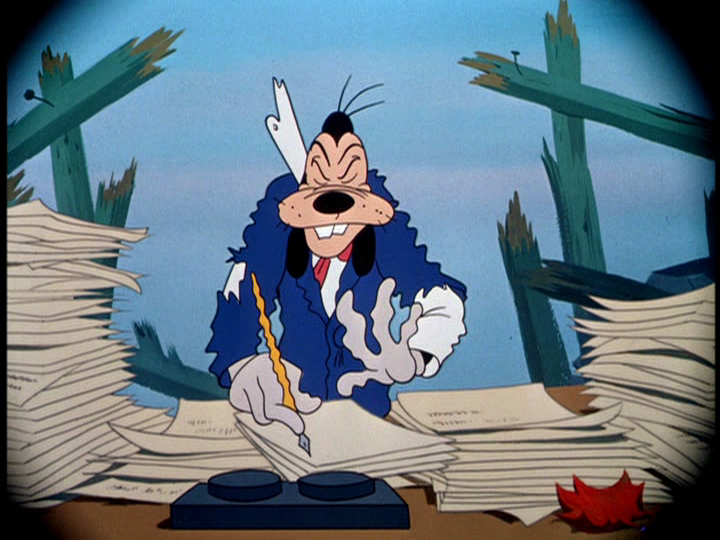
George continues to cause mischief in the classroom, and finally sets the clock ahead an hour to 3 o’clock, when the bell rings and the students take off like a shot. Goofy is left to clean up the students’ mess, and have a parent-teacher conference. In this conference, the parent grabs Goofy by his collar and demands to know “What’s the matter with my kid’s grammar?” before punching Goofy on the head. As the short draws to a close, the school building suddenly explodes, and we see “I will not bomb the school again” written several times on the chalkboard by George, still using the squeaking chalk.

June 25

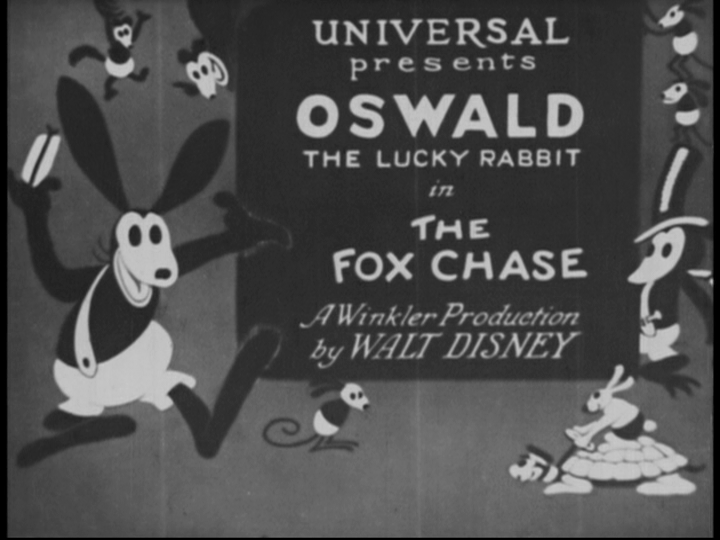
June 25, 1928 – The Oswald the Lucky Rabbit Short The Fox Chase is Released to Theaters

On June 28, 1928, the Oswald the Lucky Rabbit short The Fox Chase was released to theaters. It was the 22nd Oswald short film, and was one of the last Oswald shorts produced by Disney. It was produced at the same time that Walt Disney and Ub Iwerks were working in secret on the first Mickey Mouse cartoon, Plane Crazy. The Oswald short would later be remade as The Fox Hunt in 1931.

It’s the day of the big fox chase, and Oswald seems to be having trouble controlling his horse. The fox in question is standing in front of the dogs, taunting them as they wait behind the starting line. The horn sounds, and everyone stands at attention, waiting for the signal. The gun fires, and everyone heads out.

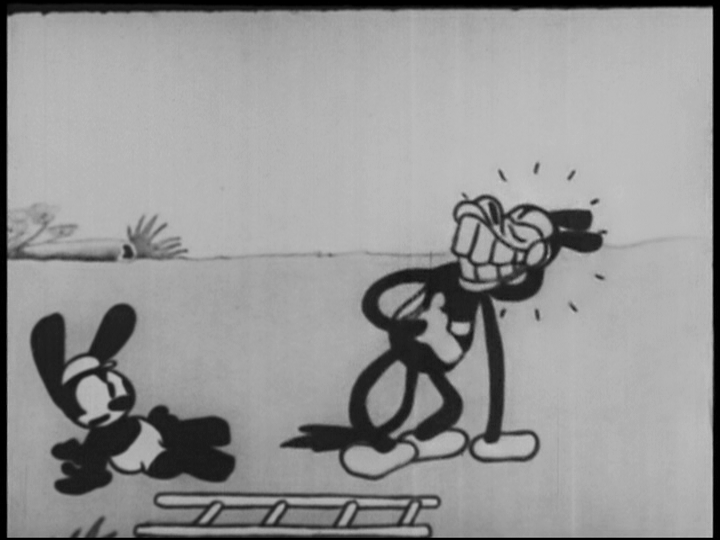
Oswald’s horse has a good laugh at Oswald’s expense while the rabbit is unable to mount

Unfortunately for Oswald, his horse is unable to head out with everyone else, and bucks Oswald off, laughing at the rabbit’s misfortune. As Oswald tries to leap onto his steed, the horse blocks him, and Oswald once again finds himself on the ground. After several failed attempts, Oswald tries to be clever by tying the horse’s tail to a nearby ladder and using it to mount, but the horse foils him again, and Oswald is dragged across the field, still clutching the ladder.

While the fox is having a good time outsmarting the dogs chasing him, Oswald is still trying to mount his horse. The horse finally stops, and Oswald, his legs completely stretched out, is no longer in the mood for games. He finally mounts the temperamental horse and continues with the chase. The fox is still able to outsmart his pursuers, but ends up running right past Oswald, who turns around suddenly. As horse and rider tumble over a stump, Oswald has become the “horse,” with his horse riding him. With another strange turn of events, Oswald then ends up riding one of the dogs chasing the fox, and jumps up and down with joy that he’s almost caught the cunning critter.

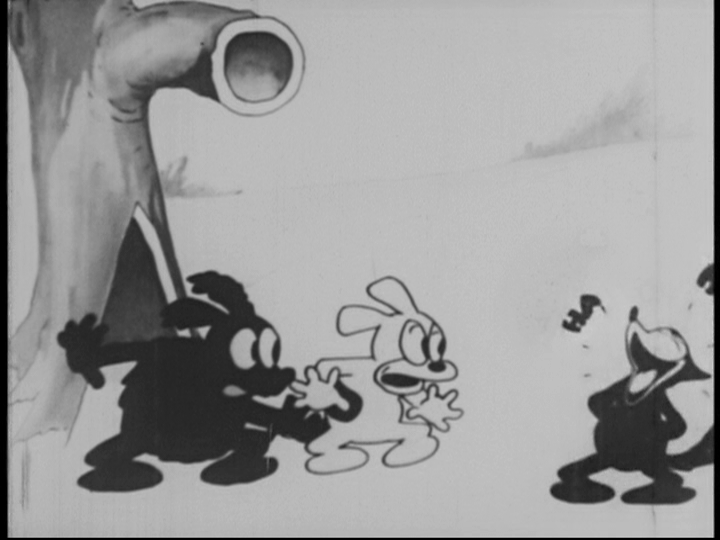
The two dogs that surprise the fox by hiding in the tree are fooled once again, and watch with surprise as the fox laughs at them

Two other dogs spot the fox heading their way and hide in a nearby tree, jumping out as the fox runs by, and all three start fighting. The fox manages to sneak out and laughs at the two dogs’ folly. The fox hides in a log and manages to keep outsmarting the dogs. When Oswald comes along, he comes up with an idea to drive the fox out, only to discover that a skunk has been hiding in the log instead. When Oswald and the two dogs run away in fear, the skunk turns to the audience and reveals that he’s only wearing a costume, and is really the fox, who laughs, as he’s won the chase.

June 24

June 24, 1949 – The Pluto Short Film Bubble Bee is Released to Theaters

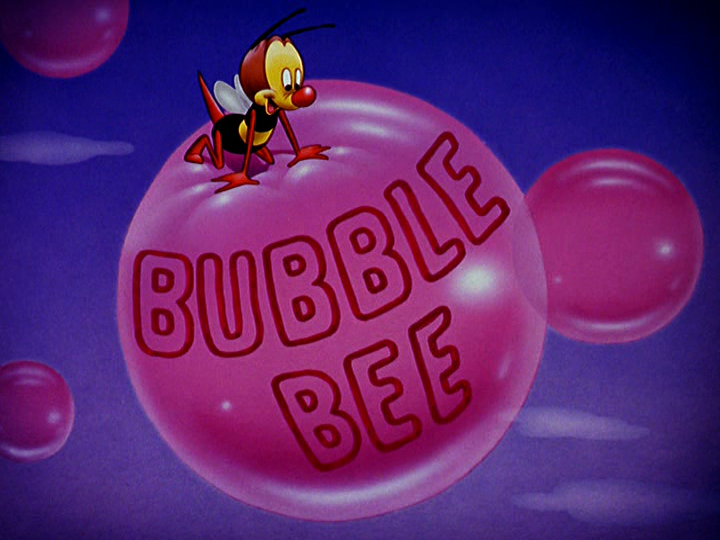
On June 24, 1949, the Pluto short film Bubble Bee was released to theaters. It was directed by Charles Nichols, with story by Milt Schaffer and Eric Gurney. The short features Spike the Bee, who usually tormented Donald Duck in various short films.

Pluto is playing with a ball in the park, when the ball lands in a patch of flowers. As Pluto leaps in after the ball, it bounces out and rolls down a path. Pluto looks around for his toy, and spies it on the top of a tall hedge. He leaps after it, only to find that he’s leapt on a bubble gum machine that looks like the design of his ball. Smelling the sweet scent of gum, Pluto decides he wants some. He looks around sneakily, then tries to shake some out of the machine.

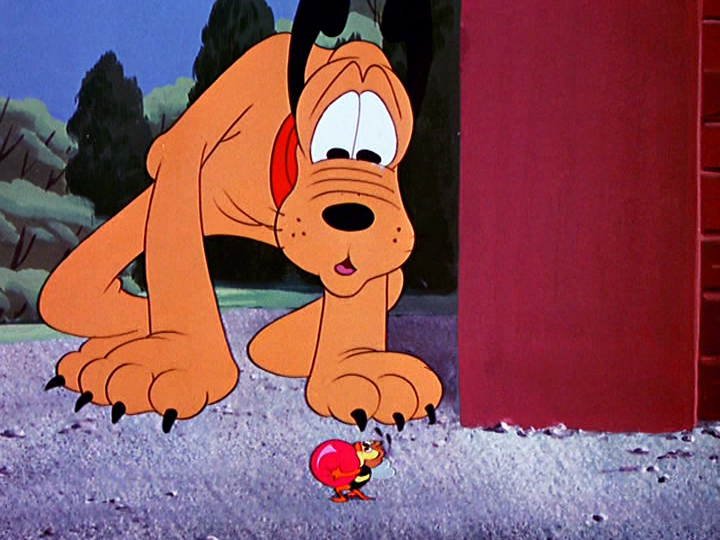
Pluto sees Spike successfully rig the machine to retrieve a gumball

As he tries and fails with many methods to get the gum, Spike the Bee appears, buzzing around the machine, and Pluto backs away in trepidation. He watches as Spike easily rigs the machine to produce a gumball. As Spike flies away, he is weighed down by his heavy prize, and Pluto is able to follow him closely. Pluto watches as Spike throws the gumball in his beehive and flies away. With a devilish grin, Pluto tries to bat the gumball from the hive, only to knock the hive down. It breaks open, revealing about twenty pieces of gum hidden inside.

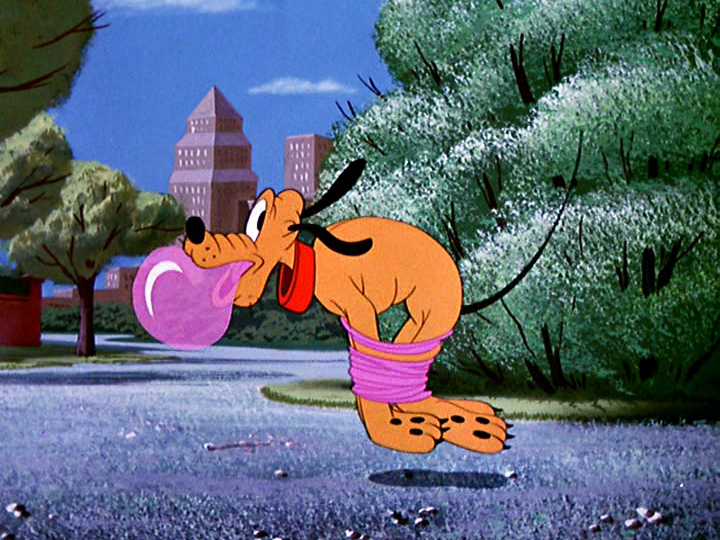
Pluto looks hungrily at his prize, and greedily laps up each piece and begins to chew them all at once. When he tries to open his mouth, the chewed gum keeps his mouth closed, and he is unable to swallow it. He continues to chew, and it rather surprised when a bubble comes out of his mouth. When he sneezes, bubbles to blow through his teeth; they all pop and cover his face with gum, but he is able to get the gum back in his mouth and keeps chewing. He then blows out a bubble, lets it fly in the air, and plays with it as a new toy.

Spike uses the gum that trapped him as a tool to trap Pluto, wrapping him up in strands of chewed gum

Meanwhile, Spike returns with another gumball, only to discover that his house is gone. He finds the ruins on the ground, as well as the footprints of the guilty party, and follows the tracks. He spies Pluto blowing bubbles, and flies after the dog in a rage, kicking him. As Pluto tries to bark, he ends up blowing another bubble, trapping Spike in the gum. Pluto lets the bubble go free, then pops it, watching in amusement as the bee is helpless in midair. The gum lands on Pluto’s nose, and Spike uses it as a tool to attack the dog, wrapping the dog’s legs in chewed gum. Spike continues chasing Pluto, and Pluto ends up accidentally swallowing the bug, who is trapped in another gum bubble. Exhausted from their chase, Spike finally gets his in the end, stinging Pluto and sending him yelping from the park.

June 21

June 21, 1961 – The Donald Duck Short Film Donald and the Wheel is Released to Theaters

“Well, frost me, Poppa, can it be your intention, to bat your choppers over nothing more than a wheel? Your brain is all tied up in a sling to think a wheel is such a great thing.”

On June 21, 1961, the Donald Duck short Donald and the Wheel was released to theaters. The story was written by Bill Berg, with songs and rhymes by Mel Leven, music by Buddy Baker, and direction by Hamilton S. Luske. It stars the vocal talents of The Mellomen (Bill Cole, Bill Lee, Thurl Ravenscroft, and Max Smith), with Ravenscroft and Smith as the father and Junior, and Clarence Nash as the voice of Donald Duck.

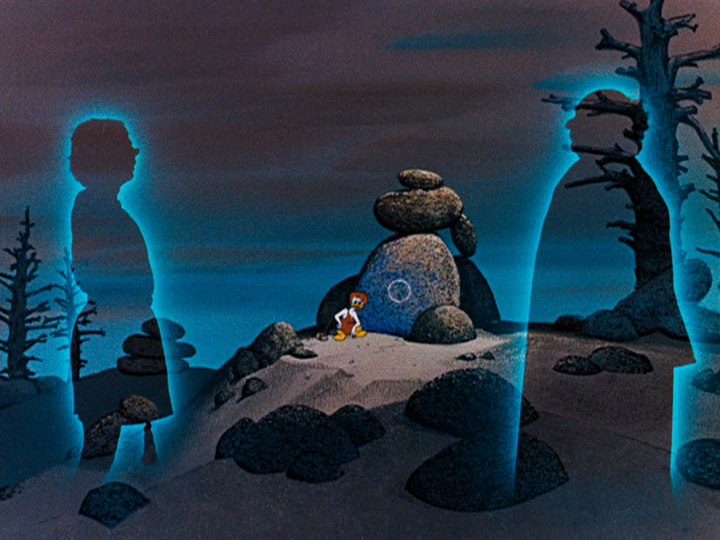
This educational short begins with two “spirits of progress” watching a piece of wood rolling around like a wheel. Junior, the younger of the spirits, asks his dad why he’s so impressed with the wheel. His father claims it to be the greatest invention of all time, to which Junior scoffs. When his father challenges him to name something better than the wheel, Junior accepts the challenge, but every invention he names is only possible thanks to the wheel. The father takes his son back in history to meet the inventor of the wheel.

The Spirits of Progress start to tell Caveman Donald about the great invention of the wheel

Back in the caveman age, we see a prehistoric Donald Duck, who, after a run-in with a tiger, is inspired to create the wheel. The spirits try to explain to Donald what a wheel is used for, but Donald seems to not be able to understand. Donald finally asks them who they are, and they explain to him that they are the “spirits of progress,” there to help him with his great invention. The first example they give him is attaching two wheels to his sled, making it easier for him to cart around.

The song at that point goes through the evolution of the wheel, with Donald also donning the attire of each time period being sung about. Steam is soon added to the idea of the wheel, with trains and automobiles lauded in song, and Donald involved in comic situations with each passing period. Finally, after a massive pile-up on the highway, Donald angrily declares he’d rather walk.

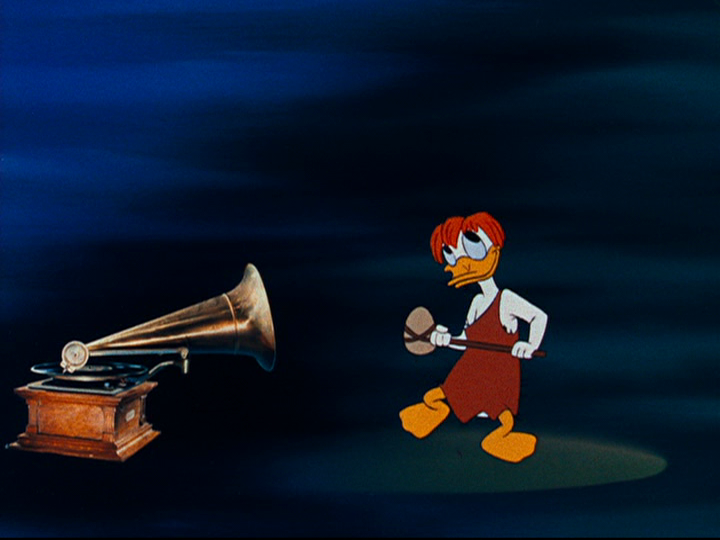
Caveman Donald dances to the music from the gramophone, a more “practical” example of the use of wheels

They go back to Donald’s time, trying to take another approach with how important the wheel is. When they try to explain that the world is round, Donald insists that the world is flat. Junior takes over this time, trying to explain the rotation of the Earth, the moon, and all the planets in the solar system. The demonstration continues with gears to show how wheels keep things working. For a more “practical” example, they begin with a music box, moving to the gramophone, then the jukebox, which features Donald dancing with a live-action dancer.

The spirits, however, push a little too hard with how important the wheel will be, showing wheels in everything he will use in his day. When they claim that he’s about to create a great invention, Donald tells them “Oh, no! I’m not going to be responsible for that!” The spirits are consoled with the fact that although Donald didn’t invent the wheel, someone eventually did.