RSS Feed

Tag Archives: Short film

December 8

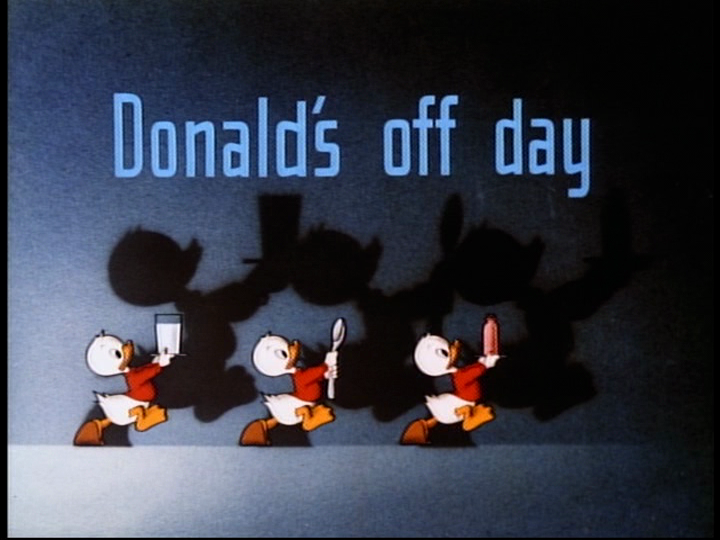
December 8, 1944 – The Donald Duck Short Film Donald’s Off Day is Released to Theaters
vlcsnap-2013-12-08-18h52m50s210

“Are you a well man? You may think so, but you probably need a doctor. Call Dr. Quack at Maine-13-uh-oh, or you may be a dead duck.”

On December 8, 1944, the Donald Duck short film Donald’s Off Day was released to theaters. It was the first short directed by Jack Hannah, who would go on to direct over 90 short films. The story was written by Bill Berg and Dick Shaw.

The sun is rising over the hill, shining through Donald’s window while someone is singing for the duck to get out of bed. His alarm then goes off, but he still doesn’t move from his bed, until the alarm clock falls over. He excitedly shoots out of bed to perform his morning exercises before getting ready for his big golf day. He rushes by the nephews and excitedly steps out, only to be greeted with a sudden storm. Dejectedly, he turns around and heads back inside, but stops when the storm suddenly disappears. As he marches off again, the storm returns, and Donald throws his hat down angrily, railing at the rain.
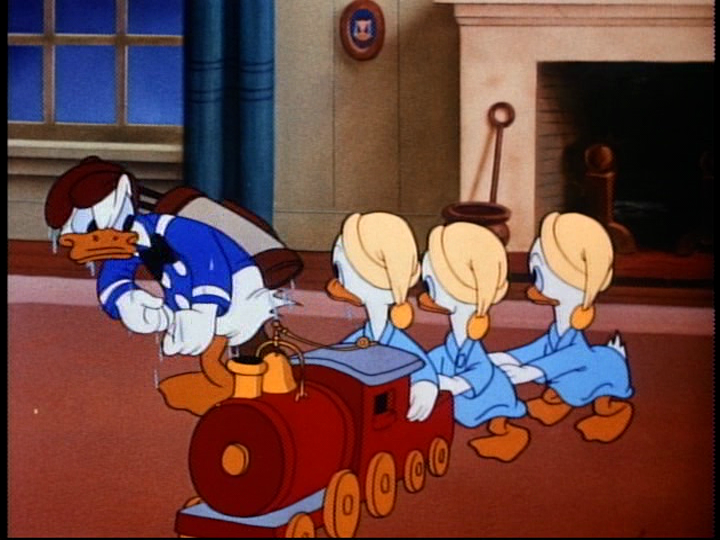
Donald storms back into the house, ready to unleash his frustration on his nephews

Donald storms back into the house, ready to unleash his frustration on his nephews

Donald goes back inside and starts yelling at his nephews, sending them to their room. He then sits by the radio, eating licorice, when he decides to pull out a book on diseases and their symptoms. Coincidentally, an ad for a Dr. Quack starts to play on the radio, warning Donald that he may need a doctor. He starts to flip through the book, and starts seeing symptoms for random diseases (a coated tongue, for instance, forgetting that he did just eat licorice). The nephews see Donald worrying, and decide to play a prank on him, making him believe he really is unwell. Donald, thinking he is unable to see, starts wandering around blindly before collapsing on the floor. The nephews put him on the couch and start attending to his needs before continuing their prank with a squeak toy which Donald believes to be his heart.

Donald, convinced he’s dying, pulls his nephews close and gives him his will, which bequeaths them his precious golf clubs. As Donald lies panicking, he suddenly notices that what he thought was his heart is the squeak toy, and catches his nephews in the act. He storms after them, recalling all they did to torment him, and as the nephews cower in the corner, awaiting his rage, the sun suddenly begins to shine. Forgetting his anger, Donald runs for his golf clubs and sprints outside, although he is struck by lightning the moment he steps out the door.
December 7

December 7, 1955 – The Disneyland Episode “The Goofy Success Story” Premieres

vlcsnap-2013-12-07-19h17m19s28

“He’s always been a modest, unassuming fellow, one who’s never let fame go to his head. So this program belongs to him.” – Walt Disney

On December 7, 1955, the Disneyland episode titled “The Goofy Success Story” premiered on ABC. The episode featured a fictionalized account of Goofy’s rise to stardom. Although his original name was “Dippy Dawg,” the name spelled out on his contract changes the spelling of “Dawg” to “Dog.” The episode was directed by Jack Kinney and Wolfgang Reitherman, and was written by Jack Kinney.

The episode begins with Walt introducing the special tribute to Goofy, who praises the character and leads into the animated story. The scene then opens on a theater, with curtains that pull back to reveal Goofy’s face, before revealing more and more curtains. Finally, the narrator takes the audience to Hollywood, where crowds are bustling about and talent scouts are everywhere, looking for the next big star. Goofy then is seen walking down the street, and has just enough money to buy a meal, but decides to spend his money on a Mickey Mouse film instead. As he sits in the theater and watches the short (the 1934 short film Shanghaied), his unique and loud laugh alerts the talent scouts.

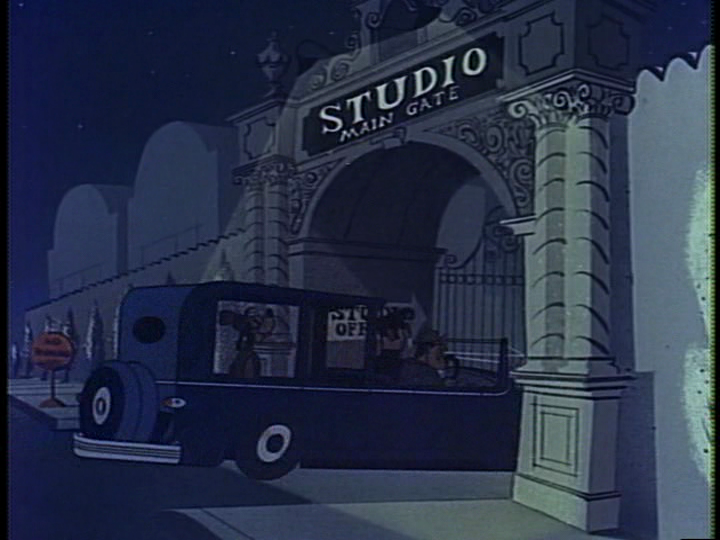
Goofy is soon whisked away to the studio with his "million dollar laugh"

Goofy is soon whisked away to the studio with his “million dollar laugh”

The talent scouts take him away to his first gig, which would eventually become the 1936 short film Moving Day. After the short ends, he is taken to the studio executive’s office to sign an iron-clad contract for $50 a week for 48 years, which he happily accepts. When he signs as Dippy Dog (his original name), the executives are unhappy with his name and decide to change it. The head executive comes up with the name “Goofy,” and Goofy happily accepts. He is paid his first paycheck, and left with nothing but a debt of $8. The executive then shows Goofy an actor’s progress chart, highlighting the rise and inevitable fall of an actor in a poetic fashion. Soon, Goofy is taken to his next picture, the 1937 short film Moose Hunters.

Goofy is soon seen on several magazine covers, and the audience is then taken to his mansion, the Hacienda Goofy. They view him in his bed, surrounded by several television cameras, which takes away all of his privacy, not that he seems to mind as he goes about his daily routine. After his morning swim, he then heads to the studio to film a new short, the 1950 short How to Ride a Horse, although it is seen that he annoys the horse before the short begins (which explains the horse’s distaste for Goofy during the short). After this, awards time has arrived in Hollywood, and Goofy readies himself to get an award, although he is dismayed to find that he has not won a single trophy, losing even to Pluto. He is soon seen alone in the theater, and leaves, depressed, walking out into the stormy streets, recalling his rise to stardom. He finds himself at the shore, and, thinking his life is over, hears the siren voice of the sea. However, he is interrupted by a telegram that provides him with the chance of a lifetime – the 1950 short film Motor Mania. The episode ends with Goofy finally winning his award.

December 5

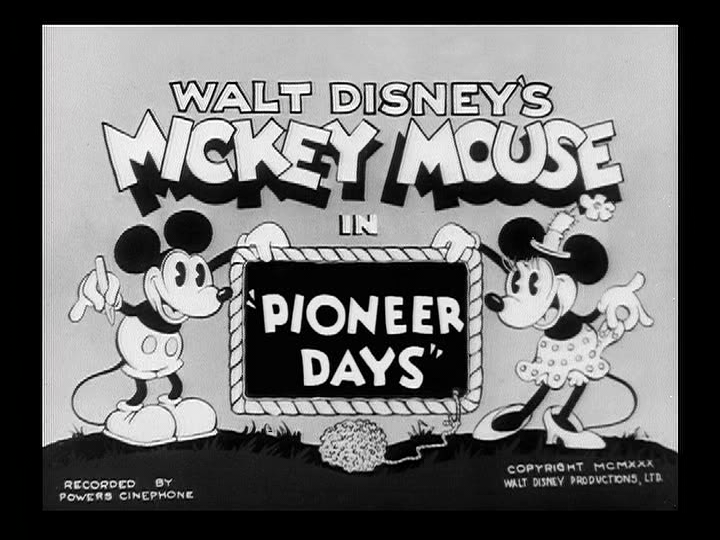
December 5, 1930 – The Mickey Mouse Short Film Pioneer Days is Released to Theaters

vlcsnap-2013-12-05-18h20m40s76

“Oh my poor Nellie Gray, they have taken you away.”

On December 5, 1930, the Mickey Mouse short film Pioneer Days was released to theaters. The short features cameos of Mickey and Minnie’s friends Clarabelle Cow and Horace Horsecollar. It was directed by Burt Gillett.

Mickey and Minnie are seen traveling with a wagon train, singing and playing the banjo. Mickey sings that he’s not afraid of Indians, but once he does, an Indian scout is seen making his way back to his camp after spying the wagon train. He alerts his tribe members, and they dance around the fire, whooping and hollering. Meanwhile, the wagon train has stopped for the evening and is sitting around a campfire, singing songs. A square dance begins, and everyone in the train joins in.

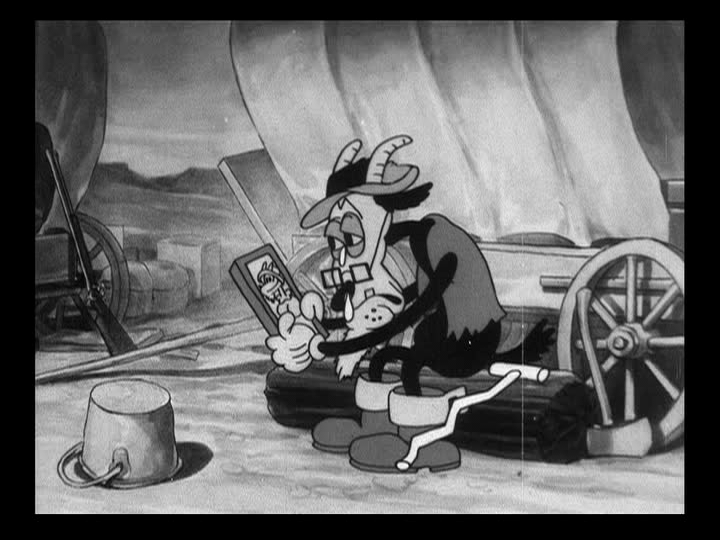
The old goat cries over a photo of his lost love, and sings a mournful song for her

The old goat cries over a photo of his lost love, and sings a mournful song for her

An old goat is morning over the loss of his love, and as he sings, everyone begins to cry, with Mickey comforting Minnie as they both sob. As they cry, an arrow is shot into the camp, landing right above Minnie’s head. The camp prepares itself for an Indian attack, and it soon becomes an all-out war. Mickey fights with gusto, hiding in a stove at one point. As his gun is blown up, he decides to use a porcupine to stop three Indians from setting fire to the wagons. After this victory, he hears Minnie screaming out for help, and sees her being ripped from a wagon and stolen away. Mickey chases after the Indian, and arrives at his camp to find he has tied Minnie to a tree. The two fight in the woods, but Minnie manages to free herself and place a hot coal down the Indian’s pants. Back at the camp, it appears that the Indians are winning, when Mickey and Minnie fool the Indians into thinking that the Calvary has arrived. The Indians flee, and the pioneers cheer.

December 3

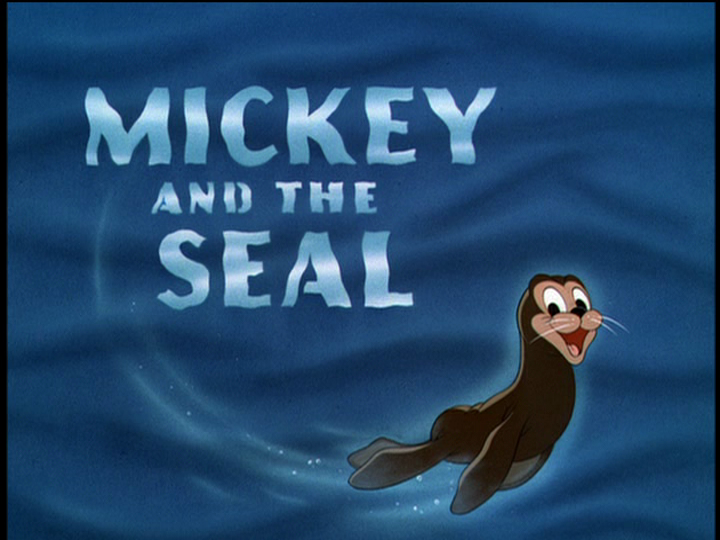
December 3, 1948 – The Mickey Mouse Short Film Mickey and the Seal is Released to Theaters

vlcsnap-2013-12-03-16h18m38s63

“Look who followed me home, Pluto!”

On December 3, 1948, the Mickey Mouse short film Mickey and the Seal was released to theaters. The short was nominated for an Academy Award, but lost to the Tom & Jerry short film The Little Orphan. The short was directed by Charles Nichols, with story by Nick George and Milt Schaffer.

The short begins in the seal park, where Mickey is feeding fish to the barking seals. He throws one into the seal pen, which is scarfed up by the smallest seal of the bunch, who performs tricks for Mickey in order to get more fish. When Mickey announces he has no more fish for the day, the baby seal decides to hide inside Mickey’s picnic basket, hoping to find more fish in Mickey’s home. Mickey takes the basket home, and is greeted by Pluto. Pluto is rather upset that there’s no food in the basket left for him, and he sulks until the basket starts to bark. The baby seal jumps out of the basket, scaring the poor dog, and Pluto tries to warn Mickey, who has started preparing a bath. Unfortunately, Mickey thinks Pluto is just messing around, and scolds him before ordering him outside.

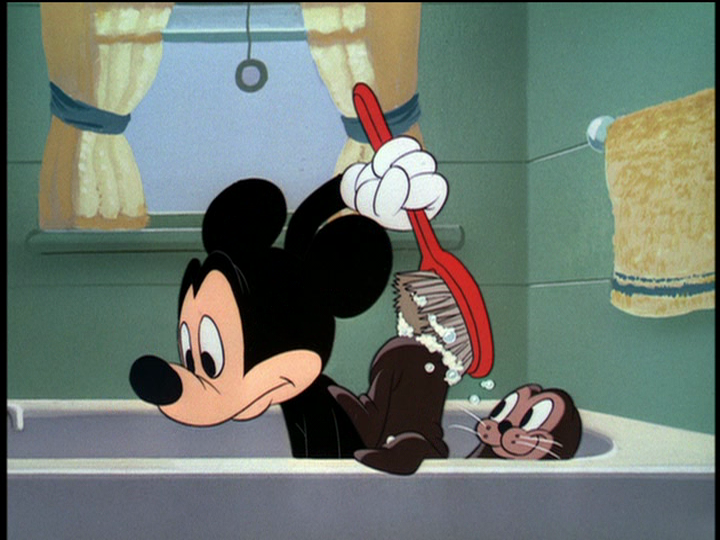
Mickey notices something is wrong when he is scrubbing something, but it's not his back

Mickey notices something is wrong when he is scrubbing something, but it’s not his back

The seal has started exploring Mickey’s home, and when he discovers the bathtub, he decides to jump right on in. Mickey then enters the tub and starts washing, unaware that the seal is in the tub. He soon notices something is up when the seal starts using his scrub brush on his head. Pluto tries to alert Mickey in the bathroom window, but Mickey just pulls down the shade. Mickey soon discovers the seal in his tub, but instead of being angry, he protects the seal from an angry Pluto. Mickey jokes that they’ll keep him for a pet, but instead decides to return him to the seal park. As Mickey and Pluto walk away, the seal explains to his friends all about his adventures in Mickey’s house. When Mickey arrives home, he is surprised to find all of the seals in his bathroom, using the tub. Pluto glares at Mickey, but all Mickey can do is smile sheepishly.

November 30

November 30, 1935 – The Silly Symphony Cock o’ the Walk is Released to Theaters

vlcsnap-2013-11-30-18h38m38s55

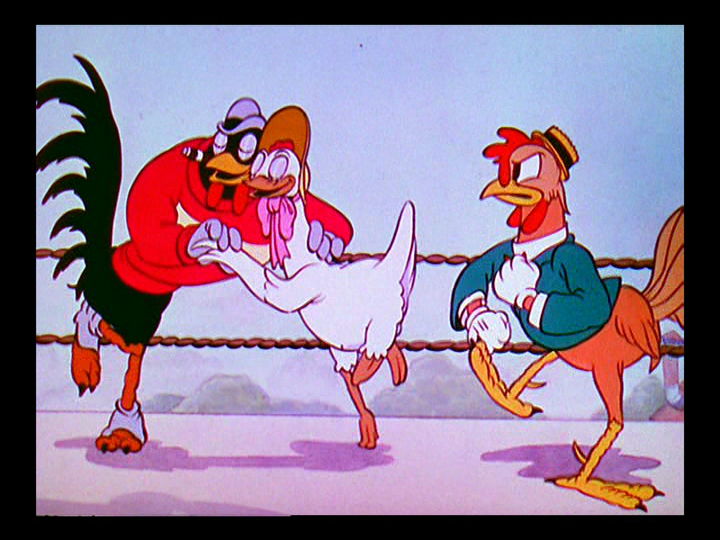
On November 30, 1935, the Silly Symphony Cock o’ the Walk was released to theaters. The music used in the film, “Carioca,” was taken from the RKO film Flying Down to Rio, which was fitting, as 1935 was the last year that United Artists would distribute Disney films, as it would move to RKO the following year after a long courtship. It was directed by Ben Sharpsteen, and marks the debut of composer Albert Hay Malotte.

The short begins with a parade, welcoming home the world’s champion boxer, Cock o’ the Walk, who struts his stuff on a float, followed by all of the hens in the town. One hick rooster is professing his love to a skinny hen, but her attention is lost when she catches the eye of Cock o’ the Walk, who asks her to dance with him. The two begin to dance, and all of the hens in town begin to gossip and join in the dancing. The entire barnyard begins to dance, including chicks, caterpillars, and peacocks.

Angered by the champion taking his girl, the hick rooster tries to break them up

Angered by the champion taking his girl, the hick rooster tries to break them up

As Cock o’ the Walk continues to dance with the hick’s girl, the hick decides to put an end to it, and the hens laugh as Cock o’ the Walk mocks him. The hick challenges the champion to a fight, with the hick working more to dodge the advances before getting pummeled. Cock o’ the Walk’s bag is knocked into the skinny hen’s lap as she cheers for the champion, and discovers that Cock o’ the Walk is not only married, but he has 14 baby chicks. Angered at this realization, she slaps him, and tried to revive the hick rooster with a kiss. His strength is renewed, and he beats Cock o’ the Walk, winning the fight and sending the champion flying into his trophies. The short ends with the hick rooster and his skinny hen dancing together happily before he lays a large kiss on her and lets out a loud rooster call.

November 28

November 28, 1947 – The Donald Duck Short Film Chip an’ Dale Premieres in Theaters

vlcsnap-2013-11-28-08h22m53s6

“Doggone freezing weather. A guy never gets a chance to sleep around here.”

On November 28, 1947, the Donald Duck short film Chip an’ Dale premiered in theaters. This short is the first time the two chipmunks have been named, and also marks the first time they are Donald’s adversaries. The short was nominated for an Academy Award, but lost to Warner Brothers’ Tweetie Pie. The short was directed by Jack Hannah, with story by Dick Kinney and Bob North.

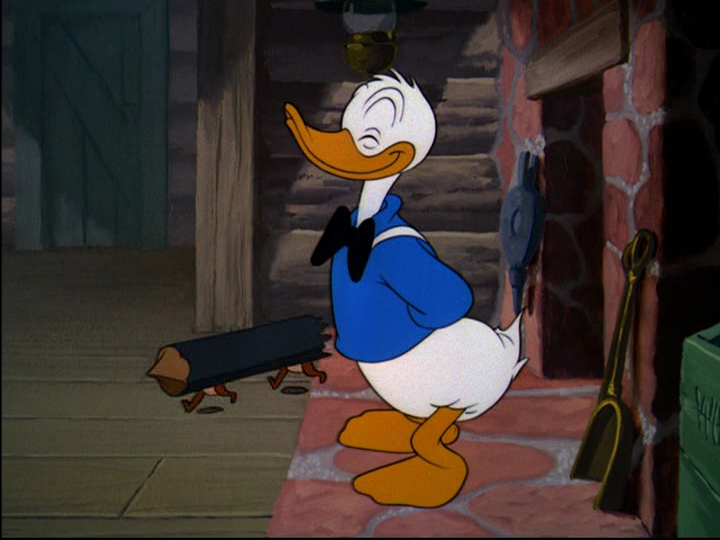
A snowstorm is raging outside, and inside his cabin, Donald is trying desperately to stay warm. He notices that the snow has come down his chimney and put out his fire. Out of firewood, he decides to go out with his axe and chop down a nearby dead tree, unaware that Chip and Dale live inside with their stores for the winter. The chipmunks watch as Donald takes off with their home, and follow him into his cabin. They sneak past him to reclaim their nuts, but are unable to grab them before Donald starts the fire. Once again, they try to sneak past him, and decide to put out the fire themselves.

As Donald enjoys the fire he's made, he's unaware that the two chipmunks are taking away the log

As Donald enjoys the fire he’s made, he’s unaware that the two chipmunks are taking away the log

As Donald thinks he’s enjoying the fire, he suddenly notices the log walking right in front of him. He lets them walk out the door, taking the log as they go, and slams the door behind them. The chipmunks take another approach of dropping snowballs down the chimney, putting out the fire. Donald traps the two in a snowball and sends them flying down the roof before starting his fire again. Chip gets the idea of rolling a snowball down a steep hill on a clear collision course with Donald’s cabin. When Donald opens the door, the giant snowball sends him flying into his backdoor, encased in snow. The two chipmunks walk happily away with their log, but not before Dale is able to give Donald a well-placed kick in the rear.

November 25

November 25, 1933 – The Mickey Mouse Short Film Giantland is Released to Theaters

vlcsnap-2013-11-24-18h34m28s80

“Tell us a story, Uncle Mickey! Yes, tell us a story, Uncle Mickey!”

On November 25, 1933, the Mickey Mouse short film Giantland was released to theaters. This short is known as the precursor to the “Mickey and the Beanstalk” segment of the 1947 package film Fun and Fancy Free; there are also many similarities to this short and the 1938 short The Brave Little Tailor. The short film was directed by Burt Gillett.

The short begins with Mickey reading Jack and the Beanstalk to his nephews. They are rapt with attention as he begins the story, and soon, Mickey inserts himself into the story, and the group begins to imagine Mickey climbing up the beanstalk, entering Giantland. He arrives at the castle door and hears the singing of the King of Giantland. He hides in the keyhole to avoid being spotted, and enters inside, trying to hide in the sugar bowl. Mickey is accidentally scooped up with a sugar cube and place in the giant’s cup of coffee, but manages to escape. After hiding in a block of Swiss cheese, Mickey is then accidentally eaten by the giant, and works to keep himself from being swallowed. When the giant develops hiccups, he swallows a jug full of water, but Mickey is able to once again avoid being swallowed.

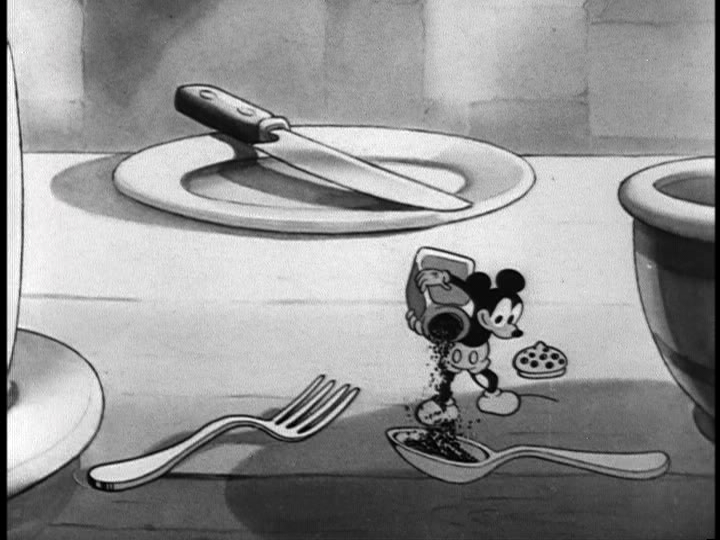
Mickey arms himself with pepper against the angry giant king

Mickey arms himself with pepper against the angry giant king

Mickey starts choking on the smoke from the giant’s pipe, and when the giant removes his pipe, he discovers the mouse. A chase ensues across the kitchen table, and Mickey ends up trapped in an empty bottle. The giant proclaims that he now has Mickey, but Mickey bites the giant’s finger and escapes, heading straight for the pepper shaker. He uses the pepper, and a spoon as a catapult, to cause the giant to sneeze. His sneezes are powerful enough to destroy the castle, and Mickey is sent flying to the ends of Giantland, where he slides down the beanstalk and burns it as the giant comes climbing down. The giant is sent tumbling to the ground, creating a massive hole where he falls. The scene then goes back to Mickey telling the story, saying that the giant went “down and down and down and down and down and down and down and down. And he came out in China.”

November 22

November 22, 1940 – The Goofy Short Film Goofy’s Glider is Released to Theaters

vlcsnap-2013-11-22-19h17m17s82

“I’m brave! But I’m careful.”

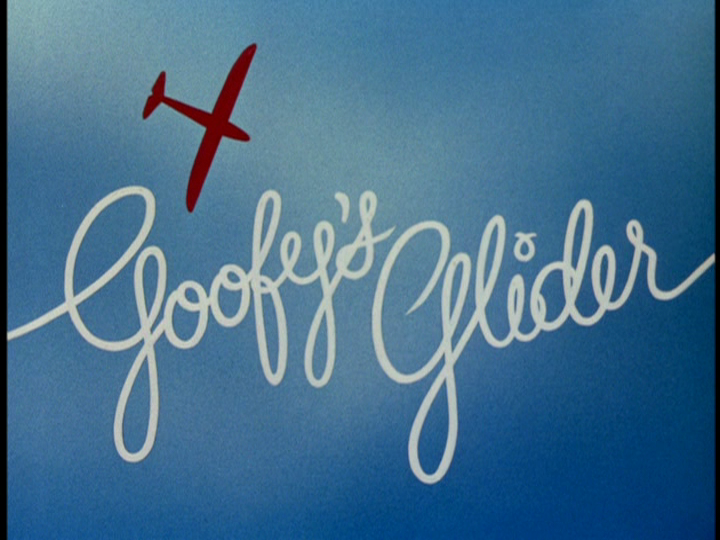
On November 22, 1940, the Goofy short film Goofy’s Glider was released to theaters. It is the second Goofy short released. The short was directed by Jack Kinney.

The short begins with Goofy voraciously reading a copy of “How to Fly.” He excitedly puts the book away and, believing he can fly, attempts to take off in a homemade glider with his legs sticking out. He starts skipping towards the gate, and breaks into a run. He is unable to takeoff, however, as he flies straight into the gate. He then tries to pull his glider along as if he is flying a kite, and as he climbs up the rope to his glider, the glider sinks lower and lower, until he is submerged into a nearby pond. His next attempt involves Goofy riding a bicycle, and the glider takes off without him. Goofy crashes the bike and attempts to chase after his glider around the barn. The glider snags onto his suspenders, and pulls Goofy up into the air before they both crash into the ground.

Goofy tries again, this time with the catapult method. He climbs into the glider, but not before putting on a parachute pack. He climbs into the glider, and as he lets the catapult go, the glider is left behind while Goofy is catapulted into the air. He jumps down, and counts to ten to pull the string, but reaches the ground before he finishes the count. He then ties rollerskates to his feet, hoping they will give him enough speed to fly with the ramp he has built. He is able to go into the air with his glider, unaware that he is flying upside down. He flies through the barn and crashes, landing in a well. His last attempt involves gasoline, TNT, gunpowder, and a cannon. He is sent speeding through the air, circling around the world. The short ends with everyone singing a flying song along with Goofy.

November 18

November 18, 1932 – The Short Film Parade of the Award Nominees Premieres at the Academy Awards

vlcsnap-2013-11-18-20h34m39s52

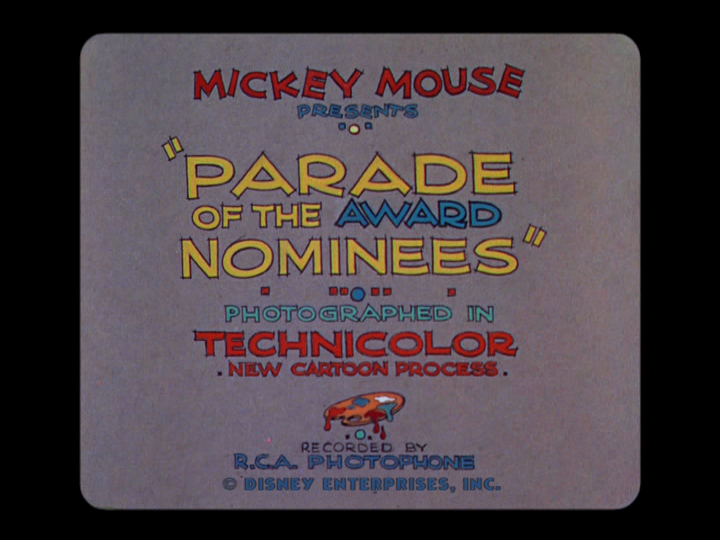
On November 18, 1932, the special short film Parade of the Award Nominees premiered at the 5th Academy Awards, held at the Ambassador Hotel in Los Angeles, California. This ceremony also introduced short films within the Oscar categories, with Disney’s Flowers and Trees winning the first Academy Award for Best Animated Short Film and being the first color winner. Parade of the Award Nominees was created specifically for the banquet, and the first short that showed Mickey Mouse in color. Pluto is also shown in color, but is a grey-ish brown rather than his standard yellow. Disney Legend Joe Grant was hired by the studio to create the caricatures of the actors for the short, and would remain at Disney for over 70 years.

Mickey is seen in a bandleader’s uniform, leading a parade which begins with Minnie holding a sing that says “Parade of the Award Nominees.” After three trumpeting pigs and a percussion set march by, a carpet is rolled out, with Clarabelle Cow throwing flowers on the ground for the actors to walk on. The first actor is Wallace Beery, for his role in The Champ, with costar Jackie Cooper. Following the two is Lynn Fontanne and Alfred Lunt for their roles in The Guardsman, and Helen Hayes for The Sin of Madelon Claudet. Next is Fredric March, who transforms to a hideous monster, as he represents his role as the titular Dr. Jekyll and Mr. Hyde. Last but not least is Marie Dressler for her role in Emma, who is followed by Pluto, who has “The End” on a flag tied to his tail.

November 14

November 14, 1927 – The Oswald the Lucky Rabbit Short Film The Ocean Hop is Released to Theaters

vlcsnap-2013-11-14-17h13m31s181

$25,000 prize for first ocean hop – New York to Paris”

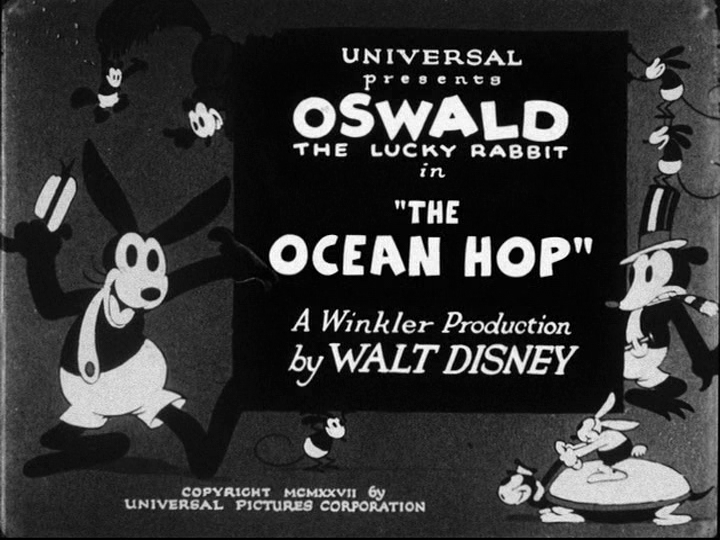
On November 14, 1927, the Oswald the Lucky Rabbit short film The Ocean Hop was released to theaters. It was the sixth Oswald short produced by the Disney Studio. There are several similarities to this short and the Mickey Mouse short film,

A prize is being offered for the first flight from New York to Paris, known as an “ocean hop.” Oswald is considered the dark horse entry, and shows up with a simple mechanical plane that makes lots of clanging and banging noises when turned on. Although mocked by another contestant, Oswald believes that his plan will succeed. The contestant comes up with a diabolical plan of placing gun near the wheels, keeping Oswald grounded. The race begins, and Oswald is unable to move thanks to the gum. The plane struggles, and the evil contestant is able to take the lead.

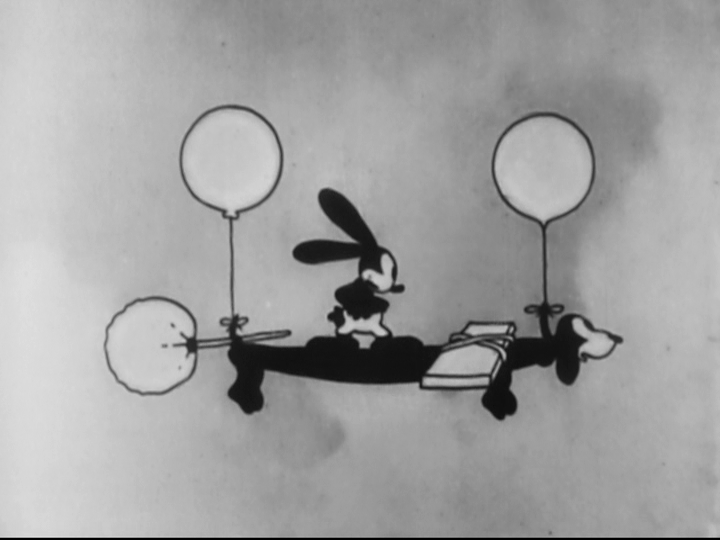
Oswald's friends help create a new plane to help him win the contest

Oswald’s friends help create a new plane to help him win the contest

Oswald’s wings and propeller take off, leaving him behind. Luckily, some friends decide to stop by and help, and set up a new plane, with a dachshund as the plane’s base. Finally, Oswald is ready to win the contest. The evil contestant passes by a sign that directs people to either Paris or the North Pole, and directs everyone else to the North Pole. In the morning, the evil contestant thinks he has nothing to worry about, when he spies Oswald flying by. He takes a gun and shoots the balloons propping the plane up, and Oswald falls to the ground, saved by a parachute. When he arrives on the ground, he’s actually landed in Paris amongst a cheering crowd.