RSS Feed

Tag Archives: Popularity

August 3

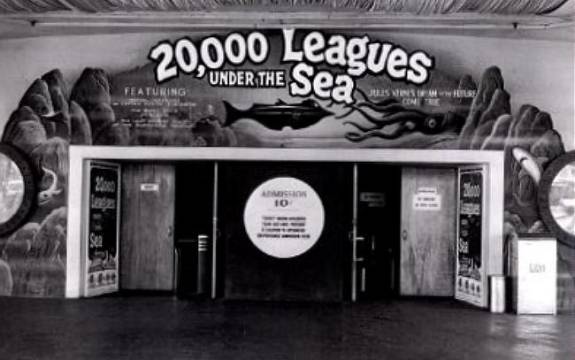
August 3, 1955 – The 20,000 Leagues Under the Sea Exhibit Opens in Disneyland

Image Credit: Vulcaniasubmarine.com

On August 3, 1955, the 20,000 Leagues Under the Sea Exhibit opened in Disneyland’s Tomorrowland, and lasted until August 28, 1966. The exhibit came about purely by accident; as the date for Disneyland drew near, Disney realized that he’d fallen behind on Tomorrowland. The film, released December 23, 1954, was immensely popular, so it was decided that the sets from the film would be used for a walkthrough attraction. This stopgap attraction proved to be more popular than expected, and lasted 11 years.

The sets were brought out of storage again in 1989 at the Disney-MGM Studios in Florida, and continued to be a popular attraction. Based on the resurgence in popularity, a similar attraction was built for Disneyland Paris in 1994, known as Les Mystères du Nautilus.

August 2

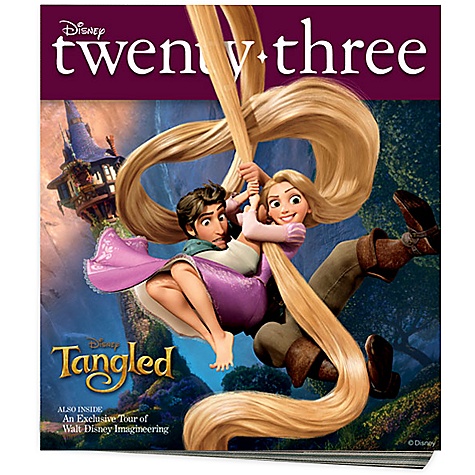
August 2, 2010 – The Seventh Issue of Disney twenty-three is Released

Image Credit: Official Disney Store Website

“Rapunzel and Flynn get Tangled up in Disney’s latest animated feature.”

On August 2, 2010, the long-awaited fall issue of Disney twenty-three, the magazine for members of D23, was sent to members and released for general purchase. The featured article for the magazine was the upcoming 50th animated film, Tangled. Other articles featured included a look at Disney Imagineering; an interview with Marty Sklar and Ray Bradbury about Epcot; tales of being a jungle cruise skipper from author Jason Surrell and John Lasseter; a salute to Fess Parker, who had passed away earlier that year; and a look at the creation of the character of the Beast from the classic film Beauty and the Beast. D23 members were also given a member-exclusive gift. A set of nine patches were created that feature the original Future World logos from its opening in 1982; members received a random design with their subscription.

July 29

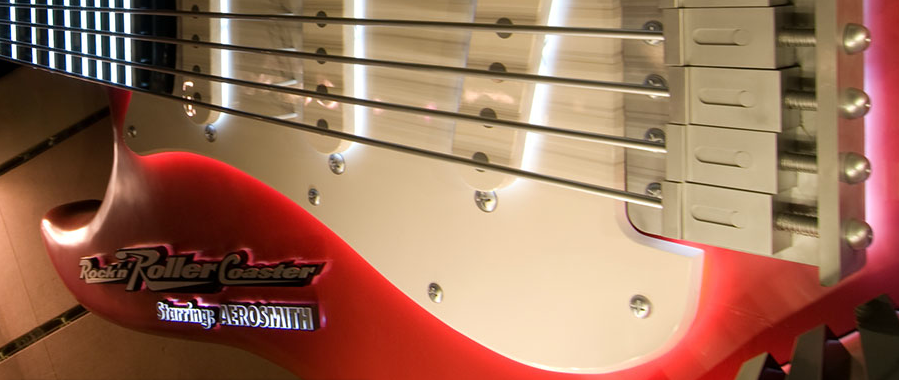
July 29, 1999 – The Rock ‘n’ Roller Coaster Starring Aerosmith Attraction Opens at Disney’s Hollywood Studios

Image Credit: Official Walt Disney World Website

“…how’s everyone going to get to the big bash? The solution: a super-stretch limousine that races across 3,400-feet of roller coaster tracks past Southern California landmarks and slices through the toughest of traffic on the LA freeways.”

On July 29, 1999, the Rock ‘n’ Roller Coaster Starring Aerosmith attraction opened at Disney’s Hollywood Studios at Walt Disney World. It is located at the end of Sunset Boulevard, next to the Twilight Zone Tower of Terror. Known as an “extreme” roller coaster, the ride goes from 0 to 60 in 2.8 seconds. The story that goes with the ride is that Aerosmith is finishing up a practice session, and is running late for their big concert across town. The Rock ‘n’ Roller Coaster, known as their super-stretch limo, will take them there, with guests along for the ride. The attraction has been sponsored by Hanes since 2008.

Guests ride through several areas of “California highway,” ranging from Interstate 5 to U.S. Route 101, all to a soundtrack of Aerosmith songs, some rewritten to accommodate the ride. Each car on the ride plays different songs; Aerosmith worked with the Disney Imagineers to create a soundtrack for each car. To play the soundtrack, each car has a special onboard audio system that includes a 125 speaker, 24 sub-woofer, and 32,000 watts.

July 1

Posted on

July 1, 1994 – The Lion King Celebration Parade Premieres in Disneyland

“Attention, all creatures great and small. It is time to trim your manes, stomp your hooves, and ruffle your feathers, in glorious celebration as we present the Legend of the Lion King!”

On July 1, 1994, the Lion King Celebration Parade began in Disneyland. The parade was the first time Audio-Animatronic figures, used on the floats, appeared outside stationary attractions; remote-controlled crocodiles and large African bugs were also used in the parade.

The parade was a mix of a Disney parade and a stage show: The parade would stop at various intervals and perform for visitors a brief show, which included the song “Circle of Life.” The segment also included men and women dressed as birds perfoming acrobatic stunts on poles, and an Audio-Animatronic Simba letting out a loud roar from the Pride Rock float. This section of the parade would end with a performance of “I Just Can’t Wait to be King” before continuing down the parade route. The parade ended its performance run on June 1, 1997.

June 26

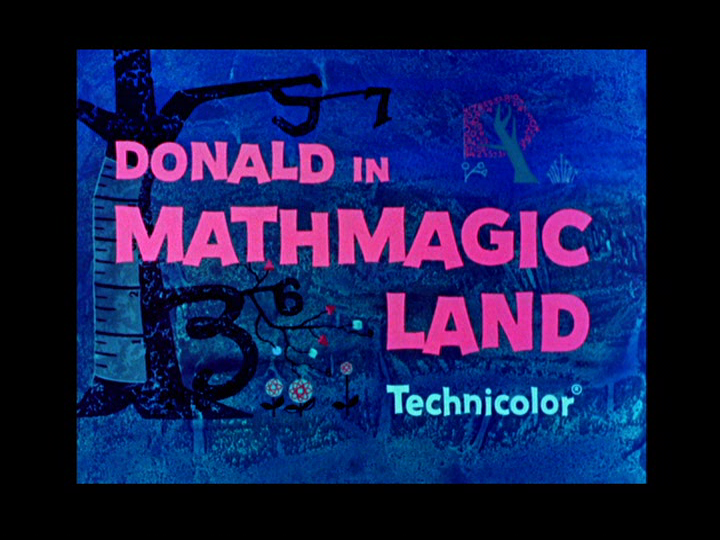
June 26, 1959 – The Donald Duck Featurette Donald in Mathmagic Land is Released to Theaters.
“By golly! You do find mathematics in the darndest places!”

On June 26, 1959, the featurette Donald in Mathmagic Land was released to theaters. This Academy Award-nominated short would go on to become one of the most popular educational films ever released by Disney. It was also shown on the first program of Walt Disney’s Wonderful World of Color, introduced by Professor Ludwig von Drake, who played the True Spirit of Adventure in the featurette. The story was written by Milt Banta, Bill Berg, and Dr. Heinz Haber, and starred Clarence Nash as the voice of Donald.

Donald, dressed in a hunter’s outfit, enters a dark room with his gun and looks around, remarking on how strange this all seems to be. He follows a trail of numbers, and finds the creature making the markings is a walking pencil, who challenges Donald to a game of tic-tac-toe, which Donald loses. He continues to walk, surprised by the square roots he runs into. He calls out hello to anyone who will hear him, and the voice of the narrator greets him. The narrator informs Donald that he is in Mathmagic Land, the land of great adventure, and that he, the narrator, is the True Spirit of Adventure. The spirit tells Donald he will take him on a journey through the wonderland of mathematics.
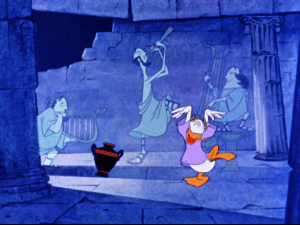
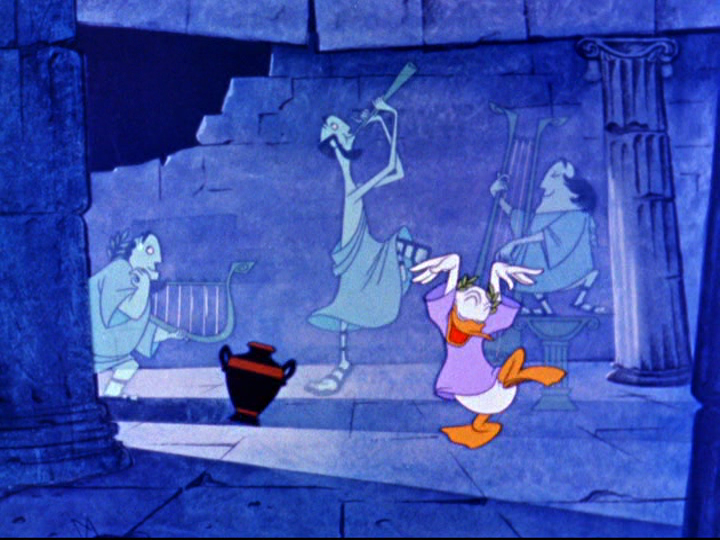
Donald having a jam session with the Pythagoreans, while learning that without math, there would be no music

As Donald storms away, saying math is for eggheads, the spirit informs Donald that without “eggheads,” there would be no music. He takes Donald back in time to Ancient Greece to meet Pythagoras, the father of mathematics and music. Donald is still confused, so the spirit shows Donald how music is full of mathematics. The first example shown is a harp, demonstrating how an octave is created. Donald and the spirit then sneak in on a meeting of the Pythagoreans, who are playing music in their meeting. Donald interrupts them, saying they need to play something with a beat. The Pythagoreans, the spirit explains, helped create the music we know and love today. As the spirits of the Pythagoreans disappear, Donald is left with a surprise – he is made a member of the Pythagoreans.

The segment then moves to another Pythagorean discovery: the pentagram, filled with mathemagic. The first concept explained is the golden section, then we move to the golden rectangle, which the pentagram creates many times over. The Greeks believed the golden rectangle to be a natural law of beauty. The spirit then shows how the pentagon, another Pythagorean shape, is found in nature, before moving on to other shapes found in nature.
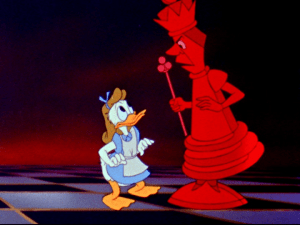
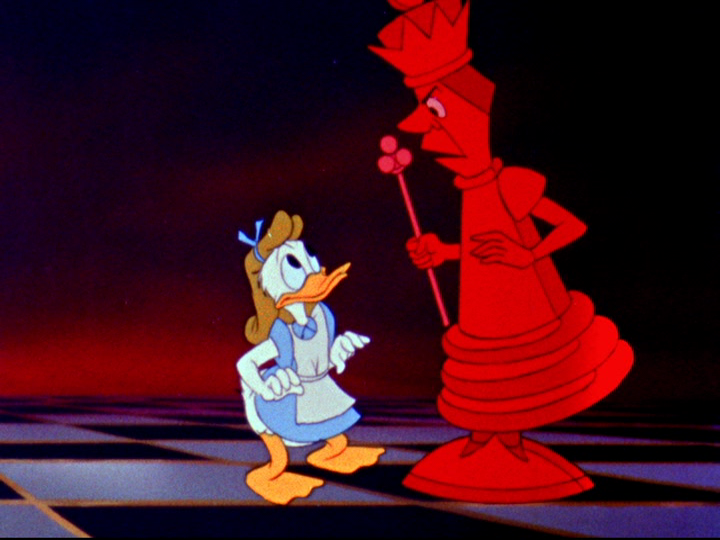
Donald plays the part of Alice when being taught the mathematical principles of the game of chess

Donald, who is enjoying his adventure so far, is delighted to hear that one can find mathematics in games, as well. The spirit begins with the game of chess, explaining it with the concept of Alice in Wonderland, with Donald playing the part of Alice. After a slight adventure with the chess pieces, Donald is able to watch a game in safety, but is bored by it. The spirit then begins to list sports with a geometric field, like baseball and football. The game that gets Donald really excited, however, is billiards. The spirit then shows an expert playing three-cushion billiards, and the mathematics used to get the perfect shot.

The spirit then tries to get Donald to play a game with his mind, only to find that Donald’s mind was completely cluttered with antiquated ideas, bungling, false concepts, and superstitions. He cleans out Donald’s mind, then has Donald think of a perfect circle, and puts a triangle in it. When asked what he sees, Donald sees a sphere. The spirit then has Donald take one thing and see how many items he can come up with using those shapes. Donald is then taken to a hall filled with doors, with most of them open. Some of the doors Donald discovers are locked, to which the spirit replies that they are the doors of the future, with the key being mathematics. The short then ends with the Galileo quote: “Mathematics is the alphabet with which God has written the universe.”
June 23

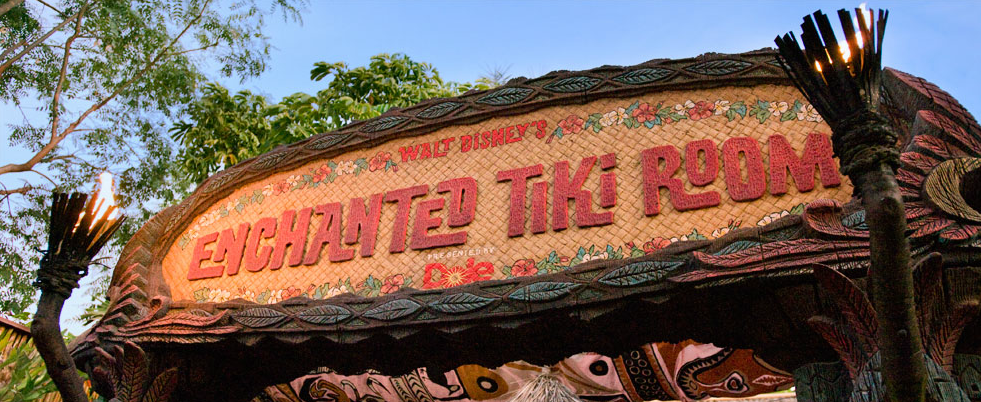
June 23, 1963 – The Enchanted Tiki Room Opens in Adventureland at Disneyland

Image credit: Official Disneyland Website

 “…All the birds sing words, and the flowers croon, in the Tiki Tiki Tiki Tiki Tiki Room.”

 On June 23, 1963, the Enchanted Tiki Room attraction opened in Disneyland’s Adventureland. The attraction, the first to feature Audio-Animatronics, was designed by WED Enterprises (now known as Walt Disney Imagineering). It was first sponsored by United Airlines, and passed to the Dole Food Company in 1976. Dole continues to host the attraction to this day.

The hosts of the show are four birds of different nationalities: the Mexican bird, Jose (voiced by Wally Boag); the Irish bird, Michael (Fulton Burley); the French bird, Pierre (Ernie Newton); and the German bird, Fritz (Thurl Ravenscroft). There are more than 150 Audio-Animatronic characters—including birds, flowers, and Tiki statues–that serenade the audience during the 15-minute show.

The attraction was first conceived as a dinner show, but the idea was shelved so that more guests could experience the room. The Tiki Room was originally controlled by an underground room with floor-to-ceiling computers, as seen in the Disneyland Tenth Anniversary Special. The attraction was closed for renovations in 2004, opening again in March 2005 for the park’s 50th anniversary, with new Audio-Animatronic figures replacing the old ones, and a new infrastructure designed by the 21st century Imagineers. The attraction is still as popular as ever, and has been replicated at Walt Disney World and Tokyo Disneyland.

June 12

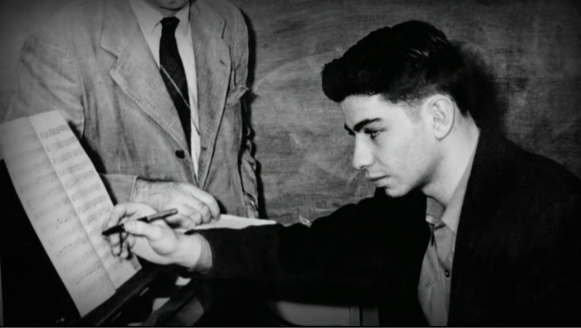
June 12, 1928 – Disney Legend and Songwriter Richard M. Sherman is Born

“I was all of seventeen in a terrible, terrible depression, and I decided to take a walk. And as I walked, I was hearing music, and I was wondering, ‘Where is this music coming from?’ And I realized it was coming from my own head. So I darted back to the apartment where we had a little piano, and started picking it out on the piano. There was this feeling I had. I’d never done that before…and my father said, ‘What are you doing here? What is this?’ and I said, ‘This is something I felt, I had to say it. This is what I feel.’” – Richard M. Sherman

Born on June 12, 1928, Richard M. Sherman was the youngest son of Rosa and Al Sherman, the latter a songwriter in what was known as “Tin Pan Alley,” an area in New York City that published popular music that dominated the market from the late 19th century to the early 20th century. The Shermans moved to Beverly Hills, California, in 1937. Richard’s interest in music developed in school, where he studied several instruments, including the flute, the clarinet, the piccolo, and the piano.

In 1958, Richard teamed up with his brother Robert, writing the song “Tall Paul” for Disney star Annette Funicello. It was a top-ten hit, eventually peaking at #7 on the Billboard Hot 100 chart, which caught the attention of Walt Disney. He contacted the Sherman Brothers and hired them to write for the Disney Studios as staff songwriters. The brothers wrote several songs for Disneyland, including their most well-known song “it’s a small world (after all).” They reached their greatest success with the film Mary Poppins, writing the hits “Feed the Birds,” “Supercalifragilisticexpialidocious,” and the Oscar winning “Chim Chim Cher-ee.” The brothers worked for Walt Disney until his death in 1966, and left the company in 1982 after writing songs for Epcot.

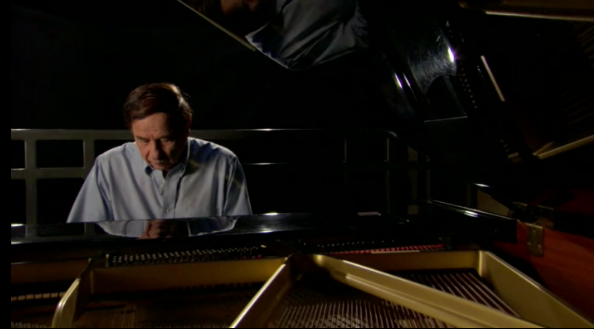
Richard playing one of his compositions in the documentary The Boys: The Sherman Brothers Story

The brothers worked on many projects outside of Disney, including the songs for the film Chitty Chitty Bang Bang and Charlotte’s Web, as well as the hit song “You’re Sixteen,” notable for being a Top Ten hit twice, first by Johnny Burnette in 1960 and Ringo Starr in 1973. Although the brothers had their greatest successes as a team, individually they have contributed greatly to the fields of music and literature. Richard released a CD in 2010 called “Forgotten Dreams,” a compilation of his piano compositions. One of his compositions, titled, “Make Way for Tomorrow Today,” was used in the movie Iron Man 2. The brothers were honored in 1990 as Disney Legends, and were awarded the National Medal of Arts in 2008. As Richard once put it, “We both really didn’t necessarily want to be songwriters. What I wanted to be was a great symphonic composer.” The brothers’ life story was chronicled in the 2009 documentary The Boys: The Sherman Brothers’ Story, which told the tale of how they ended up bound together and delighted the children of the world with their fantastical songs.

June 11

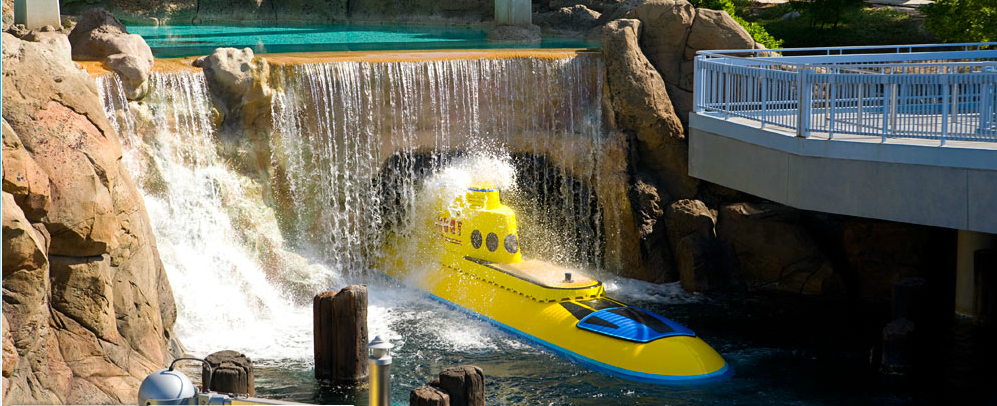
June 11, 2007 – The Finding Nemo Submarine Voyage Attraction Opens

Image Credit: Official Disneyland Website

“Immerse yourself in the world of Disney-Pixar’s Finding Nemo on this fascinating submarine voyage!”

On June 11, 2007, the Finding Nemo Submarine Voyage attraction opened at Tomorrowland in Disneyland. It is a redesign of the Submarine Voyage attraction, which closed in 1998. Guests board the Nautical Exploration and Marine Observation Institute’s research submarine (known as N.E.M.O.), and are able to look out portholes to see a newly erupting volcano and a stunning underwater environment. One of the first views that will delight fans of the movie Finding Nemo is the dentist’s niece Darla swimming around in the coral, holding a baggie containing a fish.

In 1998, after the original Submarine Voyage was closed, it was reported by Paul Pressler, Disneyland’s president at the time, that the ride would be redone with a new theme by 2003. After the box-office failure of Atlantis: The Lost Empire, plans to use that film as the theme were shelved. The success of the Pixar film allowed the attraction to be rebuilt with the Finding Nemo theme.

There’s something for guests above and below the water. Under, guests can put on “sonar headphones,” giving them the ability to hear the fish chatter among themselves, especially as the guests follow Marlin on his search to find Nemo. Onshore, the seagulls from the movie perch on a nearby buoy, shouting their familiar call of “Mine! Mine! Mine!” Guests can also watch the voyage on the “SubCam,” manned by a member of the N.E.M.O. Institute.

June 7

Posted on

June 7, 1998 – The Lion King Wins Six Tony Awards

Image Credit: The Official Website for the Tony Awards

 “Tom [Schumacher] and I want to thank the Tony committee and the theater community for embracing this show and honoring us this way.” – Peter Schneider

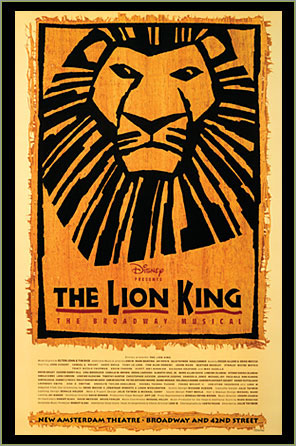
On June 7, 1998, the 52nd Annual Tony Awards were held at Radio City Music Hall in New York. The Lion King musical walked away with six awards, including Best Musical, beating out Ragtime, Side Show, and The Scarlet Pimpernel. The Lion King also won Best Direction of a Musical for director Julie Taymor, Best Choreographer for Garth Fagan, Best Scenic Design for a Musical for Richard Hudson, Best Costume Design for a Musical for Julie Taymor and Michael Curry, and Best Lighting Design of a Musical for Donald Holder.

The musical, based on the animated film released in 1994, was a phenomenon when released on Broadway, smashing records and earning rave reviews. Julie Taymor, the director, was the first female to receive a Tony for Best Direction of a Musical. “Julie Taymor is a goddess; we’re eternally grateful for your courage, your passion, and the genius that is your gift,” Tom Schumacher announced upon receiving the Tony Award for Best Musical. Using her studies in pre-Bunraku puppetry in Japan, Taymor also helped to create the costumes for the musical, with a variety of masks and puppets used to portray the animals in the show; this unique design helped set the musical apart from the movie.

May 13

Posted on

May 13, 1992 – Fantasmic! Premieres at Disneyland

Image Credit: Official Disneyland Website

“Welcome to Fantasmic! Tonight, our friend and host Mickey Mouse uses his vivid imagination to create magical imagery for all to enjoy. Nothing is more wonderful than the imagination, for in a moment, you can experience a beautiful fantasy or an exciting adventure. But beware, nothing is more powerful than the imagination, for it can also expand your greatest fears into an overwhelming nightmare.”

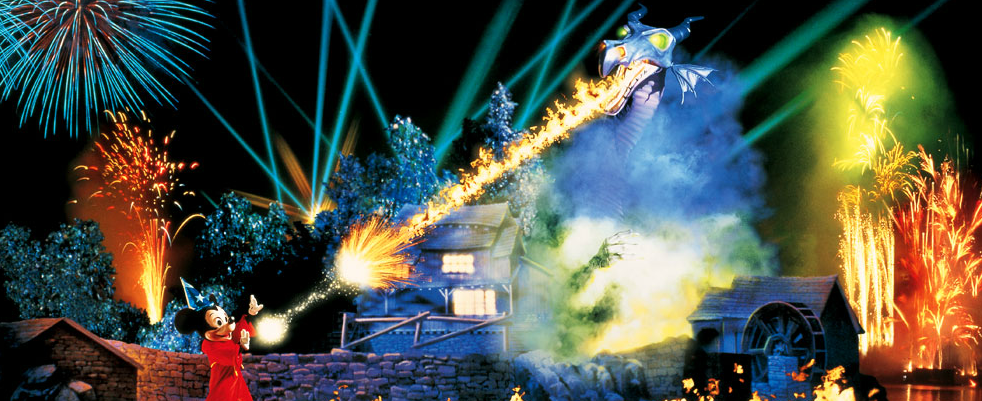
On May 13, 1992, the evening show Fantasmic! premiered at Tom Sawyer Island at Disneyland. The spectacular show involves water effects and fireworks, with live actors in Disney character costumes acting out the plot of Mickey’s dream. The show has become one of the most popular nighttime events in the park’s history, and has expanded to a show in Walt Disney World’s Hollywood Studios resort (located in Sunset Boulevard), and Tokyo Disneyland’s Tokyo DisneySea Resort (located at the Mediterranean Harbor).

The story features Mickey Mouse using his imagination to create a wonderful fantasy world, which is soon threatened by Disney villains, including Maleficent and Ursula. Many scenes from classic Disney animation were reworked to be shown on three giant screens made of mist, while some classic characters appear by live-action actors to recreate classic scenes, including the fight between Peter Pan and Captain Hook.

The show has been reworked several times, including creating more accessibility for audience members, as the show’s unexpected popularity ended up causing traffic jams on the shores of the Rivers of America. Guests would line up for hours to get a good spot to see the show. The show is approximately 22 minutes long, and is shown late at night, usually past 9:00pm.