RSS Feed

Tag Archives: Pixar

June 6

Posted on

June 6, 2006 – The Soundtrack for Disney Pixar’s Cars is Released Through Walt Disney Records

 Cars (Soundtrack from the Motion Picture)

“Slow down, you’re gonna crash, baby you were screamin’ it’s a blast, blast, blast. Look out baby you got your blinders on, everybody’s lookin’ for a way to get real gone.”

On June 6, 2006, the soundtrack for the seventh Disney Pixar full-length animated feature film Cars was released through Walt Disney Records. The album is a compilation of score and songs by popular and contemporary artists, with the score composed by Pixar veteran Randy Newman. Songs on the album include “Real Gone” by Sheryl Crow, “Route 66” by Chuck Berry, with a cover version by John Mayer, a cover of “Life is a Highway” by Rascal Flatts, “Behind the Clouds” and “Find Yourself” by Brad Paisley, “Our Town” by James Taylor, “Sh-Boom” by The Chords, and “My Heart Would Know” by Hank Williams. The album peaked at number 6 on the Billboard charts, and would go on to be nominated for the Best Compilation Soundtrack Album Grammy.

June 5

Posted on

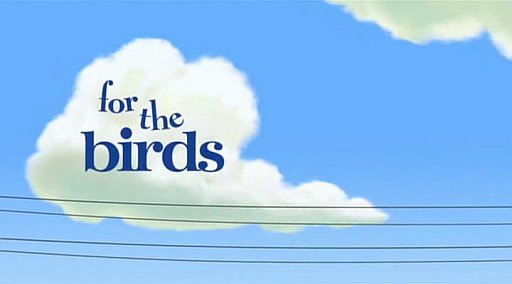
June 5, 2000 – The Pixar Short Film For the Birds Premieres at the Annecy International Animated Film Festival

For_the_Birds

“[For the Birds] began actually as a student film, a long time ago, and I could never bring myself to draw all these little birds that are about to pop up on the screen.” – Director Ralph Eggleston

On June 5, 2000, the Pixar short film For the Birds premiered at the Annecy International Animated Film Festival in Annecy, France. After its showing, it was released alongside Pixar’s fourth animated feature, Monsters, Inc, and would go on to win several awards, including the Academy Award for Best Short Animated Film. According to Pixar, the names of the smaller birds that start the teasing are Bully, Chipper, Snob, and Neurotic. The short was re-rendered into 3D for the 3D theatrical rerelease of Monsters, Inc. in 2012. It was directed by Ralph Eggleston.

A bird flies onto the screen and perches on a nearby telephone wire and makes himself comfortable. He is soon joined by several others, and they all begin to squeak amongst themselves, before they are interrupted by a strange honking noise. They all turn to see a large, rather dopey-looking bird, and they start making fun of him. The big bird doesn’t realize that he’s being made fun of, and decides to join the birds on the wire. As he sits on the wire, it bends underneath his weight, and the birds slide into him. Annoyed, they squawk loudly, and one of the birds pecks him hard in the side, sending the big bird flying off the wire, although still holding on with his feet. The same small bird that pecked the big bird pecks one of the big bird’s toes, and it slips from the wire. The birds then get an idea to keep pecking away until the big bird has let go, with the other birds cheering the main two birds on. A bit too late, one bird realizes that once the big bird lets go, they will all be catapulted into the air. As the birds are shot out of their feathers, the big bird sits up, still rather oblivious to the teasing and the malice, and starts blowing the feathers gently. The smaller birds land on the ground, completely naked, and the big bird laughs hysterically as the birds scamper into the nearby wheat field in shame.

May 31

Posted on

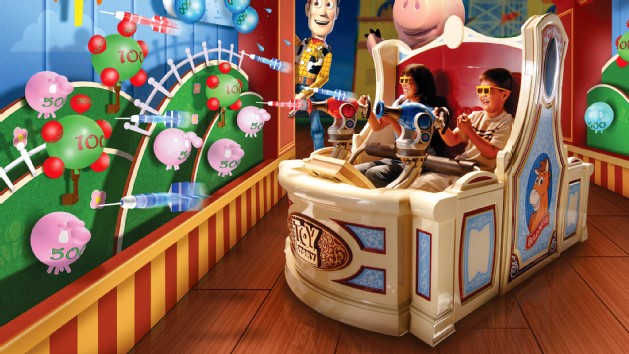
May 31, 2008 – The Attraction Toy Story Midway Mania! Opens in Walt Disney World’s Hollywood Studios

toy-story-mania-00

“Ride and shoot moving targets at this midway-style, 4D shootin’ game starring your favorite Toy Story characters.”

On May 31, 2008, the 4-D attraction Toy Story Midway Mania! opened in Walt Disney World’s Hollywood Studios. Inspired by the Toy Story franchise, guests board spinning vehicles while wearing 3-D glasses, and enter Andy’s room to play five carnival midway games. It is one of the most technologically advanced and expensive attractions created for the park, costing about $80 million. The host of the attraction is an Audio-Animatronic Mr. Potato Head, decked out as 1920s barker, who tells jokes and identifies people in the audience to talk to. The five games of skill are: Hamm & Eggs (shooting down barnyard animals and hardboiled eggs), Rex & Trixie’s Dino Darts (launching darts and popping balloons), Green Army Men Shoot Camp (baseball toss at plates), Buzz Lightyear’s Flying Tossers (a ring toss on the Little Green Men), and Woody’s Rootin’ Tootin’ Shootin’ Gallery (suction-cup darts shot at mine0cart targets). Each game has an Easter egg that triggers gameplay changes or additional targets.

May 26

Posted on

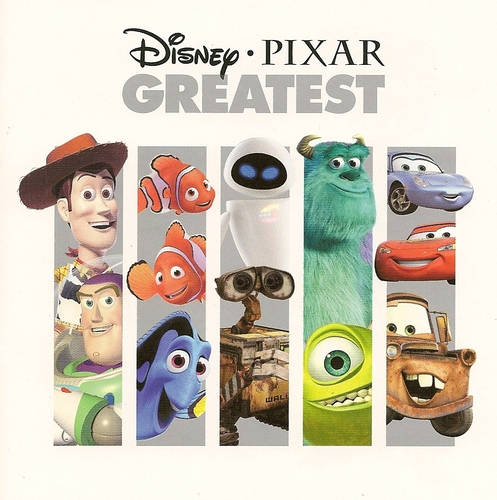
May 26, 2009 – The Compilation Album Disney Pixar Greatest is Released Through Walt Disney Records

Disney Pixar Greatest

“There isn’t anything I wouldn’t do for you, we stick together, we can see it through ‘cause you’ve got a friend in me, yeah, you’ve got a friend in me.”

On May 26, 2009, the compilation album Disney Pixar Greatest was released through Walt Disney Records. The album contains a mix of songs and scores from the Pixar films released through 2009, ending with Up. The scores, composed by Randy Newman, Thomas Newman, and Michael Giacchino, are recognizable pieces from the films, including Randy Newman’s “The Scare Floor” from Monsters, Inc., Thomas Newman’s “Define Dancing” from WALL-E, and Michael Giacchino’s “Carl Goes Up” from Up.

May 16

Posted on

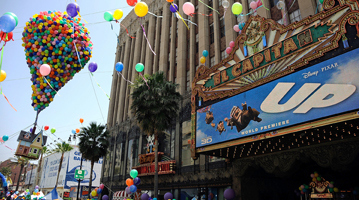
May 16, 2009 – The Disney/Pixar Film Up Has its World Premiere

pixar-up

“My favorite part of the film is the wonderful montage of just showing a life from early to late, and without words, and I’m really proud of us for doing that sequence.” – Bob Peterson, voice of Dug

On May 16, 2009, the Disney/Pixar film Up had its world premiere at the El Capitan Theatre in Los Angeles, California. Many celebrities were on hand for the celebration, including Jon Voight, Barbara Eden, and several Disney Channel stars. Hollywood Boulevard was cleared for the decorations, which included thousands of balloons, street performers, and an appearance by Carl, Russell, and Dug themselves. The film would go on to have a general release on May 29, 2009.

May 2

Posted on

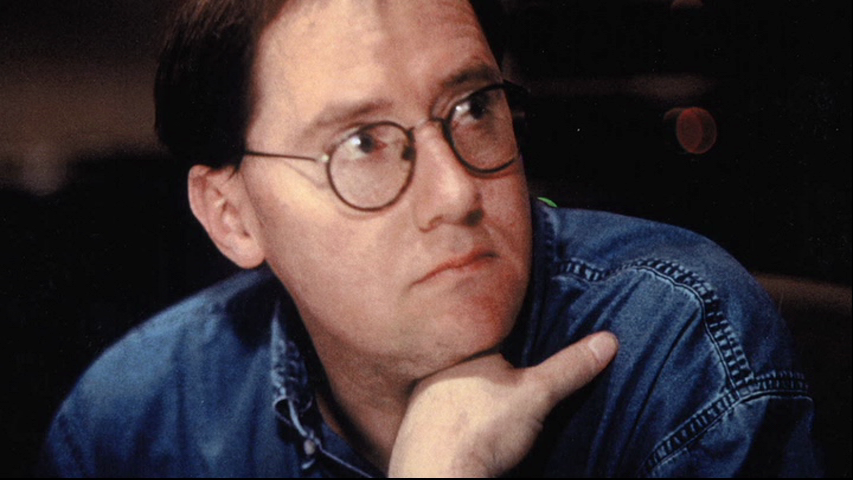
May 2, 2009 – John Lasseter is Awarded an Honorary Doctorate from Pepperdine University

vlcsnap-2012-01-11-17h20m38s189

“Never let anyone kill your dreams.”

On May 2, 2009, John Lasseter, Chief Creative Officer of Walt Disney Studios and Pixar Animation Studios, gave the commencement address at the Frank R. Seaver College of Letters, Arts, and Sciences at Pepperdine University, in Malibu, California. Lasseter was also presented an Honorary Doctorate degree for his work in the field of computer animation. Lasseter had started his education there, as it was the alma mater of his parents and siblings, but transferred to the California Institute of the Arts to pursue his dream of becoming an animator. In his speech, he encouraged the almost 500 graduates to never let anyone destroy their dreams.

April 6

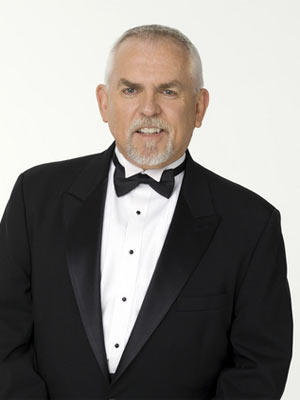
April 6, 1947 – Actor John Ratzenberger is Born

john-1

“[Ratzenberger’s] the ultimate Pixar character actor. He’s someone so clear, I know that guy after only two lines of dialogue. Having him in every film is like our Hitchcock cameo.” – Animator and Director Pete Doctor

On April 6, 1947, John Deszo Ratzenberger was born in Bridgeport, Connecticut. In 1971, he moved to London, where he worked as a house framer and began his acting career. His first role was in the 1976 film The Ritz. Throughout the ’70s and ’80s , Ratzenberger continued to score minor and major film roles in such films as Superman, Superman II, Star Wars Episode V: The Empire Strikes Back, and Ghandi. In 1982, he auditioned for a new sitcom series: Cheers. Although he originally auditioned for the role of Norm Peterson, he came up with the role of Cliff Clavin, the bar’s “know-it-all.” The series ran for eleven seasons, and reached critical acclaim. In 1995, Ratzenberger was cast in Pixar’s first full-length computer animated feature Toy Story as the piggy bank Hamm, and soon after became a recurring “lucky charm” for the studio, having a part in every Pixar film to date. Animator and director Andrew Stanton said in an interview, “We were at a press junket for Toy Story at Marino del Rey, and all the talent were invited to join us for a celebratory cigar and toast. John hung out with us all night. He was so much fun, I remember saying, ‘Let’s have him be in a film again.’” Ratzenberger has stated that “every time I get Pixar on the line, I just drop whatever I’m doing and get over to the studio.” He will soon be heard in Pixar’s Monster’s University, reprising his role of the Abominable Snowman.

March 31

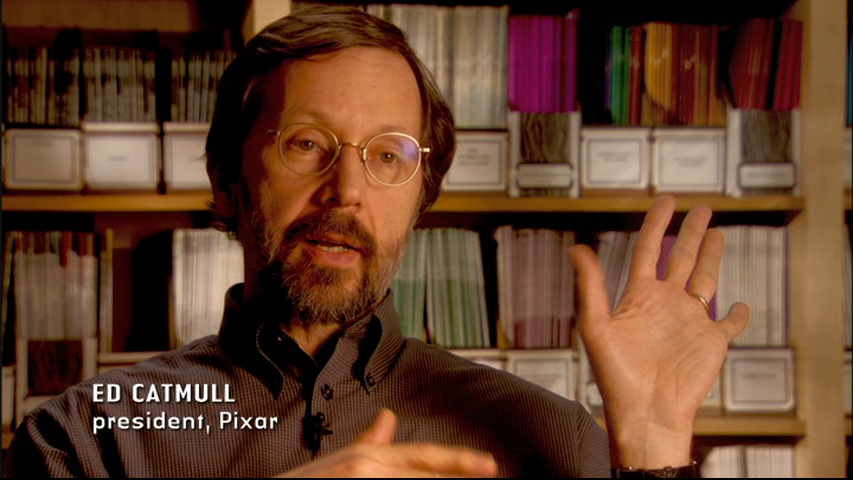
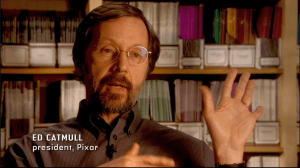
March 31, 1945 – Ed Catmull, President of Pixar Animation Studios and Walt Disney Animation Studios, is Born
vlcsnap-2013-03-31-08h17m29s92

“I drew a lot; I wanted to be an animator. I wanted to be an artist. But at the same time, I believed that I wasn’t good enough to be an animator, so I switched over to physics and computer science. As soon as I took the first class, I just fell in love with it, it just blew everything else away.”

On March 31, Edwin Earl Catmull was born on March 31, 1945, in Parkersburg, West Virginia. Although he loved to draw from an early age and dreamed of becoming an animator, he believed early on that he didn’t have the talent necessary, and decided to study physics and computer science at the University of Utah. Around the country at that time, funding was given to select universities to pursue computer science, and Catmull participated in one of the first labs in computer graphics. In this lab, Camtull created a short computer-animated film of his own left hand, which ultimately helped in the development in creating curved surfaces and eliminating jagged edges. This film was inducted into the National Archives in December, 2011 as a ground-breaking work. In 1974, Catmull graduated with his PhD. Soon after graduation, Alexander Schure, founder of the New York Institute of Technology, hired Catmull as the head of the computer graphics department in the hopes of creating new tools and products to create computer animation. There, Catmull met Alvy Ray Smith, who became a close collaborator and friend for many years. At NYIT, Catmull and his research group developed several tools that would allow animators to draw and paint directly into the computer, including Tween, Paint, and SoftCel.

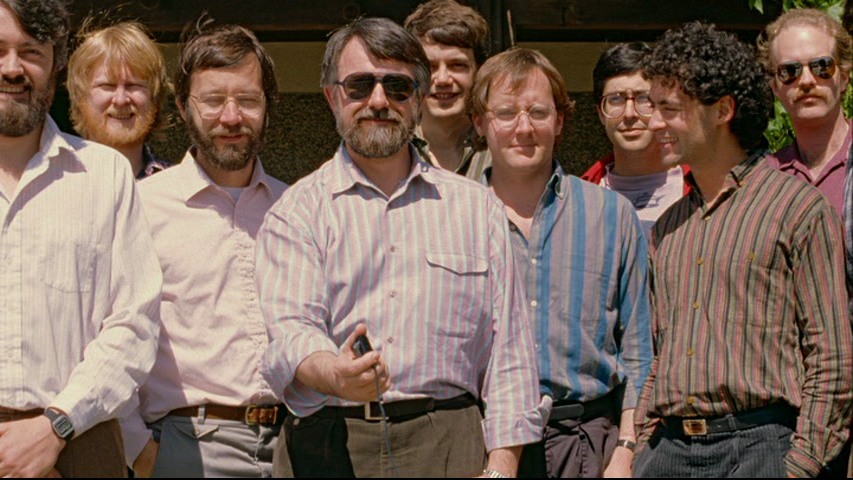
The work being done by Catmull and his team was noticed by George Lucas, who hired Catmull to form a new computer division at Lucasfilm. Catmull accepted the offer, and in 1979, he became the Vice President of the computer graphics division. Catmull and Smith, however, were still working toward the goal of a completely computer animated full-length film. Tom Porter, technical director at Pixar noted that, “…Ed and Alvy realized, in order to get in the game, we’ve got to put characters up on the screen, and that meant character animation, and that changed everything right there.” As luck would have it, Catmull ran into John Lasseter at a conference, and Catmull jumped at the chance to bring a real animator to Lucasfilm to help realize the dream of a computer animated film. With Lasseter, the group created the short film The Adventures of Andre and Wally B., along with new software to replicate the squash and stretch movements of traditional animation, which was well received at the 1984 SIGGRAPH conference. Catmull and the team also developed the most powerful graphics computer of the time: the Pixar Image Computer. However, sales of this computer were stagnant, as the software was only sold in limited markets. Catmull and Smith, with Lucas’ blessing, spun off the computer division as Pixar, and struggled to find an investor.
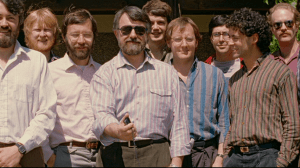
Catmull (L) with the rest of the Pixar team from Lucasfilm

Catmull (L) with the rest of the Pixar team from Lucasfilm

In 1986, their prayers were answered when Steve Jobs heard of Pixar. “That was the first time I met Ed [Catmull], and he shared with me his dream to make the world’s first computer-animated film. And I, in the end, ended up buying into that dream, both spiritually and financially,” Jobs shared in an interview. He launched Pixar, and Catmull was named as Chief Technical Officer. He also helped develop the RenderMan system used in Toy Story and Finding Nemo. In 2006, when Disney acquired Pixar, Catmull was then named the President of Pixar and Disney Animation, and with Lasseter, the two were put in the prime position of bringing the art of 2-D animation back to life. “Everybody at Pixar loves 3-D animation, you know, we helped develop it. But we also love 2-D animation, and to think that 2-D was shut down, and that [Pixar was] used as an excuse to shut it down was awful,” Catmull said about the decision of most animation studios shutting down their traditional animation studios. “We saw this art form being thrown away, so for us, it was just, it was a tragic time.” Bob Iger, CEO of the Walt Disney Studios, wanted to take the studio back to the glory days of animation, and knew that Pixar had the right people to do that. “While we will make 3-D movies, we’re also going to make 2-D movies, cause it’s part of this wonderful heritage that we’ve got here, and it’s a beautiful art form,” says Catmull. “It feels like this [partnership between Disney and Pixar] is the true culmination of the building of Pixar and this amazing company into something which will continue on and continue to make waves in the future.”
February 27

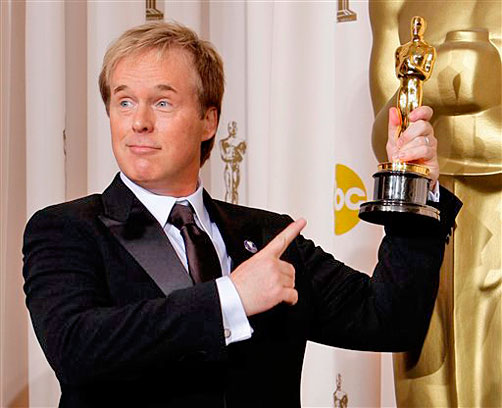
February 27, 2005 – The Pixar Film The Incredibles Wins Two Academy Awards

BradBird

“Animation is about creating the illusion of life, and you can’t create it if you don’t have one.” – Brad Bird at his acceptance speech

On February 27, 2005, the 77th Academy Awards were held at the Kodak Theater in Los Angeles, California. Nominated for four Academy Awards, the sixth Pixar film, The Incredibles, walked away with two, including Best Animated Feature, beating out DreamWorks’ Shark Tale and Shrek 2. The Academy was also awarded the Best Sound Editing Oscar to Michael Silvers and Randy Thom, who were nominated against Paul N.J. Ottosson for Spider-Man 2 and Randy Thom and Dennis Leonard for The Polar Express. This would be director Brad Bird’s first Academy Award; he would win again three years later for Ratatouille.

January 31

January 31, 2010 – The Score for Pixar’s UP Wins Two Grammy Awards

Up 1

“[Regarding “Married Life” as Ellie’s theme]…when you watch the film, it’s fun to see how that score changes with them as well.” – Michael Giacchino

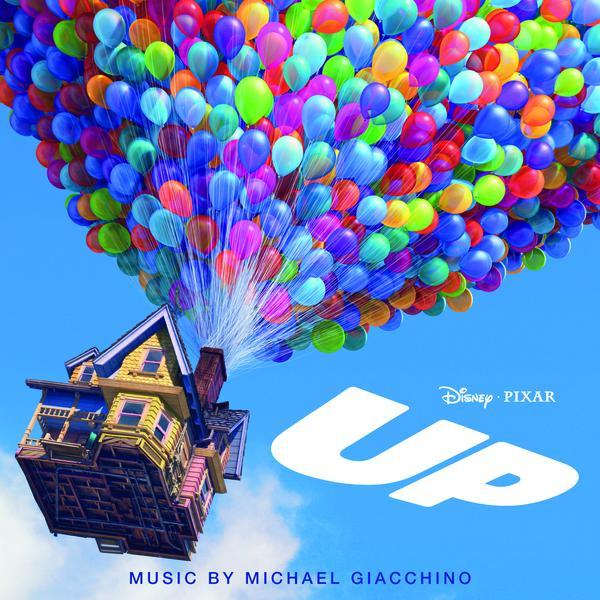
On January 31, 2010, the 52nd Grammy Awards was held in Los Angeles, California. Michael Giacchino’s score for the Pixar film UP was awarded two Grammys: one for Best Score Soundtrack Album, beating out Alexandre Desplat’s The Curious Case of Benjamin Button, Nicholas Hooper’s Harry Potter and the Half-Blood Prince, Danny Elfman’s Milk, and Giacchino’s collaboration with Varese Sarabande for Star Trek; the other award was for Best Instrumental Composition for the piece “Married Life,” which was up against Paquito D’Rivera’s “Borat in Syracuse,” Tim Davies’ “Counting to Infinity,” Bob Florence’s “Fluffy,” and Steve Wiest’s “Ice-Nine.” It is one of the few scores in history to win an Academy Award, a Golden Globe, a BAFTA, and a Grammy.