RSS Feed

Tag Archives: Black and white

December 6

December 6, 1922 – The Laugh-O-Gram Film Cinderella is Released
vlcsnap-2012-12-05-19h53m30s22

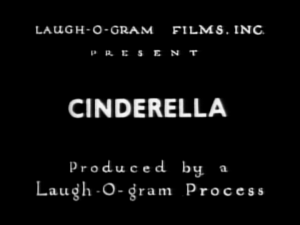
“Cinderella, whose only friend was a cat.”

On December 6, 1922, the Laugh-O-Gram Film Cinderella was released. This was a silent film from Walt Disney’s early Laugh-O-Gram Studio, founded in May 1922. Cinderella was one of the six fairy tale cartoons produced during the studio’s contract with Pictorial Clubs, Inc. The short is a modern-day (of the time) take on the classic fairy tale.

The opening of the short introduces Cinderella and her only friend, the cat; her two stepsisters; and the prince, who chases a bear with a shotgun. A group of bears is seen dancing, playing music, and being merry, until they see the prince, who chases them all into their cave. The prince victoriously captures all the bears and drags them out in a row, their feet tied to a single rope. The prince then sends out invitations to a ball, and his trusty servant dog takes them to every home in the kingdom.

The night of the ball arrives, and the stepsisters head to the ball, leaving Cinderella alone with the cat. As they both lament that they wish they could go to the ball, the Fairy Godmother appears in a cloud of smoke, letting Cinderella and the cat know that she has come to grant their wish. Instantly, Cinderella is turned into a flapper, and a motorcar appears in their living room, ready to drive Cinderella and the cat to the ball.
Once the two set their eyes on each other, they dance the night away

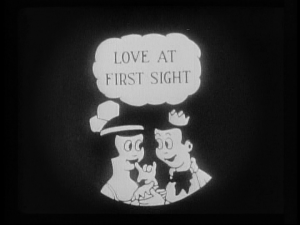
Once the two set their eyes on each other, they dance the night away

At the ball, the prince is dancing with one of the stepsisters when he spies Cinderella, and it is love at first sight between the two. Everyone wonders who the girl is. Meanwhile, Cinderella’s cat is busy dancing with the prince’s dog. As the guests start to rush for the food, Cinderella and the prince spend time together alone in the garden. Cinderella suddenly notices that it’s five minutes to midnight, and dashes out of the ball, losing her shoe in the process. As she runs home, her clothes soon change to rags.

The next day, the prince sets out to find her, following a set of footprints that unfortunately lead to a duck. He finally finds Cinderella’s house and has the stepsisters try on the shoe, but of course it doesn’t fit. Then he sees Cinderella, and realizes that she is the mystery girl from the ball. The prince and Cinderella, as well as the cat and the dog, live happily ever after.
December 2

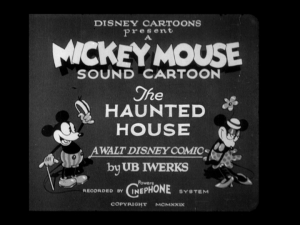
December 2, 1929 – The Mickey Mouse Short Film The Haunted House is Released to Theaters

vlcsnap-2012-12-01-17h53m41s93

“I c-c-can’t play!”

On December 2, 1929, the Mickey Mouse short film The Haunted House was released to theaters. Many of the skeletons’ dance moves are similar to those of the Silly Symphony The Skeleton Dance. The short was directed by and stars Walt Disney.

It’s a dark and stormy night, and Mickey is trying to get home, with his umbrella flying away in the wind. He spies a house nearby and decides to see if he can wait out the storm there. As he opens the back door, the door and back hallway completely fall apart, revealing another door that opens for him. He screams in fear, but ends up inside, with the door magically locking him in. Bats and spiders fly and crawl about, further frightening an already scared Mickey.

vlcsnap-2012-12-01-17h57m22s255

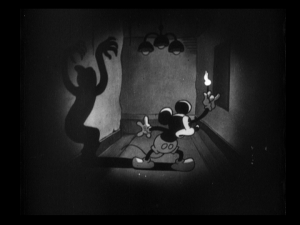
After the lights go out, Mickey lights a match to see the hallway, unaware of his shadow playing tricks

The lights go out. Mickey lights a match, only to be scared by his own shadow. He comes face to face with a Grim Reaper and a herd of skeletons, who sit him down at the piano and force him to play. Mickey carefully begins to play, with the Grim Reaper guiding his hands to perform the melody. The whole crew begins to dance to the music, with some of the other skeletons joining with their own “musical instruments.” When Mickey finishes the song he tries to leave, but the skeletons see him and come after him. Mickey finally jumps out a window and flees the house back into the storm.

November 18

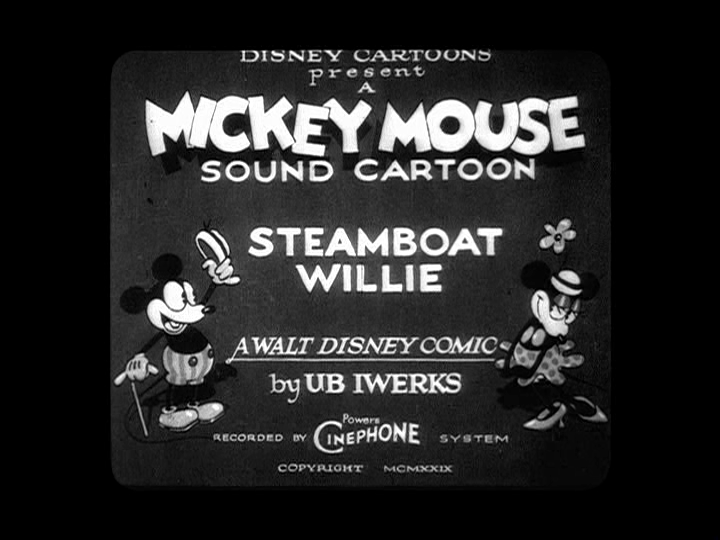
November 18, 1928 – The First Mickey Mouse Short Film, Steamboat Willie, Premieres

“I only hope that we never lose sight of one thing – that it was all started by a mouse.” – Walt Disney

On November 18, 1928, the first Mickey Mouse short film, Steamboat Willie, premiered in theaters. Not only is it notable for being the first Mickey Mouse short film released (although not the first Mickey Mouse short produced), but it is also notable for being one of the first cartoons with synchronized sound, and the first to have a fully post-produced soundtrack. When Walt Disney was unable to get a deal with RCA or Western Electric for the film, he turned to Pat Powers and his bootleg Powers Cinephone process. The initial recording session was a disaster, which ended with Disney hiring a 15-piece band to play, and Walt Disney voicing all of the characters. The film’s title was a parody of a Buster Keaton film called Steamboat Bill Jr. The Disney film premiered at the Colony Theater in New York, and was an instant success, skyrocketing Mickey and the Disney Studios to stardom.

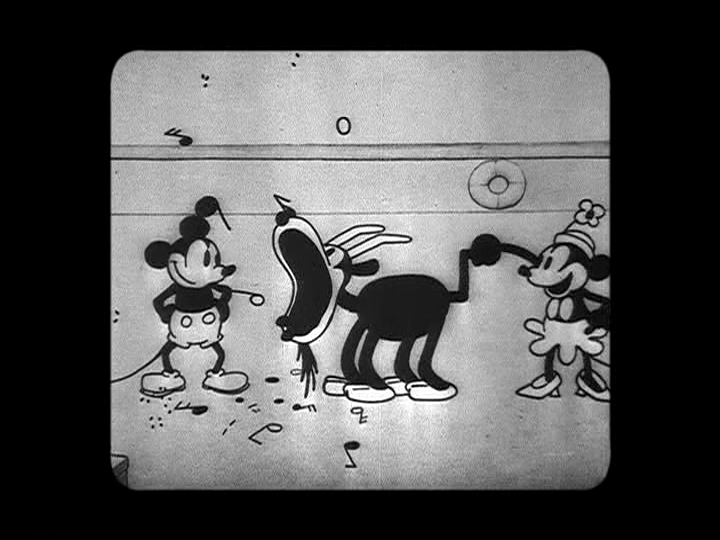
A steamboat is heading down the river, with Mickey at the wheel, whistling a “Steamboat Bill.” Pete appears behind him, yells at him for taking control of the boat, and sends the mouse flying onto the lower deck. The boat reaches Podunk Landing and the cargo is loaded quickly. A frantic Minnie Mouse sprints to catch the boat before it leaves, only to just miss it. Luckily, Mickey hears her cries and uses the hook on the boat to bring her aboard. She drops her guitar and sheet music, which is soon devoured by a nearby goat.

After the goat eats Minnie’s sheet music, the two use the goat to play the tune “Turkey in the Straw”

As Mickey tries to pull the guitar away from the goat, he and Minnie come to the conclusion that the goat can be worked like a turn-crank record player. Using whatever materials he can find, including an animal menagerie, the two begin their own rendition of “Turkey in the Straw.” After the performance, Mickey turns around to find Pete waiting for him angrily, and is sent to the galley to peel potatoes.

November 12

November 12, 1932 – The Mickey Mouse Short Film The Klondike Kid is Released to Theaters

“Guess we’re both nobodys.”

On November 12, 1932, the Mickey Mouse short film The Klondike Kid was released to theaters. The short was directed by Wilfred Jackson, and stars Walt Disney as Mickey Mouse, Marcellite Garner as Minnie Mouse, Pinto Colvig as Goofy and Pluto, and Billy Bletcher as Pierre.

The short opens at the Klondike Bar in the middle of a blizzard, but inside, the atmosphere is merry with many people drinking and dancing. Mickey is playing the piano, and scrapes up the change people throw at him when he finishes. As he gathers the coins, he notices at the window a girl, who faints in the snow. He rescues her, bringing her into the warmth. She begins to cry, and when Mickey asks her name, she responds that she’s just “nobody.” She laughs at his jokes, and warms up to him when he offers her some food.

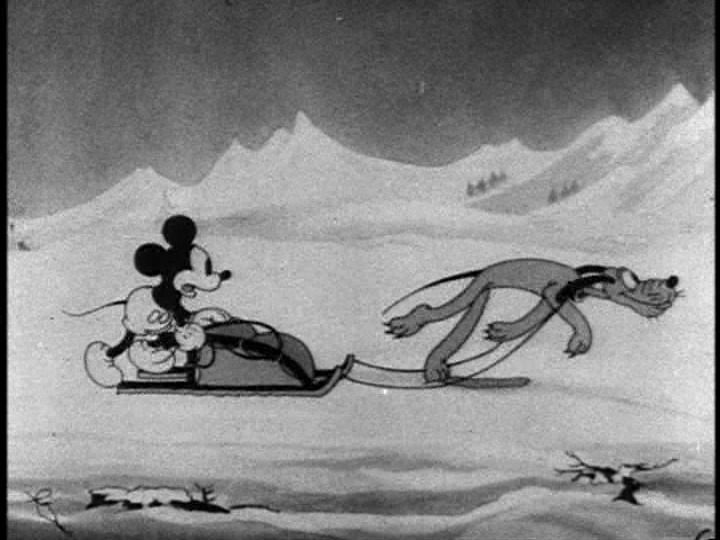
After Pierre kidnaps the girl, Mickey uses Pluto as his sled dog and pursue the villain

The door of the bar bursts open, and in storms Peg Leg Pierre, who attacks Mickey and pins him to the wall before he kidnaps the girl. As she screams in terror, many of the patrons try to help her, but are prevented by an ensuing gunfight. Pierre steals her away, but Mickey frees himself and chases after her. He harnesses Pluto as his sled dog, but Pluto gets the idea of running only after he spots a rabbit to chase. The sled breaks, and Mickey finds himself skiing down the hill into Pierre’s hideout.

Inside Pierre’s cabin, Mickey and Pierre fight and the two are caught in mattress springs. Meanwhile’s Pluto’s rabbit chase ends with him snowballing down the hill and knocking Pierre’s cabin from its foundation. As the short ends, Pierre is knocked out, and Mickey and the girl attempt to kiss, only to kiss Pluto, who pops out of the snow in between them.

October 30

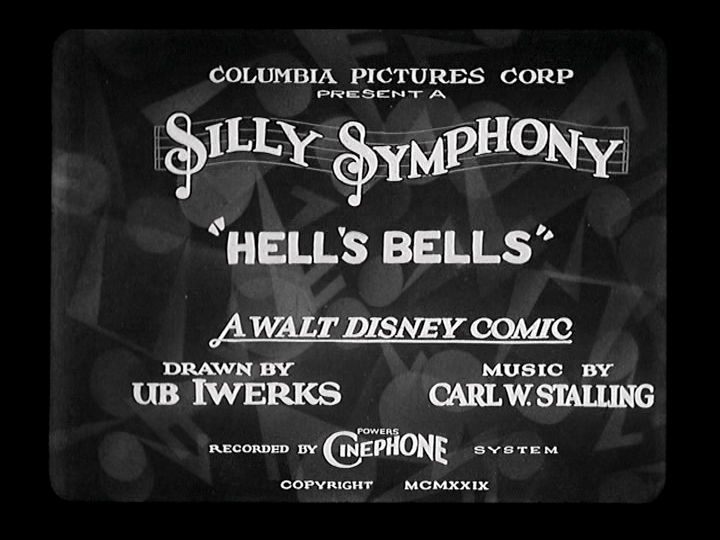
October 30, 1929 – The Silly Symphony Short Film Hell’s Bells is Released to Theaters

On October 30, 1929, the Silly Symphony short film Hell’s Bells was released to theaters. The short was drawn by Ub Iwerks, and is also notable for being Iwerks’ first foray into directing. The music for the short was done by Carl Stalling; the piece heavily featured in the short is “Funeral March of a Marionette” by Charles-Francois Gounod.

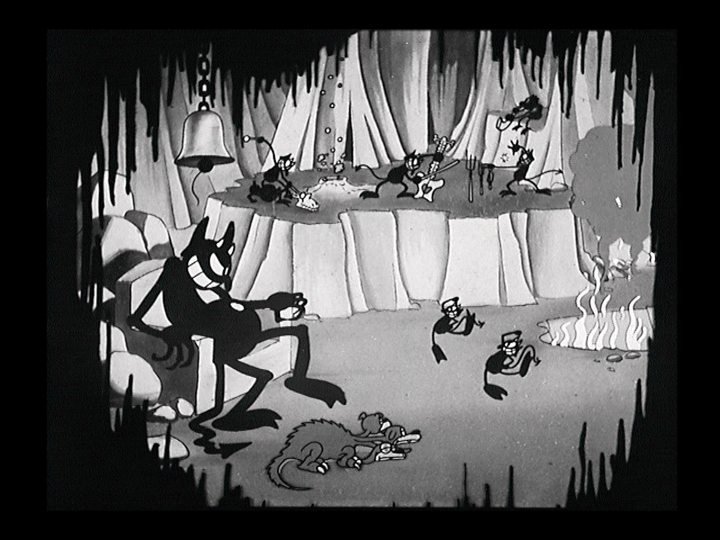
The short first erupts into a blaze of fire, which reveals an underground cavern populated by bats, spiders, and other strange creatures that introduce themselves to the camera one by one. Satan is then seen sitting in his chair, being entertained by dancing musical demons, who use skulls, volcanoes, and even each other to create the music. A troupe of demons also dance around merrily, with comical results. Satan claps with delight before ringing a bell, alerting the other demons to bring their master dinner.

Satan sits on his throne, listening to the entertaining music performed by his minions

After enjoying his dish, Satan grabs a demon and feeds him to his three-headed dog, laughing at the result. He tries to grab the other demon to feed his pet, but the demon manages to escape Satan’s grasp, sending him flying into the fiery pits below.

October 27

October 27, 1954 – The Television Series Disneyland Premieres on ABC

“…this year, we want you to see and share with us the experience of building this dream into a reality.”

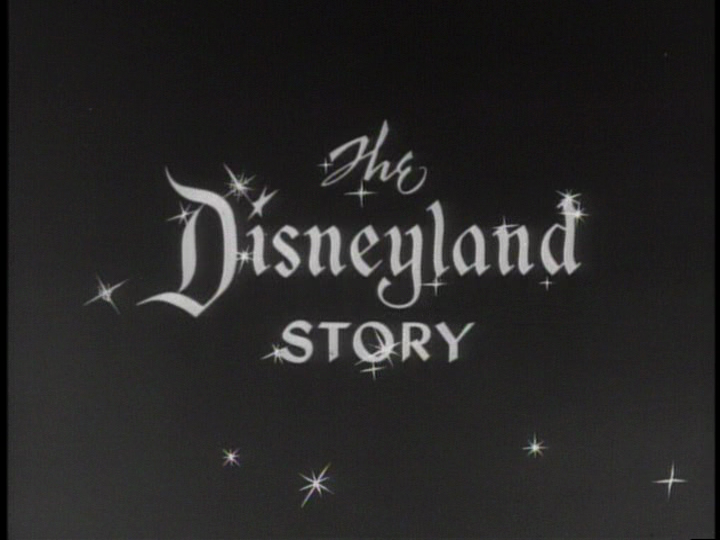
On October 27, 1954, the first episode of the Disney anthology series Disneyland premiered on ABC. The show, named after the theme park Walt Disney was planning to build, gave audiences glimpses of the dream that would become the California theme park. The first episode was entitled “The Disneyland Story,” and was directed by Robert Florey.

When Walt Disney was in the midst of creating his theme park, he realized that the only way he could secure enough funding was to embrace the new medium of television. He struck a deal with the then-fledgling ABC network, which agreed to help provide financing if he created a weekly hour-long television show for them, with Walt as host. This show made Walt Disney a familiar figure in households nationwide, and created several staples in popular culture, including the Davy Crockett craze of the 1950s.

“The Disneyland Story” begins with an aerial view of the Walt Disney Studio in Burbank, California. There is then a behind the scenes view at what is going on at the studios, including a look at the upcoming film 20,000 Leagues Under the Sea, a live-action model stage for Sleeping Beauty, and some strange music being composed in the music department. The narrator takes us to a place called the Disneyland Plans Room, where “something unusual is going on in the studio today, something that never happened before.” Walt then takes over as host, introducing his vision of Disneyland, the four worlds of the park, and the format of the four worlds of the television show. Introducing Frontierland, he then presents a segment about the Davy Crockett serial that will soon begin filming, and introduces Fess Parker, who sings the theme song.

Going to Adventureland, Walt presents producer Ben Sharpsteen, who talks about the planned area and shows some films they’ve done of the Galapagos Islands, the Falkland Islands, Lapland, Morocco, and Portugal. Walt introduces Tomorrowland, and director and animator Ward Kimball explains the plans and ideas for the Tomorrowland segments, including designing and building the first passenger-carrying rocket. The last realm Disney introduces is Fantasyland, where “in this land, hopes and dreams are all that matter.” He then says that Uncle Remus would have called it a “laughing place,” which leads into the “laughing place” segment from Song of the South.

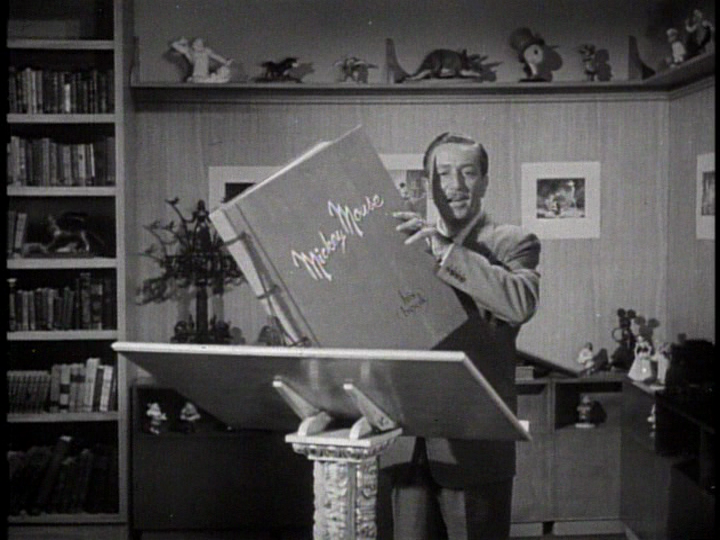
Walt Disney pulls down a book from his shelves that chronicles the life of his greatest star, Mickey Mouse

To remind everyone that “it all started with a mouse,” Walt then presents the story of Mickey Mouse, starting with his humble beginnings in the short film Plane Crazy. He introduces Mickey’s friends and fellow stars – Pluto, Goofy, and Donald – before presenting one of the most important roles in Mickey’s career: the role of the sorcerer’s apprentice in Fantasia. After exploring Mickey’s career, clips are shown of the next week’s episode, a presentation of the Disney film Alice in Wonderland.

October 23

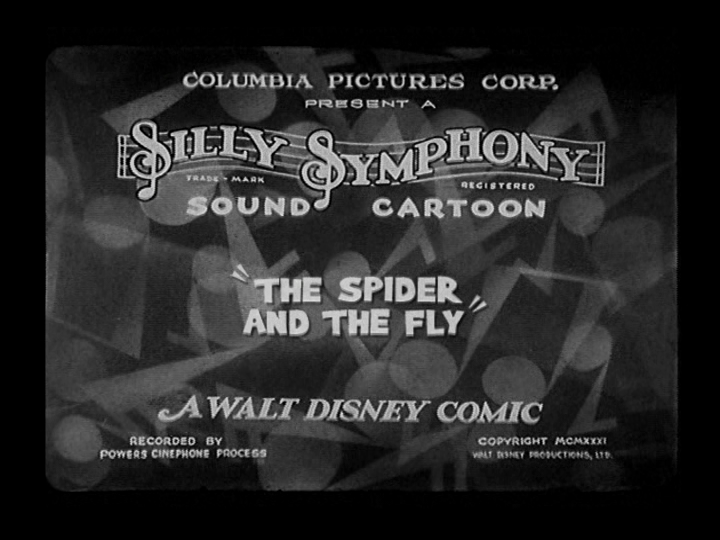
October 23, 1931 – The Silly Symphony The Spider and the Fly Premieres in Theaters

On October 23, 1931, the Silly Symphony The Spider and the Fly was released to theaters. The short was directed by Wilfred Jackson.

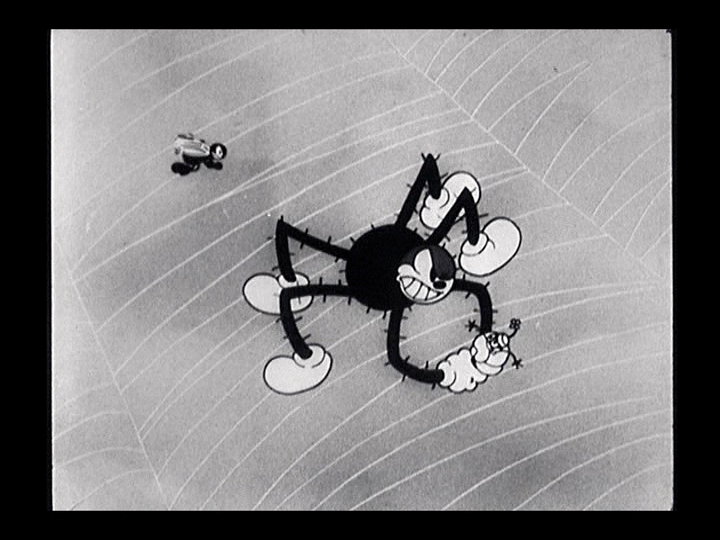
The short opens with a group of flies buzzing around an empty kitchen, snacking on an open jar of jam and playing with a bar of soap and a flyswatter. Two flies fly out an open window and explore a tap near the house. Watching hungrily nearby is a vicious spider, who spies the two flies near the tap and sets out to trap them by using his web as a harp, enticing the two to dance to the music.

The spider holds the female fly captive in his web while the male fly tries to distract him enough to let her escape

As the two dance closer and closer to the spider, the female fly is caught in his web. The male tries to rescue his mate, but the spider manages to catch him briefly before he escapes. Making his way back to the group, the fly sounds an alarm, and every fly nearby, including the horseflies in the nearby stable, gets ready for battle. The flies seize whatever they can from the house to throw on the spider, from pepper to pins. Finally, they use a match to set his web on fire, and place a piece of flypaper beneath him as he jumps, trapping him. They free the female fly, and everyone cheers.

October 17

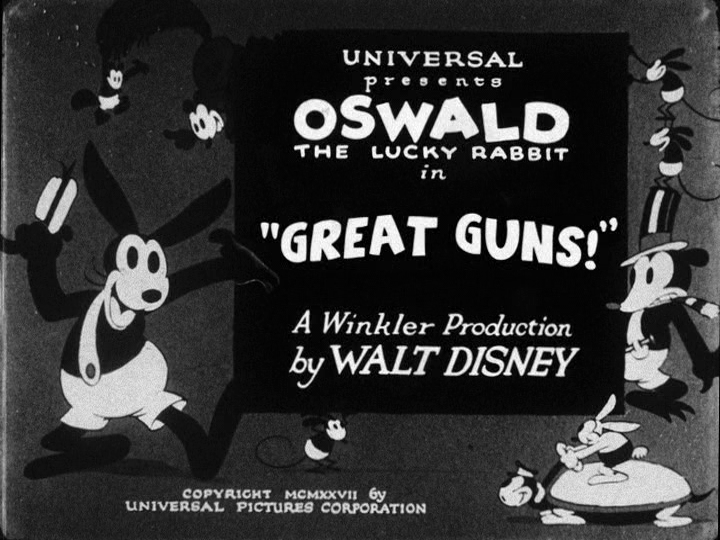
October 17, 1927 – The Oswald the Lucky Rabbit Short Film Great Guns! is Released to Theaters

On October 17, 1927, the Oswald the Lucky Rabbit short film was released to theaters. It was the fourth Oswald cartoon released by Disney.

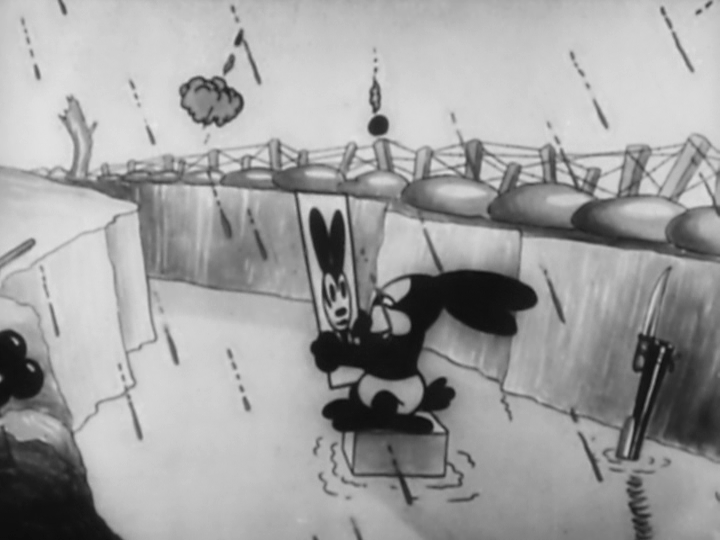
A newsboy runs down the street, holding up a newspaper with the headline of war. The factories’ whistles and bells sound, and everyone rushes to the recruiting office, including Oswald. He stops in front of his girlfriend’s house, calling to her, and as she comes out, she marvels at how impressive he looks as a soldier. As the trumpets sound, the two share one last kiss before he leaves. The scene soon changes to Oswald kissing a photo of his girl while stuck in a trench, bombs flying everywhere.

Oswald distracts himself from war by kissing the picture of his girlfriend while stuck in a trench

Cannons are shooting from all around, and neither side can get over the walls of the trench. Oswald seems oblivious to all the warfare as he continues to kiss his girlfriend’s picture, which annoys a pilot flying overhead. To get Oswald’s attention, he drops a bomb so that it tears a hole right through the picture. Maddened, Oswald gets in his own plane and chases after the pilot. The two fight in the air before crashing to the ground and continuing their fight with their fists. As Oswald gives the other pilot a good thrashing, he is stopped by a high-ranking officer for the other side, and sheepishly tries to walk away.

The officer chases Oswald, and tries to blow the rabbit up with a cannon – only to find that it is too short range. Thinking quickly, Oswald uses an elephant nearby as a cannon to fire back at the officer. Unfortunately, the elephant is blown to bits, leaving Oswald vulnerable again, but not for long, as he bats back the cannonballs with his ears.  Oswald himself is soon blown to smithereens, but his girlfriend shows up as an army nurse and uses a martini shaker to bring him back to his whole self. Oswald revived, the two share a kiss.

October 3

October 3, 1955 – The First Episode of The Mickey Mouse Club Premieres on ABC

“We are the Merry Mousketeers, Mouseketeers! We’ve got a lot above our ears, above our ears!”

On October 3, 1955, the first episode of The Mickey Mouse Club premiered on ABC. The series was a part of Walt Disney’s contract with ABC, which gave him the money needed to finance the building of Disneyland. The series was the second television series for Disney, and has become one of the most beloved television series ever released. The show was known for its animated opening and theme song, with Donald Duck having varying misfortunes as he struck a gong at the end. The show usually featured about 24 different Mouseketeers, with as many as 39 at one point. This series ran from 1955 to 1959.

The first episode, “Fun With Music Day,” begins with the Mickey Mouse Club Newsreel, which gives kids an idea of kids’ lives across the world. It starts in the Florida Everglades, where kids are on an airboat ride exploring the Everglades, the home of the Seminole Indians. The news then travels to Rome, where the Italians are celebrating Carnival. As they ride a merry-go-round, the kids play the song “Bibbidi-Bobbidi-Boo” from Cinderella on instruments. A world report follows, starting in London, where television star Sooty joins the Mickey Mouse Club. In Tokyo, veteran cameraman Henry Kotani brings the news of the Tokyo swim meet. Golden Oak Ranch is then shown, on location during the filming of The Adventures of Spin and Marty, then it’s going back to Burbank, where the camera shows the filming of Davy Crockett, following the cast on location to Kentucky. The camera then goes back to the Disney Studios, introducing the Mouseketeers.

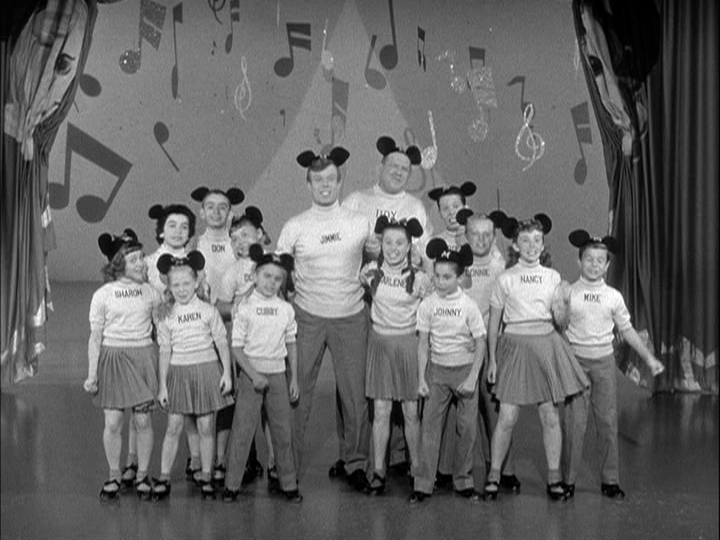
The first showing of the Mousketeers, with hosts Jimmie and Roy

After a quick commercial break, the show returns, with host Jimmie Dodd introducing a tap dance routine by Mousketeers Don, Doreen, Darlene, Bobby, Annette, Lonnie, and Nancy. They are soon joined by Sharon, Mike, Karen, Cubby, Johnny, and Jimmie. Roy jumps in at the end before they sing an introduction song and the roll call. After this, the Mouseketeers present “A Mousekartoon Special” called The Friendly Farmers. They perform a song about farmers owning some animals, while a special guest acts out the animals.

The Mouseketeers then perform “The Shoe Song” with Roy drawing as they sing. Jimmie announces the Musketeers as they come in, performing in costumes ranging from clowns, to cowboys, to ballerinas. It ends with a “wedding” between Cubby and Karen, with several shoes tied to the back of their kart. This is then followed with a serial known as “What I Want To Be,” which explores the careers of a pilot and an airline hostess, as hosted by Alvy Moore. A young girl named Pat and a young boy named Duncan are taken to see what being a hostess and a pilot is really like, with the promise that the segment will continue the next day.

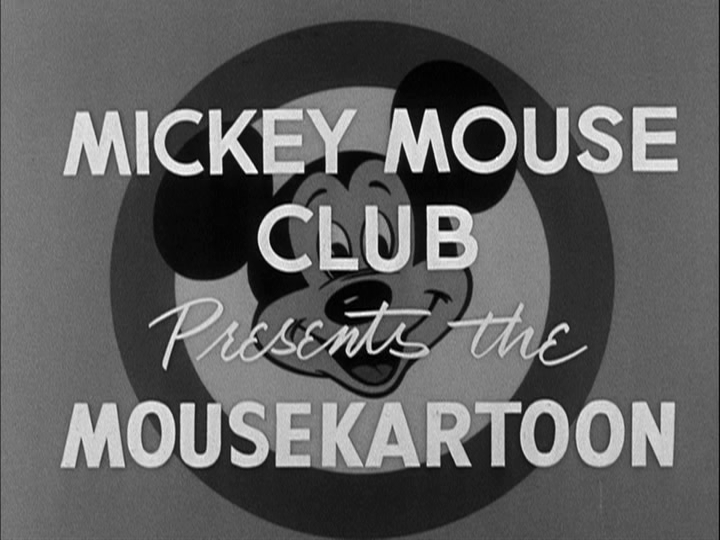
The title for the Mousekartoon, with one being shown every day

Following that is the Mousekartoon, presented by Karen. She lets the audience know that the cartoon that day is Pueblo Pluto, a short film originally released on January 14, 1949, with Jimmy MacDonald voicing Mickey. After the Mousekartoon, Jimmie steps on camera, introducing how the show will be set up from that episode forward, including the themes of the days of the week. After this, the Mouseketeers and Jimmie sing goodbye, and Mickey gives a goodbye as well.

September 19

September 19, 1927 – The Oswald the Lucky Rabbit Short Oh Teacher Premieres in Theaters

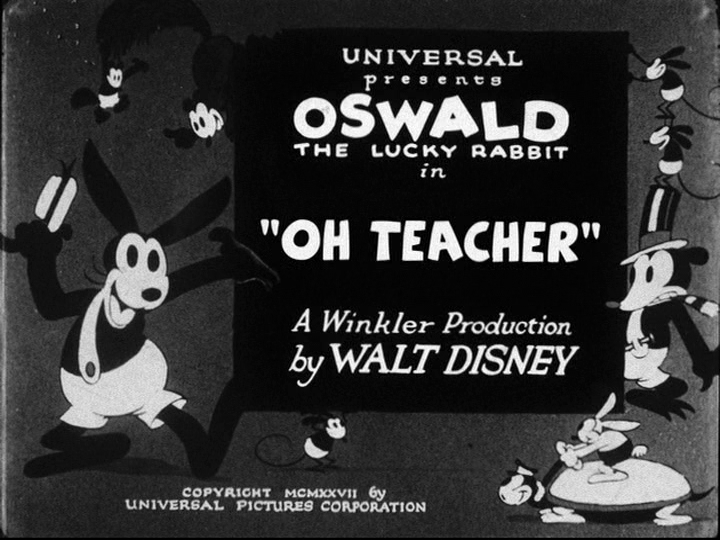
On September 19, 1927, the Oswald the Lucky Rabbit short film Oh Teacher was released in theaters. It was the second Oswald short released after Trolley Troubles.

Oswald is seen riding his bike, swinging his schoolbooks around on their strap. As he rides by, he picks up a flower and begins to play a game of “She Loves Me, She Loves Me Not,” which turns out in his favor. He stops at his girlfriend’s, letting her sit in the sidecar of his bike, and the two ride off for school.

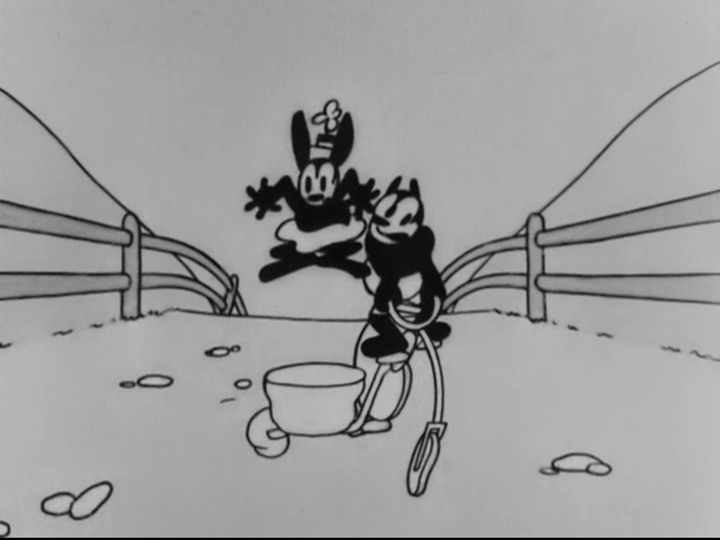
The troublemaker loses control of the bike as it winds down a rocky road

Near the schoolhouse, a mother pig stands with her child, kisses him goodbye, then places him on a hook to be picked up by the school trolley. A troublemaker grabs the child’s tail on the trolley, using it to pull him and his bike along. The conductor gets angry and uses exhaust fumes to brush the kid off. As the troublemaker sits in the middle of the road, he spies Oswald riding down the path, and decides to play a prank, pushing Oswald from his bike. The troublemaker quickly takes control of the bike (and Oswald’s girlfriend), but is unable to control it as it careens down a rocky path.

Oswald chases after the bike, but is unable to stop it as it crashes into a pole, splitting the sidecar from the bike. Oswald’s girlfriend, helpless, is sent on a one-way trip into the river, where she tries to keep her head above water and screams for help. In a clever gag, Oswald uses the cry for “help” to take him to his girlfriend, reaching out to her from the bank. The troublemaker, however, climbs on Oswald and saves the girl, taking the credit for Oswald’s hard work. The girl falls for the troublemaker, and Oswald challenges the troublemaker to a fight, which he loses.

The school bell rings, and all the students march inside. At recess, Oswald waits for the troublemaker to show his face, ready to clobber him. Once again, a fight begins between the two, with Oswald accidentally winning, and having his girlfriend fall in love with him again.