RSS Feed

Tag Archives: Black and white

April 21

April 21, 1930 – The Mickey Mouse Short Film Fiddling Around is Released to Theaters

vlcsnap-2013-04-20-21h39m20s13

“As an encore, I will play the finale from the overture ‘William Tell.’”

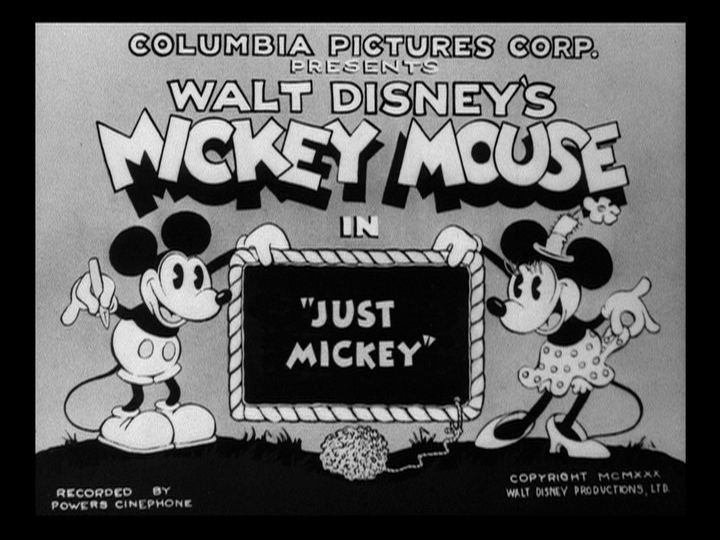
On April 21, 1930, the Mickey Mouse short film Fiddling Around was released to theaters. This short is also known as Just Mickey, which was the short’s original working title. This is also one of the rare instances that Mickey is seen with hair. The pieces performed in the short are Schumann’s “Traumerei” and one of Listz’s “Hungarian Rhapsodies,” as well as the called out finale of the “William Tell Overture.”

Several pairs of curtains part on a large stage, revealing Mickey walking ceremoniously with a fiddle, but he trips at the front of the stage. As the audience laughs, Mickey blushes, but gets on with his performance, except that one of his violin strings breaks. He then musses his hair in an artistic manner before playing highly regarded pieces of classical music. He then breaks into a rather tragic piece, wailing and crying the entire length. He finishes that tune by crying and carrying his violin behind him as he walks offstage. He then comes back to wild applause from the audience. He then comes back on stage to announce his encore from the “William Tell Overture.” His spirited playing has him crawling across the stage, throwing his violin in the air, and breaking it in half. The concert is a rousing success.

April 2

April 2, 1908 – Actor, Dancer, and Disney Legend Buddy Ebsen is Born

vlcsnap-2013-04-01-21h16m17s201

“Buddy [Ebsen] said that it was really difficult for him [to lose the role], but once he saw Fess [Parker] on screen, he knew that Walt had made the right decision.” – Paul F. Anderson, author of The Davy Crockett Craze.

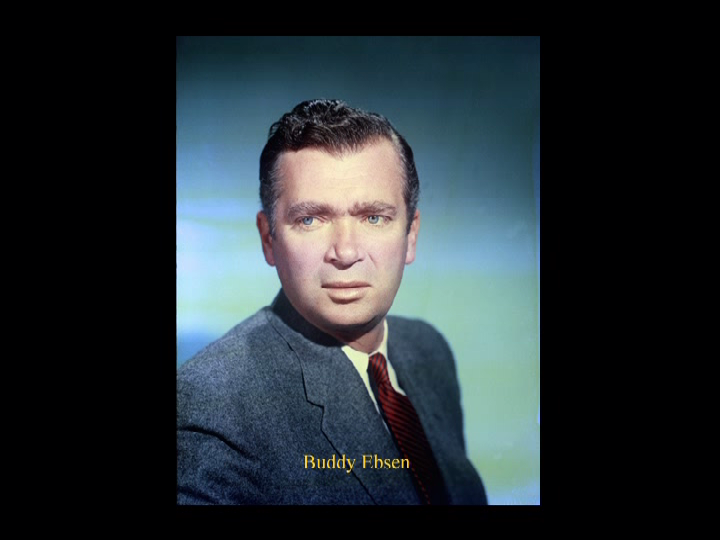
On April 2, 1908, Christian Rudolph “Buddy” Ebsen, Jr., was born in Belleville, Illinois. At the age of ten, his family moved to Florida, where he and his siblings learned how to dance at their father’s dance studio in Orlando. Although he had aspirations to be a doctor, the collapse of the Florida land boom in the 1920s forced him to leave the University of Florida and head to New York City to become a dancer. He and his sister, Vilma Ebsen, became a dual act in vaudeville as “The Baby Astaires.” This led to a screen test by MGM, and they each signed a two-year contract with MGM, making their screen debut in Broadway Melody of 1936. While this would be Vilma’s only film, Ebsen’s career took off as a dancer in several films.

In 1939, Ebsen was cast in The Wizard of Oz as the Scarecrow, but swapped roles with Ray Bolger, who was originally cast as the Tin Man. However, Ebsen’s involvement in the film was short-lived, as he experienced an allergic reaction to the aluminum dust in the make-up, and was forced to leave the film. During World War II, Ebsen became a Lieutenant, Junior Grade in the Coast Guard, and after the war, he resumed his acting career in the new medium of television. In 1954, Ebsen starred in one of his more well-known roles: George Russel in Walt Disney’s Davy Crockett. Originally, Ebsen was tapped to play Davy Crockett, but Walt Disney, after seeing Fess Parker in a bit part in the sci-fi film Them was convinced that Parker was the man to play Crockett. Ebsen was then cast in the role of Russel. For Disney, Ebsen also stared in The One and Only, Genuine, Original Family Band as Calvin Bower, and the serial “Corky and White Shadow” on the Mickey Mouse Club. Ebsen would also dance on film for the staff to study and create Audio-Animatronics. In 1962, Ebsen scored his most famous role of Jed Clampett on the long-running sitcom, The Beverly Hillbillies. In 1973, he starred in another series, Barnaby Jones. In 1993, Ebsen was named a Disney Legend. He passed away in 2003 at the age of 95.

February 23

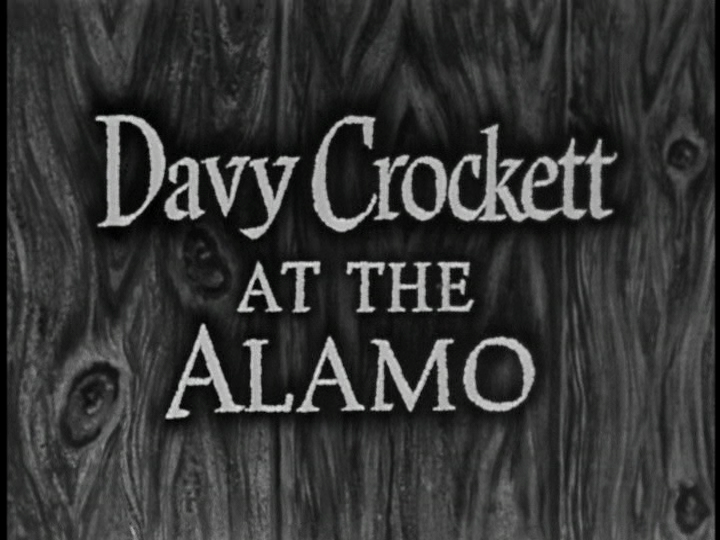
February 23, 1955 – “Davy Crockett at the Alamo” Premieres on ABC
vlcsnap-2013-02-23-09h52m19s150

“During the past season, we’ve presented two stories based on the life of Davy Crockett of Tennessee, a man whose courage, whose humor, and exploits lifted him into the legend class.”

On February 23, 1955, the final episode in the Davy Crockett trilogy, “Davy Crocket at the Alamo,” premiered on ABC in the Disney Anthology series Disneyland. Although this was written as Davy Crockett’s last adventure, two additional episodes were created thanks to the show’s enormous popularity; these final episodes were turned into a full-length feature film. The “Alamo” episode was directed by Norman Foster, and was written by Tom Blackburn. It stars Fess Parker as Davy Crockett, Buddy Ebsen as George Russel, Hans Conreid as Thimblerig, Nick Cravat as Bustedluck, Kenneth Tobey as James Bowie, and Don Megowan as William Travis.

The story begins with Davy and his friend George Russel heading out West “to follow the sun.” On a riverboat, a sly fellow named Mr. Thimblerig is playing pinochle with the travelers. He asks Davy and George to participate in the game. Davy says he doesn’t hold much for gambling, considering it foolish, but he finally consents to play and in the course of the game, he reveals to everyone how Thimblerig has been swindling them all. Thimblerig then realizes he’s been playing Davy Crockett, and ends the game, having been “hoisted on his own petard.” Later that evening, Davy stands on the railing of the boat, telling George of his intentions to head to Texas to help all the settlers in trouble. George is not thrilled with this plan, but he decides to go along with it. As they head downstairs for a drink, Thimblerig drunkenly offers his companionship, and ends up accompanying Davy and George to Texas.
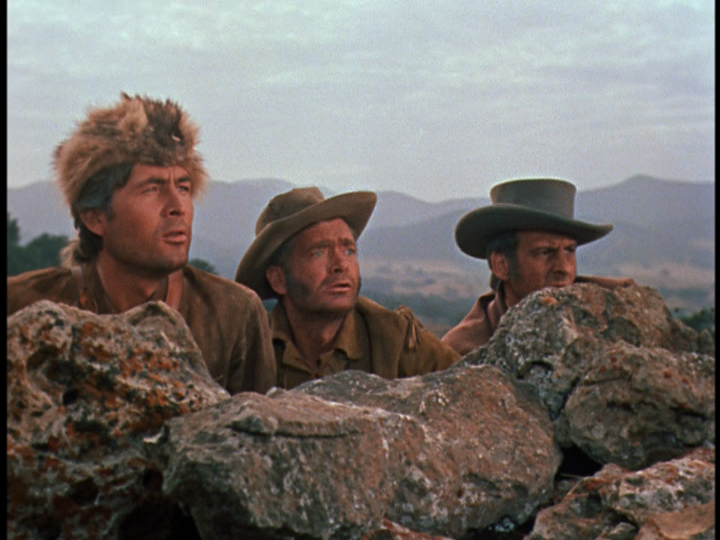
Davy, Georgie, and Thimblerig peer over the rocks carefully to observe their surroundings

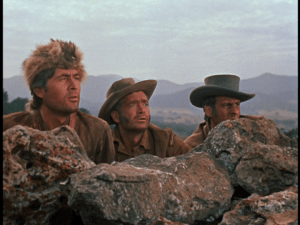
Davy, Georgie, and Thimblerig peer over the rocks carefully to observe their surroundings

As the three arrive in Texas, Davy spots smokesignals in the distance and follows them, although he knows that it could be the dangerous Comanche tribe. The trio peeks over a rock formation to see a Comanche warrior help the buffalo stampede, when the warrior falls off his horse. Crockett tries to help the injured Indian when the warrior pulls a knife on him. Davy and the warrior scuffle, but Davy wins and helps nurse the warrior back to health, nicknaming him “Bustedluck.” Davy then converses with Bustedluck, who offers to lead them to a white settlement as thanks for their help. They pass a small group of Mexicans, who warn Davy and the others that San Antonio has been taken over by Santa Ana, and the Texans have moved to the Alamo, which is surrounded by soldiers. Davy and his men continue to the Alamo anyway, and are soon pursued by Mexican soldiers. The Texans inside the Alamo help protect Davy and his crew until they can get safely inside the fort.

Davy is then sent to meet Jim Bowie, the commander, who is thrilled that Crockett is here, until he realizes that Crockett brought only four men. Davy volunteers to be a courier for more troops, but Bowie tells him that he’s needed there to help at least hold the fort. Colonel Bowie had been injured and with his condition worsening, he relinquishes his command. While Crockett is offered the position, he refuses and gives it up to William Travis, who is second in command to Bowie. Travis gives Crockett and a group of men the south wall to protect, and they watch as a messenger is sent from Santa Ana’s camp. The message says that the men in the Alamo are allowed to surrender on Santa Ana’s terms, or they will be slaughtered. Travis and Davy refuse to surrender, and the battle starts.
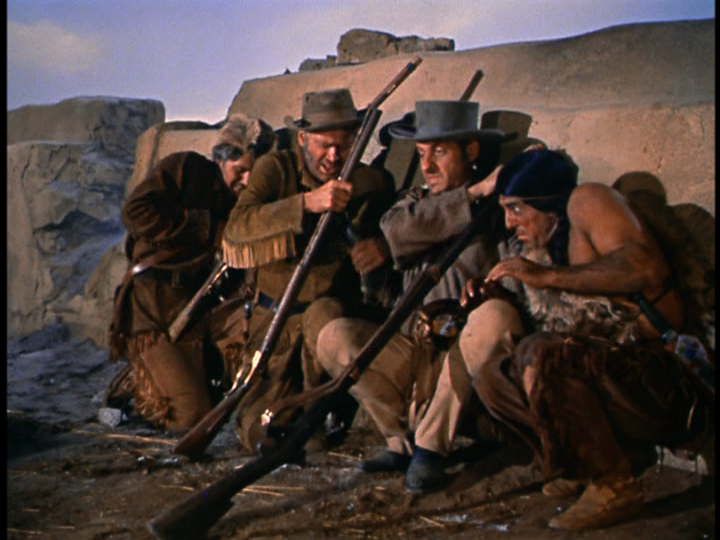
Davy and his crew band together as the Alamo is shelled day and night

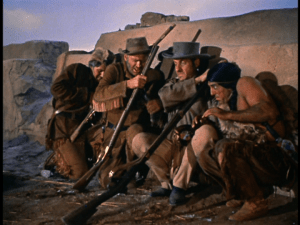
Davy and his crew band together as the Alamo is shelled day and night

The Alamo is shelled all day and night, but after four days there are still no casualties. Late one night, George lets Davy know that they’re almost out of ammunition, and Davy reveals that he’s known that since they got there, only Bowie made him promise not to say anything. George is furious, thinking that Davy couldn’t trust him, and storms away, declaring that it’s now “every man for hisself.” George then goes to Travis, asking to be let out to get more troops from Goliad. George then makes it out, while Davy watches, worrying. A few days later, George makes it back, but arrives with the bad news that Goliad won’t be able to spare any men. Davy has to break the news to the ailing Bowie, who requests to be taken outside to be with his men. Travis breaks the news to the men that they are on their own to protect the Alamo. He then gives the men the option to either stay or leave, and not a single man will leave the Alamo.

One of the lookouts spies Santa Ana’s men sneaking up to the fort, and the final battle begins as those men storm the Alamo. The men in the Alamo are able to hold off the men in the first wave, but it becomes increasingly difficult with each storm of the small building. Bustedluck is the first of Crockett’s men to die, stabbed with a bayonet while protecting Thimblerig. Thimblerig is then shot by the invading troops, as is Travis. George is shot several times, but refuses to go down until he fires the cannon, and Bowie, hidden away in a room, prepares himself with two pistols as the soldiers break in. Davy turns to the dying George, whose last words are “Give ’em what fer, Davy.” Davy fights bravely as the last survivor as the men advance on him, although he is eventually killed in the process. The story ends with the flag waving above the Alamo turning into the flag of the State of Texas.
February 15

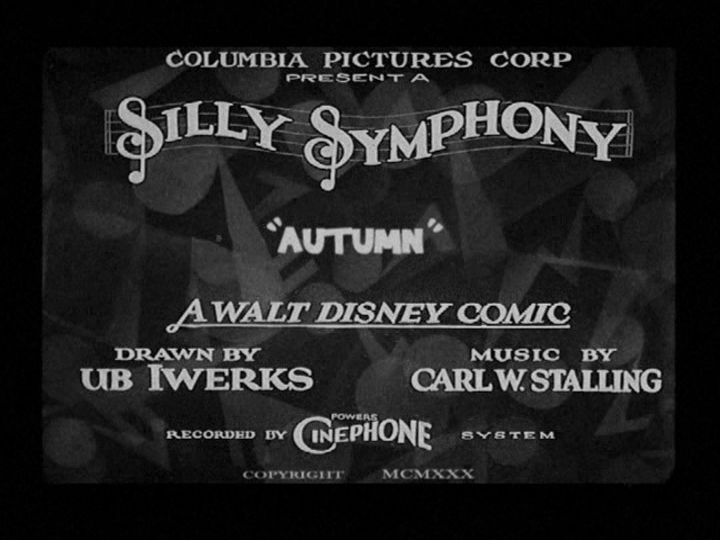
February 15, 1930 – The Silly Symphony Autumn is Released to Theaters

vlcsnap-2013-02-14-21h40m26s208

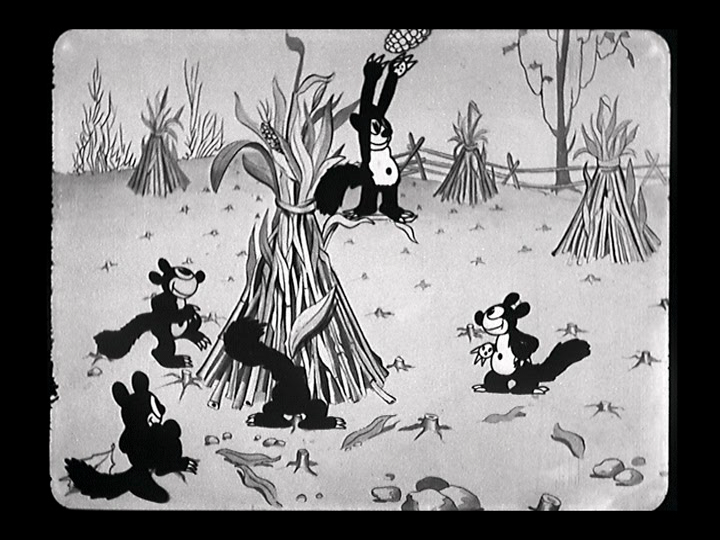
On February 15, 1930, the Silly Symphony Autumn was released to theaters. This short film was part of a series of Silly Symphonies about the seasons: Springtime released in 1929, Summer released in early 1930, and Winter released in late 1930. The short was directed by Ub Iwerks, with music by Carl Stalling.

The short opens with the leaves falling from the trees, and squirrels gathering nuts before the winter approaches. One squirrel is rather upset that he can’t shake the last nut from a tree, but when it does fall, it lands on his head and hits the ground. As he reaches to pick it up, the nut begins to dance around, surprising the squirrel. He slams his paw on it, cracking it open and revealing a caterpillar, who saunters away.

The squirrels continue to gather food, even from the corn nearby

The squirrels continue to gather food, even from the corn nearby

Other squirrels gather corn from the field nearby, one using his teeth to pull out individual kernels. As they continue to pack their food away in the trees, a crow sneaks in and steals some cobs of corn, with the other crows helping to pack their food away in the scarecrow. A skunk tries to pack away a pumpkin for the winter, only to end up smashing it after he tries to shove it into a tree. A porcupine wanders over to an apple tree and collects the fruit on his quills, while beavers build their dams nearby.

A row of ducks swims in the nearby lake, eating worms; one accidentally eats a shoelace and ends up with a boot on his head. As they swim, a cold gust of wind interrupts the scene, bringing about the beginning of winter. The ducks sound the alarm and fly off into the sky as they head for warmer weather, and the other animals take shelter from the coming cold.

February 11

February 11, 1958 – The First Episode of the “Annette” Serial Premieres on the Mickey Mouse Club

vlcsnap-2013-02-10-19h08m52s53

“All I know is the necklace is gone and that McCleod girl was the only one left in this room when we went out to supper!”

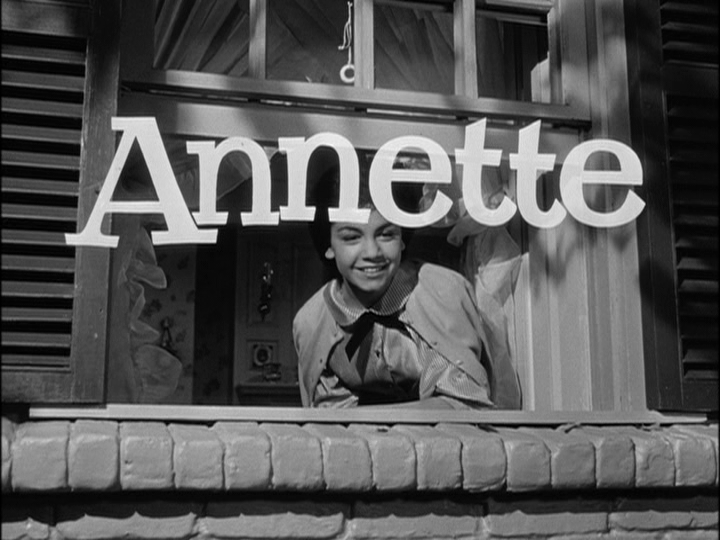
On February 11, 1958, the first episode of the “Annette” serial premiered on the Mickey Mouse Club. The serial was based on the novel Margaret by Janette Sebring Lowrey (known for Pokey Little Puppy), and was adapted by Lillie Hayward. It was renamed “Annette” to capitalize on the popularity of Annette Funicello, who played the lead role. The serial was filmed on the Walt Disney Studio lot; the animation studio served as the front of the high school. The serial was directed by Charles Lamont, and stars Tim Considine as Steve, David Stollery as Mike, Roberta Shore as Laura, Richard Deacon as Dr. McCleod, Sylvia Field as Lila McCleod, Mary Wickes as Katie, and Judy Nugent as Jet.

The first episode, entitled “An Introduction,” has the McCleod housekeeper, Katie, introducing the story of Annette and how she came to stay with the McCleods. Dr. McCleod lives with his sister, Lila, and they both are surprised one morning when their niece, Annette, arrives from Ashford, Nebraska. Katie explains that the McCleods had no idea that they even had a niece, as they had lost touch with their brother years ago. Although Dr. McCleod wasn’t too sure about having Annette stay with them, as neither he nor Lila knew anything about raising children, he changed his mind and allowed her to stay instead of shipping her off to boarding school.

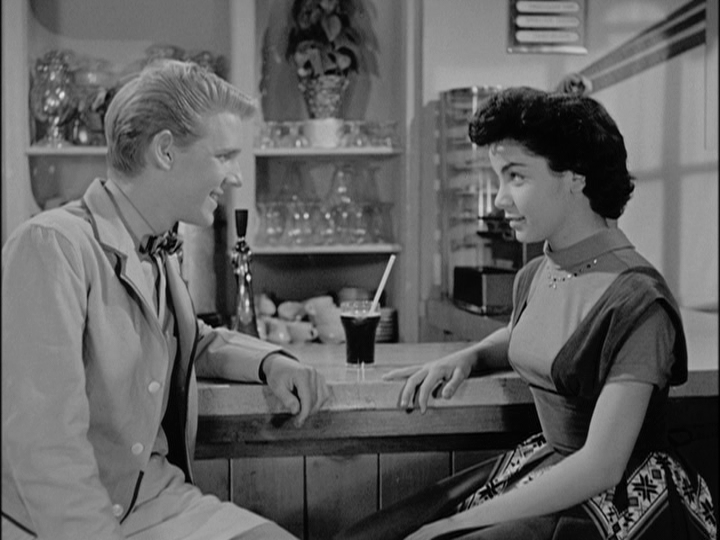
Annette makes a friend in Mike, who works at the malt shop

Annette makes a friend in Mike, who works at the malt shop

As she settles in, Annette begins to meet people and make friends in the town. She had met Stephen Abernathy, the most popular boy in town, as she was on her way to the McCleods and asked him for directions to the house. Annette makes a friend in neighbor girl Jet, who provides the McCleods’ food from her family’s farm. When Lila takes Annette shopping, they meet Mrs. Abernathy, Lila’s best friend, and Mrs. Abernathy’s daughter, Val. Mrs. Abernathy invites Annette to Val’s party so she can meet other kids her age. Although Mrs. Abernathy decides to send Stephen to pick Annette up for the party, Stephen already has a date with his girlfriend, Laura, so she sends another boy named Olmstead Ware, who is nowhere near as polite as Stephen, and cares more about food than anything else in life. He asks Annette to swing by the malt shop, where they meet Mike, who becomes one of her closest friends.

The party is a success, until Laura’s necklace goes missing, and she immediately blames Annette for its disappearance, but Annette had left the party before the necklace had disappeared. Even at school, Laura continued to spread the rumor that Annette stole the necklace, partly because she was jealous of Annette being the new girl in town. Annette, hurt by the continuing attacks, decides to run away back to Nebraska. Katie then stops the story there, saying that she can’t reveal any more, but hopes that everyone will tune in again to find out what happens.

January 7

January 7, 1931 – The Mickey Mouse Short Film The Birthday Party is Released to Theaters

vlcsnap-2013-01-06-19h52m25s167

“Oh I’m fine. Heh, we’re both fine!”

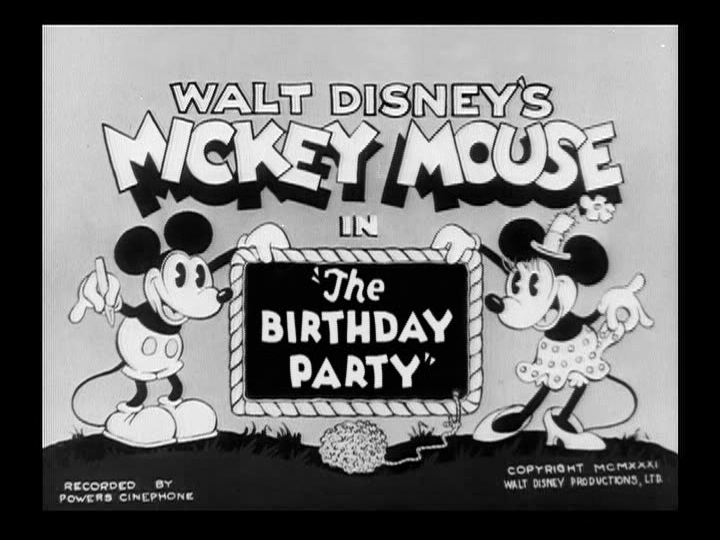
On January 7, 1931, the Mickey Mouse short film The Birthday Party was released to theaters. This short is a good example of the characters that were considered an early version of the Disney gang, including Horace Horsecollar and Clarabelle Cow. The short was directed by Burt Gillett, and stars Walt Disney as Mickey Mouse and Marcellite Garner as Minnie Mouse.

Mickey strolls down the street with a straw hat and cane, whistling a merry tune. He arrives at the front porch of Minnie’s house and rings the doorbell; inside, Minnie and several of their friends are inside waiting to surprise him. They run and hide in the house, and Minnie answers the door, engaging in some flirtatious banter with Mickey. Once he steps inside, all of their friends emerge to shout out “surprise!” A cake is brought out and Mickey is asked to blow out the candles, only to blow the cake all over the chef.

After receiving a piano as his birthday gift, Mickey and Minnie play a duet for their party guests

After receiving a piano as his birthday gift, Mickey and Minnie play a duet for their party guests

Minnie calls Mickey over to a big package marked “Happy Birthday Mickey.” He opens it to reveal his own piano and stool. As it is set up right next to Minnie’s, the two begin to play a piano duet and sing along. A dance party begins, with everyone being merry, including the fish in the fishbowl. Mickey and Minnie take a break from piano to dance, much to the enjoyment of the other guests. Horace Horsecollar and Clarabelle Cow also dance for the crowd before Mickey begins to play a tune on a nearby xylophone. Minnie resumes the piano as Mickey plays another xylophone tune, with the xylophone acting of its own accord at one point, taking Mickey for a ride around the room. It bucks him, and as he hits the floor, a floorboard knocks a fishbowl down from its pedestal, landing on Mickey’s head.

December 31

December 31, 1918 – Actress and Disney Legend Virginia Davis is Born

vlcsnap-2012-12-31-08h01m51s156

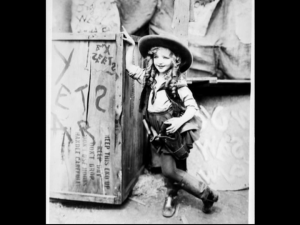
“One of my favorite pictures was Alice’s Wild West Show. I was always the kid with the curls, but I was really a tomboy, and that picture allowed me to act tough. I took great joy in that.”

On December 31, 1918, actress Virginia Davis was born in Kansas City, Missouri. Starting at the tender age of two, Davis began taking acting and dance lessons, and began starring in advertisements at age three. A young Walt Disney discovered Davis in an advertisement for Warneke’s Bread, and talked Davis’ mother into letting Davis star in a series of short films featuring a live-action girl in a cartoon world. She shot the pilot film, called Alice’s Wonderland. After the Laugh-O-Gram studio failed and Disney moved to Los Angeles, he called the Davis family and convinced them to move to California, and Davis continued to star in the Alice comedies for 13 more films. She did audition for voices in Snow White and the Seven Dwarfs and Pinocchio, but was not hired.

After her work at Disney, Davis continued to act in films, including Three on a Match and The Harvey Girls. She earned a degree from the New York School of Interior Design, and later had a successful career as a real estate agent. She has continued to make appearances at special Disney events, including Disneyana events at the parks. Davis was honored as a Disney Legend in 1988, being considered Walt’s first star. She passed away at the age of 90 in 2009.

December 28

December 28, 2011 – Bambi and A Computer Animated Hand are Inducted Into the National Film Registry

Image credit: wikipedia

Image credit: wikipedia

“…culturally, historically, or aesthetically significant.”

On December 28, 2011, the new inductees into the National Film Registry were announced, which included the 1942 Disney animated feature Bambi and one of the earliest examples of computer animation by Ed Catmull (now co-founder of Pixar and President of Pixar and Disney Animation Studios), A Computer Animated Hand. Bambi was recognized not only as one of Walt Disney’s favorites, but also for its “eloquent message of nature conservation.” A Computer Animated Film has been considered revolutionary in combining the science of the computer and the art of animation, showing the potential of both. The film, and Catmull especially, were recognized for working out “the concepts that become the foundation for computer graphics that followed.”

December 15

December 15, 1925 – The Alice Comedy Alice in the Jungle Premieres

vlcsnap-2012-12-15-10h00m31s125

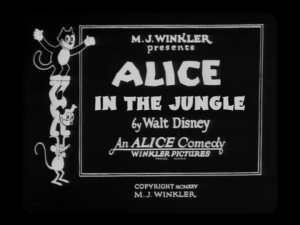
On December 15, 1925, the Alice Comedy Alice in the Jungle premiered in theaters. As of now, it one of the few comedies released on DVD for the public, although the Alice Comedies are now in the public domain. The short was directed and produced by Walt Disney, and stars Virginia Davis as Alice.

The short begins with Alice riding on the back of an elephant, holding a shotgun. Her friend Julius spies something and whistles for a bird, who carries him around to spy on the land from above. The bird becomes annoyed with Julius’ antics and kicks him off right over a pool filled with alligators. Luckily, Julius manages to remain uneaten, but is soon attacked by another alligator on shore, who eats his tail. He does manage to retrieve his tail before heading back to Alice.

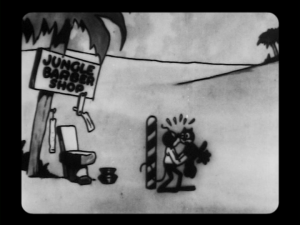
The barber thanks Julius profusely for his help in reacquiring a barber pole

The barber thanks Julius profusely for his help in reacquiring a barber pole

Two elephants are running around the jungle, dancing and skipping, before they pull the swimsuits out of their “trunks,” and go for a swim in a nearby pool. One of the two climbs a tree to go for a dive, with the other one draining the pool of its water, so as to play a mean prank on their friend. The scene then moves over to the jungle barber shop, with a hippo eating the barber’s striped pole, thinking it to be a candy cane. The barber breaks down in tears before Julius happens to stumble on the situation. The barber explains to Julius what happened, and Julius, spying a nearby tiger, has a plan. He covers the tiger’s tail in starch and wakes it up. The tiger runs away startles, accidentally knocking off its own tail. The barber is overjoyed when he sees the replacement pole.

Alice is then seen chasing a bear, who keeps hitting her with his slingshot. She follows him into a dark cave, but is soon chased out by a lion. She screams for help, and her cry finds Julius, who comes to her rescue. Although he saves her from one lion, a whole herd of them begin to chase Alice and Julius, with the two making their escape on the back of their elephant.

December 9

December 9, 1931 – The Mickey Mouse Short Film Mickey’s Orphans Premieres in Theaters

vlcsnap-2012-12-08-19h09m26s218

“Aw, isn’t it adorable?”

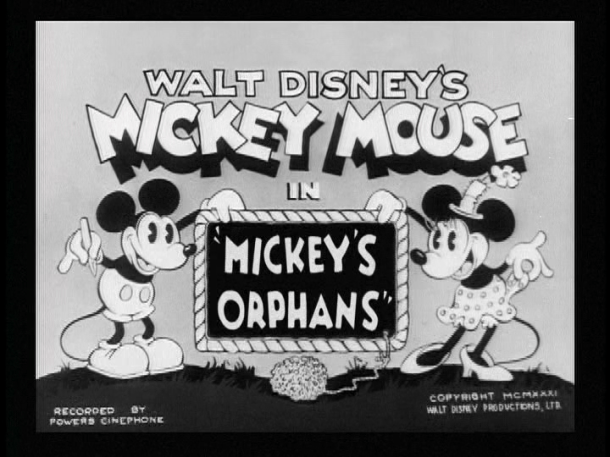
On December 9, 1931, the Mickey Mouse short film Mickey’s Orphans premiered in theaters. It was the first Disney cartoon with a Christmas theme, and was nominated for an Academy Award for Best Animated Short Film, but lost out to Disney’s Flowers and Trees. The short was directed by Burt Gillett, and stars Walt Disney as Mickey and Marcellite Garner as Minnie.

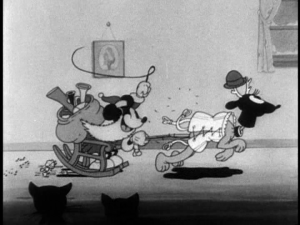
A mysterious figure trudges through the snow carrying a large covered basket as the carol “Silent Night” is heard in the background. The figure stops at a window of a nearby house and sees Minnie and Mickey preparing for Christmas. The figure leaves the basket on the doorstep and departs. Pluto brings the basket inside and pulls the blanket off to reveal a multitude of orphan kittens, who proceed to explore their new surroundings. Mickey and Minnie take to the kittens, but Pluto is rather suspicious of these invaders.

To entertain the kittens, Mickey and Pluto dress like Santa and a reindeer

To entertain the kittens, Mickey and Pluto dress like Santa and a reindeer

The kittens begin to wreak havoc on the house, pulling on Pluto’s ears and tail, and playing with the hanging light fixtures. Dismayed, Minnie suddenly comes up with an idea that Mickey and Pluto set in motion: Mickey plays Santa Clause to the kittens and Pluto plays the reindeer. The kittens are thrilled with their gifts, and parade around the house like a marching band playing a tune. Some kittens, who received saws and other tools, begin tearing the house apart. They continue to play pranks on Mickey and Pluto, until Minnie reveals the large decorated Christmas tree – which the mischievous kittens proceed to take apart.