RSS Feed

Tag Archives: Academy Award winning

January 5

January 5, 1935 – The Silly Symphony The Tortoise and the Hare is Released to Theaters

vlcsnap-2014-01-05-11h00m53s146

“You don’t talk tootin’, cutie. I’m the very best there is!”

On January 5, 1935, the Silly Symphony The Tortoise and the Hare was released to theaters. It was based on the Aesop fable Hare and the Tortoise. The short won the Academy Award for Best Cartoon in 1934, winning against Columbia’s Holiday Land and Universal’s Jolly Little Elves. It was released as an educational film in 1986, retitled Aesop’s Hare and the Tortoise, with an overview done by Walt Disney from an episode of Disneyland. A sequel to this short was also released in 1936, entitled Toby Tortois Returns. The short was directed by Wilfred Jackson.

The short begins on race day, with everyone turning out to see the big race between Toby Tortoise and Max Hare. Max steps out meet the cheering crowd, while Toby is greeted by laughs. Toby greets Max with a friendly “may the best man win,” with Max replying that of course he will, but promises not to beat Toby too badly. The official starts the race, and Max takes off with a shot, while Toby is still at the starting line. As Max runs by so fast that trees are pulled out from their roots, he stops when he sees Toby galloping slowly with some snails. Max decides to “take a nap” while Toby continues his pace, and when Toby sees the sleeping Hare, he tries to use the situation to his advantage. Max then gets up and speeds past Toby once again.

Max stops racing so he can chat up some girls from the local girls' school

Max stops racing so he can chat up some girls from the local girls’ school

Max stops once he sees the girls of Miss Cottontail’s Girls’ School, thinking that he has plenty of time to chat with the young ladies. The girls see Toby galloping by, and try to stop him to talk. Toby refuses to stop, as he has a race to run. As Toby continues, Max stays with the girls to off his speed skills. Suddenly, a cheer rings out, and Max realizes that he needs to hurry to catch up to Toby. Toby sees Max running full speed and picks up his pace. It’s a fight to the finish, and Toby manages to win in the end. The crowd cheers for Toby and carries them on his shoulders as the victor.

November 10

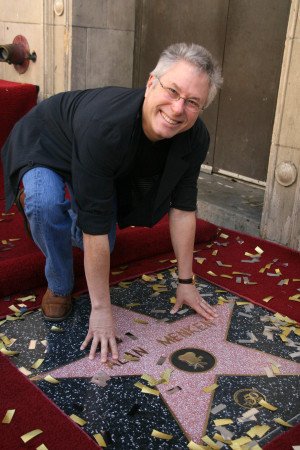
November 10, 2010 – Alan Menken is Awarded a Star of the Hollywood Walk of Fame

at the Alan Menken Hollywood Walk of Fame Star Ceremony, El Capitan Theater, Hollywood, CA. 11-10-10

“Back then there was a genuine outreach on the part of Disney…to work with theater people. I didn’t know it at the time, but Michael Eisner was a theater major in college.”

On November 10, 2010, composer and pianist Alan Menken was awarded a star on the Hollywood Walk of Fame. Through his work with Disney starting in the late 1980s, Menken has been awarded eight Academy Awards, with 18 overall nominations, as well as 10 Grammy awards. His star is placed near the Disney owned El Capitan Theater on Hollywood Boulevard. As his award was well-timed with the release of the Disney film Tangled, voice of Rapunzel Mandy Moore was on hand at the ceremony, as was Richard Sherman, well-known Disney composer and songwriter.

October 18

October 18, 1990 – The 1990 Class of Disney Legends are Inducted

Legends02

“Any mechanical things you had to do, what you said was, ‘Call Roger, he’ll know how to fix it.’ Without [Roger Broggie], Disneyland wouldn’t have happened.” – Michael Eisner, then CEO of the Walt Disney Company

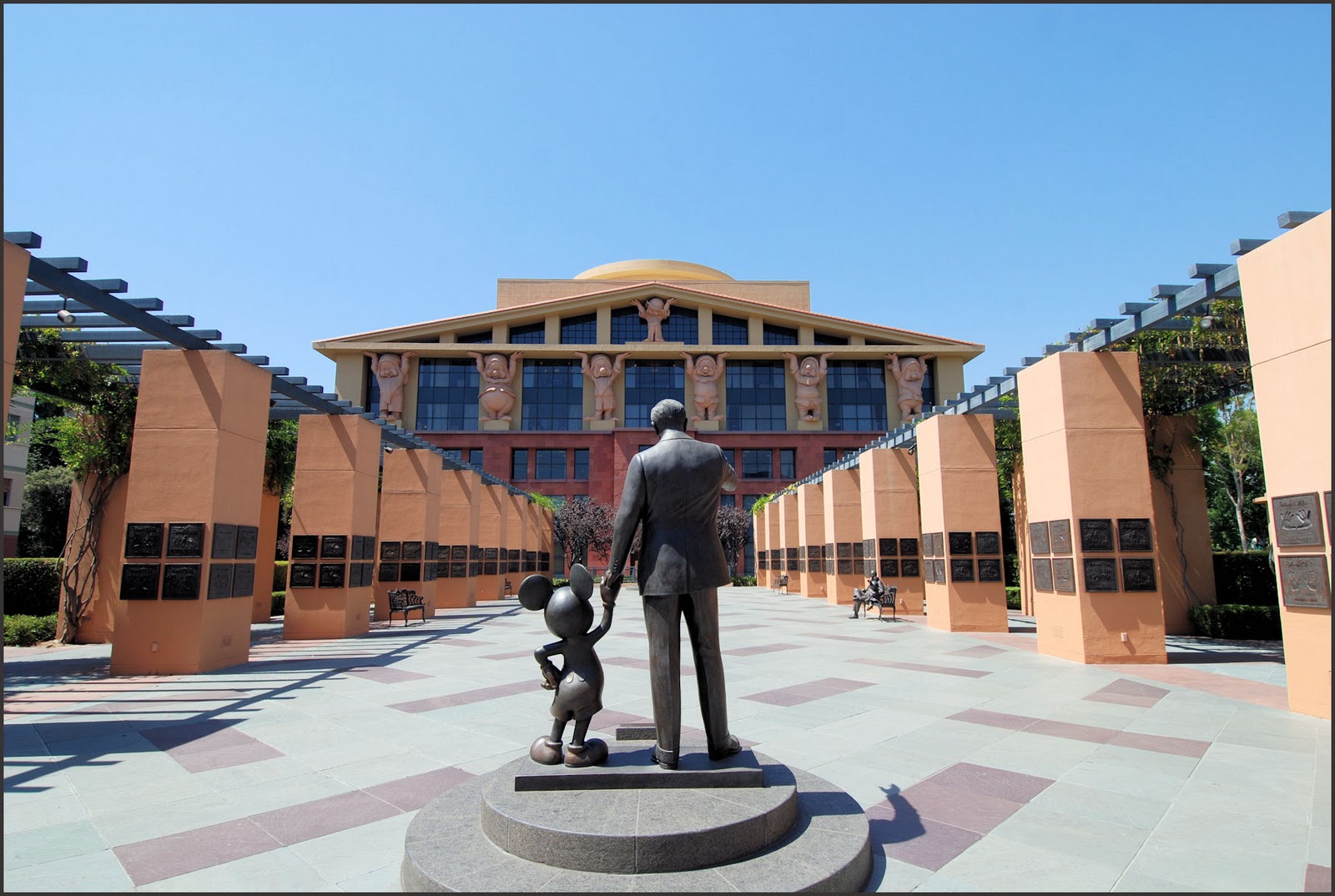
On October 18, 1990, the new 1990 class of Disney Legends were inducted at the special ceremony at the Disney Legends Promenade. Among those inducted were Roger Broggie (Imagineering), Joe Fowler (Attractions), John Hench (Animation and Imagineering), Richard Irvine (Imagineering), Herb Ryman (Imagineering), and Richard and Robert Sherman (Music). Irvine and Ryman were the only ones awarded posthumously; since the ceremony, Broggie, Fowler, Hench, and Robert Sherman have passed away. Broggie was known as Disney’s original Imagineer, beginning work in 1939 at the company as a precision machinist. Fowler, a retired ship builder, was invited personally by Walt Disney to lead construction of Disneyland. Hench began at Disney as a sketch artist in 1939, and moved to the Imagineering department in 1954; he was also awarded an Academy Award for his special effects work on the live-action film 20,000 Leagues Under the Sea, and was Mickey Mouse’s official portrait artist. Irvine helped create what is now known as Walt Disney Imagineering, creating leading a team of Imagineers to create Disneyland. Ryman created the preliminary sketches of the park, and was able to turn Walt Disney’s ideas into drawings from which the Imagineers could work. The Sherman Brothers were well known for creating some of the most memorable songs for Disney films, and are best known for their work on the classic film Mary Poppins.

September 20

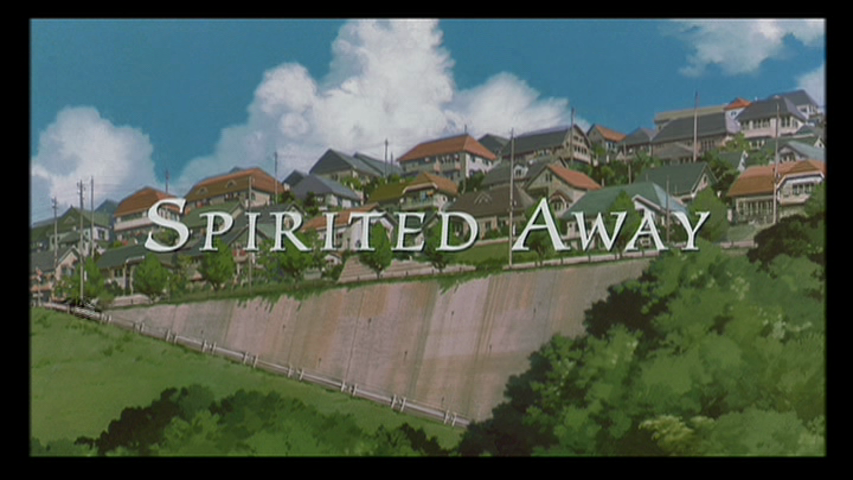
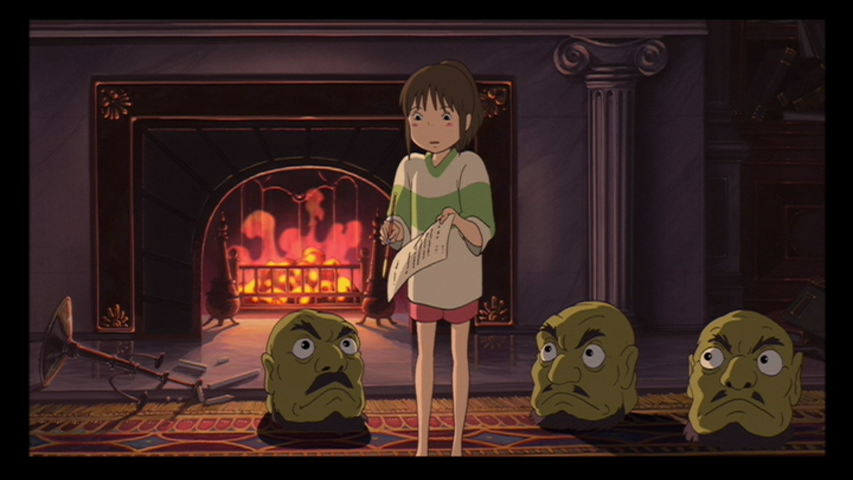
September 20, 2002 – The Studio Ghibli Film Spirited Away is Given a Limited Release in the United States
vlcsnap-2013-09-19-17h04m50s65

“Why should I hire you? Anyone can see you’re a lazy, spoiled crybaby, stupid to boot! I’ve nothing for you – forget it!”

On September 20, 2002, the Studio Ghibli film Spirited Away (known in the original Japanese as 千と千尋の神隠し) was released in the United States in a limited amount of theaters, with a general release on September 27, 2002. The film was written by director Hayao Miyazaki, who was inspired by a friend’s ten-year-old daughter, wishing to write for her a character she could look up to. Disney asked Pixar’s John Lasseter, a fan of Miyazaki’s work, to oversee the English-language version of the film. The film became the most successful film in Japanese history, grossing over $229,000,000 in the Japanese box office. It would go on to win the Academy Award for Best Animated Feature at the 75th Academy Awards; its success helped solidify the popularity of Studio Ghibli films within the United States, with Disney internationally distributing most of the studio’s library.

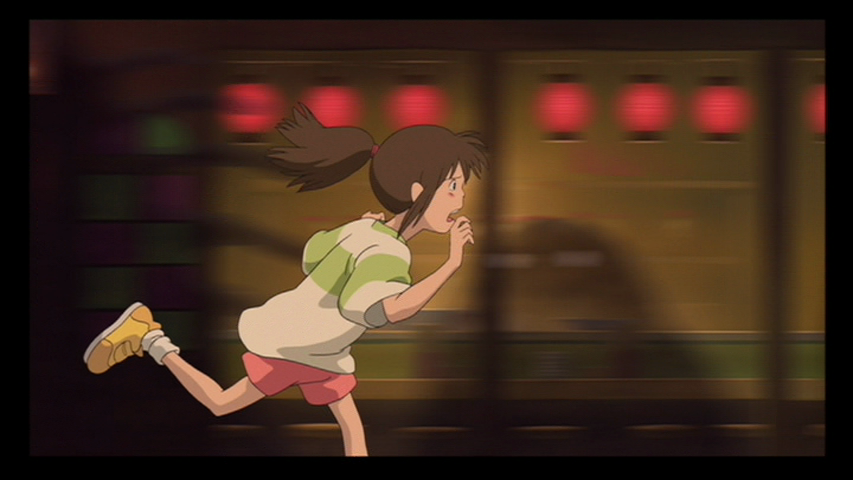
The film begins with ten-year-old Chihiro sulking in the backseat as she and her parents drive to their new home. Chihiro hates the move, and doesn’t hesitate to let her parents know. They end up lost on a back road, and Chihiro notices a rather strange stone outside. They come across a dilapidated old building, and although Chihiro doesn’t want to explore, her parents let their curiosity get the best of them. Not wanting to be left alone, she follows them. Her father thinks it’s only an abandoned theme park, but Chihiro still has a bad feeling about the place. Her parents then smell something delicious, and discover a delectable feast. Chihiro refuses to eat, but her parents dig right in. Feeling something isn’t right, Chihiro looks around the buildings, and notices black smoke from the chimney of what appears to be a bath house. She comes across a boy on the bridge, who warns her to escape before it gets dark. As she runs back to her parents, she is shocked to find that they have turned into pigs.
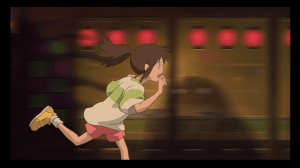
Chihiro runs through the bathhouse, looking for her parents, unable to believe they have been turned into pigs

Chihiro runs through the bathhouse, looking for her parents, unable to believe they have been turned into pigs

Chihiro runs around the bathhouse, and finds she is trapped at the bathhouse, as the nearest town is now far away across a river. As she moans to herself that she must be dreaming, she finds herself disappearing. She then sees several spirits making their way to the bathhouse from a ferry-boat and, frightened, she runs away. She is soon found by the boy from the bridge, who has her eat something so she won’t disappear, assuring her that she will not turn into a pig. He then protects her from a strange bird flying overhead, and takes her through several back passageways until they reach the bridge. He warns her not to breath as they cross the bridge, otherwise the spell keeping her invisible will wear off. A frog leaps into the boy’s face, and Chihiro lets out a breath of surprise, revealing herself. The boy, named Haku, continues to protect her, but gives her directions to go to the boiler room to find Kamaji and ask him for work, so she can stay and save her parents. Once she has work, the witch that runs his world will not be able to harm her.

Although frightened, Chihiro follows Haku’s instructions, ending up at Kamaji’s boiler room. When she asks him for a job, he first ignores her, then tells her that he doesn’t need any more help than the susuwatari that work for him. She assists one of the susuwatari by taking his piece of coal to the furnace, causing the rest of the susuwatari to pretend that they can’t carry their coal, wanting Chihiro to do their jobs. Kamaji then tells her that there is no work for her, just as a girl named Lin enters. As she panics upon seeing Chihiro, Kamaji tells her that Chihiro is his granddaughter. He convinces Lin to take Chihiro to Yubaba for a job, which Lin does begrudgingly. Lin then protects her from a suspicious attendant, leaving Chihiro to travel to Yubaba alone with a strange spirit. At first, Yubaba refuses to let Chihiro work at the bathhouse. She tries to find out who helped her, but Chihiro keeps demanding that she should be given a job. Yubaba then taunts her, but Chihiro tries to remain calm, even thought they are interrupted by a rather large baby.
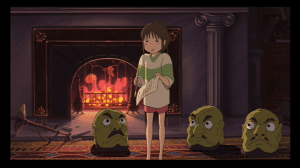
Chihiro, after her persistent asking, is given a contract by Yubaba

Chihiro, after her persistent asking, is given a contract by Yubaba

Yubaba then agrees to give Chihiro a job as she tried to calm the baby down, and gives Chihiro a contract to sign. Yubaba then takes Chihiro’s name, leaving her as just “Sen.” She calls for Haku, who is tasked to take care of her. As she tries to talk to him, he answers her coldly, telling her to call him “Master Haku.” Haku then calls out to Lin to take care of her, as no one wants to work with a human. In private, Lin reveals that she’s actually a kind person who is happy that Chihiro was able to make it past Yubaba. Lin warns Chihiro to stay away from Haku, as he is Yubaba’s henchman. The next morning, Haku sneaks into the room where Chihiro stays with the other women and tells her to meet him at the bridge, as he will show her where her mom and dad are. As she runs to the bridge, she comes across a strange spirit that seems to be watching her. Haku then meets her and takes her to the pig pen, and she starts to cry after seeing them. As she sits outside, he gives her her old clothes, with the farewell card her friend gave her. Haku tells her that Yubaba controls others by stealing their names, and she needs to remember her real name if she wishes to leave, but must keep it a secret. Haku no longer remembers his real name, but he strangely remembers hers. He kindly offers her food that will help her regain her strength, but she still starts to cry as she realizes what kind of situation she has found herself in. She heads back to her residence and hides her clothes, unaware that the strange spirit from before has followed her.

Work begins for the night, and Chihiro works as hard as she can, although she is given rather challenging tasks. She meets the spirit that’s been following her and leaves the door open for it. Chihiro and Lin are sent to scrub the big tub, which hasn’t been cleaned in ages. Meanwhile, Yubaba senses a spirit coming that she can only call “scum.” As she tries to get a tab for her bath, the foreman refuses her, but the spirit she let in kindly gives it to her. He appears a few minutes later with more tabs, although she refuses them, making him sad. Yubaba is then alerted that a Stink God is at the gate and, while she can’t refuse the customer, she wants to rush it out as soon as possible. Chihiro is then given the job to attend to it, although she struggles due to its stench. The god enters the bath, but needs another tab to clean itself. As Yubaba watches, Chihiro successfully cleans the god, revealing it to be not a Stink God, but a River God. Chihiro then earns the respect of Yubaba and the staff, thanks to her actions.
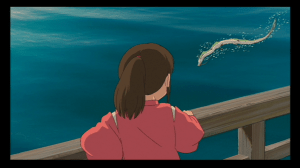
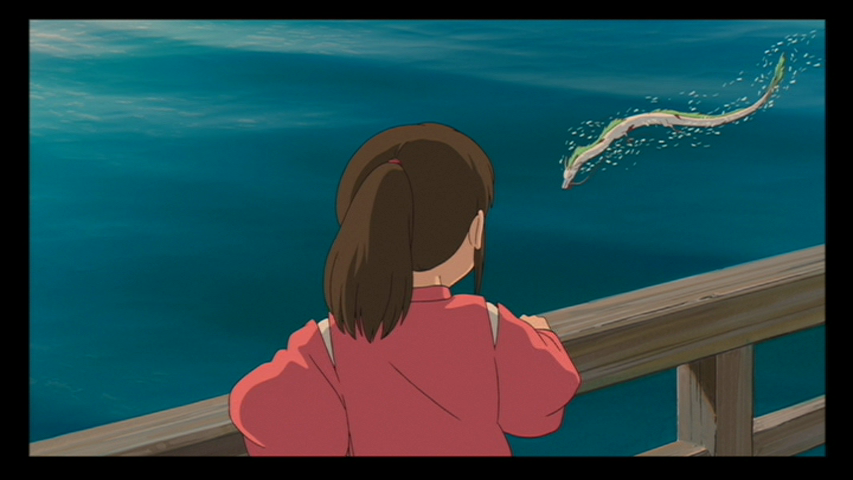
Chihiro sees Haku getting attacked by the paper birds

Chihiro sees Haku getting attacked by the paper birds

Late that night, the spirit, called No-Face, tempts a frog worker with gold before swallowing him. He then demands to be treated like a customer, using the frog’s voice to speak. He pays everyone with gold he created, and everyone rushes to keep him happy, so long as he gives them gold. Chihiro, however, is the only one not tempted by the gold, and stays in her room. She spies a dragon being attacked by several paper birds, and calls out to him, realizing that the dragon is Haku. The paper birds fly away when Haku crashes into her room, and while she wants to care for his injuries, he flies out to find Yubaba. Chihiro then rushes off to stop him, but is interrupted by No-Face, who offers her a large amount of gold. She refuses him, and No-Face is saddened by this. Angered, he starts eating employees. Meanwhile, Chihiro continues her search for Haku, and breaks into Yubaba’s residence. She then comes across Yubaba’s rather large baby, who threatens to scream and break her arm if she doesn’t play with him. One of the paper birds, which had attached itself to Chihiro, starts talking, mocking the baby. It is then revealed to be Yubaba’s twin sister, Zeniba, who turns the baby into a mouse, and Yubaba’s bird into an insect. She then demands to take Haku to kill him for stealing a magic seal from her, but Chihiro refuses to move.

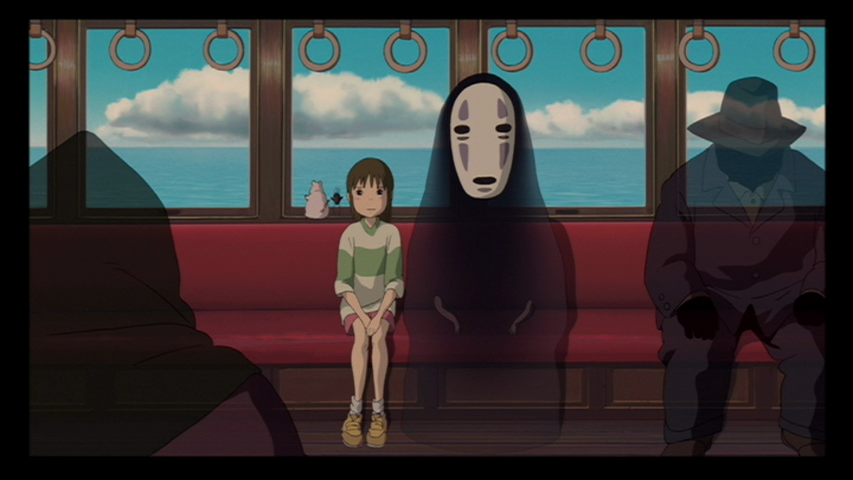
Haku wakes, breaks the spell that Zeniba cast to appear, and falls down a trap door, taking Chihiro with him. He regains consciousness enough to escape, flying into the boiler room. Chihiro then uses an emetic dumpling she received from the River God to free the seal from inside Haku, which is slowly killing him. The seal is spat out, and Haku is returned to human form, although he is once again unconscious. Kamaji then looks after Haku as Chihiro goes to return the seal to Zeniba. He gives Chihiro a train ticket to help her get to Zeniba’s, although she will have to walk back. As Chihiro looks for Yubaba, No-Face is tearing the place apart, wanting to see Chihiro. He tries to offer Chihiro anything she wants, but she refuses, telling him he should go back to where he came. He tells her that he is really lonely, and demands that she take the old. She gives him the other half of the emetic dumpling, and he releases everyone he ever swallowed. He follows her to the train, once again his silent, semi-transparent self. They all board the train and head to Zeniba’s.
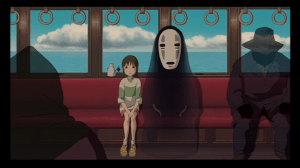
Chihiro and her friends sit on the long journey to Zeniba's

Chihiro and her friends sit on the long journey to Zeniba’s

Haku wakes up later that evening, and asks Kamaji where Chihiro is, and what happened, as he doesn’t remember anything, other than Chihiro calling out for him in the darkness. He then goes to Yubaba, asking if she still hasn’t noticed that she’s lost something precious. She finally realizes that her baby is longer with her, and the gold is just sand. She panics, looking for her baby, and angrily demands that Haku tell her where he is. When she finds that he’s with Zeniba, she sits down in dismay. Haku agrees to get the baby back, but only if she allows Chihiro and her parents to be sent back to their world. Meanwhile, Chihiro and her friends arrive at Zeniba’s, and are greeted by a lamppost that will show them the way. Inside, Zeniba proves to be a kindly witch, but sadly tells Chihiro that she can’t help her, and she will have to do it on her own. When Chihiro tells Zeniba she must go back, she provides Chihiro with a magic hairtie that will protect her. Haku then appears at Zeniba’s, and Zeniba forgives Haku, making him promise to protect her. She then keeps No-Face as her helper as she flies away on Haku’s back. Suddenly, Chihiro has a flashback to when she was little and nearly drowned in a river. She was rescued by Haku, the spirit of the river, and reveals his true name to be Kohaku. He turns back into human form, and thanks her for saving him by giving him back his real name.

They arrive back at the bathhouse, and Yubaba tricks Chihiro again, as Chihiro must guess which pigs are her parents in order to break the spell. Chihiro correctly answers that her parents aren’t there, and the contract is broken, freeing Chihiro and her family. Haku takes her back to her parents, but he can’t take her further than the gate, but he promises they will meet again, although she must not look back when she goes through the tunnel back to her world. Her parents act like nothing has happened, and Chihiro quickly makes her way back, resisting the urge to look back. Chihiro joins her parents as they set off for the new house.

August 15

August 15, 1901 – Lyricist and Disney Legend Ned Washington is Born

vlcsnap-2013-08-15-04h02m39s76

“[Washington] would win an Academy Award not just for ‘When You Wish Upon a Star,’ and for the score, but he won another Academy Award for another song he wrote in 1952…so he really is someone who, historically, is very much associated with very popular song.” – Daniel Goldmark, Music Professor at Case Western Reserve University

On August 15, 1901, Ned Washington was born in Scranton, Pennsylvania. He joined the Disney Studios in 1938, writing songs for the animated feature films Pinocchio, Saludos Amigos, and Dumbo. Washington was awarded two Academy Awards for Pinocchio, one for Best Original Song for “When You Wish Upon a Star,” and the other for Best Original Score. Washington was also nominated for the Academy Award for Best Original Song for “Baby Mine” from Dumbo. Washington left the Disney Studios in 1940. Over the course of his career, Washington was nominated for eleven Academy Awards, winning once more for his song “High Noon (Do Not Forsake Me, Oh My Darlin’)” from the 1952 film High Noon. Washington passed away in 1976. He was named a Disney Legend in 2001.

August 6

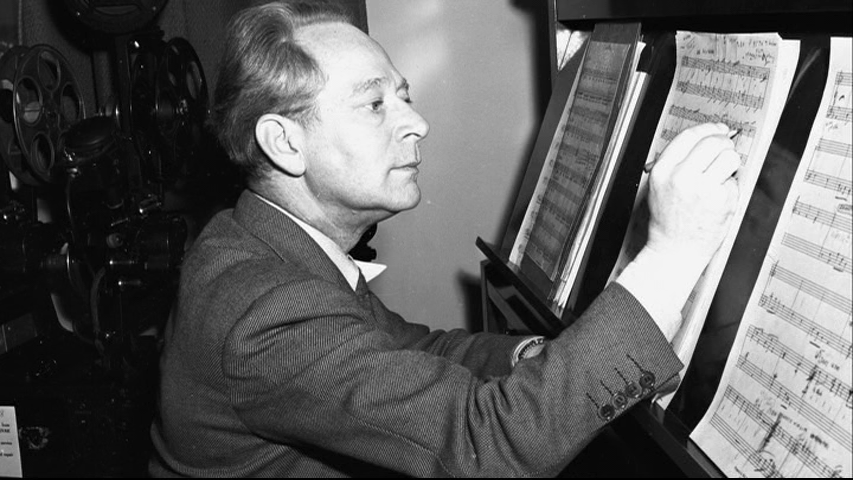
August 6, 1887 – Composer and Disney Legend Oliver Wallace is Born

vlcsnap-2013-08-06-19h53m54s164

On August 6, 1887, Oliver George Wallace was born in London, England. In 1904, he moved to the United States and started work as a conductor in theaters and as an organist for silent films. In 1936, Wallace was hired by the Disney Studios and composed more than 100 short films, which included the 1942 Donald Duck short Der Fuehrer’s Face. Wallace would also work on several of Disney’s animated films, winning an Academy Award for Dumbo, along with Frank Churchill. Wallace would also compose for Fun and Fancy Free, The Adventures of Ichabod and Mr. Toad, Cinderella, Alice in Wonderland, and Peter Pan. After the studio moved into live-action feature films, Wallace would work on scoring several of these, including Darby O’Gill and the Little People; Wallace would also move into scoring several of the True Life Adventures documentaries. He continued to work until his death in 1963. Wallace was named a Disney Legend in 2008.

August 2

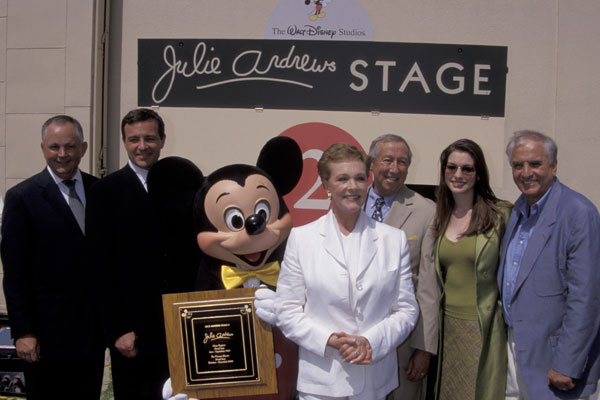
August 2, 2001 – Stage 2 of the Walt Disney Studios is Dedicated as the Julie Andrews Stage

mq_003

“I’m so pleased to be here today as we honor Julie, our great friend and family member, in a very special way.” – Roy E. Disney

On August 2, 2001, Stage 2 of the Walt Disney Studios was dedicated as the Julie Andrews Stage in a special ceremony. The stage itself, opening in April of 1949, is the second oldest stage on the studio lot, and one of the largest in the Los Angeles area. It has served many purposes, from filming of The Mickey Mouse Club, to hosting the building of Disneyland attractions. Two of Andrews’ films were filmed on this stage: Mary Poppins and The Princess Diaries. Attending the ceremony to honor Andrews were Roy Disney, Chairman of the Walt Disney Motion Pictures Group Richard Cook, director of The Princess Diaries Gary Marshall and its star Anne Hathaway, Dick Van Dyke, and Richard Sherman of the Sherman Brothers songwriting team.

July 22

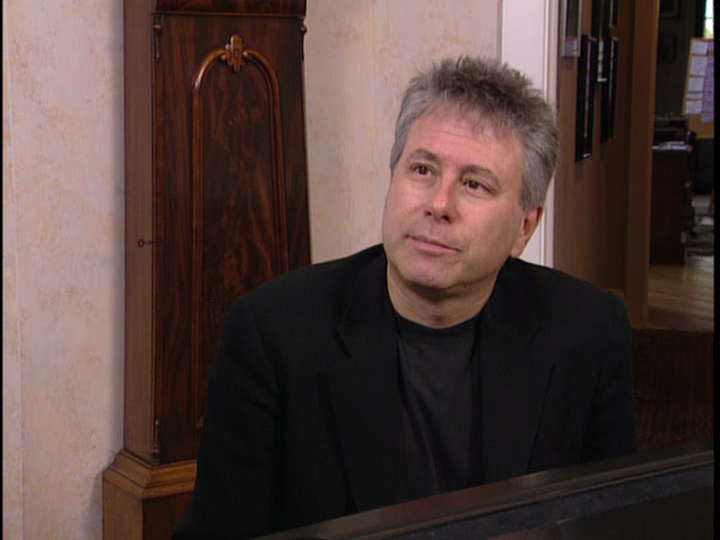
July 22, 1949 – Film Composer, Songwriter, and Disney Legend Alan Menken is Born

vlcsnap-2013-07-22-05h20m18s225

“He’s a very clever man, that Alan Menken. He’s like Mr. Melody. Whenever he would send in a song on Beauty and the Beast or Hunchback [of Notre Dame] or some of the Aladdin songs, you can’t get them out of your mind. There’s no antidote for them except another Alan Menken song, cause they’re so getable and singable.” – Don Hahn, Producer

On July 22, 1949, composer and songwriter Alan Irwin Menken was born in New Rochelle, New York. His parents would play records of Broadway musicals and musical theater standards in his youth, and Menken displayed musical talents at an early age, studying the piano and violin. Coming from a family of dentists, Menken went to NYU as a pre-med student. He then changed his focus to music, and began to work in clubs and write jingles, and wrote a rock ballet right after college for the Downtown Ballet Company, where he met his wife Janis. His first musical success was an adaptation of Kurt Vonnegut’s God Bless You, Mr. Rosewater with Howard Ashman, who would become his close songwriting partner. The two would hit it big with the 1982 Off-Broadway hit Little Shop of Horrors.

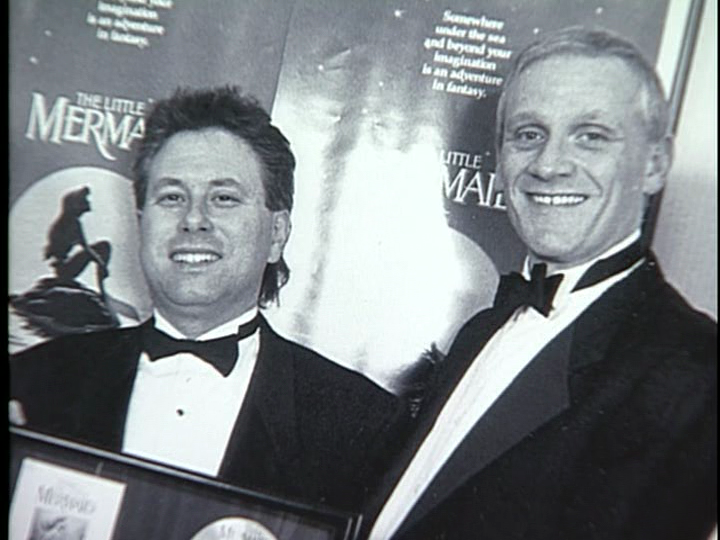
Menken (L) and songwriting partner Howard Ashman

Menken (L) and songwriting partner Howard Ashman during the accolade season for The Little Mermaid

Ashman was approached by Disney to help create the music for a new animated feature, The Little Mermaid. As Menken has said in interviews, it was his and Ashman’s job to reinvent the Disney animated feature, bringing a real sense of current musical theater trends to these Disney musical films. The Little Mermaid became the biggest hit for the studio in decades, and ushered in a whole new era for Disney, known as the Disney Renaissance. The duo was honored with two Academy Awards between them for The Little Mermaid: Best Song (“Under the Sea”) and Best Original Score. Menken and Ashman were then asked to compose for Beauty and the Beast and Aladdin. Unfortunately, around this time, Ashman was diagnosed with HIV, and passed away before Beauty and the Beast was released in theaters. Menken continued to be hired by the studios, working with songwriter Tim Rice to complete work for Aladdin, which also won two Academy Awards for Best Song (“A Whole New World”) and Best Original Score.

For the film Pocahontas, Menken teamed up with lyricist Stephen Schwartz, once again winning two Academy Awards for its music. Menken continued to work with Disney on films Hercules, Home on the Range, Newsies, Enchanted, The Shaggy Dog, and Tangled. He has also moved back to Broadway, helping bring to the stage some of these Disney hits, including Beauty and the Beast and The Little Mermaid; he has also contributed to the stage shows featured at the Disney parks. Over the course of his career, Menken has won eight Academy Awards, holding the record for most wins for any living person. In 2001, Menken was named a Disney Legend.

June 22

June 22, 2004 – Six Disney Songs are Listed on AFI’s 100 Years…100 Songs List

 100years_songs

“When you wish upon a star, your dreams come true.”

On June 22, 2004, the American Film Institute released their list of the top 100 songs in American cinema in a documentary special on CBS, known as 100 Years…100 Songs. Of the 400 nominees, six Disney songs were included in the final list, ranging from Disney’s early years to the Disney Renaissance period. The highest ranking song was “When You Wish Upon a Star” from Pinocchio, ranking at number 7. “Some Day My Prince Will Come” from Snow White and the Seven Dwarfs ranked at number 19, “Supercalifragilisticexpialidocious” from Mary Poppins ranked at number 36, “Zip-a-Dee-Doo-Dah” from Song of the South ranked at number 47, “Beauty and the Beast” ranked at number 62, and “Hakuna Matata” from The Lion King ranked at number 99.

June 18

June 18, 1999 – The 37th Animated Feature Film Tarzan is Generally Released

vlcsnap-2013-06-18-05h23m51s252

“Somewhere, something is calling for you. Two worlds: one family.”

On June 18, 1999, Disney’s 37th Animated Feature Film Tarzan was released generally to theaters. The film was based on Tarzan of the Apes by Edgar Rice Burroughs. Glen Keane, animator for adult Tarzan, designed the character after watching his son perform skateboarding stunts and by watching extreme sports, giving the character a feel of “surfing” through the jungle. For the jungle, a new 3D painting and rendering technique was created for film, called Deep Canvas. This technique allows animators to create a computer animated background that still has the feel of a traditional painted background; it was awarded a special Academy Award in 2003. The songs for the film were written and performed by singer-songwriter Phil Collins, with score by Mark Mancina. Collins’ song “You’ll Be in My Heart” won the Academy Award and Golden Globe for best Original Song. The film overall was a critical and financial success, and was the last film of the Disney Renaissance to have a box office impact. The screenplay was written by Tab Murphy, Bob Tzudiker, and Noni White, and was directed by Chris Buck and Kevin Lima. It stars Tony Goldwyn as Tarzan, Minnie Driver as Jane, Glenn Close as Kala, Lance Henriksen as Kerchak, Brian Blessed as Clayton, Nigel Hawthorne as Professor Porter, Rosie O’Donnell as Terk, and Wayne Knight as Tantor.

There’s been a shipwreck, but a couple and their young child have been able to make it out alive. They look to the jungle as a place of safety in their small boat, and sail towards it. In the jungle, a gorilla couple is also enjoying family time with their baby. The scenes switch between the two families as they work on creating homes for themselves. One night, the baby gorilla wakes up and goes after a frog to play with it, unaware that the leopardess Sabor is nearby and on the prowl. The baby is unable to escape, and is viciously attacked and killed by Sabor. As the gorillas migrate, the mother, Kala, sadly trails behind, until she hears the sound of a baby cry, and takes off in its direction. She comes across the tree house that the human family has built, and opens the door to find that Sabor has killed the parents inside. She hears the baby cry from its crib, and finds that he has not been harmed. Kala takes to the child, and adopts him as her own. However, she soon discovers that Sabor never left the house, and runs to escape, the baby still in her hands. Sabor chases the baby after Kala accidentally drops him into netting nearby, but they manage to escape, and Kala brings the baby back to her herd.

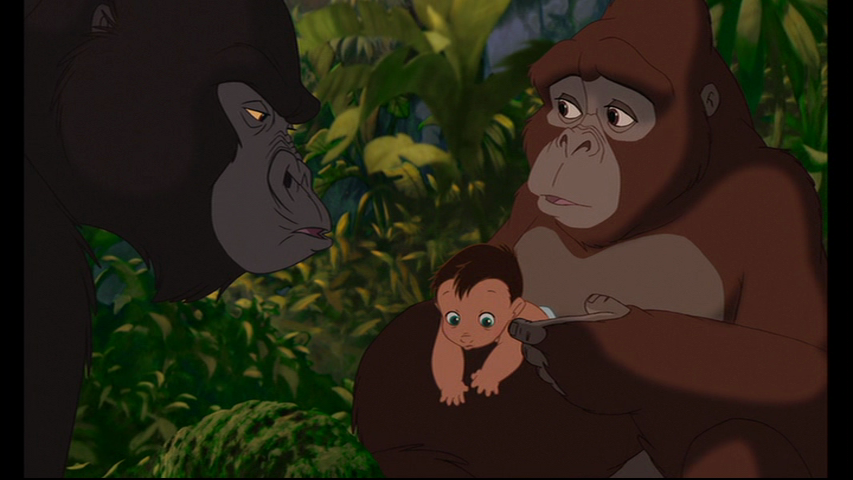
Kala tells Kerchak her intentions of adopting the baby as her own, but he refuses to accept the child

Kala tells Kerchak her intentions of adopting the baby as her own, but he refuses to accept the child

When Kala joins the herd, she declares that she will be the baby’s mother, although her mate Kerchak refuses to accept him. He begrudgingly accepts that Kala will raise him, but tells her that he will never acknowledge him as his son. Kala decides to call the baby Tarzan. The years pass, and Tarzan has grown into a willful child, who still has a hard time fitting in with the herd. Although he is friends with another gorilla named Terk, the other children want nothing to do with what they call the “hairless wonder.” The kids play a prank on him, telling him he can play with them if he retrieves a hair from an elephant and, desperate to fit in, goes to get one, but nearly ends up stomped to death by the elephants. He accidentally starts a stampede that breaks through where the gorillas are nesting, incurring the wrath of Kerchak. Saddened that Kerchak believes that Tarzan will never fit in with the herd, he runs away. Kala finds him later, and tells him that they are family, as their hearts are exactly the same. With renewed vigor, Tarzan is determined to prove his worth to the family.

After adapting to everything in the jungle, Tarzan grows into a strong man, able to hold his own against anything. One day, Tarzan senses something nearby, and narrowly escapes when Sabor breaks through. Kerchak tries to defend the family against Sabor, and Tarzan assists him by taking on the leopardess. In the end, Tarzan manages to kill Sabor, and the whole herd cheers. It looks like Kerchak is about to accept Tarzan as a member of the herd, when a strange sound pierces through the jungle. Kerchak informs everyone they need to move, but Tarzan goes off to explore the strange sound. He comes across a trio of people, and studies them carefully: a trigger-happy guide named Mr. Clayton, Professor Porter, and his daughter, Jane. Jane takes a moment to draw a baby baboon, but is soon chased by the baby’s entire herd. Tarzan soon jumps in to save her. She is rather frightened by Tarzan, but soon discovers that he is rather gentle and nothing to fear. He introduces himself, and starts mimicking her, quickly picking up English. He then helps take her back to her camp.

Tarzan and Kerchak clash over the idea of whether the humans are dangerous or not

Tarzan and Kerchak clash over the idea of whether the humans are dangerous or not

Terk, elephant friend Tantor, and other members of the herd go looking for Tarzan, and come across the camp set up by the Professor and Clayton. The group starts trashing the camp, but are soon chased away by an angry Kerchak. The Professor and Clayton return to the camp after Tarzan leaves with the frightened herd, and Jane relays the story of how Tarzan saved her to her companions. Back at the nest, Kerchak decrees that no one is to go near the strangers, and gets into an argument with Tarzan, as Tarzan does not believe Jane to be dangerous. Tarzan is furious, wondering why Kala never told him that there were creatures that looked like him. Jane tells her father about Tarzan, and Tarzan soon returns to the camp to see her. Jane then decides to teach Tarzan about the world outside of the jungle, while Clayton wishes to use Tarzan to find the gorillas. Tarzan and Jane grow closer, and Jane asks if Tarzan will take them to the gorillas, but he refuses, as he wishes to obey Kerchak. Unfortunately, the ship soon arrives to take the professor and Jane back to England, and Jane asks Tarzan to come with her. Tarzan says he can’t, and asks her to stay. Clayton then takes advantage of Tarzan’s feelings for Jane, and has Tarzan take them to see the gorillas, as Clayton says Jane will wish to stay if she sees them.

Terk and Tantor keep Kerchak occupied as Tarzan takes Jane to the camp. Unfortunately, Kerchak arrives to find the group there, and attacks Clayton. Tarzan saves them from Kerchak, but also alienates himself from the family in the process. Kala finally reveals the truth about Tarzan’s parents, and leaves him to make up his mind about if he should stay in the jungle or go with Jane. In the end, Tarzan decides to go back to England with Jane, much to the sorrow of Kala. As the humans head to the ship, Clayton reveals his true intentions of capturing all of the gorillas, with Jane and the professor trapped in cages to prevent them from stopping Clayon’s plan. Terk and Tantor, hearing Tarzan’s cry for help, set out to rescue their friend. In the jungle, Kerchak and the herd sense danger, and as he tries to protect the herd, he is soon captured. As the herd is trapped in cages and tied down by ropes, Tarzan appears in the mist, bringing with him a whole herd of jungle animals to free the herd. Kerchak asks in surprise that Tarzan came back, and Tarzan tells him that he came home. As Clayton tries to shoot Tarzan, Kerchak takes the bullet. Angered, Tarzan fights Clayton, destroying his gun. As Clayton tries to attack Tarzan with his knife, he is caught in the vines, and dies by hanging as a vine stays wrapped around his neck. Tarzan returns to the herd to fine Kerchak dying. Kerchak finally accepts Tarzan as his son, and asks that Tarzan take care of the family from then on.

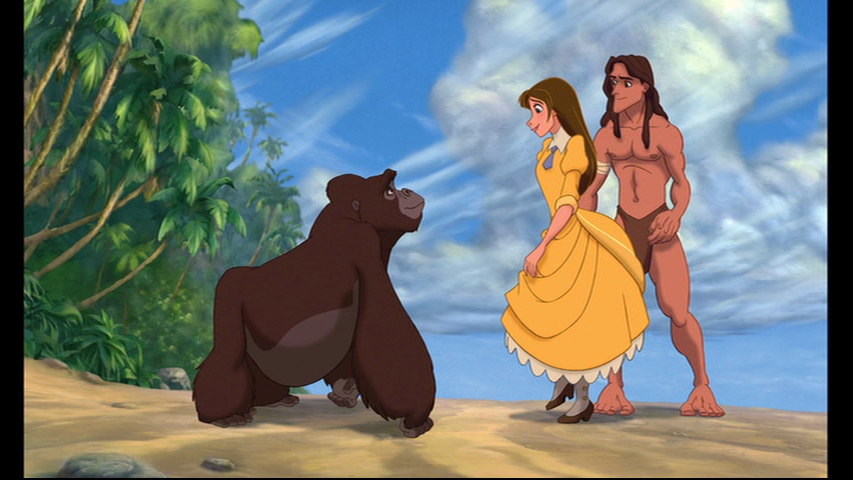
Jane, deciding to stay, is welcomed into the family

Jane, deciding to stay, is welcomed into the family

Jane still has to return to England, and the two say goodbye on the beach. Jane is heartbroken with having to leave Tarzan behind, and her father tells her that she needs to stay. Realizing that with Tarzan is where she belongs, she returns to the beach and embraces Tarzan. The Professor decides he wishes to stay as well, and the two effectively join the family.