RSS Feed

Tag Archives: Short film

August 8

August 8, 1952 – The Special Short Film The Little House is Released to Theaters
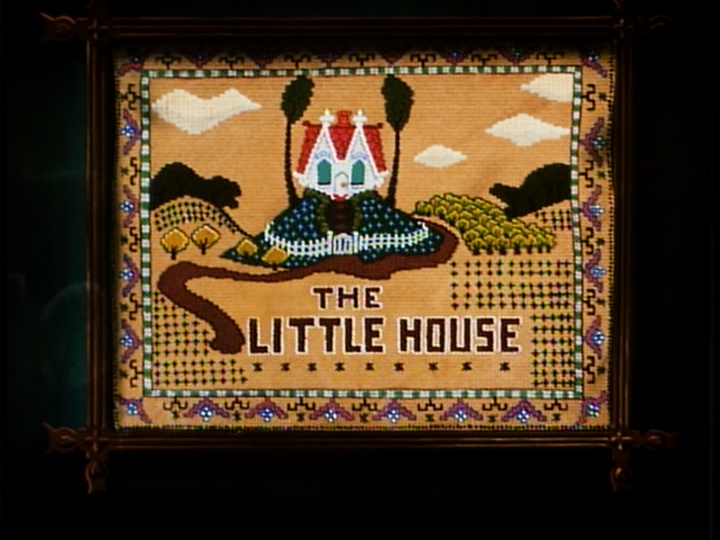
“Once upon a time there was a little house on a little hill, way out in the country.”

 On August 8, 1952, the special short film The Little House was released to theaters. The short was based on the 1942 children’s book by Virginia Lee Burton, and was adapted for the screen by Bill Peet and Bill Cottrell. It was directed by Wilfred Jackson and narrated by Sterling Holloway.

The short begins with the introduction of the happy little house, out in the country, who has just been bought by a young married couple. Shortly after, the house is filled with children and life, and the house loves each and every member of the family. At night, however, the house feels a bit lonely, with no other houses nearby. She gets her wish, as expansion quickly heads her way, with giant mansions built on every side. The house attempts to make friends with the houses, but they want nothing to do with her. Unfortunately for them, a large fire breaks out and destroys the mansions, with the little house left charred, but still intact.
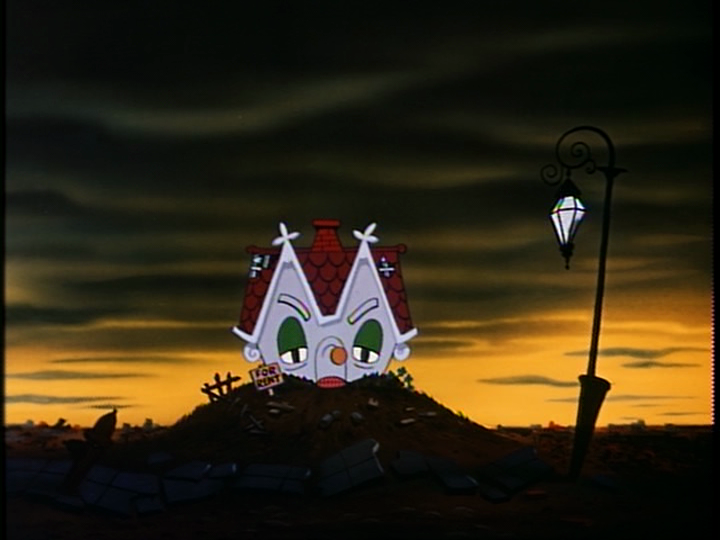
The little house finds herself amongst the debris of the “buildings of progress” as everything is built then destroyed

After those houses are gone, the little house soon finds herself surrounded by tall apartment buildings, musing to herself that she is “surrounded by progress.” The family soon moves out of the house, leaving her behind. She worries that she will never feel happy again, what with the empty feeling inside. Soon, the apartment buildings are torn down, and the house is left in the middle of a pile of debris. As she thinks she will soon have peace and quiet, a rumbling in the distance tells her otherwise.

Tall skyscrapers are built around her, with the house now boarded up, and a “For Sale” sign left in the front of her yard. The house sadly believes that she’s reached the end, and she will never see the sun again. One day, and crew comes by and pulls her from the ground, taking her away to the country. She opens her eyes to see that she’s on a little hill in the country again, all fixed up, with another newly married couple ready to begin their lives with her.
August 1

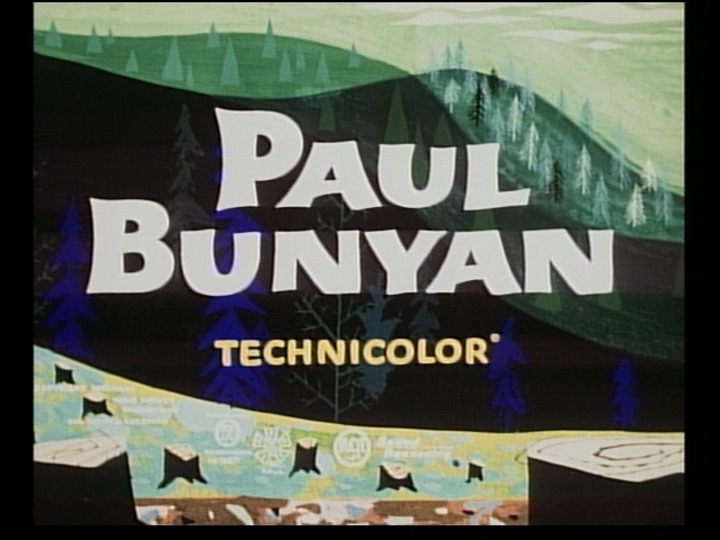
August 1, 1958 – The Special Short Film Paul Bunyan is Released to Theaters

“A job that needed a great big man, Paul Bunyan was the one.”

On August 1, 1958, the special short film Paul Bunyan was released to theaters. The short was directed by Les Clark, with the story adapted by Lance Nolley and Ted Berman, and voices provided by the Mellomen. The short was also nominated for an Academy Award for Best Short Subject (Cartoon) at the 31st Academy Awards.

The story of Paul Bunyan begins with his arrival in a small town on the coast of Maine, when lumberjack Cal McNab looks inside a cradle that has been left in right on the edge of town and sees a giant baby inside. The whole town adopts the baby and names him Paul Bunyan, and everyone pitches in to make his clothes and feed him. Paul quickly grows up in the town, attending school and playing with the boys of the town at the swimming hole. One Christmas, the town gave Paul a giant axe, and he took to cutting timber “like a duck takes to water.” Paul provides his town with enough timber to last a lifetime, and the town grows quickly, becoming too crowded for Paul. One morning, he leaves a note for the town, thanking them for everything, and letting them know he was looking for more room. Cal ends his part of the tale stating that the whole town was going to miss Paul.

Paul saves Babe, who is so grateful, he remains as Paul’s pet and best friend

The next part of the story is told by straw boss Chris Crosshaul, who meets Paul in the Midwest. Paul is seen cutting timber as fast as he can, and stomps the stumps back into the ground before leaving for more room and more trees to cut. As Paul leaves, he runs into the worst blizzard the country had ever seen, with the flames freezing when he tries to light a fire. In the middle of his task, he hears a sound in the distance, and sees a large ox frozen in the snow. The ox has turned blue from the cold. He thaws the ox out, and the ox, grateful for Paul’s help, becomes Paul’s pet, “Babe.” The two continue their travels in the storm, leaving behind them many tracks that filled with water and became the land of 10,000 lakes. They continue to chop down trees, dig the Missouri River to send the logs down to the sawmill, and build Pike’s Peak to view other parts of the country left to chop down. According to Crosshaul, Paul and Babe also created the Grand Tetons and Yellowstone Falls through their roughhousing.

The last chapter of the story is told by river foreman Shot Gunderson. The day Paul arrived at his camp, the camp was in trouble: they could get timber in the river, but the river was too windy and the logs couldn’t get to the mill. With Paul and Babe’s help, the river is pulled straight, and the logs go directly to the sawmill. One day, a traveling salesman comes to town, demonstrating a steam-powered chainsaw, which promises to chop down trees faster than regular chopping. A competition is set between the man versus machine, and the two set to work on the day. Unfortunately for Paul, the machine beats Paul by 1/4th inch, and discouraged, walks away from town. Gunderson tells the audience, however, not to feel sorry for Paul and Babe, as they’re in Alaska, creating the Northern Lights thanks to their roughhousing.

July 30

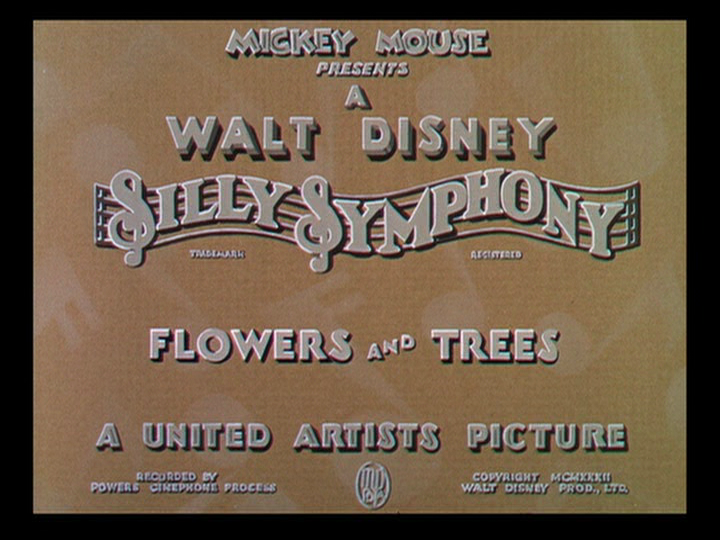
July 30, 1932 – The Academy Award Winning Silly Symphony Flowers and Trees is Released to Theaters

On July 30, 1932, the groundbreaking Silly Symphony Flowers and Trees was released to theaters. The short was directed by Burt Gillett, and became a landmark in Disney animation. Originally conceived in black and white, the short was scrapped at great cost to the studio to be redone in the new Technicolor process. Walt Disney signed an exclusive deal with Technicolor that gave him alone the rights of the process for two years, and after this short, all of the Disney shorts would be released in color. This process helped enhance the quality of Disney’s films, and Flowers and Trees would be awarded an Academy Award for Best Cartoon; at the same ceremony, Walt would be awarded a special Academy Award for the creation of Mickey Mouse.

One spring morning, the trees and flowers wake to the sound of a bird’s chirping, stretching in the morning light. One pair of trees in particular is enjoying the day, while an old stump scares the bird that tries to wake him. One tree begins to play a harp for his love, a beautiful young tree, who dances gracefully to the music while flowers dance around her. The flowers then bring her closer to her love and dance around them before making a heart shaped wreath on the ground. The male tree places it around the female’s head.

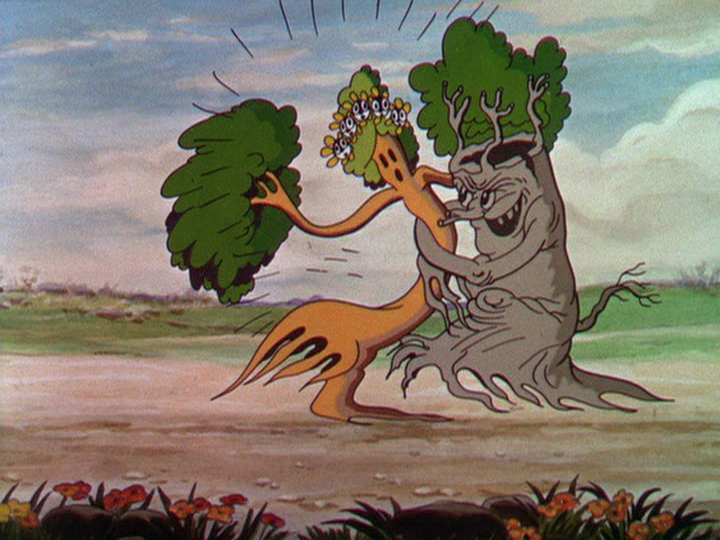
The female tree is captured by the stump, and she struggles in vain to escape

She continues to dance, unaware she is being pursued by the jealous, cranky old stump. He grabs her for his own, and the young male tree saves her before beginning a sword fight with the stump. The old stump is defeated, and decides to set the young male tree on fire. The male tries to stomp out the blaze, but to no avail. The plants that can run begin to flee, while others try to help put out the flames. The stump watches will glee as he sees the young couple being engulfed in flames, but soon finds himself victim of the blaze as well.

The flames being to grow in intensity, and the birds flock together to create a hole in the clouds that causes rain to fall and put out the fire. What’s left of the stump is found on the road, a victim of his own plan to destroy the couple, with his vultures swarming around the remains. After the storm clears, the male tree, proposes to the female, and the flowers sound the wedding bells.

July 28

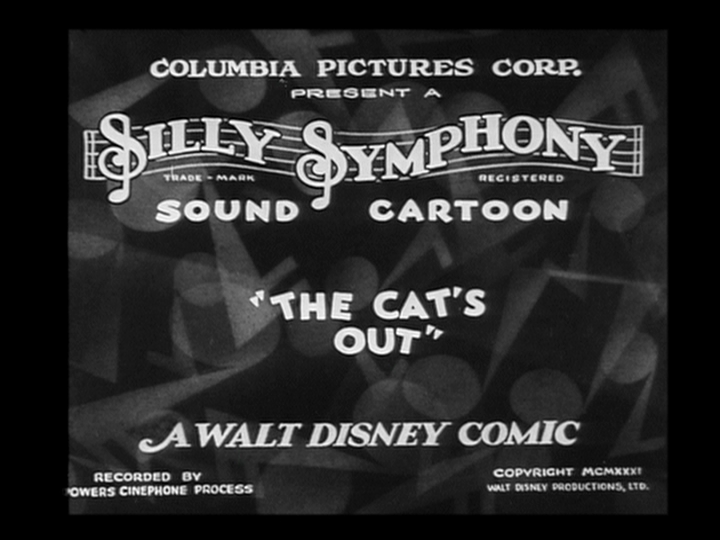
July 28, 1931 – The Silly Symphony The Cat’s Out is Released to Theaters

On July 28, 1931, the Silly Symphony The Cat’s Out was released to theaters. It has been copyrighted as The Cat’s Nightmare, but the studio now refers to it by its original name. The short was directed by Wilfred Jackson.

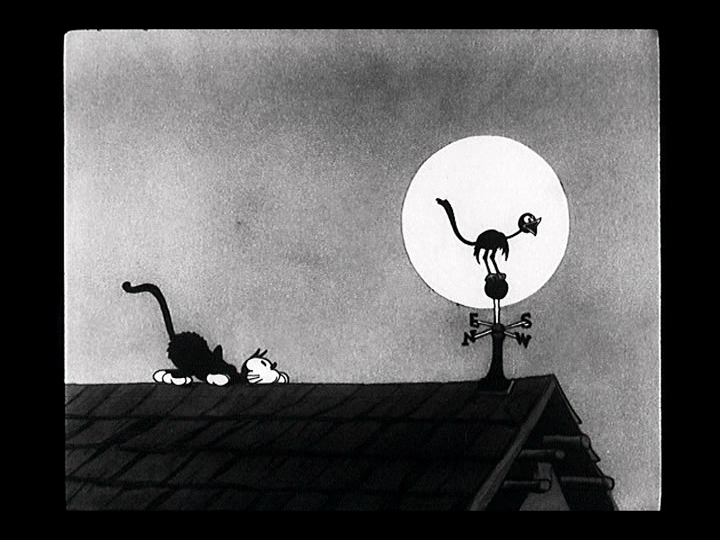
A cat is put out for the night outside a country home, and howls at the door before going off to explore.­­ As he perches on a fence, still howling, neighbors begin to throw shoes, and one lands on the cat’s head. He runs away in a flurry, falls off the fence, and lands in a washtub. After drying himself, the cat hears a bird chirping from its perch on a weathervane.

The cat carefully stalks his prey, which is perched on the weathervane

The cat, now suddenly hungry, stalks the bird, waiting for his chance to attack. He catches the bird by the tail just as it takes off, and tries to remain on the roof by wrapping his tail around the weathervane. Unfortunately, he loses his balance and falls, ripping the vane from the roof. As he lands on the ground, the vane falls soon after, landing on his head. The cat’s lives begin fleeing to heaven, but he is able to grab his last one and save it. The bird he chased shows up, and as he is about to grab it again, it triples in size and begins to taunt the cat.

The cat, annoyed by the taunting, punches the bird. As his feathers fly off, the feathers become more birds, which circle the cat and taunt him mercilessly, trying to peck him with their beaks. Suddenly, the birds disappear, and a herd of owls in the trees scares the cat. He runs to hide behind a bucket, but the water pump, now alive, dumps water on him. The startled cat runs into a pole and knocks down a scarecrow. As the cat hides behind a pumpkin, the scarecrow comes to life and begins to dance. The multiple dancing scarecrows appear and dance together before they merge back into one scarecrow again, who climbs back on his pole.

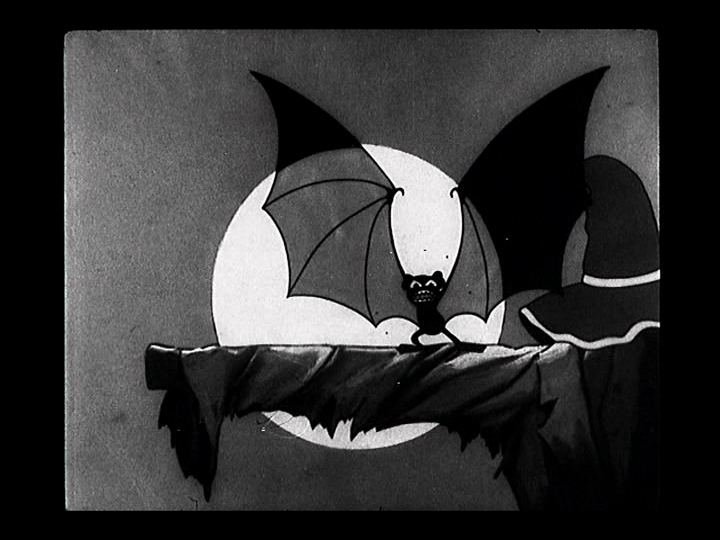
A bat appears from under the scarecrow’s hat and begins to dance in the moonlight, which frightens the already scared cat

From under the scarecrow’s hat, a bat appears and begins to dance in the moonlight. The terrified cat throws the pumpkin at the bat, which turns into a flock of bats that swarm the cat. The cat flees, only to find himself trapped at the mercy of giant spiders. As they attack, he is able to escape them, but everywhere he goes, he finds more trouble: trees come to life and beat him, and the bird laughs at the cat’s misfortune.

The cat wakes to find that it has all been a dream, and it’s now morning. He goes to the door of his house and howls, hoping the owner will let him in. The owner opens the door and the cat steps inside while the owner grabs the bottle of milk, then shoves the cat back outside. Angrily, the cat paws at the welcome mat, then blows his master a raspberry before haughtily walking away.

July 27

July 27, 1956 – The Special Short Film In the Bag Premieres in Theaters

“First you stick a rag, put it in the bag, bump bump, then you bend your back, put it in the sack, bump bump.”

On July 27, 1956, the special short film In the Bag was released to theaters. This short was the second of what was to be a potential series for the character Humphrey the Bear, but the series was canceled when the Disney Studios stopped making short films. Humphrey was introduced in the 1950 Goofy short Hold That Pose; he then was an antagonist for Donald Duck in several shorts. In the two shorts released, Humphrey’s foil was a good-natured park ranger named J. Audubon Woodlore. The short, filmed in Cinemascope, was directed by Jack Hannah, with the story by Dave Detiege and Al Bertino. Humphrey was voiced by James MacDonald and Ranger Woodlore by Bill Thompson. Smokey the Bear also makes a cameo in this short.

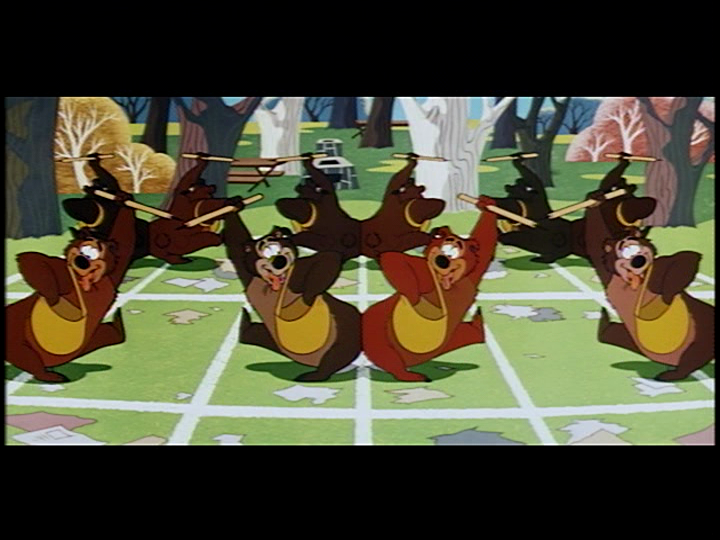
The guests are leaving the campgrounds, and Ranger Woodlore steps out of the ranger station, perturbed at the mess the guests have left behind. He begins to clean, when he realizes he has all the help he needs. He calls over Humphrey, who gathers all the other bears when Woodlore offers a surprise. He tells them that they’re going to play a game, and the bears are all excited. Woodlore sets up the playing field, and has Humphrey hand out the equipment to pick up the trash.

The bears seem to enjoy their “game,” dancing to the little ditty that Ranger Woodlore invented

Ranger Woodlore begins to sing a song to inspire the bears, and they pick up trash with vigor, until they notice they’ve just been doing the ranger’s chores. They angrily dump out the trash and storm away. Woodlore has an idea to get them back – he makes his special batch of chicken cacciatore, but tells them “He who does not clean up his section of the park does not get any supper.” The bears race to put all the pieces of trash in Humphrey’s section, leaving him as the dupe. He races to clean, but his bag snags on a branch and rips open, sending trash flying everywhere.

Humphrey is sent once again to clean, but is struck by misfortune at every turn. He finds an unused match in the trash, and sets to light the pile of trash on fire, when Smokey the Bear steps on it and warns the audience that only they can prevent forest fires. Desperate, Humphrey sees a hole in the ground, shoves the trash in there, then triumphantly skips to get his supper. Just as he’s about to reach for the plate, the “hole” starts to shake, and a sign reveals that it’s actually the geyser Old Fateful. It erupts, sending trash flying all over the park. Ranger Woodlore apologizes, but reminds him that rules are rules, and Humphrey once again dances as he picks up trash around the park.

July 25

July 25, 1927 – The Alice Comedy Alice the Whaler is Released to Theaters

“Thar she blows!”

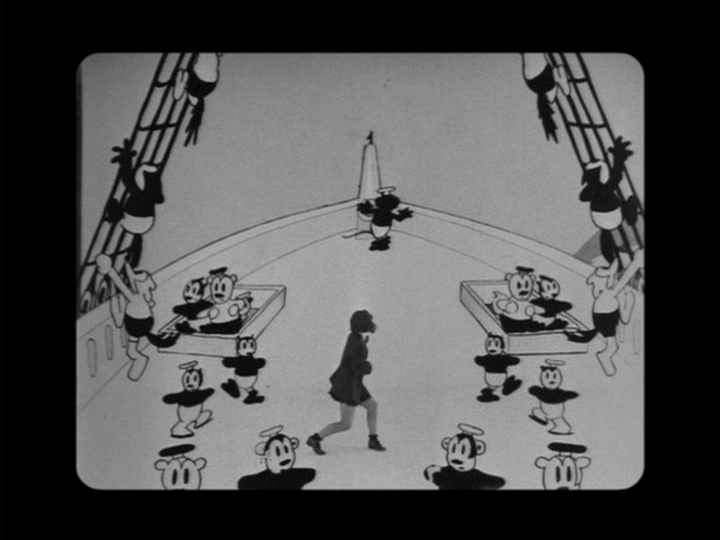
On July 25, 1927, the Alice Comedy Alice the Whaler was released to theaters. This was the third to last Alice Comedy produced by the Disney Studios, and stars the fourth and final actress to play Alice, Lois Hardwick.

It’s a turbulent day at sea, but Alice and her crew are having a merry time on the ship’s deck, dancing and playing sea shanties. One of the members of the crew is doing a wonderful job miming, up to the point where, as he pretends to pull on a rope, he pulls down an anvil that lands smack on his head, which causes Alice to laugh. In the kitchen, members of the crew are hard at work, with the chef capturing the chicken trying to escape from the pot, and a mouse hard at work peeling potatoes. The mouse tries to save the dishes that keep falling out of the cupboard due to the ship’s rocking, but they end up crashing to the floor in a giant mess. When the chef sees the broken dishes, he demands that he head out to get eggs.

Alice and her crew gather to their stations when a whale is spotted nearby

The mouse stands on the top of the mast, trying to catch any of the birds that are flying past, and ends up on the back of one. He smacks it on the head to beat it into submission, and finally gets it to land on the deck. He demands that it lay eggs, but it can’t, until the mouse finds a way for it to do so. Delivering the eggs to the chef, the chef then demands that the mouse go get some milk; when he attempts to beat the mouse for his insubordination, the chef ends up breaking the eggs. The mouse goes to the goat to milk her, but the rocking of the boat makes this a rather difficult task, until the mouse nails the goat’s feet to the floor. Julius, Alice’s feline friend, spots whales frolicking in the waves, and everyone quickly sets to work. The harpoon is let loose, and the whale leaps in pain as it gets caught on the tail. Unfortunately for the crew, the short ends with the ship being dragged across the ocean by the whale.

July 24

July 24, 1942 – The Donald Duck Short Film Donald’s Gold Mine is Released to Theaters

“Quack quack quack quack, quack quack quack quack, excavating for a mine…”

On July 24, 1942, the Donald Duck short film Donald’s Gold Mine was released to theaters. It was directed by Dick Lundy, and stars Clarence Nash as the voice of Donald.

The Lucky Duck Mine is hard at work, and Donald is inside, singing a song as he shovels rocks into his cart. His donkey decides to join in the singing (although he is very off-key), much to Donald’s annoyance, and he shoves the cart into the donkey to silence him. The donkey shoves the cart right back, sending a shovel full of rocks down Donald’s throat. Donald tries to trick the donkey into shoving all the rocks out of his stomach, but once he does, he gives the donkey a “Thanks, pal” before giving him another sharp kick.

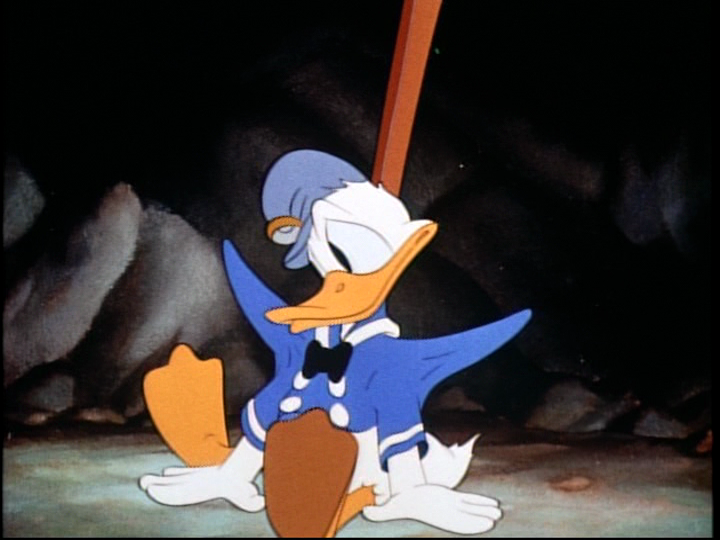
Donald finds the pickaxe stuck in his shirt after a slip from a boulder

Donald then takes a pickaxe and starts to mine, but slips on a boulder and ends up wearing the pickax, which is stuck beneath his shirt. He struggles to remove it, but to no avail, and the donkey continues to bray at the duck’s misfortune. He finally manages to remove to the pickax, which sticks into the ceiling and brings down a multitude of gold nuggets, which land in his cart.

Suddenly seeing dollar signs, Donald climbs into his cart and laughs maniacally at his good fortune, throwing pieces into the air while crying out that he’s rich. Unfortunately, the pieces spook the donkey, who takes off flying with Donald stuck in the cart; Donald and his cargo get dumped in the ore drop shaft when the donkey comes to a sudden stop. The donkey runs to see Donald getting caught in the ore drop process, narrowly missing being crushed over and over again. The donkey comes out to the finish, seeing Donald processed as a 24K gold block, and brays once again at the duck’s misfortune.

July 20

July 20, 1951 – The Donald Duck Short Film Lucky Number is Released to Theaters

“Flash! Here it is, ladies and gentlemen. Get your tickets ready for the big drawing of the new Zoom V-8, the super car of the continent!”

On July 20, 1951, the Donald Duck short film Lucky Number was released to theaters. It was directed by Jack Hannah, with the story by Nick George and Bill Berg. It stars Clarence Nash as the voices of Donald, Huey, Dewey, and Louie.

It’s a lovely day at Donald’s Service Station, and Donald is outside cleaning the pumps while his nephews are fixing a car in the garage. The radio announcer interrupts their activities, announcing that it’s time to declare a winner for the drawing of a new car. The boys call their uncle over, and he holds up his ticket excitedly; unfortunately, he is off by only one number. He drops the ticket angrily and marches back to his chores.

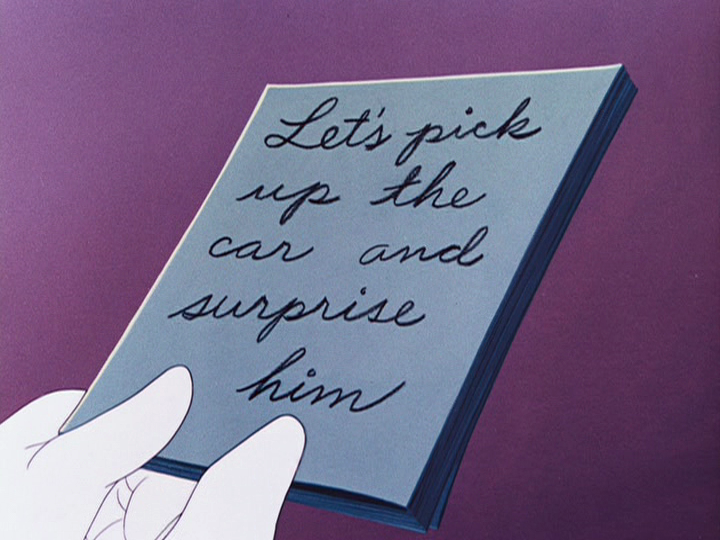
One of the nephews writes a note to the others to keep his idea a secret from Uncle Donald

Just as Donald leaves the garage, the announcer says there’s been a slight error, and declares Donald’s number the winner. The nephews grab Donald’s discarded ticket and decide to surprise him by picking up the car themselves. The announcer continues that the winner must be at the car lot by two o’clock, or a new winner will be drawn. Realizing they only have ten minutes to get there, the nephews quickly fix their car and speed out of the garage, much to the annoyance of Donald, who yells at them as they pass.

It’s smooth sailing at first for the trio, but they soon realize they’re out of gas. They quickly drive back to the service station, where Donald is not happy to see them. Without any money to pay for the gas, Donald refuses to fill their car, pushing them into a billboard of the Zoom V-8, the very car Donald has won. The nephews come up with a quick plan, and attack the billboard with a saw.

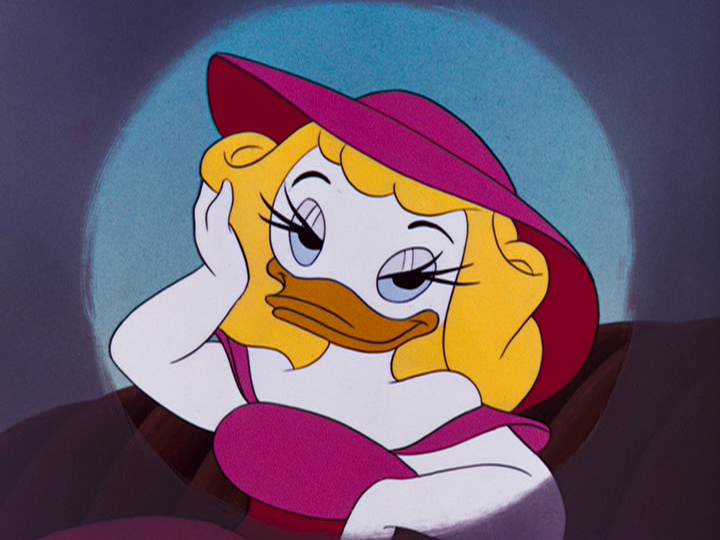
One of the nephews disguises himself as a beautiful woman so he can trick Donald into filling the car with gas

Disguised as the new car, and one of the nephews dressed as a woman, Donald doesn’t hesitate to help the “lady” out, and the nephews quickly drive away, with Donald still daydreaming. Realizing he’s been tricked, he runs inside just as the phone rings. The man on the other end lets Donald know that his nephews are coming back with a big surprise for him, and he decides he’s going to get them back.

Grabbing a big barrel of oil sludge, he waits until the trio comes back with the new car. Thinking that he’s been tricked again, he covers the new car in the sludge, then pours gasoline on the three to “wash them off.” He then overinflates the car’s tires, while the nephews can only watch in horror. The final blow is when he crushes the car, sending the wheels flying into the air. As Donald laughs at his handiwork, the radio announcer tells everyone that Donald Duck must be enjoying his new car, taking it out for a spin in the country. Realizing what he’s done, he faints, and his nephews can only shrug.

July 19

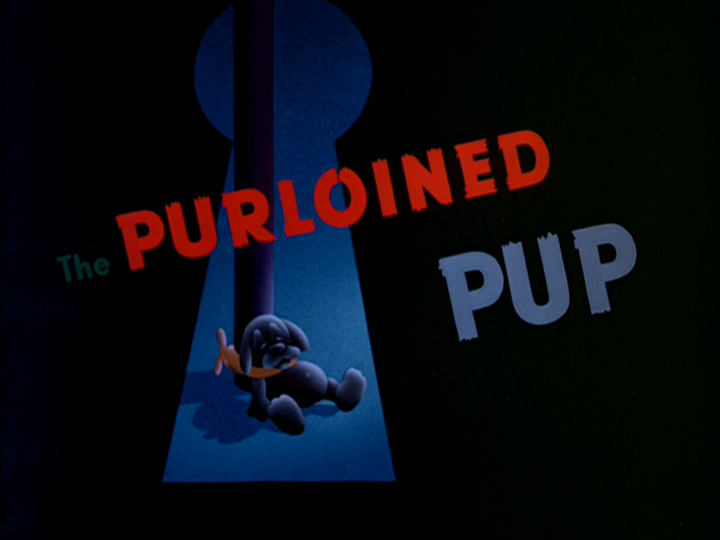
July 19, 1948 – The Pluto Short Film The Purloined Pup is Released to Theaters

“Dog Stealer Takes Baby Pup! 10,000 Bones Ransom Asked”

On July 19, 1948, the Pluto short film The Purloined Pup was released to theaters. In this short, Pluto’s main antagonist (and sometimes rival for a female’s affections), Butch, plays the part of a dognapper. The short was directed by Charles Nichols, with the story by Harry Reeves and Jesse Marsh.

A newspaper flashes across the screen, with the news that a puppy named Ronnie has been dognapped. The police suspect Butch, a paroled dognapper seen in the vicinity, and put rookie police dog Pluto on the case. Pluto sniffs out the trail, and comes across Ronnie’s collar. Thinking he’s close, he sneaks past some heavy pipes and spies Butch in front of an abandoned mansion, viciously chewing on a bone.

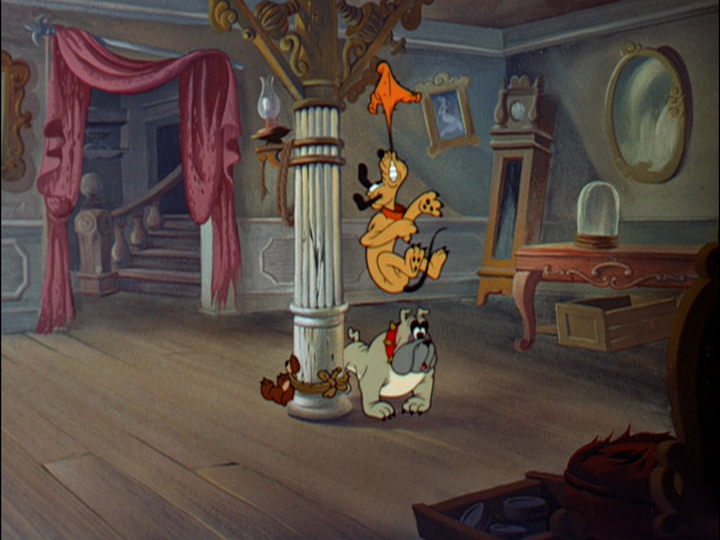
Several times, Pluto is able to avoid detection by Butch while trying to rescue Ronnie

Pluto comes up with a plan of action, buries his capture kit, and slips into the nearby moat to swim past Butch. He makes his way into the house just as Butch returns, and pretends to be a lion-skin rug to avoid detection. Butch enters a room and closes the door, and Pluto peeks through the keyhole to see Ronnie weeping and tied to a column. Butch threatens to hurt the puppy for the noise he’s making and walks out of the room, leaving the door open. Pluto sneaks in, but the sound of the door closing alerts Butch, who tries to pick up the stranger’s scent. Pluto, fortunately, is once again able to avoid detection.

As Butch leaves again, Pluto frees the puppy, who barks happily, giving away the rescue. Butch pursues the two into the pipes near the mansion, and ends up thinking that Pluto is in one of the pipes, when he is actually tormenting himself thanks to a U-shaped pipe. Butch then spies the puppy coming out of its hiding place, but Pluto is able to pull the pup away before Butch can hurt him. During a chase across the pipe-filled yard, Pluto grabs his capture kit and sets it up, trapping Butch in a straight-jacket, muzzle, and handcuffs. Ronnie, now safe, leads Butch by the rope to his muzzle to the police station where he happily turns the criminal in.

July 18

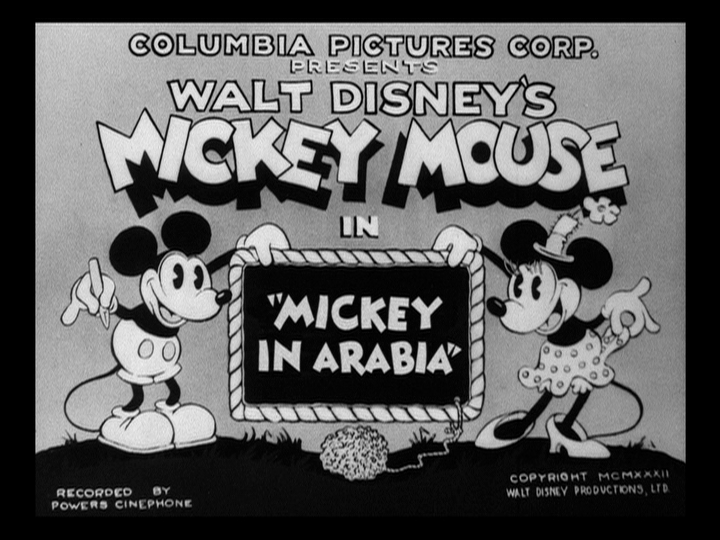
July 18, 1932 – The Mickey Mouse Short Film Mickey in Arabia is Released to Theaters


“Alley-oop!”

On July 18, 1932, the Mickey Mouse short film Mickey in Arabia was released to theaters. The short was directed by Wilfred Jackson, and stars Walt Disney as Mickey Mouse and Marcellite Garner as Minnie Mouse.

Mickey and Minnie are vacationing in the Middle East, and are seen riding a rather unusual camel through the desert. They enter a city and pull to a stop, looking around at the strange new sights, including a snake charmer taming several cobras. Mickey and Minnie leave the camel to drink from a nearby beer barrel, and the two explore the city and take pictures. As Minnie is setting up a shot, an evil sheik captures  and rides off with her, while Mickey attempts to pursue them on his drunken camel.

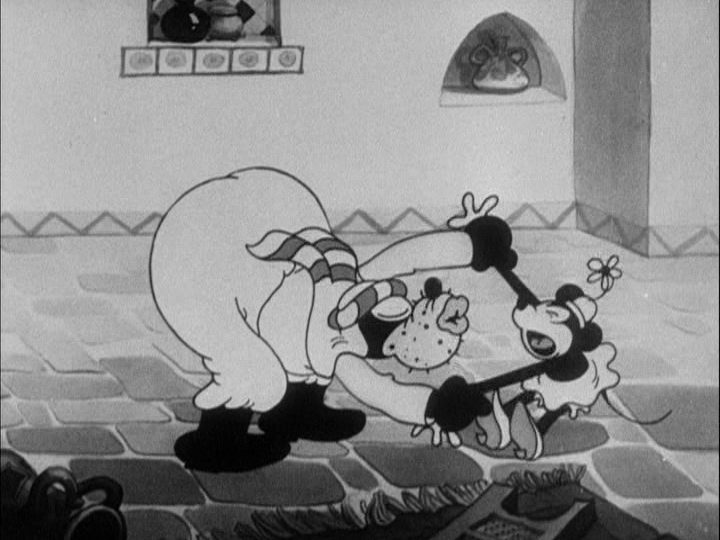
Minnie struggles to avoid kissing the sheik, who has kidnapped her and taken her to his castle

Minnie is taken to the sheik’s castle, where the sheik tries to get Minnie to kiss him, but to no avail. Mickey climbs the castle walls to come to Minnie’s rescue, diving in the room and kicking the sheik out of the way. As he and Minnie try to flee, the sheik’s soldiers stop them at every turn. The sheik, blinded by his turban, pulls out two pistols and begins to fire wildly, while every member of his army hides in terror.

Mickey hides Minnie in a vase and tries to open the door, only to find it locked. The sheik, finally removing his turban from his eyes, throws a sword at Mickey, but misses thanks to Minnie’s scream. Mickey grabs the sword, not realizing he’s grabbed only the hilt, and charges at the sheik. Suddenly realizing that the sword’s blade is missing, Mickey ducks, tripping the evil sheik and sending him flying. Angered, the sheik throws all sorts of swords at the mouse, who dodges them. Mickey hides behind a board, where all the swords land, and throws all of them back at the sheik, tearing the shiek’s clothes to shreds in the process.

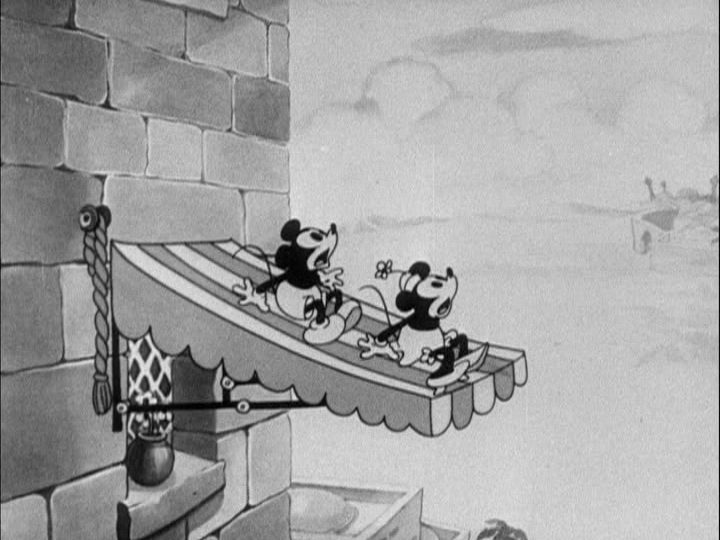
Mickey and Minnie watch in horror as the sheik has followed them and attempts to jump onto their perch

As the sheik pursues them in his holey long-johns, Mickey grabs Minnie and the vase she is hiding in and they flee up a tower. Mickey trips on the roof, sending Minnie flying. He saves her by her hat, but ends up falling from the roof himself. The lucky pair land on a veranda blind. The sheik leaps after them, but Mickey pulls the blind in, and the sheik lands head first in the sand. The guards throw their spears at the two as well, but with another pull of the blind, the spears land on the sheik instead. The happy couple jumps from their perch onto their camel’s back and ride off into the desert.