RSS Feed

Tag Archives: Short film

December 6

December 6, 1922 – The Laugh-O-Gram Film Cinderella is Released
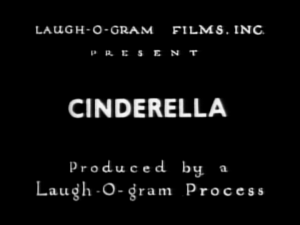
vlcsnap-2012-12-05-19h53m30s22

“Cinderella, whose only friend was a cat.”

On December 6, 1922, the Laugh-O-Gram Film Cinderella was released. This was a silent film from Walt Disney’s early Laugh-O-Gram Studio, founded in May 1922. Cinderella was one of the six fairy tale cartoons produced during the studio’s contract with Pictorial Clubs, Inc. The short is a modern-day (of the time) take on the classic fairy tale.

The opening of the short introduces Cinderella and her only friend, the cat; her two stepsisters; and the prince, who chases a bear with a shotgun. A group of bears is seen dancing, playing music, and being merry, until they see the prince, who chases them all into their cave. The prince victoriously captures all the bears and drags them out in a row, their feet tied to a single rope. The prince then sends out invitations to a ball, and his trusty servant dog takes them to every home in the kingdom.

The night of the ball arrives, and the stepsisters head to the ball, leaving Cinderella alone with the cat. As they both lament that they wish they could go to the ball, the Fairy Godmother appears in a cloud of smoke, letting Cinderella and the cat know that she has come to grant their wish. Instantly, Cinderella is turned into a flapper, and a motorcar appears in their living room, ready to drive Cinderella and the cat to the ball.
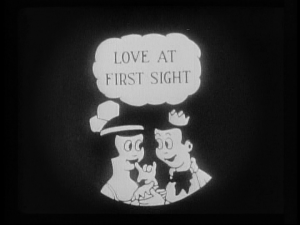
Once the two set their eyes on each other, they dance the night away

Once the two set their eyes on each other, they dance the night away

At the ball, the prince is dancing with one of the stepsisters when he spies Cinderella, and it is love at first sight between the two. Everyone wonders who the girl is. Meanwhile, Cinderella’s cat is busy dancing with the prince’s dog. As the guests start to rush for the food, Cinderella and the prince spend time together alone in the garden. Cinderella suddenly notices that it’s five minutes to midnight, and dashes out of the ball, losing her shoe in the process. As she runs home, her clothes soon change to rags.

The next day, the prince sets out to find her, following a set of footprints that unfortunately lead to a duck. He finally finds Cinderella’s house and has the stepsisters try on the shoe, but of course it doesn’t fit. Then he sees Cinderella, and realizes that she is the mystery girl from the ball. The prince and Cinderella, as well as the cat and the dog, live happily ever after.
December 4

December 4, 1942 – The Goofy Short Film How to Fish is Released to Theaters

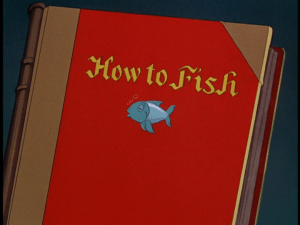
vlcsnap-2012-12-03-17h25m44s44

“This desire becomes acute only through bodily contact with the cosmic undulations of Pisces, or fishes. This creates a mental malady known as ‘Fishus Febris,’ or ‘fishing fever.’”

On December 4, 1942, the Goody short film How to Fish was released to theaters. It is technically the third in Goofy’s “How To” series. The short was directed by Jack Kinney, and narrated by John McLeish.

The short, presented as a book, opens as an instructional text all about fishing, including when to fish, which is determined by the zodiac. We then move to Goofy in his study, when he suddenly he has the overwhelming urge to go fishing. On the next page, Goofy is at a lake, having spent an uncomfortable night on the beach, ready to get on the water. The narrator then introduces a trout, who is afraid of his own shadow.

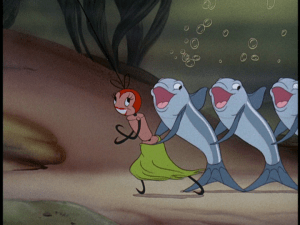
Goofy uses one of his lures to bring the fish to him in a conga line

Goofy uses one of his lures to bring the fish to him in a conga line

Goofy tries to sneak up on the fish, only to fall from a tree and land in the water, with the fish jumping up and attacking his hat, leaving it a tattered mess. The next lesson in the book is about fly-fishing and its many lures, including one that looks like a hula girl and leads the fish in a conga line. Goofy tries to let his line fly, but it hooks around a tree; as he tries to reel his catch in, he ends up in a tangled mess. He then tries to go out with a motorboat, and accidentally hooks his motor. The motor takes off, slicing the boat into pieces, and dragging Goofy all across the lake. However, Goofy is still impressed that he caught something, much to the exhaustion of the narrator.

December 2

December 2, 1929 – The Mickey Mouse Short Film The Haunted House is Released to Theaters

vlcsnap-2012-12-01-17h53m41s93

“I c-c-can’t play!”

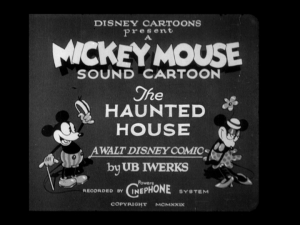
On December 2, 1929, the Mickey Mouse short film The Haunted House was released to theaters. Many of the skeletons’ dance moves are similar to those of the Silly Symphony The Skeleton Dance. The short was directed by and stars Walt Disney.

It’s a dark and stormy night, and Mickey is trying to get home, with his umbrella flying away in the wind. He spies a house nearby and decides to see if he can wait out the storm there. As he opens the back door, the door and back hallway completely fall apart, revealing another door that opens for him. He screams in fear, but ends up inside, with the door magically locking him in. Bats and spiders fly and crawl about, further frightening an already scared Mickey.

vlcsnap-2012-12-01-17h57m22s255

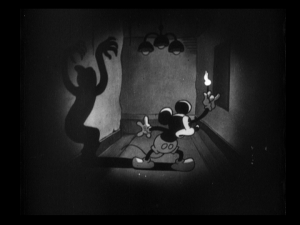
After the lights go out, Mickey lights a match to see the hallway, unaware of his shadow playing tricks

The lights go out. Mickey lights a match, only to be scared by his own shadow. He comes face to face with a Grim Reaper and a herd of skeletons, who sit him down at the piano and force him to play. Mickey carefully begins to play, with the Grim Reaper guiding his hands to perform the melody. The whole crew begins to dance to the music, with some of the other skeletons joining with their own “musical instruments.” When Mickey finishes the song he tries to leave, but the skeletons see him and come after him. Mickey finally jumps out a window and flees the house back into the storm.

November 25

November 25, 1938 – The Special Short Film Ferdinand the Bull is Released to Theaters

“All the other little bulls he lived with would run, and jump, and butt their heads together, but not Ferdinand.”

On November 25, 1938, the special short film Ferdinand the Bull was released to theaters. The short was based on the book The Story of Ferdinand by Munro Leaf, with illustrations by Robert Lawson. Ferdinand the Bull won the Academy Award for Best Cartoon of 1938. It was directed by Dick Rickard, and narrated by Don Wilson; Milt Kahl provided the voice of Ferdinand’s mother, while Walt Disney provided the voice for Ferdinand. Several members of Disney staff were caricatured as characters at the bullfight; Walt himself was caricatured as the matador.

The short opens in Spain, introducing the little bull Ferdinand, who much preferred to sit in the pasture and smell the flowers rather than butt heads with the other little bulls. His mother worried about him, but Ferdinand was quite content under his cork tree. As the years went by, Ferdinand grew to be big and strong, but never dreamed of fighting in the bullfights like the others.

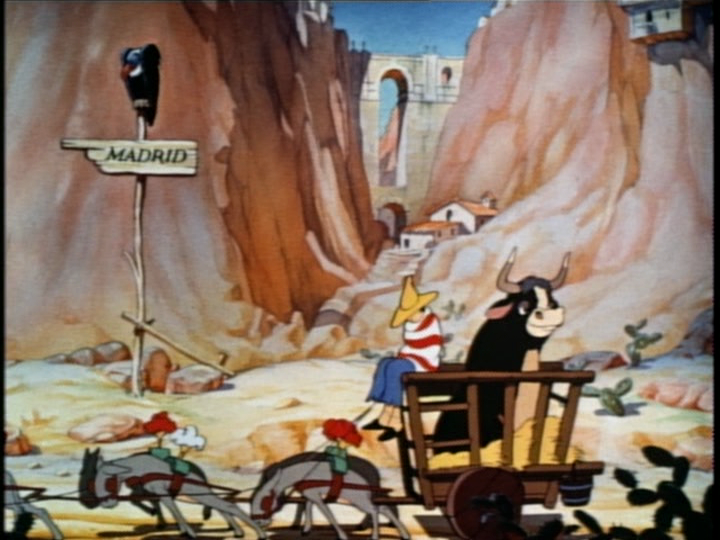
After displaying a fierce reaction to the bee sting, Ferdinand is carted to Madrid to fight the matador

One day, a group of men came to pick the biggest, strongest, and toughest bull to fight in Madrid. Ferdinand ignored them and went to sit under his tree, but accidentally sat on a bee. His surprised, fierce reaction to the bee’s sting convinces the men that Ferdinand is the strong, tough bull they are looking for, and they cart him off to Madrid.

Ferdinand’s bullfight opens with much fanfare. The matador appears in the ring to great applause, ready to do battle with the bull. Unfortunately for the matador, Ferdinand is not in a fighting mood. As the matador flees from Ferdinand’s approach, everyone is surprised to see the bull sniff a bouquet of flowers that has been tossed into the ring. The matador is furious that Ferdinand won’t be fierce, and tries any approach he can to get a reaction from the flower-loving bull. After revealing a daisy flower tattooed on his chest, Ferdinand gives the matador a kiss. Frustrated, the men in charge cart Ferdinand back to his little area under the cork tree, letting him remain and smell the flowers.

November 24

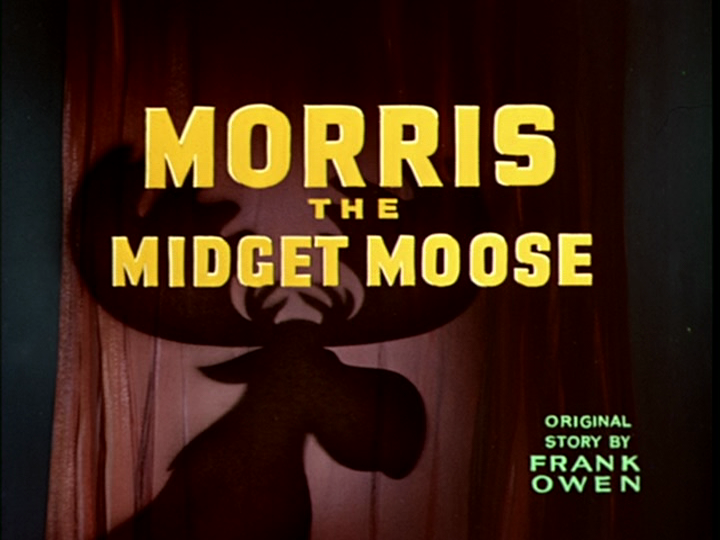
November 24, 1950 – The Special Short Film Morris the Midget Moose Premieres in Theaters

“Now, Morris was four years old and should have been full-grown. But no matter how hard he tried, he couldn’t grow an inch.”

On November 24, 1950, the special short film Morris the Midget Moose premiered in theaters. The short was based on an original story by Frank Owen. It also brings back the character of the “boodle beetle,” who was known more often than not for being an antagonist of Donald Duck. It was directed by Charles Nichols, with story by Eric Gurney and Bill de la Torre.

The short begins with two young bootle beetles fighting over a berry. Their grandfather decides to teach them a lesson through telling them a story: the story of Morris the Midget Moose. Morris was unable to grow any bigger than a puppy. He wished to play with the bigger moose, but he couldn’t keep up with them due to his size, and became the laughingstock of his tribe.

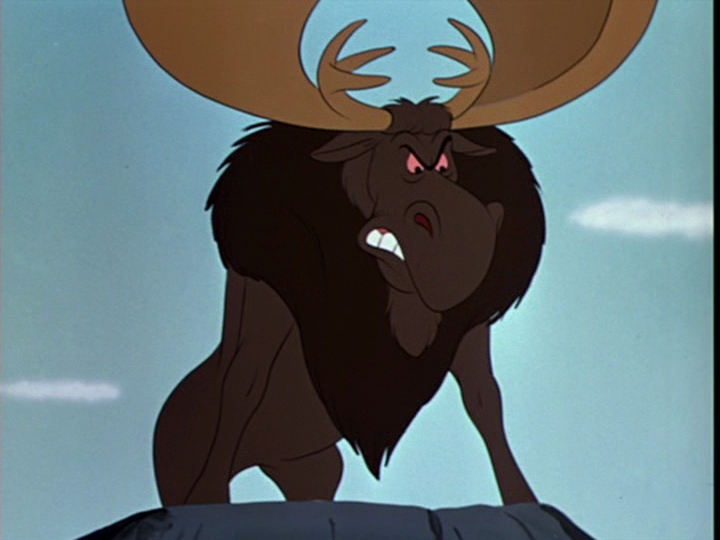
The Mighty Thunderclap, the leader of the tribe, stands ready for the day when the other moose challenge him for leadership

The day came where each moose would challenge the mighty Thunderclap, the largest moose of them all, for leadership of the tribe. All the moose lined up for the challenge, except Morris, until he realized that his antlers were as big as the others. But when it came time to battle Thunderclap, he only reduced the mighty moose to laughter. Poor Morris was devastated, and unaware that he was being watched nearby by a moose named Balsam. Balsam gets Morris’ attention and explains that he is just as sad, if not more so, than Morris, for although he was a full grown moose, his antlers never grew in. The two become the best of friends, with the two helping each other out.

One day, they realized by working together, the two appeared to be the biggest moose in the tribe. This gets Thunderclap’s attention, and there is soon a battle between Morris and Balsam versus Thunderclap. The pair is able to scare Thunderclap away, never to be heard from again, and the grandfather explains that the moral is “two heads are better than one.”

November 21

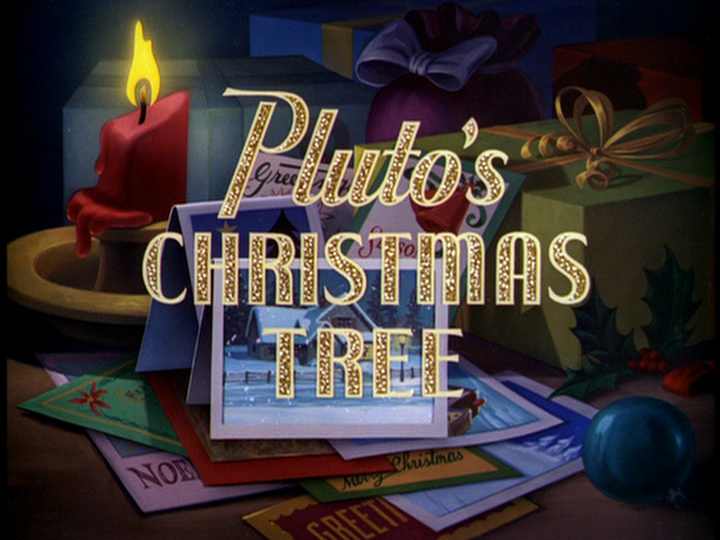
November 21, 1952 – The Mickey Mouse Short Film Pluto’s Christmas Tree is Released to Theaters

“Okay Pluto, let’s get our tree!”

On November 21, 1952, the Mickey Mouse short film Pluto’s Christmas Tree was released to theaters. Although labeled a Mickey Mouse short, Pluto is the main character, with Chip and Dale as his antagonists. It was directed by Jack Hannah, with story by Bill Berg and Milt Schaffer.

It’s a snowy day in suburbia, when Mickey and Pluto leave their house to go find the perfect Christmas tree. As Pluto sniffs around, Chip and Dale are nearby, gathering nuts. Chip throws one at Pluto, startling the dog. Pluto playfully chases after them, until they hide in a pine tree – the same one Mickey decides to chop down. Mickey and Pluto drag the tree home, and Mickey begins to decorate it. Chip and Dale, having fallen asleep on the journey home, wake up and marvel at the decorations now adorning the tree. Dale spies a candy cane and tries to grab one, but becomes more amused at his reflection in an ornament.

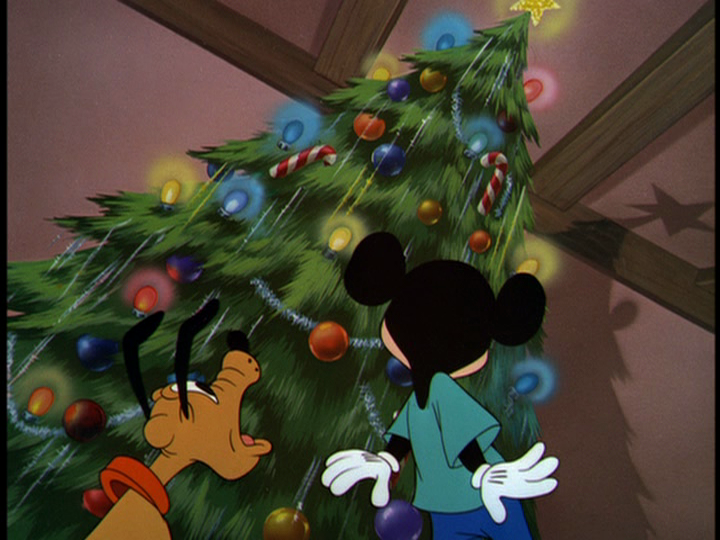
Pluto tries to alert Mickey to the appearance of the chipmunks, but they disappear just as Mickey turns around

After Mickey finishes decorating, Pluto notices a strange light flickering from the side of the tree. He investigates and finds Chip and Dale hiding inside, with Dale throwing ornaments to distract the dog. Pluto tries to alert Mickey to the appearance of the chipmunks, but Mickey just dismisses the dog, leaving Pluto alone again to track down the pair. When he chases Dale, Dale takes the hat and beard off of one of Mickey’s Santa candles and puts them on, trying to fool the dog. When Pluto barks, Mickey goes to light the candles; so as not to catch on fire, Dale blows the match out once it comes close. Pluto once again resumes his chase of the chipmunks, and dives into the tree. A fight that includes Mickey ensues, ending with the tree’s destruction. While initially mad at Pluto, Mickey is surprised to see the chipmunks in the tree. Mickey invites them to stay, as it is Christmas. They hear Goofy, Donald, and Minnie caroling outside, and all watch from the window.

November 18

November 18, 1928 – The First Mickey Mouse Short Film, Steamboat Willie, Premieres

“I only hope that we never lose sight of one thing – that it was all started by a mouse.” – Walt Disney

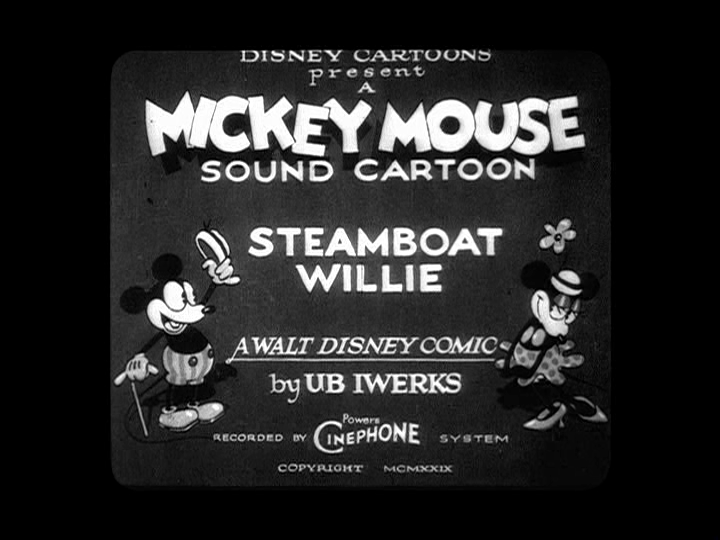
On November 18, 1928, the first Mickey Mouse short film, Steamboat Willie, premiered in theaters. Not only is it notable for being the first Mickey Mouse short film released (although not the first Mickey Mouse short produced), but it is also notable for being one of the first cartoons with synchronized sound, and the first to have a fully post-produced soundtrack. When Walt Disney was unable to get a deal with RCA or Western Electric for the film, he turned to Pat Powers and his bootleg Powers Cinephone process. The initial recording session was a disaster, which ended with Disney hiring a 15-piece band to play, and Walt Disney voicing all of the characters. The film’s title was a parody of a Buster Keaton film called Steamboat Bill Jr. The Disney film premiered at the Colony Theater in New York, and was an instant success, skyrocketing Mickey and the Disney Studios to stardom.

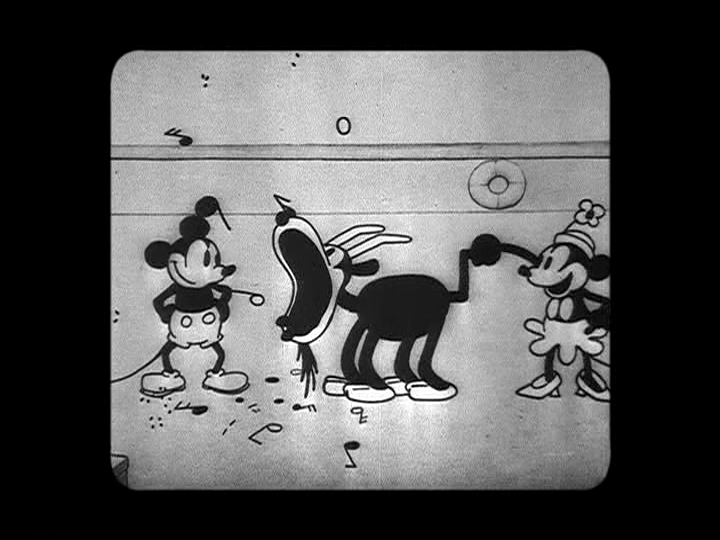
A steamboat is heading down the river, with Mickey at the wheel, whistling a “Steamboat Bill.” Pete appears behind him, yells at him for taking control of the boat, and sends the mouse flying onto the lower deck. The boat reaches Podunk Landing and the cargo is loaded quickly. A frantic Minnie Mouse sprints to catch the boat before it leaves, only to just miss it. Luckily, Mickey hears her cries and uses the hook on the boat to bring her aboard. She drops her guitar and sheet music, which is soon devoured by a nearby goat.

After the goat eats Minnie’s sheet music, the two use the goat to play the tune “Turkey in the Straw”

As Mickey tries to pull the guitar away from the goat, he and Minnie come to the conclusion that the goat can be worked like a turn-crank record player. Using whatever materials he can find, including an animal menagerie, the two begin their own rendition of “Turkey in the Straw.” After the performance, Mickey turns around to find Pete waiting for him angrily, and is sent to the galley to peel potatoes.

November 12

November 12, 1932 – The Mickey Mouse Short Film The Klondike Kid is Released to Theaters

“Guess we’re both nobodys.”

On November 12, 1932, the Mickey Mouse short film The Klondike Kid was released to theaters. The short was directed by Wilfred Jackson, and stars Walt Disney as Mickey Mouse, Marcellite Garner as Minnie Mouse, Pinto Colvig as Goofy and Pluto, and Billy Bletcher as Pierre.

The short opens at the Klondike Bar in the middle of a blizzard, but inside, the atmosphere is merry with many people drinking and dancing. Mickey is playing the piano, and scrapes up the change people throw at him when he finishes. As he gathers the coins, he notices at the window a girl, who faints in the snow. He rescues her, bringing her into the warmth. She begins to cry, and when Mickey asks her name, she responds that she’s just “nobody.” She laughs at his jokes, and warms up to him when he offers her some food.

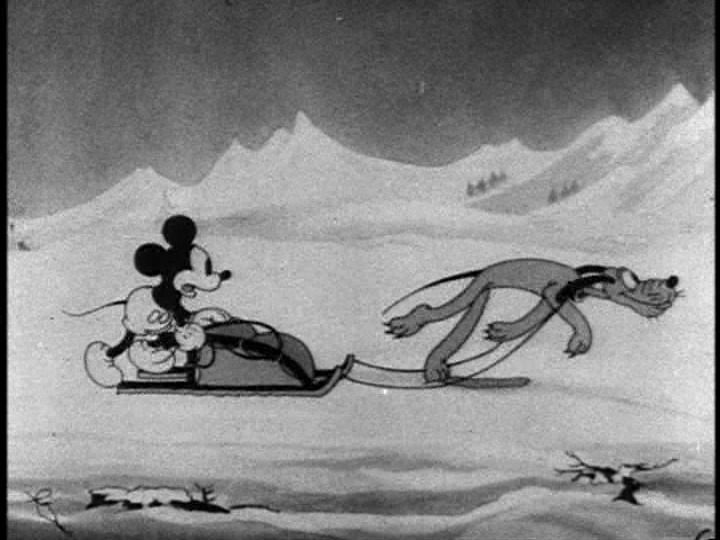
After Pierre kidnaps the girl, Mickey uses Pluto as his sled dog and pursue the villain

The door of the bar bursts open, and in storms Peg Leg Pierre, who attacks Mickey and pins him to the wall before he kidnaps the girl. As she screams in terror, many of the patrons try to help her, but are prevented by an ensuing gunfight. Pierre steals her away, but Mickey frees himself and chases after her. He harnesses Pluto as his sled dog, but Pluto gets the idea of running only after he spots a rabbit to chase. The sled breaks, and Mickey finds himself skiing down the hill into Pierre’s hideout.

Inside Pierre’s cabin, Mickey and Pierre fight and the two are caught in mattress springs. Meanwhile’s Pluto’s rabbit chase ends with him snowballing down the hill and knocking Pierre’s cabin from its foundation. As the short ends, Pierre is knocked out, and Mickey and the girl attempt to kiss, only to kiss Pluto, who pops out of the snow in between them.

November 11

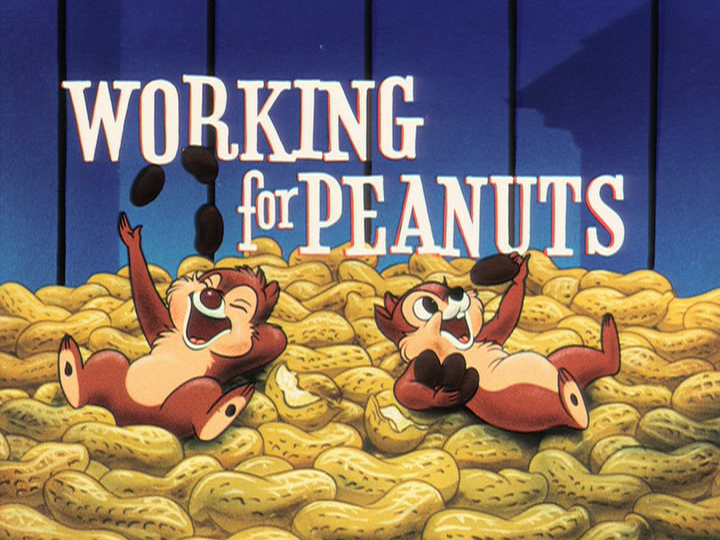
November 11, 1953 – The Donald Duck Short Film Working for Peanuts is Released to Theaters

“I don’t know – let’s open it and see! Look, two nuts!”

On November 11, 1953, the Donald Duck short film Working for Peanuts was released to theaters. Filmed in 3D, it was shown at Disneyland as part of an attraction called 3D Jamboree, and was later shown at Walt Disney World as part of the Magic Journeys attraction. The short was directed by Jack Hannah, with story by Nick George and Roy Williams, and stars Clarence Nash as the voice of Donald Duck.

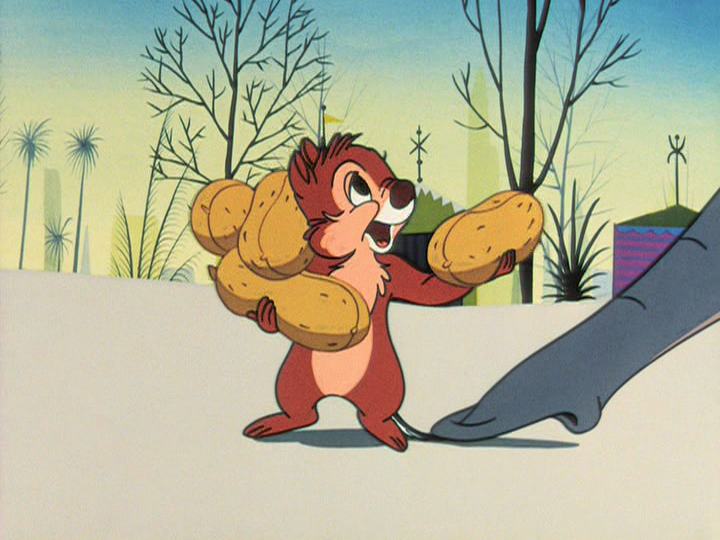
The short begins with Chip and Dale storing acorns in their tree for the winter, when Dale accidentally throws Chip a peanut instead of an acorn. They open up the shell of the nut and are surprised to see two nuts inside. They each take one, and like it so much that they run off to find more. Their search leads them to the zoo, where the crowds are throwing peanuts at the elephant named Dolores; the sight of all the nuts causes the chipmunks to drool. As Dale rushes to grab the nuts, Chip stops him, having caught sight of the caretaker, Donald Duck.

When Dale is caught stealing Dolores’ peanuts, he tries to bribe the elephant with one of the nuts

Once Donald leaves, the two get to work gathering some of Dolores’ peanuts. The elephant is alarmed at their thievery, but sets to work getting her peanuts back. The two can only watch as she uses her trunk to deplete their supply from the tree. As Chip and Dale retaliate, hitting her with a tree branch, Dolores runs to Donald for help. Donald chases after them, but knocks himself unconscious in the process. After Dolores revives Donald, he spies the pair tap dancing, “working for peanuts” as one customer puts it. The chase begins again, with the chipmunks knocking over a bucket of white paint. Seeing Dale drenched in the paint gives Chip an idea.

There’s a knock at the door of the zoo, which Donald opens to reveal a package that contains “genuine albino chipmunks.” The instructions for the creatures include to “feed only select grade A peanuts (and humor them).”  Donald is excited about the find, and gives them a special place to stay. Dolores provides them with a swimming pool, and without thinking, Dale rushes in, losing the paint from his bottom half before Chip is able to pull him from the water. However, they fool Donald and Dolores into thinking Dale is only wearing suspenders, and remain at the zoo, happy and provided with all the peanuts they could ever want.

November 6

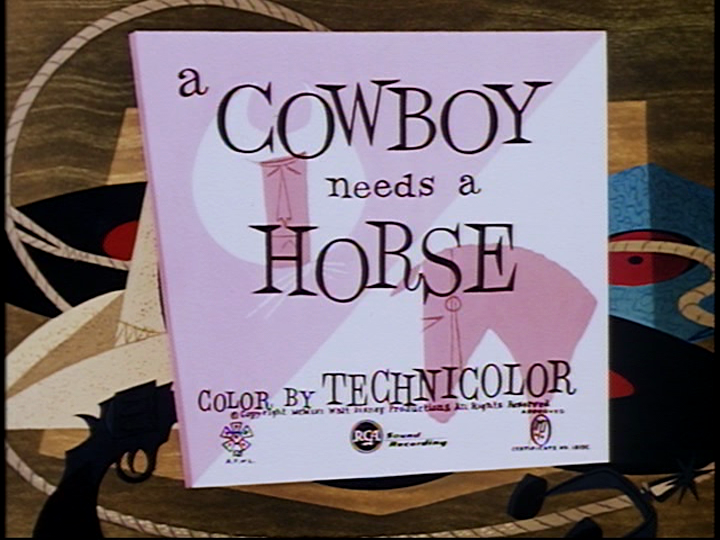
November 6, 1956 – The Special Short Film A Cowboy Needs a Horse Premieres in Theaters

“If he wants to keep riding, riding along…”

On November 6, 1956, the special short film A Cowboy Needs a Horse premiered in theaters before the True-Life Adventure film Secrets of Life. The short’s song of the same name was written by Paul Mason Howard and Billy Mills. The short was directed by Bill Justice, with story by Dick Kinney and Roy Williams.

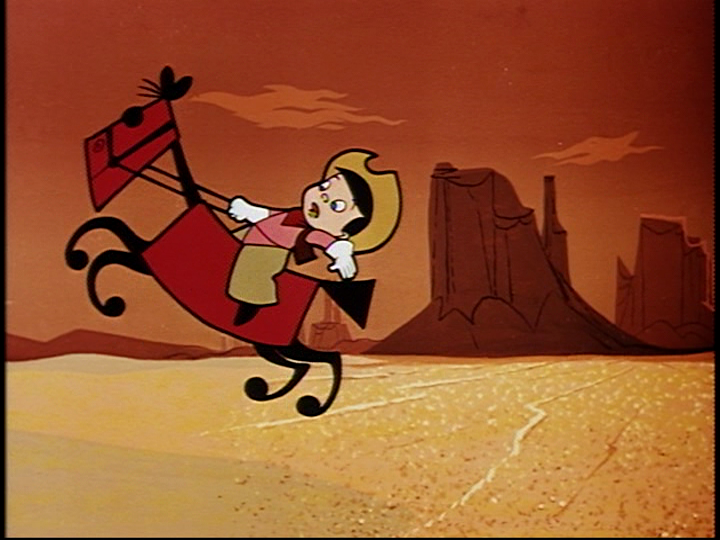
A little boy is sleeping in his bed, and dreams of being a cowboy. In his dreams, his bed turns into a horse, and the little boy magically gets a rope, a song, a hat, boots, and spurs, to become a cowboy. As he travels the desert with his horse, they are caught by an Indian tribe. He uses his pistols to fire back, until his pistols run out of bullets. Using his trusty rope, he captures the tribe, but makes peace with the chief, who offers him a peace pipe. The boy takes it and blows bubbles with it, to the chief’s delight. The chief gives the boy his headdress in gratitude.

Upon the sound of danger, the boy mounts his horse and chases after the villains in his dream

The boy suddenly hears gunshots, and looks to see some varmints trying to rob a stagecoach. He and his horse take off, just as the robber grabs the money. They give chase, and the boy and varmint roll down a hill, fighting, with the boy winning. He throws back the money, with the stagehand pointing to a reward sign for the criminal. The boy refuses the reward, happy just to help. Just as he and his horse are about to go on their way, they spy two other criminals attempting to blow up the railroad tracks. Although he is unable to remove the dynamite before it explodes, the boy throws himself on the tracks, and the train runs over him.

Work isn’t done for the boy: he hears a loud scream below, and spies a girl being tied to a cactus and being threatened by a villain. Jumping on his horse, he runs to her rescue, saving her just in time. The girl offers to kiss him, but he refuses, instead offering her a ride home instead. As the dream comes to an end, the boy relinquishes all of the things that make him a cowboy, and drifts out of his dream.