RSS Feed

Tag Archives: Short film

December 28

December 28, 2011 – Bambi and A Computer Animated Hand are Inducted Into the National Film Registry

Image credit: wikipedia

Image credit: wikipedia

“…culturally, historically, or aesthetically significant.”

On December 28, 2011, the new inductees into the National Film Registry were announced, which included the 1942 Disney animated feature Bambi and one of the earliest examples of computer animation by Ed Catmull (now co-founder of Pixar and President of Pixar and Disney Animation Studios), A Computer Animated Hand. Bambi was recognized not only as one of Walt Disney’s favorites, but also for its “eloquent message of nature conservation.” A Computer Animated Film has been considered revolutionary in combining the science of the computer and the art of animation, showing the potential of both. The film, and Catmull especially, were recognized for working out “the concepts that become the foundation for computer graphics that followed.”

December 27

December 27, 1940 – The Pluto Short Film Pantry Pirate is Released to Theaters

vlcsnap-2012-12-27-09h13m35s121

“You let me catch you messin’ around in my kitchen again, and I’m gonna bust all the hide off’n you!”


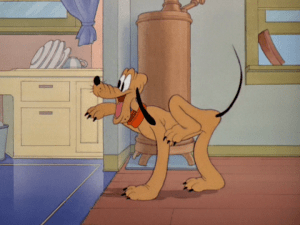
On December 27, 1940, the Pluto short film Pantry Pirate was released to theaters. The short has been cut when released on television, due the depiction of the cook as a somewhat stereotypical black servant, which was a normal depiction in films of this time period. The short was directed by Clyde Geronimi, and stars Lillian Randolph as the cook.

Pluto is thrown out of a kitchen by the scruff of his neck, with the cook tying him to his doghouse in the backyard. She warns him to stay, and Pluto lets one tear roll down his cheek. Inside, the cook pulls a roast from the oven, with the scent leaking through the screen door and wafting all the way to Pluto. He frees himself from the rope and sneaks into the kitchen once again, his mouth salivating at the thought of the roast.

Pluto traipses about happily in the house, thinking about how he can get the roast that the cook just made

Pluto traipses about happily in the house, thinking about how he can get the roast that the cook just made

Inside the house, Pluto slips on the polished floor, and is almost spotted by the cook. He has an idea to use the ironing board to get close to the roast, but immediately steps back to the wall when the board starts to buckle under his weight. He tentatively tries again, but he still isn’t close enough. Keeping his toes on the board, he is able to reach the handle of the oven, and is finally close enough to reach the roast, when he accidentally falls, pulling the oven door down and ending up in the oven himself. He flies out with a cry, and bumps into a box of soap, spilling its contents into a nearby bucket of water. The soap also fills the air, and Pluto sneezes from the irritation. Each sneeze sends out a stream of bubbles from his mouth. One bubble in particular sticks to his nose, and when he attempts to blow it away, the bubble only increases in size until it explodes.

Trying to return to his main mission of the roast, Pluto stalks his prey, until he sneezes and knocks into a table with china cups. None of the cups break, but the sound is enough to alert the cook, who has been upstairs. After she leaves, Pluto sneaks towards the roast again, this time bringing with him the tablecloth and cups without him noticing. When he does, he sneezes again, sending the cups flying into the air. Thinking he’s done for, he closes his eyes, but the cups neatly stack themselves on his backside, the handles slipping onto his tail. He breathes a sigh of relief, but not for long, as he keeps sneezing. All the cups finally break, with the cook racing downstairs to see what’s going on. As he races to the door, he keeps getting thrown back by his sneezes, but finally makes it outside and pretends he’s been asleep the entire time. The cook is fooled by his act, and Pluto smiles, bubbles still leaking from his mouth.

December 26

December 26, 1941 – The Goofy Short Film The Art of Self Defense is Released to Theaters

vlcsnap-2012-12-26-10h21m56s181

“From the earliest dawn of humanity, the cold, unrelenting law of nature has been, and still is, the survival of the fittest.”

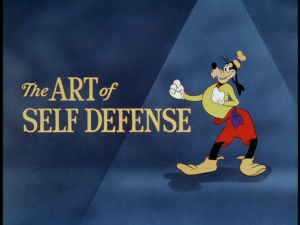
On December 26, 1941, the Goofy short film The Art of Self Defense was released to theaters. This was one of the first shorts to show more than one Goofy-designed character in the same scene. The short was directed by Jack Kinney, and stars John McLeish as the narrator.

The short takes us through the history of man defending himself, beginning with the cavemen. Two cavemen are seen beating each other over the head with a hammer and a club. The scene then travels to ancient Egypt, where moving wall paintings show that man has learned to use his hands for combat, particularly poking the other person in the eye. Reaching the middle ages, two knights are seen clad in armor, hitting each other with maces much as the cavemen did with their clubs. Time rushes forward to the Romantic Age, with two men slapping each other with gloves rather daintily. One of the men gets the idea to put his snuff box in his glove, giving his slap a little more “oomph.” The scene then changes to when boxing came into vogue, but these men, as the narrator puts it, “could fight for only seventy-five or eighty rounds.”

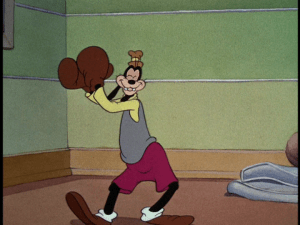
Goofy arrives at the boxing gym, ready to learn all the fundamentals of how to defend himself

Goofy arrives at the boxing gym, ready to learn all the fundamentals of how to defend himself

The audience is then brought to the modern era, with Goofy entering a boxing gym. He starts to punch enthusiastically, until the narrator stops him, informing him that they were learn to box properly, with scientific conditioning. They learn how to breathe properly, but as the narrator gets involved with his own commentary, Goofy breathes in (forgetting to breathe out) to the point of floating like a balloon. When he is finally told to exhale, Goofy sails around the gym as all the air is pushed out. Next, Goofy attempts to jump rope, but ends up tangled. He then tries to punch a double-ended bag, only to have the bag knock him out.

Goofy then shadow boxes – literally – ended up knocked out by his own shadow with every punch shown, from jabs, to crosses, to uppercuts. When the narrator points out there is a rule that no boxer shall ever be hit below the belt, Goofy manages to pull his pants and belt above his head, so there is nowhere for his shadow to strike, but the shadow, after kicking Goofy out of his clothes, manages to win just the same. After weeks of conditioning, the night of the fight arrives, and Goofy steps confidently into the ring. His opponent, however, knocks him out with one punch.

December 24

December 24, 1937 – The Mickey Mouse Short Lonesome Ghosts is Released to Theaters

vlcsnap-2012-12-23-19h32m40s223

“Notice! We exterminate all kinds of ghosts! Day and night service.”

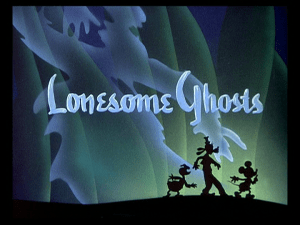
On December 24, 1937, the Mickey Mouse short film Lonesome Ghosts was released to theaters. The short made great use of a new invention of the animation department: transparent paint, which helped give the ghosts a more realistic ghastly appearance. The film was directed by Burt Gillett, and stars Walt Disney as Mickey Mouse, Pinto Colvig as Goofy, and Clarence Nash as Donald Duck.

A group of four ghosts in a haunted mansion one winter’s night are bored, until one spots an ad in the paper for a ghost extermination service. Hoping to have new people to scare, they decide to call the service. Meanwhile, at Ajax Ghost Exterminators Headquarters, Mickey, Goofy, and Donald are sitting around the table sleeping when the phone rings. They wake up and scramble to answer it, and readily take the job the ghosts “scare up” for them. The ghosts wait anxiously, and watch with delight as the trio arrives. Mickey and the gang enter the house with trepidation, and hear the ghosts making noises inside.

The trio agrees to split up, hoping that they can divide and conquer the ghosts

The trio agrees to split up, hoping that they can divide and conquer the ghosts

Mickey suggests that the three separate and surround the ghosts, and the three go their separate ways. As Mickey goes one way, he meets a ghost that he tries to shoot it with his shotgun, but the ghost sticks his fingers in the barrel, causing the gun to implode. Mickey then chases the ghost around the house, only to be surprised by all four of the ghost residents. The ghosts had meanwhile taken great delight in scaring Donald with loud noises, although he punches one in the kisser.

Goofy is also startled by the ghosts and their noises, and although he tries to convince himself that he is not scared, he runs and hides when he spots them. He spies a ghost in the mirror who imitates every move Goofy makes. Goofy knows something is wrong with his reflection, but he can’t quite put his finger on it. He finally figures it out, but is unable to fight the ghost. While stuck fighting himself in a dresser, the ghosts push him down the stairs, where he crashes into Mickey and Donald, sending them flying into the pantry. The trio and the dresser fly into barrels of molasses and bags of flour, covering the three entirely. As the ghosts come to admire their handiwork, they mistake the flour-covered three as ghosts and flee the mansion in a panic.

December 23

December 23, 1938 – The Silly Symphony Mother Goose Goes Hollywood is Released to Theaters
vlcsnap-2012-12-23-08h44m57s97

“Any resemblance of characters herein portrayed to persons living or dead, is purely coincidental.”

On December 23, 1938, the Silly Symphony Mother Goose Goes Hollywood was released to theaters. The film takes many of the popular actors of the time and caricatures them as characters in Mother Goose stories. The film was nominated for an Academy Award, but lost to Disney’s Ferdinand the Bull. The short was directed by Wilfred Jackson.

The short is presented in book form, going through the pages of a collection of Mother Goose’s stories. The first page opens the short with a parody of the MGM logo, using a goose rather than a lion. The page then flips to the first tale of Little Bo Peep, with Bo Peep being portrayed by Katherine Hepburn. She bemoans the loss of her sheep, then turns the page to reveal Old King Cole (Hugh Herbert) and his court jester, Ned Sparks. His fiddlers are called in, with the fiddlers being none other than the Marx Brothers. Herbert enjoys the show, but Sparks is obviously less than thrilled. Joe Penner, playing a servant, brings in a big bowl, asking if the king wants to buy a duck, with Donald Duck popping out of the bowl and repeating the question. When Herbert quickly closes the bowl, Donald throws a fit.
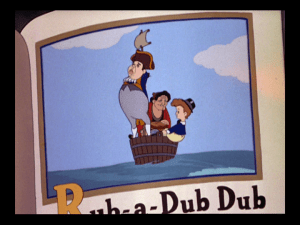
Charles Laughton, Spencer Tracy, and Freddie Bartholomew sit in a tub as they perform the nursery rhyme

Charles Laughton, Spencer Tracy, and Freddie Bartholomew sit in a tub as they perform the nursery rhyme

The page turns to the nursery rhyme, “Rub-a-Dub Dub,” with the three men played by Charles Laughton, Spencer Tracy, and Freddie Bartholomew. Bartholomew falls overboard, and Laughton remarks on this drolly. Tracy quickly retrieves Bartholomew, and Bartholomew gives his thanks before they are all alerted to Katherine Hepburn in a motorized contraption, still searching for her sheep. The three men try to hitch a ride, but are swept overboard as the page turns to Humpty Dumpty, played by W.C. Fields. He pulls down a nearby birds nest, thinking a tiny chickadee is inside, only to find that the nest is occupied by Charlie McCarthy. Charlie continues to taunt Fields, with Fields falling off the wall and into a mushroom, made to resemble an egg cup. The next story is Simple Simon, played by Stan Laurel, who is fishing in an old tin can, using a fish as bait to catch worms. The pieman, played by Oliver Hardy, is whistling nearby, and presents a a pie to Laurel, who refuses it to grab a different one. As Hardy tries the same trick Laurel performed, he ends up destroying all but one pie. When Laurel points this out, Hardy throws the pie at him, missing Laurel, but hitting Hepburn, still searching for her sheep.

See-Saw Margery Daw is the next tale, portrayed by Edward G. Robinson and Greta Garbo. Garbo asks to be alone, with Robinson replying that she asked for it. He steps away from the see-saw, letting Garbo crash to the ground as the page turns to Little Jack Horner. Eddie Cantor, playing Jack, beings singing “Sing a Song of Sixpence.” Several African-American stars begin to poke their heads out of the pie, including Cab Calloway, who leads the others in song as he asks Little Boy Blue (Wallace Beery) to blow his horn. Fats Waller and Stepin Fetchit remark about the boy, until Beery blows it until his face turns purple. The page then turns to reveal a pop-up of the old woman’s shoe, with every Hollwood star in attendance for a big old bash. A few more people show up, including Clark Gable, Edna May Oliver, ZaSu Pitts, Joan Blondell, and George Arliss. Fats Waller plays the piano, with some unnecessary help from the Marx Brothers. Fred Astaire begins to tap dance, inviting Stepin Fetchit to dance. The short ends with Katherine Hepburn still on the search.
December 20

December 20, 1946 – The Goofy Short Film Double Dribble is Released to Theaters

vlcsnap-2012-12-19-20h11m15s239

“Good evening, ladies and gentlemen. We’re about to witness the basketball battle of the century.”

On December 20, 1946, the Goofy short film Double Dribble was released to theaters. The players’ names that are announced by the narrator are actually names of Disney animators, such as “Kinney” for animator and director Jack Kinney. The short was directed by Jack Hannah, with story by Bill Berg and Milt Banta.

The day of the big basketball game arrives, with half of the stadium filled to capacity for the home team, University U, while the visitor side (P.U.) has a solitary fan in the seats. The teams hit the court, practicing their free throws before the game. One tiny player on the P.U. team is excited to play, but the much taller players ignore him as the game gets underway. A replay of one of the plays shows that, in slow motion, the players are much more violent than meets the eye. The game continues, with each team scoring left and right, with the U.U. fans overstepping their bounds as they “assist.” The first half ends, with U.U. leading 16 – 12.

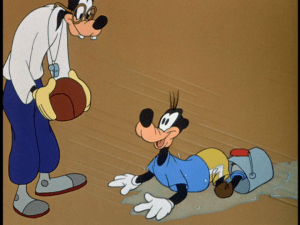
The smallest player, Marathu, is the most enthusiastic, although not the best player on either team

The smallest player, Marathu, is the most enthusiastic, although not the best player on either team

In the second half, the P.U. coach nervously watches as his team members are repeatedly called out by fouls. Finally, the last player he can send in is the shortest member of the team, Marathu. With one minute to go, the score is in U.U.’s favor, 35 – 34. Marathu tries to be involved in the game, but he lags behind his taller teammates. Suddenly, he has the ball – only to have it taken away. He retrieves the ball by untying the string to the opposing player’s shorts, revealing the player’s polka dot boxers. Ball in hand, Marathu makes his way to the basket, with the player in boxer shorts chasing after him. As the opposing player trips and falls, he lifts a floorboard, which sends Marathu flying into the air and in through the hoop – and P.U. wins, 36 – 35.

December 18

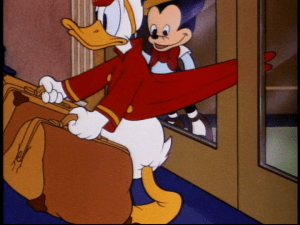
December 18, 1942 – The Donald Duck Short Film Bellboy Donald is Released to Theaters

vlcsnap-2012-12-17-19h14m11s145

“The guest is always right.”

On December 18, 1942, the Donald Duck short film Bellboy Donald was released to theaters. It was directed by Jack King, and stars Clarence Nash as Donald Duck and John McLeish as Pete.

The story opens with Bellboy Donald receiving another lecture on losing his temper with hotel guests from the hotel manager, who threatens to fire Donald if he does it again. The manager gives Donald a pin with the hotel’s motto – the guest is always right – to remind him that his job is at stake.

Shortly after, a guest pulls up to the front of the hotel, and Donald hurries out to serve him. The guest’s son, Junior, immediately begins to torment Donald, but Donald is able to keep his cool, for the time being. As Donald struggles to bring in the bags, Junior comes back to taunt him. Junior drops his banana peel on the walkway, and a bag-laden Donald slips and trips into the hotel.

Junior continues his torment of Donald, including closing the elevator doors on Donald's shirt

Junior continues his torment of Donald, including closing the elevator doors on Donald’s shirt

After the mishap with the bags, and accidentally tearing the customer’s luggage, Donald takes the guests to their rooms on the 80th floor. Junior decides to have fun with the elevator, and Donald, on the way. He closes the door on Donald’s shirt, ripping off the duck’s bellboy uniform. Junior continues to cause trouble for Donald, who sees his motto button once again and tries to play it nice with the boy. When Junior pretends to offer Donald a soda, Donald steps in the elevator, only to have the boy start the elevator, dropping down eighty flights, and leaving Donald caught in the air. Having had enough, Donald loses his temper. He asks the manager if he is fired, and when the manager says yes, Donald gives Junior a spanking.

December 15

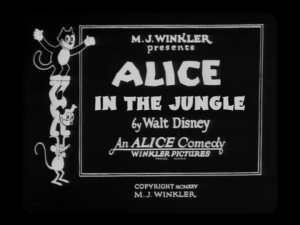
December 15, 1925 – The Alice Comedy Alice in the Jungle Premieres

vlcsnap-2012-12-15-10h00m31s125

On December 15, 1925, the Alice Comedy Alice in the Jungle premiered in theaters. As of now, it one of the few comedies released on DVD for the public, although the Alice Comedies are now in the public domain. The short was directed and produced by Walt Disney, and stars Virginia Davis as Alice.

The short begins with Alice riding on the back of an elephant, holding a shotgun. Her friend Julius spies something and whistles for a bird, who carries him around to spy on the land from above. The bird becomes annoyed with Julius’ antics and kicks him off right over a pool filled with alligators. Luckily, Julius manages to remain uneaten, but is soon attacked by another alligator on shore, who eats his tail. He does manage to retrieve his tail before heading back to Alice.

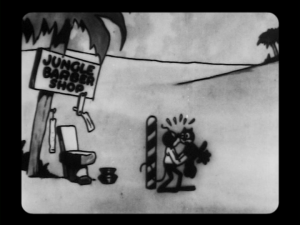
The barber thanks Julius profusely for his help in reacquiring a barber pole

The barber thanks Julius profusely for his help in reacquiring a barber pole

Two elephants are running around the jungle, dancing and skipping, before they pull the swimsuits out of their “trunks,” and go for a swim in a nearby pool. One of the two climbs a tree to go for a dive, with the other one draining the pool of its water, so as to play a mean prank on their friend. The scene then moves over to the jungle barber shop, with a hippo eating the barber’s striped pole, thinking it to be a candy cane. The barber breaks down in tears before Julius happens to stumble on the situation. The barber explains to Julius what happened, and Julius, spying a nearby tiger, has a plan. He covers the tiger’s tail in starch and wakes it up. The tiger runs away startles, accidentally knocking off its own tail. The barber is overjoyed when he sees the replacement pole.

Alice is then seen chasing a bear, who keeps hitting her with his slingshot. She follows him into a dark cave, but is soon chased out by a lion. She screams for help, and her cry finds Julius, who comes to her rescue. Although he saves her from one lion, a whole herd of them begin to chase Alice and Julius, with the two making their escape on the back of their elephant.

December 14

December 14, 1935 – The Silly Symphony Broken Toys is Released to Theaters

vlcsnap-2012-12-13-21h38m34s241

“Boy, what a dump to end up in.”

On December 14, 1935, the Silly Symphony Broken Toys was released to theaters. The short features caricatures of famous actors of the time, including W.C. Fields, Ned Sparks, and Stepin Fetchit. The short was directed by Ben Sharpsteen.

A wheelbarrow rolls to a shallow area marked with a sign that says, “No Dumping.” A pile of trash, including an old sailor doll with a broken leg falls from the wheelbarrow. The sailor doll quickly reattaches his leg and looks around, seeing other broken-down and old toys in the dump. The toys are depressed that no one wants them, but the sailor doll tells them that he knows of a place where they’d all be welcome. Inspired by his words, the toys decide to fix themselves up, and finally leave the dump.

The sailor toy helps remove excess sawdust from one toy to help fill another

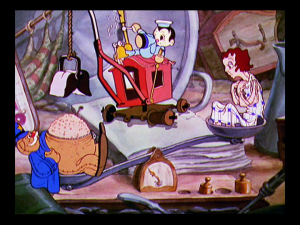
The sailor toy helps remove excess sawdust from one toy to help fill another

As the toys dance around helping each other make their repairs, they use the supplies around them to fix each other: a pencil replaces a toy soldier’s leg, and a stamp covers a hole in a rag doll. One little doll has no eyes, so all of the toys band together to give her a set of lovely blue eyes. The sailor, playing doctor, sews her eyes on, and she is thrilled that she is finally able to see. They all climb out of the dump, and the sailor leads them to a house in the nearby village that is the local orphanage, where they know they will be happy and loved.

December 12

December 12, 1941 – The Educational Short Film 7 Wise Dwarfs is Released

vlcsnap-2012-12-11-19h54m08s91

“Heigh ho, heigh ho, we’re the wisest dwarfs we know!”

On December 12, 1941, the educational short film 7 Wise Dwarfs was released theatrically. The short is a wartime piece commissioned by the Film Board of Canada, in conjunction with the Local War Savings Committee, to educate Canadian audiences about the importance of War Bonds during World War II. It features the dwarfs from Snow White and the Seven Dwarfs, years after their first appearance. In the short, the dwarfs sing about “five-for-four” – the phrase meant that by buying war bonds, there was a long-term return of five dollars for every four invested. The short was directed by Dick Lyford and Ford Beebe.

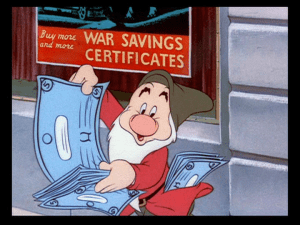
The short begins with the dwarfs mining for gems, singing “Heigh Ho.” Doc throws gems into bags labeled with the dwarfs’ names, and Dopey places the gems Doc rejects into his own bag. The dwarfs then march from the mine past Ottowa’s Parliament Hall, and suddenly stop at the post office. Doc spots a sign in the window, asking citizens to by more and more war savings certificates. The dwarfs run inside the post office, accidentally closing the door on Dopey. Undeterred, he spies the bank nearby, and decides to cash his gems there in exchange for war bonds.

Even Grumpy comes out of the post office happy as he carries his war bonds

Even Grumpy comes out of the post office happy as he carries his war bonds

The dwarfs are then seen leaving the post office, each one’s arms filled with war bonds. They march home, singing that they’ve done their part to “win the war with five-for-four.” The short then turns into a plea to the audience to lend their savings to help pay for weapons and supplies for the war effort, and asking them to “invest in victory.”